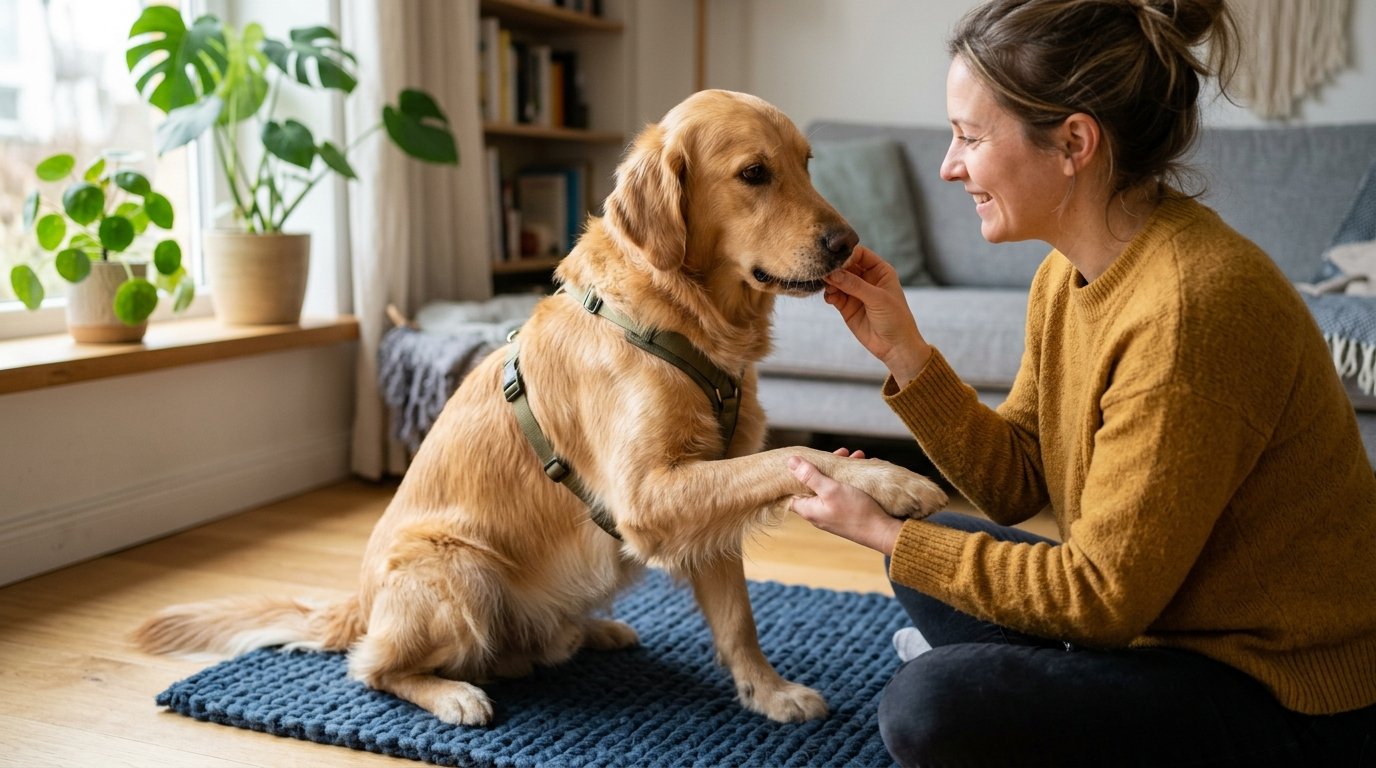
The best answer depends on your dog, the context, and the full pattern of behavior. Look at multiple signals rather than one isolated action.
A happy pet needs more than food, exercise, and a comfortable place to sleep. The way you care for, handle, and communicate with your pet can have a major effect on how safe and confident they feel around you.
That is where Real-Life Care and Cooperation for Happier Pets becomes important.
Everyday situations such as brushing, nail trimming, cleaning ears, putting on a harness, giving medication, or visiting the veterinarian can be stressful for a dog. When these experiences repeatedly involve fear, force, or unpredictable handling, your dog may begin to resist them before they even happen.
A more thoughtful approach is to teach your dog what to expect, reward calm participation, pay attention to body language, and give them appropriate opportunities to communicate when something feels overwhelming.
The goal is not to make every care procedure perfectly voluntary. Real life does not always work that way. Instead, the goal is to make necessary care safer, more predictable, and less frightening whenever possible.
Table of Contents
What Real-Life Care and Cooperation Means
Cooperative care is an approach that teaches an animal to participate in handling and routine care rather than automatically resisting it.
For a dog, this might mean learning to:
- Stand calmly while being brushed
- Offer a paw for nail care
- Step onto a scale
- Place their chin on your hand
- Wear a harness
- Allow brief examination of an ear
- Stand calmly for a veterinary examination
- Enter a carrier or vehicle
- Accept gentle body handling
The important part is not creating a dog that never moves or objects.
Instead, you are building predictability, trust, communication, and positive associations.
AAHA describes cooperative care as a positive-reinforcement-based approach that can help animals participate voluntarily in aspects of veterinary treatment and reduce fear and stress.
Pet Harmony’s approach also highlights predictability and the importance of recognizing that real-world care sometimes requires additional management rather than expecting perfect cooperation in every situation.
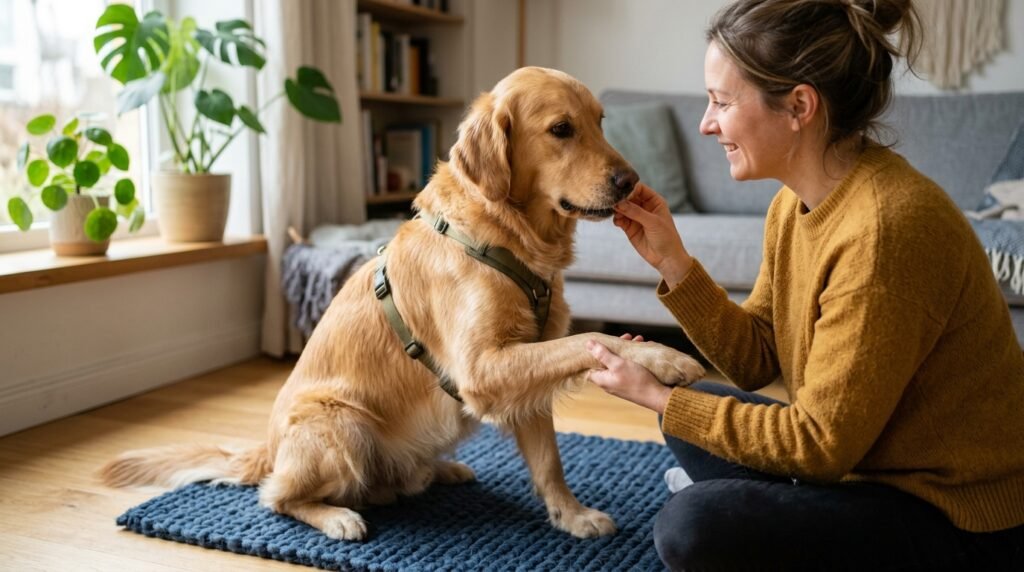
Why Cooperation Matters for Happier Pets
Imagine two dogs getting their nails trimmed.
The first dog is grabbed, restrained, and rushed through the process. The owner becomes frustrated when the dog pulls away.
The second dog has been gradually introduced to paw handling. The owner uses treats, takes breaks, watches body language, and stops when the dog becomes overwhelmed.
The procedures may look similar from the outside, but the experiences can be completely different for the dogs.
Cooperation can help create:
Less fear around routine handling:
Positive experiences can help your dog form better associations with grooming and care.
More predictable interactions:
Dogs often cope better when they understand what is about to happen.
Better communication:
Owners become more skilled at recognizing signs of discomfort, avoidance, and relaxation.
Safer care:
A dog that is less frightened may be less likely to struggle, snap, or attempt to escape.
A stronger relationship:
Your dog learns that you listen to their signals instead of ignoring them whenever possible.
AAHA notes that forceful restraint can increase injury risks and may negatively affect both medical and emotional outcomes. Its guidance encourages low-stress handling and appropriate positive reinforcement.
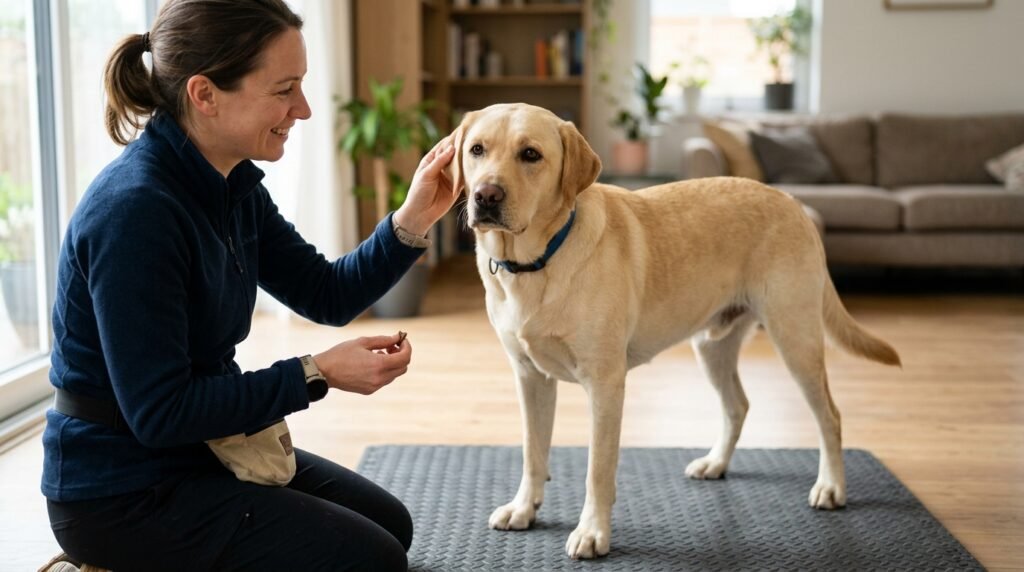
Build Trust Through Predictable Daily Care
Cooperative care does not begin with nail clippers.
It begins with the everyday relationship you already have with your dog.
Dogs learn from repeated experiences. If touching their ears always means something unpleasant is about to happen, they may begin avoiding your hand before you even reach their ear.
Instead, create small, positive interactions.
Start with simple handling
While your dog is relaxed:
- Briefly touch a shoulder.
- Give a reward.
- Pause.
- Touch another body area.
- Reward calm behavior.
- Gradually introduce slightly more challenging handling.
Keep early sessions extremely short.
You are not trying to complete a grooming session. You are teaching your dog that being touched does not automatically mean something scary is coming.
Make routines predictable
Use consistent patterns for common activities.
For example:
Touch → reward → pause
or:
Show object → reward → touch → reward → finish
Predictability can make new experiences easier to understand.
AAHA’s cat-training guidance similarly identifies predictability, choice, and control as important components of cooperative care, including stationing on a mat or other surface.
Teach Your Dog to Participate in Handling
One of the most useful cooperative-care skills is teaching a dog a simple behavior that gives them a predictable job.
A chin rest, hand target, or stationing behavior can work well.
For example, you might teach your dog to place their chin gently on your palm.
Start by rewarding any movement toward your hand.
Then gradually reward:
- Nose approaching your hand
- Chin touching your hand
- Chin staying for one second
- Longer calm duration
- Gentle handling while maintaining the position
The behavior can eventually become a communication tool.
If your dog repeatedly lifts their head, moves away, or shows obvious distress, that information matters.
Do not simply interpret every movement as stubbornness.
Your dog may be saying that the current step is too difficult.
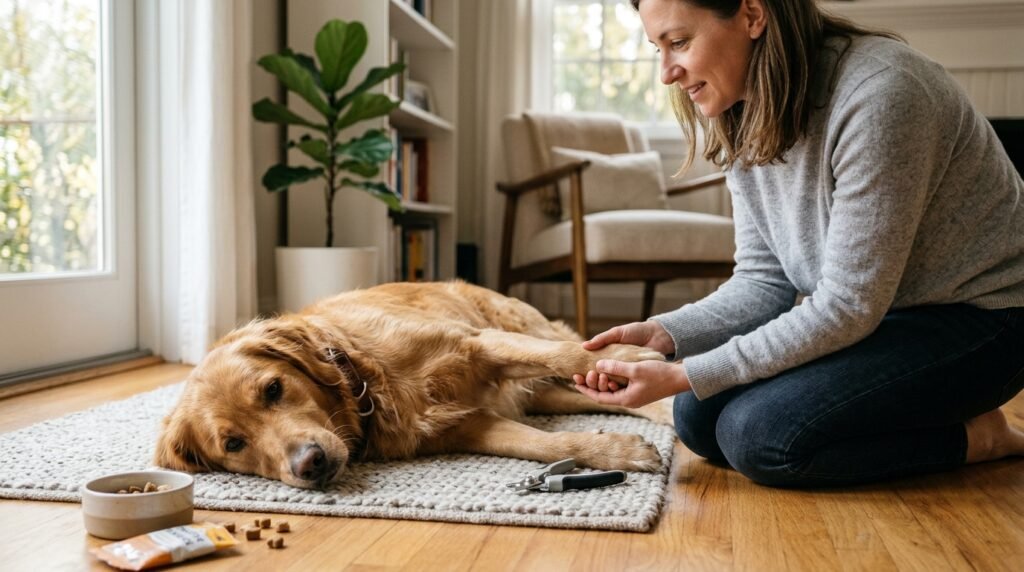
Make Grooming and Nail Care Less Stressful
Grooming is one of the easiest areas in which cooperative care can make a difference.
Many dogs dislike having their feet touched. Others become nervous when they hear nail clippers, see a brush, or feel an unfamiliar tool against their body.
Break grooming into tiny steps
Instead of going directly from:
No grooming → complete nail trim
use a progression such as:
Tool nearby → reward
Tool touches paw → reward
Tool touches nail → reward
One nail handled → reward
Short break
Another nail → reward
The process may take longer initially, but rushing can create setbacks.
Do not turn every session into a test
Your dog does not need to complete the entire grooming job every time you practice.
Sometimes the most successful session is simply:
“We touched the paw calmly, received a reward, and stopped.”
That experience gives you something positive to build on next time.
Prepare for Better Veterinary Visits
Veterinary care is sometimes unavoidable, even when a dog is frightened.
That is why preparation matters.
AAHA recommends positive experiences and low-stress strategies for veterinary visits, including appropriate rewards, calm behavior, and discussing anxiety-management options with the veterinary team when necessary.
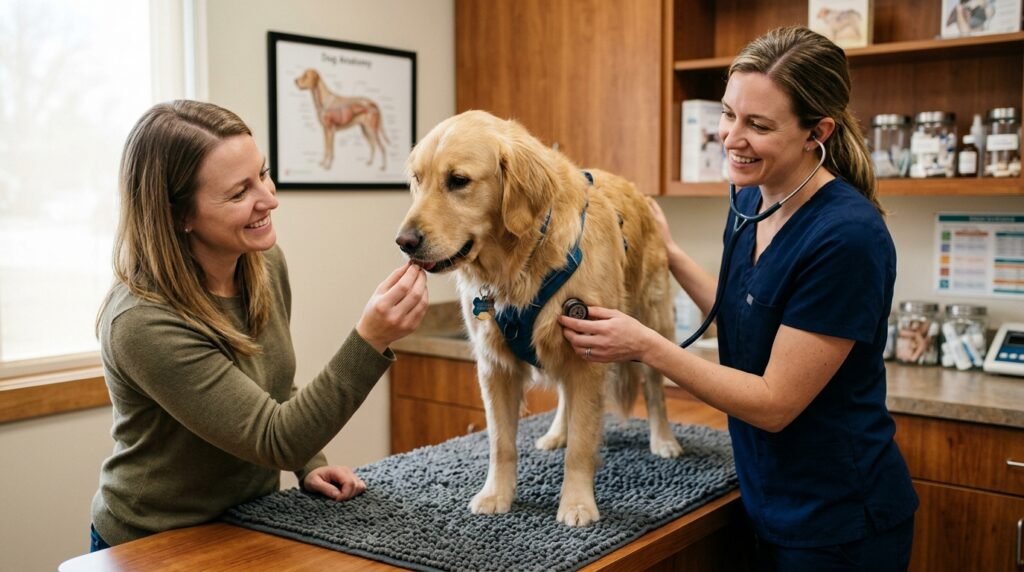
Practice veterinary-style handling at home
You can gradually practice:
- Touching paws
- Looking briefly at ears
- Touching shoulders and legs
- Opening the mouth briefly
- Standing on a stable surface
- Walking onto a scale-like platform
- Wearing a muzzle if your veterinarian recommends one
- Remaining calm while another person approaches
Keep everything within your dog’s comfort level.
Consider “happy visits”
Some veterinary practices offer short visits where the dog comes inside without receiving an examination.
The purpose is simply to create positive associations with the environment.
AAHA describes this type of gradual preparation in its cooperative-care case study, where a fearful dog made progress through repeated low-pressure visits, positive reinforcement, and teamwork between the family, veterinarian, and behavior professionals.
Read Your Pet’s Body Language
Cooperation requires communication.
Dogs cannot verbally tell you:
“I am becoming uncomfortable.”
They communicate through behavior and body language.
Possible signs of stress can include:
- Turning the head away
- Lip licking
- Yawning outside normal tiredness
- Trying to escape
- Lowered body posture
- Ears held back
- Tail position changes
- Freezing
- Repeated attempts to avoid handling
- Growling or snapping
A single behavior does not always have one meaning. Consider the entire situation and your dog’s normal behavior.
NIH specifically emphasizes that animals can experience stress and that people—especially children—need to understand appropriate boundaries when interacting with pets.
Respect the early signals
Do not wait for a growl before taking discomfort seriously.
If your dog is already trying to turn away, move backward, or escape, make the exercise easier.
That might mean:
- Increasing distance
- Removing the grooming tool
- Taking a break
- Returning to an easier step
- Offering a higher-value reward
- Ending the session
Learning these signals is one of the most important parts of Real-Life Care and Cooperation for Happier Pets.
When Cooperation Is Not Enough
Cooperative care is valuable, but it should not become another unrealistic standard.
There will be emergencies.
A dog may have a painful injury. A veterinarian may need to perform an urgent procedure. A dangerous object may need to be removed. A pet may be too frightened to safely participate.
In those circumstances, safety comes first.
AAHA states that appropriate medication or chemical restraint may sometimes be necessary for fearful or aggressive patients and should be determined with veterinary guidance.
Using medication or restraint when medically appropriate does not mean you have failed at cooperative care.
The larger goal is reducing unnecessary fear while keeping everyone safe.
If your dog regularly growls, snaps, bites, panics, or cannot tolerate necessary handling, ask your veterinarian about working with an appropriately qualified behavior professional.
Everyday Habits That Strengthen the Human-Animal Bond
Cooperative care is only one part of creating a happier relationship.
Give your dog meaningful choices
Whenever safely possible, allow your dog to choose between:
- Two enrichment activities
- Different resting locations
- Which toy to use
- Whether to continue a simple training game
- Which direction to explore during a safe walk
Choice does not mean allowing unsafe behavior.
It means recognizing that your dog is an active participant in your shared life.
Use positive reinforcement
Reward behaviors you want to see again.
Rewards do not always have to be food.
Depending on the dog, reinforcement might include:
- Treats
- Toys
- Play
- Praise
- Sniffing opportunities
- Access to something enjoyable
- A break
Keep learning sessions short
Five successful minutes can be more useful than twenty frustrating minutes.
End while your dog is still comfortable.
Give your dog opportunities to sniff and explore
Walks do not need to be purely about physical distance.
Allowing safe sniffing and exploration gives dogs opportunities to investigate their environment and engage naturally with it.
Create a reliable routine
Consistent feeding, exercise, rest, training, and care routines can make daily life easier to predict.
That predictability can be particularly valuable for dogs that are easily worried by change.
What Happier Pet Care Really Looks Like
A happier pet is not necessarily a pet that happily accepts everything.
A healthier relationship is one in which the owner learns to recognize the difference between:
“My dog doesn’t understand this yet.”
and
“My dog is genuinely overwhelmed.”
That distinction changes how you respond.
Instead of asking:
“How can I make my dog stop resisting?”
ask:
“What can I change so my dog feels safer and can participate more successfully?”
Sometimes the answer is better training.
Sometimes it is more time.
Sometimes it is a different environment.
Sometimes it is a veterinary examination.
And sometimes medication or professional behavior support is the safest option.
The important thing is to treat cooperation as a relationship skill rather than a battle of wills.
FAQs
What is cooperative care for dogs?
Cooperative care is a training approach that helps dogs participate more comfortably in grooming, handling, veterinary procedures, and other necessary care. It commonly uses gradual exposure, positive reinforcement, predictable routines, and attention to the dog’s behavior.
Can cooperative care make dogs less afraid of grooming?
It can help create more positive associations with grooming when training is gradual and appropriate to the individual dog. Dogs with significant fear may need help from a qualified trainer or veterinary behavior professional.
Should I force my dog to accept necessary care?
Safety sometimes requires handling, particularly during emergencies. However, unnecessary force can increase fear and resistance. For routine care, gradual training and low-stress handling are generally preferable. AAHA recommends humane, low-stress handling and cautions against forceful restraint when it is unnecessary.
How can I make veterinary visits easier for my dog?
Practice handling at home, reward calm behavior, use positive associations with the clinic, consider low-stress veterinary practices, and discuss anxiety with your veterinarian if your dog becomes highly fearful.
Conclusion
Real-Life Care and Cooperation for Happier Pets is ultimately about changing the way we think about everyday pet care.
Your dog does not need to cooperate perfectly with every procedure. You do not need to turn every nail trim into a training project. And you should never ignore safety or necessary medical treatment.
Instead, focus on the things you can control:
- Make routines predictable.
- Introduce handling gradually.
- Reward calm participation.
- Learn your dog’s body language.
- Give appropriate choices.
- Avoid unnecessary force.
- Prepare for grooming and veterinary care before problems arise.
- Get professional help when fear or aggression makes care difficult.
The result is more than easier grooming or calmer vet visits. Over time, these small interactions can help create a relationship built on trust, communication, safety, and cooperation.
That is what makes everyday care better for both ends of the leash.
Key Takeaways
- Consider the context around the behavior.
- Look for patterns instead of relying on one signal.
- Seek qualified help when behavior is sudden, severe, or unsafe.
Frequently Asked Questions
Is every behavior a sign of the same emotion?
Not necessarily. Dogs use combinations of signals, and context matters.
When should I contact a professional?
Consider veterinary or qualified behavior support for sudden, severe, escalating, or safety-related concerns.