The best answer depends on your dog, the context, and the full pattern of behavior. Look at multiple signals rather than one isolated action.
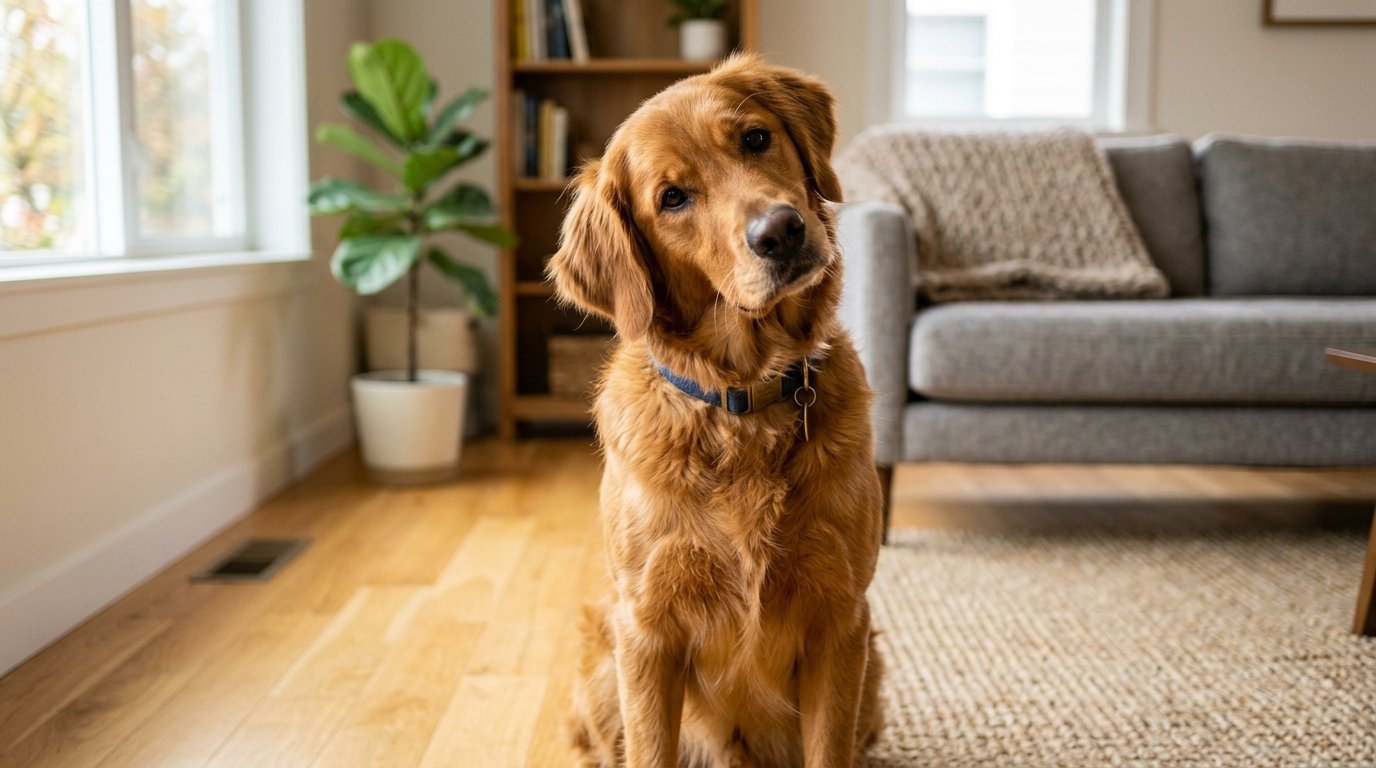
Few dog behaviors are as adorable as the classic head tilt. You say your dog’s name, make a strange noise, or ask, “Want to go for a walk?” and suddenly one ear rises while the head angles dramatically to one side.
But why do dogs tilt their heads in the first place?
The honest answer is that scientists do not have one definitive explanation. Research and veterinary experts suggest that dogs may tilt their heads while trying to process sounds, locate where a noise is coming from, improve their view, understand meaningful words, communicate engagement, or respond to behavior that humans have accidentally reinforced.
In most situations, a brief head tilt is completely normal. However, there is an important distinction between a temporary “listening” tilt and a head that remains tilted to one side. A persistent or sudden head tilt can sometimes indicate an ear or balance problem and deserves veterinary attention.
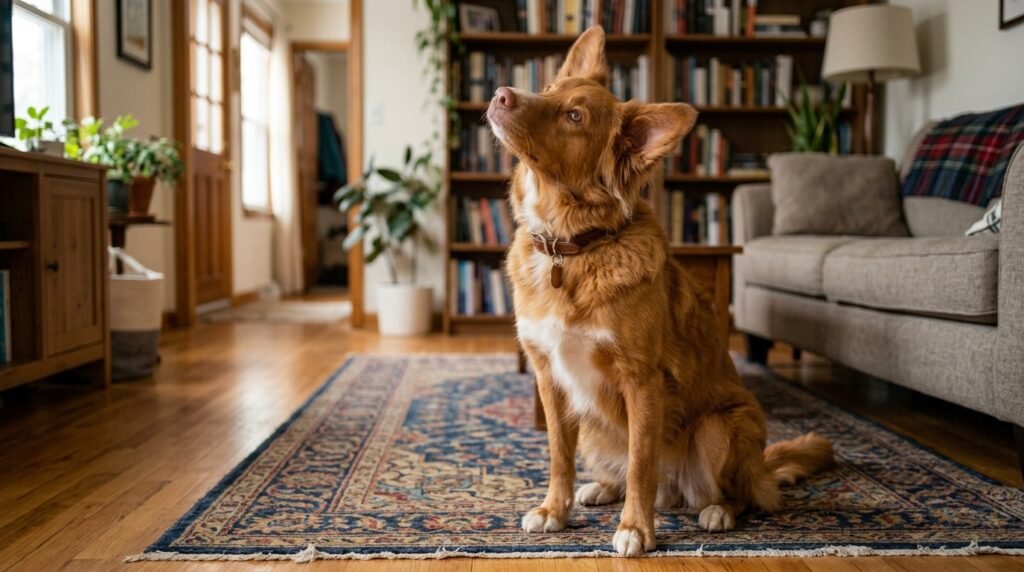
Here are 7 fascinating reasons dogs may tilt their heads and how to tell a cute behavioral response from a potential medical warning sign.
Table of Contents
1. Dogs May Tilt Their Heads to Locate a Sound
One of the most likely explanations is that your dog is trying to figure out where a sound is coming from.
Dogs have highly developed hearing, but their ears and head shape can affect how sound reaches each ear. Depending on the breed and ear structure, the ear flaps may partially cover the ear canals. Changing the position of the head and ears can help a dog gather additional information about a sound’s direction.
Imagine hearing an unfamiliar noise behind you. You might turn your head automatically to determine its source. Dogs use similar sensory adjustments.
A dog may tilt its head when it hears:
- A new noise outside
- A high-pitched sound
- A squeaky toy
- Another animal
- An unfamiliar word
- A sound coming from another room
- A noise that humans cannot easily detect
The tilt does not necessarily mean your dog is confused. It may simply be gathering more information.
Why does the direction of the tilt matter?
Dogs can use differences in the timing and intensity of sounds reaching each ear to help determine where a noise originated. VCA explains that dogs may adjust their head and movable ear flaps to optimize sound detection and assess the location and distance of sounds.
That means the cute head tilt may actually be part of a sophisticated sensory process.
Still, scientists have not established that every ordinary head tilt exists specifically to improve hearing. It is better to describe hearing as a likely explanation, rather than a proven universal cause.
2. Your Dog May Be Trying to See Your Face Better
Another fascinating explanation involves vision.
Your dog’s muzzle can partially obstruct its view, especially when the dog is looking directly ahead. Tilting the head may change the visual angle and help the dog see your face or body language more clearly.
This may be particularly noticeable in dogs with longer muzzles.
When your dog looks at you while you are talking, it is not relying only on your voice. Dogs can also pay attention to facial expressions, body posture, gestures, tone, and other visual signals. VCA notes that a dog’s muzzle may interfere with its forward field of vision and that changing the head position could improve its visual perspective.
That could explain why your dog sometimes tilts its head even when there is no unusual sound.
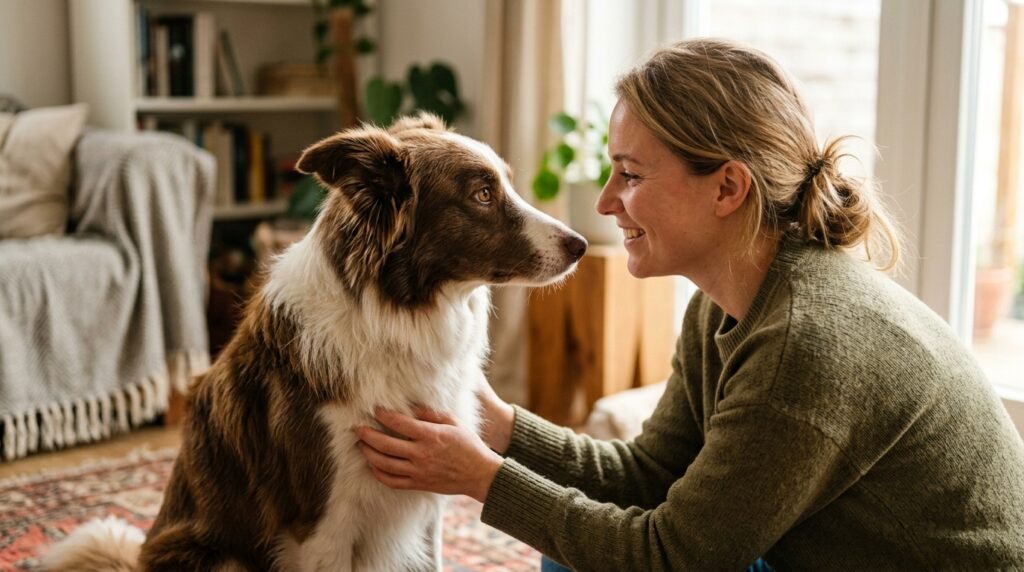
For example, imagine standing directly in front of your dog and speaking animatedly. Your dog may be trying to interpret:
- Your facial expression
- Your eye movements
- Your hand gestures
- Your body position
- Your tone of voice
The head tilt may help your dog gather those clues.
Does every breed tilt for the same reason?
Probably not.
Breed differences in muzzle length, ear shape, skull structure, and facial anatomy may influence how a dog experiences sound and vision. Purina notes that longer-muzzled dogs have been reported to tilt their heads more frequently than some flat-faced breeds, although head tilting also occurs in flat-faced dogs.
So vision may be part of the explanation, but it is unlikely to be the whole story.
3. Head Tilting May Help Dogs Process Meaningful Words
This is one of the most interesting scientific findings about canine head tilting.
A 2021 study published in Animal Cognition investigated head tilting in 40 dogs while they listened to their owners request familiar toys by name. The researchers found that dogs capable of learning multiple toy names tilted their heads much more frequently during the task than typical dogs.
The study suggested a relationship between head tilting and processing meaningful or relevant information.
In other words, your dog’s head tilt may sometimes happen because the information you are providing matters to them.
Think about what happens when you say:
“Where’s your ball?”
or
“Do you want a treat?”
If your dog has learned that certain words predict something important, those words may immediately capture its attention.
A head tilt could occur as your dog attempts to connect the sound with a familiar object, activity, or memory.
Does a head tilt prove your dog understands every word?
No.
This is an important distinction.
The study does not mean that every dog who tilts its head understands human language like a person does. The researchers studied a specific group of dogs with unusual abilities to learn object names, and the study itself was exploratory.
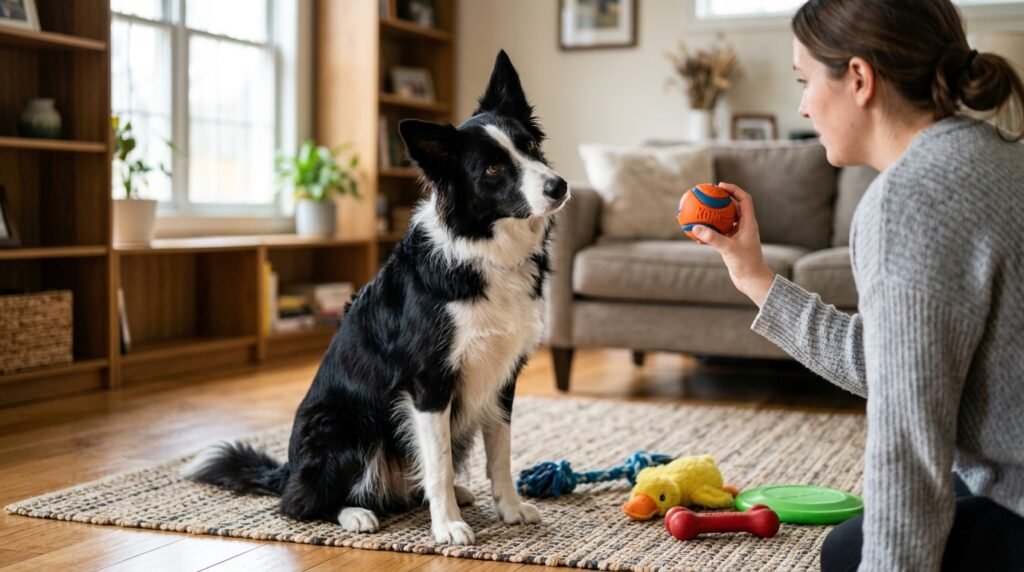
So if your dog tilts its head when you say “walk,” it may be processing a meaningful cue—but you should not automatically assume it understands the entire sentence.
4. Your Dog May Be Paying Extra Attention to You
Sometimes the simplest explanation is that your dog is highly engaged.
When you talk to your dog, it may be concentrating on your voice, facial expression, gestures, and body language all at once.
VCA describes the head tilt as a possible sign of engagement, comparing it to the way a person might nod during a conversation to show that they are listening. Social dogs may repeat the behavior because it helps maintain interaction with their human.
You may notice this especially when:
- You speak in an animated voice
- You introduce a new command
- You ask a question
- You mention something exciting
- Your dog is waiting for an instruction
- You are holding a favorite toy
- You are preparing to go outside
Look at your dog’s entire body rather than the head alone.
A relaxed body, forward attention, natural ear position, and normal movement generally suggest your dog is simply interested in what is happening.
The head tilt is only one piece of canine body language.
5. Your Dog May Have Learned That Head Tilting Gets a Reaction
Here’s a reason many owners overlook: you may have accidentally taught your dog to do it.
Think about your own reaction.
Your dog tilts its head.
You laugh.
You say, “Aww!”
You reach down to pet it.
You grab your phone for a picture.
Maybe you even offer a treat.
From your dog’s perspective, that behavior produced a wonderful result.
Dogs learn through consequences. When a behavior consistently receives attention, affection, food, play, or another reward, the behavior can become more likely to happen again. Both VCA and Purina discuss positive reinforcement as a possible reason head tilting can become more frequent.
This does not mean the original head tilt was fake.
Your dog may have initially tilted its head because it was listening or processing information. But after receiving enthusiastic human attention, it may learn that the behavior is socially rewarding.
Over time, your dog might even offer a head tilt when it knows you love seeing it.
Can you teach a dog to tilt its head?
Yes, potentially.
Like many behaviors, a head tilt can become associated with a cue through reward-based training. However, there is no reason to encourage a head tilt if your dog is uncomfortable or showing signs of illness.
The goal should always be to reward relaxed, voluntary behavior—not to mistake a medical symptom for a trick.
6. Your Dog May Be Responding to Something Unfamiliar or Interesting
Dogs are naturally information-seeking animals.
A strange noise, unfamiliar word, new object, unusual movement, or unexpected situation can capture their attention. A temporary head tilt may simply be part of that investigation.
For example, your dog might tilt its head when you:
- Make a clicking sound
- Whisper
- Play a new recording
- Use an unfamiliar word
- Open a strange package
- Bring home a new object
- Imitate an animal sound
- Speak in an unusual tone
The behavior may disappear once your dog understands what is happening.
This is why context matters when interpreting a head tilt.
If your dog tilts its head for two seconds after hearing an unfamiliar noise and then returns to normal, that is very different from a dog that keeps its head angled to one side while walking, eating, or resting.
The first situation is usually a behavioral response.
The second can be a medical concern.
7. A Persistent Head Tilt Can Signal a Health Problem
This is the most important reason to understand the difference between a temporary head tilt and a persistent head tilt.
A brief tilt while listening is generally considered a normal behavior. But if your dog suddenly develops a head tilt that remains present, especially when there is no obvious sound or interaction triggering it, you should contact your veterinarian.
Possible medical causes include problems affecting the ears, balance system, or nervous system.
One important possibility is vestibular disease, which affects the system responsible for balance and spatial orientation. Dogs with vestibular problems may develop a persistent head tilt along with other signs.
Warning signs to watch for
A medical head tilt may occur alongside:
- Loss of balance
- Stumbling
- Falling
- Circling
- Leaning to one side
- Vomiting
- Disorientation
- Rapid involuntary eye movements
- Head shaking
- Ear pain or irritation
- Unusual ear discharge
- Difficulty walking
- Reduced appetite
PetMD notes that sudden or persistent head tilting can be associated with vestibular, ear, neurological, or other medical conditions, while PDSA lists balance problems, abnormal eye movements, vomiting, ear symptoms, and other changes as possible accompanying signs.
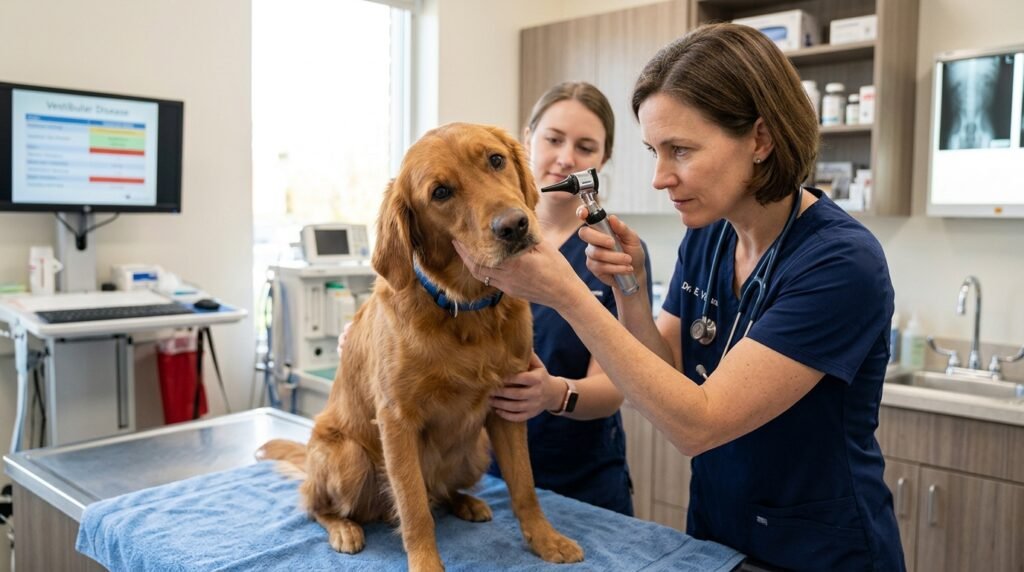
Cute head tilt vs. medical head tilt
A useful way to think about the difference is:
Normal behavioral tilt:
- Happens briefly
- Has an obvious trigger
- Often occurs while listening
- Stops when the interaction ends
- Your dog otherwise acts normally
Potential medical tilt:
- Remains present
- Appears suddenly without an obvious trigger
- Happens repeatedly throughout the day
- Is accompanied by balance problems
- Occurs with vomiting, abnormal eye movements, or disorientation
- Your dog appears uncomfortable or unwell
If you notice a persistent or sudden abnormal head tilt, don’t assume your dog is simply being cute. A veterinarian can determine whether an ear, vestibular, neurological, or other problem is responsible.
Why Do Dogs Tilt Their Heads When You Talk?
One of the most common situations is the classic head tilt during conversation.
Your dog may be listening carefully, trying to identify familiar sounds, watching your face, or processing words and tone.
Dogs do not interpret human communication through words alone. They can use auditory and visual information together, including tone, facial expressions, gestures, and body language. VCA notes that dogs may tilt their heads during human interaction as they work to hear and interpret what their owners are communicating.
So when you say:
“Do you want to go outside?”
and your dog suddenly tilts its head, there may be several things happening at once.
Your dog could be:
- Recognizing a familiar word.
- Paying closer attention to your voice.
- Watching your face.
- Anticipating an activity.
- Trying to interpret your tone.
- Responding to a behavior that has previously earned attention.
There is no reliable way to know which explanation applies every time.
That uncertainty is part of what makes the behavior so interesting.
Do Dogs Tilt Their Heads Because They Are Confused?
Sometimes a head tilt may occur when a dog encounters information it has not fully processed, but “confused” is not a scientifically established explanation for every head tilt.
A dog may be investigating an unfamiliar sound or trying to determine what a human is communicating. That can look like confusion to us, but the underlying process may involve attention, sensory processing, or learning.
The 2021 Animal Cognition research is especially interesting because head tilting was more frequent among dogs that had learned object names when they heard those meaningful words. The researchers proposed that the behavior could be associated with processing relevant stimuli.
So instead of assuming:
“My dog is confused.”
it is more accurate to think:
“My dog is paying close attention and trying to figure out what this information means.”
Why Does My Dog Always Tilt the Same Way?
Some dogs appear to have a preferred direction.
The research on head tilting found that individual dogs could show a stable preference for tilting to one side across different tests and over several months. This finding may relate to individual differences in how dogs process information, although more research is needed before scientists can explain exactly why.
Therefore, a dog that repeatedly tilts left during certain interactions is not necessarily showing a problem.
What matters more is whether the behavior is temporary and context-dependent or persistent and accompanied by other symptoms.
If your dog suddenly begins holding its head at an unusual angle all the time, that is different and should be evaluated by a veterinarian.
Can Head Tilting Mean My Dog Is Smart?
This is where the story gets especially interesting.
You may have seen claims that dogs who tilt their heads are smarter. The scientific evidence does not justify such a broad conclusion.
However, the 2021 study found that dogs classified as Gifted Word Learners tilted their heads much more often during a task involving familiar toy names than typical dogs. The researchers suggested that the behavior could be associated with processing meaningful information.
That is fascinating—but it does not mean:
Head tilt = intelligent dog.
The study involved a specific group of dogs and examined a particular task. More research is needed to determine how broadly the findings apply to dogs in general.
Your Labrador, Golden Retriever, Chihuahua, or mixed-breed dog does not need to tilt its head to prove that it is intelligent.
Every dog processes information differently.
What Should You Do When Your Dog Tilts Its Head?
If your dog gives you a brief head tilt while listening to you, there is usually no reason to panic.
You can simply observe what happened immediately before the behavior.
Ask yourself:
- Did I say a familiar word?
- Did my dog hear a strange sound?
- Was I holding a favorite toy?
- Did something unusual happen?
- Did I react with attention or affection?
- Did the head return to its normal position?
Watching the surrounding behavior can tell you much more than the head tilt alone.
If your dog seems comfortable and returns to normal immediately, you can enjoy the adorable moment.
If the head remains tilted, your dog loses balance, circles, vomits, develops abnormal eye movements, or otherwise seems unwell, contact your veterinarian promptly.
Frequently Asked Questions
Why do dogs tilt their heads?
Dogs may tilt their heads while listening to sounds, trying to locate noise, improving their visual perspective, processing meaningful words, paying attention to people, investigating something unfamiliar, or repeating a behavior that has been positively reinforced. Scientists have not identified one universal reason.
Why do dogs tilt their heads when you talk to them?
They may be paying close attention to your voice, trying to interpret familiar words, watching your face and body language, or processing information. A head tilt during conversation is usually normal when it is brief and your dog otherwise behaves normally.
Does a dog head tilt mean they understand you?
Not necessarily. A head tilt may indicate attention or processing, but it does not prove that a dog understands the complete meaning of what you said. Research has found interesting associations between head tilting and meaningful word processing in a specific group of dogs with exceptional toy-name learning abilities.
When should I worry about my dog’s head tilt?
Be concerned if the head tilt is persistent, sudden, or accompanied by symptoms such as stumbling, falling, circling, vomiting, disorientation, abnormal eye movements, ear pain, or other unusual behavior. These signs can occur with ear or vestibular problems and warrant veterinary evaluation.
Final Thoughts
So, why do dogs tilt their heads?
There is no single answer.
Your dog may be trying to locate a sound, improve its view, process a meaningful word, focus more closely on you, investigate something unfamiliar, or repeat a behavior that has earned positive attention. Scientific research also suggests that head tilting may sometimes be connected with how certain dogs process meaningful information.
The important thing is to look at the whole dog and the context.
A quick head tilt when you say “treat” is usually just one of those charming behaviors that makes living with dogs so enjoyable. But a head that stays tilted to one side—especially alongside balance problems, vomiting, abnormal eye movements, or other symptoms—is different and should be checked by a veterinarian.
The next time your dog gives you that famous sideways look, enjoy the moment—but remember that behind the cuteness may be a surprisingly complex combination of hearing, vision, attention, learning, and communication.
Key Takeaways
- Consider the context around the behavior.
- Look for patterns instead of relying on one signal.
- Seek qualified help when behavior is sudden, severe, or unsafe.
Frequently Asked Questions
Is every behavior a sign of the same emotion?
Not necessarily. Dogs use combinations of signals, and context matters.
When should I contact a professional?
Consider veterinary or qualified behavior support for sudden, severe, escalating, or safety-related concerns.