
The best answer depends on your dog, the context, and the full pattern of behavior. Look at multiple signals rather than one isolated action.
Have you ever thrown a bright red ball into green grass and wondered why your dog seemed to lose it almost immediately? You may have assumed your dog simply was not paying attention. But the answer may have more to do with the fascinating way your dog’s eyes process color.
What colors can dogs see? Dogs can see color, but they do not see the same full spectrum that humans do. Their vision is generally described as dichromatic, meaning their color perception is based on two primary types of color-sensitive cone cells rather than the three types found in typical human vision. This makes blues and yellows easier for dogs to distinguish, while reds and greens may appear more muted or blend into other shades.
Understanding what colors can dogs see is more than an interesting science question. It can help you choose toys, training equipment, and visual environments that may be easier for your dog to navigate.
The good news is that dogs are not living in a black-and-white world. Their world simply looks different from ours.
Let’s look at seven surprising facts about dog vision and what your dog may actually see.
Table of Contents
1. Dogs Are Not Completely Colorblind
One of the biggest myths about canine vision is that dogs can see only in black, white, and gray.
That is not accurate.
Dogs can see colors, although their color range is more limited than ours. Dogs can see colors, although their color range is more limited than ours. Their vision is often compared to red-green color blindness in humans because they have two main types of color-sensitive cone cells rather than the three typically found in humans. As a result, dogs are better at distinguishing blues and yellows, while some reds and greens can be harder for them to tell apart. Dogs are particularly able to distinguish variations within the blue and yellow parts of the visual spectrum, while red and green are much harder for them to differentiate.
So when asking what colors can dogs see, the answer is not simply “black and white.”
A dog’s visual world includes colors, but those colors may appear:
- Less vivid
- More muted
- Less varied than human vision
- More dependent on contrast and brightness
This is an important distinction because a dog may still see an object even if the object does not appear in the same color that you see.
For example, your bright red dog toy may not disappear completely from your dog’s vision. However, against a green lawn, the contrast may be less useful than it would be for a human.
What Colors Do Dogs See Best?
Dogs generally distinguish blue and yellow most easily compared with colors such as red and green. This does not mean every blue or yellow object will automatically stand out, because brightness, background, distance, and movement also affect how easily a dog notices something.
For everyday play, blue and yellow toys can therefore be useful choices, particularly when they create strong contrast with the grass, flooring, or other background.
If you are wondering what colors do dogs see best, think of blue and yellow as the most useful starting point rather than assuming color is the only factor that matters.
Can Dogs See Blue
Yes, dogs can see blue. Blue is one of the colors they can distinguish relatively well because canine color vision is based on sensitivity to blue and yellow wavelengths. A blue toy may therefore be easier for a dog to distinguish than a red or green toy in some environments.
However, visibility still depends on the background. A blue toy placed on a similarly colored surface may be harder to notice, while a moving toy with strong contrast can stand out much more clearly.
2. Blue and Yellow Are Among the Easiest Colors for Dogs to See
If you are choosing a toy based primarily on visibility, blue and yellow are commonly considered useful choices.
Research-based explanations of canine color vision indicate that dogs are especially capable of distinguishing variations in blue and yellow. Different shades may still appear differently to your dog, but these parts of the spectrum are generally more visually meaningful to them than red and green.
This has practical implications.
Imagine placing three balls on green grass:
- A red ball
- A green ball
- A bright blue ball
The blue ball may create stronger visual contrast for your dog than the red or green options.
A yellow toy can also be easier to distinguish depending on the surrounding environment.
Why This Matters During Play
Dogs do not rely on color alone when locating an object. They also use:
- Motion
- Contrast
- Brightness
- Shape
- Smell
- Sound
That means a red toy can still be exciting. But if your goal is to make an object easier to visually locate, color contrast can be helpful.
Pro Tip: When playing fetch outside, consider trying a blue or yellow toy and compare your dog’s ability to locate it against toys that blend more closely with the environment.
3. Red and Green Do Not Look the Same to Dogs
One of the most interesting answers to what colors can dogs see involves red and green.
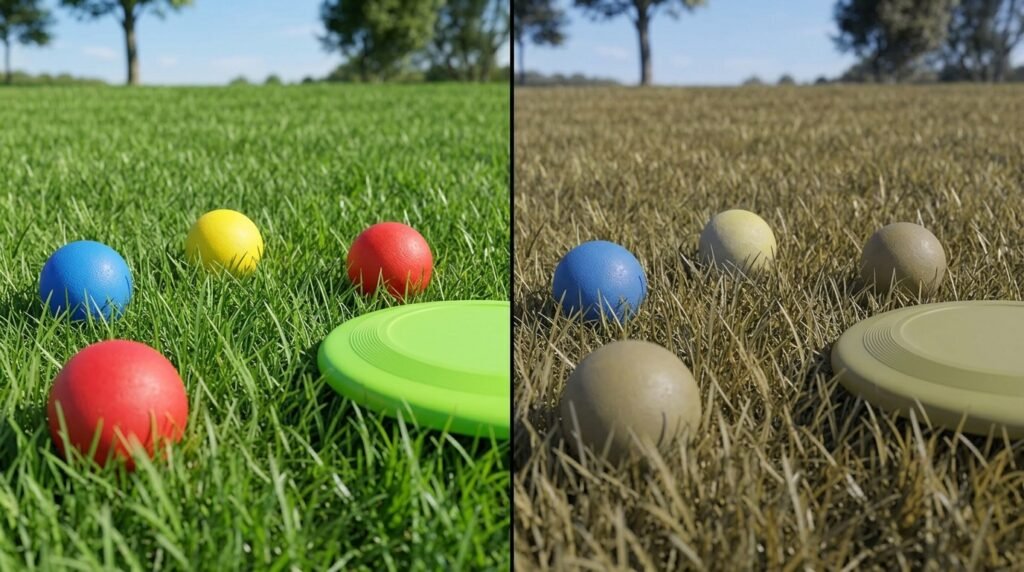
Dogs do not generally distinguish these colors the way humans do. Instead, shades of red and green may appear more muted and can shift toward brownish, grayish, or yellowish-looking tones depending on the exact color, brightness, and surrounding contrast.
This explains a classic fetch problem.
You throw:
A red ball into green grass.
To you, the contrast is obvious.
To your dog, however, the ball and the grass may not create the same visual separation.
That does not mean your dog cannot find the ball. Dogs have other powerful senses and visual abilities. Movement, scent, and brightness can all help them locate it.
But if you want to make the game visually easier, changing the toy color may make a difference.
This is also one reason why understanding your dog’s senses as a complete system is more useful than focusing on eyesight alone. Dogs interpret their environment through a combination of sight, smell, sound, and body-based information.
Dogs also rely heavily on body language and other visual signals when communicating with people and other dogs.
4. Dog Vision Is Different From Human Vision in More Ways Than Color
Color is only one part of the story.
When people ask what colors can dogs see, they often assume the answer will explain everything about dog eyesight. But canine vision has several important differences from human vision.
Dogs generally have fewer types of cone cells involved in color perception than humans, which limits their ability to distinguish the same range of colors. However, their eyes are also adapted in ways that can provide advantages in other situations.
Dogs Are Good at Detecting Motion
Dogs can be highly responsive to movement.
This makes sense when you think about a dog watching:
- A squirrel running across the yard
- A ball rolling across the ground
- A person walking toward the house
- Another dog moving in the distance
A stationary object may be less visually interesting than something moving.
Dogs Can Perform Better in Dim Light
Dogs also have visual adaptations that help them function in lower-light conditions. Their retinas contain many rod cells, which are particularly sensitive to light and movement. Dogs also have a reflective layer called the tapetum lucidum that can help make better use of available light.
This does not mean dogs have perfect night vision.
It simply means their visual strengths are different from ours.
Humans tend to have an advantage in fine detail and the full range of color perception, while dogs can have advantages related to motion detection and seeing in dimmer conditions.
5. Dogs Use Contrast, Not Just Color
A major mistake dog owners make is thinking that the best toy is simply the brightest one.
Brightness and color are not the same thing.
A toy that creates strong contrast against its surroundings may be easier for a dog to notice than a toy that happens to be brightly colored from a human perspective.
For example:
- A blue toy on pale sand may stand out.
- A yellow toy against dark soil may create useful contrast.
- A red toy in green grass may be harder to distinguish by color alone.
- A moving object may be easier to notice regardless of its color.
This is where what colors can dogs see becomes a practical question rather than just a fun fact.
When choosing toys or training tools, think about the environment where your dog will use them.
Consider the Background
Ask yourself:
- Will the toy be used on grass?
- Will it be used on dark flooring?
- Will it be used indoors?
- Will your dog play with it at dusk?
- Does the object blend into its surroundings?
A highly visible toy for a human may not necessarily be the easiest toy for a dog to see.

What Colors Are Dogs Attracted To?
If you want to grab your dog’s attention quickly, you might wonder what colors are dogs attracted to naturally. Because the dog visible spectrum is limited to dichromatic vision, dogs are instinctively drawn to bright blues and distinct yellows. These colors pop out against dull backgrounds. If you want to keep your dog highly engaged during training or playtime, always opt for a vibrant blue or yellow toy, as their eyes will naturally track these shades much better than red or green.
6. A Dog’s Eyes Are Only Part of How They Understand the World
Dogs do not experience the world through vision alone.
Their sense of smell is especially important, and sound, movement, touch, and learned associations also influence how they respond to people and objects.
That is why you should not assume that a dog who does not immediately notice something has poor eyesight.
Your dog may simply be processing other information.
For example, during a walk, your dog might ignore a visually obvious object because they are focused on:
- An interesting scent
- Another animal
- A sound
- Your body movement
- A familiar routine
Understanding this broader perspective can also improve training.
If you are teaching a dog to locate a toy, remember that movement and reward history may matter just as much as color.
The bigger lesson is simple:
Dogs do not experience the world like humans.
The more we understand the way they perceive their environment, the better we can adapt our interactions to their needs.
7. Understanding Dog Vision Can Help You Make Better Everyday Choices
The answer to what colors can dogs see can actually influence some simple decisions you make every day.
You do not need to redesign your entire home around blue and yellow.
But knowing how your dog sees can help you think more carefully about certain situations.
Choosing Dog Toys
If you play outside frequently, consider toys that provide useful visual contrast.
Blue and yellow can be practical options, especially when a toy might otherwise blend into grass or other natural backgrounds.
Training Equipment
Markers, targets, or visual training objects may be easier for a dog to distinguish when they contrast clearly with the environment.
However, training success still depends heavily on timing, consistency, reinforcement, and clear communication.
Home Environment
For older dogs or dogs with declining vision, contrast can sometimes make navigation easier. Changes in vision should always be discussed with a veterinarian, especially if they are sudden or accompanied by bumping into objects, hesitation, eye changes, or unusual behavior.
For broader everyday health awareness, see PawMindTips’ 7 Common Dog Health Issues Every Pet Parent Should Know. The site also emphasizes that educational content does not replace professional veterinary advice when a dog’s health or behavior changes suddenly.
Play and Enrichment
Visual stimulation can be part of play, but remember that dogs often enjoy activities involving:
- Sniffing
- Searching
- Chewing
- Problem-solving
- Movement
- Social interaction
The best enrichment activities engage your individual dog’s preferences rather than assuming every dog responds to the same visual cues.
What Does the World Look Like to a Dog?
There is no single photograph that can perfectly recreate a dog’s visual experience. Scientists can study canine eyes and how dogs respond to different wavelengths of light, but translating that information into a human-style image is only an approximation.
In general, dogs see a more limited range of colors than humans. Blue and yellow are easier for them to distinguish, while red and green can be more difficult to tell apart. Their vision also depends heavily on brightness, contrast, movement, and the surrounding environment.
Generally, however, what colors can dogs see can be understood like this:
Dogs experience a more limited color palette than humans.
Blue and yellow hues are easier for them to distinguish.
Red and green are more difficult to tell apart and may appear as muted shades that blend toward browns or grays.
At the same time, dogs can use motion, brightness, contrast, and other sensory information to understand their surroundings.
So a dog’s world is not dull.
It is simply optimized differently.
Are Dogs Colorblind?
Yes and no.
Dogs are often described as colorblind because they cannot perceive the same range of colors as humans.
However, this does not mean dogs see only black and white.
A more accurate explanation is that dogs have dichromatic color vision, meaning their color perception is based primarily on two types of cone cells.
This distinction matters because the phrase “colorblind” can create the wrong mental picture.
Your dog is not watching a black-and-white movie.
Instead, your dog experiences a different color spectrum.
How Can You Use This Information During Fetch?
If your dog regularly loses a toy in the grass, try experimenting with color.
Instead of always choosing:
- Red
- Orange
- Green
Try:
- Blue
- Yellow
Then watch how your dog responds.
Remember, color is only one factor. A toy’s:
- Movement
- Size
- Shape
- Scent
- Sound
- Contrast
can also influence how easy it is for your dog to find.
A squeaky toy, for example, may be easy to locate partly because your dog can hear it.
A scented toy may be easy to locate because your dog’s nose provides information that eyesight cannot.
This is another reminder that what colors can dogs see is only one piece of the much larger picture of canine perception.
Can a Dog’s Vision Change With Age?
Yes.
Like humans, dogs can experience age-related changes affecting their eyes and vision. Some eye problems may develop gradually, while others can appear more suddenly.
Possible signs of vision problems can include:
- Bumping into furniture
- Difficulty navigating in unfamiliar spaces
- Hesitation around stairs
- Increased anxiety in dark environments
- Changes in eye appearance
- Squinting or eye discomfort
- Suddenly becoming less confident
A sudden change in vision or behavior deserves veterinary attention.
Do not assume that a dog is simply “getting older.”
The information in this article explains normal canine color perception. It is not intended to diagnose vision loss or eye disease.

FAQs
What Colors Can Dogs See Best?
Dogs are generally best at distinguishing shades in the blue and yellow range. They can also perceive differences in brightness and contrast, while red and green are more difficult for them to distinguish.
Can Dogs See Red?
Dogs can see light reflected from red objects, but they do not perceive red in the same way humans do. Red may appear as a darker or more muted shade, which can make it difficult to distinguish from certain surrounding colors.
Are Dogs Completely Colorblind?
No. Dogs are not limited to black-and-white vision. They have dichromatic vision and can distinguish some colors, particularly in the blue and yellow portions of the spectrum.
What Colors Can Dogs See on Grass?
Because green can be difficult for dogs to distinguish from certain red-toned objects, toys with blue or yellow coloring may create more useful visual contrast against grass. Movement and scent can also help your dog locate an object.
What Colors Can Chihuahuas, Pugs, and Yorkies See?
Many owners ask if smaller breeds have different eyesight, searching for things like what colors can Chihuahuas see, or what colors can Pugs and Yorkies see. The truth is, color vision does not change based on the dog’s breed or size. Whether you have a tiny Yorkie, a flat-faced Pug, or a large German Shepherd, all dogs share the same dichromatic vision. They all see the world in shades of blue, yellow, gray, and brown.
What Dog Can See Color Best?
While all dog breeds have the same basic color receptors (cones) for blue and yellow, breeds that are specifically bred for hunting and visual tracking (like Greyhounds or Whippets) might be better at noticing visual contrast and movement from a distance. However, their actual color palette remains exactly the same as any other breed.
Final Thoughts: What Colors Can Dogs See?
So, what colors can dogs see?
Dogs can see color, but their visual spectrum is different from ours. They are generally better at distinguishing blues and yellows, while reds and greens are harder for them to tell apart.
But color is only one part of canine vision.
Dogs also rely on movement, brightness, contrast, smell, and sound to understand the world around them.
The next time your dog struggles to find a red ball in the grass, remember that they may not be ignoring you. They may simply be seeing the game differently.
By understanding what colors can dogs see, you can make smarter choices about toys, training tools, and everyday activities—and gain a new appreciation for the unique way your dog experiences the world.
For more practical dog-care guidance, explore PawMindTips and its growing library of dog behavior, body language, health, nutrition, and training content.
Key Takeaways
- Consider the context around the behavior.
- Look for patterns instead of relying on one signal.
- Seek qualified help when behavior is sudden, severe, or unsafe.
Frequently Asked Questions
Is every behavior a sign of the same emotion?
Not necessarily. Dogs use combinations of signals, and context matters.
When should I contact a professional?
Consider veterinary or qualified behavior support for sudden, severe, escalating, or safety-related concerns.