The best answer depends on your dog, the context, and the full pattern of behavior. Look at multiple signals rather than one isolated action.
Choosing a crate can feel surprisingly complicated. There are wire crates, plastic crates, soft-sided options, furniture-style designs, and heavy-duty models. Then you have to think about size, safety, comfort, your dog’s behavior, and how the crate will actually be used.
The good news is that learning how to choose a dog crate does not have to be overwhelming.
The best crate is not necessarily the biggest, most expensive, or most attractive option. It is the one that gives your dog enough room to move comfortably, matches their behavior and lifestyle, and provides a secure place where they can relax.
Whether you are bringing home a new puppy or choosing a crate for an adult dog, these seven tips can help you make a safer and more confident decision.
Table of Contents
Quick Answer: How Do You Choose the Right Dog Crate?
When deciding how to choose a dog crate, start by measuring your dog rather than choosing based only on breed or weight. Your dog should be able to stand comfortably, turn around, and lie down naturally.
Then consider:
- Your dog’s age and expected adult size
- The crate’s purpose
- Your dog’s behavior and chewing habits
- Ventilation and visibility
- Door placement and ease of entry
- Safety features
- Comfort and bedding
A crate should be a secure resting space—not a place for punishment.
1. Measure Your Dog Before Choosing a Crate
The most important step in learning how to choose a dog crate is measuring your individual dog.
Two dogs of the same breed can have very different body shapes. One may be taller, longer, or broader than another. That is why choosing a crate based only on breed recommendations can lead to a poor fit.
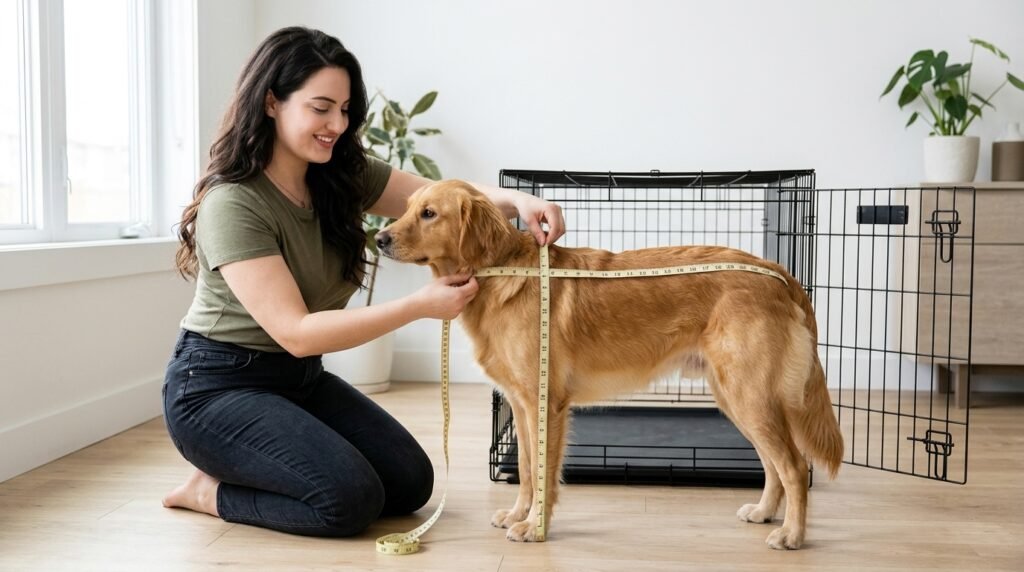
Start with two basic measurements:
Measure Your Dog’s Length
With your dog standing naturally, measure from the front of the body to the base of the tail.
Then allow some additional space so your dog can lie down comfortably without feeling cramped.
Measure Your Dog’s Height
Measure from the floor to the highest point of your dog’s head or ears, depending on which point is taller when your dog is standing normally.
The crate should provide enough vertical space for your dog to stand without crouching.
Veterinary guidance commonly emphasizes that an appropriately sized crate should allow a dog to stand, turn around, and lie down comfortably. Individual measurements are generally more useful than relying only on breed or weight charts.
A Simple Fit Test
Before settling on a crate, ask:
- Can my dog stand naturally?
- Can my dog turn around comfortably?
- Can my dog lie on their side?
- Can my dog enter and exit easily?
If the answer is no, the crate is probably too small.
2. Choose the Right Dog Crate Size—Not Simply the Biggest One
A common mistake when figuring out how to choose a dog crate is assuming that bigger is always better.
Your dog needs enough room to move comfortably, but an excessively large crate may not always be ideal—especially for a puppy being house-trained.
A puppy may use one end of an oversized crate as a sleeping area and another as a bathroom area.
For growing puppies, a crate with a divider can be particularly useful. You can buy a crate designed for your puppy’s expected adult size and gradually increase the available space as your puppy grows. This approach is also recommended in veterinary crate-sizing guidance.
The Right Crate Size Should Balance:
Comfort: Your dog should not feel cramped.
Movement: Your dog should be able to change positions naturally.
House Training: Puppies should not have excessive unused space.
Future Growth: Puppies may need a crate that can adapt as they mature.
If you’re preparing for a new puppy, crate selection should also be part of your broader setup plan, alongside food, bedding, training supplies, and puppy-proofing.
New Puppy Checklist: Essential First 30 Days Guide
3. Match the Crate Type to Your Dog’s Needs
There is no single crate type that works perfectly for every dog.
When deciding how to choose a dog crate, think about your dog’s personality, behavior, and how the crate will be used.
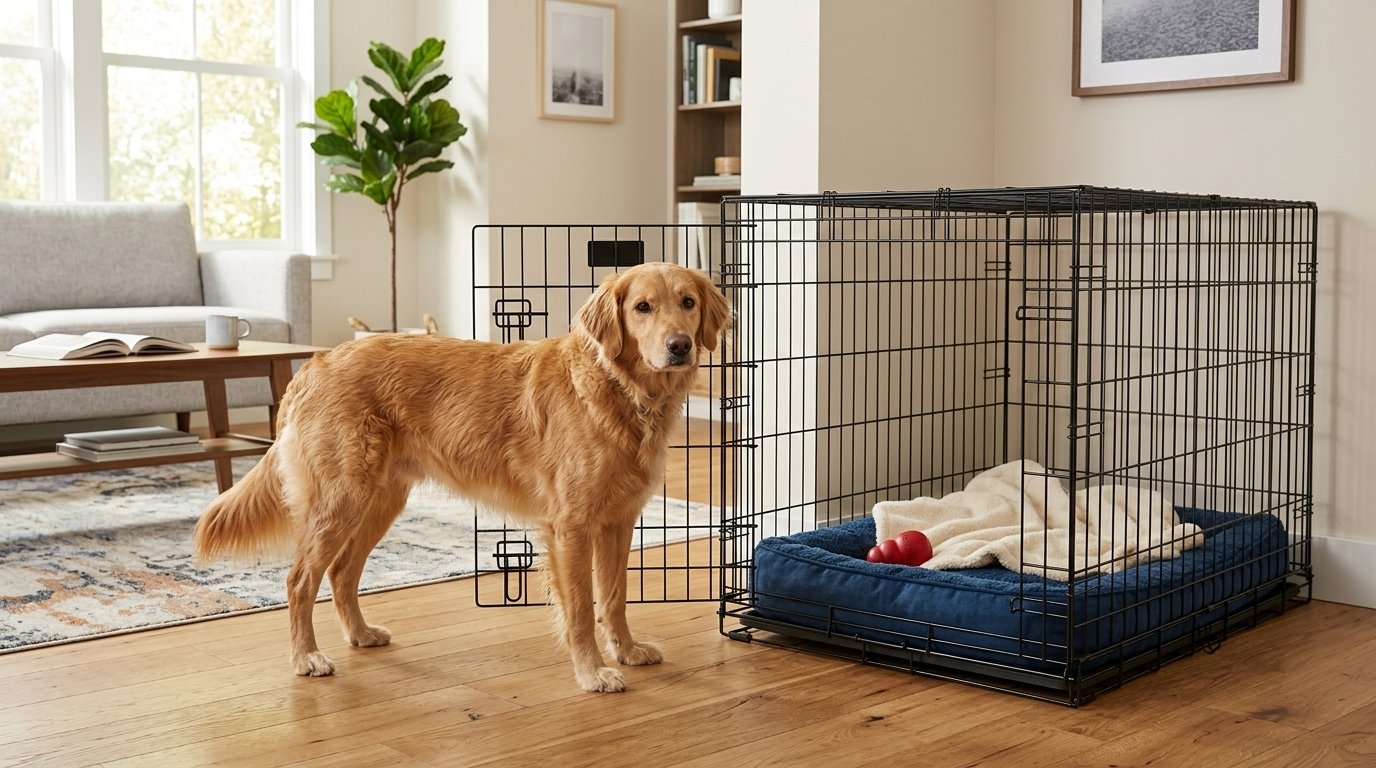
Wire Dog Crates
Wire crates are popular because they provide:
- Strong airflow
- Good visibility
- Easy cleaning
- Folding storage
- Divider options for growing puppies
They can be a practical all-purpose choice for many dogs.
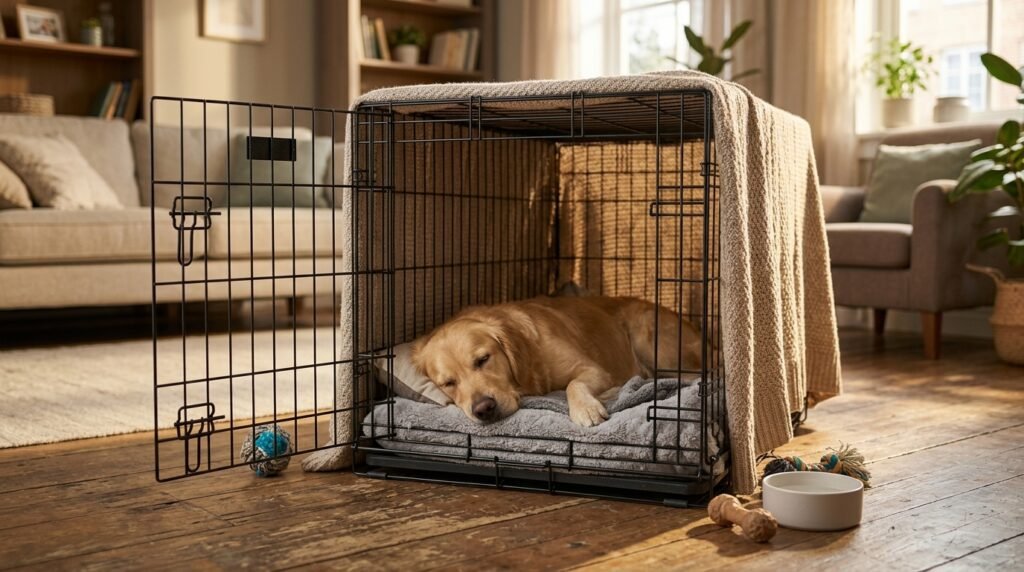
However, some dogs may find the open design overstimulating. A dog that becomes anxious when surrounded by activity may prefer a more enclosed setup.
Plastic Dog Crates
Plastic crates often provide a more enclosed environment.
They can be useful for:
- Travel
- Dogs that prefer privacy
- Easy cleanup
- Creating a den-like environment
However, ventilation should always be considered carefully, especially in warm environments.
Soft-Sided Crates
Soft-sided crates can work well for:
- Calm dogs
- Temporary use
- Short trips
- Easy portability
They are generally not the best option for powerful chewers or dogs that panic and attempt to escape.
Heavy-Duty Crates
Heavy-duty crates may be appropriate for large, strong, or escape-prone dogs.
However, a stronger crate is not automatically the solution to anxiety. If a dog repeatedly panics, injures themselves, or desperately tries to escape, simply buying a tougher crate may not address the underlying problem.
CareCredit’s veterinary-authored guide similarly differentiates crate styles based on factors such as durability, airflow, visibility, travel needs, and escape behavior.
4. Consider Your Dog’s Age, Behavior, and Personality
Understanding how to choose a dog crate also means understanding the dog who will use it.
A crate suitable for a calm adult dog may not be suitable for a teething puppy or a powerful dog that chews through household items.
Puppies
Puppies often benefit from:
- Durable materials
- Easy-to-clean surfaces
- Appropriate sizing
- Divider panels
- Safe construction without loose or chewable parts
Remember that puppies grow quickly.
Adult Dogs
For adult dogs, focus on:
- Current body measurements
- Sleeping habits
- Temperament
- Whether the crate will be used daily
Senior Dogs
Older dogs may need:
- Easier entry
- More supportive bedding
- Enough room to reposition comfortably
- A crate location that is quiet and accessible
Dogs That Chew or Escape
If your dog regularly chews, bends wires, or attempts to escape, consider whether the issue is simply crate strength.
Some dogs may be experiencing stress, separation-related problems, or confinement anxiety. A veterinarian or qualified behavior professional can help identify the underlying cause.
A crate should never become a situation where a distressed dog repeatedly risks injury.
Why Do Dogs Bark? 7 Reasons Behind Your Dog’s Barking
5. Check Important Safety Features Before Buying
A crate should not only fit your dog—it should also be physically safe.
Before making your final choice, inspect the following areas.
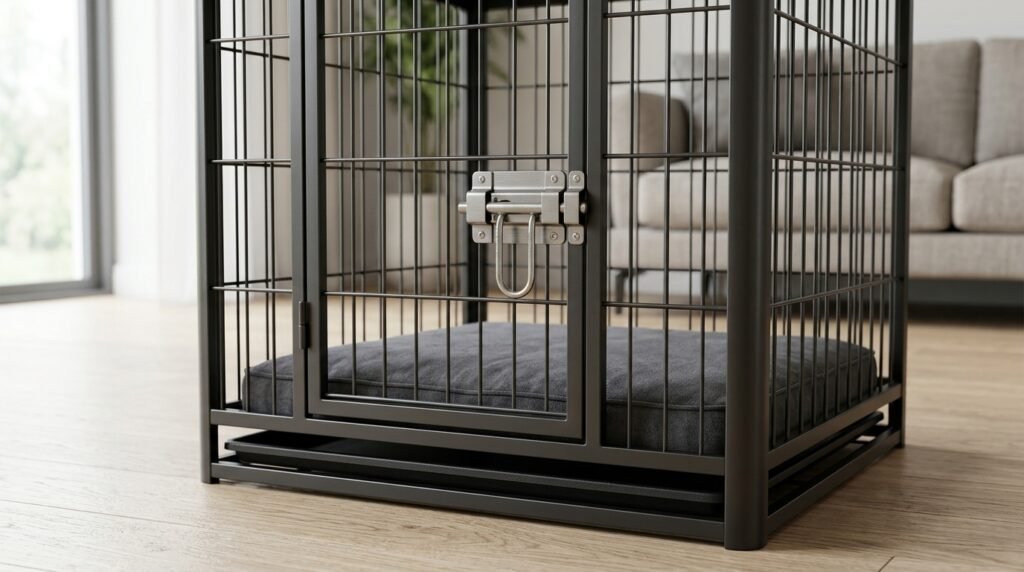
Secure Latches
The door should close securely without opening easily.
Check that the latch:
- Works smoothly
- Does not leave sharp edges exposed
- Cannot easily trap your dog’s paw or collar
Smooth Construction
Look carefully for:
- Sharp wire ends
- Rough seams
- Broken welds
- Loose hardware
- Damaged plastic
Stable Base
The crate should sit securely on the floor without excessive wobbling.
Appropriate Bar Spacing
For wire crates, the spacing should not allow a dog’s head, paws, or limbs to become trapped.
Good Ventilation
Airflow is especially important with more enclosed crates.
The crate should not become excessively hot or stuffy.
These safety factors align with current veterinary guidance highlighting secure latches, smooth edges, stable construction, appropriate bar spacing, ventilation, and easy cleaning.
PawMindTips Pro Tip: Before introducing your dog to a new crate, inspect the entire crate yourself. Run your hands carefully along accessible surfaces and check the door, latch, corners, and floor for potential hazards.
6. Think About Where and How the Crate Will Be Used
Another important part of how to choose a dog crate is considering its purpose.
Ask yourself:
Will the crate stay in one room?
A heavier wire or furniture-style crate may work well.
Will you travel frequently?
Portability and travel requirements may become more important.
Will the crate be moved between rooms?
Weight, folding ability, and handles may matter.
Will your dog use it during training?
Easy access, appropriate sizing, and positive crate introduction become especially important.
Consider Door Placement
Some crates have front doors, while others include side doors or multiple entry points.
This can make a significant difference depending on where you plan to place the crate.
Before buying, measure the space in your home—not just your dog.
You do not want to find the perfect crate only to discover that the door cannot open properly in your chosen location.
7. Prioritize Comfort Without Making the Crate Unsafe
A comfortable crate can help your dog view it as a resting space rather than a place of isolation.
Depending on your dog’s needs, you might consider:
- A properly fitted crate mat
- Supportive bedding
- A safe blanket
- A familiar toy
- Appropriate temperature and ventilation
However, comfort should never compromise safety.
Young puppies and strong chewers may destroy bedding or ingest pieces of fabric or foam. Choose accessories based on your individual dog’s habits and supervise new items before leaving your dog alone with them.
The goal is not to fill the crate with as many accessories as possible.
The goal is to create a space where your dog can rest comfortably and safely.
PetMD notes that thoughtful crate accessories and a positive introduction can help create a secure, comfortable resting environment.
How to Introduce Your Dog to a New Crate
Choosing the right crate is only half of the process.
Even the best crate can become stressful if a dog is forced inside or learns to associate it with punishment.
Start slowly.
Step 1: Leave the Door Open
Allow your dog to explore the crate voluntarily.
Step 2: Create Positive Associations
Place treats, toys, or meals near and eventually inside the crate if appropriate for your dog.
Step 3: Avoid Forcing Your Dog Inside
Forcing a fearful dog into a crate can create negative associations.
Step 4: Build Time Gradually
Once your dog is comfortable entering voluntarily, gradually increase the amount of calm time spent inside.
Positive crate acclimation is also emphasized in veterinary guidance; a crate should function as a safe space rather than a form of punishment.
Good Manners Training in 7 Days: A Proven, Essential Guide for Your Dog”
Common Mistakes to Avoid When Choosing a Dog Crate
Before making your purchase, avoid these common mistakes:
Choosing by Breed Alone
Breed can provide a starting point, but individual measurements matter more.
Choosing by Weight Alone
Two dogs with the same weight can have very different heights and body lengths.
Buying the Largest Crate Available
Too much unused space may not be ideal for every situation, especially during puppy house training.
Ignoring Your Dog’s Behavior
A soft-sided crate may not be appropriate for a powerful chewer, while a highly open crate may not suit every dog’s preferences.
Using the Crate as Punishment
The crate should not become associated with fear or discipline.
Forgetting About Future Growth
Puppies can quickly outgrow a crate.
Ignoring the Crate’s Location
Think about temperature, household activity, access, and door clearance before choosing where the crate will go.
How to Choose a Dog Crate for a Puppy
If you’re choosing a crate for a puppy, planning ahead can save money and make training easier.
One practical option is to choose a crate that fits the puppy’s expected adult size and use a divider to control the available space while the puppy grows. PetMD specifically recommends this approach as one option for rapidly growing puppies.
When choosing a puppy crate, prioritize:
- Durability
- Easy cleaning
- Safe materials
- Properly adjustable space
- Good ventilation
- Secure doors
You should also remember that crate training is only one part of raising a well-adjusted puppy.
Socialization, exercise, routine, nutrition, and positive training all matter.
How Much Exercise Does a Dog Need? 7 Factors Every Owner Should Know”
When a Dog Crate May Not Be the Right Solution
A crate is a useful tool, but it is not appropriate for every situation.
If your dog shows intense distress, repeatedly injures themselves trying to escape, or panics when confined, do not assume that a stronger crate will solve the problem.
Persistent distress may require help from:
- Your veterinarian
- A qualified dog trainer
- A veterinary behavior professional
A crate should support management, training, and rest—not become a source of ongoing fear.
FAQs
How do I know what size dog crate to buy?
Measure your dog’s length and height, then choose a crate that allows them to stand comfortably, turn around, and lie down naturally. Avoid relying only on breed or weight recommendations.
Should a dog crate be just big enough for the dog?
The crate should provide enough room for comfortable movement, but excessive unused space may be less helpful for some puppies during house training. The right amount of space depends on your dog’s age and how the crate will be used.
What type of dog crate is best?
The best type depends on your dog’s behavior and intended use. Wire crates offer ventilation and visibility, plastic crates can provide a more enclosed environment and travel utility, soft-sided crates suit some calm dogs, and heavy-duty crates may suit strong or escape-prone dogs.
Should I buy a bigger crate for my puppy to grow into?
You can buy a crate designed for your puppy’s expected adult size and use a divider to adjust the available space as your puppy grows.
Where should I put my dog’s crate?
Choose a location that is safe, well-ventilated, and comfortable. Avoid areas that are excessively hot, isolated, or constantly chaotic. Make sure the crate door can open fully and that your dog can access it safely.
Final Thoughts: How to Choose a Dog Crate
Learning how to choose a dog crate starts with understanding your individual dog.
Measure your dog first. Then consider their age, behavior, comfort needs, crate purpose, and safety requirements.
The right crate should allow your dog to stand, turn around, and rest comfortably while providing a secure environment that fits your home and lifestyle.
Most importantly, introduce the crate gradually and positively. A well-chosen crate can become a useful space for rest, travel, management, and training—but it should never be used as punishment.
By following these seven tips, you can choose a crate that is not just the right size, but the right fit for your dog’s everyday life.
Key Takeaways
- Consider the context around the behavior.
- Look for patterns instead of relying on one signal.
- Seek qualified help when behavior is sudden, severe, or unsafe.
Frequently Asked Questions
Is every behavior a sign of the same emotion?
Not necessarily. Dogs use combinations of signals, and context matters.
When should I contact a professional?
Consider veterinary or qualified behavior support for sudden, severe, escalating, or safety-related concerns.