The best answer depends on your dog, the context, and the full pattern of behavior. Look at multiple signals rather than one isolated action.
Bringing home a puppy often comes with one big question: When Do Puppies Stop Growing? You may wonder whether those oversized paws will turn into a large adult dog, when your puppy will reach its final height, or whether continued weight gain means your dog is still growing.
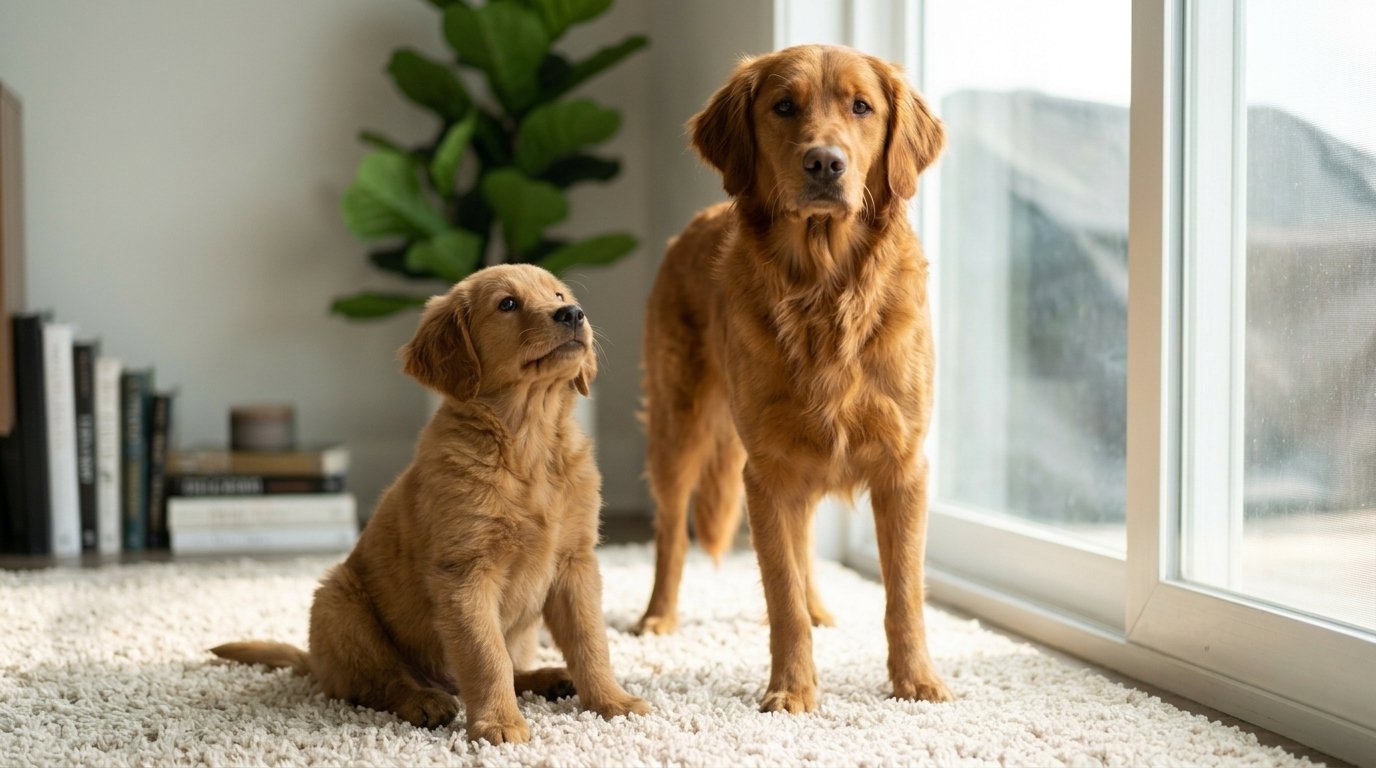
The answer is not the same for every puppy. Toy and small breeds generally reach adult size much sooner than large and giant breeds. Some dogs may be close to their adult height before their first birthday, while giant breeds can continue developing well into their second year. The American Kennel Club notes that puppies can continue growing anywhere from about 6 to 24 months depending largely on size and breed.
So, When Do Puppies Stop Growing depends on more than age alone. Breed, genetics, expected adult size, nutrition, health, and the difference between skeletal growth and filling out all matter.
A puppy can stop getting taller while still gaining muscle and body condition. That is why “fully grown” does not always mean the same thing as “finished developing.”
In this guide, you’ll learn 7 practical signs your dog may be fully grown, how growth differs by breed size, how to use a puppy growth chart, and when a puppy’s growth pattern deserves a veterinarian’s attention.
Table of Contents
Puppy Growth at a Glance
Before looking at individual signs, it helps to understand the broad timeline.
| Dog Size | Typical Time to Reach Adult Size |
|---|---|
| Toy breeds | About 6–9 months |
| Small breeds | About 9–12 months |
| Medium breeds | About 12–15 months |
| Large breeds | About 12–18 months |
| Giant breeds | About 18–24 months |
These are general ranges, not guarantees for individual dogs. Spot & Tango gives similar broad ranges, while AKC notes that small breeds may finish growing around 6–8 months, medium dogs around 12 months, and giant breeds may continue growing to 18–24 months.
A useful distinction is that physical growth happens in stages. Height may stabilize first, followed by muscle development and changes in body composition.
That means a 12-month-old Labrador, for example, may look nearly adult-sized while still developing physically. A Great Dane of the same age can still have substantial growth ahead.
1. Your Puppy’s Height Has Stopped Increasing
One of the clearest everyday clues is a stable standing height.
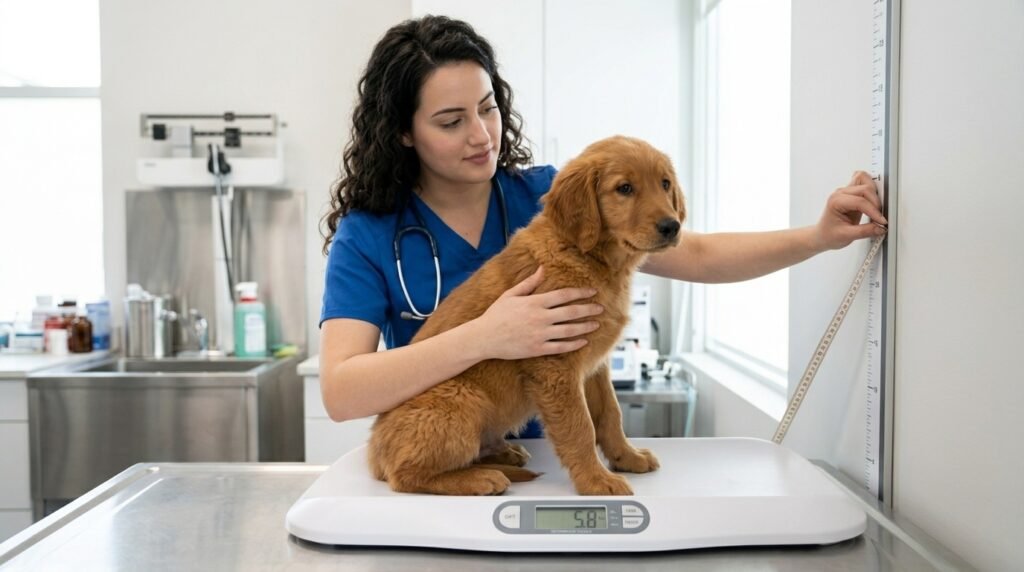
If you have been measuring your puppy regularly and the measurement stays essentially the same over several weeks, your dog may be approaching its adult height.
This is particularly useful when combined with breed expectations. A small-breed puppy that has stopped getting taller around the expected maturity window may be close to its final size. A giant-breed puppy showing the same pattern at a young age, however, may still have considerable growth ahead.
Do not expect perfectly identical measurements every time. Your puppy’s posture, flooring, measuring technique, and even how calmly your dog stands can affect the result.
For better tracking:
- Measure at approximately the same time of day.
- Have your puppy stand naturally on a level surface.
- Measure from the floor to the highest point of the shoulders.
- Record the result with the date.
- Compare measurements over several weeks rather than day to day.
Height alone does not prove that growth is finished. It is one piece of the bigger picture.
2. Weight Becomes Stable
A second useful sign is a period of relatively stable body weight.
If your puppy has stopped gaining weight rapidly and remains within an appropriate body-condition range, physical growth may be slowing or nearing completion.
However, stable weight does not automatically mean your puppy is fully grown.
A young dog can temporarily plateau and then experience another growth phase. Conversely, a dog may stop growing taller but continue gaining healthy muscle as it matures.
This is why veterinarians often look at growth trends rather than a single number.
WALTHAM Puppy Growth Charts were developed as a clinical tool to monitor growth over time. Their approach emphasizes tracking a puppy’s measurements along an expected growth curve rather than assuming that one particular percentile is ideal for every dog.
That distinction is important.
A puppy does not have to sit at the “middle” of a growth chart to be healthy. What matters is whether its growth follows an appropriate, consistent pattern.
If your puppy suddenly stops gaining weight, loses weight, or moves sharply away from its previous growth pattern, talk with your veterinarian.
3. Your Dog Is Reaching the Expected Breed-Size Timeline
Breed and expected adult size are among the strongest clues when asking When Do Puppies Stop Growing.
A Chihuahua and a Great Dane may be the same age, but they do not follow the same growth schedule.
Small dogs generally mature earlier because their adult skeleton is smaller. Large and giant breeds require more time for their bones and joints to develop.
AKC reports that small breeds commonly finish growing around 6–8 months, while medium breeds may reach adult size around 12 months. Large and giant dogs can continue growing considerably longer, with giant breeds sometimes reaching full size at 18–24 months.
Here is a simplified guide:
Toy Breeds
Toy dogs can reach adult size surprisingly quickly. Many are close to their final height and weight by roughly 6–9 months.
Small Breeds
Small dogs commonly approach adult size during the first year, often around 9–12 months.
Medium Breeds
Medium dogs usually take longer and may continue growing toward 12–15 months.
Large Breeds
Large dogs can continue skeletal development through 12–18 months.
Giant Breeds
Giant breeds have the longest growth period. Some may continue developing until 18–24 months.
These ranges are useful for expectations, but your dog’s genetics still matter.

4. Your Puppy’s Body Starts Looking More Proportional
Puppies often look awkward while growing.
They may have:
- Oversized paws
- Long legs
- A narrow chest
- A lanky body
- A disproportionately large head
- Loose-looking skin
- A puppy-like body shape
As growth slows, these proportions usually become more balanced.
Your puppy may start looking less “leggy” and more like an adult dog. The chest can become deeper, the neck may become stronger, and muscle definition can become more noticeable.
This is one reason owners sometimes think their puppy has suddenly “filled out” even though the dog has not gained much height.
Importantly, filling out is not necessarily the same as getting taller.
After skeletal growth is largely complete, dogs can continue developing muscle and body fat as they mature. AKC specifically notes that puppies can continue developing body composition after skeletal growth has finished.
So if your puppy looks slightly broader or more muscular after reaching its expected height, that does not necessarily mean the dog is still growing taller.
5. Your Puppy’s Growth Plates Are Maturing
Growth plates are areas of developing cartilage near the ends of certain bones.
During puppyhood, these areas allow bones to lengthen. As skeletal maturity is reached, the growth plates gradually harden and close.
This is one reason large and giant breeds require extra care during their growing period.
AKC explains that growth plates are softer during puppyhood and become completely calcified when bone growth is complete.
A veterinarian can assess skeletal maturity when there is a medical reason to do so, sometimes using X-rays.
You should not try to determine growth-plate closure at home.
Instead, think of growth plates as the biological explanation for why your puppy’s age alone cannot tell you whether physical growth is finished.
A six-month-old small dog may be much closer to skeletal maturity than a six-month-old giant-breed puppy.
6. Your Puppy’s Growth Rate Has Clearly Slowed
Puppies grow extremely quickly during their early months.
Over time, that growth rate naturally slows.
You may notice that:
- Your puppy needs fewer size increases in collars or harnesses.
- Weight gains become smaller.
- Height changes become less noticeable.
- Your puppy’s body proportions become more adult-like.
- Monthly measurements become increasingly stable.
This gradual slowdown is normal.
The important point is that growth should generally follow an appropriate trajectory for the individual dog.
WALTHAM’s growth-chart approach is useful here because it focuses on repeated measurements rather than a single weight. A puppy’s growth can be monitored over time to identify unusually rapid or unusually slow patterns.
Rapid growth is not necessarily better growth.
Overfeeding a puppy in an attempt to make it bigger can create unhealthy weight gain rather than desirable development. This is particularly important for large-breed puppies, whose nutritional needs differ from those of smaller dogs.
7. Your Veterinarian Confirms Your Dog Is Near Adult Maturity
The most reliable way to put all the clues together is through regular veterinary care.
Your veterinarian can consider:
- Breed or estimated breed mix
- Current age
- Weight history
- Body condition
- Growth pattern
- Physical development
- Nutrition
- Overall health
- Skeletal maturity when relevant
This is especially useful for mixed-breed dogs.
If you know your puppy’s parents, their adult size can provide useful context. If your puppy’s background is unknown, predicting final size becomes more difficult.
Sydney Animal Hospitals notes that puppy weight calculators can provide an estimate of adult size using factors such as breed, current weight, age, and sex, but also emphasizes that these calculations are estimates rather than guarantees.
That makes a calculator useful for planning, but not a replacement for veterinary assessment.
Puppy Growth Chart by Dog Size
A puppy growth chart can help you understand how quickly different dogs tend to mature.
One important caution: a general chart should be treated as a guide, not a diagnosis.
AKC provides an approximate percentage-of-adult-size chart showing that smaller dogs tend to reach a much higher percentage of their final size earlier than larger dogs. For example, its chart estimates small dogs at roughly 75% grown by six months, compared with about 60% for large dogs and 50% for extra-large dogs.
A simplified reference looks like this:
| Age | Toy/Small | Medium | Large | Giant |
| 6 months | Often well advanced | Developing rapidly | Still growing | Often far from final size |
| 9 months | Near adult size | Approaching adult size | Still developing | Still developing |
| 12 months | Usually adult-sized | Near adult size | Often still growing | Usually still growing |
| 15 months | Adult | Usually adult | Near adult size | Still developing |
| 18 months | Adult | Adult | Often adult-sized | May still be growing |
| 24 months | Adult | Adult | Adult | Some may finally reach full size |
These categories are intentionally broad because individual dogs vary.
The WALTHAM growth-chart system is more sophisticated than a simple age-to-weight table. Its charts divide dogs into different predicted adult-weight categories and use repeated measurements to track growth patterns.
Why a Puppy Growth Chart Is More Useful Than One Weight
Many owners make the mistake of asking:
“What should my puppy weigh right now?”
A better question is:
“Is my puppy following a healthy growth pattern?”
Two puppies of the same age can have very different healthy weights because their adult sizes are different.
For example, a healthy six-month-old Chihuahua and a healthy six-month-old German Shepherd should not be expected to weigh the same.
A growth chart becomes much more informative when you enter measurements regularly.
Record:
- Date
- Age
- Weight
- Breed or estimated breed
- Body-condition observations
- Any significant health changes
If your puppy’s measurements consistently follow its expected trajectory, that can provide useful reassurance.

If the pattern suddenly changes, your veterinarian can investigate why.
How Much Exercise Does a Dog Need? 7 Factors Every Owner Should Know
Can You Predict Your Puppy’s Adult Size?
You can estimate adult size, but you cannot predict it with perfect accuracy from one measurement.
Breed is one of the most useful clues. Parent size is also important when known.
Some puppy calculators use age, current weight, breed, and sex to estimate adult size. Sydney Animal Hospitals, for example, uses breed, current weight, age, and gender in its calculator and cautions owners that the result is an estimate.
For mixed breeds, predictions become more difficult because genetic contributions from different breeds can produce a wide range of adult sizes.
That is why you should avoid treating a calculator result as a guarantee.
Use it as a planning tool rather than a promise.
Do Puppies Keep Gaining Weight After They Stop Growing Taller?
Yes.
This is one of the most important things to understand about puppy maturity.
A dog can stop increasing significantly in height while continuing to develop:
- Muscle
- Chest depth
- Body condition
- Coordination
- Strength
- Adult proportions
In other words, “fully grown” is not always a single moment.
Skeletal growth, muscle development, and behavioral maturity can occur on different timelines.
This is especially noticeable in larger dogs.
A young Labrador, Golden Retriever, German Shepherd, or similar large breed may look close to adult height while continuing to develop a more mature body shape.
Giant breeds can take even longer.
Do Male and Female Puppies Grow at the Same Rate?
Not necessarily.
Sex can influence adult size and growth patterns, but it should not be used as the only predictor.
Genetics, breed, nutrition, health, and individual variation all contribute.
Sydney Animal Hospitals lists gender among the factors that can influence puppy growth and emphasizes that growth is affected by multiple variables rather than one characteristic alone.
For that reason, avoid comparing your male puppy directly with a female puppy of the same breed and age unless you are also considering their individual growth history.
Does Nutrition Affect Puppy Growth?
Absolutely.
Nutrition provides the building blocks required for healthy development, but more food does not mean better growth.
Overfeeding can encourage excessive weight gain, while insufficient nutrition can interfere with healthy development.
Large- and giant-breed puppies deserve particular attention because their growth needs are different from those of small breeds.
AKC notes that large and giant breeds are particularly sensitive to imbalances involving nutrients such as calcium during skeletal development. It recommends appropriate large-breed puppy diets rather than trying to accelerate growth.
A good approach is to:
- Feed a complete and balanced puppy diet.
- Follow feeding guidance rather than guessing portions.
- Monitor body condition.
- Adjust portions as your puppy grows.
- Ask your veterinarian about breed-specific nutritional needs.
- Avoid deliberately overfeeding to make a puppy “grow bigger.”
Healthy growth is the goal—not maximum growth speed.
Does Exercise Affect Puppy Growth?
Exercise is essential for puppies, but growing bones and joints should not be subjected to excessive repetitive impact.
Age-appropriate activity helps puppies develop coordination, strength, confidence, and healthy body condition.
However, prolonged high-impact exercise can be inappropriate for growing puppies.
AKC specifically warns against excessive, prolonged activities such as jogging for young dogs, particularly before growth plates have fully fused in large and giant breeds.
Instead, focus on:
- Short walks
- Supervised play
- Training games
- Sniffing activities
- Gentle exploration
- Age-appropriate free movement
If you are unsure whether a particular activity is appropriate for your puppy’s age and breed, ask your veterinarian.
What About Mixed-Breed Puppies?
Mixed-breed puppies can be harder to predict.
If you know the parents, their adult sizes can provide useful clues.
If you do not know the parents, the puppy’s expected adult size may be harder to estimate accurately.
Sydney Animal Hospitals also notes that mixed-breed puppies can be more difficult for size-prediction tools because they inherit characteristics from multiple breeds.
In these cases, tracking your puppy’s actual growth over time is often more useful than relying on one early estimate.
A veterinarian can also help assess whether the puppy’s development appears appropriate.
When Should You Be Concerned About Puppy Growth?
Normal growth has variation, but certain changes deserve veterinary attention.
Contact your veterinarian if your puppy:
- Stops gaining weight unexpectedly.
- Loses weight without an obvious reason.
- Has persistent poor appetite.
- Appears unusually weak or lethargic.
- Has repeated vomiting or diarrhea.
- Develops obvious limb abnormalities.
- Has persistent lameness or pain.
- Shows a dramatic change in growth trajectory.
- Seems significantly smaller or larger than expected for its background.
- Has other signs of illness.
A growth chart is not designed to diagnose disease.
Its value is that it can help reveal a pattern that deserves closer evaluation.
WALTHAM’s guidance emphasizes that unusually rapid or unusually slow changes across growth channels can indicate a potential growth problem and may justify further investigation.
Dog Emergency Preparedness: 7 Essential Tips Every Owner Should Know
How to Track Your Puppy’s Growth at Home
You do not need expensive equipment to monitor basic growth.
Step 1: Weigh Your Puppy Regularly
Use a consistent scale when possible.
Very small puppies can sometimes be weighed using a suitable household scale, while larger dogs may need a pet or veterinary scale.
Step 2: Measure Height
Measure from the floor to the shoulder area using the same technique each time.
Step 3: Record the Date
Keep a simple growth log.
Step 4: Take Monthly Photos
Photos can help you notice changes in body proportions that numbers do not show.
Step 5: Compare Trends
Look at several measurements rather than reacting to one number.
Step 6: Share the Record With Your Vet
A growth history can make veterinary assessments more useful.
The Biggest Mistake Owners Make
One of the biggest mistakes is assuming that a puppy should grow as quickly as possible.
Fast growth is not automatically healthy growth.
The goal is steady, appropriate development for the individual puppy.
This is particularly important for large and giant breeds, where excessive weight and inappropriate growth can place additional stress on developing joints.
Instead of asking, “How can I make my puppy bigger?” ask:
“Is my puppy growing at an appropriate rate for its expected adult size?”
That question leads to much better decisions about nutrition, exercise, and veterinary care.
Frequently Asked Questions
When Do Puppies Stop Growing Completely?
When Do Puppies Stop Growing depends primarily on breed size and individual development. Toy and small dogs may reach adult size during their first year, while large and giant breeds can continue growing into the second year. Some giant breeds may not reach their full adult size until around 18–24 months.
How Can I Tell If My Puppy Is Fully Grown?
Look for several signs together: stable height, a slowing or stable weight trend, more adult body proportions, reduced growth rate, and development appropriate for the dog’s breed and size. Your veterinarian can provide the best overall assessment.
Do Puppies Keep Gaining Weight After They Stop Growing Taller?
Yes. A puppy can reach close to its final height while continuing to develop muscle, chest depth, and adult body composition. Physical maturity does not necessarily happen at exactly the same time as height growth ends.
Can a Puppy Growth Chart Predict Final Adult Weight?
A growth chart can help estimate and monitor development, but it cannot guarantee a puppy’s final weight. Breed, genetics, sex, nutrition, health, and individual variation all influence adult size. Puppy calculators should be treated as estimates rather than exact predictions.
Are Large-Breed Puppies Still Growing at One Year?
Many are. Large breeds commonly continue developing after their first birthday, while giant breeds can continue growing into their second year. The exact timeline depends on breed and individual development.
Is It Bad If My Puppy Grows Quickly?
Rapid growth is not automatically healthy. Excessive weight gain and inappropriate nutrition can create problems, particularly during the development of large and giant breeds. Monitor your puppy’s body condition and growth trend rather than trying to maximize growth speed.
Conclusion
So, When Do Puppies Stop Growing? There is no single age that applies to every dog.
Small puppies can approach adult size within their first year, while large and giant breeds often need considerably longer. The most useful clues are your puppy’s breed or expected adult size, height and weight trends, body proportions, growth rate, and overall health.
A puppy growth chart can help you monitor the pattern, but it should not be treated as a guarantee of final size. Regular veterinary checkups provide a more complete picture, particularly when your puppy’s growth appears unusually fast, slow, or inconsistent.
Most importantly, remember that reaching adult height is only one part of growing up. Your puppy may continue building muscle and developing mature body proportions even after the biggest growth spurts are over.
If you track growth consistently, provide appropriate nutrition and exercise, and work with your veterinarian, you can give your puppy the best chance of developing into a healthy adult dog.
Key Takeaways
- Consider the context around the behavior.
- Look for patterns instead of relying on one signal.
- Seek qualified help when behavior is sudden, severe, or unsafe.
Frequently Asked Questions
Is every behavior a sign of the same emotion?
Not necessarily. Dogs use combinations of signals, and context matters.
When should I contact a professional?
Consider veterinary or qualified behavior support for sudden, severe, escalating, or safety-related concerns.