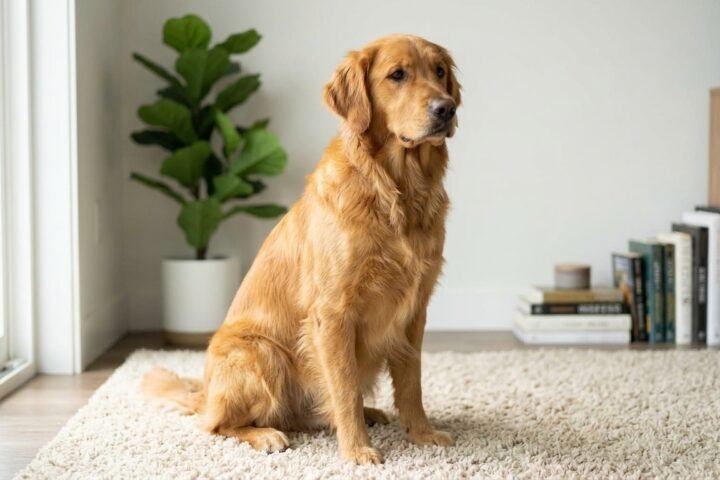
The best answer depends on your dog, the context, and the full pattern of behavior. Look at multiple signals rather than one isolated action.
Leaving your dog home alone is sometimes unavoidable. Work, appointments, errands, and family responsibilities can all mean spending part of the day away from your pet. But how long can you leave a dog home alone without causing unnecessary stress, accidents, or discomfort?
There is no single number that works for every dog. A young puppy may need a bathroom break after only a short time, while a healthy adult dog may comfortably handle several hours. Senior dogs, dogs with medical conditions, and dogs with separation-related distress may need even more frequent attention.
The goal isn’t to find the longest possible time your dog can tolerate. It’s to find a reasonable amount of alone time that fits your dog’s age, health, physical needs, temperament, and training.
In this guide, you’ll learn how long dogs can generally stay home alone by age, what changes those limits, how to recognize when your dog is struggling, and how to make alone time easier.
Table of Contents
How Long Can You Leave a Dog Home Alone?
For a healthy, well-adjusted adult dog, how long can you leave a dog home alone is often measured in several hours rather than an entire day.
A practical guideline is:
| Dog’s age or situation | General alone-time guideline |
|---|---|
| Under 10 weeks | About 1 hour |
| 10–12 weeks | About 2 hours |
| 3 months | About 3 hours |
| 4 months | About 4 hours |
| 5 months | About 5 hours |
| 6+ months | Around 5–6 hours, depending on the dog |
| Healthy adult | Often 4–6 hours comfortably |
| Healthy adult with good preparation | Up to 6–8 hours may be possible occasionally |
| Senior dog | Often needs shorter periods and more frequent breaks |
| Dog with separation-related distress | Duration should be based on the dog’s individual tolerance |
These are guidelines, not guaranteed limits.
The American Kennel Club gives a commonly used puppy guideline ranging from about one hour for puppies under 10 weeks to six hours around six months, while noting that even adult dogs generally should not be left without a bathroom opportunity for much longer than six to eight hours.
Veterinary guidance also emphasizes that individual differences matter. A dog’s age, health, behavior, and ability to remain comfortable alone should all be considered.
Most importantly, don’t confuse physical ability with emotional well-being.
A dog that can physically hold its bladder for six hours isn’t necessarily comfortable being alone for six hours every day.
How Long Can Puppies Be Left Alone by Age?
Puppies require the most careful planning because they are still developing bladder control, learning household rules, and becoming comfortable with separation from their people.
If you’re wondering how long can you leave a dog home alone when that dog is still a puppy, age should be one of your first considerations.
Puppies under 10 weeks
Very young puppies generally shouldn’t be expected to spend long periods alone.
At this stage, they need frequent bathroom opportunities, feeding, supervision, social interaction, and sleep. A puppy under 10 weeks may only be able to manage around an hour alone at a time.
If you need to be away longer, arrange for a trusted person to provide care rather than expecting a very young puppy to manage an extended absence.
Puppies from 10–12 weeks
Around this age, some puppies can begin working toward approximately two hours alone, provided they have already had positive experiences with short periods of separation.
Don’t jump immediately from 15 minutes to two hours.
Instead, gradually increase the duration while watching how your puppy responds.
Puppies around 3–4 months
A three-month-old puppy may manage around three hours, while a four-month-old may manage approximately four hours under favorable circumstances.
However, these numbers aren’t permission to leave every puppy alone for exactly that long.
Your puppy may need to go outside sooner, especially after eating, drinking, playing, or waking from a nap.
Puppies around 5–6 months
Older puppies generally have better bladder control and can gradually tolerate longer periods alone.
The AKC’s age-based guidance reaches approximately five hours at five months and six hours at six months, but it also emphasizes that puppies need exercise, bathroom breaks, and gradual preparation.
For a puppy approaching a normal workday, a midday visit is often a much better arrangement than expecting the puppy to remain alone for the entire day.
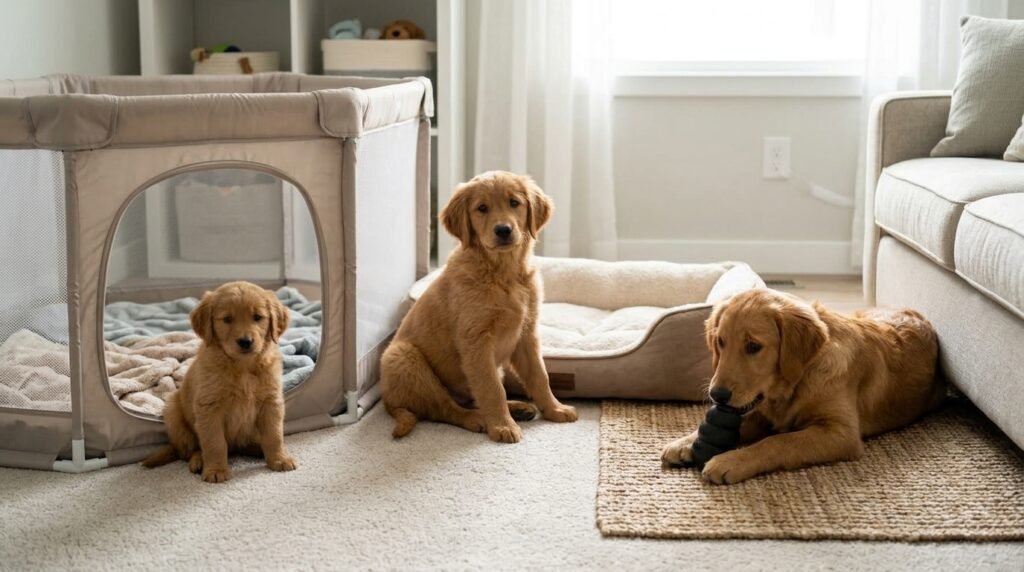
A simple puppy rule
A commonly used guideline is roughly one hour of bladder-holding ability per month of age, although individual puppies can vary.
Think of that as a rough biological guideline—not a target for daily isolation.
A puppy’s emotional development matters just as much as bladder control.
How Long Can Adult Dogs Stay Home Alone?
Once a dog is fully grown and comfortable being alone, the situation becomes more flexible.
Still, how long can you leave a dog home alone shouldn’t be answered solely by saying, “An adult dog can hold it for eight hours.”
A healthy adult dog may physically tolerate a longer period than a puppy, but that doesn’t mean spending most of every day alone is ideal.
For many healthy adult dogs, four to six hours is a reasonable comfortable range. Some well-adjusted dogs can manage six to eight hours, particularly when they have appropriate exercise, enrichment, a comfortable environment, and a reliable bathroom routine.
The important distinction is between:
- what a dog can tolerate occasionally
- what a dog experiences every day
- what the individual dog actually finds comfortable
Some dogs sleep much of the time while their owners are away. Others become restless, vocal, destructive, or distressed.
AKC behavior guidance recommends watching the dog’s actual behavior rather than assuming that a specific number of hours is suitable for every dog.
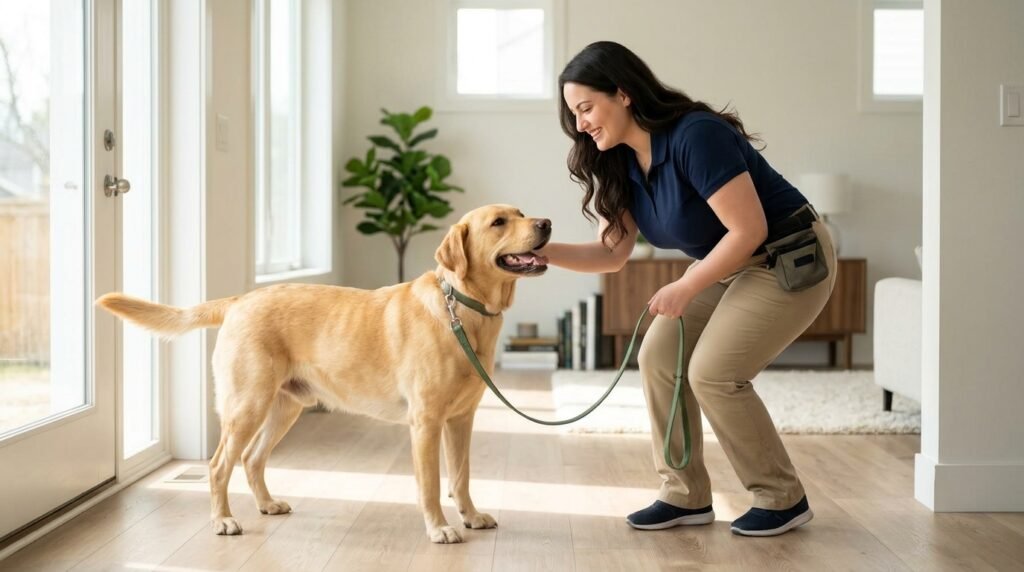
Can you leave an adult dog alone while you’re at work?
Sometimes, yes—but an eight-hour workday should not automatically mean eight uninterrupted hours alone.
A better workday routine may look like:
Morning: Bathroom break, exercise, breakfast, and interaction.
During the day: Dog remains in a safe environment with access to water and appropriate enrichment.
Midday: Dog walker, sitter, family member, or another bathroom and interaction break.
Evening: Exercise, training, play, companionship, and normal household interaction.
A midday break can make a major difference, particularly for dogs that don’t cope well with long periods alone.
What About Senior Dogs?
Senior dogs often require a more individualized approach.
An older dog may have spent years comfortably alone for several hours, but age-related changes can alter those needs.
Senior dogs may experience:
- More frequent urination
- Reduced bladder control
- Arthritis or mobility problems
- Increased thirst
- Medication schedules
- Changes in sleep
- Hearing or vision loss
- Cognitive changes
- Increased anxiety or confusion
For that reason, how long can you leave a dog home alone becomes less about age alone and more about the senior dog’s current health and daily routine.
A senior dog that still sleeps comfortably, eats normally, moves well, and remains relaxed while alone may manage several hours.
Another senior dog may need a bathroom break after only a couple of hours.
If your older dog suddenly begins having accidents, pacing, becoming confused, vocalizing, or struggling when left alone, speak with your veterinarian rather than assuming the behavior is simply old age.
What Factors Change How Long Your Dog Can Be Alone?
Age is important, but it isn’t the only factor.
1. Bladder and bowel needs
A dog that needs to urinate frequently cannot comfortably follow the same schedule as another dog.
Puppies, seniors, and dogs with certain health conditions may require more frequent bathroom breaks.
2. Health
Medical conditions can change how often a dog needs water, food, medication, exercise, or bathroom access.
A dog taking medication at specific times may also require a different schedule.
3. Temperament
Some dogs are naturally more independent. Others strongly prefer human company.
Breed tendencies can sometimes provide clues, but they should never be used as a substitute for observing your individual dog.
4. Exercise needs
A dog with significant unused physical energy may struggle more during a long period alone.
Appropriate exercise before you leave can help your dog settle, but exercise shouldn’t be viewed as a way to “wear out” an anxious dog.
5. Mental stimulation
Boredom can contribute to destructive behavior.
Food puzzles, safe chew items, and appropriate enrichment can give your dog something constructive to do while you’re away.
6. Previous experiences
A newly adopted dog may need time to understand that being left alone does not mean being abandoned.
Dogs that have experienced major changes in their environment or routine may also need a slower adjustment.
7. Training history
A dog that has gradually learned to relax alone may handle your absence much better than a dog that has always had someone nearby.
8. Access to a safe environment
A dog left loose in a thoroughly dog-proofed home has different options from a dog confined to a small crate for the entire absence.
A crate can be useful when properly introduced, but it should not become a way to confine a dog for excessive periods.
Is It Okay to Leave a Dog Alone for 8 Hours?
This is one of the most common versions of the question: how long can you leave a dog home alone if you work a full-time job?
An occasional eight-hour absence may be manageable for some healthy, well-adjusted adult dogs.
But eight uninterrupted hours should not automatically become the daily standard for every dog.
Consider:
- Has your dog been gradually taught to stay alone?
- Can your dog comfortably wait for a bathroom break?
- Does your dog remain relaxed?
- Does your dog have access to water?
- Is the environment safe?
- Does your dog receive enough exercise and attention outside those hours?
- Is your dog showing signs of distress?
- Can someone provide a midday break?
If you’re routinely gone for eight or more hours, consider arranging a dog walker, pet sitter, trusted family member, neighbor visit, or appropriate daycare.
The American Kennel Club specifically recommends getting a dog accustomed to being alone gradually and suggests help such as a dog walker when longer absences are unavoidable.
The goal isn’t to make your dog “tough enough” to tolerate an increasingly long absence.
The goal is to build a routine that works for both of you.
Signs Your Dog May Be Alone Too Long
Your dog can’t tell you directly that their schedule is uncomfortable, so you need to look for behavioral clues.
Potential warning signs include:
- Repeated barking or howling
- Destructive chewing
- Scratching doors or windows
- Pacing
- Drooling or excessive panting
- Repeated accidents indoors
- Escape attempts
- Refusing food while alone
- Excessive vocalization
- Restlessness
- Repetitive behaviors
- Extreme excitement or distress when you return
The ASPCA notes that barking, destructive behavior, house soiling, escape attempts, pacing, and other distress behaviors can occur with separation anxiety.
However, don’t automatically diagnose separation anxiety from one accident or a chewed shoe.
Destruction can also result from boredom, incomplete training, environmental stimulation, or normal exploratory behavior.
Merck Veterinary Manual similarly emphasizes that separation-related problems need to be distinguished from other causes of destructive behavior, house soiling, or anxiety.
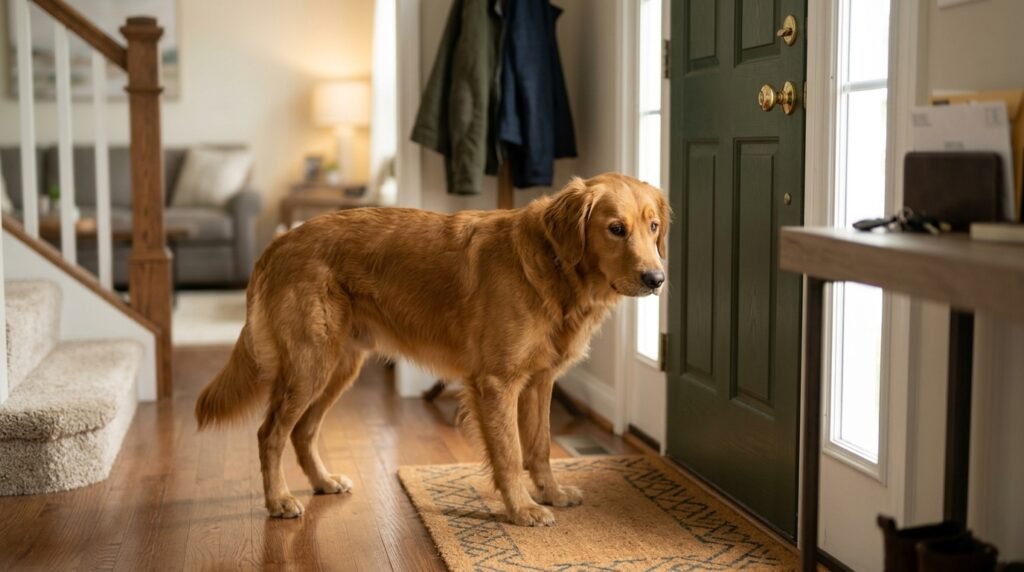
How can you know what your dog does while you’re gone?
A pet camera can be useful.
Your dog may appear perfectly calm when you leave but spend the next several hours pacing or barking.
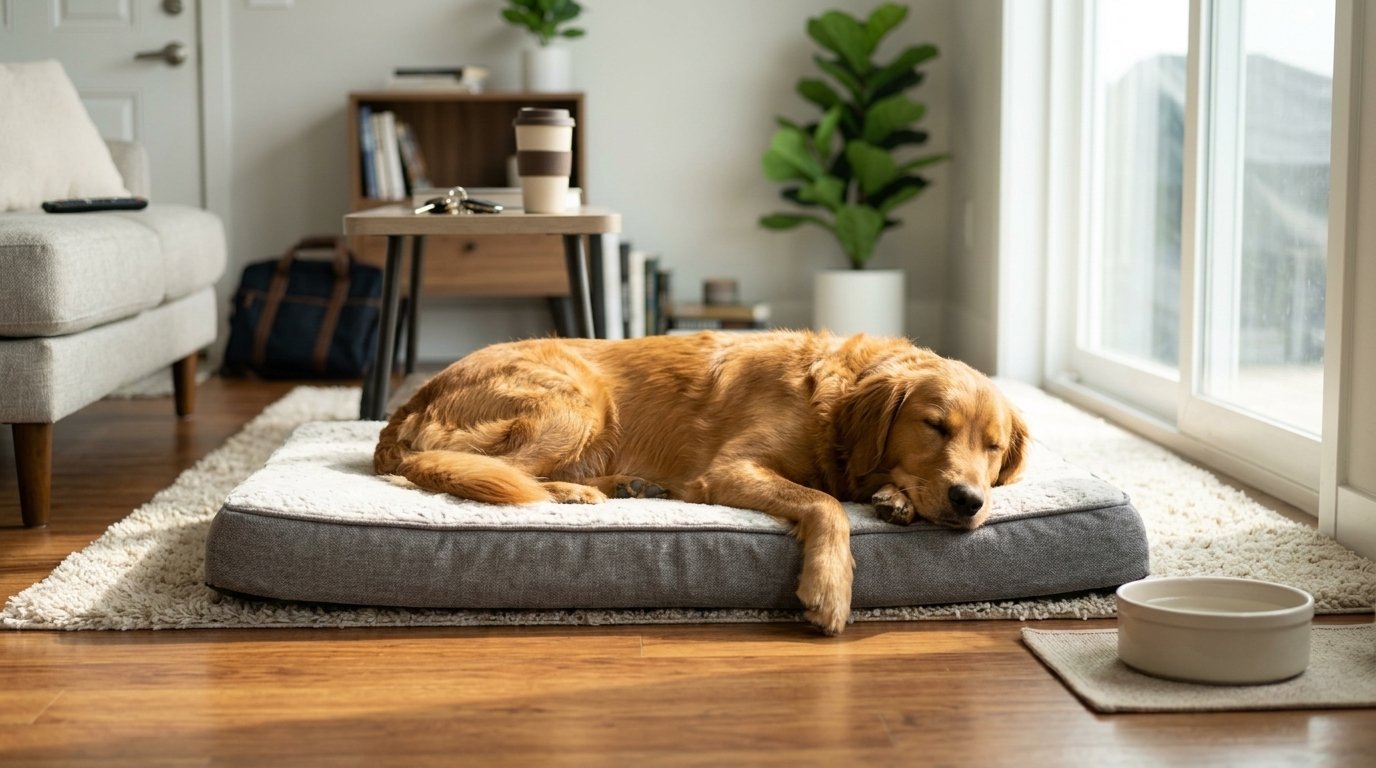
On the other hand, you may discover that your dog simply settles into their bed and sleeps.
Seeing what actually happens gives you much better information than guessing.
How to Help Your Dog Feel Comfortable Home Alone
The best approach is to teach alone time gradually instead of suddenly expecting a dog to handle a full workday.
1. Start with short absences
If your dog struggles when you leave, start below the point where they become distressed.
For some dogs, that may mean only a few minutes.
Gradually increase the duration when your dog remains relaxed.
The AKC recommends building alone time progressively rather than immediately expecting a puppy or inexperienced dog to tolerate long absences.
2. Create a predictable routine
Dogs often benefit from knowing what happens next.
A consistent pattern might be:
Wake up → bathroom → breakfast → walk → quiet time → owner leaves.
The exact schedule doesn’t have to be identical every day, but predictable routines can make departures less dramatic.
3. Exercise before leaving
Give your dog an appropriate opportunity to move, sniff, explore, and use the bathroom before you leave.
The goal isn’t to exhaust your dog completely.
It’s to satisfy normal physical and mental needs before a period of rest.
4. Provide safe enrichment
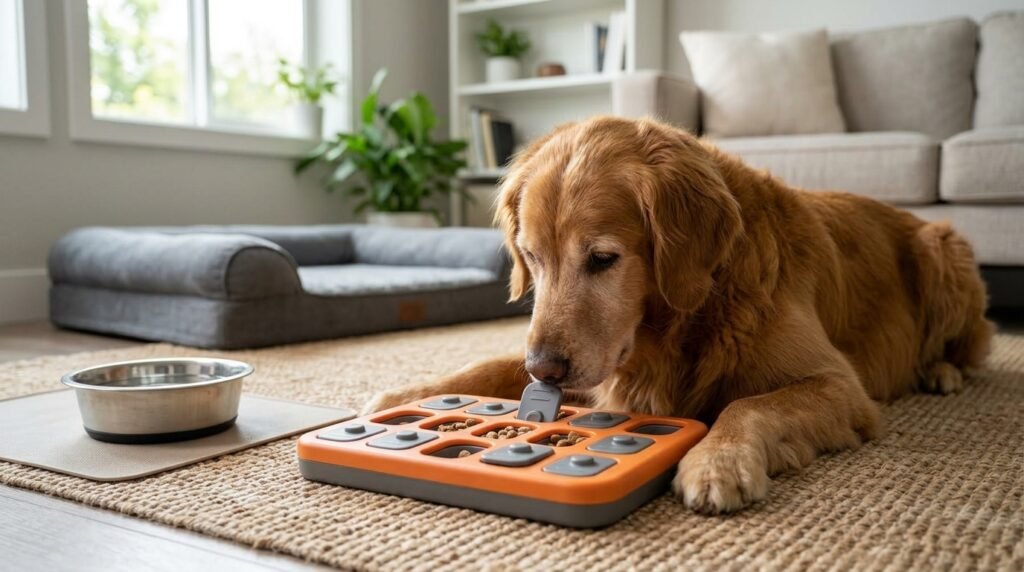
Depending on your dog’s habits and safety needs, consider:
- Food-stuffed toys
- Puzzle feeders
- Appropriate chew items
- Snuffle activities
- Rotated toys
- A comfortable resting area
Avoid leaving any toy or chew unattended if your dog has a history of destroying or swallowing pieces of it.
5. Keep departures calm
You don’t need a dramatic goodbye.
A simple, predictable departure can help prevent leaving and returning from becoming emotionally overwhelming events.
The AKC recommends calm departures and providing appropriate activities when dogs are left alone.
6. Don’t punish accidents after you return
If you come home to a mess, punishment won’t teach your dog why the accident happened.
If the behavior is caused by anxiety, punishment may make the situation worse.
Instead, determine why the problem occurred and adjust the dog’s schedule or seek professional help when necessary.
The ASPCA specifically advises against punishment for separation-related behaviors because these behaviors are distress responses rather than deliberate disobedience.
What to Do If You Have to Be Away Longer
Sometimes your schedule simply cannot change.
If you know you’ll be away longer than your dog can comfortably manage, plan for assistance before you leave.
Hire a dog walker
A midday walk can provide exercise, bathroom access, and human interaction.
Arrange a pet sitter
A sitter can be particularly useful for puppies, seniors, dogs taking medication, or dogs that struggle with long periods alone.
Ask family or a trusted neighbor
A reliable person can sometimes provide a quick bathroom break and companionship.
Consider daycare
Daycare can work for dogs that enjoy social environments and are appropriate candidates for group care.
It isn’t necessary for every dog, and some dogs may prefer a quiet home visit instead.
Adjust your work schedule when possible
If your workplace permits flexible hours or occasional remote work, even reducing the longest stretch alone can help.
Merck Veterinary Manual recommends minimizing alone time for dogs with separation-related distress and notes that dog sitters and daycare can be useful alternatives when owners cannot bring their dogs to work.
Frequently Asked Questions
How long can you leave a dog home alone during the day?
A healthy adult dog may often manage four to six hours comfortably, while some well-adjusted adults can tolerate six to eight hours. Puppies and senior dogs generally need more frequent breaks. The appropriate duration depends on the individual dog’s physical and emotional needs.
Can I leave my dog home alone for 8 hours?
Some healthy adult dogs can manage an eight-hour absence occasionally, but it shouldn’t automatically be treated as the ideal daily routine. A midday bathroom, exercise, or companionship break is preferable when possible.
How long can a puppy be left home alone?
Puppies need much shorter periods alone. A commonly used guideline is approximately one hour per month of age, although very young puppies may need even more frequent care. The puppy’s bladder control, training, and comfort with separation must all be considered.
How do I know if my dog is unhappy being left alone?
Watch for repeated barking, howling, pacing, destruction, house soiling, escape attempts, excessive drooling, or other distress behaviors that occur primarily when you’re gone. If these signs are persistent, discuss them with your veterinarian or a qualified behavior professional.
Conclusion
So, how long can you leave a dog home alone? The answer depends on much more than a number on the clock.
Puppies generally need frequent bathroom breaks and gradual alone-time training. Healthy adult dogs can usually handle longer periods, but several hours alone should still be balanced with exercise, companionship, enrichment, and bathroom opportunities. Senior dogs may need a shorter schedule because their health and mobility can change with age.
Most importantly, don’t use your dog’s maximum physical tolerance as the goal.
Pay attention to how your dog actually behaves when you’re away. If your dog is calm, comfortable, and appropriately cared for, your routine may be working well. If your dog repeatedly shows distress, accidents, destructive behavior, or escape attempts, it’s time to shorten the alone period and consider professional guidance.
A little planning—especially a midday break when needed—can make being home alone much easier for your dog and much less stressful for you.
Key Takeaways
- Consider the context around the behavior.
- Look for patterns instead of relying on one signal.
- Seek qualified help when behavior is sudden, severe, or unsafe.
Frequently Asked Questions
Is every behavior a sign of the same emotion?
Not necessarily. Dogs use combinations of signals, and context matters.
When should I contact a professional?
Consider veterinary or qualified behavior support for sudden, severe, escalating, or safety-related concerns.