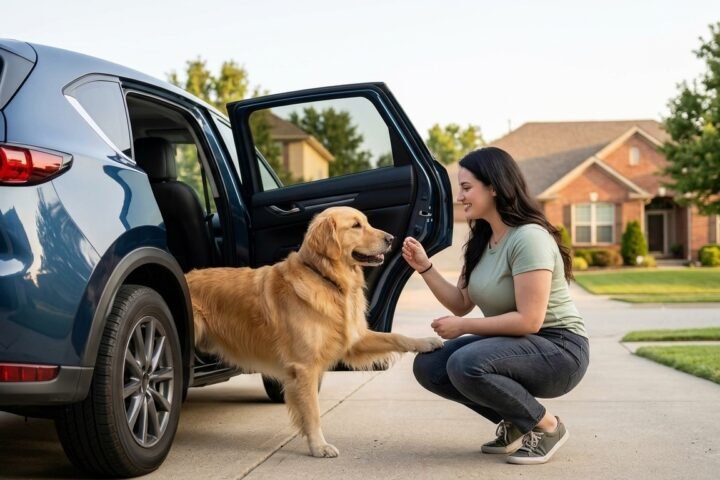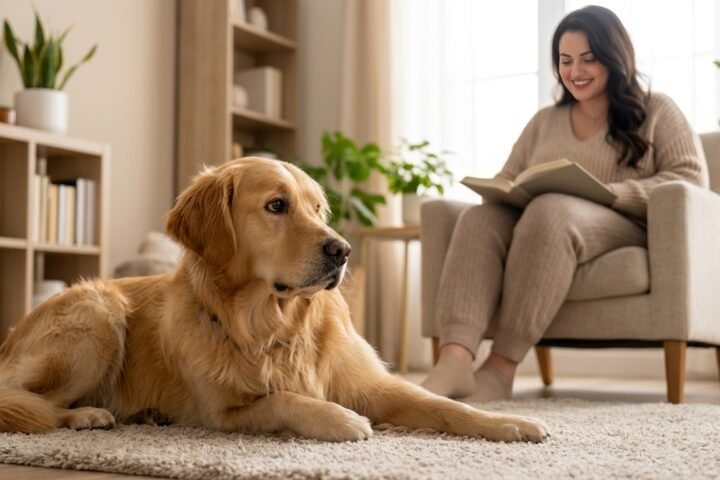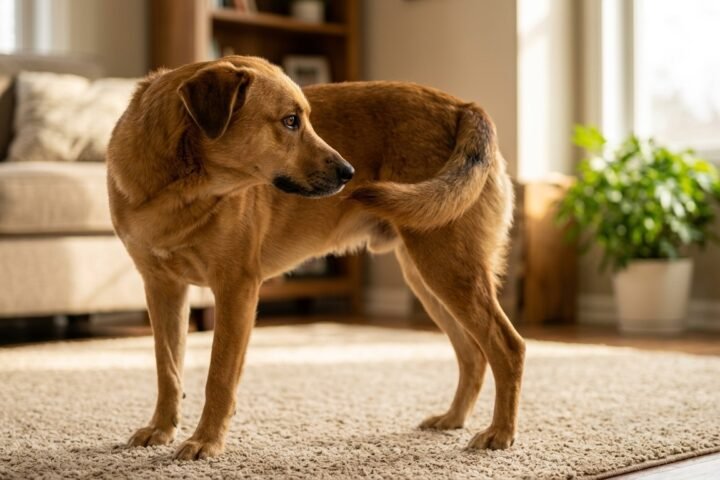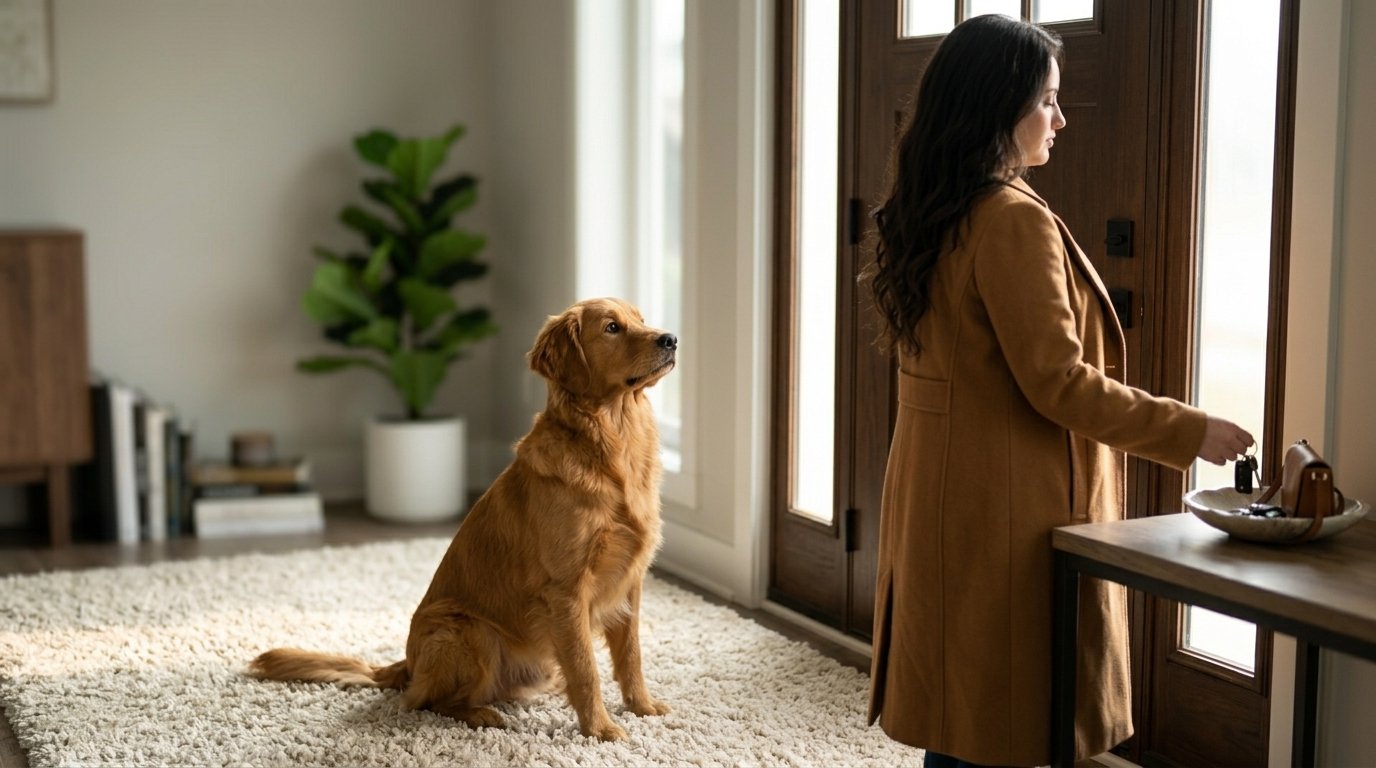
If your dog starts barking, pacing, scratching at the door, destroying furniture, or having accidents shortly after you leave, you may be dealing with more than boredom. Separation anxiety in dogs can cause intense distress when a dog is separated from an important person or left alone.
The difficult part is that these behaviors can look similar to ordinary chewing, incomplete house training, boredom, noise fear, or other behavioral problems. The timing and pattern are therefore extremely important.
In this guide, you’ll learn the 9 most common signs of separation anxiety in dogs, why it develops, how to tell it apart from other problems, and seven practical ways to help your dog become more comfortable when you’re away. You’ll also learn when veterinary or professional behavioral help is appropriate.
Table of Contents
What Is Separation Anxiety in Dogs?
Separation anxiety is a fear- or anxiety-related behavioral problem that occurs when a dog becomes distressed during or in anticipation of being separated from a particular person or being left alone.
The distress may begin before you even walk out the door.
For example, your dog may start pacing when you put on your shoes, follow you closely when you pick up your keys, or become restless when you walk toward the front door. Veterinary guidance from the Merck Veterinary Manual explains that separation-related distress can occur during or in anticipation of an owner’s absence.
Once the owner leaves, the dog may bark, howl, pace, scratch at doors, destroy objects, eliminate indoors, drool excessively, or become unable to settle.
Importantly, a dog that follows you around the house is not automatically suffering from separation anxiety. Merck notes that close attachment behaviors by themselves do not establish a diagnosis.
What matters is the overall pattern: Does your dog’s distress specifically increase when you are preparing to leave or when you are gone?
9 Signs Your Dog May Have Separation Anxiety
One symptom by itself does not prove that your dog has separation anxiety. However, several symptoms that repeatedly occur around your departures can be a strong reason to investigate further.
1. Excessive Barking, Whining, or Howling
Persistent vocalization is one of the most noticeable signs.
A dog with separation-related distress may bark, whine, or howl soon after you leave. Some dogs may continue vocalizing for a substantial portion of the absence.
The timing is important.

If your dog only barks when a delivery driver walks past the house, the behavior may have nothing to do with separation. But if your dog begins vocalizing immediately after the front door closes, separation-related distress becomes more likely.
According to the American Animal Hospital Association (AAHA), excessive vocalization such as barking, whining, and howling can be among the signs of separation anxiety in pets.
2. Destructive Chewing or Scratching
Destructive behavior is another common warning sign.
Your dog may chew:
- Door frames
- Windowsills
- Furniture
- Carpets
- Personal belongings
- Crates or barriers
Dogs experiencing separation distress may concentrate destructive behavior around exits because they are attempting to regain access to their owner.
This is different from a puppy randomly chewing furniture because it is exploring its environment.
If the destruction happens almost exclusively when you’re away, take note of the timing.
3. Pacing and Inability to Settle
Some dogs do not destroy anything. Instead, they spend their time pacing.
They may walk from room to room, repeatedly check the door, circle around the house, or change positions without ever appearing comfortable.
Merck identifies pacing, restlessness, and inability to settle among the clinical signs associated with separation distress.
A dog that normally naps for several hours but suddenly spends your absence pacing should not simply be labeled “naughty.”
The inability to relax can be a much more useful clue than destruction alone.
4. Potty Accidents While You’re Away
A previously house-trained dog that suddenly urinates or defecates when left alone may be experiencing separation-related distress.
However, this symptom requires caution.
Medical conditions can also cause changes in bathroom habits. That’s why a veterinarian should be involved when house-soiling appears suddenly or without an obvious explanation.
The Merck Veterinary Manual’s guidance on diagnosing behavior problems emphasizes that veterinarians should first consider possible health problems that could cause behavioral changes.
So don’t assume every accident is anxiety.
Look at the entire pattern.
5. Excessive Panting, Drooling, or Trembling
An anxious dog may show physical signs of stress while alone.
These can include:
- Heavy panting
- Excessive drooling
- Trembling
- Restlessness
- Rapid movement around the house
- Heightened alertness
- Difficulty relaxing
These signs are not unique to separation anxiety.
Heat, pain, illness, noise fear, and other forms of anxiety can produce similar behaviors. That’s why context matters.
If your dog suddenly begins panting heavily when alone, especially if this is accompanied by vomiting, weakness, breathing difficulty, or other physical symptoms, contact your veterinarian rather than assuming the cause is behavioral.
6. Escape Attempts
Some dogs become so distressed that they try desperately to get back to their owners.
You may notice:
- Scratching at doors
- Chewing through barriers
- Digging at windows
- Breaking through gates
- Trying to escape a crate
- Damaging walls near exits
This behavior can be particularly dangerous.
A dog that repeatedly attempts to escape may break teeth, damage nails, injure paws, or suffer other injuries.
If your dog is physically hurting itself while you’re away, this is no longer simply a nuisance behavior. Safety should become a priority.
7. Anxiety Before You Leave
Some dogs become distressed before the actual departure.
Your dog may suddenly follow you around when you:
- Pick up your keys
- Put on your shoes
- Grab your work bag
- Put on a jacket
- Walk toward the garage
- Approach the front door
These behaviors can be especially revealing because they show that your dog has learned to associate certain events with your upcoming absence.
Merck notes that some dogs show signs even while their owners are preparing to leave, including responses to cues such as putting on shoes, grabbing keys, or going to the door.
8. Extremely Intense Greetings When You Return
A dog that is happy to see you is perfectly normal.
But some dogs become unusually frantic when their owner returns.
They may jump excessively, whine, bark, lick intensely, race around the room, or struggle to calm down.
An excited greeting alone does not establish separation anxiety. However, when an exaggerated greeting occurs together with significant distress during your absence, it can become part of the overall picture.
The Merck Veterinary Manual identifies exaggerated greeting behavior as part of the clinical picture that can accompany separation distress.
9. Refusing Food When Alone
This sign is easy to overlook.
Many owners assume that leaving a stuffed food toy or favorite treat will automatically keep an anxious dog occupied.
But a highly distressed dog may refuse food altogether.
If your dog happily eats a favorite chew while you are home but completely ignores it after you leave, that can provide useful information about the dog’s emotional state.
Food enrichment can be helpful for some dogs with mild separation-related problems, but it should not be treated as a universal solution.
Why Do Dogs Develop Separation Anxiety?
There is no single explanation for why a particular dog develops separation-related distress.
Individual temperament, fear and anxiety, environmental changes, previous experiences, routine changes, and other factors can contribute.
A 2026 study published in the Journal of Veterinary Behavior examined separation-related problems in 730 dogs and found that fear and anxiety-related characteristics were particularly important predictors.
Several situations can make separation problems more likely or cause them to become noticeable.
Major Changes in Routine
A dog that previously had someone home most of the day may struggle when that schedule suddenly changes.
Examples include:
- Returning to an office job
- Starting school
- Changing work hours
- Moving to a new schedule
- Spending significantly less time at home
The dog may not understand why its familiar routine has suddenly disappeared.
Moving to a New Home
A new home introduces unfamiliar smells, sounds, rooms, neighbors, and routines.
Some dogs adjust quickly, while others become more dependent on their owners during the transition.
If separation problems appear after moving, maintaining a predictable routine can help the dog regain a sense of security.
Loss of a Person or Animal
Losing a family member or animal companion can dramatically change a dog’s daily social environment.
A dog that previously spent time with another household member may suddenly find itself alone for longer periods.
That change can reveal separation-related problems that weren’t previously obvious.
Long Periods of Constant Companionship
Another common situation occurs when a dog becomes accustomed to having its owner around almost constantly.
For example, a person may work from home for months and then suddenly return to full-time office work.
The dog hasn’t necessarily “become spoiled.”
Instead, its normal routine has changed dramatically.
This is one reason gradual independence training can be useful before a major schedule change occurs.
Is It Separation Anxiety or Something Else?
This is one of the most important questions to answer.
A dog that destroys your sofa while you’re gone could have separation anxiety.
But it could also be bored.
A dog that urinates indoors could be anxious.
But it could also have a medical problem.
A dog that barks at the window could be distressed by your absence.
But it could also be reacting to people, animals, traffic, or other environmental triggers.
Merck specifically notes that diagnosing separation distress requires excluding other possible causes, including incomplete house training, exploratory behavior, external stimuli, noise aversion, and confinement anxiety.
Ask These Questions
Before assuming the diagnosis, ask:
- Does the behavior happen specifically when my dog is alone?
- Does it begin soon after I leave?
- Does my dog show anxiety while I prepare to leave?
- Does my dog remain calm if another person stays home?
- Does the behavior also occur when I’m present?
- Does my dog react to outside noises?
- Can my dog eat normally while alone?
- Does the behavior happen in a crate but not when loose?
- Did the problem begin suddenly?
- Are there any new physical symptoms?
A camera can be one of the most useful tools for answering these questions.
You don’t have to guess what your dog does for two hours after you leave.
A simple home pet camera can show whether your dog settles, sleeps, paces, vocalizes, reacts to outside noises, or becomes distressed almost immediately.
Merck describes video recording as an invaluable diagnostic tool for observing behavior that occurs when owners are absent.
7 Ways to Help a Dog With Separation Anxiety
Helping an anxious dog is usually a gradual process.
The goal isn’t to force your dog to tolerate a long absence. Instead, you want to create repeated experiences in which being alone remains manageable.
1. Prevent Long Periods of Panic
One of the most important principles is to reduce repeated episodes of severe distress while you’re working on the problem.
If your dog becomes extremely anxious after five minutes, repeatedly leaving for three hours gives your dog many opportunities to rehearse that panic.
Whenever practical, consider temporary management such as:
- A trusted pet sitter
- A family member
- A dog walker
- Appropriate daycare
- A trusted friend
- Bringing your dog with you when possible
Merck recommends leaving dogs with separation anxiety alone as rarely as possible during treatment because repeated distress can make the problem more difficult to manage.
Management is not a replacement for training.
It simply reduces unnecessary panic while you work on the underlying problem.
2. Build a Predictable Daily Routine
Dogs often benefit from predictable routines.
Try to provide consistent opportunities for:
- Exercise
- Meals
- Bathroom breaks
- Training
- Play
- Rest
- Independent activities
This doesn’t mean every activity must happen at exactly the same minute.
Instead, your dog should have a reasonably predictable rhythm.
Appropriate physical activity can also help your dog settle more comfortably. If you’re unsure whether your dog’s daily activity level is appropriate, see our guide on how much exercise your dog needs before increasing exercise simply to tire your dog out.
3. Reward Calm Independence
You don’t have to wait until you’re leaving the house to work on independence.
Start while you’re still home.
If your dog chooses to lie on its bed instead of following you from room to room, calmly reward that relaxed behavior when appropriate.
You can also practice short periods in which your dog remains comfortable while you move around the home.
The goal is to teach:
“I can relax even when my person isn’t right beside me.”
This is different from ignoring your dog.
You’re actively reinforcing a useful emotional and behavioral skill.
4. Make Departures Calm and Predictable
Many dogs learn that certain departure cues predict a long absence.
Keys come out.
Shoes go on.
The owner grabs a bag.
The door opens.
And the dog’s anxiety rises.
Keep the actual departure routine calm and predictable.
You can also practice harmless versions of departure cues while staying home. For example, pick up your keys and then sit down. Put on your shoes and continue doing something around the house.
The goal is to make those cues less emotionally dramatic.
5. Use Food Toys and Enrichment Strategically
A stuffed food toy, puzzle feeder, or safe long-lasting chew can give your dog something constructive to do.
These tools can be particularly useful when paired with relaxation training.
But enrichment should not be expected to “cure” severe separation anxiety.
If your dog is too distressed to eat, the problem is probably beyond what a simple food puzzle can solve.
In mild cases, however, special food-based activities can help create positive associations with independent time.
6. Be Careful With Crate Training
A crate can be a comfortable safe space for a dog that already enjoys being there.
But it is not automatically the right solution for separation anxiety.
If your dog has confinement anxiety, forcing it into a crate while you’re away may increase distress and create a dangerous escape attempt.
Watch your dog’s behavior.
If your dog calmly rests in the crate, that’s very different from a dog that bites the bars, throws itself against the door, screams, or attempts frantic escape.
If you’re unsure, ask your veterinarian or qualified behavior professional about the safest setup.
7. Use Gradual Departure Training
For many dogs, gradual departure training is one of the most important parts of treatment.
The basic principle is simple:
Start below your dog’s anxiety threshold and increase the duration slowly.
Suppose your dog begins pacing after 30 seconds.
Starting with a five-minute absence is not a good training exercise.
Instead, begin with a duration your dog can handle comfortably.
Then repeat successful experiences before making the absence slightly longer.
The exact progression will differ from dog to dog.
Merck’s current guidance recommends simulated absences that remain short enough not to trigger anxiety and notes that graduated departure programs can take months to complete.
A Simple Graduated-Departure Training Plan
Here’s what the process can look like.
Step 1: Find Your Dog’s Threshold
Use a camera if possible.
Determine when your dog first begins showing signs of anxiety.
That might be:
- 10 seconds
- 30 seconds
- 1 minute
- 5 minutes
- Or longer
Your starting point should be comfortably below the point where distress begins.

Step 2: Practice Very Short Absences
Leave briefly and return before your dog becomes anxious.
The purpose is to create successful repetitions.
You’re not testing your dog.
You’re teaching your dog.
Step 3: Increase Gradually
If your dog remains relaxed during several repetitions, increase the duration slightly.
Avoid making large jumps.
Going from 30 seconds to 10 minutes because the previous attempt went well can be too much.
Step 4: Monitor Body Language
Don’t focus only on barking.
Watch for:
- Pacing
- Panting
- Restlessness
- Lip licking
- Drooling
- Scratching
- Repeated door checking
- Refusing food
- Inability to lie down
A dog doesn’t have to bark to be anxious.
Step 5: Reduce the Duration After a Setback
If your dog becomes anxious at a particular duration, don’t push harder.
Return to a shorter duration that was successful.
Then build again more gradually.
The objective is consistent calm behavior, not simply reaching a larger number of minutes.
When Should You See a Veterinarian?
Some cases can be managed with carefully planned training and environmental changes.
Others need professional help.
You should speak with your veterinarian if:
- The behavior appeared suddenly
- Your dog has unexplained house-soiling
- Your dog refuses food
- Your dog vomits when left alone
- Your dog injures itself
- Your dog repeatedly attempts dangerous escapes
- Your dog becomes severely distressed within minutes
- The problem is getting worse
- Your training attempts aren’t helping
- You cannot safely leave your dog alone
A veterinarian can help rule out medical problems and determine whether your dog’s behavior requires a more comprehensive treatment plan.
For moderate or severe cases, medication may sometimes be used alongside behavior modification.
Current Merck guidance notes that fluoxetine and clomipramine are FDA-approved in the United States for canine separation anxiety when used with an appropriate behavioral treatment program.
In May 2026, the U.S. Food and Drug Administration also announced approval of tasipimidine oral solution (Tessie) for treatment of noise aversion and separation anxiety in dogs.
This does not mean medication is necessary for every dog.
Medication decisions should be made by a veterinarian based on the dog’s individual symptoms, health, severity, and treatment plan.
Why Punishment Usually Makes the Problem Worse
One of the biggest mistakes owners can make is punishing a dog for behavior that happened while the owner was away.
Imagine coming home to a destroyed door.
You are angry.
Your dog is already overwhelmed.
Punishing the dog afterward doesn’t teach the dog how to calmly handle your absence.
Instead, punishment can add another negative experience to an already stressful situation.
Veterinary behavior guidance emphasizes management and reinforcement-based behavior modification for fear- and anxiety-related problems. Merck also notes that flooding is generally avoided because it can make fearful animals worse.
So avoid:
- Yelling
- Hitting
- Rubbing a dog’s nose in an accident
- Punishing destruction after the fact
- Deliberately leaving the dog alone for hours to “get used to it”
The goal is to reduce fear, not increase it.
Can You Prevent Separation Anxiety in Dogs?
You cannot guarantee that a dog will never develop separation-related distress.
However, you can build healthy independence from an early age.
For puppies and newly adopted dogs, gradually introduce comfortable periods of alone time.

Useful habits include:
- Rewarding calm independent behavior
- Providing appropriate exercise
- Using positive reinforcement
- Maintaining a predictable routine
- Practicing short departures
- Providing safe enrichment
- Avoiding sudden dramatic changes whenever possible
- Monitoring your dog during major schedule changes
The goal is not to make your dog less attached to you.
It’s to help your dog understand that your absence is temporary and manageable.
Frequently Asked Questions
Can separation anxiety in dogs develop suddenly?
Yes. A dog may appear comfortable being alone for years and then develop separation-related problems after a significant change in routine, environment, household members, or other stressful event. A sudden behavioral change should also prompt consideration of medical causes.
How long can a dog with separation anxiety be left alone?
There is no single safe number of hours that applies to every dog with separation anxiety. The important question is how long the individual dog can remain comfortable without showing distress. During treatment, absences should generally stay below the dog’s anxiety threshold whenever possible.
Will getting another dog fix separation anxiety?
Not necessarily. Some dogs are distressed specifically by separation from a particular human caregiver, so another dog may not solve the underlying problem. A second pet should never be treated as a guaranteed treatment for separation anxiety.
How long does it take to treat separation anxiety in dogs?
Treatment time varies considerably. Mild cases may progress more quickly, while moderate or severe cases can require a long-term behavior plan. Merck notes that graduated departure programs can take months to complete.
Conclusion
Separation anxiety in dogs is not simply bad behavior.
For an anxious dog, your departure can trigger genuine fear or distress. Barking, pacing, destruction, accidents, escape attempts, excessive panting, and frantic greetings can all be clues—but they need to be interpreted in context.
Start by observing what happens before, during, and after your departure. Use a camera if possible, rule out medical causes when appropriate, reduce unnecessary episodes of panic, and build alone-time tolerance gradually.
Most importantly, don’t punish your dog for behavior caused by distress.
If the anxiety is severe, your dog is injuring itself, or your training attempts are not progressing, involve your veterinarian or a qualified veterinary behavior professional. With the right combination of management, behavior modification, and professional support when needed, many dogs can become substantially more comfortable spending time alone.