
Good dog dental care is about much more than keeping your dog’s breath fresh. Plaque can build up on the teeth, harden into tartar, irritate the gums, and contribute to periodontal disease. Once dental disease becomes advanced, it can cause pain, tooth loss, and damage to the tissues supporting the teeth.
The good news is that a consistent routine can make a major difference. Regular toothbrushing is one of the most effective ways to control plaque at home, while appropriate dental products and veterinary examinations can provide additional protection.
This guide explains the most practical ways to protect your dog’s teeth, how to start brushing if your dog dislikes it, which dental products deserve consideration, and which signs mean it is time to call your veterinarian.
Table of Contents
Why Dog Dental Care Matters
Your dog uses its mouth every day for eating, playing, exploring, and communicating. That constant use also exposes the teeth and gums to bacteria and food debris.
Dental disease generally begins with plaque, a bacterial film that develops on the teeth. If plaque is not regularly removed, it can contribute to inflammation around the gums. Over time, mineralization can turn plaque into tartar, also called calculus.
Tartar is much harder to remove than soft plaque. It can also contribute to an environment where bacteria accumulate around and below the gumline.
According to the Merck Veterinary Manual, periodontal disease is one of the major causes of tooth loss in dogs because damage can eventually affect the tissues and bone that support the teeth.
This is why dog dental care should not be treated as something you only address when your dog develops bad breath.
A better approach is prevention.
Dental health starts at home
Home care is important because plaque can begin accumulating again after the teeth have been cleaned. AAHA recommends daily brushing as the best way to help reduce plaque accumulation, alongside other appropriate dental-care measures.
However, home care does not replace veterinary dentistry. Brushing helps control plaque on accessible tooth surfaces, but it cannot provide the same examination, dental radiographs, or cleaning below the gumline that a veterinary dental procedure can provide.
How Plaque and Tartar Affect Dogs
It helps to understand the difference between plaque and tartar.
Plaque is a soft bacterial film that develops on the teeth. Because it is relatively soft, mechanical cleaning such as brushing can help remove it.
Tartar, or calculus, forms when plaque mineralizes. Once firmly attached, it generally cannot be removed effectively with ordinary brushing at home.
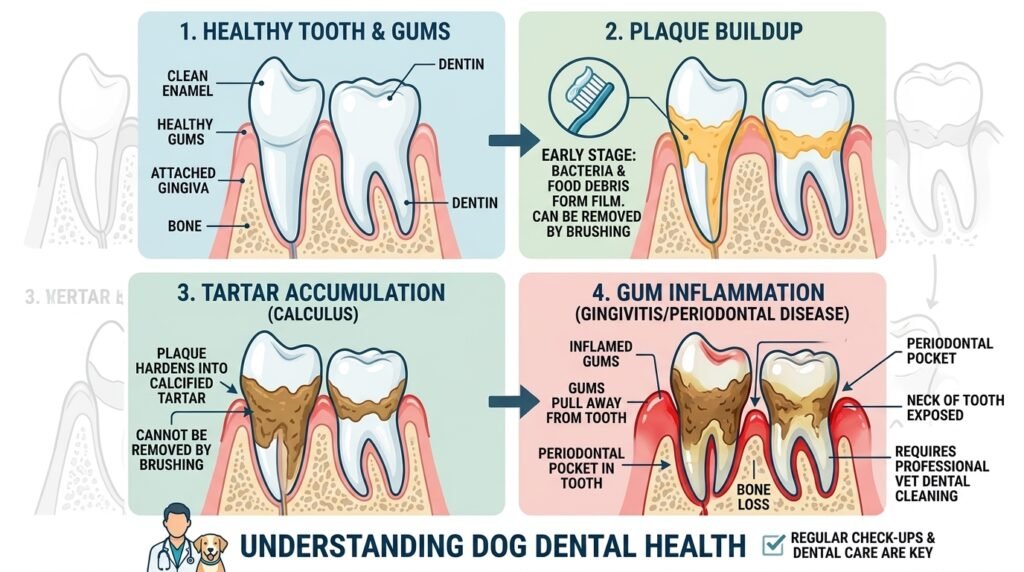
The progression can look roughly like this:
Plaque → gum inflammation → tartar/calculus → periodontal disease → tissue and bone damage
Not every dog progresses at the same speed. Age, breed, genetics, oral anatomy, and individual dental-care habits can influence risk. Small dogs, in particular, can be more prone to periodontal problems.
That is why starting a dental routine early is valuable.
9 Ways to Improve Your Dog’s Dental Health
1. Brush Your Dog’s Teeth Regularly
Brushing is the foundation of effective dog dental care.
A dog-specific toothbrush or appropriately sized soft-bristled brush can help mechanically remove plaque from the tooth surfaces. Use toothpaste formulated specifically for dogs, rather than ordinary human toothpaste. Veterinary guidance warns against using human toothpaste because some formulations can contain ingredients that are unsafe when swallowed by pets.
Daily brushing is ideal when your dog accepts it, although consistent brushing several times a week is still more realistic for many households.
The key is consistency.
A two-minute brushing session once every few months is not an effective dental routine. A short, calm session performed regularly is much more useful.
2. Introduce Brushing Gradually
If your dog has never had its teeth brushed, do not immediately force a toothbrush into its mouth.
Instead, break the process into small steps.
Start by allowing your dog to investigate the toothbrush. You can then let your dog taste a small amount of dog-safe toothpaste.
Once your dog is comfortable, gently touch the lips and teeth with your finger before progressing to the brush.
A simple progression is:
- Touch your dog’s cheek and lips.
- Reward calm behavior.
- Let your dog taste the toothpaste.
- Touch the teeth gently with your finger.
- Introduce the toothbrush.
- Brush for only a few seconds at first.
- Gradually increase the brushing time.
- Reward your dog after each successful session.
This approach makes dog dental care feel like a predictable routine rather than a struggle.
If your dog becomes frightened, highly resistant, or attempts to bite, stop rather than forcing the procedure.
3. Focus on the Outside Surfaces of the Teeth
You do not need to create a complicated dental routine.
For many dogs, concentrating on the outer surfaces of the teeth—particularly where the teeth meet the gums—is a practical starting point.
PetMD recommends working through the mouth in sections and focusing on the outward-facing surfaces.
Use gentle movements rather than aggressively scrubbing.
Your goal is to remove plaque without irritating the gums or making your dog fearful of future brushing.
Safe Flea and Tick Treatment for Dogs: 7 Ways to Reduce Risk
4. Choose Dental Products With Evidence Behind Them
The dental aisle can be confusing. You may see:
- Dental chews
- Dental diets
- Toothpastes
- Water additives
- Dental powders
- Oral gels
- Dental wipes
Not every product has the same level of evidence.
One useful starting point is the Veterinary Oral Health Council (VOHC). VOHC reviews submitted evidence against its standards and awards its Seal of Acceptance to products that demonstrate efficacy for plaque, tartar, or both.
Its current accepted-products list includes dental diets, edible chews, water additives, oral gels, toothpastes, toothbrushes, and wipes for dogs.
That does not mean a VOHC-accepted product replaces brushing or veterinary care. Instead, it gives owners a more evidence-based way to evaluate supplemental dental products.
5. Consider Dental Chews
Dental chews can provide mechanical action as a dog chews.
The 2025 Journal of Veterinary Dentistry study found that a daily dental chew tested in dogs without initial professional scaling could partly reduce dental deposits.
However, a dental chew should be considered part of a dental routine rather than a universal replacement for brushing.
When choosing one, look for an appropriate size and follow the manufacturer’s feeding instructions. VOHC acceptance can also be a useful screening criterion.
Always supervise your dog with chews and choose products appropriate for the dog’s size and chewing habits.
6. Ask Your Veterinarian About Dental Diets
Some specially formulated dental diets are designed to help reduce plaque or tartar through the way the food interacts mechanically with the teeth and through specific formulations.
VOHC’s current dog-product list includes several dental diets with plaque or tartar claims.
A dental diet may be especially worth discussing with your veterinarian if your dog is prone to dental problems or refuses toothbrushing.
However, do not switch a dog with specific nutritional or medical requirements to a new diet without considering its overall nutritional needs.
7. Consider Water Additives or Other Supplemental Care
Water additives can be another option for owners whose dogs resist brushing.
The evidence is product-specific rather than a blanket endorsement of every water additive. The 2025 study found that one tested water additive appeared more useful when combined with another mechanical home-care method, rather than functioning as a complete replacement for mechanical cleaning.
That is an important distinction.
A water additive may complement your dog’s routine, but it should not create a false sense that brushing and veterinary dental care are unnecessary.
If you choose one, follow the label directions and consider products with appropriate veterinary evidence, including those listed by VOHC.
8. Check Your Dog’s Mouth Regularly
You do not need to perform a professional dental examination at home.
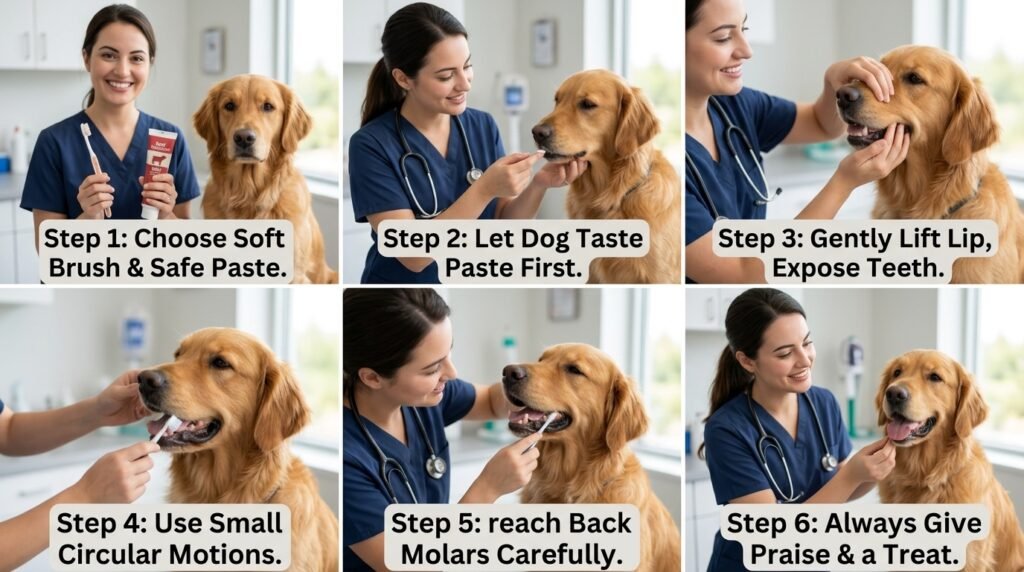
Instead, make a quick visual check part of your routine.
Look for:
- Red or swollen gums
- Visible tartar
- Bleeding around the gums
- Persistent bad breath
- Excessive drooling
- Difficulty chewing
- Dropping food
- Chewing on one side
- Reluctance to eat hard food
- Loose or damaged teeth
- Swelling around the mouth
Bad breath should not automatically be dismissed as normal “dog breath.” AAHA identifies bad breath as a common early sign of dental disease.
If something looks abnormal, arrange a veterinary dental examination rather than attempting to scrape tartar off yourself.
9. Keep Regular Veterinary Dental Examinations
Even excellent home dog dental care cannot replace professional assessment.
A veterinarian can examine areas that are difficult for owners to evaluate and determine whether your dog has gingivitis, periodontal disease, fractured teeth, loose teeth, or other oral problems.
When a professional dental procedure is needed, veterinary teams can use anesthesia to safely examine the mouth, take dental radiographs when indicated, and clean areas that cannot be properly reached while a dog is awake. AAHA notes that anesthesia is necessary for thorough veterinary dental evaluation and cleaning because veterinarians cannot safely perform complete radiographic and subgingival procedures on an awake dog.
Professional care is therefore not a failure of home care.
It is one part of a complete dental-health strategy.
How to Brush Your Dog’s Teeth Step by Step
If your dog is comfortable with handling, you can gradually build a toothbrushing routine.
Step 1: Choose the right supplies
You will generally need:
- A dog toothbrush or soft-bristled brush
- Dog-safe toothpaste
- A few small rewards
Avoid human toothpaste unless your veterinarian specifically directs you otherwise. Dogs swallow toothpaste rather than reliably spitting it out, which makes ingredient safety important.
Step 2: Pick a calm time
Do not attempt the first brushing session when your dog is excited, tired from stressful activity, or already resisting handling.
Choose a quiet moment when your dog is relaxed.
Step 3: Start small
At first, brushing only a few teeth for several seconds may be enough.
Reward cooperation.
Over several sessions, gradually work toward brushing more of the mouth.
Step 4: Use gentle movements
Place the brush along the outside of the teeth near the gumline and use gentle strokes.
There is no benefit to aggressively scrubbing.
Step 5: Build consistency
The long-term goal is regular brushing.
If daily brushing is practical and your dog accepts it, that is excellent. If your schedule makes daily brushing difficult, create a realistic routine you can actually maintain and discuss additional dental-care options with your veterinarian.
Research has shown that regular home-care protocols can help reduce dental deposits, although the appropriate approach depends on the dog’s existing oral-health status.
Dental Chews, Diets, and Water Additives: What Actually Helps?
These options can be confusing because they are often marketed as complete dental solutions.
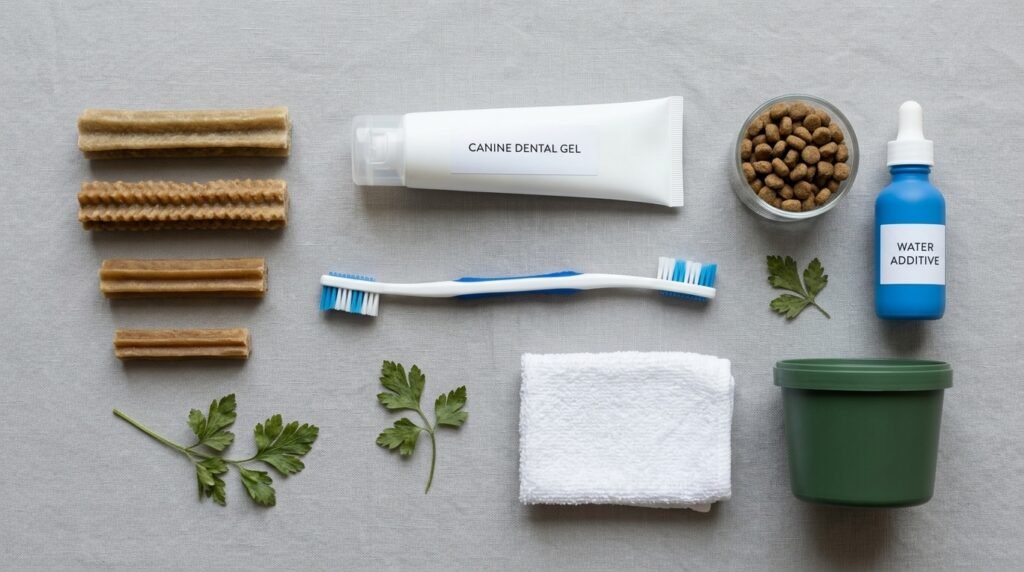
A better way to think about them is as supporting tools.
| Dental option | Main role | Should it replace brushing? |
|---|---|---|
| Toothbrushing | Mechanical plaque removal | No |
| Dental chews | Mechanical cleaning during chewing | No |
| Dental diets | Support plaque/tartar control | No |
| Water additives | Supplemental oral care | No |
| Dental powders | Supplemental care | No |
| Professional cleaning | Removes established dental deposits and permits veterinary examination | No—this complements home care |
The exact effectiveness varies by product.
VOHC’s accepted-product database is useful because it identifies products that have met its requirements for plaque and/or tartar-control claims.
The most important point is not to turn dental care into a product-shopping exercise.
A good routine can be simple:
Brush regularly + use appropriate supplemental care + monitor the mouth + maintain veterinary dental examinations.
Signs Your Dog May Have Dental Disease
Dogs do not always make dental pain obvious.
The 2025 research literature notes that dogs with moderate or even severe periodontal disease may continue eating until more obvious signs such as bad breath or dental pain appear.
That means owners should pay attention to subtle changes.
Potential warning signs include:
Persistent bad breath
A consistently unpleasant odor may indicate oral disease rather than ordinary dog breath.
Red or bleeding gums
Healthy gums should not routinely appear swollen or bleed during normal handling.
Difficulty eating
Watch for chewing changes, dropping food, eating more slowly, or avoiding certain textures.
Excessive drooling
New or unexplained drooling can have several causes, including oral discomfort.
Facial swelling
Swelling around the mouth or face warrants veterinary attention.
Loose or broken teeth
Do not attempt to remove or manipulate a loose tooth yourself.
Behavior changes
A dog that suddenly becomes reluctant to have its face touched may be experiencing discomfort.
If you notice significant pain, facial swelling, bleeding, difficulty eating, or other concerning symptoms, contact your veterinarian promptly.
When Does a Dog Need Professional Dental Care?
A professional dental examination is especially important when you notice visible tartar, inflamed gums, persistent bad breath, oral pain, loose teeth, or difficulty eating.
Home brushing is designed primarily for prevention and maintenance.
It is not an effective substitute for removing significant established dental disease.
The Merck Veterinary Manual explains that advanced periodontitis involves damage to the tissues and bone supporting the teeth and can result in permanent loss of tooth support. Professional treatment may include cleaning above and below the gumline and, depending on the disease, dental radiographs or extractions.
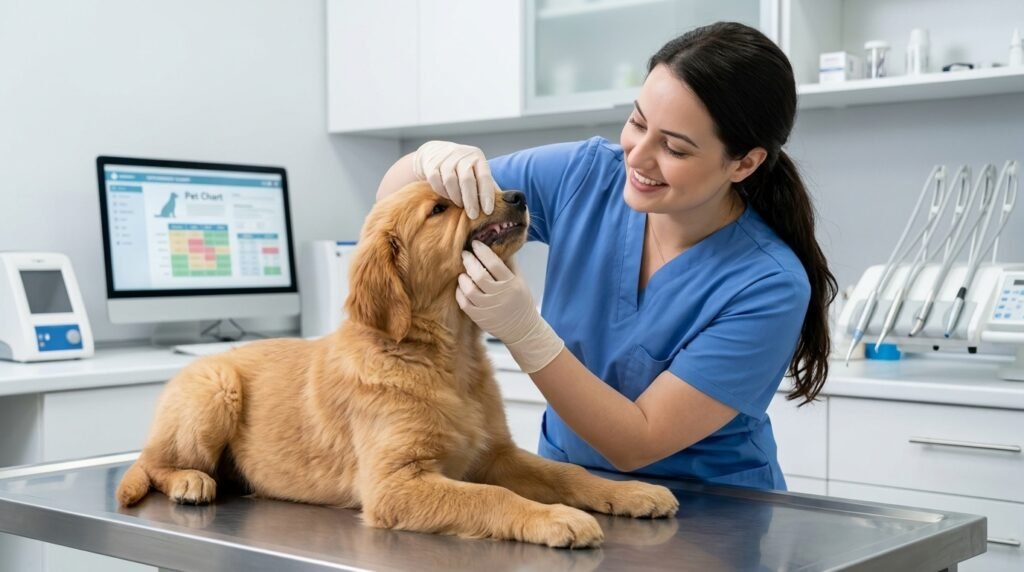
This is one reason it is better to address dental problems early rather than waiting until your dog stops eating.
Common Dog Dental Care Mistakes to Avoid
Using human toothpaste
Do not assume toothpaste made for people is appropriate for dogs. Dogs swallow toothpaste, and some human formulations contain ingredients that are unsafe for pets.
Scraping tartar at home
Trying to chip or scrape hardened tartar yourself can injure the mouth and does not address disease below the gumline.
Relying only on dental treats
Dental chews can be useful, but they should not automatically be considered a substitute for brushing or professional veterinary care.
Ignoring bad breath
Persistent bad breath can be an early sign of dental disease.
Waiting until your dog has trouble eating
Dogs can continue eating despite significant oral disease. Waiting for obvious eating difficulty may mean the disease has already progressed.
Forcing brushing
If your dog becomes frightened or aggressive during brushing, forcing the process can create a bigger handling problem.
Instead, slow down and work on gradual desensitization. If you cannot safely brush your dog’s teeth, ask your veterinarian about alternative home-care strategies.
A Simple Dog Dental Care Routine
You do not need a complicated schedule to get started.
A practical routine could look like this:
Daily
- Check your dog’s mouth casually.
- Provide any veterinarian-approved dental product according to directions.
- Brush the teeth if your dog comfortably accepts daily brushing.
Several times per week
- Brush if daily brushing is not yet realistic.
- Reward calm cooperation.
- Gradually improve your dog’s tolerance if brushing is still new.
Regularly
- Check for tartar, gum redness, bad breath, damaged teeth, or chewing changes.
- Review dental products and their evidence with your veterinarian.
During veterinary visits
- Ask your veterinarian to examine your dog’s teeth and gums.
- Discuss professional cleaning if dental disease is present.
- Ask whether a dental diet, chew, water additive, or other product makes sense for your dog.
The most effective routine is the one you can maintain consistently and safely.
Frequently Asked Questions
1. How often should I brush my dog’s teeth?
Daily brushing is ideal when your dog accepts it. Consistent brushing several times per week can also be a practical routine for many owners. Veterinary guidance emphasizes regular brushing because plaque can accumulate quickly.
2. Can dental chews replace brushing a dog’s teeth?
No. Dental chews can provide mechanical cleaning and may help reduce plaque or tartar, particularly when the product has appropriate evidence. However, they should be viewed as supplemental dog dental care rather than a universal replacement for brushing.
3. Is bad breath normal in dogs?
Persistent bad breath should not simply be considered normal. It can be a sign of dental disease, especially when accompanied by red gums, tartar, drooling, chewing difficulty, or other oral changes.
4. Does my dog still need a professional dental cleaning if I brush regularly?
Yes, potentially. Brushing is an important preventive measure, but it cannot fully replace veterinary dental examinations or professional treatment when tartar and periodontal disease have developed. Your veterinarian can determine how often professional dental care is appropriate for your dog.
Conclusion
Effective dog dental care does not depend on one miracle product. It is a routine built around regular plaque control, appropriate dental products, monitoring for warning signs, and veterinary care when needed.
Start with the basics: introduce your dog gradually to a toothbrush and dog-safe toothpaste, make brushing a predictable part of the routine, and consider evidence-supported dental chews, diets, or water additives when appropriate. VOHC’s accepted-product list can help you evaluate products that have demonstrated plaque or tartar-control claims.
Most importantly, do not wait for obvious pain before paying attention to your dog’s mouth. Regular dental care can help you identify problems earlier and support healthier teeth and gums throughout your dog’s life.
If you see persistent bad breath, red or bleeding gums, facial swelling, loose teeth, significant tartar, difficulty eating, or signs of oral pain, contact your veterinarian for an examination.