The best answer depends on your dog, the context, and the full pattern of behavior. Look at multiple signals rather than one isolated action.
Teaching basic obedience can make everyday life with your dog easier, calmer, and safer. Among the first behaviors most owners want to teach are sit and stay. The good news is that you don’t need complicated equipment or hours of training to get started.
If you’re learning how to teach your dog sit and stay, the most important principle is to teach each behavior in small, achievable steps. Your dog should first understand what “sit” means before you expect them to remain sitting while you move away.
Reward-based training makes the process easier to understand because your dog gets clear feedback about which behavior earns a reward. Short sessions, consistent cues, and gradually increasing difficulty can help prevent frustration for both you and your dog.
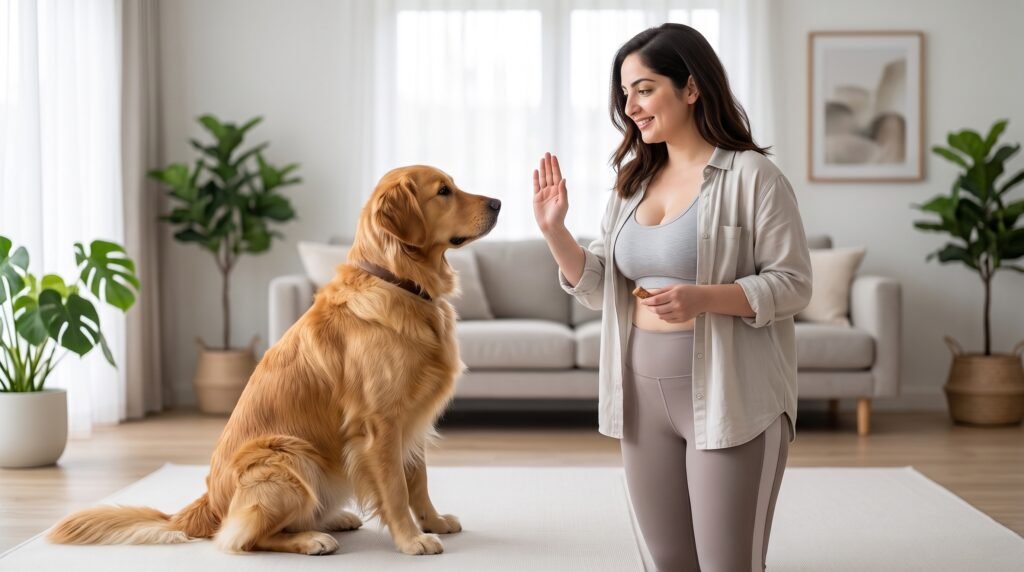
This guide explains how to teach your dog sit and stay from the beginning, including how to introduce the verbal cues, build a reliable stay, avoid common mistakes, and practice the behaviors around everyday distractions.
Table of Contents
Why Sit and Stay Matter
Before learning how to teach your dog sit and stay, it helps to understand why these two behaviors are so useful.
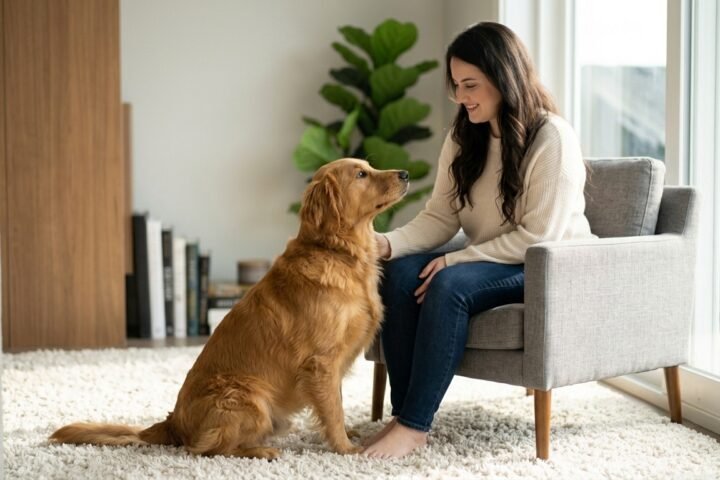
A sit gives your dog a simple alternative to jumping, rushing forward, or becoming overly excited. You can ask for a sit before meals, greetings, going outside, or receiving attention.
Stay adds another layer of self-control. Instead of simply sitting when asked, your dog learns to remain in that position until you provide a release cue.
A reliable stay can be useful when you:
- Open the front door
- Put on your dog’s leash
- Prepare a meal
- Greet visitors
- Take photos
- Groom your dog
- Practice obedience
- Move through appropriate public areas
- Ask your dog to pause before crossing a doorway
The goal is not to make your dog afraid of making mistakes. The goal is to make the desired behavior clear and rewarding.
Reward-based methods are widely recommended by professional veterinary behavior organizations. The American Veterinary Society of Animal Behavior recommends reward-based training and discourages aversive training methods.
For owners wondering how to teach your dog sit and stay, this means focusing on communication rather than punishment.
What You Need Before Training
You don’t need a large training setup.
Gather:
- Small training treats
- A quiet area
- A few minutes of uninterrupted time
- A consistent verbal cue
- A hand signal
- A release word
- Patience
Choose rewards your dog actually values. Training treats should be small enough that you can give several during a session without overfeeding.
Choose a Release Cue
A release cue tells your dog when the exercise is finished.
You might choose:
- “Free”
- “Okay”
- “All done”
- “Release”
Pick one phrase and use it consistently.
For example:
Sit → Stay → Reward → Free
Without a clear release cue, some dogs may become confused about when they are allowed to move.
Keep Sessions Short
Long training sessions can cause dogs to lose interest.
Instead, practice for a few minutes at a time and finish after a successful repetition.
If your dog becomes distracted or frustrated, make the exercise easier.
Learning how to teach your dog sit and stay is not about rushing toward a perfect result. It is about building one successful repetition after another.
How to Teach Your Dog to Sit
Teaching sit is usually the best place to begin.
Step 1: Start in a Quiet Area
Choose a location where your dog is comfortable and there are few distractions.
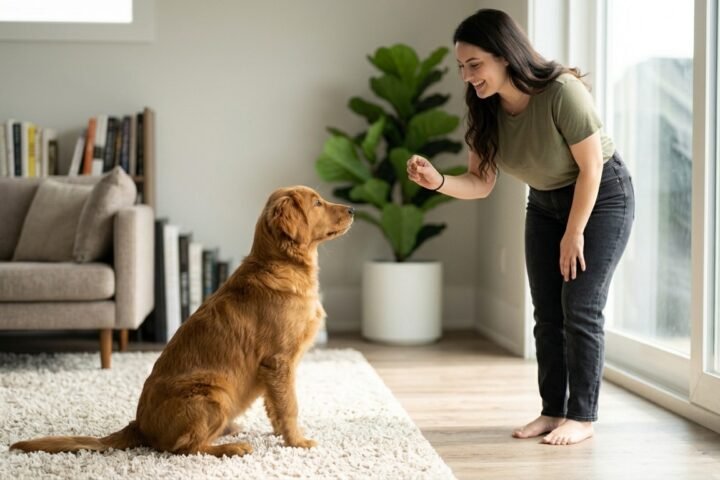
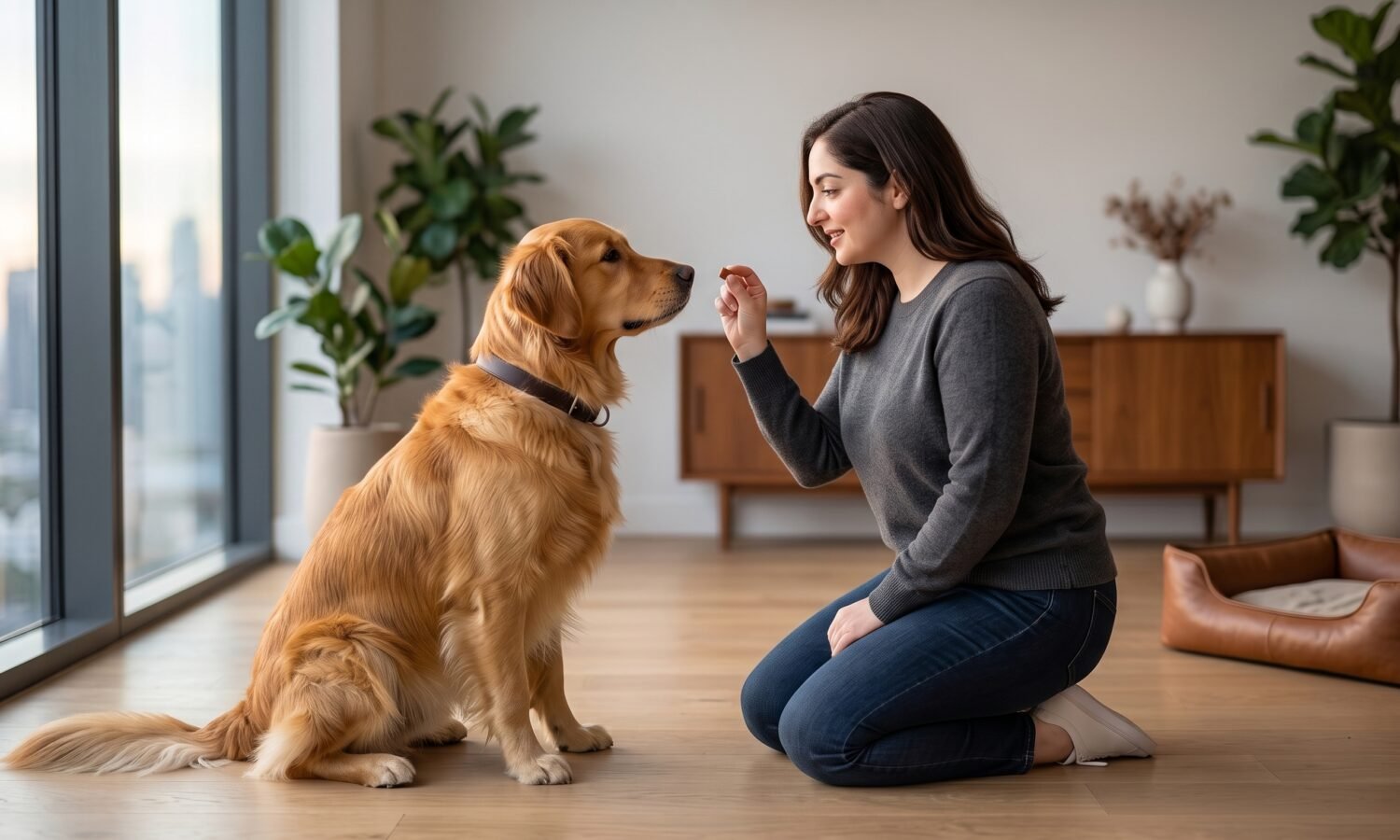
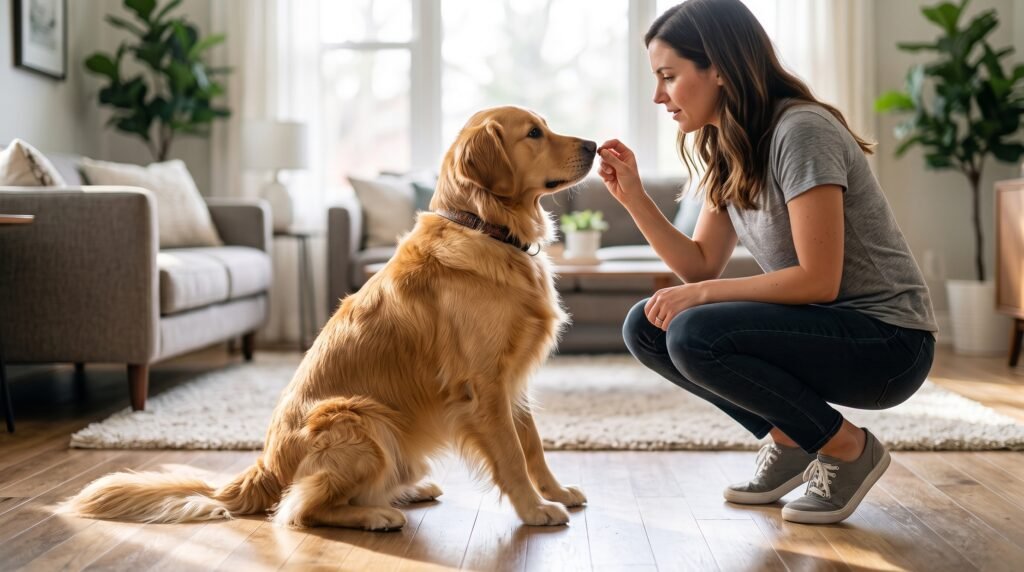
Stand in front of your dog and hold a small treat near their nose.
Allow your dog to smell the treat without grabbing it.
Step 2: Move the Treat Up and Back
Slowly move the treat upward and slightly backward over your dog’s head.
Your dog will usually follow the movement with their nose.
As the head moves upward, the rear may naturally lower toward the floor.
Avoid physically pushing your dog’s rear down.
You want your dog to discover the movement themselves.
Step 3: Reward the Moment They Sit
The instant your dog’s rear touches the floor, mark the behavior with praise or a marker word.
Then give the treat.
Timing is extremely important.
You want your dog to understand:
Sit happens → reward follows.
The American Kennel Club recommends rewarding the dog when the desired sit occurs rather than forcing the dog into position.
Step 4: Add the Word “Sit”
Once your dog is beginning to follow the hand movement reliably, introduce the verbal cue.
Say:
“Sit.”
Then give your hand signal.
When your dog sits, reward immediately.
Repeat this process several times.
Step 5: Reduce Dependence on the Treat Lure
A common beginner mistake is always showing the treat before giving the command.
Once your dog understands the behavior, use an empty hand to make the same motion.
When your dog sits, reward from your other hand.
This helps your dog learn to respond to the cue rather than simply following visible food.
Step 6: Practice Without Food in Your Hand
Eventually, your dog should be able to respond when you simply say “sit.”
You can still reward successful repetitions, but the reward does not need to be visible beforehand.
This is an important part of how to teach your dog sit and stay because you want your dog to respond to communication rather than only to a visible treat.
Step 7: Reward Voluntary Sits
Look for opportunities to reward your dog when they sit naturally.
For example, if your dog sits calmly instead of jumping while you prepare their food, reward that calm behavior.
Over time, your dog may begin offering a sit because they have learned that calm behavior produces good outcomes.
How to Teach Your Dog to Stay
Once your dog understands sit, you can begin teaching stay.
The biggest mistake is asking for too much too soon.
Do not start by asking your dog to sit while you walk across the entire room.
Start with seconds.
Step 1: Ask for Sit
Ask your dog to sit.
Wait for the dog to settle.
Reward if appropriate.
Step 2: Introduce the Stay Cue
Give your chosen stay hand signal.
A common signal is an open palm facing toward your dog.
Say:
“Stay.”
Remain close to your dog.
Wait for only one or two seconds.
If your dog remains in position, reward them.
Step 3: Release Your Dog
After the successful repetition, use your release word.
For example:
“Stay.” → wait → reward → “Free.”
This teaches your dog that the stay ends when you give the release cue.
Step 4: Gradually Increase Duration
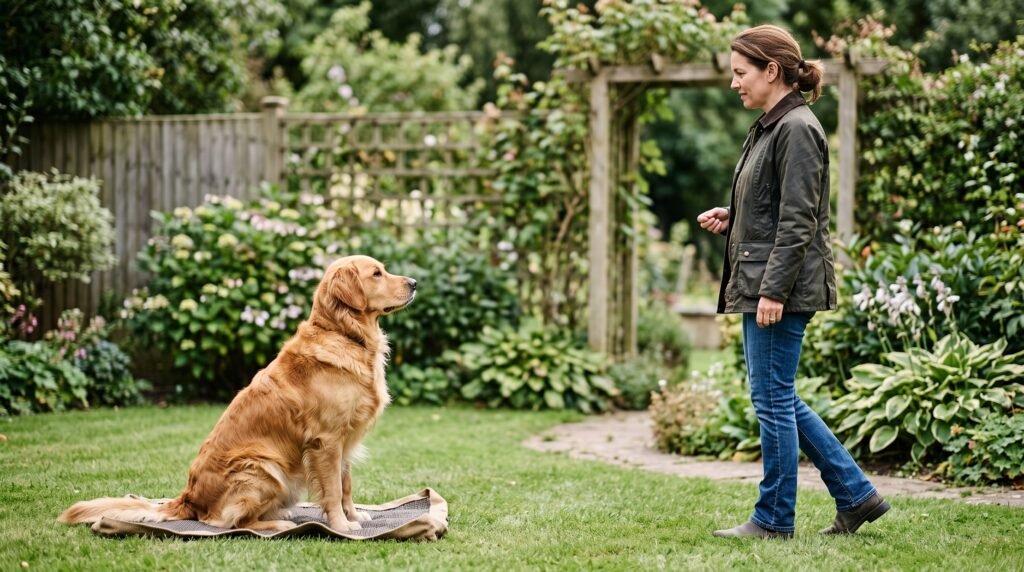
Once your dog can stay for a couple of seconds, gradually increase the duration.
For example:
- 2 seconds
- 3 seconds
- 4 seconds
- 5 seconds
- 7 seconds
- 10 seconds
You don’t need to increase the time every single repetition.
Sometimes repeat an easy duration so your dog continues experiencing success.
Step 5: Introduce Distance
After your dog can remain in place for a reasonable duration while you’re nearby, begin adding distance.
Take one small step backward.
Immediately return and reward your dog.
Then use your release cue.
If your dog gets up, reduce the distance.
This gradual progression is central to how to teach your dog sit and stay reliably.
Step 6: Add Distractions Later
Distractions should be introduced gradually.
Your dog might perform perfectly in your living room but struggle when someone walks past.
That doesn’t necessarily mean your dog has forgotten the command.
The environment has simply become more difficult.
Practice gradually around:
- Family members
- Mild household sounds
- Toys
- Another quiet room
- A backyard
- Calm outdoor environments
The Three Ds of Stay Training
One of the easiest ways to understand how to teach your dog sit and stay is to remember the three Ds:
Duration. Distance. Distraction.
Duration
Duration means how long your dog stays in position.
Start with very short periods.
Don’t expect a beginner dog to remain in a stay for several minutes.
Build the behavior gradually.
Distance
Distance means how far you can move away from your dog.
Start with one step.
Then return and reward.
Increase the distance only when your dog is consistently successful.
Distraction
Distraction refers to what is happening around your dog.
A quiet room is easier than a busy backyard.
A backyard is usually easier than a crowded public environment.
Increase distractions gradually.
Don’t Increase Everything at Once
This is one of the most important lessons in how to teach your dog sit and stay.
Suppose your dog can stay for 15 seconds.
Don’t suddenly:
- Increase the stay to two minutes
- Walk 20 feet away
- Add a toy
- Invite another dog into the area
That creates too much difficulty at once.
Instead, change one variable at a time.
For example:
Increase duration → practice → increase distance → practice → add distractions.
This gives your dog a much clearer path to success.
Common Mistakes to Avoid
Asking for Too Much Too Soon
If your dog can stay for five seconds, don’t suddenly expect five minutes.
Increase difficulty gradually.
Repeating the Command
Avoid saying:
“Stay, stay, stay, stay!”
Give one clear cue.
If your dog gets up, make the exercise easier and try again.
Rewarding After the Dog Moves
If you’re teaching a stay, reward your dog while they are still holding the correct position.
Otherwise, your timing can become confusing.
Walking Away Too Quickly
Many dogs naturally want to follow their owners.
If your dog breaks the stay as soon as you take one step, don’t punish them.
Simply reduce the distance.
Showing the Treat Too Early
If your dog only performs when they see food, you may be relying too heavily on the lure.
Gradually transition from visible food to hand signals and verbal cues.
Practicing Only at Home
Dogs don’t automatically generalize every behavior to every environment.
Practice in different rooms first.
Then move to calm outdoor locations.
Using Punishment
Punishing a dog for getting up can create confusion or anxiety.
Reward-based training is a better foundation for teaching behaviors.
If your dog repeatedly struggles, make the exercise easier instead of escalating corrections.
A Simple 7-Day Training Plan
If you’re starting from scratch, this framework can help.
| Day | Main Goal | Practice |
|---|---|---|
| Day 1 | Sit | Introduce the lure and reward |
| Day 2 | Sit cue | Add the verbal “sit” |
| Day 3 | Stay | Practice 1–5 second stays |
| Day 4 | Duration | Gradually increase time |
| Day 5 | Distance | Add one or two steps |
| Day 6 | Distractions | Practice in another room |
| Day 7 | Real-life practice | Use sit and stay during routines |
This is only a framework.
Some dogs will progress faster, while others will need additional repetitions.
When learning how to teach your dog sit and stay, your dog’s actual performance should determine when you increase difficulty.
Practicing Sit and Stay in Everyday Life
Formal training sessions are helpful, but everyday situations provide excellent opportunities to reinforce the behaviors.
Before Meals
Ask for a sit before putting down your dog’s food.
Once your dog is calm, release them to eat.
Before Going Outside
Ask your dog to sit while you prepare the leash.
Once calm, give the release cue.
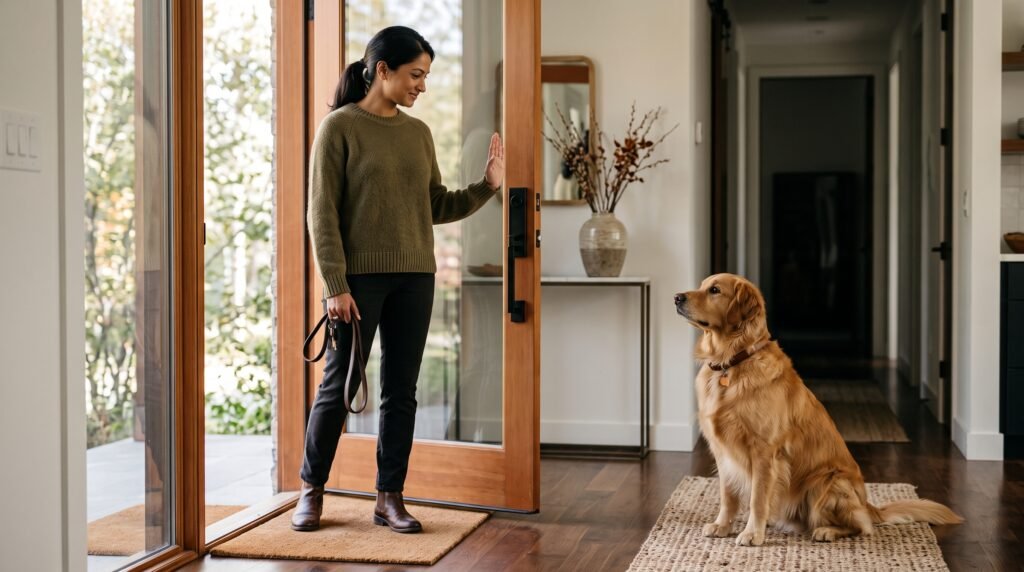
At the Front Door
Practice a very short stay while you reach toward the door.
Keep the difficulty appropriate.
You don’t need to open the door fully during early training.
During Greetings
Ask for a sit before allowing a calm greeting.
If your dog becomes too excited, reduce the difficulty.
During Grooming
A short stay can help your dog learn to remain still while being brushed.
Keep grooming practice positive and brief.
Around Toys
Ask for a sit before starting a favorite game.
This can help your dog learn that calm behavior can lead to something rewarding.
These everyday repetitions can make how to teach your dog sit and stay much more practical because your dog learns to use the behaviors outside formal training sessions.
What to Do When Your Dog Breaks Stay
Dogs will break stays.
It is part of the learning process.
Instead of thinking, “My dog is being stubborn,” ask:
“Was the exercise too difficult?”
Check the following:
- Was the duration too long?
- Did you move too far away?
- Was the environment too distracting?
- Was your dog tired?
- Was your dog overstimulated?
- Did you introduce multiple challenges at once?
- Was the reward motivating enough?
If your dog breaks a 20-second stay, return to 10 seconds.
If your dog breaks when you move five feet away, return to one or two feet.
If your dog cannot stay in the backyard, return to a quieter room.
This process of adjusting difficulty is one of the most useful principles in how to teach your dog sit and stay.
Reward the Easy Success
Suppose your dog fails at 15 seconds.
Don’t keep repeating 15 seconds.
Try 8 seconds.
If your dog succeeds, reward.
Then perhaps try 10 seconds.
The goal is to create a pattern of successful repetitions.
Don’t Chase Your Dog
If your dog gets up during stay, don’t turn the exercise into a game of chasing.
Calmly reset your dog.
Make the next repetition easier.
How Long Should Training Sessions Be?
There is no universal perfect training-session length.
Your dog’s age, temperament, environment, motivation, and experience all matter.
For many dogs, several short sessions are easier than one long session.
You might practice:
- Two minutes in the morning
- Two minutes later in the day
- Two minutes in the evening
The exact schedule can vary.
Watch your dog’s behavior.
If they are still engaged and succeeding, you can continue briefly.
If they become distracted or frustrated, stop or simplify the exercise.
When owners ask how to teach your dog sit and stay, they often focus on the exact number of repetitions. Quality matters more than simply performing a large number of repetitions.
How to Make Sit and Stay More Reliable
Once your dog understands both cues, start changing the context gradually.
Practice in:
- Different rooms
- The hallway
- The backyard
- A quiet outdoor area
- Near familiar people
- During normal household routines
Don’t immediately move from a quiet home to a highly distracting environment.
Instead, make small changes.
Use Different Body Positions
Once your dog understands the basic stay, you can gradually practice while:
- Standing normally
- Turning slightly
- Taking a step sideways
- Taking a step backward
- Sitting down nearby
Always adjust the difficulty based on your dog’s success.
Practice the Release
The release cue should remain meaningful.
Don’t allow your dog to decide that the exercise is over.
If your dog gets up early, calmly reset.
Then reward a shorter successful stay and release them properly.
This helps your dog understand that you control the end of the exercise.
Frequently Asked Questions
How do I teach my dog to sit and stay?
Start by teaching sit with a reward. Once your dog understands sit, introduce a short stay. Reward while your dog remains in position, then use a consistent release cue. Gradually increase duration, distance, and distractions.
What is the easiest way to teach a dog to sit?
Hold a small treat near your dog’s nose and slowly move it upward and slightly backward. When your dog naturally lowers their rear to the floor, immediately reward. Once the movement is reliable, add the verbal “sit” cue.
How long does it take to teach a dog to stay?
There is no universal timeline. Some dogs understand the basic concept quickly, while others need more repetition. Focus on successful progress rather than a specific number of days.
Why does my dog get up during stay?
The exercise may be too difficult. Your dog may be struggling with duration, distance, distractions, or a combination of these factors. Make the exercise easier and rebuild gradually.
Should I say “stay” repeatedly?
No. Give one clear cue and then observe your dog. Repeating the command can make the cue less meaningful.
Can puppies learn sit and stay?
Yes. Puppies can learn basic behaviors using age-appropriate reward-based training. Keep sessions short and set realistic expectations.
Should I reward my dog every time?
Frequent rewards are especially useful while a behavior is being learned. As your dog becomes reliable, you can vary the type and frequency of reinforcement while continuing to reward good behavior.
What is the difference between stay and wait?
Training terminology varies. “Stay” commonly means maintaining a position until released, while “wait” may mean pausing temporarily. Choose clear cues and use them consistently.
Why does my dog stay inside but not outside?
Outdoor environments usually contain more distractions. Your dog may understand the behavior but not yet be able to perform it reliably in a more difficult environment. Practice gradually.
Can I teach sit and stay without treats?
Yes, but rewards can make the learning process easier. You can eventually use praise, play, toys, access to activities, or other rewards your dog values. During initial learning, treats can provide very clear feedback.
Final Thoughts
Understanding how to teach your dog sit and stay starts with patience, clarity, and gradual progression.
Teach sit first. Reward the correct behavior immediately. Then introduce stay for only a few seconds before gradually increasing duration, distance, and distractions.
Don’t expect perfection immediately.
If your dog gets up, make the exercise easier. If your dog succeeds, reward that success. Over time, your dog can learn that listening to your cues produces predictable and rewarding outcomes.
The most effective approach to how to teach your dog sit and stay is not to rush. Build the behavior in small pieces, practice consistently, and gradually transfer those skills into real-life situations.
With positive reinforcement and good timing, how to teach your dog sit and stay becomes less about controlling your dog and more about creating clear communication between you and your companion.
Want to learn more about your dog’s behavior, nutrition, and everyday health? Explore more practical dog-care guides on PawMindTips.
Key Takeaways
- Consider the context around the behavior.
- Look for patterns instead of relying on one signal.
- Seek qualified help when behavior is sudden, severe, or unsafe.
Frequently Asked Questions
Is every behavior a sign of the same emotion?
Not necessarily. Dogs use combinations of signals, and context matters.
When should I contact a professional?
Consider veterinary or qualified behavior support for sudden, severe, escalating, or safety-related concerns.