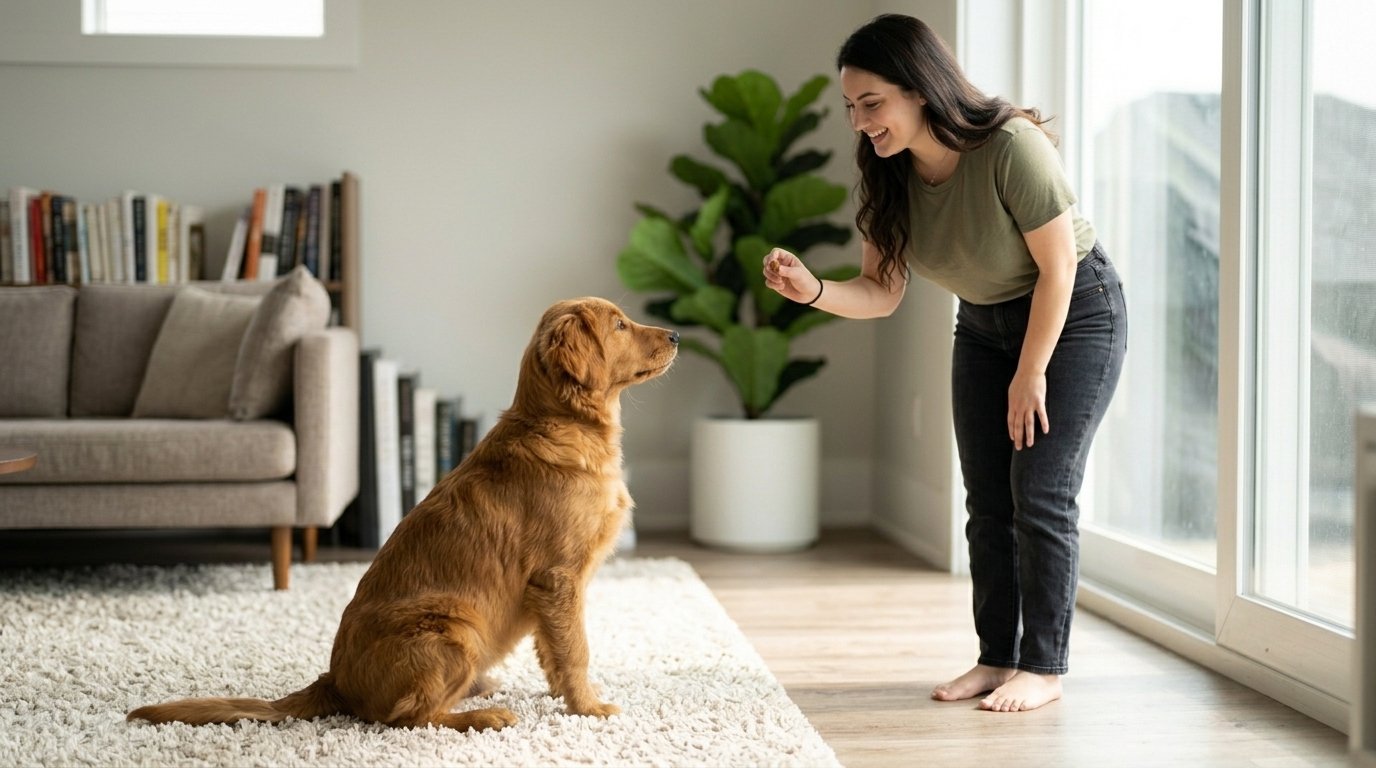
To teach a dog to stay, start in a quiet room with a familiar sit or down. Say “stay,” wait one second, and reward your dog while they remain in position. Then use a release word such as “free.” Build duration gradually before adding distance or distractions, and make the exercise easier whenever your dog struggles.
A good stay has three important elements: duration, distance, and distractions. Your dog needs to learn to remain in position for longer periods, stay there while you move away, and eventually maintain the behavior when interesting things are happening nearby.
This guide explains how to teach a dog to stay using seven practical steps, including reward timing, the release cue, troubleshooting mistakes, and ways to turn a basic stay into a useful everyday behavior.
Table of Contents
What Does “Stay” Mean in Dog Training?
Before learning how to teach a dog to stay, it helps to define exactly what the cue should mean.
When you say “stay,” your dog should remain in the position you requested until you provide a separate release cue. If your dog is sitting when you say “stay,” the goal is for the dog to continue sitting rather than deciding independently that the exercise is finished.
This is different from simply asking your dog to sit.
For example:
Sit: Your dog places their rear on the floor.
Stay: Your dog remains in that position until released.
Release cue: Your dog is told that they are free to move.
A release cue might be “free,” “okay,” “all done,” or another short word that your household can use consistently. The specific word is less important than teaching your dog that it marks the end of the behavior.
The American Kennel Club’s guidance on teaching a dog to stay also distinguishes the stay behavior from the release that tells the dog when they can move.
This distinction is important because many dogs naturally get up when their owner takes a step, reaches for something, or changes position. A clear release cue helps prevent your dog from making that decision for themselves.
What You Need to Teach a Dog to Stay
You do not need complicated equipment for basic stay training.
Prepare:
- Small training treats
- A quiet training area
- A consistent stay cue
- A consistent release cue
- A few minutes of focused practice
- A calm attitude
Your dog should ideally already understand a position such as sit or down. If your dog does not reliably respond to either position, work on that skill first.
Choose treats that your dog finds motivating, but keep them small. You may be rewarding frequently during the early stages, so large treats are unnecessary.
The best starting environment is usually a quiet room with few distractions. Your dog should be able to focus on you without competing with people, toys, food, noises, or other animals.
Training when your dog is extremely excited can make the first sessions unnecessarily difficult. The Royal Kennel Club’s dog training guidance similarly recommends choosing an appropriate training moment rather than starting when a dog is overly excited.
The goal of the first sessions is not to prove what your dog can tolerate.
The goal is to create successful repetitions.
How to Teach a Dog to Stay in 7 Simple Steps
The most effective way to learn how to teach a dog to stay is to break the behavior into small pieces. Your dog should understand one level before you make the exercise harder.
Step 1: Ask for a Position Your Dog Already Knows
Start with your dog directly in front of you or close beside you.
Ask for “sit” or “down,” depending on the position you want to use.
Once your dog is in position, pause briefly.
At this point, don’t immediately walk across the room.
Your dog first needs to understand that remaining in position is what earns the next reward.
You can introduce a hand signal at the same time. A flat, open palm facing your dog is commonly used as a visual stay signal.
Say your stay cue calmly.
For example:
“Sit.” → “Stay.”
Then wait only a very short moment.
If your dog remains in position, reward them.
Early success might last only one or two seconds. That is completely fine.
A reliable behavior is built from easy repetitions.
Step 2: Reward Your Dog While They Are Still Staying
This is one of the most important parts of how to teach a dog to stay correctly.
Reward your dog while they are still holding the requested position.
If your dog stands up and then receives the treat, you may accidentally reinforce getting up.
Instead, approach your dog or deliver the reward without causing them to move.
For example:
Sit → Stay → 1–2 seconds → treat while sitting → “Free.”
Let your dog move after the release, then begin another repetition. During these first short stays, reward before releasing. Later, you can give several rewards during a longer stay before ending it with your release cue.
The AKC’s stay-training instructions emphasize rewarding the dog while the stay is still being maintained rather than making the release itself the main source of reinforcement.
This is particularly important because staying still is not always naturally exciting for a dog.
If the dog learns that remaining still produces rewards, the behavior becomes more valuable.
Step 3: Teach a Clear Release Cue
Your dog also needs to learn when the stay is finished.
Choose one release word.
Good options include:
- “Free”
- “Okay”
- “Release”
- “All done”
Pick one and use it consistently.
For example:
“Stay” → pause → treat → “Free.”
After saying the release word, encourage your dog to move.
You can take a step away, invite them toward you, or toss a treat a short distance away.
The purpose is to create a clear pattern:
Stay means remain in position.
Release means you are allowed to move.
Avoid using your release cue casually throughout the day if you want it to remain clear.
This is especially important with words such as “okay,” which people commonly use in normal conversation.
The Royal Kennel Club’s advice on stay training also recommends a consistent release cue so the dog understands when movement is permitted.
Step 4: Gradually Increase Duration
Once your dog understands the basic exercise, begin increasing the amount of time they remain in position.
Do not jump from two seconds to two minutes.
Try something like:
- 2 seconds
- 3 seconds
- 4 seconds
- 3 seconds
- 5 seconds
- 4 seconds
- 6 seconds
Notice that the duration does not have to increase every time.
Mixing easy repetitions with slightly harder ones can help your dog stay successful.
If your dog breaks at six seconds repeatedly, return to four or five seconds.
That is not going backward.
It is adjusting the difficulty so your dog can succeed again.
A common mistake is turning stay training into an endurance competition. Owners keep increasing the time until the dog eventually gets up, then become frustrated.
Instead, think like a teacher.
You want to increase the difficulty gradually enough that your dog understands what you want.
When learning how to teach a dog to stay, successful repetitions are more valuable than impressive-looking failures.
Step 5: Add Small Movements Before Walking Away
After your dog can stay for several seconds with you nearby, introduce small movements.
Don’t immediately turn your back and walk across the room.
Start with something much easier.
Try:
- Moving one foot
- Shifting your weight
- Leaning slightly away
- Turning your shoulders
- Taking half a step
- Turning briefly to one side
Reward your dog if they remain in position.
Why does this matter?
Dogs pay close attention to human movement. If your dog is used to following you, your first backward step may be enough to make them stand.
That does not necessarily mean your dog is stubborn.
It means the exercise became harder.
Make the movement smaller and repeat it.
Then gradually build toward a full step.
The AKC’s recommendations for stay training specifically note that handler movement can cause a dog to break position, which is why distance should be introduced gradually.
Step 6: Increase Distance One Step at a Time
Once your dog can remain in position while you make small movements, begin increasing distance.
Ask your dog to stay.
Take one step backward.
Immediately return to your dog.
Reward them while they are still in position.
Then give your release cue.
Repeat.
When that becomes easy, try two steps.
Then three.

The important part is that you return to your dog before releasing them during the early stages.
For example:
Stay → one step back → return → reward → release.
Then:
Stay → two steps back → return → reward → release.
Do not assume that a dog who can stay beside you for 30 seconds can automatically stay for 30 seconds while you are across the room.
Distance changes the difficulty.
The Royal Kennel Club’s progression for teaching stay recommends reducing the expected duration when first introducing distance, then gradually building both skills.
Step 7: Introduce Distractions Gradually
The final stage is helping your dog maintain the stay when something interesting happens.
Start with mild distractions.
For example:
- You sit down nearby.
- Someone walks across the room.
- You pick up a toy.
- A family member moves around.
- You open a cabinet.
- You gently clap your hands.
- You move toward another part of the room.
If your dog succeeds, reward them.
If they immediately get up, the distraction was probably too difficult.
Make it easier.
For example, if your dog cannot stay while someone walks across the room, have that person remain farther away or move more slowly.
The AKC guidance on training dogs around distractions recommends starting with small distractions and gradually increasing their intensity rather than immediately exposing the dog to overwhelming situations.
The same principle applies to stay training.
Your dog may understand the cue perfectly in a quiet room but struggle when another dog, person, toy, or exciting sound appears.
That does not mean the training failed.
It means the behavior needs to be practiced in that environment.
How to Build a Reliable Stay Using the Three Ds
A major part of how to teach a dog to stay is understanding the three Ds:
Duration
How long does your dog remain in position?
Distance
How far can you move away?
Distraction
How much activity can happen around your dog while they continue staying?
These variables should initially be trained separately.
Imagine your dog can remain in a sit for 30 seconds while you stand directly beside them.
If you suddenly:
- walk 20 feet away,
- leave the room,
- have someone ring the doorbell,
- and throw a toy nearby,
you have dramatically increased the difficulty.
Your dog may fail even though they understood the original exercise.
Instead, increase one variable at a time.
For example:
Stage 1: 10 seconds beside you.
Stage 2: 20 seconds beside you.
Stage 3: 30 seconds beside you.
Stage 4: 5 seconds while you take one step away.
Stage 5: 5 seconds while you take several steps away.
Stage 6: Short stay while a mild distraction occurs.
Then gradually combine them.
This progression is one of the most important principles in how to teach a dog to stay because it prevents you from making the behavior unnecessarily difficult.
How Long Should a Dog Stay?
There is no single number that every dog should reach.
The appropriate duration depends on:
- Age
- Training experience
- Environment
- Motivation
- Distractions
- Physical comfort
- Individual temperament
- The purpose of the stay
A young puppy may initially manage only a few seconds.
An experienced adult dog may eventually hold a stay for much longer.
Do not judge your dog’s progress solely by duration.
A five-second stay in a busy environment can be harder than a one-minute stay in a quiet bedroom.
That is why reliable training should focus on the entire picture rather than one impressive number.
The Royal Kennel Club’s stay guidance also emphasizes progressing at the dog’s own pace and not moving ahead when the current level is not secure.
What to Do If Your Dog Breaks the Stay
A broken stay is not a reason to punish your dog.
Instead, treat it as information.
Ask yourself:
What made the exercise too difficult?
Perhaps you:
- Asked for too much time
- Moved too far away
- Added a distraction too quickly
- Used a weak reward
- Moved suddenly
- Practiced for too long
- Started in an overly exciting environment
Calmly reset your dog.
Return to the previous level where they were successful.
For example, if your dog repeatedly breaks at 15 seconds, go back to 8–10 seconds.
Reward successful repetitions.
Then build again.
The American Kennel Club’s stay-training guidance recommends reducing the difficulty rather than punishing the dog when the stay breaks.

Keep Stay Practice Separate From Recall Practice
If your dog gets up before the release, calmly reset without scolding or physically pushing them back into position. Make the next repetition shorter or easier, and reward before they move.
Avoid routinely calling your dog to you to finish a stay. During early practice, return to your dog, reward them in position, and then release.
If you have already called your dog and they come to you, still reward that response. They followed your recall cue. Adjust the next stay repetition rather than making coming when called unrewarding.Common Mistakes When Teaching a Dog to Stay
Knowing what not to do can make how to teach a dog to stay much easier.
Asking for too much too quickly
If your dog has only practiced five-second stays, don’t suddenly demand several minutes.
Build gradually.
Walking away too soon
Distance makes the behavior harder.
Stay close until your dog understands the basic concept.
Rewarding after the dog gets up
Whenever practical, reward the dog while they are still maintaining the stay.
Forgetting the release cue
If your dog does not understand when the exercise ends, they may decide for themselves when to move.
Increasing all three Ds together
Don’t dramatically increase duration, distance, and distraction at the same time.
Practicing only at home
A dog may learn that “stay” works in the living room but not understand that the same cue applies in the backyard, driveway, or other environments.
Generalization takes practice.
Training when your dog is overwhelmed
If your dog is surrounded by exciting distractions, learning becomes harder.
Start somewhere easier and gradually work toward more challenging environments.
How to Make Stay Training More Reliable
Once your dog understands the basic stay, your next goal should be reliability rather than simply longer duration.
Try practicing in several locations:
- Living room
- Bedroom
- Hallway
- Backyard
- Quiet outdoor area
- Garage or driveway
- Different rooms when visiting family
Change only one major variable at a time.
For example, if you’re moving from the living room to the backyard, temporarily reduce the duration.
Your dog may know the behavior but still need help understanding that the cue applies in a new location.
You can also vary your own movement.
Practice:
- Standing still
- Turning sideways
- Walking one step
- Walking several steps
- Walking around your dog
- Sitting down
- Picking something up
As your dog becomes more reliable, gradually introduce mild distractions.
Practicing gradually in different settings helps your dog use the stay cue in everyday life, not only during familiar training sessions.
Using Stay in Everyday Situations
A reliable stay can be useful throughout your dog’s daily routine.
You can practice it while:
Opening the front door
Begin with the front door closed and your dog several feet away. Practice a short stay while you reach toward the handle, then return and reward.
Before practicing with the door open, use a secure barrier or a leash held by another adult to prevent escape. Keep the exercise easy and reward your dog in position. A stay cue is an extra skill, not a replacement for physical safety measures.

Preparing food
Ask your dog to stay while you place their bowl down.
Release them when you are ready.
Grooming
A short stay can help your dog remain in position while you calmly brush or handle them.
Taking photographs
Stay can help your dog remain in a specific position while you move into place.
Greeting visitors
A trained stay can create a moment of calm before your dog is released to greet someone.
For more advanced door manners, the American Kennel Club’s guidance on preventing dogs from darting through doors explains how stay and place-based behaviors can be incorporated into door training.
However, remember that a stay cue should not be treated as a substitute for physical safety measures around traffic, open gates, unfamiliar animals, or other dangerous situations.
If the environment is genuinely unsafe, management and appropriate physical barriers should come first.
How to Stop a Dog From Pulling on the Leash: 8 Effective Training Tips
Stay vs. Wait: Are They the Same?
The words can be used differently by different trainers, so consistency is more important than the specific vocabulary.
A common distinction is:
Stay: Remain in the current position until released.
Wait: Pause temporarily and prepare for another cue or permission to continue.
For example, a trainer might teach a dog to “wait” at a door and then move forward when released.
The exact terminology can vary between training systems.
What matters most is that everyone in your household uses the same cues consistently.
If one person uses “stay” to mean remain completely still while another uses it to mean “don’t go through the door yet,” the dog may receive confusing information.
Choose clear cues and keep their meanings predictable.
How to Keep Stay Training Fun
Stay requires impulse control, and holding still may not be naturally exciting for every dog.
That is why rewards matter.
Use a reward your dog actually values, especially when introducing a new distraction.
You can also keep sessions short.
Instead of practicing for 20 minutes, try several brief sessions throughout the day.
For example:
Morning: 3 minutes
Afternoon: 2–3 minutes
Evening: 3 minutes
End while your dog is still engaged.
If your dog begins wandering away, losing focus, or making repeated mistakes, the session may have become too difficult or too long.
Short, successful practice is generally more productive than repeatedly pushing your dog past their current ability.
When Should You Move to the Next Training Level?
Move forward when your dog can consistently succeed at the current level.
For example, don’t increase distance simply because your dog managed one successful repetition.
Look for a pattern.
If your dog can remain in position successfully through several repetitions, you can make the exercise slightly harder.
But if the new level causes repeated failures, return to the previous step.
This creates a simple training cycle:
Practice → succeed → increase slightly → succeed → increase again.
If things fall apart:
Reduce difficulty → succeed → rebuild.
That approach is far more effective than repeatedly testing the limit.
Learning how to teach a dog to stay is ultimately about managing difficulty so your dog understands exactly which behavior earns reinforcement.
Frequently Asked Questions
How long does it take to teach a dog to stay?
It depends on the individual dog, their previous training, and the difficulty of the environment. Many dogs can learn the basic idea through short sessions, but developing a reliable stay around distractions takes more time and repetition.
What is the best release word for dog training?
There is no single required release word. “Free,” “okay,” “release,” and “all done” can all work. Choose one short cue and use it consistently so your dog learns that the word means they are allowed to move.
Why does my dog get up when I walk away?
Your movement may be increasing the difficulty too quickly. Start with a tiny movement, such as shifting your weight or taking half a step, then return and reward your dog for staying. Gradually increase distance as your dog becomes more confident.
Can you teach a puppy to stay?
Yes. Puppies can learn the foundation of stay, but expectations should be appropriate for their age and attention span. Begin with very short durations, frequent rewards, and minimal distractions before gradually increasing difficulty.
Conclusion
Learning how to teach a dog to stay is not about forcing your dog to remain still for an impressive amount of time. It is about teaching a clear behavior and gradually increasing the challenge.
Start with a position your dog already understands. Introduce the stay cue, reward your dog while they are still holding the position, and teach a consistent release cue. Then gradually build duration, distance, and distractions.
If your dog breaks the stay, don’t punish them or repeatedly test the same difficult level. Lower the difficulty, create another successful repetition, and build from there.
With consistent short sessions and sensible progression, the stay command can become a genuinely useful everyday skill for your dog—not just another obedience exercise.