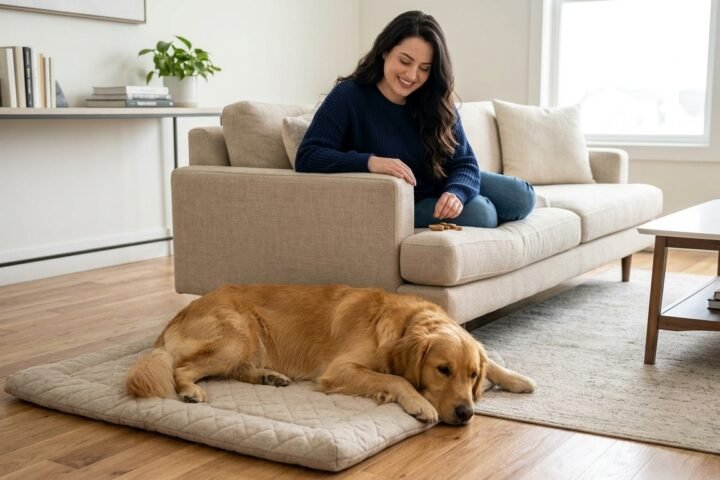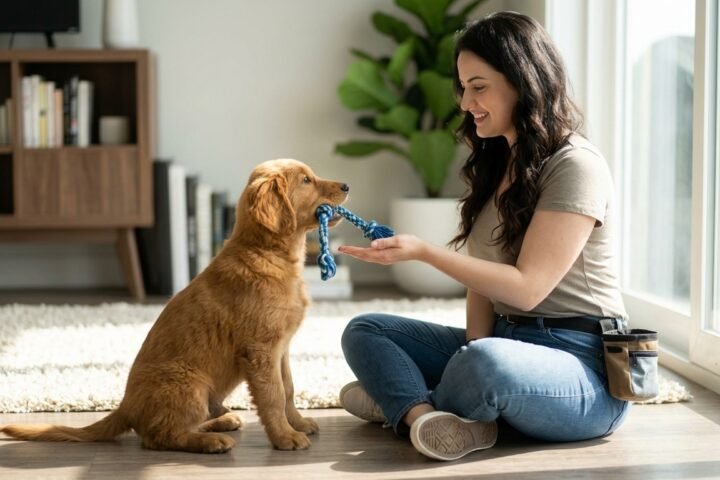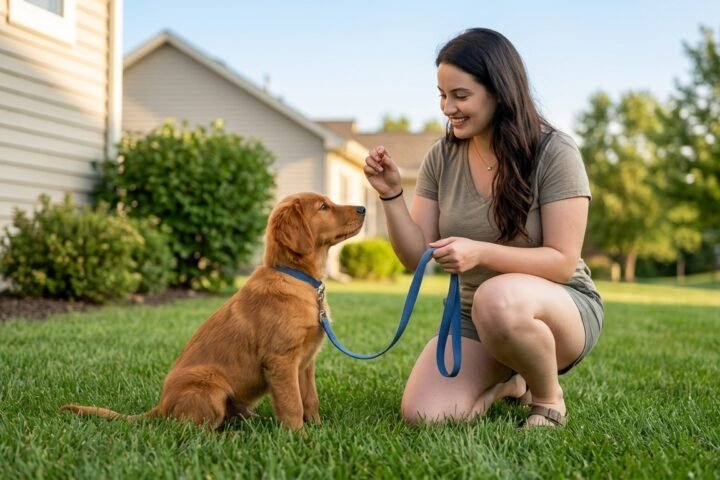
Dog resource guarding happens when a dog tries to maintain control of something they consider valuable. That resource might be food, a chew, a toy, a stolen sock, a resting place, or even access to a favorite person. The dog may freeze, eat faster, stare, hover over the item, growl, snap, or bite when someone approaches.
Resource guarding does not automatically mean your dog is dominant, disobedient, or generally aggressive. The behavior is usually driven by concern about losing something valuable. However, because it can escalate into a bite, it should always be taken seriously.
The safest response combines prevention, careful household management, reward-based training, and professional assistance when necessary. Do not punish the warning signs or repeatedly take items away to “prove” that you are in charge.
Table of Contents
What Is Dog Resource Guarding?
Dog resource guarding includes avoidance, threatening behavior, or aggression used to retain control of a valued resource. Researchers studying canine possessive aggression emphasize that guarding can range from moving away with an item to biting someone who approaches.
Commonly guarded resources include:
- Food bowls
- Treats and long-lasting chews
- Bones
- Favorite toys
- Objects stolen from the floor or trash
- Beds, crates, couches, and resting spaces
- Doorways or particular areas
- A favorite family member
- Items found during walks
- Puppies in the case of a mother dog
Some dogs guard only one especially valuable item. Others react around several categories of resources. A dog who guards a chew from another dog may remain completely relaxed when a person walks past the food bowl.
Context therefore matters. Observe what the dog guards, who approaches, how close that person or animal gets, and what signals appear before the reaction.
Resource guarding is not the same as ordinary enjoyment of an object. A dog carrying a toy away to chew quietly is not necessarily guarding it. Concern rises when the dog becomes tense, blocks access, threatens, or reacts aggressively because someone approaches.
Signs of Resource Guarding in Dogs
Dog resource guarding often begins with signals that are easier to miss than a growl. Recognizing those signals gives you an opportunity to increase distance before the situation escalates.
Early signs can include:
- Pausing or becoming completely still
- Lowering the head over an item
- Turning the body to block access
- Carrying an item farther away
- Eating faster when someone approaches
- Holding an object tightly
- Watching the approaching person from the corner of the eyes
- Showing the whites of the eyes
- Closing the mouth suddenly
- Becoming unusually quiet
- Licking the lips
- Refusing to leave a resting place
- Taking an item beneath furniture
More obvious warnings include:
- A hard stare
- A stiff or forward-leaning posture
- Growling
- Lip lifting
- Showing teeth
- Air snapping
- Lunging
- Chasing someone away
- Biting
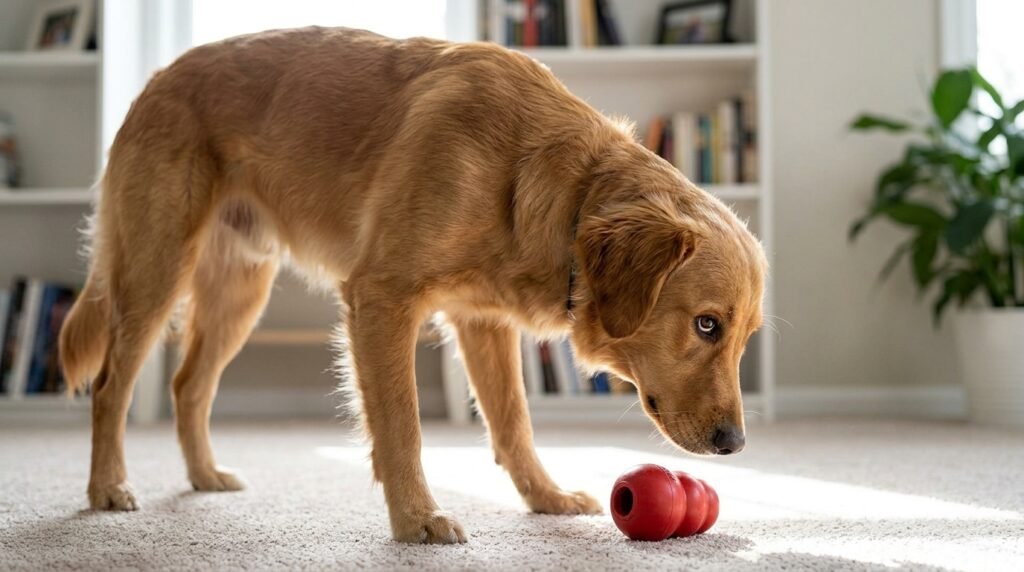
Dogs should be evaluated through their complete posture and the surrounding situation. A single lip lick, for example, does not prove guarding. However, lip licking combined with freezing, hovering over a chew, and watching an approaching child is meaningful. PawMindTips’ guide to why dogs lick their lips explains why this signal must be interpreted in context.
A practical risk guide
| Observed behavior | Approximate concern | Recommended response |
|---|---|---|
| Carries the item away but remains loose and relaxed | Lower | Give space and begin preventive trade training |
| Freezes, blocks the item, or eats faster | Moderate | Stop approaching and introduce management |
| Growls, bares teeth, or air snaps | High | Avoid direct retrieval and contact a qualified professional |
| Lunges, bites, or causes injury | Serious | Separate safely and obtain professional behavior help |
| Guards from a child or vulnerable adult | Serious | Use immediate barriers and professional guidance |
This table is not a diagnostic tool. A dog’s size, bite history, triggers, household members, and predictability all affect the actual risk.
Why Do Dogs Develop Resource Guarding?
There is rarely one universal explanation. Dog resource guarding can be influenced by natural behavior, learning history, stress, competition, genetics, and medical discomfort.
Fear of losing something valuable
If approaching people repeatedly remove food or toys, a dog may learn that human proximity predicts loss. The dog then tries harder to keep the item.
This is why taking the bowl away, reaching into the food, or repeatedly testing the dog can make the problem worse. Even if the dog initially tolerates these actions, the experience does not necessarily teach trust.
Previous competition or scarcity
A dog who previously competed for food may behave as though access remains uncertain. This history is not always known, particularly with adopted dogs.
Resource guarding can also develop in an otherwise well-cared-for home. Its presence does not prove that the dog was abused, starved, or neglected.
The value of the resource
Many dogs guard only unusually valuable objects, such as meat, bones, stuffed food toys, discarded food, or stolen laundry. A dog may ignore ordinary kibble but become tense around a high-value chew.
Dogs that steal clothing may do so for scent, attention, play, or comfort rather than guarding. PawMindTips explains these possible motivations in Why Does My Dog Steal My Clothes?. Guarding becomes a separate concern if the dog stiffens, growls, or threatens when someone tries to retrieve the clothing.
Stress and insecurity
Household disruption, conflict with another pet, unpredictable handling, insufficient rest, or repeated confrontations can increase a dog’s overall stress. A dog that already feels unsafe may protect valued resources more intensely.
If anxiety affects several parts of your dog’s life, the strategies in How to Help a Nervous Dog can complement a resource-specific plan.
Pain or illness
A dog who suddenly guards a bed, body area, or previously unimportant object should receive veterinary attention. Pain, impaired mobility, sensory changes, cognitive decline, or another medical problem may make an approaching person feel threatening.
The behavior should not be dismissed as stubbornness, especially when it appears suddenly in an adult or senior dog.
Resource guarding is not breed-specific
Any breed or mix can display guarding behavior. Labeling it as a characteristic of one breed can cause owners to overlook the dog’s individual triggers, learning history, health, and environment.
What to Do During a Resource-Guarding Incident
Your immediate priority is safety—not proving ownership of the item or completing a training exercise.
If your dog freezes, growls, or guards something:
- Stop approaching. Do not continue reaching toward the dog.
- Keep your body neutral. Avoid staring, leaning over the dog, yelling, or making sudden movements.
- Move children and other pets away. Use calm movement and barriers when possible.
- Do not grab the collar. Reaching toward the dog’s neck puts your hand near the mouth.
- Create distance. Give the dog room to relax.
- Use a remote trade only when safe. Toss several excellent treats away from the item. Retrieve it only after the dog has moved far enough away and cannot immediately return.
- Secure the environment afterward. Use a door or gate while removing the object.
If the item is harmless, allowing the dog to finish it may be safer than creating a confrontation. If the dog has medication, poison, a sharp object, or another immediate hazard, call your veterinarian or an emergency veterinary clinic for real-time guidance rather than placing your hands near the dog’s mouth.
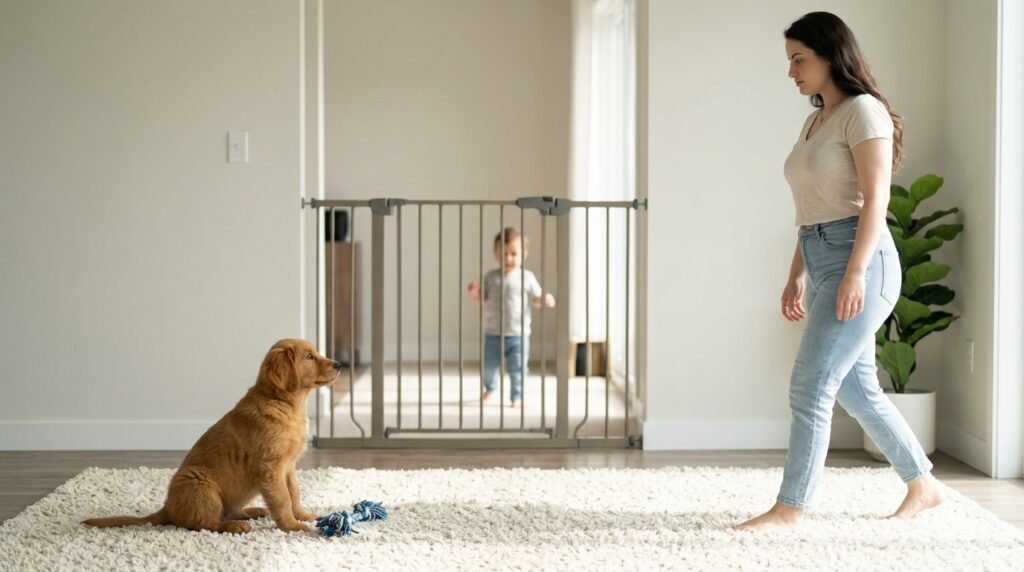
Never encourage a child to perform a trade. An adult should manage the environment, and a professional should design the behavior plan when a dog guards from children.
Do not punish the growl
A growl communicates discomfort and warns that the dog needs distance. Punishing it may suppress that warning without changing the underlying fear.
The next incident may then appear to happen “without warning” because the dog has learned that growling brings punishment. The American Veterinary Society of Animal Behavior recommends reward-based training and advises against aversive methods for training and behavior problems.
Hitting, yelling, pinning, leash corrections, shock collars, and “alpha” techniques can increase fear and create a more dangerous association with approaching people. These actions can also damage the trust needed for safe behavior modification. For more on everyday interactions that undermine security, see habits that destroy dog trust.
How to Manage Dog Resource Guarding: 7 Safe Steps
Management does not mean you have failed to train your dog. It prevents rehearsals, reduces bite risk, and creates the safety needed for learning.
1. Identify the exact guarding pattern
Keep a private log that records:
- What item or location was involved
- Who approached
- The distance at which the dog reacted
- The first body-language change
- Whether another animal was present
- What happened immediately before and after
- Whether the dog was tired, stressed, ill, or in pain
Do not provoke incidents to collect information. Record only situations that happen naturally, then prevent them from recurring.
A clear pattern helps distinguish food guarding from guarding stolen objects, sleeping spaces, or a particular person.
2. Prevent access to predictable triggers
Put laundry, tissues, trash, children’s toys, and unsafe objects out of reach. Use closed hampers, covered trash cans, cabinets, and doors.
If one particular chew reliably triggers dog resource guarding, stop offering it while you develop a safer plan. Your dog does not need access to every high-value item.
Prevention is especially important when the guarded object creates a repeated cycle:
Dog steals object → person chases dog → dog guards object → confrontation occurs.
3. Separate dogs for meals and high-value items
Feed dogs in separate rooms, crates, or secure areas where they cannot approach one another. Close the barrier before bowls or chews appear and collect items before the dogs reunite.
Do not expect dogs to “work it out.” Even dogs that normally get along may compete over a valuable resource.
Give each dog their own:
- Food bowl
- Water access when conflict occurs
- Resting area
- Enrichment toy
- Chew
- Training space
The Humane Colorado resource-guarding guidance similarly recommends separation around food, treats, bones, and other valuable objects.
4. Establish child-safety rules
Children should never:
- Approach a dog who is eating
- Touch or remove the food bowl
- Take toys or chews
- Crawl into the dog’s crate
- Hug a dog resting with an item
- Attempt a trade
- Test whether the dog will growl
- Punish or confront the dog
Use physical barriers instead of relying only on verbal rules. A closed door, secure gate, or separated feeding room is more reliable than expecting a young child to remember instructions every time.
If dog resource guarding occurs in a home with infants, toddlers, or children who cannot consistently follow safety rules, obtain professional help promptly.
5. Teach a voluntary trade before an emergency
Practice with an object your dog enjoys but does not guard.
- Give the dog the low-value object.
- Present or toss a better reward.
- When the dog releases the object, mark the behavior with “yes” or a click.
- Let the dog eat the reward.
- When appropriate, return the original object.
- End after a few successful repetitions.
Returning safe objects teaches the dog that releasing something does not always mean losing it forever.
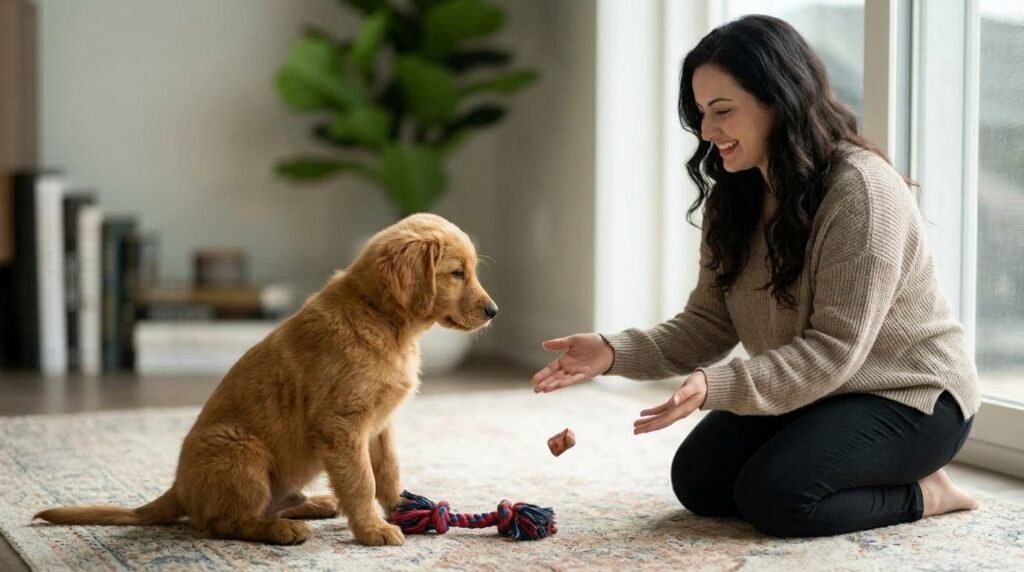
Do not place your hand near the item if the dog becomes stiff, eats frantically, stops accepting food, or watches you intensely. Those signs mean the exercise is too difficult or unsafe.
6. Teach “drop it” without chasing
Begin with a toy that does not trigger guarding. Offer a high-value treat near the dog’s nose and say “drop it” once. When the dog releases the toy, reward immediately.
Over time, pause briefly after saying the cue so the dog has an opportunity to release the item before seeing the food. Continue rewarding successful responses.
“Drop it” should predict a worthwhile outcome—not an angry person pulling something from the dog’s mouth.
A stay cue can also help with general household management, although it is not a treatment for guarding. PawMindTips’ guide to teaching a dog to stay provides a separate foundation exercise.
7. Build positive associations with safe approaches
In mild cases, a qualified professional may recommend counterconditioning: the person appears at a safe distance, something excellent is delivered, and the person moves away.
The basic association becomes:
Person approaches → bonus appears → person leaves
The goal is not merely to stop growling. It is to change how the dog feels about an approaching person.
Stay far enough away that the dog remains loose, eats normally, and can disengage from the resource. If the dog freezes, hovers, eats faster, growls, or refuses the treat, you are too close.
Do not progress by a fixed schedule. Advance according to the dog’s relaxed response.
How Humane Behavior Modification Works
Treatment commonly uses desensitization and counterconditioning.
Desensitization means exposing the dog to a very low-intensity version of the trigger. For resource guarding, this could mean a person appearing many feet away rather than walking directly to the bowl.
Counterconditioning means pairing that low-intensity trigger with something the dog values. The dog learns that an approaching person predicts an additional reward rather than loss.
Veterinary Partner explains that successful management must address the dog’s underlying emotion and motivation, which may involve fear, anxiety, or frustration. Its resource-guarding overview also emphasizes that behavior plans must be adapted to the individual dog.
An example for a mild food-bowl case
Suppose a dog remains relaxed when an adult stands 12 feet away but becomes tense at 8 feet.
A professional plan might begin beyond 12 feet:
- The adult appears briefly.
- A valuable treat is tossed toward the bowl.
- The adult immediately moves away.
- The dog finishes eating without further interruption.
- The exercise is repeated in short, controlled sessions.
Distance is reduced only when the dog consistently remains relaxed and anticipates the bonus. The adult does not reach for the bowl, stand over the dog, or test how close they can get.
The ASPCA’s food-guarding guidance notes that these procedures can be complex. If the dog becomes stressed, stops eating, continues guarding, or fails to progress, the exercises should stop and qualified help should be obtained.
This type of exercise is unsuitable for unsupervised children, dogs with significant bite histories, or situations in which the owner cannot reliably recognize canine body language.
Managing Different Resource-Guarding Scenarios
Food and bowls
Feed the dog in a quiet, low-traffic area. Leave the dog alone while eating, and retrieve the empty bowl only after the dog has walked away and is separated if necessary.
Do not stick your hand into the bowl or remove food while the dog eats. These “tests” can teach the dog that your approach is a genuine threat.
Toys and chews
Rotate toys instead of leaving every item available. Avoid high-value chews that repeatedly produce conflict. Practice trades with safe, low-value objects before working around more valuable ones.
If dogs share a home, provide chews only behind secure barriers.
Stolen objects
Do not chase the dog. Chasing can turn stealing into a rewarding game or increase defensive behavior.
Move calmly, prevent the dog from reaching a confined hiding place, and toss treats away from the object if doing so is safe. Improve storage afterward so the incident is less likely to recur.
Furniture and resting places
If the dog guards a couch or bed, stop physically pushing or pulling them off. Call the dog away from a safe distance and reward movement to another comfortable location.
Until professional guidance is available, restrict access with doors, gates, or furniture arrangement. Never disturb a sleeping dog by grabbing or startling them.
Guarding a person
A dog positioned beside a favorite person may stiffen, block another person, growl, or lunge when someone approaches.
This is not proof that the dog is protecting someone heroically. The person may have become a valued resource, or the dog may feel insecure about proximity and access.
Avoid petting or reassuring the dog while they actively block someone. Calmly create separation without physical confrontation and seek professional guidance, especially if the dog guards against family members.
Guarding between dogs
Resource guarding directed at other dogs is often best controlled through long-term environmental management. Dogs should not have to compete for meals, chews, toys, resting areas, or human attention.
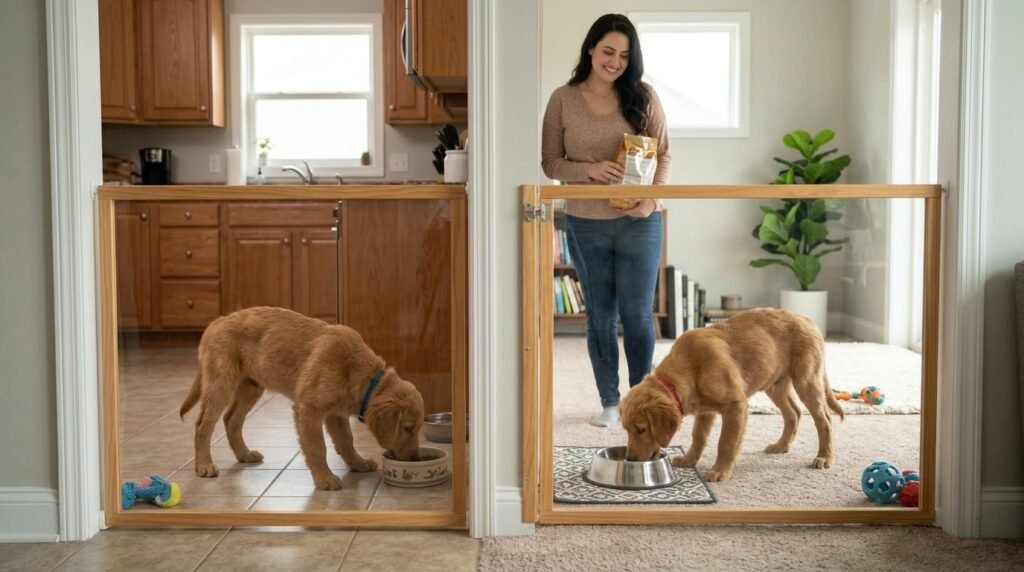
Train each dog separately before practicing calm behavior at a safe distance. Do not punish both dogs or force them to eat near each other.
When to Call a Veterinarian or Behavior Professional
Arrange a veterinary examination when dog resource guarding:
- Begins suddenly
- Becomes significantly worse
- Appears alongside pain, stiffness, or sensitivity
- Starts in an adult or senior dog without a previous history
- Is associated with changes in appetite, sleep, movement, or awareness
- Involves guarding a body part or resting location
- Appears after illness, injury, or medication changes
A veterinarian can assess whether pain, neurological disease, sensory decline, cognitive changes, or another health problem could be contributing.
Seek qualified behavior support when:
- The dog has bitten or made contact with teeth
- Lunging, snapping, or repeated threats occur
- The reactions are becoming more intense
- Children or vulnerable adults live in the home
- The dog guards unpredictable objects
- The dog guards a person
- Conflicts occur between household pets
- You cannot safely prevent access to triggers
- The dog refuses food or becomes tense during training
- You feel frightened or uncertain
Look for a board-certified veterinary behaviorist or an experienced reward-based behavior consultant who regularly handles aggression cases. The American College of Veterinary Behaviorists maintains information about finding veterinary behavior expertise.
Ask any professional:
- What qualifications and relevant experience do you have?
- Have you handled resource-guarding and bite-risk cases?
- Which methods and equipment do you use?
- How will household safety be managed?
- What will happen if the dog growls?
- Will you coordinate with our veterinarian?
Avoid anyone who recommends provoking the dog, removing food by force, punishing growling, using pain or fear, or demonstrating dominance.
Frequently Asked Questions
Can dog resource guarding be completely cured?
Some dogs improve substantially, but no ethical professional can guarantee that guarding will disappear permanently. Successful treatment may include reduced intensity, safer emotional responses, reliable management, and fewer opportunities for conflict. Continue sensible precautions even after improvement.
Should I pet my dog while they are eating?
It is generally unnecessary and may make some dogs uncomfortable. Let your dog eat peacefully. If you need to change an existing guarding response, use a structured plan based on safe distance and positive associations rather than touching the dog or reaching into the bowl.
Why does my dog guard things only from other dogs?
The dog may consider another animal a more likely competitor than a person. Feed pets separately and use barriers for chews and high-value toys. Do not force dogs to share or punish warnings, because conflict can escalate quickly.
Will neutering or spaying stop resource guarding?
Spaying or neutering should not be treated as a direct cure for resource guarding. The behavior often involves learning, fear, perceived competition, and context. Discuss the procedure’s health and behavioral considerations with your veterinarian while addressing guarding through management and an individualized behavior plan.
Conclusion
Dog resource guarding is best understood as an attempt to retain something valuable, not as a battle for household leadership. The behavior can include subtle freezing and blocking as well as growling, snapping, or biting.
Start by preventing access to predictable triggers, separating pets around valuable items, protecting children with physical barriers, and avoiding confrontation. Teach voluntary trades only under safe conditions and use reward-based methods that change what an approaching person predicts.
Never punish the growl or forcibly remove a guarded object. If the behavior is sudden, severe, escalating, directed toward children, or associated with a bite, contact your veterinarian and a qualified behavior professional. With careful management and properly designed support, many families can reduce conflict and create safer, more predictable routines.