Learning how to potty train a puppy can feel overwhelming during those first few days of puppy ownership, especially when accidents seem to happen without warning. The good news is that successful puppy potty training doesn’t require punishment or complicated techniques. It requires a predictable schedule, close supervision, frequent bathroom opportunities, and immediate positive reinforcement.
If you’re wondering how do you potty train a puppy, start by thinking about the process from your puppy’s perspective. A young puppy doesn’t automatically understand that your carpet is off-limits while the grass outside is the correct bathroom. You have to teach that distinction through repetition.
Whether you call the process puppy potty training, house training a puppy, or toilet training a puppy, the goal is the same: help your puppy develop a reliable habit of eliminating in an appropriate location.
Here’s how to do it step by step.
Table of Contents
When Should You Start Potty Training Your Puppy?
Start as soon as your puppy comes home.
You don’t need to wait until your puppy masters sit, stay, or other obedience commands. House training is one of the first routines a new puppy should begin learning.
Young puppies have limited bladder control, so frequent accidents don’t necessarily mean they aren’t learning. Physical maturity develops alongside training.
The American Kennel Club recommends beginning housetraining when a puppy comes home and emphasizes consistency, supervision, schedules, and positive reinforcement.
That means your initial goal shouldn’t be to make an 8-week-old puppy hold their bladder for long periods. Instead, create frequent opportunities for the puppy to eliminate in the correct location.
Think of every successful outdoor potty trip as another repetition of the behavior you want.
As your puppy becomes older and more reliable, you can gradually extend the time between bathroom trips.
Potty training is also part of a puppy’s broader education. Once your puppy begins adjusting to household routines, basic obedience exercises such as teaching your dog to stay can help build communication and impulse control.
How to Potty Train a Puppy in 7 Simple Steps
If you’re asking how can you potty train a puppy without constantly cleaning your floors, prevention is more effective than waiting for mistakes.
The following seven steps form the foundation of a reliable potty-training routine.
1. Choose One Consistent Potty Spot
Decide where you want your puppy to eliminate.
For most families, this will be a specific outdoor area that’s easy to reach quickly.
During early training, take your puppy to approximately the same location each time. Keeping the location consistent helps make bathroom trips predictable.
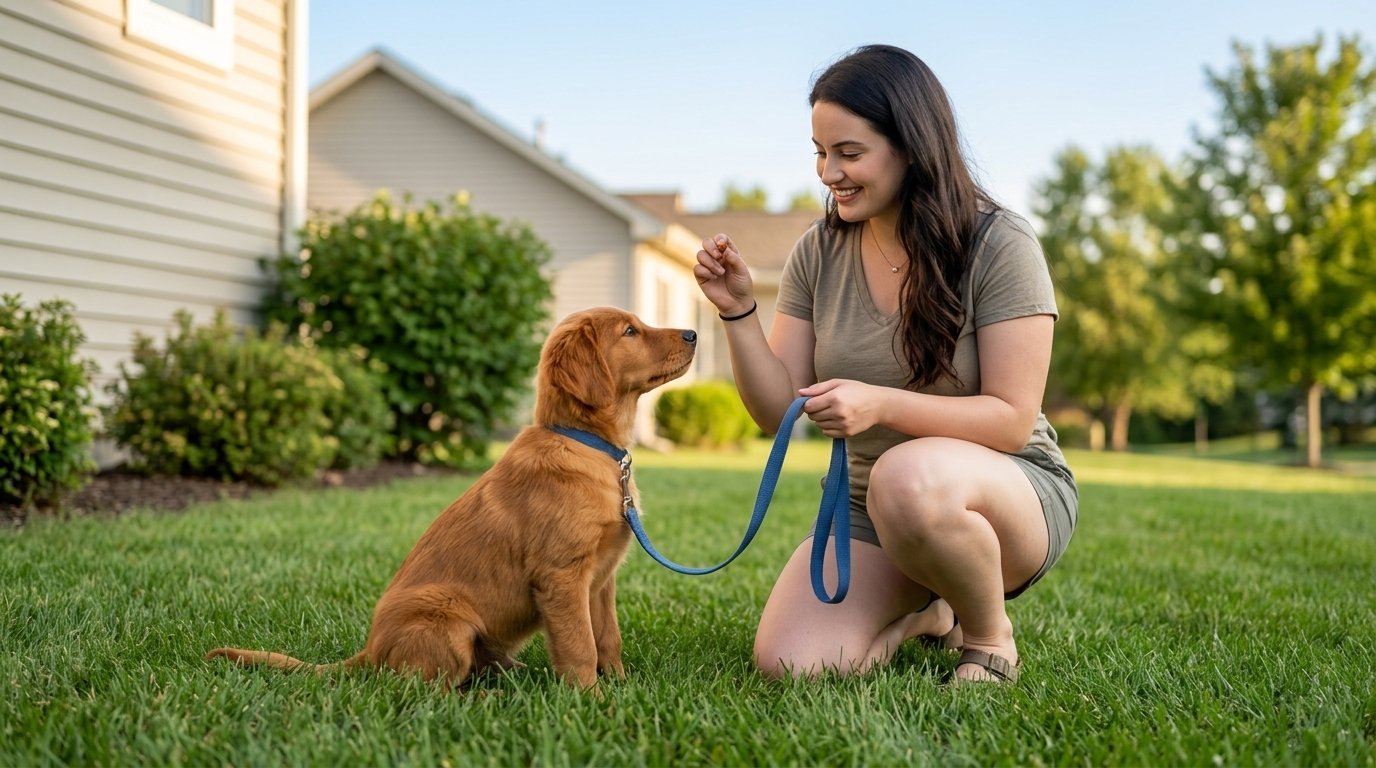
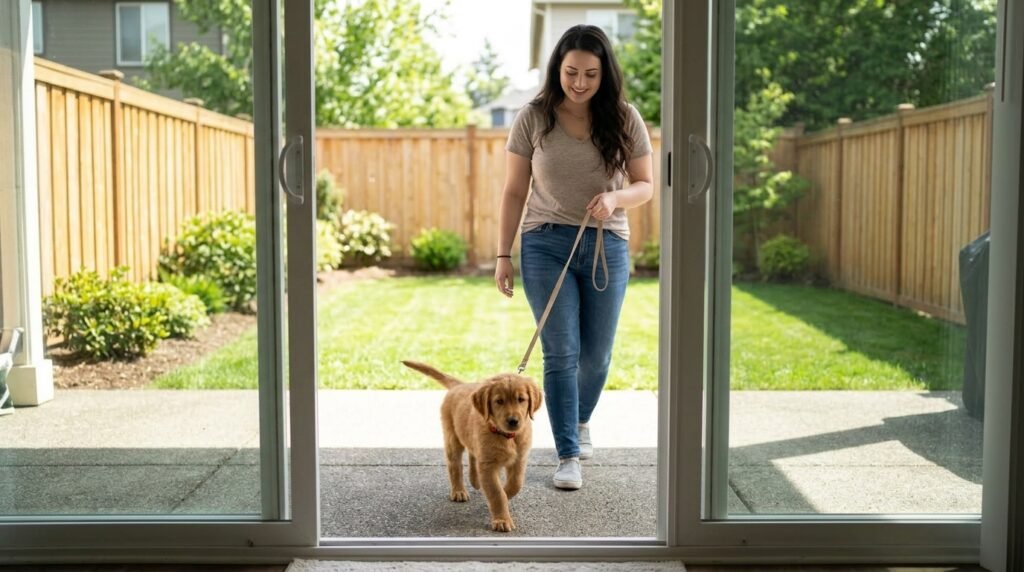
Use a leash even if you have a fenced yard when practical. This prevents the puppy from immediately turning every potty trip into an exciting exploration session.
Once you’re outside, give your puppy enough time to sniff and settle.
Avoid immediately throwing toys, running around the yard, or distracting the puppy.
When your puppy eliminates successfully, praise and reward them.
The sequence should become easy for the puppy to understand:
Potty outside → reward → fun things happen.
2. Create a Puppy Potty Training Schedule
A consistent schedule is one of the most important parts of learning how to potty train a puppy.
Don’t depend entirely on your puppy asking to go outside. During early training, you should proactively provide bathroom opportunities.
Take your puppy outside:
- First thing in the morning
- After waking from a nap
- Shortly after meals
- After drinking
- After energetic play
- After exciting interactions
- Before going into the crate
- Immediately after leaving the crate
- Before bedtime
- Whenever you notice potty signals
Humane World for Animals recommends frequent outdoor trips and specifically emphasizes opportunities after waking, playing, eating, and drinking.
Very young puppies may need to go outside much more frequently than new owners expect.
Don’t assume that because an adult dog can comfortably wait several hours, your puppy should be able to do the same.
A predictable feeding routine can also make bowel movements easier to anticipate.
3. Learn the Signs Your Puppy Needs to Potty
A schedule prevents many accidents, but learning your puppy’s individual signals makes puppy potty training much easier.
Common signs include:
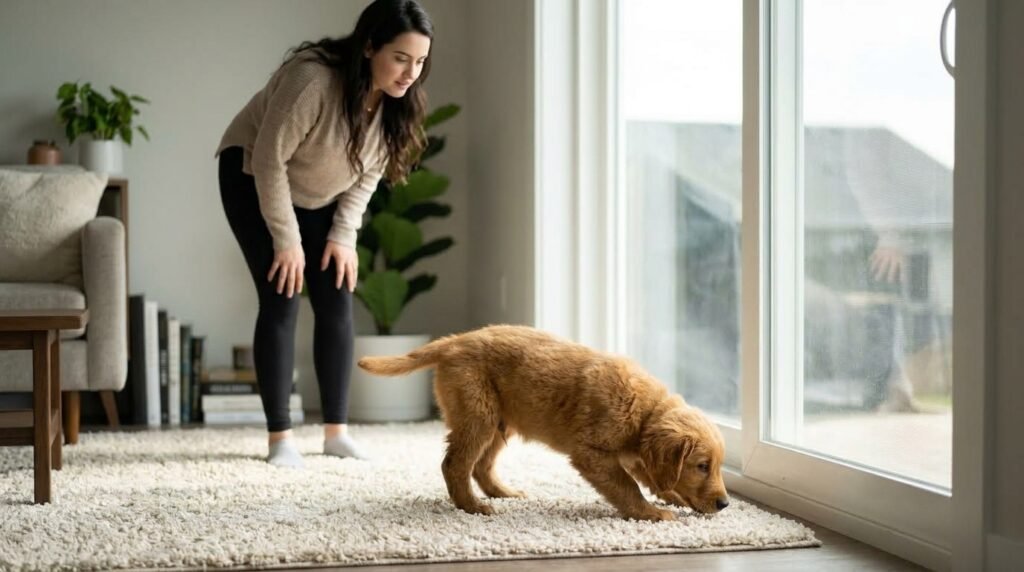
- Sniffing the floor intensely
- Circling
- Suddenly wandering away
- Becoming restless
- Moving toward a door
- Whining
- Returning to an old accident location
- Suddenly stopping play
- Squatting
Dogs Trust identifies behaviors such as sniffing, circling, restlessness, and preparing to squat as signals that a dog may need to eliminate.
Every puppy can develop slightly different signals.
One puppy may walk directly toward the back door. Another might stare at you, pace around the room, or suddenly leave a play session.
Pay attention to what happens immediately before an accident. Those patterns can teach you what your puppy’s warning signs look like.
If you notice one, act immediately.
Don’t wait another five or ten minutes just to confirm your suspicion.
Take your puppy directly to the potty area.
4. Reward Successful Potty Trips Immediately
Owners wondering how do I potty train my puppy should pay particular attention to reward timing.
Your puppy needs to understand exactly which behavior earned the reward.
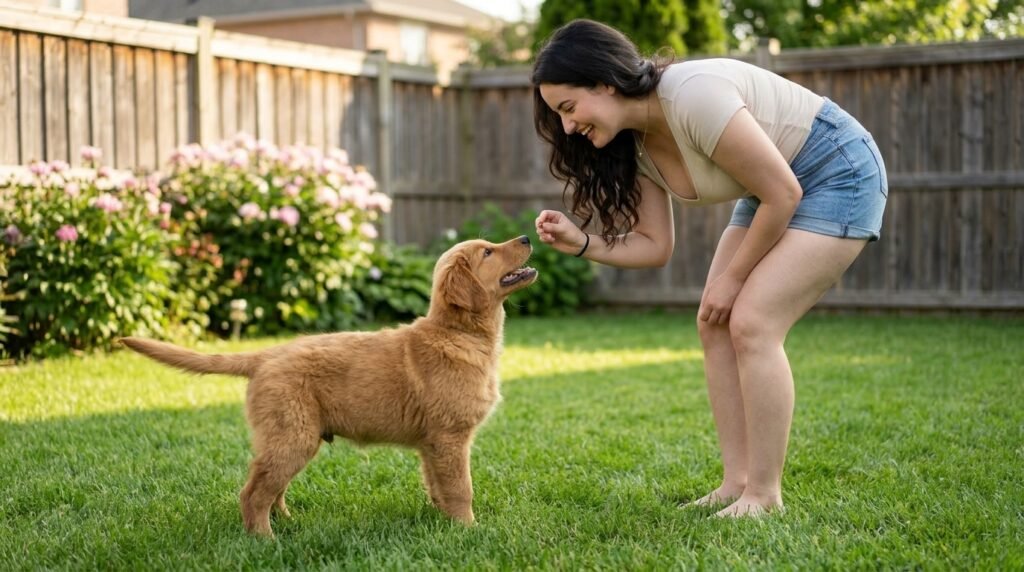
When your puppy finishes eliminating outside, praise them and offer a small treat immediately.
Don’t wait until you’re back inside.
If you walk into the kitchen, open a treat container, and reward the puppy several minutes later, the puppy may associate the reward with entering the kitchen instead of going potty outside.
The clearest sequence is:
Puppy eliminates → finishes → immediate praise and reward.
Positive reinforcement helps make the correct behavior worth repeating.
Best Friends Animal Society recommends rewarding successful elimination while avoiding punishment for accidents.
The same principle applies to other puppy behaviors. Rewarding what you want is generally more useful than waiting for undesirable behavior and reacting afterward. PawMindTips’ good manners training guide explains how consistent reinforcement can help build better everyday habits.
5. Teach a Potty Cue
Once your puppy begins regularly eliminating in the correct location, introduce a simple verbal cue.
You could use:
- “Go potty”
- “Potty”
- “Do your business”
The exact phrase matters less than consistency.
Initially, say the cue when your puppy is beginning to eliminate. After the puppy finishes, reward them.
Over time, your puppy can begin associating the words with the behavior.
Don’t stand outside repeating “go potty, go potty, go potty” to a puppy who hasn’t learned what those words mean.
Build the association gradually.
A reliable potty cue can become especially useful before bedtime, before long car rides, while traveling, or when bad weather makes you want the bathroom trip to be efficient.
6. Supervise Your Puppy Indoors
One of the most common reasons house training a puppy becomes difficult is too much freedom too soon.
Imagine allowing a 10-week-old puppy to wander freely through five rooms.
You get distracted for a few minutes.
Your puppy walks behind the couch, urinates, and returns.
Nobody notices until later.
From your puppy’s perspective, using the carpet worked perfectly well.
That’s why prevention is such an important part of learning how to house train a puppy.
While your puppy is awake and loose indoors, supervise them closely.
When you can’t provide active supervision, use an appropriate puppy-safe area or a properly introduced crate for a reasonable period.
As your puppy becomes more reliable, gradually increase their freedom.
Don’t go directly from one supervised room to unrestricted access to the entire house.
7. Handle Puppy Accidents Calmly
Accidents are part of the learning process.
If you catch your puppy beginning to eliminate indoors, calmly interrupt and take them to the designated potty location.
If they finish outside, reward them.
If you discover the accident after it has already happened, clean it thoroughly and move on.
Do not:
- Yell
- Hit your puppy
- Rub their nose in urine or feces
- Drag them toward an old accident
- Frighten them
- Punish them after the fact
Punishment doesn’t clearly explain where your puppy should eliminate.
It can instead teach the puppy that eliminating around you is unsafe. Some puppies may then start hiding before they pee or poop.
Use an appropriate enzymatic pet cleaner to thoroughly clean accident areas. Lingering odors can encourage a puppy to return to a previously soiled location.
If you’re wondering how do you potty train your puppy after several accidents, the solution usually isn’t harsher discipline. Increase supervision, shorten the time between potty breaks, and give your puppy more opportunities to succeed.
Puppy Potty Training Schedule by Age
There’s no single schedule that works perfectly for every puppy.
Age matters, but so do size, activity, meals, water consumption, sleep patterns, health, and the individual puppy.
A practical starting framework looks like this:
| Puppy Age | Practical Potty Approach |
|---|---|
| 8–10 weeks | Provide very frequent bathroom opportunities, often around every 1–2 hours while awake when appropriate |
| 10–12 weeks | Continue frequent breaks, especially after meals, drinking, naps, and play |
| 3–4 months | Gradually increase intervals as bladder control and reliability improve |
| 4–6 months | Maintain the routine while gradually allowing more household freedom |
| 6+ months | Many puppies can manage longer periods, but individual needs still vary |
These intervals aren’t guarantees.
A puppy who just drank a large amount of water and played energetically may need to urinate much sooner than expected.
Sleeping puppies may sometimes go longer than active puppies.
Instead of treating a chart as a strict rule, use it as a starting point and observe your puppy.
For example, suppose you’re taking your puppy outside every two hours, but accidents repeatedly occur after 90 minutes.
Don’t keep waiting two hours simply because your schedule says so.
Temporarily switch to shorter intervals.
Once your puppy remains accident-free consistently, gradually extend the interval.
That’s a much more effective approach to how to potty train your puppy than expecting the puppy to adapt instantly to an arbitrary schedule.
How to Toilet Train a Puppy at Night
Owners asking how do I toilet train a puppy often find nighttime more challenging than daytime.
The same basic principles apply, but nighttime trips should be calm and uneventful.
Take your puppy outside immediately before bedtime.
If a young puppy wakes during the night and needs to eliminate:
- Take the puppy directly to the potty location.
- Keep lights and conversation minimal when practical.
- Allow enough time for elimination.
- Quietly reward successful potty behavior.
- Return the puppy to their sleeping area.
Avoid turning a 2 a.m. bathroom break into playtime.
Otherwise, some puppies may discover that waking their owner results in attention and entertainment.
Very young puppies may not be physically capable of sleeping through an entire night without eliminating.
If your puppy repeatedly has an accident at roughly the same time every night, set a temporary bathroom break slightly before the usual accident.
As bladder control improves, gradually extend the interval.
This same process answers queries such as how do you toilet train a puppy or how to bathroom train a puppy: create predictable opportunities, reward the correct location, supervise closely, and gradually increase the interval as physical control develops.
How to Potty Train a Puppy With a Crate
A crate can be a useful management tool, but it isn’t a shortcut.
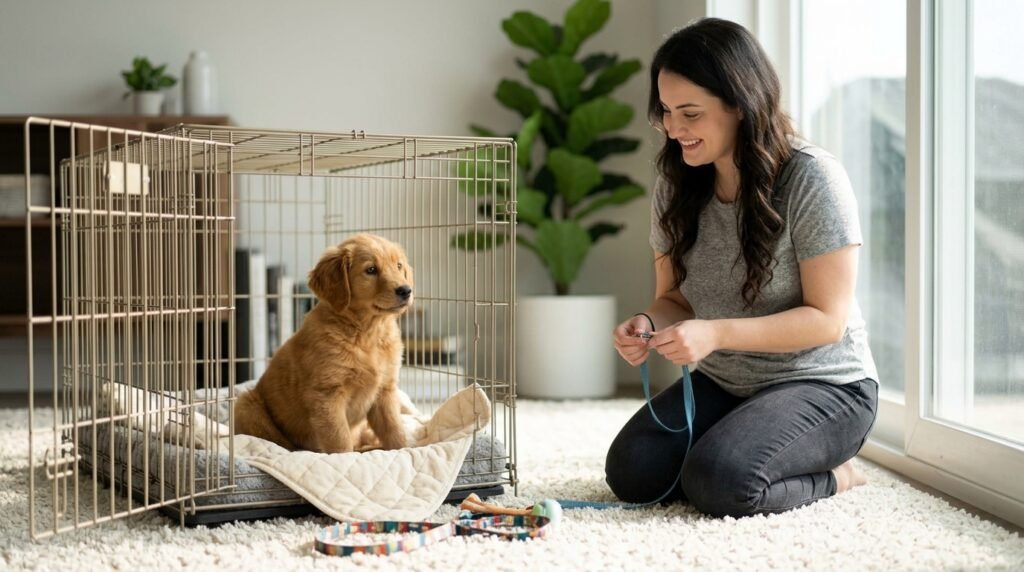
A properly introduced crate gives your puppy a safe resting area and helps prevent unsupervised wandering when you can’t actively watch them.
However, confinement doesn’t magically increase bladder capacity.
A young puppy who physically needs to urinate still needs a bathroom opportunity.
Your puppy’s crate should:
- Allow comfortable standing, turning, and lying down
- Be introduced positively
- Feel like a safe resting space
- Never be used as angry punishment
- Be paired with regular potty trips
- Never be used to force a puppy to wait beyond reasonable physical limits
When you take your puppy out of the crate, head directly to the designated potty area.
Don’t open the crate and then allow the puppy to wander around the living room for 15 minutes first.
That creates an unnecessary opportunity for an accident.
Also watch how your puppy responds emotionally to confinement. Persistent panic or extreme distress can be different from ordinary puppy protest. If you’re concerned about distress when your dog is left alone, PawMindTips’ guide to separation anxiety in dogs explains common signs and management considerations.
Should You Use a Puppy Pad?
A puppy pad can be helpful in certain situations, but consider your long-term goal before making pads a permanent part of your training strategy.
Indoor potty options may be practical when:
- Outdoor access is difficult
- You live in a high-rise apartment
- A very young puppy can’t safely access a shared outdoor area yet
- Mobility limitations make frequent outdoor trips difficult
- You need a temporary indoor toilet arrangement
However, there’s a potential tradeoff.
If your ultimate goal is for your puppy to eliminate exclusively outside, teaching that an indoor surface is an acceptable bathroom may create an additional transition later.
That doesn’t mean puppy pads are inherently bad.
It means you should use them intentionally.
If you choose pads, keep the location consistent rather than putting pads all over the house.
As you transition toward outdoor potty training, gradually make the outdoor location increasingly valuable through praise and rewards.
If you have reliable and safe outdoor access and your long-term goal is outdoor elimination, starting directly with the desired outdoor behavior may be simpler.
Why Does My Puppy Keep Having Accidents in the House?
Even after you understand how to potty train a puppy, accidents can still happen.
Instead of labeling your puppy stubborn, look for patterns.
Potty Breaks Are Too Far Apart
If accidents consistently occur before the next scheduled trip, shorten the interval.
Your puppy is giving you useful information.
Your Puppy Has Too Much Freedom
Reduce access to the house temporarily.
Supervision becomes much harder when a small puppy can disappear into another room.
You Aren’t Recognizing Potty Signals
Watch for sudden sniffing, circling, wandering, restlessness, and changes in play.
Your Puppy Gets Distracted Outside
Some puppies become fascinated by birds, leaves, smells, people, and noises.
Keep the initial potty trip calm and focused.
Play can happen after successful elimination.
Rewards Are Coming Too Late
Reward your puppy immediately after they finish, while you’re still at the potty location.
Your Puppy Didn’t Finish
Some puppies urinate and then need to defecate a few minutes later.
Don’t automatically rush indoors the instant the puppy urinates.
Old Accident Areas Still Smell
Clean previous accidents thoroughly with an appropriate enzymatic cleaner.
Family Members Follow Different Rules
Consistency matters.
Everyone caring for the puppy should understand:
- Where the puppy should potty
- Which door to use
- Which cue you’re teaching
- When bathroom breaks happen
- How successful trips are rewarded
- How accidents are handled
If you’re searching how can I potty train my puppy because progress seems inconsistent, reviewing these environmental factors is often more productive than changing the entire training method.
How Long Does It Take to House Train a Puppy?
There’s no universal deadline for puppy house training.
Some puppies understand the basic concept quickly but continue having occasional accidents while their physical control develops. Others need considerably more time and repetition.
Humane World for Animals notes that housetraining commonly takes several months and that individual factors can affect progress.
Rather than focusing on one deadline, watch for gradual improvement.
Signs your training is working include:
- Fewer accidents
- Longer intervals between bathroom trips
- More obvious signals
- Moving toward the door
- Quickly eliminating when taken to the potty location
- Longer accident-free periods overnight
- Remaining reliable with gradually increased freedom
A few accident-free days don’t necessarily mean training is finished.
Increase freedom gradually.
If your puppy begins having accidents after you expand access from one room to the entire house, reduce the area again.
That’s not failure.
It simply means your puppy wasn’t ready for that level of freedom yet.
When Puppy Potty Problems May Need a Veterinarian
Most accidents during early puppy potty training are training or management issues, but not every change in elimination is behavioral.
Contact your veterinarian if your puppy’s urination or bowel habits seem abnormal or suddenly change.
Pay particular attention to:
- Straining to urinate
- Repeated attempts to urinate with little output
- Blood in urine
- Crying or apparent pain during urination
- A major increase in thirst
- Unusually frequent urination
- Persistent diarrhea
- Vomiting
- Significant lethargy
- Loss of appetite
- A previously house-trained dog suddenly having frequent accidents
Dogs Trust recommends seeking veterinary advice when toileting problems raise concerns because medical causes may need to be ruled out.
Training can’t correct an underlying health problem.
If your puppy appears ill or is having difficulty urinating, prioritize veterinary care rather than simply increasing discipline or confinement.
Common Puppy Potty Training Mistakes to Avoid
Learning how to potty train a puppy becomes easier when you know what not to do.
Waiting for the puppy to ask every time: Young puppies may not know how to signal reliably yet. Provide proactive bathroom opportunities.
Punishing accidents: Punishment can create fear without teaching the correct location.
Giving too much freedom: Household access should expand as reliability improves.
Missing post-play potty trips: Excitement and activity can be followed by a sudden need to eliminate.
Forgetting trips after naps: Take your puppy outside shortly after waking.
Rewarding too late: Keep treats ready so successful outdoor elimination can be reinforced immediately.
Expecting adult bladder control: Physical maturity can’t be rushed through training.
Changing the routine constantly: Consistent schedules, locations, and cues make learning easier.
Using the crate for excessive periods: A crate is a management tool, not a way to avoid providing bathroom breaks.
Stopping supervision too early: Several successful days are encouraging, but they don’t necessarily mean your puppy is completely house trained.
The simplest answer to how do I potty train a puppy is therefore not a secret technique. It’s consistency repeated often enough for the correct behavior to become predictable.
Frequently Asked Questions
How do I potty train my puppy if I work during the day?
Provide a potty trip before leaving and arrange age-appropriate bathroom opportunities while you’re away. A young puppy shouldn’t be expected to wait through a full workday simply because nobody is home. Depending on your situation, a trusted family member, neighbor, pet sitter, or appropriately managed indoor potty area may be necessary.
How do you potty train a puppy quickly?
Focus on preventing mistakes rather than looking for shortcuts. Use frequent scheduled bathroom trips, one consistent potty location, close supervision, immediate rewards, and appropriate confinement when you can’t supervise. Puppies still need time for physical bladder control to mature.
How do you toilet train a puppy that keeps having accidents?
Temporarily shorten the interval between bathroom trips and increase supervision. Track when accidents occur and look for patterns involving meals, drinking, naps, play, or excessive freedom. Clean accident areas thoroughly and reward correct elimination immediately. If urination seems unusually frequent or your puppy appears unwell, contact your veterinarian.
How do you potty train your puppy without punishment?
Prevent accidents with supervision and frequent bathroom opportunities, then reward outdoor elimination immediately. If you catch an accident beginning, calmly move the puppy to the appropriate potty area. If you discover it afterward, simply clean it. Punishing a puppy after an accident doesn’t clearly teach where they should eliminate.
Conclusion
Understanding how to potty train a puppy becomes much simpler once you stop looking for a quick trick and start building a predictable routine.
Take your puppy outside frequently, particularly after waking, eating, drinking, playing, and leaving the crate. Learn your puppy’s individual potty signals, use a consistent bathroom location, and reward successful elimination immediately.
If you’ve been wondering how to potty train your puppy, how to house train a puppy, or how to toilet train a puppy, the underlying method is essentially the same: create frequent opportunities for the correct behavior, supervise carefully, prevent unnecessary mistakes, and gradually increase freedom as reliability improves.
Expect some accidents along the way.
Your puppy isn’t trying to make life difficult. They’re learning a completely new household rule while their bladder and bowel control are still developing.
With patience, positive reinforcement, appropriate management, and a consistent schedule, those frequent bathroom trips can gradually become a dependable lifelong habit.