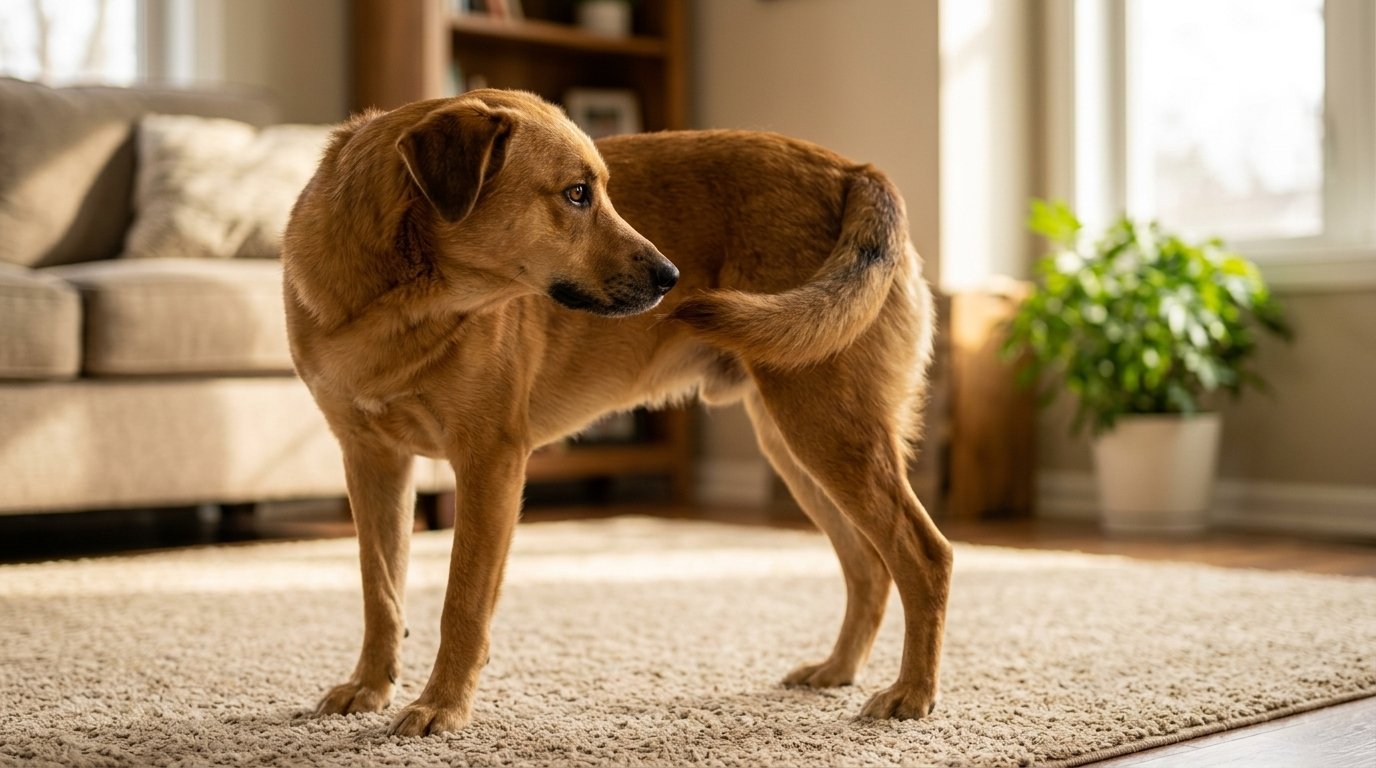
Why do dogs chase their tails? Some dogs do it during play, while others are responding to boredom, attention, itching, pain, or a repetitive behavior problem. An occasional playful turn is different from a dog repeatedly biting their tail or struggling to stop.
The most useful clues are what happens before the chasing, whether your dog can comfortably move on, and whether their skin or everyday behavior has changed. Those details help you decide whether to observe, adjust your dog’s routine, or call your veterinarian.
If your dog is injuring their tail, seems painful, or cannot settle, contact your veterinarian promptly. Collapse, severe bleeding, or ongoing seizure activity needs emergency care.
Table of Contents
Why do dogs chase their tails? Start with the pattern
Tail chasing describes an action, not a diagnosis. Two dogs can make nearly identical circles for very different reasons. One might turn briefly during a playful moment; another might be trying to reach an uncomfortable area.
VCA’s explanation of tail chasing includes playful behavior, learned attention, physical discomfort, and compulsive behavior. Your dog’s age, recent history, and accompanying signs matter more than how entertaining the movement looks.
Use this comparison to organize what you see. It cannot identify the cause by itself.
| Pattern you notice | What to do next |
|---|---|
| A brief, occasional turn during play, followed by normal activity | Observe without encouraging a performance; offer other play opportunities. |
| Repeated episodes during quiet or frustrating periods | Review the context and daily routine; arrange veterinary advice if it persists or increases. |
| Sudden chasing with licking, chewing, tenderness, or visible skin changes | Contact your veterinarian for an examination. |
| Repetitive spinning that interrupts rest, meals, or normal interaction | Seek prompt veterinary assessment. |
| Serious injury, collapse, or seizure-like activity | Contact an emergency veterinary service. |
There is no useful universal rule that a particular number of spins per day is safe. A change from your own dog’s baseline deserves attention, especially if the episodes become harder to interrupt or start affecting normal life.
Also distinguish tail-directed behavior from general circling. If your dog circles without looking toward their tail, describe that accurately rather than assuming it has the same explanation. A short video can capture a difference that is difficult to describe over the phone.
Play, boredom, and learned attention
Puppy exploration and playful movement
Puppies explore moving objects and their own bodies. Brief tail-directed play can happen during that exploration. However, being young does not make repeated biting or frantic spinning harmless.
Watch what your puppy does afterward. Do they return to their toy, walk away, or lie down comfortably? Or do they immediately restart and keep targeting the same spot?
You do not need to turn an isolated playful moment into a training emergency. Keep suitable toys available, provide ordinary interaction, and avoid deliberately provoking another round for a video. If the behavior becomes a pattern, mention it to your veterinarian rather than waiting indefinitely for your puppy to outgrow it.

Too few opportunities for satisfying activity
Think beyond whether your dog has a yard. Ask what they actually do during the day. Time outdoors may involve exploration, but it may also mean standing at the same fence with little to investigate.
A useful daily review includes movement, sniffing, social contact the dog enjoys, opportunities to chew safely, and uninterrupted rest. Note which parts are present and which regularly disappear on your busiest days.
Choose activity that fits your dog’s health and preferences. Understanding how much exercise a dog needs can help you plan around age, ability, and energy level. Increasing strenuous exercise indiscriminately is not a substitute for investigating a new behavior.
A response that earns attention
Your reaction may become part of the routine. If everyone looks up, laughs, or starts playing when the dog turns toward their tail, that response can make the action worth repeating.
Notice whether the sequence is consistent: you begin a phone call, the dog spins, and you stop talking to engage them. That is useful information, but it does not prove attention is the only cause.
Give your dog opportunities to receive attention before that sequence starts. Invite a calm interaction or prepare an appropriate activity before sitting down to work. When your dog approaches quietly, acknowledge that approach instead of overlooking it until they do something more dramatic.
Itching, irritation, and pain around the tail
A dog repeatedly reaching backward may be trying to address discomfort. Look for licking, chewing, hair loss, an unusual tail position, or reluctance to sit. Observe gently; do not force an examination if your dog pulls away or appears painful.
Fleas and irritated skin
Fleas can cause biting and overgrooming, including irritation near the tail base. You may notice thinning fur or redness, but failing to find an actual flea does not exclude the problem. Cornell describes these patterns in its guidance on fleas in dogs.
Tell your veterinarian which preventive product your dog receives and when the last dose was given. Use the actual package or a photograph rather than relying on its color or a partial name.
If fleas are involved, treatment may need to address other household pets and the environment as well. Do not combine products or increase doses on your own. Your veterinarian can help select an appropriate plan.
Skin irritation also has causes other than fleas. Chewing is not enough to determine whether an allergy, infection, or another problem is present. A photograph can document changes, but it cannot replace examining the skin.
Rear-end discomfort and injury
Pay attention to where your dog is trying to reach: the tail tip, the base, the skin alongside it, or beneath the tail. Include scooting or changes around bowel movements in your description.
A recent accident matters, even if it seemed minor at the time. Tell your veterinarian about a door closing near the tail, rough play, a fall, grooming, or any new sensitivity to touch. These events do not establish a cause, but they give the examination a clearer starting point.
Do not pull the tail through different positions to test it. Avoid squeezing the anal glands, applying irritating home remedies, or giving human pain medicine. Ask your veterinarian how to prevent further chewing safely while you arrange care.
Stress and compulsive tail chasing
Some repetitive behavior occurs when dogs are frustrated or highly aroused. Watch for a consistent situation: visitors arriving, activity beyond a window, noisy household routines, or difficulty settling after excitement.
The Merck Veterinary Manual’s discussion of repetitive behavior distinguishes stress-related displacement behavior, stereotypies, and compulsive disorders. A dog that briefly redirects activity during frustration is not automatically experiencing a compulsive disorder.
Concern increases when repetition becomes difficult to stop, appears outside the original situation, or interferes with ordinary activities. German Shepherd Dogs and Bull Terriers are among breeds with a recognized predisposition to spinning or tail chasing, but breed alone cannot diagnose the problem.
A veterinarian must consider physical causes before concluding that the behavior is compulsive. The behavior’s appearance cannot reliably separate discomfort from a behavioral disorder at home.
In everyday life, reduce unnecessary pressure while you seek advice. A quieter space and more predictable interactions may help a dog cope with a difficult situation. Practical ways to help a nervous dog feel safer can support that approach.
Describe the circumstances without assigning a motive. “He started when three visitors entered and continued after they sat down” is more useful than “He was being jealous.” Specific observations leave room for your veterinarian to consider several explanations.
What to record before calling your veterinarian
You do not need a complicated tracker. A phone note can capture enough information to make an appointment more productive. Do not delay care to complete a log if your dog is uncomfortable or injured.
For each naturally occurring episode, record:
- Time and setting: Where was your dog, and who was present?
- What came first: Play, a noise, a departure, grooming, or nothing obvious?
- The movement: Looking backward, circling, licking, biting, or several of these?
- Duration: Use a clock when practical instead of estimating from memory.
- Response: Did your dog notice a familiar, gently spoken cue?
- Afterward: Did they rest, resume normal activity, or begin again?
- Other changes: Skin, appetite, sleep, movement, stool, or sensitivity to handling.
For example: “Tuesday, 7:10 p.m., living room. Started while dinner was being prepared. Turned toward tail several times, then licked the base. Looked up when called and went back to licking.” This provides more information than simply labeling the episode “bad.”
If it is safe, record a short video from a comfortable distance. Include the dog’s whole body and a little of the surrounding scene. Do not corner the dog, create a trigger, or let an injury continue to obtain better footage.
Also note episodes you might otherwise miss. If a household member sees the behavior during the day, ask them to describe it in the same straightforward format. Differences between settings can be useful.
Save the original videos with dates so you can find them easily during the appointment. If several people care for your dog, choose one shared note rather than keeping conflicting accounts in separate messages. Record ordinary, comfortable periods as well as concerning episodes.
Keep interpretation separate from observation. “I think it may be boredom” can be one note; what you actually saw should be another. That makes it easier to reconsider the explanation if the pattern changes.
How to respond safely at home
1. Check the immediate situation
Look for injury, distress, or difficulty staying upright before thinking about training. Give the dog space, move children and other pets away, and reduce nearby hazards if you can do so safely.
Do not grab a spinning dog’s tail or reach toward their mouth. If the dog is hurting themselves and cannot move on, contact your veterinarian for immediate guidance. Repeating louder commands is unlikely to give you useful information.
2. Invite a familiar alternative
For a responsive dog without obvious distress, try a calm, familiar cue. An easy walk toward you or a previously learned mat behavior can provide a different activity.
Reward the alternative once your dog performs it. Keep the interaction quiet. The American Veterinary Society of Animal Behavior recommends reward-based training and advises against aversive methods.
Practice useful cues at ordinary calm times, too. An unfamiliar instruction is much harder to use when your dog is already occupied. Start in a quiet room, ask for something simple, reward success, and finish before the exercise becomes frustrating.
3. Plan ahead of predictable moments
If your notes reveal a regular pattern, prepare before it starts. For example, arrange a comfortable resting space before visitors arrive or provide a suitable activity before your evening work call.
Avoid creating a routine in which spinning is always the first step toward receiving a treat. Reinforce calm choices throughout the day, including moments when your dog is not seeking your attention.
This is a practical timing adjustment, not a reason to withhold help from a distressed dog. Medical discomfort and persistent behavioral problems still need professional assessment.
4. Offer achievable enrichment
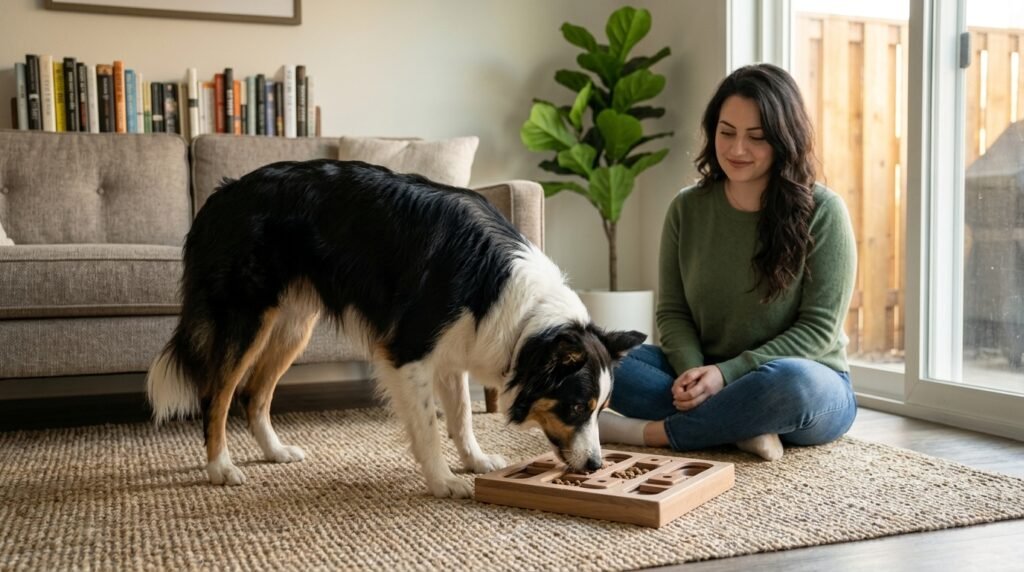
Begin with something easy enough for your dog to enjoy. Options might include sniffing on a relaxed walk, searching for part of a meal in a safe area, or working with a simple food toy under supervision.
Choose items suited to your dog’s size and chewing habits. Remove damaged toys, and account for food used in activities within the daily feeding plan. If a puzzle creates frustration, simplify it rather than assuming your dog needs a harder challenge.
These indoor dog enrichment ideas offer activities for days when outdoor conditions limit your options. Keep an eye on whether your dog actually enjoys the activity and can settle afterward.
5. Protect rest and review the result
A schedule should leave room for quiet periods. Give your dog a comfortable place where household members will allow them to rest. Avoid repeatedly waking or engaging them simply because you are trying to prevent boredom.
Review more than the number of episodes. Is your dog comfortable? Is the skin improving? Can they eat, sleep, and interact normally? Are the episodes becoming more intense even if there are fewer of them?
Bring those changes to your veterinarian. A home adjustment that seems helpful does not rule out an underlying medical issue, and persistent symptoms should not become a prolonged trial of increasingly elaborate toys.
When your dog needs veterinary care
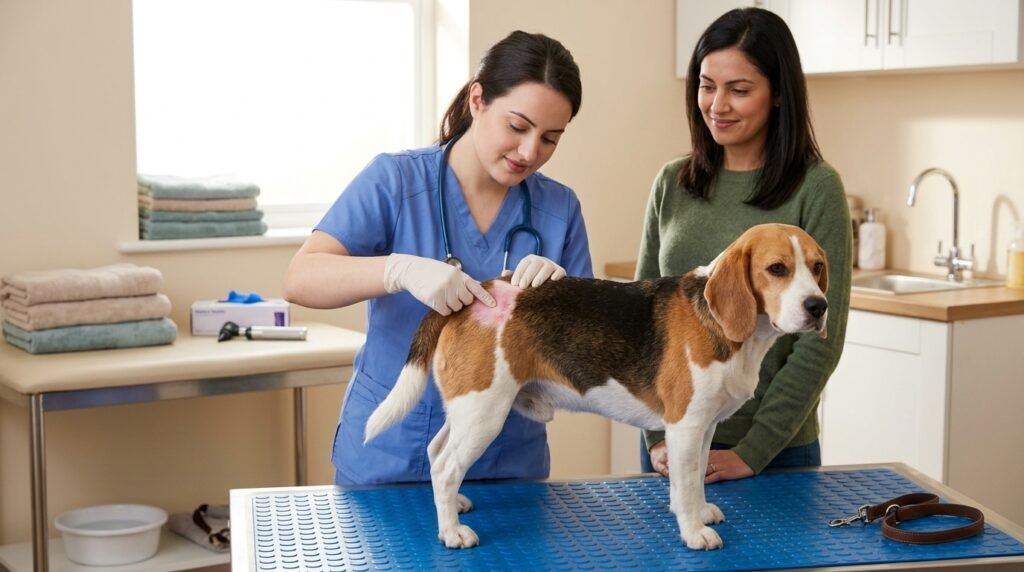
Arrange an examination for new, recurring, or increasing tail chasing, particularly when it includes biting or other changes. Call sooner if your dog seems painful, develops damaged skin, or cannot rest normally.
An older dog’s new spinning or tail chewing should also be investigated. Do not assume it is simply aging. Tell your veterinarian if you have also noticed changes in awareness, navigation, sleep, or interaction.
Seek emergency guidance for severe injury, uncontrolled bleeding, collapse, inability to stand, or seizure-like activity. A seizure lasting more than five minutes or multiple seizures within 24 hours is an emergency, according to Cornell’s guidance on seizures and epilepsy in dogs. Start contacting veterinary help as an episode continues; do not wait for a stopwatch threshold before asking for advice.
Tail chasing by itself does not establish a seizure disorder. If your dog appears unaware, has abnormal movements, or seems confused afterward, describe those details. Keep your hands away from the mouth and follow the clinic’s instructions.
When calling, lead with the immediate concern: “My dog is biting the tail and has broken the skin,” or “My dog is circling and cannot stand normally.” Then provide the timing, current condition, and relevant history. This helps the clinic assess urgency.
What happens at the veterinary appointment
Your veterinarian may examine the skin, tail, rear end, movement, and nervous system, depending on the signs. They will also ask about medications, parasite prevention, the home environment, and how the behavior developed.
The Merck Veterinary Manual’s guidance on diagnosing behavior problems emphasizes medical evaluation alongside a detailed history. Videos can help when the behavior does not happen during the consultation.
Bring your notes, recordings, medication list, and preventive product information. Mention treatments or routine changes you have already tried, including whether they helped and for how long.
Useful questions include:
- Which possible causes are being investigated first?
- What should I do if another episode starts at home?
- Does the tail need protection from further chewing?
- Which changes would mean calling sooner?
- When should we reassess the plan?
Treatment depends on the findings. A physical problem needs targeted care; a behavioral condition may need environmental changes and a structured behavior plan. Some dogs also benefit from prescribed medication. Merck describes medication as part of broader behavior modification and treatment, rather than a replacement for addressing the dog’s circumstances.
Ask whether a veterinary behaviorist or another specialist would be appropriate. A trainer can assist with skills, but medical investigation and prescribing belong with a veterinarian.
Agree on practical measures of progress. These might include fewer injuries, easier settling, restored sleep, or less frequent episodes. Follow-up gives your veterinarian an opportunity to adjust the plan instead of leaving you to guess whether it is working.

FAQs
Is it normal for a puppy to chase their tail every day?
Daily occurrence alone cannot tell you whether the behavior is harmless. Consider duration, intensity, biting, and whether your puppy readily returns to normal activities. Brief exploration may occur, but repeated or increasing episodes deserve veterinary advice, particularly if there is any skin damage.
Does tail chasing mean my dog has worms?
No. Tail chasing is not a reliable way to diagnose intestinal parasites. Several physical and behavioral problems can produce similar actions. Tell your veterinarian about scooting, stool changes, and parasite prevention so they can decide whether testing or treatment is appropriate.
Should I ignore my dog when they chase their tail?
First consider discomfort and safety. Avoid turning harmless attention-seeking behavior into a spectacle, and reward calm alternatives. However, do not ignore biting, distress, injury, or episodes that are difficult to interrupt. Those need veterinary guidance.
Can a dog stop compulsive tail chasing without medication?
Treatment depends on the individual dog and diagnosis. Some management plans emphasize environmental and behavioral changes; others also require medication. There is no guaranteed home cure. Work with your veterinarian and judge improvement by comfort and normal daily function, not just whether spinning briefly stops.
Help your dog move on from tail chasing
Why do dogs chase their tails? The answer depends on the individual pattern: play and learned attention are possibilities, but so are irritation, pain, and a behavioral disorder.
Start with one useful step: observe what happens before, during, and after the behavior. Give your dog safe activities and calm interaction, and contact your veterinarian when the behavior is new, repetitive, painful, or disruptive. Your goal is a dog who feels comfortable and can return to everyday life.