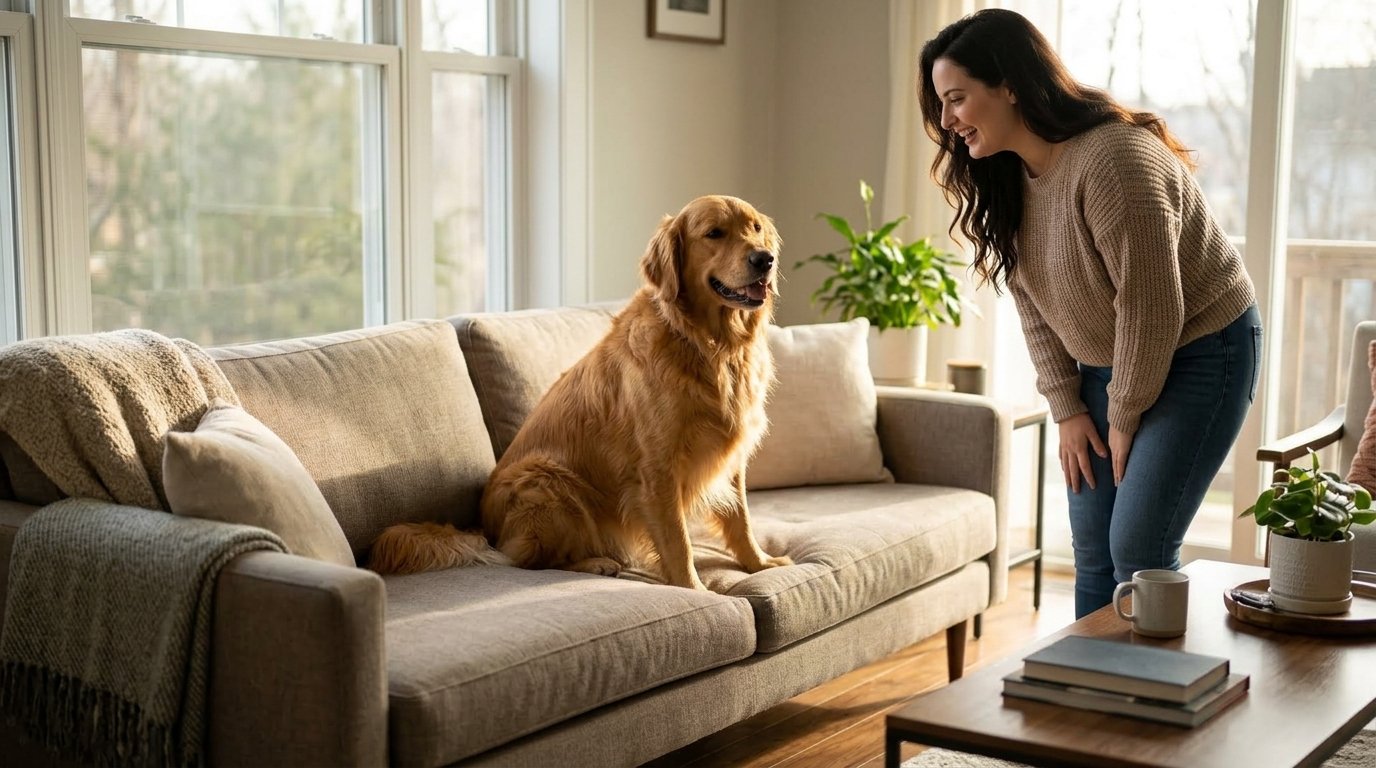
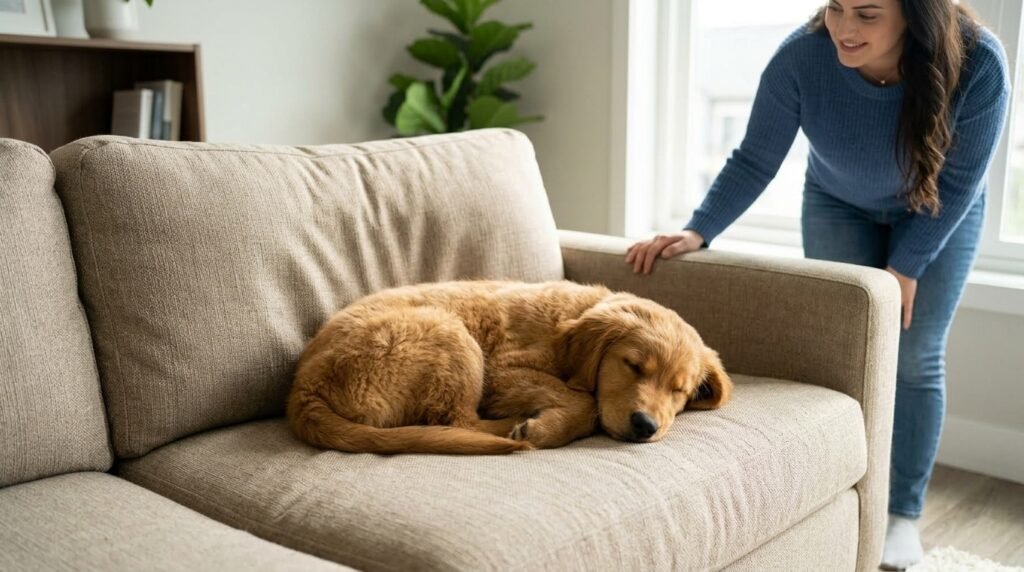
You get up from the couch for two minutes, walk into the kitchen, and come back to find your dog curled up exactly where you were sitting. So, why does my dog steal my seat when I get up?
In most cases, your dog is not trying to challenge you or “take over” the house. Your recently vacated seat may simply be warm, comfortable, familiar, and strongly associated with you. Dogs also learn quickly that certain behaviors lead to attention, interaction, or access to desirable places.
However, context matters. A dog that happily moves when you return is very different from a dog that stiffens, growls, snaps, or refuses to let you reclaim the spot.
Here are seven common reasons dogs steal their owner’s seats, what the behavior may mean, and how to respond if you want your favorite spot back.
Table of Contents
Quick Answer: Why Does My Dog Steal My Seat When I Get Up?
The most common explanations are warmth, your scent, comfort, attachment, attention, learned behavior, and opportunity.
Your dog may have discovered that your seat is:
- Warm from your body
- Softer or more comfortable than other spots
- Filled with your familiar scent
- Close to you
- A predictable resting location
- A reliable way to get your attention
- Simply available the moment you leave
For many dogs, this is completely normal.
The most important clue is what happens when you come back.
If your dog looks relaxed and willingly moves, the behavior is usually nothing to worry about. If your dog becomes tense, freezes, growls, bares their teeth, snaps, or attempts to prevent you from approaching, the situation may involve resource guarding and deserves more careful handling.
7 Reasons Your Dog Steals Your Seat
1. Your Seat Is Warm
Sometimes the explanation is wonderfully simple: your dog likes a warm place to lie down.
If you’ve been sitting on the couch for 30 minutes, the cushion has absorbed some of your body heat. When you stand up, your dog gets an opportunity to enjoy that warmth without doing any of the work.
Dogs naturally seek comfortable resting areas, so a warm cushion can be highly attractive.
This may be especially noticeable when:
- The room is cool
- Your dog has a short coat
- Your dog is small
- Your dog is older
- The furniture is particularly soft
- Your dog already prefers warm sleeping areas
Your dog may not be thinking, “That is my owner’s seat.”
They may simply be thinking, in canine terms, “That looks comfortable.”
If your dog moves when you return without any conflict, there is usually no reason to turn the behavior into a major issue.
2. Your Seat Smells Like You
Scent is an important part of how dogs experience their environment.
The place where you regularly sit carries your familiar scent. To your dog, that can make the spot more recognizable and comforting than another chair that nobody uses very often.
This may help explain why your dog chooses your exact spot even when other parts of the couch are available.
Your scent can be especially appealing to a dog who enjoys staying close to you.
That does not necessarily mean your dog is anxious. It may simply mean your scent is familiar and associated with positive experiences such as food, walks, play, affection, and safety.
In other words, your dog may not be stealing your seat because the furniture itself is special.
The part that matters may be you.
This is also one reason seat-stealing can look especially adorable: your dog may settle into a place that smells strongly like their favorite person.
3. Your Spot Is Simply More Comfortable
Your dog may have discovered that your seat has the best combination of comfort and location.
Think about what makes your favorite chair your favorite.
Maybe it has:
- Better cushioning
- A good view of the room
- A convenient position
- A soft blanket
- Less foot traffic
- Easy access to you
- The perfect temperature
Your dog can make exactly the same calculation.
They don’t need to understand the concept of “my seat” to recognize that one location is better than another.
This is particularly likely if your dog regularly chooses the same chair or cushion even when you are not using it.
In that case, the behavior may have less to do with your departure and more to do with the physical qualities of the location.
4. Your Dog Wants to Stay Close to You
Dogs are social animals, and many form strong relationships with their human family members.
If your dog takes your seat immediately after you get up, the behavior can sometimes be connected to their desire to remain close to you.
They cannot follow you and stay in your chair at the same time, but they can settle in the place you just occupied.
This does not automatically mean separation anxiety.
A dog can be strongly attached to you while still being perfectly comfortable spending time alone.
For example, your dog might follow you around the house, sleep near you, and take your seat when you leave—but still calmly relax in another room when you go out.
That is very different from a dog who panics whenever you disappear.
If you notice broader clingy behavior, you can read more about why dogs follow their owners everywhere and how normal attachment differs from separation-related distress.
5. Your Dog Has Learned That Stealing Your Seat Gets a Reaction
This one is easy for owners to overlook.
Imagine your dog jumps into your seat.
You laugh.
You talk to them.
You pet them.
You say, “Move over!”
You try to negotiate.
Or you offer a treat to get them out.
From your dog’s perspective, something interesting just happened.
They got your attention.
Dogs learn from consequences. If a behavior repeatedly produces something rewarding, they may be more likely to repeat it.
That does not mean your dog is manipulating you in a human sense. It means the behavior has become successful.
For example, if your dog jumps into your chair and you always start a playful conversation with them, your dog may eventually learn:
Empty seat → jump in → human comes over → attention happens.
If you want to reduce the behavior, try making the alternative behavior more rewarding rather than turning seat-stealing into a dramatic confrontation.
6. Your Dog Likes the Routine
Dogs often become very familiar with household routines.
Maybe you sit on the couch every evening.
Maybe your dog naps nearby while you watch television.
Maybe you get up several times during the evening to grab water, make food, or answer the phone.
Your dog can learn these patterns.
Eventually, the moment you stand up may become a predictable cue that your seat is available.
That can turn seat-stealing into a little household routine.
The behavior may become even stronger if your dog has successfully claimed the spot many times before.
Again, this does not require a complicated explanation.
Your dog found something that works.
7. Your Dog May Be Guarding the Spot
This is the situation that deserves the most attention.
Most seat-stealing is harmless.
But sometimes a resting place becomes a resource that the dog wants to protect.
Resource guarding occurs when a dog behaves in ways intended to maintain control over something they consider valuable. That resource can be food, toys, stolen objects, resting places, or even access to a person.
Watch your dog’s body language when you approach.
Potential warning signs include:
- Body stiffening
- Freezing
- A hard stare
- Showing the whites of the eyes
- Lip lifting
- Growling
- Showing teeth
- Snapping
- Blocking your approach
- Lunging
These behaviors are different from a dog who simply looks sleepy and moves over when you ask.
If your dog guards the couch, chair, bed, or another resting area, do not assume the dog is simply being “stubborn.”
It is more useful to treat the behavior as information about how the dog feels about that resource.
Does Stealing Your Seat Mean Your Dog Loves You?
It can be consistent with attachment, but you should not interpret the behavior as proof of love by itself.
Your dog may like your seat because it smells like you.
They may want to remain close to you.
They may associate you with safety and good experiences.
They may also simply like warm cushions.
The best interpretation comes from the entire pattern of behavior.
A dog who takes your seat and then happily moves beside you may be showing a mixture of comfort, attachment, and opportunity.
A dog who takes your seat and becomes distressed when you leave may have a broader anxiety issue.
A dog who guards the seat from you is showing something different again.
So rather than asking what one behavior “means,” look at what your dog does before, during, and after the seat-taking.
Is It a Dominance Behavior?
This is where older dog-training explanations can become misleading.
Some older articles describe seat-stealing as evidence that a dog is trying to become the “alpha” or establish dominance over the household. Modern behavior guidance does not support using dominance as a default explanation for ordinary behaviors like taking a preferred resting place. AVSAB specifically addresses misconceptions around dominance theory and recommends evidence-based, reward-focused approaches instead.
If your dog jumps into your seat and then happily moves when you return, there is little reason to interpret the event as a power struggle.
Instead, consider the simpler explanations first:
Is it warm?
Is it comfortable?
Does it smell like you?
Does your dog enjoy being near you?
Does the behavior get attention?
Has your dog learned that this is a desirable place?
Those explanations are often more useful than assuming your dog is trying to establish household rank.
What Should You Do If Your Dog Steals Your Seat?
If you don’t mind sharing, you may not need to do anything.
But if you want your seat back, you can teach your dog that another resting place is a better option.
1. Give your dog an appealing alternative
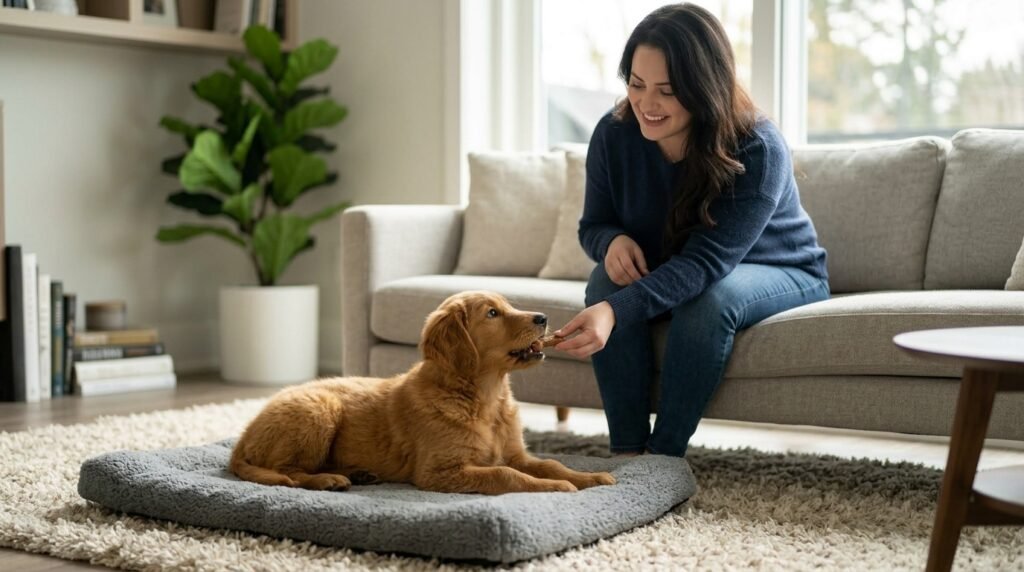
Put a comfortable dog bed or mat near your usual seating area.
The goal is not simply to tell your dog where not to go.
Give them somewhere they genuinely enjoy being.
You can make the alternative more attractive with:
- Comfortable bedding
- A familiar blanket
- Praise
- Appropriate treats
- A safe chew
- A favorite toy
The closer the alternative is to you, the easier it may be for a social dog to accept.
2. Teach a calm “place” or “off” cue
A simple cue can help your dog understand what you want.
When your dog is relaxed, guide them toward their designated resting area and reward them for settling there.
Keep training positive and consistent.
Reward the behavior you want to see.
The American Veterinary Society of Animal Behavior recommends reward-based training rather than aversive or confrontational methods.
3. Reward your dog for choosing their own spot
You do not always need to wait until your dog steals your chair.
If you notice your dog voluntarily lying on their own bed, quietly reward that decision.
This teaches an important lesson:
You don’t have to steal the best seat to get good things.
Over time, your dog may become more likely to choose the alternative independently.
4. Keep your reaction boring
If your dog steals your seat because the behavior reliably produces attention, dramatic reactions can accidentally strengthen it.
Instead, stay calm.
Call your dog to their alternative location or use a cue they already understand.
Then reward the desired behavior.
The goal is to make the correct choice easy and worthwhile.
What If My Dog Growls When I Try to Take My Seat Back?
Take this seriously.
A growl is not something to punish simply because you dislike hearing it. A growl can be a warning that your dog is uncomfortable with what is happening. Dogs may growl when they feel threatened, trapped, or when they are guarding something valuable.
If your dog growls when you approach their resting place:
Do not:
- Grab the collar
- Drag the dog off
- Push the dog
- Yell
- Corner the dog
- Try to physically overpower them
- Punish the growl
Confrontation can increase the risk of escalation.
Instead, create distance and consider getting professional behavior assistance, especially if the dog has snapped or bitten before.
The ASPCA recommends professional help for serious resource guarding, particularly when there is a bite risk.
If children live in the home, take extra precautions. Children may not recognize warning signals or understand that approaching a guarding dog can be dangerous.
How to Tell Harmless Seat-Stealing From a Problem
A simple comparison can help:
| Behavior | More likely harmless | More concerning |
|---|---|---|
| Takes your warm seat | ✓ | |
| Looks relaxed | ✓ | |
| Sleeps comfortably | ✓ | |
| Moves when asked | ✓ | |
| Wags or approaches normally | ✓ | |
| Stiffens when you approach | ✓ | |
| Gives a hard stare | ✓ | |
| Growls | ✓ | |
| Shows teeth | ✓ | |
| Snaps or lunges | ✓ | |
| Prevents you from approaching | ✓ |
This isn’t a diagnosis. It is simply a practical way to notice when an ordinary household habit may be turning into a behavior problem.
Could Seat-Stealing Be Related to Separation Anxiety?
Sometimes it can occur alongside attachment or separation-related behaviors, but seat-stealing alone does not prove separation anxiety.
Look at what happens when you actually leave.
Does your dog:
- Calmly settle down?
- Sleep?
- Play?
- Eat?
- Relax independently?
Or do they:
- Bark continuously?
- Pace?
- Destroy doors or furniture?
- Try to escape?
- Panic?
- Become extremely distressed?
The second pattern is more concerning.
If your dog shows multiple signs of distress when left alone, see our guide to separation anxiety in dogs for a broader explanation of the condition and practical ways to recognize it.
Similarly, if your dog’s behavior reflects fear or nervousness rather than simple attachment, our guide on helping a nervous dog feel safe at home covers safe spaces, predictable routines, body language, and gradual behavior support.
What Not to Do When Your Dog Steals Your Seat
Don’t assume your dog is challenging your authority
A dog taking your chair is not automatically a dominance problem.
Don’t punish the behavior
Punishment can create conflict without teaching your dog what you actually want them to do instead.
Don’t physically force a guarding dog off furniture
If your dog is growling or showing other warning signs, physical confrontation can be dangerous.
Don’t accidentally reward the behavior
If every seat theft turns into treats, cuddles, or an exciting game, your dog may learn that seat-stealing works.
Don’t ignore a sudden behavior change
If your dog suddenly becomes unusually possessive, irritable, or protective of resting areas, consider what else has changed. A veterinarian can help evaluate sudden or significant behavioral changes, particularly when other health or behavior changes are present.
FAQ
Why does my dog steal my seat when I get up?
Usually because the seat is warm, comfortable, smells like you, or gives your dog a desirable place to rest. Attention and learned behavior can also contribute.
Why does my dog sit in my spot instead of their own bed?
Your spot may simply be more attractive. It may be warmer, softer, more elevated, or closer to you. Your scent can also make it especially familiar.
Does my dog steal my seat because they love me?
Possibly. Your scent and proximity can make your seat comforting, but seat-stealing can also have simple explanations such as warmth, comfort, or habit.
Is my dog stealing my seat a sign of dominance?
Not necessarily. Ordinary seat-taking should not automatically be interpreted as dominance. Modern behavior guidance favors looking at the specific circumstances and the dog’s body language rather than assuming a hierarchy problem.
How can I stop my dog from stealing my seat?
Give your dog a comfortable alternative resting place, teach a positive “place” or “off” cue, and reward them for choosing their own spot. Avoid turning the behavior into a confrontation.
What if my dog growls when I try to take my seat back?
A growl is a warning signal that should be taken seriously. Do not punish or physically force the dog away. Create distance and seek help from a qualified behavior professional if resource guarding is suspected.
Conclusion
So, why does my dog steal my seat when I get up?
Most of the time, the answer is much simpler than a canine power struggle.
Your seat may be warm, comfortable, familiar, and filled with your scent. Your dog may enjoy being close to you, like the location, or have learned that jumping into your spot gets a reaction.
For a relaxed dog that happily moves when you return, seat-stealing is usually just another quirky household habit.
The important exception is when your dog becomes tense, growls, snaps, or actively guards the spot. That changes the situation from a funny couch habit into a potential resource-guarding concern.
Rather than trying to prove who is “in charge,” focus on what your dog is communicating and teach the behavior you want through calm, reward-based training.
And if your dog keeps stealing your seat?
You may simply have to accept the truth: your dog has excellent taste in furniture.