A dog who knows how to sit, stay, and come can still struggle with something much less obvious: doing nothing.
If your dog follows you around the house, repeatedly asks for attention, becomes restless while you work, or seems unable to relax when something interesting is happening nearby, learning how to teach a dog to settle can be extremely useful.
Settling isn’t about forcing your dog to stay perfectly still. The goal is to teach your dog that quiet, relaxed behavior is safe and rewarding.
With practice, your dog can learn to lie comfortably near you while you watch TV, work at your desk, eat dinner, talk with visitors, or spend time somewhere with manageable distractions.
And there is an important distinction to make from the beginning:
Settle is not the same thing as stay.
Table of Contents
What Does “Settle” Mean in Dog Training?
A settle is a period of relaxed inactivity.
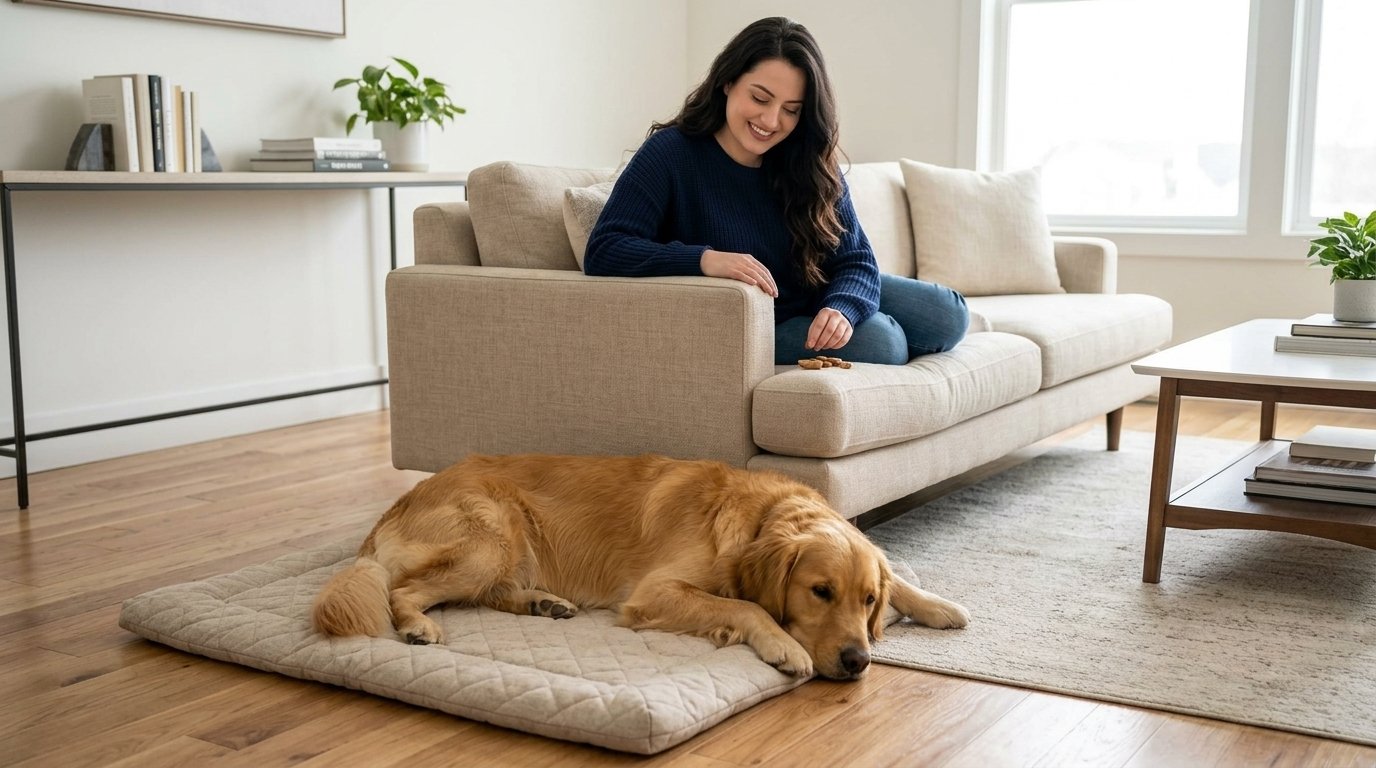
Your dog might lie on a mat, bed, rug, or eventually the floor beside you. They aren’t expected to stare at you waiting for another command. Ideally, their body begins to soften and they gradually disengage from whatever is happening around them.
According to VCA Animal Hospitals’ guidance on teaching settle and calm, the goal is for a dog to become physically and emotionally relaxed. Trainers can gradually reward softer postures such as shifting onto a hip or putting the chin on the floor.
That is different from simply seeing a dog lying down.
A dog can technically be in a down position while remaining highly alert. They might stare intensely at your treat pouch, track every movement in the room, hold their muscles tightly, or look ready to spring up.
That isn’t the type of relaxation we’re trying to build.
Settle vs. Stay: What’s the Difference?
This distinction matters because PawMindTips already has a complete guide on how to teach a dog to stay.
A stay is primarily about maintaining a requested position until you give a release cue.
Settling focuses more heavily on relaxation.
Think of it this way:
| Stay | Settle |
|---|---|
| Maintain a requested position | Relax comfortably |
| Dog may remain alert | Dog should gradually disengage |
| Often involves clear criteria | Allows more natural repositioning |
| Ends with a release cue | May become part of normal downtime |
| Obedience/life skill | Relaxation/self-regulation skill |
Your dog may already know down and stay, which can make early settle training easier. But don’t turn every settle session into a prolonged stay exercise.
You want relaxation rather than rigid compliance.
Before You Teach Your Dog to Settle
Good settle training begins before you reach for the treats.
A dog who desperately needs to potty, hasn’t had an appropriate opportunity for movement or enrichment, or is overwhelmed by the environment may have a legitimate reason for remaining restless.
Start by considering your dog’s basic needs.
Has your dog had an opportunity to relieve themselves? Have they had age- and health-appropriate physical activity? Have they had opportunities to sniff and explore? Do they have somewhere comfortable to rest? Is the room reasonably quiet?
Don’t interpret every inability to relax as disobedience.
Pet Harmony recommends being proactive and considering basic needs and the dog’s resting environment before expecting calm behavior.
You should also choose your training rewards carefully.
For many exercises, an exciting treat is helpful. During settle training, however, a reward that sends your dog bouncing around looking for another piece can work against your goal.
VCA suggests small, relatively low-value treats such as kibble for early calm training if higher-value food makes the dog overly excited.
Gather What You Need
For your first sessions, keep things simple:
- A comfortable mat, blanket, or dog bed
- Small treats or pieces of your dog’s normal kibble
- A quiet room
- A leash if it helps safely limit wandering
- A chair for you
- A few distraction-free minutes
The mat is particularly useful because it creates a consistent environmental signal.
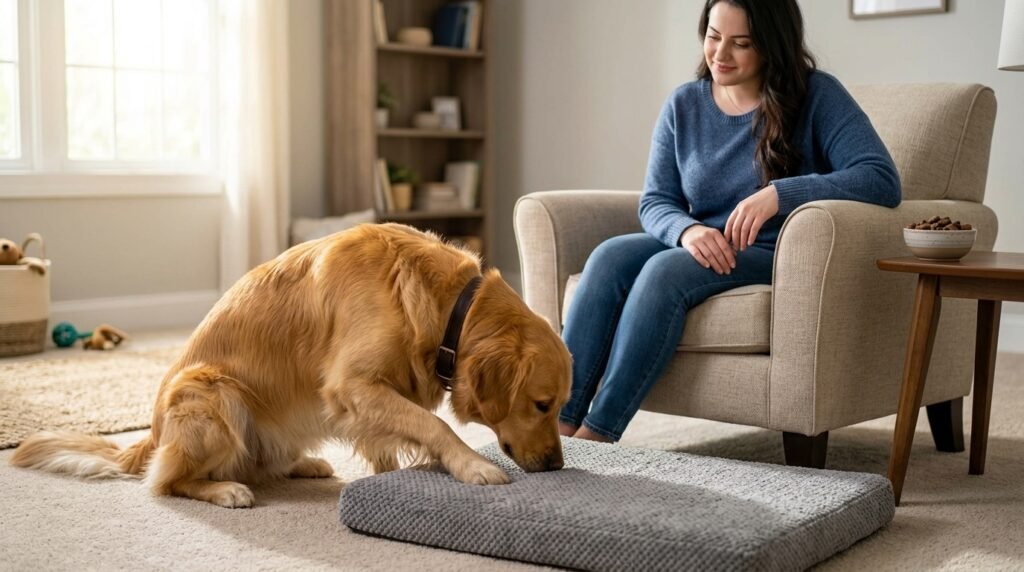
Eventually, your dog should be able to settle without depending completely on that mat. Initially, though, it can help make the exercise easier to understand.
How to Teach a Dog to Settle in 7 Steps
The best way to approach how to teach a dog to settle is to begin with behavior your dog can already offer.
Don’t start in the middle of a family gathering and repeatedly say “settle.”
Teach the skill when nothing interesting is happening first.
Step 1: Start Somewhere Boring
Choose a quiet room in your home.
Turn off unnecessary distractions and put the settle mat beside your chair.
Sit down.
You can allow your dog to investigate the mat naturally. If your dog already knows a comfortable down cue, you can use it to help establish the starting position, but don’t spend the entire exercise repeatedly issuing commands.
The objective is to move from:
“My owner told me to lie down.”
toward:
“Nothing is happening right now, so I can relax.”
Maddie’s Fund’s settle-training guidance similarly recommends beginning in a quiet room and progressively extending the dog’s relaxed period rather than starting in a challenging environment.
Give your dog enough room to sit, stand, turn around, and lie down comfortably.
Then wait.
Step 2: Capture the First Calm Choices
This is where many owners unintentionally miss opportunities.
Suppose your dog stops pacing for two seconds.
That’s progress.
They sit.
Better.
They lie down.
Excellent.
They shift onto one hip.
Even better.
Their head lowers.
That’s exactly the direction you want.
Instead of focusing only on a perfect final position, reward calm behavior as it develops.
Quietly place a treat between your dog’s front paws.
Avoid enthusiastically announcing:
“YES! GOOD DOG! AMAZING!”
Your praise might be wonderful during recall or trick training, but you don’t want your celebration to launch your dog back onto their feet.
Use a soft voice and slow movements.
VCA specifically recommends quiet reward delivery and placing food between the dog’s front feet to reduce the chance that food delivery itself causes renewed excitement.
This teaches an important lesson:
Calm behavior makes good things happen.
The American Veterinary Society of Animal Behavior’s humane dog-training guidance recommends reward-based approaches for dog training rather than aversive methods.
So there’s no need to correct your dog for standing up.
If they get up, simply make the next repetition easier.
Step 3: Reward Relaxation, Not Just Lying Down
Now become more selective.
At first, lying down may be enough to earn food. Once your dog understands that remaining near the mat pays off, begin looking for actual signs of relaxation.
You might notice:
- Muscles becoming loose
- Weight shifting onto one hip
- Head lowering
- Chin resting on the floor
- Soft eyes
- Slower movements
- Less staring at you
- Reduced scanning of the room
- A comfortable side-lying position
- A deep sigh followed by continued relaxation
These details matter.
A dog lying perfectly upright in a sphinx-like down while staring intensely at your hand may be performing a trained position rather than settling.
Don’t worry about forcing a specific posture.
Instead, quietly reinforce progressively softer behavior.

If you’re unsure whether your dog’s body language represents stress rather than relaxation, PawMindTips’ guide to the signs of a stressed dog can help you look at the broader pattern rather than one isolated signal.
Your goal isn’t:
dog lies down = endless treats.
It’s:
dog begins genuinely relaxing = calm behavior is reinforced.
Step 4: Add the “Settle” Cue
Don’t rush to name the behavior.
Repeating “settle, settle, settle” while your dog is walking around doesn’t teach them what the word means.
First create the behavior.
Then name it.
When your dog regularly lies down and begins softening soon after you start the exercise, quietly say:
“Settle.”
Say it once as your dog begins moving into the relaxed behavior you’ve been reinforcing.
Then reward appropriately.
VCA recommends introducing the verbal cue as the dog begins displaying those softer calm postures so the word becomes associated with the behavior.
Over repeated sessions, the sequence can become:
“Settle” → dog lies down → body relaxes → reward.
But remember what the cue means.
You’re not trying to create a stricter version of “down.”
The end goal is calmness.
Step 5: Gradually Increase the Time Between Rewards
At first, you may need to reward frequently enough that your dog understands the exercise.
But if a treat arrives every two seconds forever, you can accidentally create a dog who lies on the mat intensely waiting for the next delivery.
That isn’t relaxation.
Once your dog understands the exercise, gradually increase the gaps between rewards.
For example, you might progress roughly from:
5 seconds → reward
7 seconds → reward
5 seconds → reward
10 seconds → reward
8 seconds → reward
12 seconds → reward
Notice that the intervals don’t have to become progressively harder every single time.
Occasionally making things easier can help maintain success.
Also watch what your dog is doing during the interval.
If they’re resting quietly, that’s excellent.
If they’re staring at your hand, pawing you, whining, or repeatedly getting up to solicit food, your reinforcement process may be creating anticipation rather than relaxation.
Wait for softer behavior when appropriate and quietly reward it.
Eventually, treats should become less frequent.
The environment itself starts communicating:
This is downtime.
This is also why teaching settle can complement PawMindTips’ broader good manners training guide rather than duplicate obedience skills such as sit, down, and stay.
Step 6: Add Distractions One at a Time
A dog who can relax beside you in a silent bedroom doesn’t automatically understand how to settle when the doorbell rings.
Dogs don’t generalize training perfectly.
You need to teach the behavior in progressively more challenging situations.
Start small.
Your distraction ladder might look something like this:
Level 1: Quiet living room
Level 2: TV playing quietly
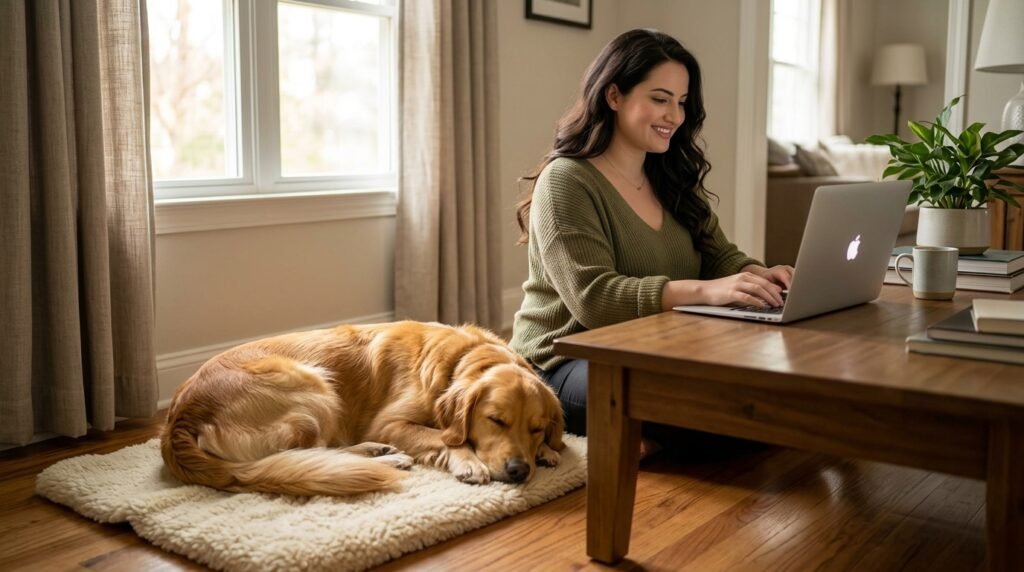
Level 3: You typing at your desk
Level 4: Another family member walking through the room
Level 5: Someone preparing food nearby
Level 6: Backyard or porch
Level 7: Familiar visitor sitting quietly
Level 8: Calm public environment appropriate for your dog
When you increase distraction, reduce another part of the challenge.
For example, if your dog could relax for 15 minutes in the living room, don’t expect the same 15-minute settle immediately when a guest arrives.
Go back to easier, more frequent reinforcement.
VCA recommends essentially returning toward the beginning of the exercise when introducing a new distraction, then gradually rebuilding relaxed behavior.
The AKC’s guidance on canine self-control also suggests reinforcing calm behavior and gradually incorporating moments of calm into more exciting activities.
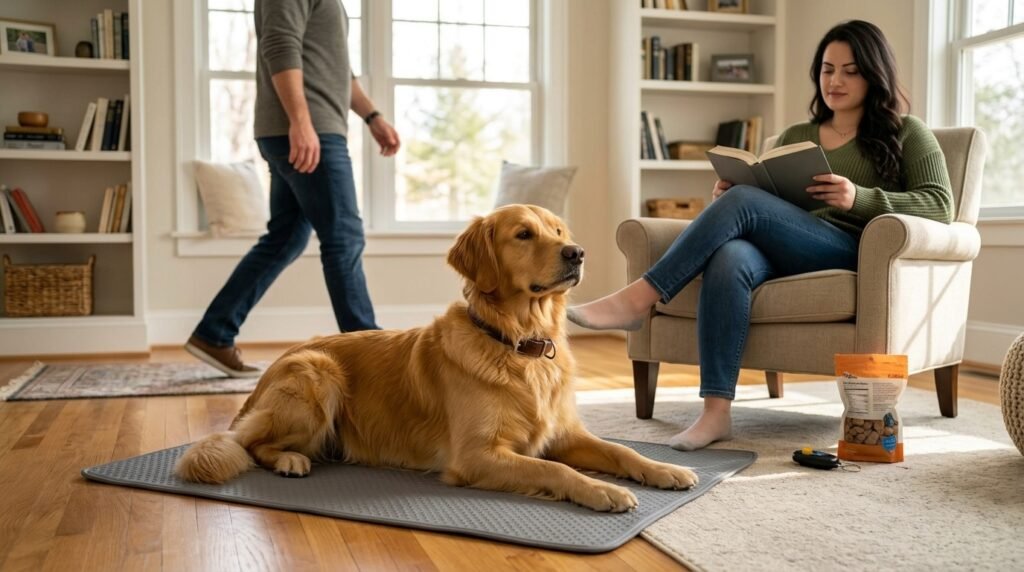
Think:
change one variable at a time.
That’s much easier for your dog than suddenly asking for perfect behavior in an overwhelming environment.
Step 7: Generalize Settling to Everyday Life
This is where settle training for dogs becomes genuinely useful.
Once your dog understands the exercise, start using normal life as practice.
Ask yourself where you’d actually like your dog to relax.
Maybe it’s while you’re:
- Working from home
- Watching television
- Eating dinner
- Reading
- Cooking
- Talking with a visitor
- Sitting outside
- Waiting at an appropriate dog-friendly location
Start with situations your dog can handle.
Don’t assume every dog should eventually lie peacefully at a crowded café, sporting event, or busy restaurant patio.
For some dogs, that environment simply isn’t comfortable.
If your dog is nervous or easily overwhelmed, pushing them into increasingly intense environments isn’t the objective. PawMindTips’ guide on how to help a nervous dog explains why reducing unnecessary pressure and understanding triggers can be more appropriate.
Success means your dog can relax in appropriate situations, not that they tolerate every situation you choose.
How to Reward Calm Behavior Without Making Your Dog Excited
This deserves special attention because rewards can change the emotional tone of training.
Suppose your dog finally puts their head down.
You immediately say:
“GOOD BOY!”
Then you reach dramatically into a noisy treat bag.
Your dog jumps up.
Now they’re staring at you.
They paw your leg.
They’ve gone from sleepy to fully engaged in three seconds.
The reward wasn’t wrong.
Its delivery was too exciting for the behavior being taught.
For settle training, try making reinforcement boring in the best possible way.
Keep treats accessible before you begin.
Move slowly.
Use quiet praise.
Drop or place food low, close to the dog’s paws.
Avoid repeatedly reaching toward a distant treat container.
And don’t assume food is the only thing that can reinforce calmness.
In everyday life, remaining comfortably near you, resting on a favorite bed, receiving gentle attention when appropriate, or simply being allowed to continue relaxing can all become part of the experience.
The broader principle is simple:
Match your reinforcement style to the emotional state you want.
Common Mistakes When Teaching a Dog to Settle
Even a straightforward exercise can become confusing if the criteria change too quickly.
Mistake 1: Starting When Your Dog Is Overexcited
Imagine trying to teach relaxation immediately after your dog has become intensely aroused by visitors.
That’s much harder than teaching the skill beforehand.
Practice how to teach a dog to settle during easy situations first.
Then gradually work toward more difficult ones.
Mistake 2: Confusing Settle With Stay
A stay can look perfectly correct while the dog remains intensely alert.
If your dog is staring at you, holding their body rigidly, and waiting for the next command, they may be performing a stay rather than genuinely relaxing.
Remember:
Stay asks for position.
Settle asks for calmness.
Mistake 3: Repeating the Cue
“Settle.”
“Settle.”
“SETTLE.”
Repeating a cue doesn’t make its meaning clearer.
If your dog doesn’t respond, consider whether the environment is too difficult or whether the cue hasn’t been trained sufficiently yet.
Mistake 4: Increasing Duration Too Fast
Going from 20 seconds to 10 minutes is a huge jump.
Build duration gradually.
Short successful repetitions are more useful than repeatedly testing how long your dog can tolerate the exercise before failing.
Mistake 5: Adding Too Many Distractions
Don’t simultaneously increase duration, distance, noise, people, movement, and environmental novelty.
Make one thing harder while keeping everything else manageable.
Mistake 6: Correcting Restlessness
Don’t punish your dog because they’re struggling to relax.
The AVSAB position on humane dog training recommends reward-based training and advises against aversive methods.
If your dog keeps failing, lower the difficulty.
Mistake 7: Expecting Training to Fix Every Cause of Restlessness
Not every dog who cannot settle simply needs more training.
A sudden change in behavior, persistent pacing, panting without an obvious reason, signs of pain, major sleep disruption, extreme fear, or other unusual symptoms deserve attention beyond a training exercise.
When behavior changes abruptly or your dog appears physically uncomfortable or distressed, contact your veterinarian.
What If Your Dog Just Won’t Settle?
First, determine whether your dog can’t settle or simply hasn’t learned the exercise yet.
Those aren’t always the same problem.
If your dog walks off the mat after 20 seconds but otherwise seems relaxed and healthy, the training may simply be progressing too quickly.
Make the exercise easier.
But if your dog repeatedly paces, pants, vocalizes, startles, hides, freezes, remains hypervigilant, or cannot rest even in familiar environments, look at the larger picture.
The inability to settle can sometimes occur alongside fear, anxiety, discomfort, or other behavioral or medical issues.
Don’t try to overpower those problems with obedience.
For a dog who appears worried, review the environmental triggers and the dog’s overall body language. The existing PawMindTips guide on helping nervous dogs provides a useful next step for distinguishing training difficulty from broader fear-related behavior.
If the behavior is severe, persistent, suddenly new, or accompanied by physical symptoms, consult your veterinarian. A qualified reward-based trainer or veterinary behavior professional may also be appropriate for ongoing behavioral concerns.
FAQs
How long does it take to teach a dog to settle?
There isn’t one fixed timeline. Some dogs begin understanding the exercise within several short sessions, while highly active, easily aroused, young, fearful, or inexperienced dogs may need substantially more practice. Measure progress by increasingly frequent relaxed choices rather than trying to meet a deadline.
Should I use a mat when teaching my dog to settle?
A mat can make early training easier because it gives your dog a consistent location associated with relaxation. Once the behavior becomes reliable, you can gradually practice on other surfaces and in other appropriate environments. Maddie’s Fund specifically recommends eventually practicing settling on different surfaces and in different locations.
Is “settle” the same as “stay”?
No. Stay generally asks your dog to maintain a position until released. Settle focuses on becoming physically and emotionally relaxed. A dog can perform a technically perfect stay while remaining alert and tense, whereas successful settling should gradually produce softer, more comfortable body language.
Can you teach a high-energy dog to settle?
Yes, high energy by itself doesn’t prevent a dog from learning calm behavior. Make sure the dog’s appropriate physical and mental needs are being met, then begin in a low-distraction environment and reinforce very small moments of calm. Increase duration and distractions gradually rather than expecting instant relaxation.
Conclusion
Learning how to teach a dog to settle isn’t about suppressing your dog’s personality or expecting them to remain motionless.
You’re teaching another useful choice:
Sometimes nothing needs to happen.
Start in a quiet environment. Use a comfortable mat. Notice and reward the first small signs of calm. Gradually favor genuinely relaxed body language, introduce the settle cue once the behavior is predictable, increase time between rewards, and add distractions slowly.
Most importantly, distinguish relaxation from obedience.
A dog who learns to switch from activity to genuine rest gains a useful everyday skill—and you gain a companion who is better prepared to relax beside you when life isn’t asking them to do anything at all.