If you have ever watched your dog confidently walk around a dim room while you are still reaching for the light switch, you may have wondered: do dogs have night vision?
Yes—but there is an important distinction.
Dogs are much better at seeing in low-light conditions than humans are. Their eyes contain more light-sensitive rod cells, their pupils can admit more light, and most dogs have a reflective structure called the tapetum lucidum that gives incoming light another chance to stimulate the retina.
But dogs cannot see in absolute darkness. They still need at least some available light for their visual system to work.
Here is how canine night vision really works, what your dog sees after sunset, why their eyes glow, and which nighttime vision changes should prompt a veterinary examination.
Table of Contents
Do Dogs Have Night Vision?
Yes, dogs have excellent low-light vision, but they cannot see in complete darkness.
That distinction is important because “night vision” can sound as though dogs are able to see perfectly in pitch-black conditions. They cannot.
Instead, dogs are biologically equipped to make better use of small amounts of available light. Moonlight, outdoor lighting, a hallway light, or other faint illumination may be enough for a dog to navigate an environment much more effectively than a person can.
Dogs’ eyes have several adaptations that help them collect and use available light, including:
- A retina rich in light-sensitive rod cells
- Relatively large pupils that can allow more light into the eye
- A reflective layer called the tapetum lucidum
- A visual system particularly sensitive to movement
These features make dogs especially capable in dim environments.
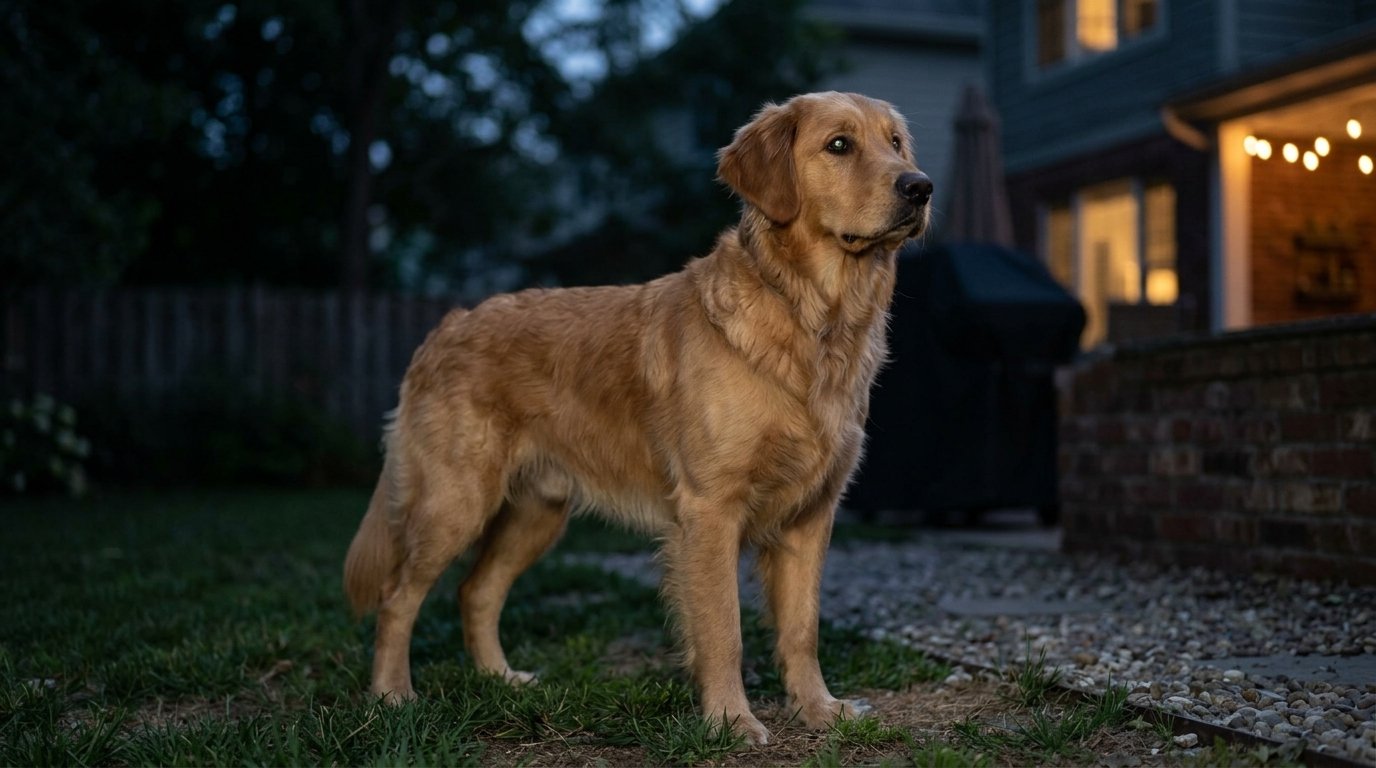
So if your dog walks around the backyard at dusk while you struggle to see the edges of the patio, your dog probably has a genuine visual advantage.
However, if there is essentially zero light, there is nothing for the retina to detect. Your dog then has to rely more heavily on other senses, particularly hearing and smell.
Can Dogs See in Complete Darkness?
No. Dogs cannot see in absolute darkness.
Vision requires light. Even the highly specialized canine eye cannot create an image when there is no light entering the eye.
This explains why a dog can appear remarkably confident outside on a moonlit night but may hesitate in a completely dark room.
There is a major difference between:
Low light:
A small amount of moonlight, streetlight, porch light, or indoor illumination is available.
Complete darkness:
Essentially no visible light reaches the dog’s eyes.
Dogs are particularly good at using the first situation. They do not have special biological night-vision goggles that allow them to see normally in the second.
Veterinary-reviewed sources similarly explain that dogs see substantially better than humans in low light but still require some light to see visually.
That is also why a small night-light can be useful for a dog that has difficulty navigating the house at night, especially an older dog or one experiencing declining vision.
How Dogs’ Eyes Are Built for Low Light
Several parts of the canine eye work together to give dogs their low-light advantage.
1. Dogs Have Many Rod Cells
The retina is the light-sensitive tissue at the back of the eye.
It contains two major types of photoreceptors:
- Rods, which are highly sensitive to low light and movement
- Cones, which are more important for color and detailed vision
Dogs have a retina with a strong emphasis on rods. That makes their visual system particularly useful when illumination is low.
Rods are not designed to give dogs a beautifully detailed, colorful picture.
Instead, they help the dog detect:
- Brightness changes
- Shapes
- Movement
- Objects in dim environments
This is one reason a dog may notice something moving in the yard before you do.
2. Their Pupils Can Admit More Light
The pupil controls how much light enters the eye.
In dim conditions, the pupil becomes larger, allowing more available light to reach the retina.
Dogs can have relatively large pupils, which contributes to their ability to collect light when conditions become darker.
This does not mean that bigger pupils magically create light. They simply help the eye make better use of the light that is already available.
3. The Tapetum Lucidum Gives Light a Second Chance
One of the most fascinating features of canine eyes is the tapetum lucidum.
This reflective tissue sits behind the retina. Light that passes through the photoreceptors without being absorbed can be reflected back toward them, giving the available light another opportunity to stimulate the retina.
That improves sensitivity in low-light conditions.
It also explains something you have probably seen many times: your dog’s eyes suddenly glowing when a flashlight or camera flash hits them.
The glow is reflected light—not light produced by the dog’s eyes.
4. Dogs Are Highly Sensitive to Movement
Dogs are particularly good at detecting movement.
Their rod-rich visual system helps them notice changes in their surroundings, which can be extremely useful when visibility is poor.
This means your dog may detect a moving animal or person in dim light even when you cannot clearly identify what you are looking at.
That does not necessarily mean your dog can see more detail than you can. In fact, canine vision generally sacrifices some fine detail in exchange for other visual advantages.
What Do Dogs Actually See at Night?
A dog’s nighttime view is not simply a brighter version of human vision.
When light levels drop, color and fine detail become less important, while brightness, contrast, shapes and movement become more useful.
Imagine walking through a dim backyard.
You might see a vague dark shape near the fence and wonder whether it is a bush, a chair, or an animal.
Your dog may be better able to notice that something is there, particularly if it moves.
However, your dog is not necessarily seeing a sharp, detailed picture.
Dogs generally have poorer visual acuity than humans. Many dogs have vision around 20/75, although visual acuity varies among individuals and breeds.
That creates an interesting tradeoff:
Dogs are better adapted to detect available light and movement, but humans generally have an advantage when it comes to fine visual detail and a broader range of colors.
What About Color at Night?
Dogs are not completely color-blind.
Their color vision is different from ours because they have two major cone types rather than the three found in humans. Dogs can distinguish blue and yellow particularly well, while many red and green shades are much less distinct to them.
In very low light, however, color becomes even less important because rod cells dominate visual processing.
That means your dog is more likely to rely on brightness, contrast, shape and movement than on identifying the exact color of an object.
If you want to learn more about your dog’s daytime color perception, see our guide on Canine Vision Decoded: What Colors Can Dogs See?
Do Dogs See Better in the Dark Than Humans?
Yes. Dogs generally see better than humans in low-light conditions.
That advantage comes from the combination of their rod-rich retinas, larger pupils and tapetum lucidum.
But “better night vision” does not mean dogs have better eyesight in every category.
Dogs have an advantage in:
- Low-light vision
- Detecting movement
- Using small amounts of available light
- Peripheral awareness in many breeds
Humans generally have an advantage in:
- Fine visual detail
- Color discrimination
- Certain aspects of visual acuity
- Reading small visual information
This is an important distinction.
Your dog may notice something moving in a dark yard long before you do, while you may be better at identifying exactly what the object is once enough light is available.
The canine visual system is not universally “better.” It is adapted differently.
Dogs evolved from animals that benefited from being able to function during periods of relatively low illumination, particularly around dawn and dusk.
Why Do Dogs’ Eyes Glow at Night?
If you have ever pointed a flashlight toward your dog and seen bright green, yellow, orange or another colored reflection, you have seen the effect of the tapetum lucidum.
The tapetum acts somewhat like a reflective surface behind the retina.
Instead of allowing unused light to simply pass through the retina and disappear, it reflects some of that light back toward the photoreceptor cells.
The reflection that escapes back through the pupil is what creates the characteristic “eye shine.”
VCA explanation of why dogs’ eyes glow in the dark
The exact appearance can vary.
Depending on the individual dog and the structures within the eye, the reflection may appear:
- Green
- Yellow
- Blue
- Orange
- Red
The color itself is not a reliable way to determine whether your dog’s eyes are healthy.
Some dogs, particularly certain blue-eyed dogs, may have less obvious tapetal reflection or different-looking eye shine.
So glowing eyes at night are usually a normal consequence of canine eye anatomy—not a sign that your dog can literally see in total darkness.
Can a Dog Lose Its Night Vision?
Yes.
A dog that normally navigates dim rooms confidently may begin struggling with low light because of aging or an eye condition.
One important example is progressive retinal atrophy (PRA), a group of inherited retinal diseases that can gradually cause vision loss.
Night vision is often affected early because the rod cells involved in low-light vision can deteriorate before other photoreceptors.
Cornell Veterinary Medicine’s guide to progressive retinal atrophy
Signs of Possible Night-Vision Problems
Pay attention if your dog suddenly:
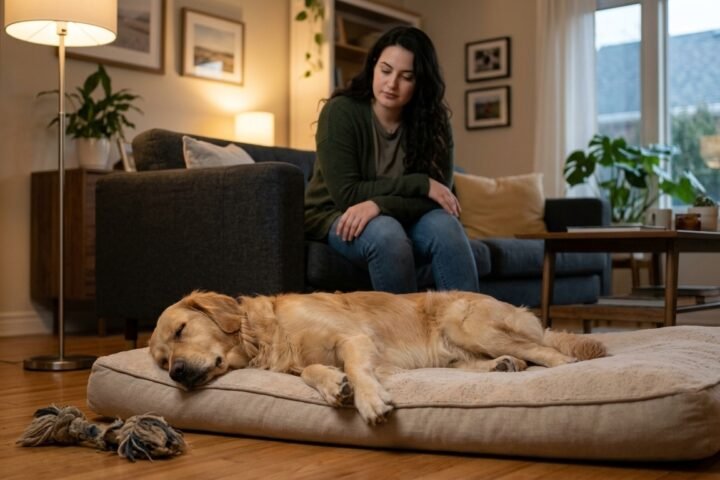
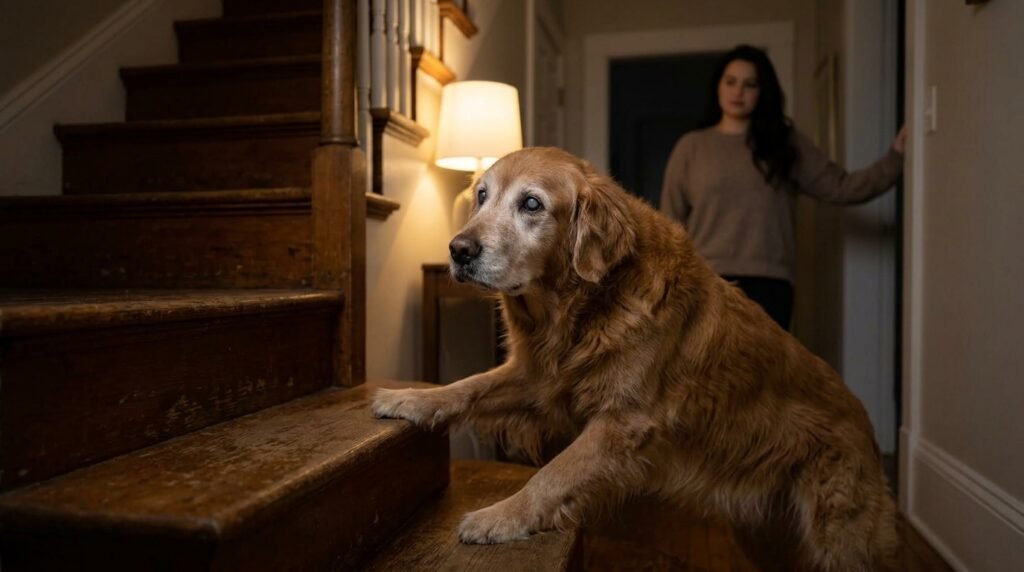
- Hesitates before entering a dark room
- Refuses to go outside after sunset
- Struggles with stairs in dim lighting
- Bumps into furniture or door frames
- Becomes unusually clumsy at night
- Seems nervous in familiar dark areas
- Has unusually dilated pupils
- Has noticeably changing eye appearance
- Becomes less confident moving through unfamiliar places
Cornell Veterinary Medicine specifically lists reluctance to enter dark rooms, hesitation on stairs, bumping into objects and clumsiness in unfamiliar surroundings among signs associated with progressive retinal atrophy.
These signs do not automatically mean your dog has PRA.
Other eye conditions can affect vision, and only a veterinarian can determine the cause.
For additional veterinary background, Merck Veterinary Manual’s information on retinal disorders in dogs explains that night blindness can be an early sign of progressive retinal atrophy.
Why Nighttime Changes Can Be Easy to Miss
Dogs are remarkably good at adapting.
A dog with gradually declining vision may learn the layout of the house and continue moving around familiar areas successfully.
You might therefore notice a problem first when:
- Furniture is moved
- The dog visits a new place
- The lights are turned off
- The dog encounters stairs
- The dog goes outside after sunset
A dog that suddenly behaves differently at night deserves closer observation, especially if the change is new or progressive.
How to Help Your Dog See and Move Safely at Night
You do not need to turn your house into a brightly lit room all night.
A few simple adjustments can make nighttime movement easier.
1. Use Soft Night Lighting
A small night-light in a hallway, near stairs, or in another frequently used area can provide useful illumination.
This can be particularly helpful for senior dogs or dogs with known vision problems.
2. Keep Furniture in Familiar Places
If your dog has declining vision, repeatedly changing furniture arrangements can make navigation more difficult.
A consistent environment gives your dog familiar spatial cues.
Cornell recommends keeping furniture in the same arrangement for dogs experiencing progressive vision loss.
3. Make Stairs Safer
If your dog is hesitating on stairs at night, do not assume they are simply being stubborn.
Improve lighting and consider using a gate where appropriate.
For dogs with significant vision loss, controlled access to stairs may be necessary.
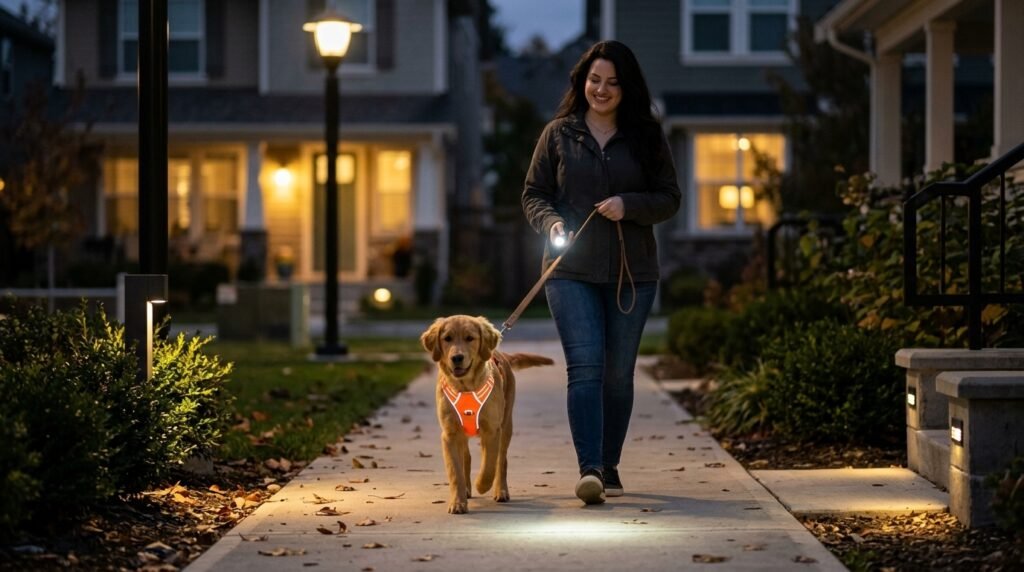
4. Use a Leash Outdoors at Night
Even dogs with excellent vision can encounter hazards at night.
A leash can prevent your dog from chasing wildlife, entering unsafe areas or becoming disoriented.
A flashlight also helps you see hazards that your dog may not identify visually.
5. Keep Pathways Clear
Avoid leaving:
- Shoes
- Boxes
- Toys
- Bags
- Furniture
- Other objects
in pathways your dog normally uses at night.
This is particularly important if your dog’s vision is declining.
6. Do Not Assume a Nighttime Behavior Is a Training Problem
If a previously confident dog suddenly refuses to walk down a dark hallway, do not immediately correct or force them.
The behavior may reflect a genuine visual limitation.
Instead, increase lighting and observe whether the problem persists.
If it does, discuss the change with your veterinarian.
When Should You Take Your Dog to the Vet?
A veterinary examination is appropriate when your dog’s vision appears to be changing, especially if the change is sudden, progressive or accompanied by other symptoms.
Pay particular attention to:
- Sudden difficulty seeing
- Cloudy or abnormal-looking eyes
- Redness or obvious eye discomfort
- Bumping into objects
- Persistent nighttime hesitation
- Dilated pupils
- Difficulty navigating stairs
- Sudden changes in behavior related to vision
- Signs of pain
- Rapid deterioration of eyesight
Some eye conditions can be painful or require prompt treatment, so it is better not to assume that a vision change is simply part of normal aging.
If your veterinarian suspects retinal disease, an examination and potentially additional testing may be needed. VCA notes that specialized testing such as electroretinography can be used when investigating progressive retinal atrophy.
The Bottom Line: Do Dogs Have Night Vision?
Yes, dogs have excellent low-light vision—but they cannot see in complete darkness.
Their rod-rich retinas, relatively large pupils and tapetum lucidum help them make efficient use of small amounts of available light.
That is why your dog may confidently move around a dim room while you can barely see.
But canine night vision has limits.
Dogs still need some light to see, and their nighttime vision is generally better at detecting movement and shapes than fine detail or a wide range of colors.
Most importantly, a sudden change in how your dog navigates at night should not automatically be dismissed as aging or stubbornness. Difficulty in dark environments can sometimes be an early sign of declining vision or an eye disorder.
Understanding how Do Dogs Have Night Vision really works helps you distinguish normal canine abilities from signs that your dog may need extra support—or a veterinary examination.
FAQs
Do dogs have night vision?
Yes. Dogs have strong low-light vision because their eyes contain many rod cells and most dogs have a tapetum lucidum that helps reflect available light back toward the retina. They still need some light to see.
Can dogs see in complete darkness?
No. Dogs cannot see in absolute darkness because vision requires light. They can, however, see much better than humans in many low-light conditions.
Do dogs see better in the dark than humans?
Generally, yes. Dogs are better adapted to dim light because of their retinal rods, pupil size and tapetum lucidum. Humans still have advantages in fine detail and color discrimination.
Why do dogs’ eyes glow at night?
Dogs’ eyes can glow when light reflects from the tapetum lucidum, a reflective structure behind the retina. The glow is reflected light rather than light produced by the eye.
Can dogs lose their night vision?
Yes. Aging and certain eye diseases can impair low-light vision. Progressive retinal atrophy, for example, often affects night vision early in its progression.
How can I tell if my dog is having trouble seeing at night?
Watch for hesitation in dark rooms, difficulty with stairs, bumping into objects, unusual nighttime clumsiness or reluctance to go outside after dark. New or worsening changes should be discussed with a veterinarian.
Conclusion
Dogs have an impressive ability to function in low light, but their vision is not the same as true “seeing in the dark.”
Their eyes are designed to make the most of limited illumination. Rods detect light and movement, larger pupils allow more light into the eye, and the tapetum lucidum reflects light back through the retina.
The result is a dog that can often navigate dim environments far better than a human.
But if your dog suddenly struggles in darkness, hesitates on familiar stairs or starts bumping into objects, pay attention. A change in nighttime vision can sometimes be an early clue that something is affecting the eyes.
Knowing what is normal for your dog is one of the best ways to recognize when something has changed.