A dog broken nail can look alarming because even a small toenail injury may bleed heavily and hurt. Keep your dog still, prevent licking, and apply steady pressure with clean gauze. Do not pull a nail that is firmly attached or cut into painful tissue. If the bleeding will not stop, the nail is torn near its base, the quick is exposed, or your dog is in marked pain, contact a veterinarian promptly.
This guide explains how to assess the damage, give safe first aid, recognize infection, and decide whether a dog broken nail can be monitored at home or needs veterinary treatment.
Important: This article provides general first-aid information, not a diagnosis or substitute for veterinary care. A painful dog may bite even if normally gentle. If you cannot examine the paw safely, stop and call your veterinary clinic.
Table of Contents
Dog Broken Nail Quick Answer: What Should You Do First?
If a dog broken nail has just caused blood, limping, or a dangling fragment, focus on three priorities: keep your dog from running, control bleeding, and prevent more tearing.
- Move your dog to a quiet, well-lit area.
- Prevent licking or chewing, using an Elizabethan collar if one is available.
- Look briefly for a cracked tip, exposed quick, dangling fragment, or injury at the nail base.
- Hold clean gauze or a clean cloth firmly against the nail without repeatedly lifting it to check.
- If bleeding continues, use pet styptic powder according to its label.
- Rinse visible dirt away with sterile saline or clean lukewarm water after bleeding is controlled.
- Call a veterinarian if the damage is deep, painful, contaminated, or still bleeding.
The Merck Veterinary Manual’s guidance for broken nails recommends pressure and a clotting aid such as styptic powder for bleeding. It also advises veterinary help when a damaged piece will not come away easily. That distinction matters: a tiny, painless sliver at the dead tip is different from a fragment connected to sensitive living tissue.
A fast severity check
| What you see | Likely next step |
|---|---|
| Small chip at the tip, no blood, dog walks normally | Smooth only a sharp dead edge if your dog is relaxed; monitor |
| Brief bleeding that stops with pressure, mild tenderness | Contact your regular vet for advice; protect and monitor closely |
| Split reaching the quick, dangling nail, or exposed pink/red tissue | Prompt veterinary evaluation |
| Tear at the nail base, uncontrolled bleeding, severe pain, or possible toe injury | Urgent or emergency veterinary care |
| Redness, swelling, pus, odor, worsening pain, or recurring nail damage | Veterinary examination |
This dog broken nail table is a triage aid, not a diagnosis. A photo sent to your clinic may help its staff advise you, but the veterinarian may still need to examine the toe.
Why a Dog Broken Nail Can Hurt and Bleed So Much
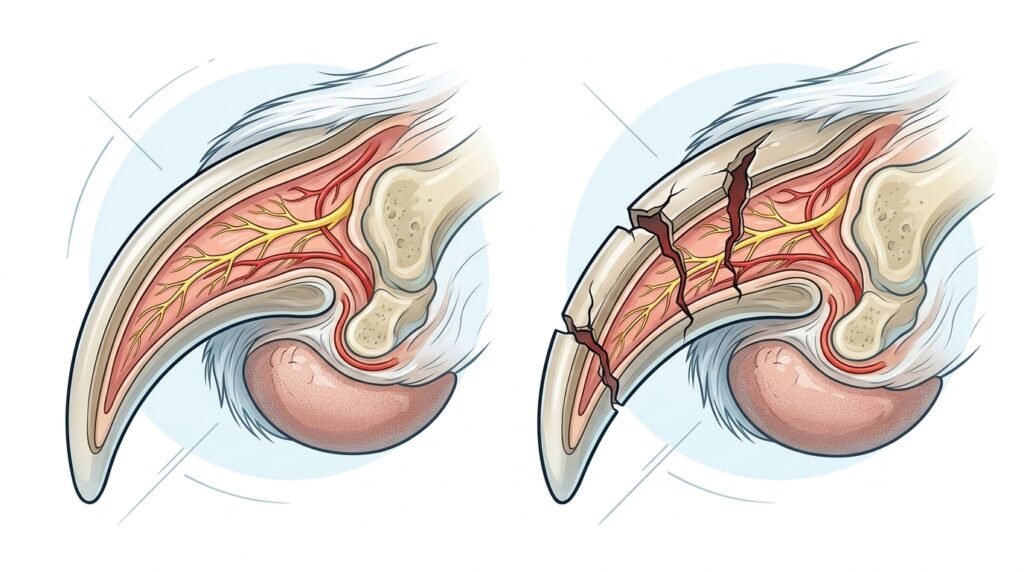
A dog’s nail has a hard outer shell made mainly of keratin. Inside is the quick, living tissue containing blood vessels and nerves. Damage limited to the empty outer tip may cause little discomfort. A split or tear that reaches the quick can produce sharp pain and surprisingly persistent bleeding.
The nail also connects closely with the end of the toe. VCA Animal Hospitals explains that damage involving the quick can create an avenue for infection and that the quick’s connection to bone makes deep infection a serious concern. This is why a nail torn at its base deserves more caution than a superficial chip.
Common dog broken nail signs include:
- Drops or smears of blood on the floor
- Sudden yelping during play, running, or nail trimming
- Holding one foot up or limping
- Repeated paw licking or chewing
- Pulling away when a toe is touched
- A crooked, split, missing, or dangling nail
- Red or exposed tissue where the hard shell has broken
Dogs do not all show pain in the same way. Some whine; others become quiet, pant, hide, resist handling, or simply stop bearing weight. Paw licking alone is not specific to a nail injury—it can also occur with allergies, foreign material, skin irritation, or other discomfort. PawMindTips’ guide to why dogs lick their paws explains those alternative possibilities.
How to Examine a Dog Broken Nail Without Making It Worse
Pain changes behavior. Before reaching for the paw, slow down and assess whether handling is safe. Ask another calm adult to help only if that person can do so without wrestling or frightening the dog. Keep your face away from the dog’s mouth, and do not punish growling; it is a warning that the dog needs space.
If your dog is extremely distressed, trying to bite, or too large to control safely, do not force an examination. Call the clinic and describe what you can see. A veterinarian may need to provide appropriate restraint, pain relief, or sedation before treating the nail.
When your dog allows a brief look:
- Compare the affected paw with the opposite paw.
- Identify which nail is damaged, including the dewclaw higher on the leg.
- Look for active bleeding and determine whether it comes from the nail or surrounding skin.
- Note whether a fragment is barely attached or firmly connected.
- Check for swelling, debris, a cut paw pad, or an object between the toes.
- Observe whether your dog can place the foot on the ground.
Do not probe beneath the nail, twist a dangling piece, or repeatedly flex the toe. Do not assume every limp is caused only by the visible nail; a hard landing can injure the toe, pad, or limb as well. If the toe looks misshapen or your dog cannot bear weight, arrange an examination.
Cooperative paw handling learned before an emergency makes assessment much safer. The PawMindTips guide to real-life care and cooperation describes how predictable, reward-based handling can help dogs feel safer during nail and paw care.
7 Safe First-Aid Steps for a Dog Broken Nail
These dog broken nail first-aid steps are intended to stabilize the injury until you receive veterinary advice. They are not a reason to delay care when the damage is severe.
1. Restrict movement
Bring your dog indoors or into a clean, confined area. Running can restart bleeding and catch a loose fragment. Carry a small dog if this can be done safely. For a larger dog, use a leash and move slowly. Avoid stairs and rough ground.
2. Prevent licking and chewing
Licking can disturb a clot, introduce contamination, and encourage further chewing. Use a properly fitted recovery cone if you have one. Do not rely on constant verbal correction, especially overnight or when you leave the room.
3. Apply steady pressure
Place folded sterile gauze or a clean, lint-free cloth against the nail. Hold continuous, gentle pressure for several minutes. Resist lifting the gauze every few seconds because that can disrupt the forming clot.
If blood soaks through, add material on top while maintaining pressure. Do not wind string, an elastic band, or a tight strip around the toe. If bleeding is heavy, spurting, or continues despite sustained pressure and styptic powder, seek urgent veterinary care.
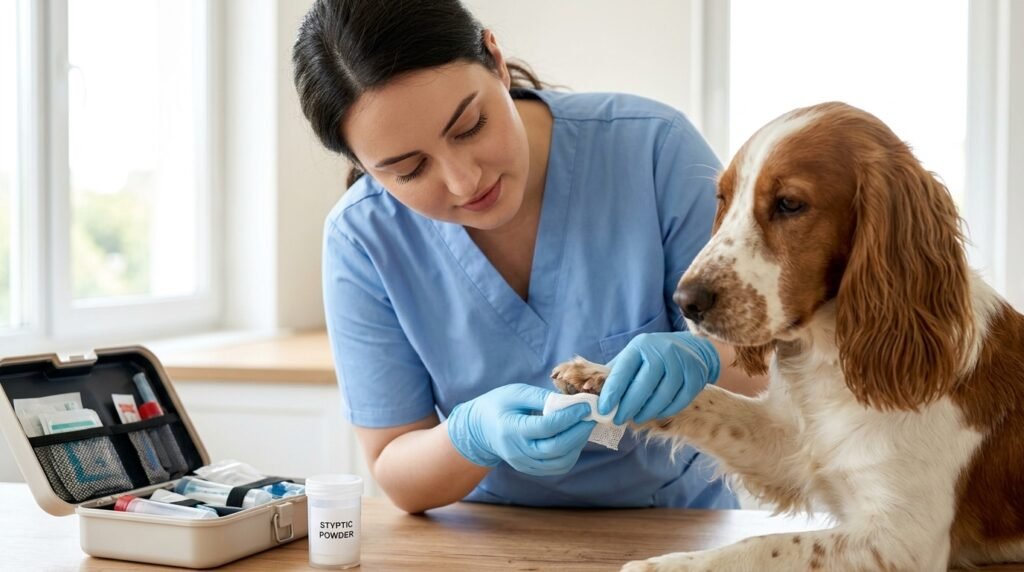
4. Use styptic powder for minor nail bleeding
Pet styptic powder can help control bleeding from the quick. Apply it according to the product label while avoiding the eyes and mouth. Cornstarch or flour may be used as a temporary clotting aid when styptic powder is unavailable, but they do not clean the wound or replace veterinary treatment.
Do not pour alcohol or hydrogen peroxide onto exposed tissue. These products can sting and may damage cells involved in healing. Do not use superglue or another household adhesive on the nail.
5. Rinse away surface dirt
Once bleeding is controlled, gently rinse obvious dirt with sterile saline or clean lukewarm water. Do not scrub the exposed quick. Pat the surrounding area dry with clean gauze.
If the injury is contaminated with soil, gravel, or dirty water, call your veterinarian. Material trapped beneath a split nail may be difficult and painful to remove at home.
6. Leave firmly attached nail pieces alone
A tiny dead tip that is almost detached may sometimes come away without pain, but a split that is still firmly connected can include living tissue. Pulling it may extend the tear, restart bleeding, and cause severe pain. If your dog flinches, cries, resists, or the fragment does not move freely, stop.
MedVet’s broken-nail guidance notes that veterinary care is particularly important when the nail remains painful, keeps bleeding, is cracked, or has an exposed quick. In many cases, safely trimming the damaged portion requires pain control and professional handling.
7. Protect the paw only if you can bandage safely
A nonstick pad with a light, temporary wrap may protect the paw during transport. However, paw bandages that are too tight or left damp can cause swelling, circulation problems, skin injury, or infection. If you have not been shown how to bandage a paw, clean gauze held gently in place for the trip—or simply preventing licking while traveling—may be safer than an improvised tight wrap.
Keep any veterinarian-approved covering clean and dry. Check exposed toes for swelling, coldness, unusual color, or separation. Remove the wrap and contact the clinic if it slips, becomes wet, smells bad, or appears to cause discomfort. Follow your veterinarian’s exact instructions about changing or removing it.
When Does a Dog Broken Nail Need a Vet?
Contact your veterinarian promptly if the quick is exposed or you are uncertain about the depth of a dog broken nail. Even when bleeding stops, the remaining fragment may move painfully with every step and may need to be trimmed back under appropriate pain control.
Arrange same-day or prompt veterinary care when:
- The nail is split into the quick or torn near its base.
- A large or painful fragment is hanging.
- Bleeding restarts whenever your dog walks.
- Your dog persistently limps, holds the paw up, or will not bear weight.
- Pain prevents you from safely examining or cleaning the nail.
- The damaged nail is a dewclaw and continues catching or moving.
- Dirt or another contaminant is lodged beneath the nail.
- Your dog has a condition or medication that could affect clotting or healing.
- Several nails are brittle, deformed, discolored, or falling off.
Seek urgent or emergency care when:
- Bleeding remains active despite continuous pressure and a suitable clotting aid.
- Blood loss appears significant, or your dog becomes weak, collapses, or has pale gums.
- The toe is badly swollen, crooked, crushed, or possibly fractured.
- The nail has been pulled out at the base with a larger open wound.
- Your dog shows severe, escalating, or uncontrolled pain.
- The injury happened with major trauma, such as being hit or caught in machinery.
If you are unsure whether the nearest emergency hospital is necessary, call your regular clinic or emergency facility while maintaining pressure. Describe the bleeding, the location of the tear, whether the quick is visible, and whether your dog can walk.
Over the following days, watch for redness, heat, swelling, discharge, odor, worsening tenderness, renewed bleeding, lethargy, or reduced appetite. These changes can indicate infection or another complication. PawMindTips’ guide to recognizing pain in dogs can help owners notice broader behavioral changes, but persistent pain still requires veterinary assessment.
Never give ibuprofen, naproxen, acetaminophen, aspirin, or leftover prescription medication unless a veterinarian specifically directs you to do so for this dog. Human pain relievers can be toxic or otherwise unsafe for dogs, and appropriate dosing depends on the individual animal.
What Will the Veterinarian Do for a Dog Broken Nail?
Dog broken nail treatment depends on where the nail broke, whether the quick or nail bed is damaged, the degree of contamination, and your dog’s pain and temperament.
The veterinary team may:
- Examine the entire toe and paw for additional injury
- Control bleeding and clean the area thoroughly
- Trim or remove the unstable damaged portion
- Use local anesthesia, sedation, or other pain control when needed
- Apply a protective bandage
- Prescribe dog-safe pain medication
- Treat infection when examination findings support it
- Recommend an X-ray if a fracture, joint injury, or deeper damage is suspected
Antibiotics are not automatically necessary for every small nail chip. The veterinarian will consider how deep and contaminated the injury is and whether infection is present or likely. Do not use leftover antibiotics, creams, or ointments without guidance; some products encourage licking, contain unsafe ingredients, or are not suitable for an exposed nail bed.
A veterinary visit is also an opportunity to ask for written aftercare directions: how long to restrict exercise, whether the paw should be covered, when a bandage needs changing, and what specific signs warrant a recheck.
Healing and Aftercare for a Dog Broken Nail
During dog broken nail recovery, keep activity calm and controlled for the first few days. Use short leash trips for bathroom breaks and avoid running, digging, jumping, rough play, mud, and swimming. If your veterinarian permits a boot or temporary cover outdoors, remove it indoors as directed so moisture does not remain trapped against the injury.
Check the toe at least daily if your dog allows and your veterinarian has not asked you to leave a bandage undisturbed. Look for:
- Dryness and decreasing tenderness
- No fresh blood
- No increasing redness or swelling
- No discharge or unpleasant odor
- Gradual return to comfortable weight-bearing
A surface injury may become comfortable quickly, but a damaged nail takes longer to grow out. Regrowth varies with the extent of injury, the individual dog, and the health of the nail-producing tissue. A full nail can take weeks or longer to look normal. Severe damage to the nail bed may cause altered or incomplete regrowth.
Do not interpret the first pain-free day as permission for full-speed exercise. A partially healed nail can snag again. Resume normal activity gradually and follow any recheck plan.

Persistent licking is not a reliable sign that “healing is happening.” It may reflect pain, itch, infection, or irritation from a wrap. If licking continues despite protection, or the injury seems worse rather than better, call the clinic.
Why Dog Nails Break and How to Prevent Another Injury
A single dog broken nail is often accidental. Common scenarios include catching a long nail in carpet or fabric, digging, running on rough ground, landing awkwardly, or cutting into the quick during trimming. Dewclaws are especially vulnerable because they sit above the weight-bearing toes and may not wear down naturally.
Practical prevention includes:
Keep nails at a functional length
Regular trimming reduces leverage and snagging. The correct interval varies because growth rate, exercise surface, and nail shape differ. A dog whose nails click loudly or alter the way the toes sit may need more frequent care. Ask a veterinarian or qualified groomer to demonstrate where and how to trim, especially with dark nails.
Use sharp, appropriately sized dog nail clippers or a grinder your dog already accepts. Dull clippers can crush or split the nail. Trim small amounts rather than trying to correct severely overgrown nails in one session.
The PawMindTips dog grooming guide places nail and paw checks within a broader routine, which can help owners notice length, cracks, redness, or tenderness before an injury worsens.
Do not overlook dewclaws
Because many dewclaws do not touch the ground, walking will not file them down. Check them during every paw inspection. A curved, overgrown dewclaw is more likely to catch and may eventually press into the skin.
Build calm handling gradually
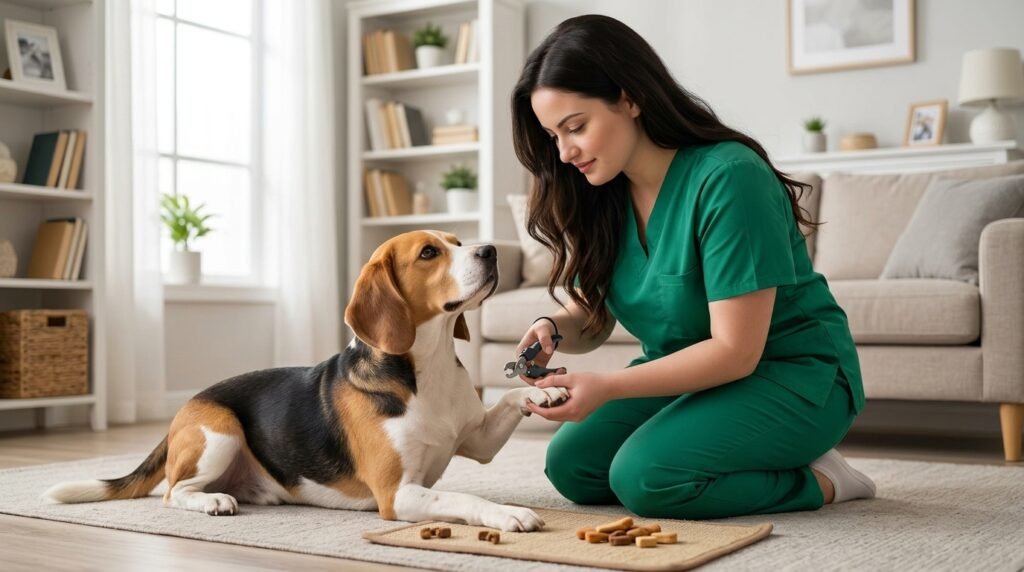
Pair brief paw touches with high-value rewards when your dog is relaxed. Progress slowly from touching the shoulder and leg to holding a paw, touching individual toes, and introducing the tool. End before your dog becomes overwhelmed. Fearful dogs may benefit from a veterinarian-recommended cooperative-care plan or professional help.
Inspect the environment and paws
Repair snagged carpeting, remove sharp debris from play areas, and check paws after hiking or vigorous outdoor activity. Appropriate traction matters for dogs who slip on smooth floors. Keep paw fur and nails maintained so you can see the toes clearly.
Investigate repeated or unusual nail problems
One torn nail after an obvious snag is different from multiple nails that split, deform, discolor, loosen, or fall off. Recurring changes may be associated with infection, inflammation, immune-mediated nail disease, trauma, or other health issues. Diet should be complete and balanced, but supplements should not be used as a substitute for diagnosis.
Schedule a veterinary examination when multiple nails are affected or when problems recur without a clear cause. The veterinarian may examine the nail bed, look for infection, review the dog’s medical history and diet, and recommend tests based on the findings.
Frequently Asked Questions About a Dog Broken Nail
1. Can a dog broken nail heal on its own?
A tiny chip limited to the hard, nonliving tip may need only smoothing and monitoring. A split involving the quick, a loose painful section, or a tear near the base should be assessed by a veterinarian. Even if bleeding stops, movement of the damaged piece can delay healing and cause pain.
2. How long does a broken dog nail take to heal?
Pain and bleeding from an uncomplicated injury may improve over several days, but nail regrowth commonly takes weeks or longer. Healing time depends on how deeply the nail tore and whether the nail bed was damaged or infected. Follow your veterinarian’s activity and recheck instructions.
3. Should I walk my dog after a broken nail?
Use only short, controlled leash walks for bathroom needs until your dog is comfortable and your veterinarian says normal activity is safe. Avoid running, rough surfaces, mud, swimming, and play that could snag the nail. A dog that cannot bear weight needs veterinary assessment.
4. What can I put on a dog nail to stop bleeding?
Start with continuous pressure using clean gauze. Pet styptic powder used according to its label can help minor nail bleeding; cornstarch or flour may serve as a temporary backup. If bleeding remains active despite pressure and a clotting aid, seek urgent veterinary care.
Conclusion
A dog broken nail needs calm handling, movement restriction, steady pressure, and protection from licking. A superficial tip chip may be manageable with monitoring, but an exposed quick, a firmly attached dangling fragment, a tear at the base, persistent bleeding, marked pain, or inability to bear weight calls for prompt veterinary advice.
Do not pull painful nail pieces, improvise a tight bandage, or give human pain medication. When in doubt, send your clinic a clear description or photo and follow its triage advice. Once the injury has healed, regular nail and dewclaw care can reduce the chance of another painful tear.