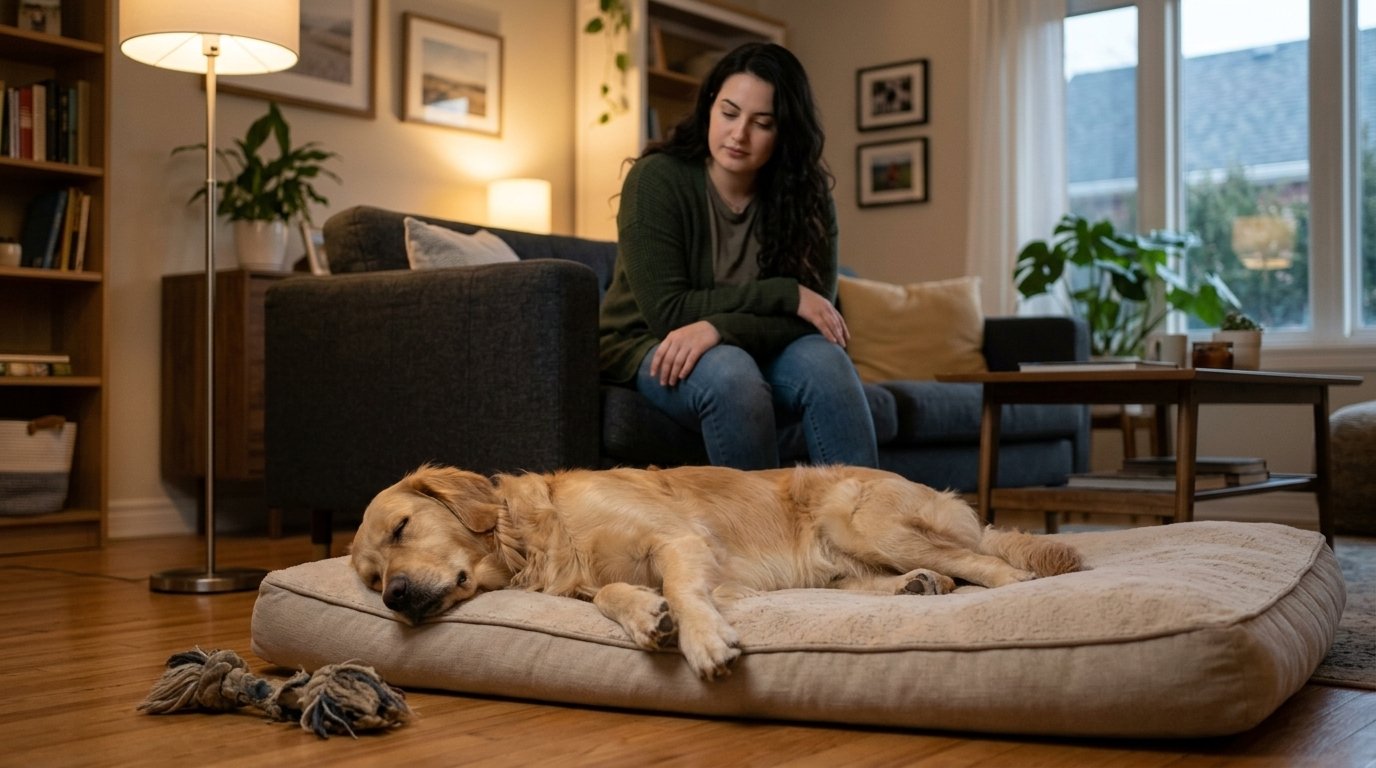
If you have watched your dog sleeping and suddenly seen a paw jerk, an ear flick, the legs paddle, or the face twitch, you may have wondered: why do dogs twitch in their sleep? In many cases, these brief movements are a normal part of sleep and may happen while a dog is dreaming.
Dogs can also make surprisingly expressive sounds while asleep. A soft whimper, tiny bark, yip, or brief howl does not automatically mean your dog is having a nightmare or is in distress.
What matters is the entire episode: how your dog is moving, how long it lasts, whether the body remains relatively relaxed, whether the behavior is new, and what your dog is like after waking.
Most brief sleep movements are not a reason to panic. However, prolonged, unusually rigid, intense, or otherwise abnormal episodes can sometimes resemble medical problems and deserve veterinary attention.
This guide explains what normal sleep twitching can look like, why puppies and senior dogs may move more in their sleep, whether you should wake your dog, and which warning signs should prompt a call to your veterinarian.
Table of Contents
Why Do Dogs Twitch in Their Sleep?
The simplest explanation for why do dogs twitch in their sleep is that sleeping does not mean the brain becomes completely inactive.
Dogs cycle through different stages of sleep, including rapid eye movement, or REM, sleep. During REM sleep, brain activity increases and dreaming is believed to occur. You may notice the eyes moving beneath closed eyelids along with small movements of the paws, legs, ears, face, or tail.
According to VCA Animal Hospitals’ explanation of canine dreaming, dogs can whine, breathe more rapidly, and move their legs during REM sleep.
That means a dog who appears to be “running” while lying on their side may simply be passing through an active part of normal sleep.
Typical dream-related movements might include:
- brief paw twitches
- small leg kicks
- gentle paddling movements
- ear flicks
- facial or whisker movements
- a twitching tail
- brief changes in breathing pattern
- movement of the eyes beneath closed eyelids
These behaviors can look dramatic when you are watching closely, especially because a completely still dog can suddenly start moving.
However, one isolated movement should not be used to diagnose what is happening inside your dog’s brain. You cannot know exactly what your dog is dreaming about simply from a paw movement or sound.
The more useful approach is to look at the overall pattern.
If your dog has always made a few small movements while sleeping, remains relaxed, wakes normally, and behaves completely like themselves afterward, the behavior is generally much less concerning than a sudden new episode involving rigidity, prolonged uncontrolled movement, or abnormal behavior after it ends.
If you are interested in how posture changes during rest, PawMindTips also has a guide to dog sleeping positions and what owners may notice.
What Does Normal Dog Twitching While Sleeping Look Like?
Normal sleep twitching does not have one exact appearance.
One dog may flick a paw a few times. Another may move all four feet as though running. A third may barely move except for an occasional facial twitch.
PetMD’s veterinary-reviewed guide to sleep twitching describes common twitching in areas such as the legs, tail, and head and notes that small vocalizations may accompany it.
A useful clue is that normal dream-related movements are commonly brief and intermittent rather than one continuous, escalating episode.
Your dog may twitch for a moment, become still, make another small movement, and then continue sleeping.
Look at the whole dog, not one paw
Try not to judge the situation based only on the most noticeable body part.
Instead, observe:
- Is the body generally relaxed?
- Are the movements brief or intermittent?
- Are the eyes closed or moving beneath the eyelids?
- Is breathing continuing?
- Does the episode stop on its own?
- Does your dog wake and behave normally afterward?
The answers provide more useful context than “my dog’s leg moved.”
The same principle applies to many canine behaviors. PawMindTips’ guide to signs of a stressed dog emphasizes considering patterns and context rather than treating one physical signal as proof of a particular emotional state.
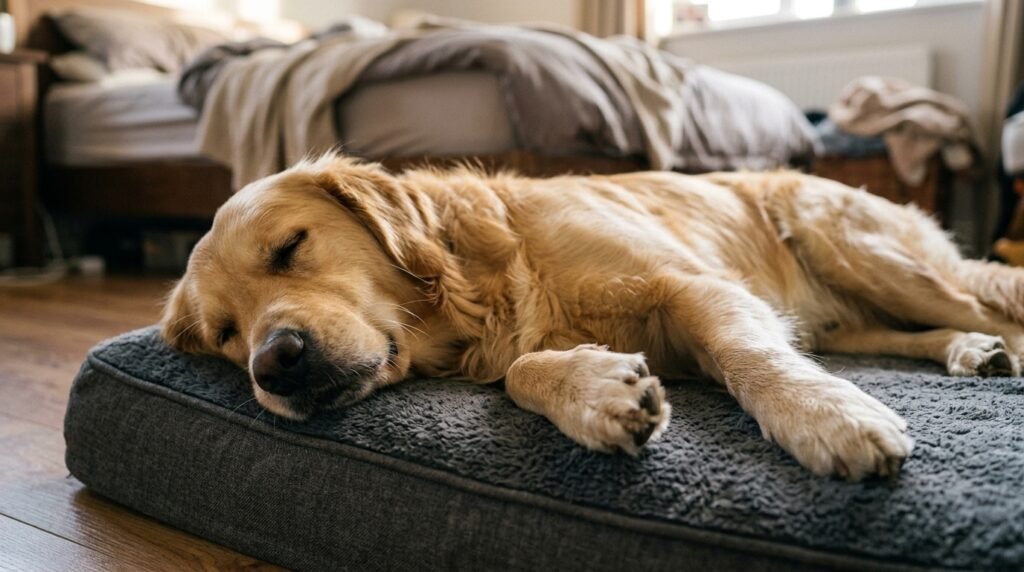
That approach is especially useful during sleep. A twitch does not automatically equal a seizure, just as a whimper does not automatically equal a nightmare.
Why does my dog look like they are running?
Paw movements can sometimes become coordinated enough that it looks as though a sleeping dog is chasing something.
It is tempting to imagine that your dog is racing through a field or chasing a squirrel. Dogs are believed to dream, and their waking experiences may contribute to dream content, but we cannot reliably translate a particular sleeping movement into a particular dream.
So enjoy the adorable “sleep running,” but avoid assigning a definite story to it.
The important distinction is whether the movement remains consistent with your dog’s usual sleep behavior or becomes unusually intense, prolonged, rigid, or accompanied by other concerning signs.
Why Do Dogs Whimper, Bark, or Howl While Sleeping?
Movement is only part of the nighttime show.
Dogs may also make sounds while asleep, including:
- soft whimpers
- tiny yips
- muffled barks
- grunts
- brief cries
- quiet growl-like sounds
- occasional short howls
These sounds can occur during active sleep and dreaming. VCA notes that whining may occur during REM sleep, while American Kennel Club guidance on canine dreaming also describes barking and leg twitching during REM sleep.
A short whimper therefore does not prove that your dog is experiencing a nightmare.
We cannot ask a dog what a particular dream contained. A vocalization could accompany a dream without telling us whether that dream was pleasant, exciting, frustrating, or frightening.
This is why it is better to describe what you actually observe:
“My dog whimpers briefly while asleep and then settles again.”
That is more useful than immediately concluding:
“My dog has nightmares every night.”
What about barking in sleep?
A few muffled barks during sleep can occur along with other dream-related activity.
Barking while awake, of course, can have many different motivations. If you are trying to understand your dog’s waking vocal behavior as well, see our guide explaining why dogs bark and what different barking patterns may mean.
The important difference here is context. A sleeping dog’s brief vocalization occurring alongside relaxed sleep movements is different from persistent nighttime vocalization while awake, pacing, appearing uncomfortable, or repeatedly failing to settle.
A sudden change in nighttime behavior deserves more attention than a familiar sleep sound your dog has made for years.
Why Puppies and Older Dogs May Twitch More in Their Sleep
Age can influence what owners notice during sleep.
Puppies
Puppies may seem exceptionally busy while sleeping.
They are processing a world full of new smells, people, surfaces, sounds, social experiences, training, and play. Puppies also spend substantial time sleeping as they develop.
PetMD’s explanation of sleep twitching notes that puppies spend more time in dream sleep than adult dogs and discusses the still-developing brain mechanisms that help inhibit large muscle movements during sleep.
That can make small kicks, facial twitches, paw movements, and vocalizations particularly noticeable in a sleeping puppy.
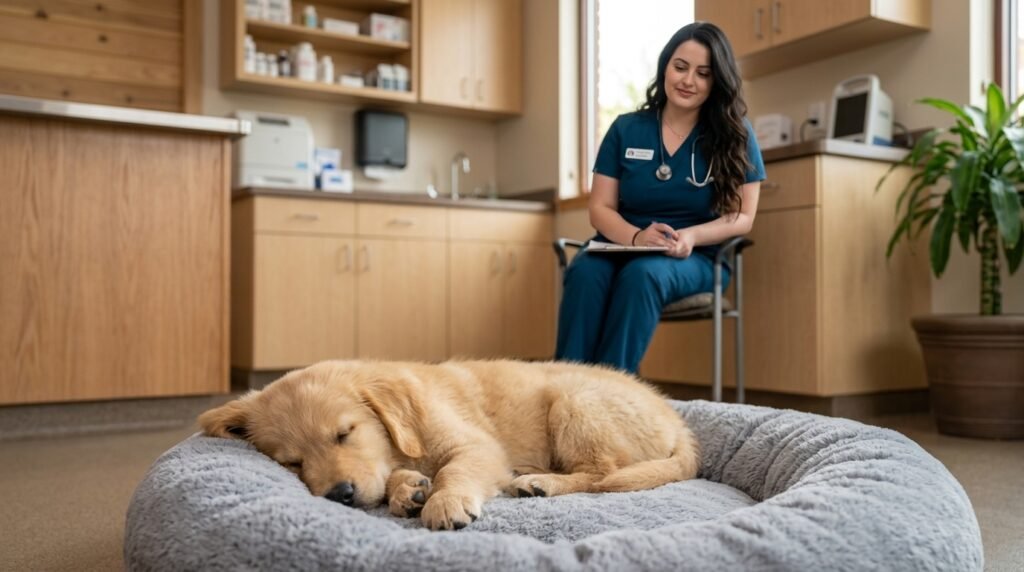
If the puppy wakes normally, appears healthy, and the movements are brief and consistent with ordinary sleep behavior, twitching alone is usually not a reason to assume something is wrong.
Senior dogs
Older dogs can also display noticeable sleep movements.
Age-related changes may affect the systems that normally limit movement during dreaming. VCA likewise notes that puppies and senior dogs tend to twitch more than middle-aged dogs.
But there is an important caution with senior dogs: do not automatically blame every new nighttime change on normal aging.
A senior dog who suddenly begins showing dramatically different sleep behavior, nighttime restlessness, confusion, difficulty settling, unusual vocalization, mobility changes, or other new symptoms should be discussed with a veterinarian.
The fact that an older dog may normally twitch during sleep does not rule out pain, neurologic problems, cognitive changes, or another medical issue.
The dog’s baseline matters.
If your 12-year-old dog has gently kicked their paws during dreams for years, that history is useful. If the same dog suddenly begins having intense episodes unlike anything you have previously seen, that change is much more significant.
Should You Wake a Dog Who Is Twitching in Their Sleep?
Usually, you do not need to wake a dog simply because you see a few normal-looking twitches or hear a brief whimper.
There is also a safety reason to avoid suddenly touching a sleeping dog.
A dog awakened abruptly from deep or active sleep may be startled and momentarily disoriented. American Kennel Club guidance on sleeping dogs warns that physically touching a dreaming dog can startle them and may result in an involuntary bite or scratch.
This is especially important for children.
Teach children that a sleeping dog’s bed or resting area should be left alone. They should not climb onto a sleeping dog, hug them, grab their paws, put their face close to the dog’s face, or shake them awake.
If you genuinely need to wake your dog
If you are concerned and need to see whether your dog responds, avoid immediately reaching down and grabbing them.
Instead, from a safe distance, try calling their name.
Give them time to orient themselves after waking. A sleepy dog may need a moment to understand what is happening.
This does not mean that waking response is a home diagnostic test that can definitively rule a seizure in or out. It is simply one observation that can provide context.
If an episode looks medically concerning, prioritize safety and veterinary guidance rather than repeatedly trying to wake or restrain your dog.
Let normal sleep continue
Sleep is important. If the movements look like your dog’s usual brief dream activity and there are no concerning signs, you generally do not need to interrupt them.
Sometimes the best response to why do dogs twitch in their sleep really is to watch quietly and let your dog finish the nap.
Sleep Twitching vs. a Possible Seizure: What Should Owners Notice?
This is where owners understandably become worried.
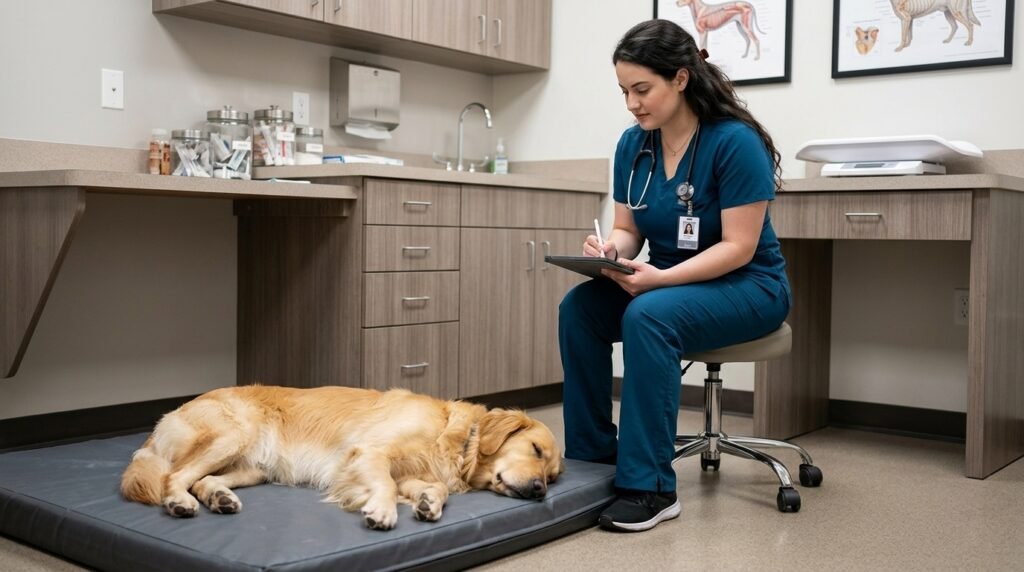
Sleep twitching and seizure activity can sometimes look similar from across the room, and no article can reliably diagnose an individual episode.
However, certain patterns can tell you when veterinary assessment is appropriate.
VCA Animal Hospitals’ guide to seizures in dogs explains that generalized seizures may involve loss of consciousness, uncontrolled muscle activity, limb paddling, salivation, and loss of bladder or bowel control. Dogs can also experience confusion or disorientation after a seizure.
AKC similarly distinguishes ordinary dream movements—which tend to be brief and intermittent—from seizure movements that can be more rigid and violent.
Here is a practical comparison:
| Observation | Often seen with normal sleep activity | More concerning pattern |
|---|---|---|
| Movement | Small twitches, kicks, brief paddling | Rigid, intense, sustained or violent movement |
| Pattern | Brief and intermittent | Prolonged or unusually severe |
| Body | Generally relaxed between movements | Marked stiffness or rigidity |
| Vocalization | Soft yip, whimper or brief bark can occur | Vocalization with other seizure-like signs needs assessment |
| Elimination | Not expected from ordinary dreaming | Urination/defecation can occur during generalized seizures |
| Afterward | Wakes and returns to normal | Confusion, disorientation, heavy panting or abnormal behavior may occur |
| Response | Dreaming dogs may wake to sound | Lack of normal responsiveness can be concerning |
This table is a guide for deciding when to seek help—not a diagnostic tool.
Not every seizure looks dramatic
Another reason not to self-diagnose is that seizures do not all look alike.
VCA explains that dogs can have generalized or focal seizures. Focal episodes may affect only certain muscle groups and can include behavioral changes rather than the classic full-body convulsion many people imagine.
That means neither of these statements is safe:
“My dog twitched, so it was definitely a seizure.”
or
“My dog didn’t have a full-body convulsion, so it definitely wasn’t a seizure.”
If an episode is new, unusual, recurring, or difficult to interpret, show your veterinarian what happened rather than trying to assign a diagnosis yourself.
When Should You Contact a Veterinarian About Sleep Movements?
Most brief sleep twitches do not require an emergency trip to the veterinary hospital.
But contact your veterinarian when your dog’s episodes are new, increasing, unusual for that individual dog, or accompanied by other concerning changes.
Veterinary assessment is particularly important if you notice:
- pronounced body rigidity
- unusually violent or prolonged movements
- repeated episodes that are becoming more frequent
- loss of bladder or bowel control during an episode
- excessive drooling or foaming
- difficulty breathing
- inability to respond normally
- collapse or similar episodes while awake
- confusion or marked disorientation afterward
- weakness or difficulty walking after an episode
- other neurologic or behavioral changes
- suspected toxin exposure
- a major sudden change from your dog’s normal sleep behavior
If your dog also has unusual episodes while awake—such as staring, altered responsiveness, or other unexplained behavior—record that information for your veterinarian as well.
When is it an emergency?
A prolonged seizure is an emergency.
VCA states that seizure activity continuing for more than five minutes is considered status epilepticus and requires urgent veterinary treatment. VCA’s seizure emergency information explains why immediate treatment is necessary.
Multiple seizures occurring close together can also require urgent care.
If you suspect poisoning, significant breathing difficulty, severe trauma, prolonged seizure activity, or another immediate emergency, contact an emergency veterinarian rather than waiting to see whether the problem disappears.
Do not put your hands in a seizing dog’s mouth. Do not try to hold the tongue, and do not physically restrain uncontrolled movements unless a veterinary professional specifically instructs you to do so.
Instead, keep yourself safe, reduce nearby hazards when you can do so without being injured, note the time, and obtain veterinary assistance.
What Should You Record for Your Veterinarian?
When a strange episode ends before you reach the veterinary clinic, your description becomes important.
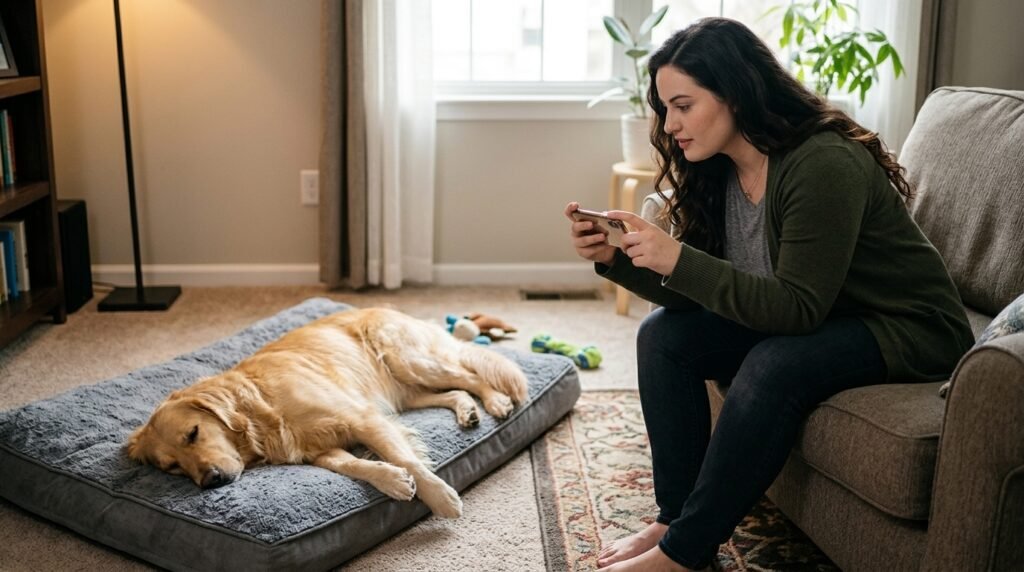
If it is safe, a video can be particularly helpful.
Do not put yourself close to a dog experiencing uncontrolled movements just to obtain footage. Safety comes first. But when you can record from a safe distance, the video may allow your veterinarian to see details that are difficult to describe afterward.
Useful information includes:
- When it happened. Was your dog deeply asleep, just falling asleep, waking, or already awake?
- How long it lasted. Use a clock or phone timer when possible. A frightening event can feel much longer than it actually was.
- Which body parts moved. Was it one paw, the face, one side, all four limbs, or the whole body?
- What the movement looked like. Was it a soft twitch, repetitive paddling, trembling, or marked rigidity?
- Whether your dog vocalized. Note barking, whimpering, howling, crying, or other unusual sounds.
- Whether there was drooling or loss of bladder/bowel control.
- How your dog behaved afterward. Did they immediately return to normal, or were they confused, weak, restless, unusually sleepy, or disoriented?
- Whether similar behavior occurs while awake.
- Whether anything else has recently changed. Appetite, drinking, walking, balance, medications, supplements, flea/tick products, possible toxin exposure, behavior, and general health can all be relevant to your veterinarian.
VCA specifically recommends recording factors such as episode frequency and duration, association with sleep or other activities, other signs of illness, medications and supplements, diet, and possible toxin exposure when veterinarians evaluate suspected seizures.
Keep a simple episode log
If the behavior repeats, create a short record containing:
Date — Time — Sleeping/Awake — Duration — Movements — Other signs — Behavior afterward
This is much more useful than relying on memory several weeks later.
Avoid attempting to provoke another episode so you can film it. Simply record naturally occurring events when it is safe to do so.
The goal is not to diagnose your dog yourself. The goal is to give your veterinarian better information.
FAQs
1. Why do dogs twitch in their sleep but act completely normal afterward?
Brief twitching can occur during normal sleep and dreaming. If your dog makes small intermittent movements, wakes normally, and immediately behaves like themselves, that pattern is generally more consistent with ordinary sleep activity than an episode followed by neurologic abnormalities. However, contact your veterinarian if the movements suddenly change or concern you.
2. Why does my dog whimper or bark while sleeping?
Dogs can vocalize during active sleep. Whimpering, small barks, yips, or other brief sounds may accompany dreaming. A sound alone cannot tell you exactly what your dog is dreaming about, so a whimper should not automatically be labeled a nightmare.
3. Is it normal for a puppy to twitch a lot while sleeping?
Puppies can show noticeable sleep twitching and spend considerable time sleeping and dreaming. Brief movements in an otherwise healthy puppy can be normal. Persistent, unusually intense, rigid, or concerning movements—or episodes accompanied by illness or abnormal behavior while awake—should be discussed with a veterinarian.
4. How can I tell whether my dog is dreaming or having a seizure?
You cannot always determine this confidently at home. Normal dream movements tend to be brief and intermittent with a relatively relaxed body, while seizure activity can involve rigidity, more intense uncontrolled movement, loss of responsiveness, drooling, elimination, or confusion afterward. If you are unsure, safely record the episode if possible and contact your veterinarian.
Conclusion
So, why do dogs twitch in their sleep? Most often, brief paw kicks, facial movements, tail twitches, small vocalizations, and other intermittent movements are associated with normal sleep and dreaming.
Puppies and senior dogs may make these movements especially noticeable. Soft whimpers or little barks can also occur without proving that your dog is having a nightmare.
In most normal-looking situations, there is no reason to shake or touch your dog awake. Give them an undisturbed place to sleep, keep children from startling sleeping dogs, and learn what is normal for your individual pet.
At the same time, do not dismiss a genuinely unusual episode as “just dreaming.” Rigidity, prolonged or violent movements, loss of responsiveness, elimination, excessive drooling, post-event confusion, repeated abnormal episodes, or a sudden change from your dog’s normal behavior deserves veterinary attention.
When you are uncertain, a safely recorded video, accurate timing, and a simple episode log can give your veterinarian valuable information—and provide a much safer answer than trying to diagnose sleep movements at home.