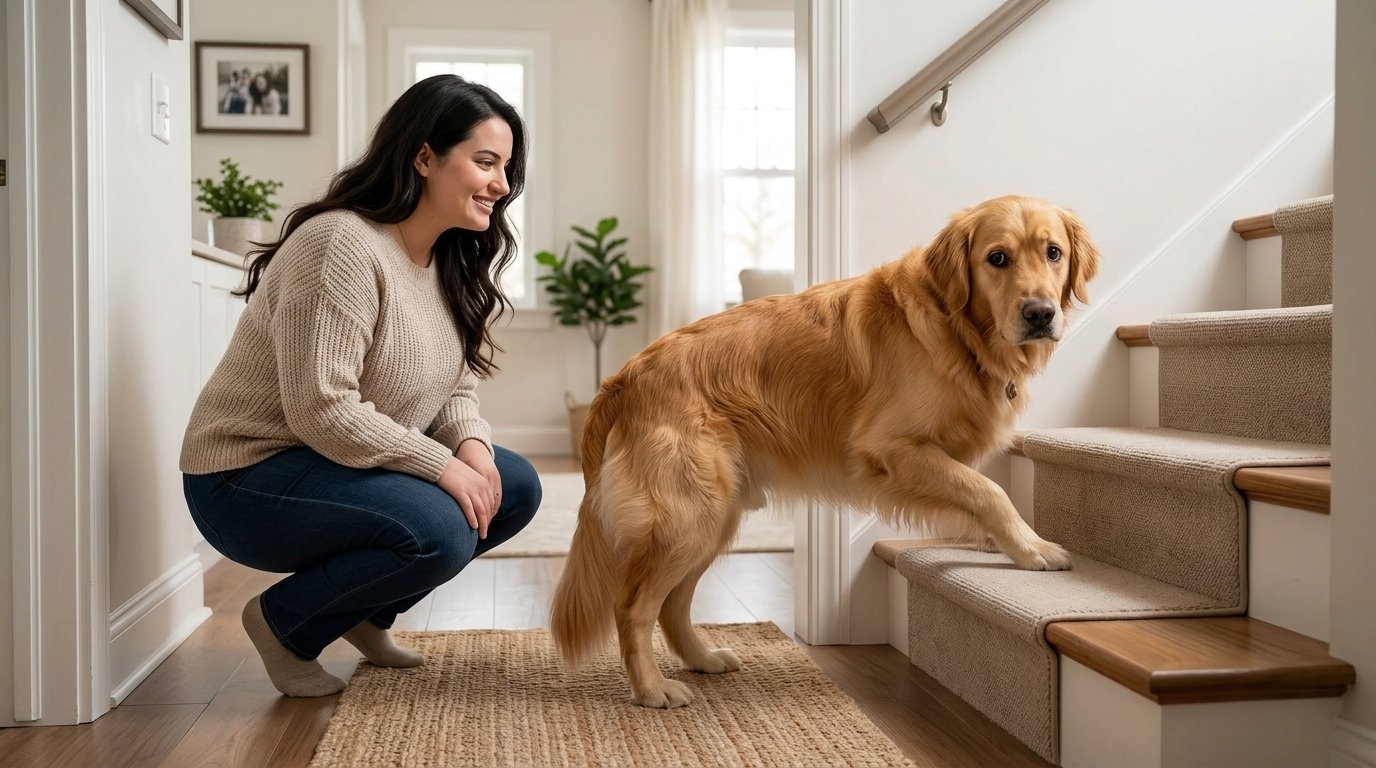
A dog afraid of stairs may stop at the first step, back away, or climb up but refuse to come down. The safest response is to slow down and find out what makes the staircase difficult. Slippery treads, an unfamiliar view, a previous scare, and physical discomfort can look surprisingly similar from across the room.
If your dog suddenly avoids stairs they used to handle comfortably, contact your veterinarian before treating it as a training problem. If the hesitation has always been there and your dog is otherwise moving normally, you can improve the setup and build confidence through short, voluntary practice.
The goal is a dog who can approach a suitable staircase calmly and make safe choices. That may mean learning one step at a time. For some dogs, especially those with health or mobility concerns, it may mean using a ramp, another route, or a stair-free part of the home.
Table of Contents
Why Is Your Dog Afraid of Stairs?
Stairs ask a dog to judge height, place each paw on a relatively narrow surface, balance, and repeat the movement. A staircase that feels ordinary to you can be unfamiliar or uncomfortable to your dog. Look at the dog, the staircase, and the history of the hesitation before deciding what to practice.
A dog who has never encountered stairs may simply lack experience. This is common when a puppy or newly adopted dog moves into a home with a different layout. Open risers, shiny wood, steep steps, and gaps along the side can add to the challenge. Even a dog comfortable on carpeted stairs may hesitate on smooth ones.
A slip or fall can also change a dog’s response. The dog may remember losing traction at a particular step or hearing a frightening noise while climbing. Some dogs approach again cautiously; others avoid the whole staircase. Do not assume they will get over it by being made to repeat the experience.
Watch what happens before your dog stops. Do they walk easily on the surrounding floor but hesitate when their paws touch the first tread? Do they look through open risers? Do they reach the landing and then freeze when they see the descent? Those details can help you make a useful change.
Body language matters, too. A dog may lower their body, pause repeatedly, turn away, tremble, or refuse a favorite treat. PawMindTips’ guide to recognizing signs of a stressed dog can help you notice when an exercise has become too difficult. If your dog retreats, let them. Giving them a way out makes it easier to begin again at a manageable level.
Fear is only one possible explanation. Pain, weakness, or trouble seeing the steps can affect stair use. A dog cannot tell you which of these is happening, so avoid labeling every refusal as stubbornness.
Why Is My Dog Suddenly Afraid of Stairs?
A sudden change deserves a veterinary conversation, especially if your dog previously used the same stairs without trouble. Dogs in pain may become reluctant to climb or descend, jump onto furniture, or be handled. Vision changes can also show up as hesitation on stairs, sometimes before an owner notices more obvious difficulty seeing. VCA Animal Hospitals
The timing may offer clues, though it cannot provide a diagnosis. Think about whether your dog recently slipped, landed awkwardly, had an unusually strenuous day, or began hesitating in other places. Notice whether the problem appears on every staircase or only one. A dog who struggles on a dark staircase may be responding to a different challenge from a dog who has trouble getting up from rest and then avoids climbing.
While arranging an assessment:
- Limit unnecessary stair trips. Use a gate or another safe route if your dog might attempt the stairs without supervision.
- Keep daily needs accessible. Set up water, a resting place, and a route outdoors that does not require repeated climbing when possible.
- Record what you observe. Note when the change began, which direction is harder, whether your dog slips, and any changes in walking or behavior.
- Avoid testing the problem repeatedly. Asking a dog to climb “just once more” may add stress or increase the risk of a fall.
Call your veterinarian promptly if the avoidance comes with limping, stiffness, difficulty rising, apparent pain, bumping into objects, or a recent fall. Seek urgent veterinary advice for a dog who cannot stand or walk normally, has marked weakness, seems severely painful, or has other serious symptoms. Do not wait for a training session to clarify an obvious mobility or injury concern.
A veterinary exam can help determine whether stair practice is appropriate and whether your dog needs a different way to move around the house. VCA notes that dogs with mobility problems may benefit from nonslip stair surfaces, supervised assistance, or avoiding unnecessary stairs, depending on their individual needs. VCA Animal Hospitals
Going Up vs. Going Down: What Troubles Your Dog?
Some dogs will climb a flight willingly and then refuse to descend. Others can step down but struggle to push upward. Treat the two directions as separate skills. Success in one direction does not mean your dog feels safe in the other.
Going down can be visually intimidating: your dog faces the drop and must place their front paws on a lower tread before the rest of their body follows. The view may feel especially uncertain on open stairs or in poor lighting. A dog might climb to the landing, turn around, and then realize the descent looks much harder.
Going up calls for a different movement. A dog who finds climbing uncomfortable may pause before lifting their front end or pushing with their hind legs. That pattern is a reason to consider physical comfort, particularly when it is new. Do not try to identify a specific joint or condition from the staircase behavior alone.
Observe where the hesitation occurs. Is it the first step, a particular tread, the turn on a landing, or the last step onto a different flooring surface? Does your dog rush the middle of the flight, as though trying to get it over with? Rushing can increase the chance of slipping even if the dog completes the stairs.
Practice the easier direction first only when your dog is physically comfortable and the route is safe. Plan how your dog will return before inviting them onto any step. Never lead a hesitant dog to a landing and leave them facing a full flight they cannot descend comfortably.
Make the Stairs Easier to Navigate
Before training, change the features you can control. A more secure staircase may solve much of the problem, and it gives your dog a fairer chance to learn. VCA recommends a nonslip stair surface for dogs with mobility difficulties and notes that some dogs should avoid unsupervised stair access. VCA Animal Hospitals
Improve traction. Check whether your dog’s paws slide on the treads or on the floor immediately before and after the staircase. Secure, nonslip treads or a properly fitted carpet runner may help. Any added covering should lie flat and stay firmly attached; a loose mat can create another hazard.
Improve visibility. Turn on the lights at both ends of the stairs, including during evening trips. Clear objects from the steps and landing. If your dog’s vision seems to have changed, make a veterinary appointment instead of assuming better lighting alone will resolve the issue.
Consider the stair design. Open risers, narrow treads, and steep flights may be difficult even after practice. A handrail helps people, but it does not give a dog traction underfoot. If the design remains unsafe for your dog, use a different route rather than asking training to overcome the physical problem.
Manage access while you work. A securely installed gate can prevent an unsupervised attempt or fall. Choose and position it for the location and your dog’s size and strength; gates at the top of stairs need particular care. The AKC notes that hardware-mounted gates are generally the safest choice for stairways and larger dogs. akc.org
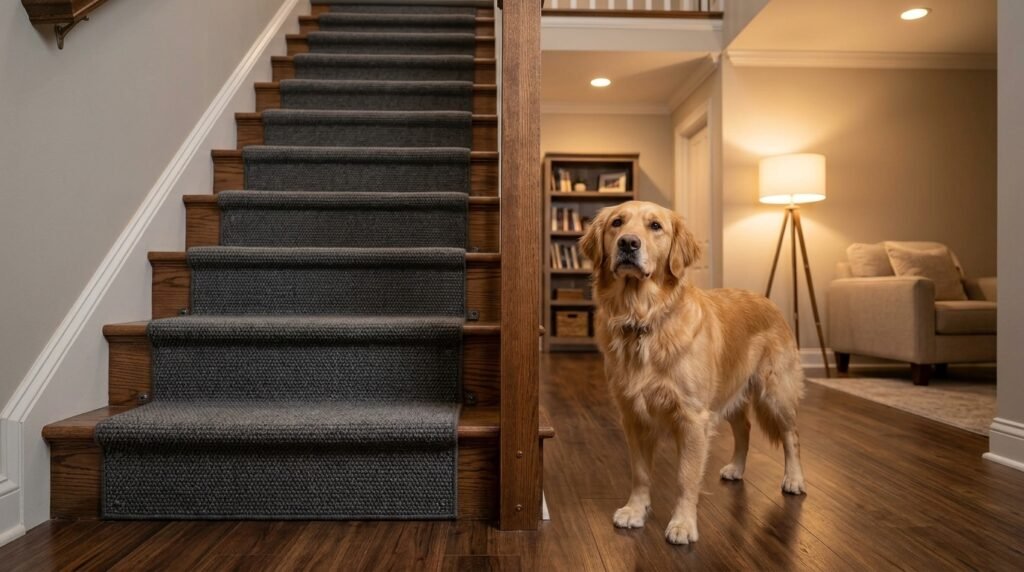
A small pet ramp or pet steps may help with furniture, but they are not automatically a safe substitute for a household staircase. Discuss ramps, supportive harnesses, or carrying with your veterinarian when your dog has a mobility concern. For a large dog, do not attempt a lift you cannot perform safely.
How to Help Your Dog Build Confidence Around Stairs
Begin training only after you have addressed a suspected medical problem and made the practice area secure. Keep sessions short enough that your dog finishes relaxed. A few good choices near the stairs are more useful than a full flight completed in panic.
Reward-based, gradual work gives your dog room to investigate. Best Friends Animal Society describes confidence building through manageable experiences, while the AKC recommends letting a dog explore stairs or ramps before expecting them to use them. Best Friends Animal Society
1. Start where your dog can relax
Stand far enough from the staircase that your dog can look at it, move normally, and accept a treat or engage with a toy. Reward a glance toward the stairs, a calm approach, or a voluntary sniff. Then move away together.
If your dog freezes or pulls back before reaching the first step, increase the distance. This is still stair training: you are building a comfortable starting point instead of rehearsing fear. PawMindTips’ broader guide to helping a nervous dog explains why small, manageable experiences can support confidence.
2. Reward choices near the first step
When your dog approaches comfortably, reward exploration at the base of the staircase. They might sniff the first tread or place one paw on it. You can mark that choice with a cheerful “yes” and give a small treat on the level floor.
Let your dog step away whenever they want. Avoid tightening the leash, pushing from behind, lifting them onto a tread, or using a treat to draw them farther than they are ready to go. A dog who stretches toward food while keeping their back feet planted may be telling you the next movement feels too hard.
If your dog does not want food, pause. They may be too worried to learn in that moment, or the reward may not interest them. Increase distance, reduce noise, or try again later.
3. Practice one easy upward movement
Once your dog willingly puts paws on the first step, reward a comfortable move onto and back off that step. Check that they have room to turn or return to the floor without slipping. You do not need to repeat the movement until they are tired.
Only add another step when the current movement looks easy: your dog approaches without being pulled, keeps a steady pace, and is willing to repeat it. Progress might take several sessions. There is no useful deadline.
For a dog who has never used stairs, an isolated, broad, low step may be a gentler place to learn the movement. It is not identical to a full staircase, so introduce the household stairs separately when the dog is ready.
4. Teach downward movement separately
Choose a setup that lets your dog practice one low downward step with a safe exit. Do not place a frightened dog high on the staircase to create a descent exercise. Instead, use a low, secure step the dog has already chosen to climb, or work with a qualified reward-based professional to plan the setup.
Reward your dog for looking at the lower surface and shifting forward comfortably. Then reward a voluntary step down. Keep the surface below nonslip and allow enough room to land. If your dog leans back, scrambles, or launches off, make the exercise easier before repeating it.
Climbing up and stepping down can be practiced in separate sessions. Your dog may need much more time with one direction. That is useful information, not a training failure.
5. Build the sequence without rushing
After your dog can manage a single step calmly in both directions, add difficulty gradually. You might practice two steps, then return to one easy step, or introduce a different landing. Change one feature at a time: number of steps, direction, location, or time of day.
Watch the quality of movement, not just whether your dog reaches the end. A dog who races, slips, or freezes halfway through needs an easier task. End the session while your dog is still comfortable and let them leave the stairs.
Keep household routines practical during training. If your dog cannot safely reach an upstairs bedroom, arrange a comfortable sleeping area downstairs. Do not make access to family, food, water, or outdoor breaks depend on completing a frightening flight.
What if progress stalls?
First check the setup: traction, lighting, noise, and the landing surface. Then consider whether the step you added was too large. Return to a point where your dog can succeed willingly.
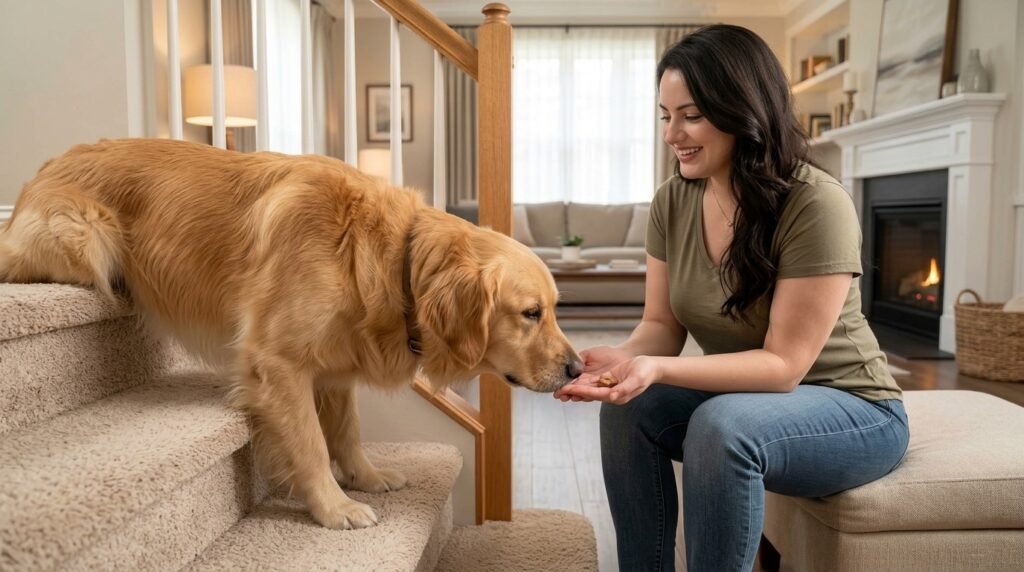
If a previously comfortable movement becomes difficult, or your dog repeatedly slips or moves unevenly, stop practice and contact your veterinarian. When the medical and environmental concerns have been addressed but fear remains intense, a qualified reward-based trainer can help adjust the plan.
Puppies, Older Dogs, and Large Dogs: Different Needs
The same principle applies across ages and sizes: the movement must be safe before you ask the dog to repeat it. The practical setup, however, may differ.
Puppies: Build familiarity without pressure
A puppy may be encountering a staircase for the first time. Let them inspect it and reward small voluntary choices. Start with a suitable low step, supervise closely, and prevent unsupervised access to a flight they cannot navigate reliably.
A puppy who suddenly becomes hesitant may also be responding to a frightening experience or a change in their environment. Avoid forcing them to continue. If they appear painful, weak, or unusually unsteady, seek veterinary advice rather than assuming it is a normal learning stage. The AKC’s puppy guidance favors introducing challenges in small, manageable steps. akc.org
Older dogs: Put comfort and access first
An older dog who used stairs for years and now avoids them needs a veterinary assessment. Changes in joints, movement, or vision may affect the decision, and fear can develop after a dog feels unsteady. VCA lists avoiding stairs among possible signs of osteoarthritis and recommends an individual care plan when it is found. vcahospitals.com
Keep essential activities on one level when feasible. Improve traction and lighting, prevent unsupervised stair use if your dog may fall, and ask the veterinarian whether assisted movement or avoiding the stairs is more appropriate. The right outcome may be a safer routine rather than restoring use of the entire flight.
Large dogs: Plan for safe assistance
A large dog can be hard to steady if they slip, and lifting one unexpectedly can injure both dog and person. Check whether the treads give the dog enough room to place their paws comfortably. Secure traction and an open, uncluttered path matter more than coaxing the dog through a narrow flight.
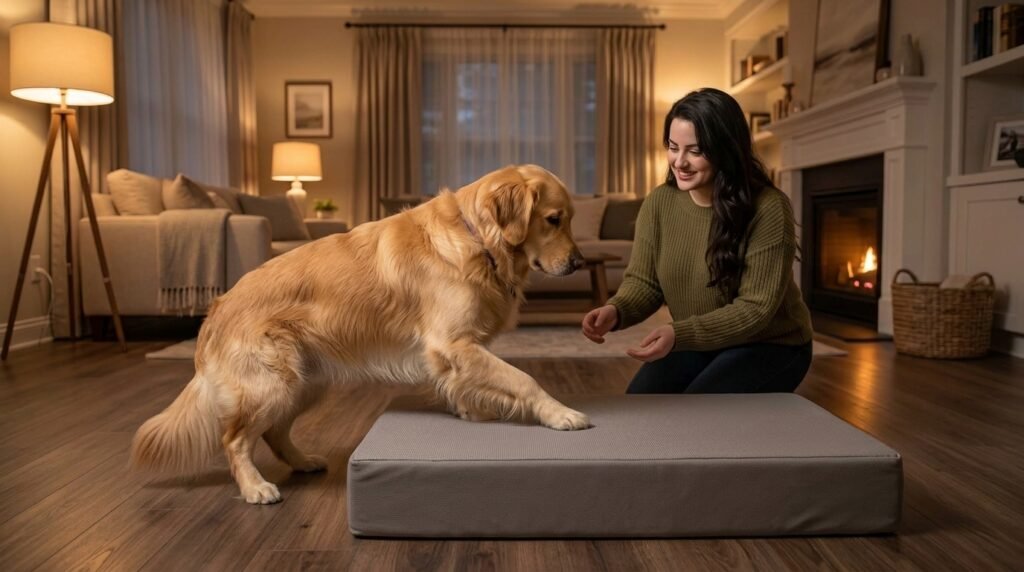
If assistance is needed because of a health or mobility issue, ask your veterinarian about an appropriate supportive harness and how to use it. Do not rely on pulling by a collar or improvising a lift on a staircase. Arrange a same-level route whenever possible while you work out a safer long-term plan.
When to Seek Professional Help
Start with your veterinarian when stair avoidance is sudden, follows a fall, or comes with any change in walking, rising, jumping, vision, or general behavior. A dog who appears severely painful, cannot walk normally, or has marked weakness needs urgent veterinary advice. Stair refusal alone cannot tell you the cause.
Once physical concerns have been assessed, a qualified trainer who uses reward-based methods can help if your dog panics near the staircase, has had a frightening fall, or makes little progress despite a safer setup and easy practice. Ask how the trainer handles a dog who freezes or tries to leave. A useful plan should allow the dog to step back, reduce difficulty, and build gradually.
For intense or widespread fear, your veterinarian may recommend a veterinary behavior specialist. Tell the professional which direction is harder, what the stairs are made of, whether your dog has slipped, and what happens when you begin practice. A short video taken without prompting your dog onto unsafe stairs may help show the setting and behavior.
You do not need to prove your dog can conquer a full staircase before asking for help. Seeking guidance early can prevent repeated frightening attempts and help you decide whether stair use is an appropriate goal at all.
FAQs
My dog is deathly afraid of stairs—where should I start?
Start by preventing unsupervised access and checking that your dog has an easy route to daily essentials. If the fear is new or movement seems uncomfortable, contact your veterinarian first. Otherwise, reward calm behavior at a distance from the stairs where your dog can still relax. Do not carry or pull them onto a step to begin training.
Why will my dog go up the stairs but not down?
Descending requires a different view and movement, so a dog may feel less secure going down. Slippery treads, poor lighting, or discomfort can also contribute. Practice downward movement as its own skill on a low, safe step. If this is a new change, arrange a veterinary assessment.
How long does it take to teach a dog to use stairs?
There is no reliable timetable. The staircase, your dog’s experience, and their physical comfort all affect progress. Move forward when your dog approaches and uses the current step willingly and steadily. If they freeze, rush, or slip, make the task easier instead of increasing the number of steps.
Should I carry my dog up or down the stairs?
That depends on your dog’s size, health, and your ability to carry them securely. Do not attempt a lift that could put either of you at risk. If your dog has pain or limited mobility, ask your veterinarian about safer access, a suitable support harness, or whether the stairs should be avoided.
Conclusion
A dog afraid of stairs needs a safer setup and a pace they can handle. Check for a medical concern when the change is sudden, improve traction and visibility, and practice one voluntary movement at a time.
Going up and going down may require separate work. If your dog remains distressed or cannot use the stairs safely, a veterinarian and qualified reward-based trainer can help you choose the right next step.