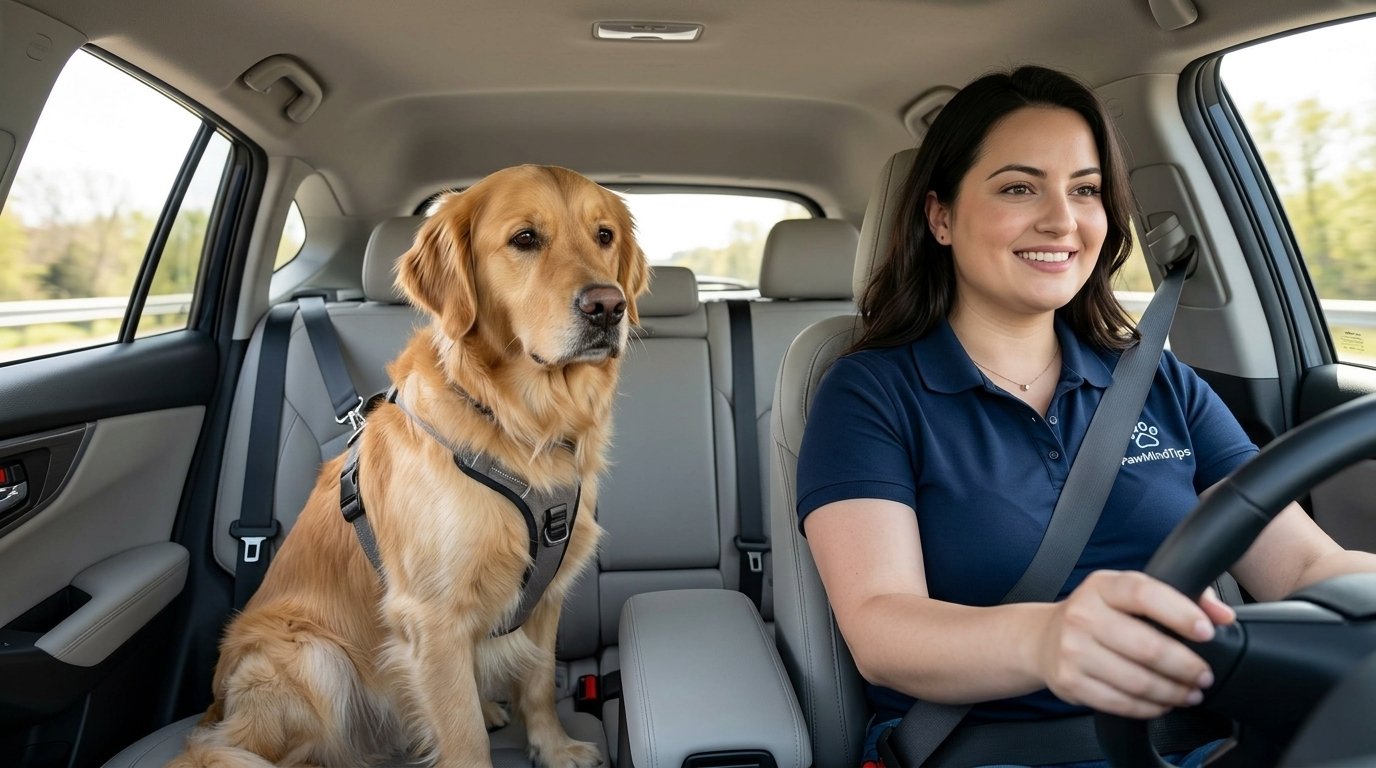
Dog whining in the car can be confusing because the same sound can mean very different things. One dog may whine because the ride makes them nauseated, another may be frightened by the movement and noise, while another may simply be bursting with excitement because the car usually means a trip to the park.
The best way to help is not to focus on stopping the noise first. Instead, look at when the whining starts, what else your dog does, and what normally happens during or after the ride.
Whining accompanied by drooling, repeated lip licking, swallowing, lethargy, or vomiting deserves particular attention because motion sickness may be involved. A dog who becomes worried before the vehicle even moves may be reacting more strongly to anticipation or a learned fear of car travel.
Once you understand the likely trigger, you can make car rides safer and use gradual, reward-based practice to help your dog become more comfortable.
Table of Contents
Why Is My Dog Whining in the Car?
Dogs whine as a form of communication. In a vehicle, that communication might reflect excitement, uncertainty, frustration, fear, nausea, discomfort, or a combination of these feelings.
Context matters more than the whining itself.
For example, consider three dogs:
- Dog A begins whining when you turn toward the dog park and otherwise looks relaxed and eager.
- Dog B refuses to approach the vehicle and starts panting before the engine is running.
- Dog C happily enters the car but begins drooling, swallowing, and whining after several minutes of driving.
All three dogs are whining, but treating them exactly the same would miss important clues.
This is why observing the whole dog is so useful. PawMindTips’ guide to signs of stress in dogs explains that behaviors such as pacing, panting, avoidance, changes in posture, and increased vocalization should be interpreted together rather than relying on one signal alone.
Whining that appears suddenly in a dog who previously traveled quietly also deserves extra attention. A sudden behavioral change can sometimes accompany pain, illness, nausea, or another physical problem.
Is It Anxiety, Excitement, or Motion Sickness?
Before trying to reduce dog whining in the car, ask one important question:
When does it begin?
The timing can provide valuable clues, although it cannot diagnose the cause by itself.
Signs that may suggest car anxiety
An anxious dog may become uncomfortable before any actual movement occurs.
You might notice:
- reluctance to approach the vehicle
- stopping or pulling away near the car
- trembling
- panting
- pacing
- tucked or lowered posture
- repeated yawning or lip licking
- refusing treats they normally enjoy
- trying to exit
- whining while the car is still parked
Some dogs even react when they see car-related cues such as keys, a travel crate, or the garage door opening.
If your dog’s reactions fit a broader nervous temperament, the PawMindTips guide on helping a nervous dog build confidence explains why gradual exposure and giving the dog choices are usually preferable to forcing them through frightening situations.
Signs that may suggest motion sickness
Motion sickness can look surprisingly similar to anxiety.
According to the Merck Veterinary Manual’s guidance on motion sickness in dogs, signs can include nausea, excessive drooling, vomiting, whining, uneasiness, and sometimes diarrhea.
Watch particularly for:
- excessive drooling
- frequent swallowing
- lip smacking or licking
- becoming unusually quiet
- restlessness
- whining after movement begins
- vomiting
- defecating during travel
- poor appetite after a trip
Motion sickness is especially common in younger dogs.
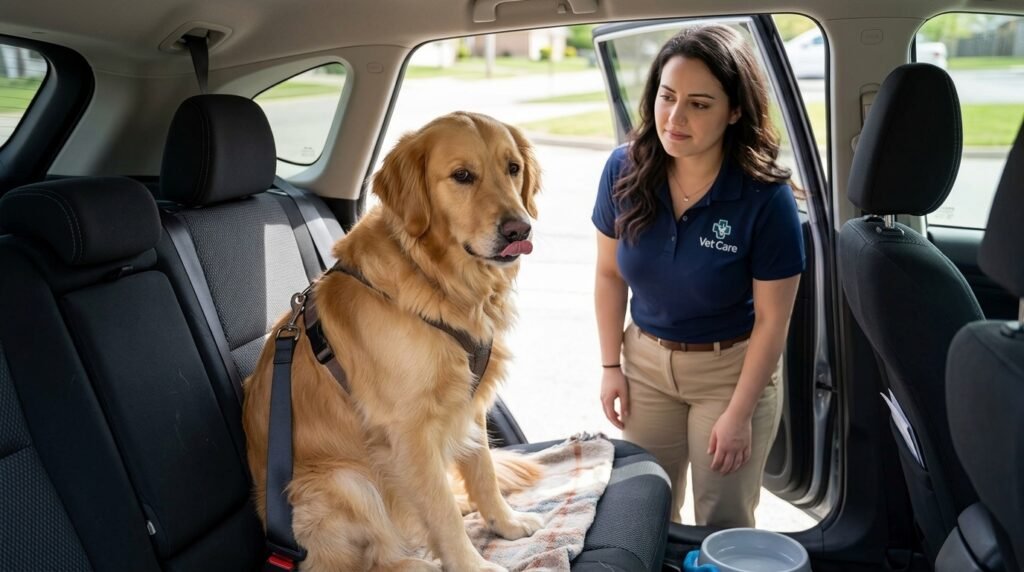
Importantly, nausea and anxiety can become connected. A dog that repeatedly feels sick while traveling may eventually learn that entering the car predicts feeling bad. The dog may then become anxious before the vehicle starts moving.
So the question is not always anxiety or motion sickness.
Sometimes it is both.
Common Reasons for Dog Whining in the Car
Understanding the cause helps you choose a more appropriate response.
1. Your dog feels anxious about car travel
Cars contain a strange combination of sensations: engine noise, vibration, unpredictable movement, changing visual scenery, traffic sounds, unfamiliar smells, and limited control over where the dog is going.
For some dogs, that is overwhelming.
Anxiety becomes especially plausible when your dog is already uncomfortable while the vehicle is stationary.
Previous frightening experiences can contribute too. A dog may remember being nauseated, frightened by a sudden stop, or taken somewhere stressful.
Punishing the resulting whining does not change that emotional association.
2. Your dog is experiencing motion sickness
The inner ear plays an important role in balance, and vehicle movement can trigger nausea.
The VCA Animal Hospitals guide to car travel with dogs notes that dogs experiencing distress during travel may salivate, pace, whine, howl, bark, or vomit and recommends veterinary consultation when salivation or vomiting occurs during movement.
Do not assume a dog is “just nervous” if physical signs of nausea are present.
Repeated nausea can make future behavioral training harder because every uncomfortable ride reinforces the dog’s negative expectation.
3. The car predicts something unpleasant
Where does your dog normally go in the car?
If the answer is almost always:
- the veterinarian
- groomer
- boarding facility
- another stressful destination
your dog may learn that getting into the car predicts something unpleasant.
The vehicle itself can eventually become a trigger.
The solution is not simply adding longer rides. Short, manageable trips that end somewhere enjoyable can help change what car travel predicts.
4. Your dog is excited
Not all dog whining in the car represents fear.
Some dogs love car rides.
A dog may recognize the road to a favorite park, hiking trail, daycare, friend’s house, or another exciting destination and begin vocalizing from anticipation.
Look at the rest of the body.
An excited dog may appear alert and eager, whereas a frightened dog may show avoidance, trembling, lowered posture, escape attempts, or an inability to settle.
Excitement can still become disruptive, especially if the dog learns that frantic behavior is part of every journey. Rewarding quieter, settled behavior can help.
5. Your dog feels physically unstable
Imagine standing on an unpredictable moving surface without knowing when the next turn or brake will happen.
Dogs can struggle to balance too.
Sliding across a seat, standing through every turn, or repeatedly losing footing may make a dog uncomfortable.
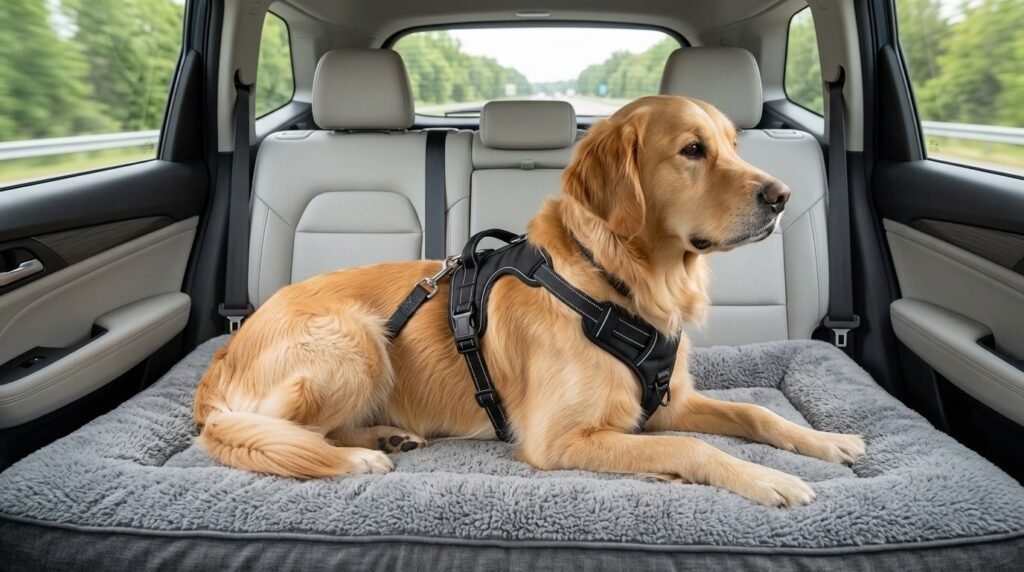
A secure travel setup can therefore serve two purposes: improving safety and giving your dog a more predictable place to settle.
6. Your dog has learned that whining gets a response
Sometimes whining begins for one reason but becomes reinforced by what happens afterward.
If every whine immediately produces talking, petting, food, or another exciting response, a comfortable dog may learn that vocalizing gets attention.
But do not jump to this explanation first.
Before treating whining as an attention-seeking habit, consider anxiety, nausea, toileting needs, pain, temperature, and other genuine sources of discomfort.
How to Help a Dog Stop Whining in the Car
Once medical problems and motion sickness have been appropriately considered, gradual training can help many dogs become more comfortable.
The goal is not to put your dog into the car and wait until they “get used to it.”
Instead, build the experience in manageable stages.
Step 1: Start outside the parked car
If your dog becomes worried before entering, begin at whatever distance allows them to remain reasonably comfortable.
That could mean standing several feet away.
Let your dog notice the vehicle.
Pair calm observation with something your dog genuinely values, such as small treats or play.
Do not pull your dog toward the car.
If they retreat, freeze, refuse food, or become increasingly distressed, make the exercise easier.
Step 2: Practice approaching the car
Over multiple short sessions, gradually work closer.
Reward voluntary investigation.
Your dog might sniff the vehicle, approach an open door, or look inside.
Progress does not have to happen in one day.
Step 3: Practice entering without driving
Once your dog willingly approaches, practice getting into the stationary vehicle.
Keep the engine off.
Let your dog enter, receive something enjoyable, spend a short period there, and leave again.
At this stage, the lesson is simply:
Getting into the car does not always mean a stressful journey is about to begin.
Step 4: Introduce the normal travel setup
Before moving the vehicle, help your dog become comfortable with whatever safe restraint system you plan to use.
Cornell University’s car-travel guidance recommends securing dogs in vehicles rather than allowing them to roam freely and advises gradual acclimation using short, positive training sessions.
Practice the restraint separately rather than introducing a new harness, new seating position, engine noise, and a long drive all at once.
Step 5: Turn the engine on without traveling
When your dog can relax in the stationary car, introduce another piece of the experience.
Start the engine.
Stay parked.
Reward relaxed behavior and keep the session brief.
Engine vibration and sound may be significant triggers for some dogs, so do not rush directly from a parked-car exercise into a long drive.
Step 6: Take an extremely short ride
Your first drive might only be down the driveway or around the block.
That is fine.
Successful short experiences are more useful than pushing through a long trip during which your dog becomes increasingly distressed.
If possible, have another adult accompany you so one person can drive safely while the other observes the dog.
Never try to deliver treats, turn around repeatedly, or manage an anxious dog while you should be concentrating on traffic.
Step 7: Increase distance gradually
When short rides are comfortable, slowly increase the duration.
Think:
one minute → several minutes → around the neighborhood → a nearby enjoyable destination.
Do not automatically increase the distance after every ride.
Use your dog’s behavior to decide when they are ready.
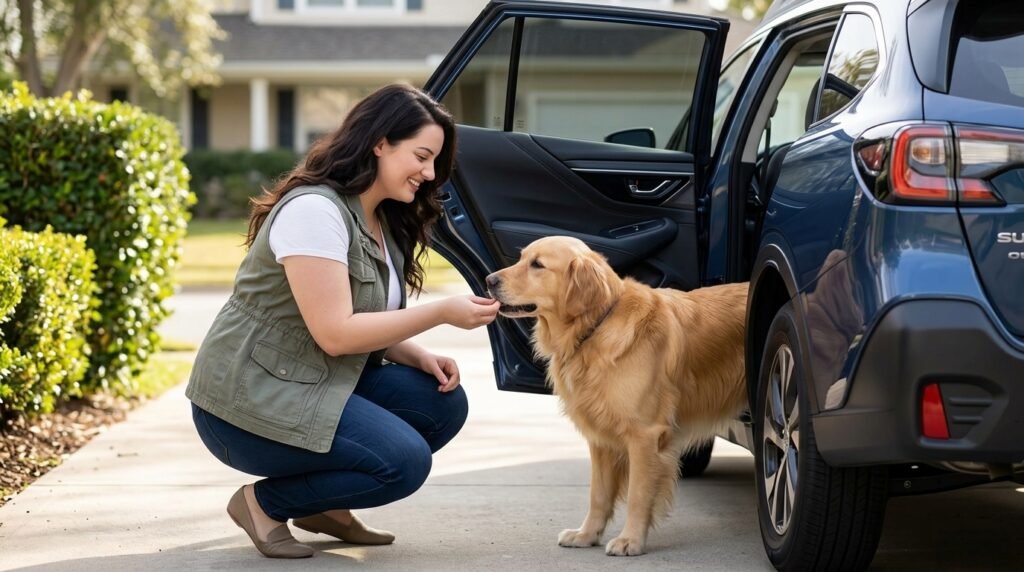
If whining suddenly becomes more intense or your dog starts panting, drooling, freezing, refusing treats, or trying to escape, you may have increased the difficulty too quickly.
Return to an easier stage.
Make Car Rides Safer and More Comfortable
Training works best when the physical environment is comfortable too.
Use an appropriate restraint
Dogs should not roam around the vehicle or sit on the driver’s lap.
Depending on your dog’s size and needs, an appropriate setup might involve a secured crate, carrier, or suitable vehicle restraint.
The ASPCA’s travel safety guidance recommends keeping pets secure during car travel and building up to longer journeys through a series of shorter drives.
A secure setup can also reduce sliding and unpredictable movement.
Keep the vehicle comfortable
Temperature matters.
A dog who is already anxious or nauseated does not need the additional stress of an overly warm vehicle.
Maintain comfortable ventilation and temperature.
And never leave your dog unattended in a dangerously warm parked vehicle.
Drive smoothly
Rapid acceleration, hard braking, and sharp turns can make balancing difficult and may worsen nausea.
Whenever road conditions allow, drive smoothly and predictably.
Bring something familiar
A familiar blanket or other safe comfort item may make the travel space feel more predictable.
However, comfort items should not interfere with your dog’s restraint or create a safety hazard.
Consider where every trip ends
If possible, mix necessary journeys with pleasant ones.
A short ride to a favorite walking location can help prevent the car from becoming a perfect predictor of veterinary appointments or other stressful experiences.
The purpose is not to overwhelm an anxious dog with outings.
It is to create manageable experiences that end well.
Mistakes That Can Make Car Whining Worse
Even well-meaning responses can accidentally make dog whining in the car harder to resolve.
Forcing your dog into the vehicle
Dragging, pushing, or repeatedly lifting a frightened dog into the car may get the journey started, but it does not teach the dog that the car is safe.
When training rather than handling an unavoidable emergency trip, voluntary progress is preferable.
Starting with long drives
A dog struggling during a two-minute trip probably does not need a 45-minute practice ride.
Training should begin below the level that causes significant distress whenever possible.
Scolding the whining
Whining caused by fear or nausea is not deliberate disobedience.
Punishment may add another unpleasant association to an already difficult situation.
Instead, identify what is driving the behavior.
Assuming every whine is anxiety
This is particularly important.
Whining combined with drooling, repeated swallowing, lip licking, lethargy, or vomiting can point toward nausea.
PawMindTips also discusses how licking behavior needs to be interpreted in context in its guide to excessive licking in dogs.
Do not spend weeks trying to train away a problem that may require veterinary management.
Giving medication without veterinary guidance
Do not give human medications, leftover prescriptions, supplements, or sedating products simply because your dog struggles in the car.
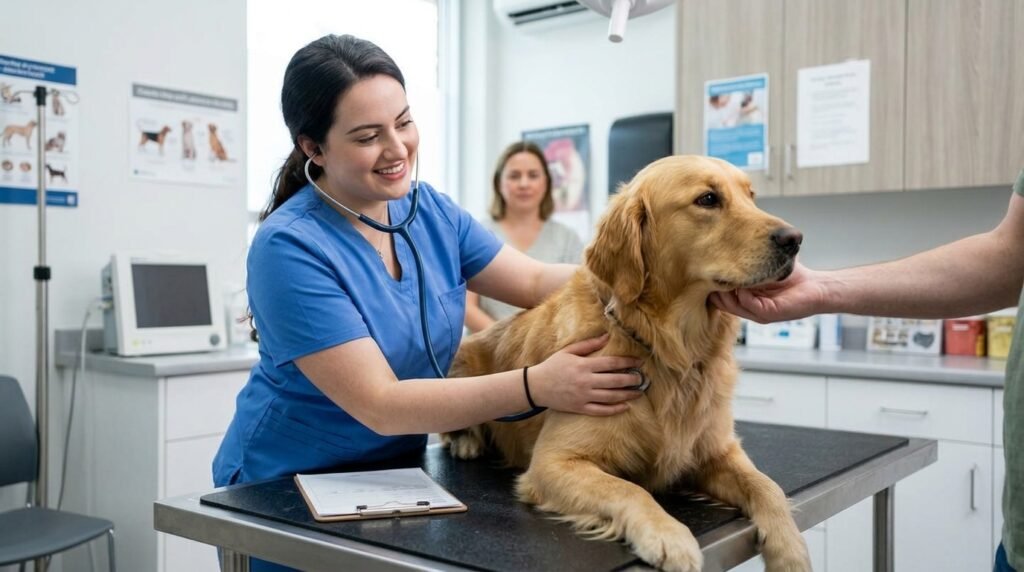
Your veterinarian can determine whether treatment for nausea, anxiety, or another medical problem is appropriate.
Puppies, Adult Dogs, and Senior Dogs May Need Different Help
Age can change how you interpret dog whining in the car.
Puppies
Motion sickness is particularly relevant in younger dogs.
At the same time, puppyhood provides an excellent opportunity to establish positive associations with safe travel.
Start with brief experiences rather than making a puppy’s earliest rides exclusively long journeys or veterinary trips.
If your puppy drools, repeatedly licks their lips, vomits, or appears ill during rides, discuss the problem with your veterinarian.
Adult dogs
An adult dog may have years of learned associations with the car.
Perhaps car travel predicts nausea. Perhaps the dog only traveled during stressful events. Perhaps they were never gradually introduced to vehicle movement.
Adult dogs can still learn new associations.
The process may simply require patience and carefully structured practice.
Senior dogs
New dog whining in the car deserves particular attention when an older dog previously traveled comfortably.
Physical discomfort, difficulty balancing, mobility changes, or other age-related health problems may make entering, exiting, or remaining stable in a moving vehicle harder.
A veterinary examination is appropriate when a senior dog’s behavior changes suddenly or persistently.
When to Talk to Your Veterinarian or a Behavior Professional
Not every episode of dog whining in the car requires professional treatment.
But some patterns should not be handled as a simple training problem.
Contact your veterinarian if your dog:
- repeatedly vomits during car rides
- drools excessively during travel
- suddenly develops car-related distress
- appears painful
- has difficulty walking or balancing
- seems unusually weak or lethargic
- has persistent diarrhea associated with travel
- becomes distressed even on very short journeys
- shows a major unexplained behavioral change
- is getting worse despite gradual training
Veterinary assessment is especially important when you suspect motion sickness.
For dogs with persistent fear after medical causes have been addressed, a qualified reward-based trainer or veterinary behavior professional can help develop a more individualized plan.
Severe panic, dangerous escape attempts, or an inability to make progress without overwhelming the dog deserve professional support rather than repeatedly exposing the dog to distress.
Frequently Asked Questions
Why does my dog whine in the car but seem excited?
Whining can occur during excitement as well as fear. Look at the entire pattern. An eager dog heading toward a favorite destination may whine while remaining loose and engaged. Whining accompanied by avoidance, trembling, excessive panting, drooling, or attempts to escape deserves closer attention.
Why does my dog whine before the car even starts moving?
Whining before movement may suggest that anticipation itself has become stressful. Your dog may associate the vehicle with previous nausea, frightening experiences, or unpleasant destinations. Gradual practice around a stationary car can help rebuild the association.
Can motion sickness cause dog whining in the car?
Yes. Motion sickness can cause whining along with excessive drooling, lip licking, repeated swallowing, uneasiness, lethargy, vomiting, or diarrhea. If nausea appears likely, talk with your veterinarian rather than treating the problem as purely behavioral.
Should I ignore my dog when they whine in the car?
Not automatically. First determine whether the whining may reflect fear, nausea, pain, toileting needs, temperature, or another genuine problem. If your dog is medically well and comfortable and the whining appears to be learned excitement or attention seeking, rewarding calm, quiet behavior may be useful.
Conclusion
Dog whining in the car is not one problem with one solution.
Some dogs are frightened. Some become nauseated. Others feel physically unstable, anticipate an unpleasant destination, or become overwhelmingly excited. And some dogs experience more than one of these things at the same time.
Watch when the whining begins and what happens alongside it. Drooling, repeated swallowing, lip licking, vomiting, avoidance, trembling, inability to settle, and sudden behavioral changes can provide important clues.
If your dog appears physically well but lacks confidence around the vehicle, start small: approach the parked car, practice getting in without driving, introduce the engine, take extremely short trips, and gradually build from successful experiences.
Most importantly, do not try to silence dog whining in the car without first asking what your dog may be communicating. If nausea, pain, sudden behavioral change, or severe distress is involved, veterinary guidance should come before more training.