If you have a dog afraid of the vacuum, simply pulling the cleaner from the closet may be enough to send your dog running, barking, hiding, or trying to attack the machine. That reaction can be frustrating when you need to clean, but your dog is not necessarily being stubborn or deliberately difficult.
A vacuum combines several things dogs can find unsettling: a loud mechanical sound, floor vibration, a large unfamiliar-looking object, and movement that repeatedly changes direction. Some dogs react mostly to the noise, while others are comfortable until the vacuum begins rolling toward them.
Fortunately, you do not need to force your dog to “get over it.” Gradual exposure at a comfortable distance, paired with something your dog enjoys, can help change the emotional response over time.
This guide explains how to break vacuum training into manageable steps, recognize when your dog needs more distance, use rewards effectively, and create a safe resting space when you simply need to get the cleaning done.
Table of Contents
Why Is Your Dog Afraid of the Vacuum?
There may not be one single reason.
A vacuum cleaner combines sound, vibration, sight, smell, and movement. Veterinary behavior guidance recommends breaking complex triggers into individual components because a dog may tolerate one part while finding another overwhelming. VCA’s guidance on desensitization and counterconditioning
The sound can be intense
Vacuum cleaners produce a continuous mechanical noise that is very different from ordinary household conversation or background sounds.
Some dogs simply notice it. Others become tense the moment the motor starts.
If your dog is also frightened by thunderstorms, fireworks, blenders, hair dryers, or other loud household noises, the vacuum may be part of a broader sensitivity to sound.
Movement adds another challenge
Noise is only half of the picture.
A vacuum rolls forward, disappears, comes back, turns abruptly, and may repeatedly approach the dog’s resting area.
That unpredictability can matter.
A dog may be perfectly comfortable sniffing a stationary vacuum but bark as soon as you push it. Another dog may ignore the movement while the machine is off but flee once the motor starts.
That distinction tells you where training should begin.
Previous experiences can matter
A dog who was startled by a vacuum in the past may learn that the machine predicts something unpleasant.
For example, a puppy sleeping peacefully when a vacuum suddenly starts beside the bed may be frightened enough to become wary of the appliance later.
You do not need to know the exact history to begin helping your dog. What matters more is identifying what your dog can comfortably handle now.
Lack of gradual exposure may play a role
Everyday household objects are not automatically neutral to puppies.
Dogs Trust’s puppy socialization guidance recommends gradual, positive introductions to household equipment such as vacuum cleaners, beginning at an easier intensity.
Adult dogs can learn new associations too. The process simply needs to begin at a level the individual dog can manage.
How to Tell When Your Dog Is Too Worried to Learn
Before trying to change the fear, learn to recognize what your dog looks like when the vacuum becomes too difficult.
A frightened dog does not always hide.
Possible signs include:
- Moving away from the vacuum
- Freezing
- Crouching
- Tucking the tail
- Pacing
- Trembling
- Panting when the room is not hot
- Repeated lip licking
- Looking for an escape route
- Refusing normally valuable treats
- Barking or growling
- Lunging toward the vacuum
- Chasing or biting at the cleaner
PawMindTips’ guide to signs of a stressed dog explains why individual signals should be interpreted together with the situation rather than in isolation.
One particularly useful clue during vacuum training is whether your dog can still comfortably eat.
A dog who normally loves chicken but suddenly cannot take it when the vacuum is present may be telling you that the exercise is too intense.
Veterinary behavior guidance recommends starting desensitization below the level that produces a fear response and increasing intensity only while the animal remains comfortable.
Think of this as your dog’s working distance.
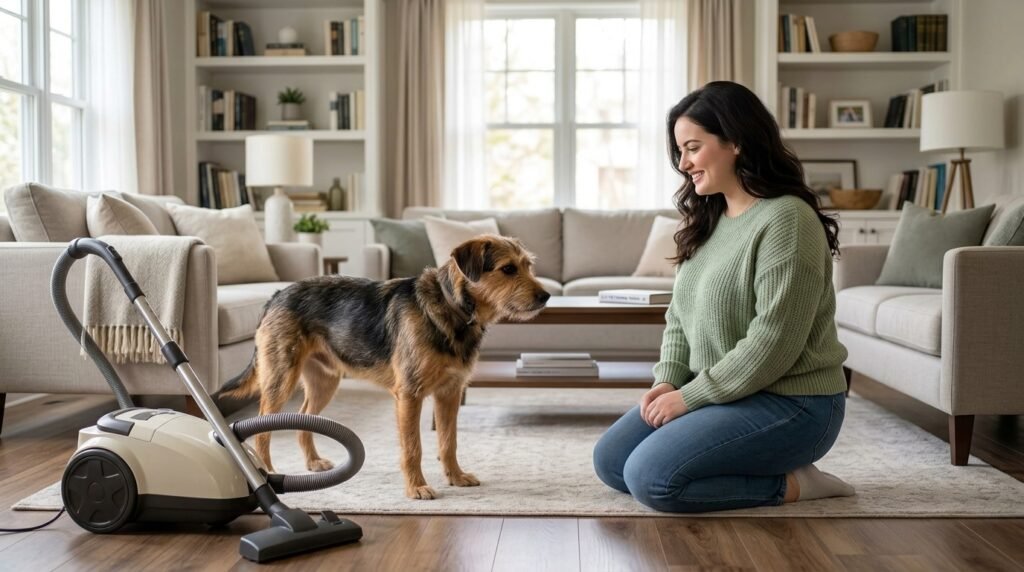
For one dog, that may mean standing six feet from a stationary vacuum. Another may initially need the cleaner across the room. A severely worried dog may need it behind a doorway.
Distance is not failure. Distance is one of your most useful training tools.
How to Help a Dog Afraid of the Vacuum Step by Step
Helping a dog afraid of the vacuum works best when you stop treating “the vacuum” as one giant challenge.
Instead, separate it into smaller pieces.
This approach combines two commonly used behavior-modification principles:
Desensitization means presenting the frightening stimulus at a low enough intensity that the dog can cope, then gradually increasing the challenge.
Counterconditioning means pairing that manageable exposure with something the dog values, such as tasty food.
VCA Animal Hospitals’ behavior guidance specifically describes controlling factors such as distance, volume, and movement while pairing exposure with favored rewards.
Step 1: Start with the vacuum turned off
Place the vacuum somewhere your dog can see it without becoming distressed.
Do not drag your dog toward it.
Do not lure your dog right up to it just because you have treats.
Your first goal is much simpler:
Vacuum appears → good things happen.
You might scatter several small treats at a comfortable distance or calmly reward your dog for noticing the machine and remaining relaxed.
If your dog chooses to approach and sniff, that is fine.
If your dog prefers to remain farther away, that is also fine.
Choice is valuable.
For a very worried dog, begin with an even easier version. The vacuum might appear at the far end of the room for a few seconds before being removed.
Repeat until its stationary presence becomes uneventful.
Step 2: Introduce tiny movements while it is off
Once your dog is relaxed around the stationary cleaner, move it only slightly.
A few inches may be enough for the first repetition.
Move → reward.
Pause.
Move → reward.
The movement should be small enough that your dog notices without immediately barking, lunging, or escaping.
Fear Free Happy Homes similarly recommends working on movement separately from noise before combining the two challenges.
Gradually increase the movement only when the current level looks easy.
You might progress from:
- A tiny wheel movement
- One short push
- One push and pull
- Several slow movements
- Normal movement with the vacuum still switched off
There is no deadline.
Step 3: Practice the sound from a comfortable distance
Now separate sound from movement.
Keep the vacuum stationary.
For dogs already worried about the motor, consider having another person switch it on in a different room or at whatever distance allows your dog to notice without panicking.
As the sound occurs, offer high-value food.
When the sound stops, the special food can stop too.
This creates a simple relationship:
Vacuum sound predicts something your dog likes.
Dogs Trust’s vacuum-training guide recommends increasing distance when a dog is worried by the noise and progressing according to the dog’s comfort.
Keep early exposures brief.
If your dog becomes tense, tries to escape, stops eating, or starts barking continuously, the session has become too difficult.
Increase the distance or shorten the sound exposure next time.
Step 4: Gradually decrease distance
When your dog can comfortably hear the vacuum from far away, you can slowly make the exercise more realistic.
Do not simply bring the machine several feet closer because one session went well.
Make small changes.
For example:
Day/session A: Vacuum running in another room.
Day/session B: Vacuum slightly closer to the doorway.
Day/session C: Vacuum near the doorway.
Day/session D: Vacuum in the same large room at considerable distance.
Your actual progression may be much slower—or faster.
Let your dog’s behavior decide.
Step 5: Combine sound and gentle movement
This is where two previously separate challenges come together.
Because combining them increases difficulty, make the movement easier again.
Switch the vacuum on at a comfortable distance and make one small movement.
Reward your dog.
Pause.
If your dog remains loose and comfortable, repeat.
Gradually build toward several slow movements.
If barking or retreat suddenly returns, separate the components again. More practice with sound alone or movement alone may be needed.
Step 6: Work toward realistic cleaning
Eventually, your dog may be comfortable enough for the cleaner to move normally while running.
Do not immediately vacuum every room for 30 minutes.
Begin with a small area and a short duration.
Continue giving your dog the ability to create distance.
Your long-term goal does not need to be a dog who loves standing beside a vacuum.
A perfectly reasonable outcome is a dog who notices the cleaner and then chooses to relax elsewhere.
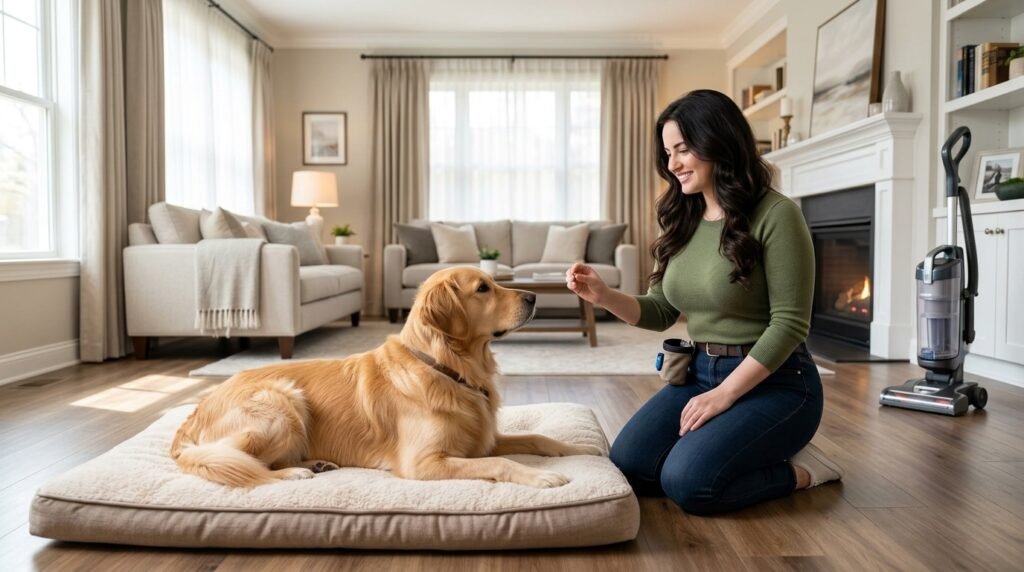
For a dog that already has a useful mat behavior, you can eventually pair vacuuming with settling on a bed. If you need to strengthen basic stationary behaviors first, PawMindTips’ guide on how to teach a dog to stay explains how to increase difficulty gradually rather than asking for too much at once.
What to Do When You Actually Need to Vacuum
Training sessions and cleaning sessions are not the same thing.
This distinction can make life much easier.
During training, you deliberately control distance, duration, sound, and movement.
During real cleaning, you need to remove dirt from the floor. You may not be able to maintain the careful intensity your dog currently needs for learning.
Until your dog is comfortable with normal vacuuming, management is appropriate.
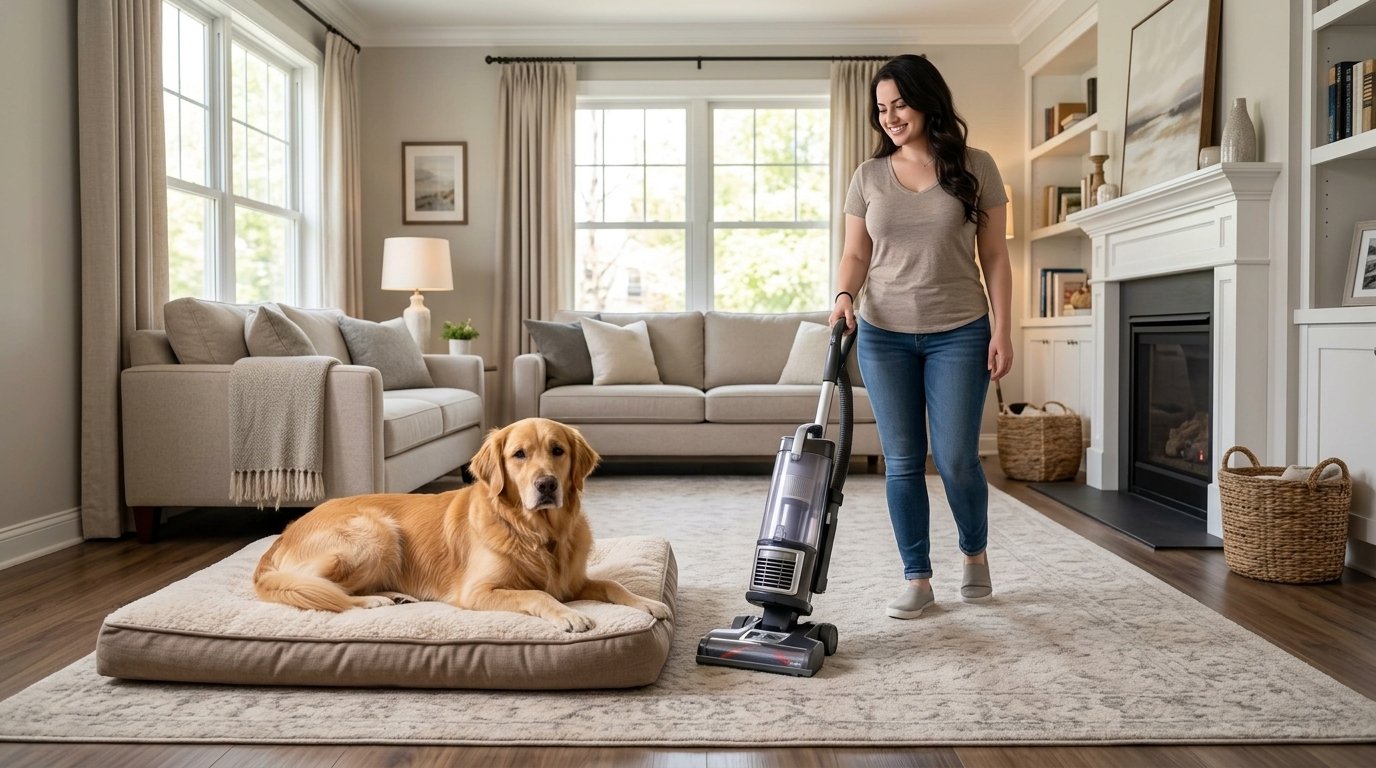
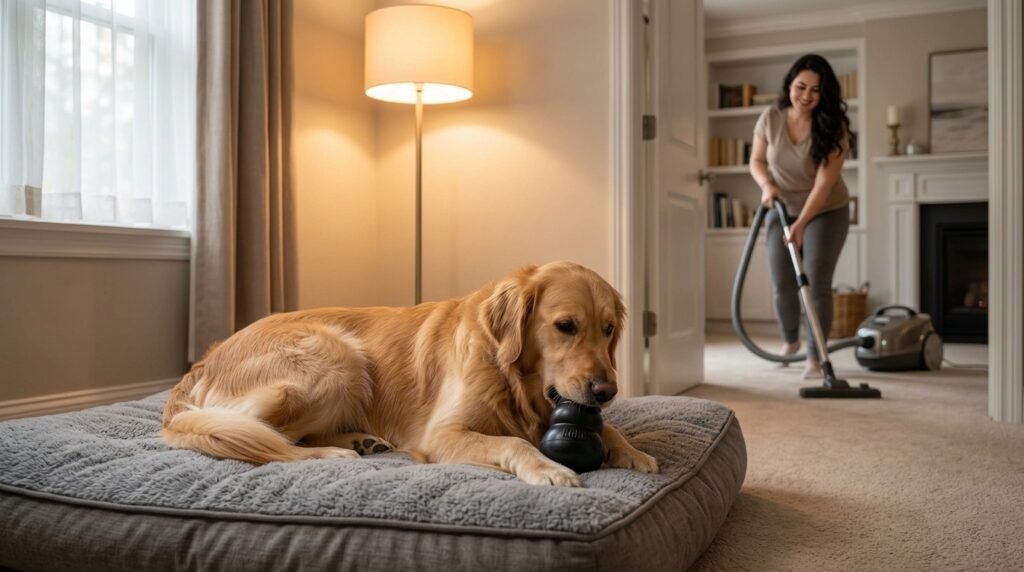
Create a safe resting area away from the cleaner.
That might be:
- A quiet bedroom
- A familiar gated room
- A comfortable bed or mat
- Another secure area your dog already enjoys
Provide water and, when appropriate for your dog, a safe long-lasting food activity or enrichment toy.
A closed door can also reduce both visual exposure and sound intensity.
If your dog is happier outside the house with another household member during major cleaning, that can be another practical option.
Dogs Trust recommends helping dogs learn to settle with an enjoyable independent activity while vacuuming occurs and suggests arranging cleaning while a highly worried dog is elsewhere if necessary.
The important point is that the safe area should actually feel safe.
Do not suddenly shut a dog into an unfamiliar crate or room that already causes distress.
And do not chase your frightened dog around the house with the vacuum while hoping repeated exposure will make the fear disappear.
The Merck Veterinary Manual’s discussion of behavior modification notes that overwhelming exposure, often called flooding, can worsen behavior rather than create the controlled learning sought through desensitization.
Management is not giving up on training.
It prevents unavoidable cleaning from repeatedly pushing your dog far beyond the level you are carefully practicing.
Why Does My Dog Bark, Chase, or Attack the Vacuum?
A dog afraid of the vacuum does not always run away.
Some dogs move toward the machine.
They may:
- Bark
- Growl
- Lunge
- Chase the wheels
- Snap at the vacuum head
- Grab the hose
- Circle the cleaner
It is easy to interpret this as the dog trying to play or “fight” the vacuum, but similar-looking behaviors can have different motivations.
Fear may be one possibility. Creating noise and rushing toward something frightening can sometimes function to make the perceived threat move away.
Movement can also produce excitement, chasing, or herding-like responses in some dogs.
That is why body language and context matter.
PawMindTips’ guide explaining why dogs bark emphasizes identifying the motivation and surrounding context rather than treating every bark as the same behavior.
If your dog attacks the cleaner, avoid turning vacuuming into a chase game.
Stop moving it if necessary, create more distance, and return to an easier training level.
There is also a physical safety issue. A dog snapping at a vacuum head, cord, or moving parts could be injured.
Teaching calm alternatives away from the cleaner is safer than allowing repeated confrontations.
Common Vacuum Training Mistakes to Avoid
Small training errors can make vacuum fear harder to change.
Forcing your dog to approach
Holding a frightened dog beside the vacuum does not teach that the vacuum is safe.
Neither does dragging your dog toward it on a leash.
Your dog should have enough space to remain comfortable and, where safely possible, the ability to move away.
Moving too quickly
One successful session does not mean your dog is ready for full-volume vacuuming right beside the bed.
If you change distance, duration, sound, and movement simultaneously, it becomes difficult to know which part caused the reaction.
Change one challenge at a time.
Using ordinary treats when the situation is difficult
Your dog’s everyday kibble may work for simple training but may not be motivating enough around a frightening trigger.
Small pieces of a higher-value food your dog safely enjoys may work better.
The reward should be meaningful to the individual dog.
Waiting for a major reaction before changing the exercise
Do not make barking or lunging your only signal that training is too difficult.
Watch for earlier changes:
- Body becoming stiff
- Ears changing position
- Moving backward
- Staring
- Repeated lip licking
- Avoiding food
- Difficulty disengaging from the vacuum
The sooner you notice discomfort, the easier it is to adjust distance.
Punishing barking or growling
Punishment may suppress a visible behavior without making the vacuum feel safer.
The American Veterinary Society of Animal Behavior’s humane training position recommends reward-based training methods rather than aversive methods for training and behavior modification.
Instead of punishing your dog’s reaction, change the setup.
If your dog repeatedly feels trapped or frightened during interactions, it can also affect trust. PawMindTips’ guide to habits that can damage dog trust discusses the importance of predictable, respectful interactions.
Making every vacuum appearance a training session
Sometimes you simply need to clean.
If your dog is not ready for that level of exposure, use the safe-space strategy instead.
Good management protects the progress you make during controlled practice.
Puppies and Vacuum Cleaners: Start Easy
If your puppy is not currently afraid of the vacuum, you have a valuable opportunity to make the appliance ordinary before a strong fear develops.
Start with the cleaner switched off.
Let the puppy see it from a comfortable distance while something pleasant happens—perhaps treats, play, or another calm activity.
Later, introduce small movement.
Then introduce low-intensity or distant sound.
Eventually combine movement and sound.
Dogs Trust’s puppy guidance similarly advises beginning with household equipment switched off and gradually progressing while keeping the experience positive.
Avoid deliberately chasing a puppy with the cleaner as a joke.
A puppy who runs may look entertaining, but you do not want the vacuum to become a predictor of being pursued.
Also remember that puppies need plenty of sleep.
If possible, avoid suddenly starting a loud vacuum right beside a sleeping puppy. Give the puppy an appropriate resting location while you clean.
Early exposure should build familiarity, not test how much the puppy will tolerate.
When to Get Professional Help
Mild vacuum worry can often be addressed through careful home training.
Professional guidance becomes more important when your dog’s response is severe, escalating, or difficult to manage safely.
Speak with your veterinarian if:
- The fear appeared suddenly without an obvious explanation
- Your dog has become unusually sensitive to multiple sounds
- The reaction is becoming more intense
- Your dog cannot recover for a long time afterward
- Your dog injures themselves trying to escape
- Your dog redirects biting toward people or other animals
- Your dog cannot take food even at considerable distance
- Fear is interfering substantially with normal life
- You suspect pain or another health problem may be contributing
A veterinarian can assess whether a medical issue needs attention and discuss appropriate behavioral support.
For significant fear, a qualified reward-based behavior professional or veterinary behaviorist can help create an individualized plan.
VCA notes that moderate or high-level fears may require structured desensitization and counterconditioning and that progressing too quickly can heighten fear.
For dogs who are nervous in several everyday situations—not just around household appliances—PawMindTips’ guide on how to help a nervous dog provides broader confidence-building strategies.
The goal is not to prove that your dog can endure something frightening.
It is to help your dog feel safer.
FAQs
Why is my dog suddenly afraid of the vacuum?
A sudden change deserves attention. Your dog may have recently been startled by the vacuum, become more sensitive to its sound or movement, or developed another physical or behavioral issue affecting how they respond. If the fear is genuinely new and significant—especially if your dog has developed other behavioral or physical changes—discuss it with your veterinarian rather than assuming it is simply a training problem.
Should I give my dog treats while vacuuming?
Yes, treats can be useful when your dog is at a comfortable enough intensity to eat and learn. The goal is to pair manageable exposure with something positive. If your dog is panicking or refuses a normally valuable treat, increase the distance or reduce the intensity rather than repeatedly offering food while continuing an overwhelming exposure.
How long does it take for a dog afraid of the vacuum to improve?
There is no fixed timeline. A mildly uncertain dog may progress relatively quickly, while a dog with an established fear may need weeks or longer of gradual practice. Veterinary behavior guidance notes that desensitization and counterconditioning can take anywhere from relatively short periods to weeks or months depending on the strength of the emotional response. The dog’s comfort should determine the pace.
Is it okay to put my dog in another room while I vacuum?
Yes. A comfortable room away from the vacuum can be excellent management, particularly while training is still underway. Give your dog access to a familiar resting area and an appropriate enrichment activity if that helps them relax. The room should be somewhere your dog already feels comfortable rather than a place that creates additional stress.
Conclusion
Having a dog afraid of the vacuum does not mean every cleaning day has to become a battle.
Start by identifying which part of the vacuum is difficult for your dog. It may be the sight, sound, vibration, movement, proximity—or a combination of them.
Then make the challenge smaller.
Begin at a comfortable distance, keep the vacuum off when necessary, introduce movement and sound separately, pair manageable exposure with valuable rewards, and progress only while your dog remains comfortable.
During actual cleaning, give your dog a safe resting space instead of turning every vacuum session into an uncontrolled exposure exercise.
Most importantly, measure progress by your dog’s comfort rather than by how close you can bring the vacuum. Slow, successful practice gives your dog the opportunity to learn that the strange machine moving around the house does not have to be a threat.