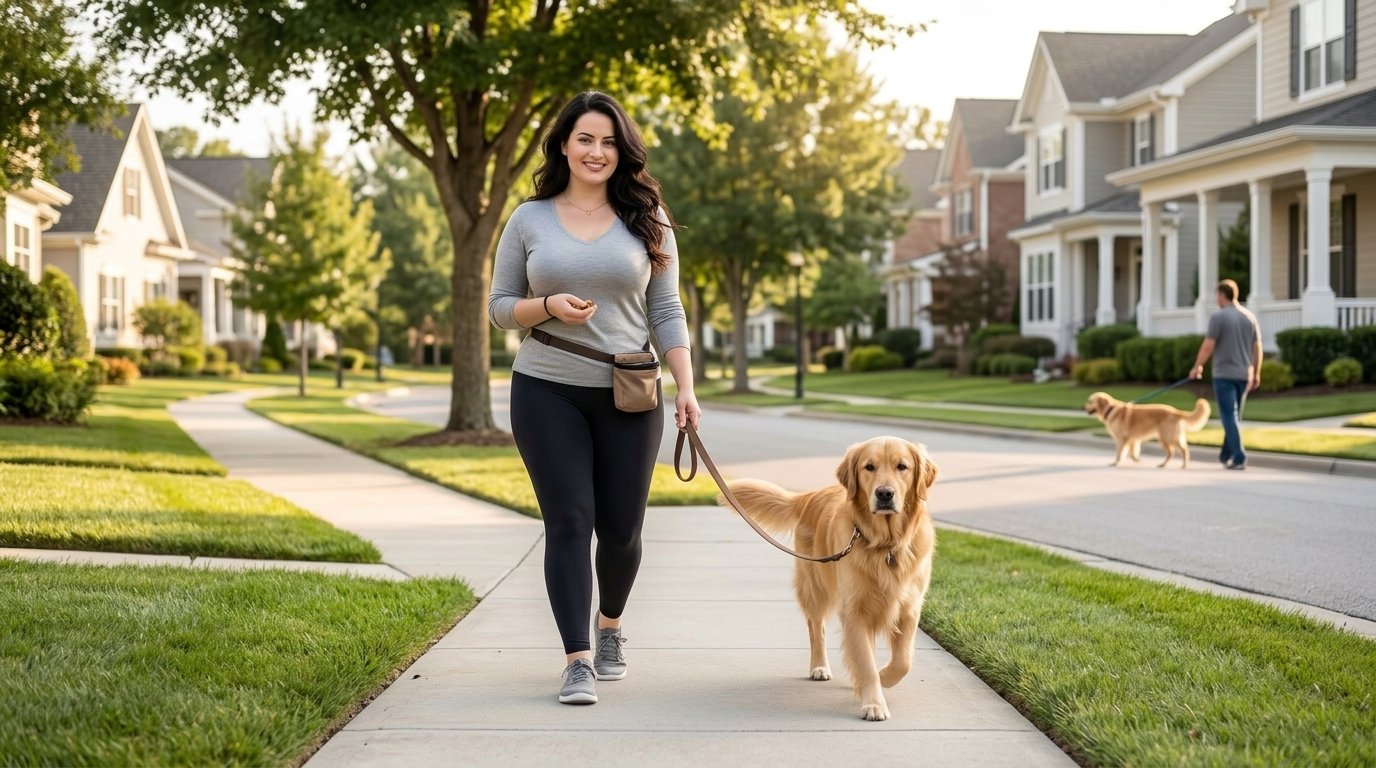
Dog barking at other dogs on walks can turn an ordinary neighborhood stroll into a stressful experience. Your dog may spot another dog across the street, stare intensely, pull forward, and suddenly begin barking or lunging. In other cases, your dog may try to back away while barking.
Although these reactions can look dramatic, barking on leash does not automatically mean your dog is aggressive. Fear, frustration, excitement, or feeling unable to create enough space can all contribute to the behavior.
The most useful response usually isn’t forcing your dog to walk closer or repeatedly saying “quiet.” Instead, start by figuring out how much distance your dog needs to remain comfortable enough to think, respond to you, and accept rewards. Then use that distance to build calmer associations and better walking habits.
This guide explains how to do that safely and gradually.
Table of Contents
Why Is Your Dog Barking at Other Dogs on Walks?
The first question is not simply, “How do I stop the barking?”
Ask:
What is my dog experiencing immediately before the barking begins?
Dogs can bark at other dogs for several different reasons. PawMindTips’ guide to why dogs bark explains that barking is communication and needs to be interpreted alongside the situation and the dog’s body language.
Fear or discomfort
Some dogs want the approaching dog to stay farther away.
You might notice:
- a lowered body
- attempts to move away
- tucked or lowered tail
- freezing
- intense scanning
- ears pulled back
- barking while retreating
Learning the broader signs of a stressed dog can make it easier to intervene before barking begins.
Frustration
Another dog may genuinely want to approach and greet.
The leash prevents that approach, frustration builds, and barking follows.
The ASPCA notes that some dogs bark at other dogs on walks because they want to greet or play but are prevented from doing so.
A frustrated dog may pull forward, whine, bounce, bark, and appear highly excited.
That doesn’t mean you should automatically allow a greeting. If pulling and barking consistently result in access to another dog, those behaviors may become part of the dog’s greeting routine.
Overexcitement
Some dogs become intensely aroused as soon as another dog appears.
They may not be frightened or intending aggression. They simply have difficulty staying regulated around an exciting trigger.
Previous unpleasant experiences
A frightening encounter with another dog can also influence later walks. Your dog may become more vigilant and respond earlier when another dog appears.
Whatever the underlying motivation, avoid assuming that barking alone tells you everything about the dog’s intent.
Look at the complete picture.
Learn Your Dog’s Comfortable Distance
One of the most useful concepts for dog barking at other dogs on walks is threshold.
Think of threshold as the point where the situation becomes too difficult for your dog to handle comfortably.
At a sufficient distance, your dog might:
- notice another dog
- remain relatively loose
- accept a treat
- respond to their name
- turn toward you
- sniff the ground
- continue walking
Move too close and you might see:
- prolonged staring
- body stiffness
- leaning hard into the leash
- ignoring familiar cues
- refusing food
- whining
- growling
- barking
- lunging
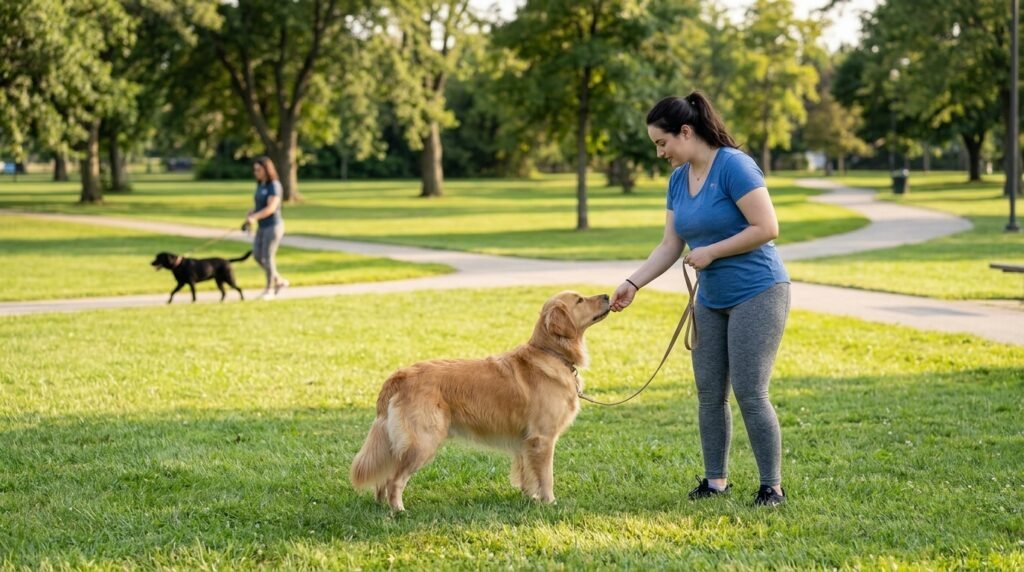
Your starting distance should be where your dog can notice another dog without becoming overwhelmed.
There is no universal number of feet.
The AKC’s guidance on leash lunging similarly recommends working below threshold and notes that the workable distance differs among dogs and triggers.
For one dog, that might mean standing across a street. Another may initially need half a field between them and another dog.
Treat distance as information
If your dog starts barking, you have learned something useful:
The current setup was probably too difficult.
Don’t interpret that moment as stubbornness or failure.
Create more distance.
You might:
- cross the street when safe
- turn down another sidewalk
- step behind a parked vehicle
- move into a driveway or open area
- make a smooth U-turn
- allow the other dog to pass before continuing
Distance is not “giving in” to your dog. It is a training variable.
VCA’s veterinary behavior guidance explains that desensitization starts with trigger exposure at an intensity low enough to avoid a significant emotional reaction, then increases gradually.
That principle is extremely useful on walks.
What to Do When Another Dog Appears
Real walks aren’t controlled training laboratories.
Dogs turn corners unexpectedly. People approach on narrow sidewalks. An off-leash dog may appear. Sometimes you simply need to get out of the situation.
Create a simple routine you can use repeatedly.
Step 1: Notice the other dog early
Scanning ahead gives you options.
If you see another dog before your own dog becomes fixated, you may be able to cross the street, change direction, or establish comfortable distance calmly.
AKC also recommends planning quieter routes and taking proactive actions such as crossing a street or making a 180-degree turn when necessary.
Step 2: Create enough space
Don’t wait for barking to prove that the dogs are too close.
If your dog is staring harder, becoming stiff, closing their mouth suddenly, or shifting their weight toward the other dog, increase distance.
Step 3: Reward the calm moment
When your dog notices the other dog without exploding into barking, mark that moment with a consistent word such as “yes,” then provide a small high-value reward.
You aren’t paying your dog to be afraid or excited.
You are building an association:
Other dog appears → staying engaged and calm pays.
Step 4: Keep moving when appropriate
Some dogs find standing still and watching another dog increasingly difficult.
If your dog can remain responsive while moving, calmly walking away or moving in an arc may be easier than asking for a prolonged sit.
Teach an emergency U-turn separately
A reliable “this way” or U-turn is one of the most practical skills for reactive walks.
Practice it when no dogs are present.
Say your cue, turn smoothly, encourage your dog to follow, and reward them when they move with you.
Repeat until the movement becomes familiar.
Only then begin using it when another dog appears at a manageable distance.
The goal is not obedience for its own sake. You are creating an easy escape route before your dog becomes overwhelmed.
Reward Calm Behavior Around Other Dogs
The central training process is straightforward:
Your dog sees another dog at a comfortable distance → something positive happens.
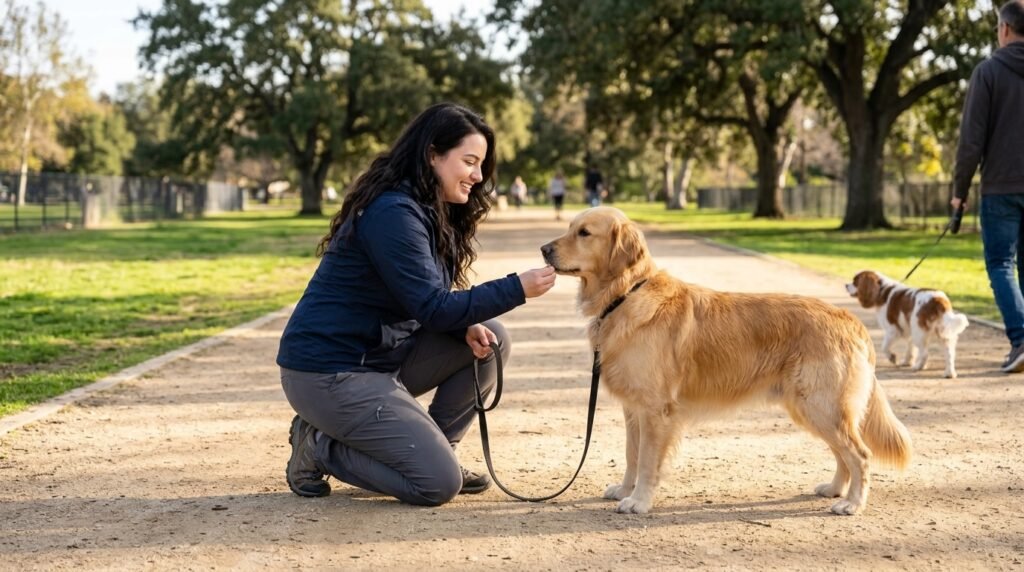
Veterinary behavior resources call this counterconditioning when a trigger associated with an unpleasant emotional response is paired with something that produces a positive response.
Start farther away than you think you need
Choose an environment where you can control distance.
The edge of a spacious park or another open location may be easier than a narrow sidewalk.
When your dog notices another dog:
- Mark the calm look.
- Give a small high-value treat.
- Let your dog notice the other dog again.
- Mark and reward another calm response.
- Increase distance if your dog begins struggling.
Over time, your dog may start seeing another dog and voluntarily looking back toward you.
That is valuable progress.
The AKC describes the same general progression: work below threshold, pair the trigger with high-value rewards, and gradually reduce distance as the dog succeeds.
Reward disengagement
Don’t only reward staring quietly.
Useful choices include:
- looking back at you
- turning the head away from the other dog
- sniffing
- following you
- responding to a familiar cue
- walking past at an appropriate distance
These behaviors show that your dog is capable of disengaging rather than becoming locked onto the trigger.
Build easy skills away from other dogs
Skills such as “watch me,” hand targeting, “find it,” and turning with you should first be taught somewhere easy.
Your living room is a better place to introduce a new cue than ten feet from a dog your pet desperately wants to approach.
If you need to strengthen basic reward-based training first, PawMindTips’ sit-and-stay training guide demonstrates the same principle of starting with low distraction and gradually increasing difficulty.
Don’t rush closer
Success at 60 feet doesn’t mean tomorrow’s goal must be 20 feet.
Change distance gradually.
If your dog begins staring, stops taking food, starts barking, or can no longer respond, make the next repetition easier.
VCA specifically warns that continuing exposure when an animal is already uncomfortable can increase the response rather than improve it.
Build Better Walks Through Gradual Practice
Training sessions matter, but so does what happens during ordinary walks.
Repeatedly putting your dog into situations where they bark and lunge at close range can make learning more difficult.
Management helps reduce those repetitions while training develops.
Choose easier routes
For now, your best walk may not be the busiest trail in town.
Try:
- wider streets
- quieter neighborhoods
- open spaces
- less crowded times
- routes with easy escape options
This isn’t necessarily permanent.
You are creating conditions where your dog can practice the behavior you actually want.
Keep a simple trigger log
Write down:
Trigger — distance — response — recovery
For example:
“Large dog across street — looked twice — accepted chicken — checked back in with me.”
Or:
“Small dog 15 feet away — froze — barked — couldn’t take food — needed U-turn.”
After several walks, patterns may become obvious.
Your dog may react more strongly to:
- dogs running
- dogs staring directly
- barking dogs
- large dogs
- small dogs
- dogs appearing suddenly
- narrow paths
- multiple dogs together
That information lets you make training more precise.
Account for difficult days
Threshold is not necessarily identical every day.
A dog who has already experienced several stressful or exciting events may have less capacity for another challenging encounter.
If your dog seems unusually vigilant, simplify the walk instead of testing how much they can tolerate.
For dogs who are generally worried in multiple environments, PawMindTips’ guide on helping a nervous dog build confidence explains why reducing pressure and using gradual exposure can be more productive than forcing interaction.
Measure recovery, not just silence
Progress doesn’t have to mean “my dog never barked.”
Look for smaller improvements:
- noticing dogs from a shorter distance without reacting
- looking back at you sooner
- accepting food more consistently
- fewer lunges
- shorter barking episodes
- recovering faster after a surprise encounter
- being able to continue walking calmly afterward
Those changes can be meaningful even before barking disappears.
Common Mistakes That Can Make Barking Worse
Forcing close greetings
Your dog doesn’t need to greet every dog encountered on a walk.
Purina’s training guidance notes that appropriate socialization is not about teaching dogs that every other dog is available for play; being able to remain relaxed and attentive around other dogs is also important.
For a worried dog, forced greetings can remove the ability to create space.
For an overexcited greeter, constant greetings can increase the expectation that every dog should be approached.
Neutrality is a perfectly reasonable goal.
Waiting until barking starts
Training is easier before your dog reaches full reaction.
Learn the earlier signs:
staring → stiffness → forward lean → whining → barking/lunging.
Intervene near the beginning of that sequence rather than the end.
Pulling toward the trigger
If your dog is frightened, dragging them closer doesn’t teach them that the other dog is safe.
If your dog is frustrated, allowing them to pull closer can make pulling part of the approach routine.
Punishing the reaction
AVSAB’s current position on humane dog training recommends reward-based methods for dog training and behavior modification.
Punishment may suppress outward behavior in some situations without resolving the fear, frustration, or arousal driving it.
Your goal should be more ambitious than simply producing silence.
You want your dog to become better able to cope.
Moving closer too quickly
Don’t judge progress by how close your dog can get.
Judge it by how comfortably your dog can function.
A relaxed dog 50 feet away is in a better learning position than a barking dog five feet away.
When to Get Help From a Trainer or Veterinarian
Mild reactions that occur at predictable distances may be manageable with thoughtful training and good environmental management.
But professional support is appropriate sooner rather than later when safety is becoming difficult.
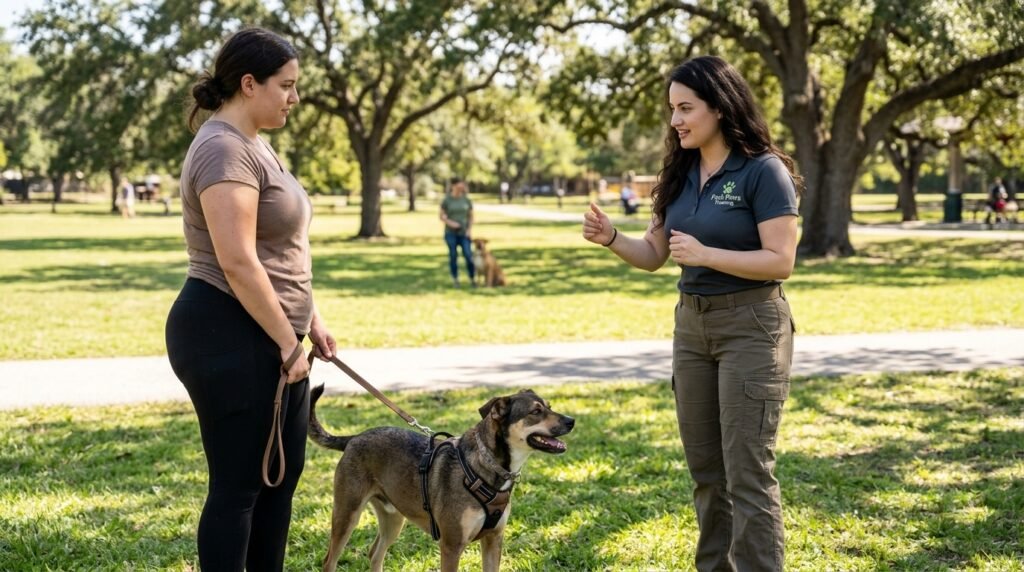
Consider a qualified reward-based trainer or behavior professional if your dog:
- regularly lunges with enough force to be difficult to control
- snaps or attempts to bite
- redirects toward you or another nearby person or animal
- cannot remain below threshold at practical distances
- reacts to dogs in most walking environments
- takes a long time to recover
- is becoming progressively more reactive
- makes walks unsafe
- shows little improvement despite careful training
The ASPCA distinguishes among trainers, Certified Professional Dog Trainers, applied animal behaviorists, and veterinary behaviorists, and notes that specific serious behavior problems may require individualized professional treatment rather than a standard group class.
A veterinary evaluation is also sensible when the behavior appears suddenly, particularly if this represents a significant change from your dog’s normal behavior.
Pain, illness, sensory changes, or other physical problems can sometimes affect behavior. Merck Veterinary Manual notes that medical and pain-related problems can contribute to irritability or aggression-related behavior.
For severe fear, anxiety, or reactivity, a veterinary behaviorist can assess both behavioral and medical factors.
Seeking professional assistance doesn’t mean training has failed. Sometimes an individualized plan is simply the safest and most efficient route forward.
FAQs
Why does my dog bark at other dogs only when on a leash?
A leash changes your dog’s options. They cannot freely approach, move away, or create space as they might otherwise. Some dogs become frustrated because they want to greet; others feel trapped or uncomfortable. Watch your dog’s full body language rather than assuming leash barking always means aggression.
Should I let my dog greet other dogs if they stop barking?
Not automatically. Calm behavior doesn’t need to end with a greeting every time. Teaching your dog that they can notice another dog and continue walking can be extremely useful. Only allow greetings when both dogs appear comfortable and the situation is appropriate.
Do treats reward my dog for barking at other dogs?
Timing matters. The goal is to work far enough away that you can reward your dog before barking starts—for calmly noticing the dog, checking in with you, disengaging, or following you away. Counterconditioning also uses something the dog values to help change their emotional association with the trigger.
How long does it take to stop dog barking at other dogs on walks?
There is no reliable universal timetable. Progress depends on the dog’s history, motivation, intensity of reactions, environment, consistency, and whether training occurs at manageable levels. VCA notes that desensitization and counterconditioning may take anywhere from weeks to months depending on the emotional response. Focus on gradual improvement rather than an arbitrary deadline.
Conclusion
When you’re dealing with dog barking at other dogs on walks, the most productive goal is not simply forcing your dog to stay quiet. Find the distance where your dog can still think and respond, prevent unnecessary close encounters, reward calm observation and disengagement, and make training progressively harder only when your dog is ready.
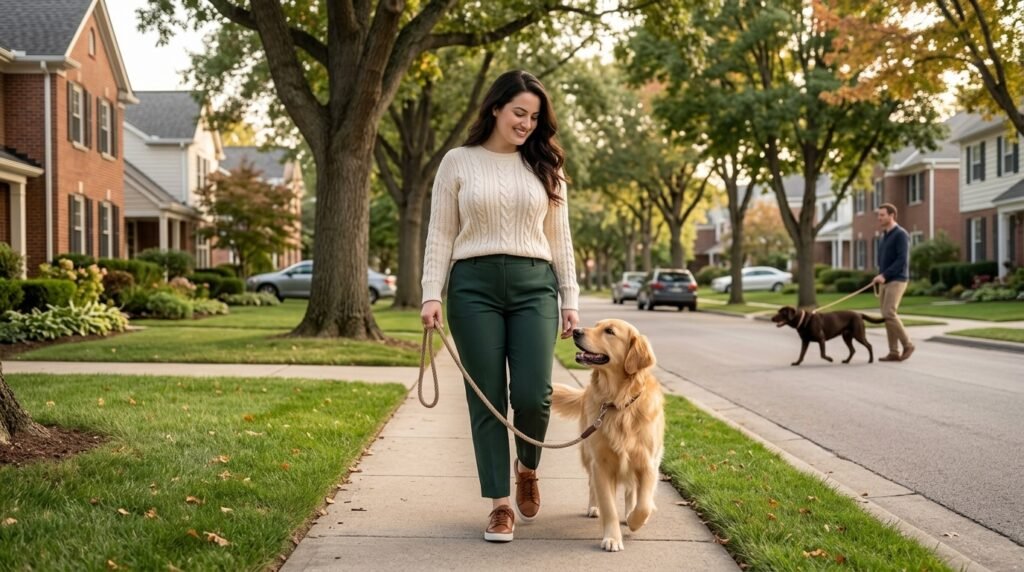
Some dogs need considerable space at first. That’s okay. Consistent successful repetitions are more valuable than repeatedly testing your dog at distances they cannot yet handle.
Watch the body language, create distance early, reward the behavior you want, and keep your expectations gradual. If reactions are severe, worsening, suddenly new, or difficult to manage safely, involve a qualified behavior professional and, when appropriate, your veterinarian.