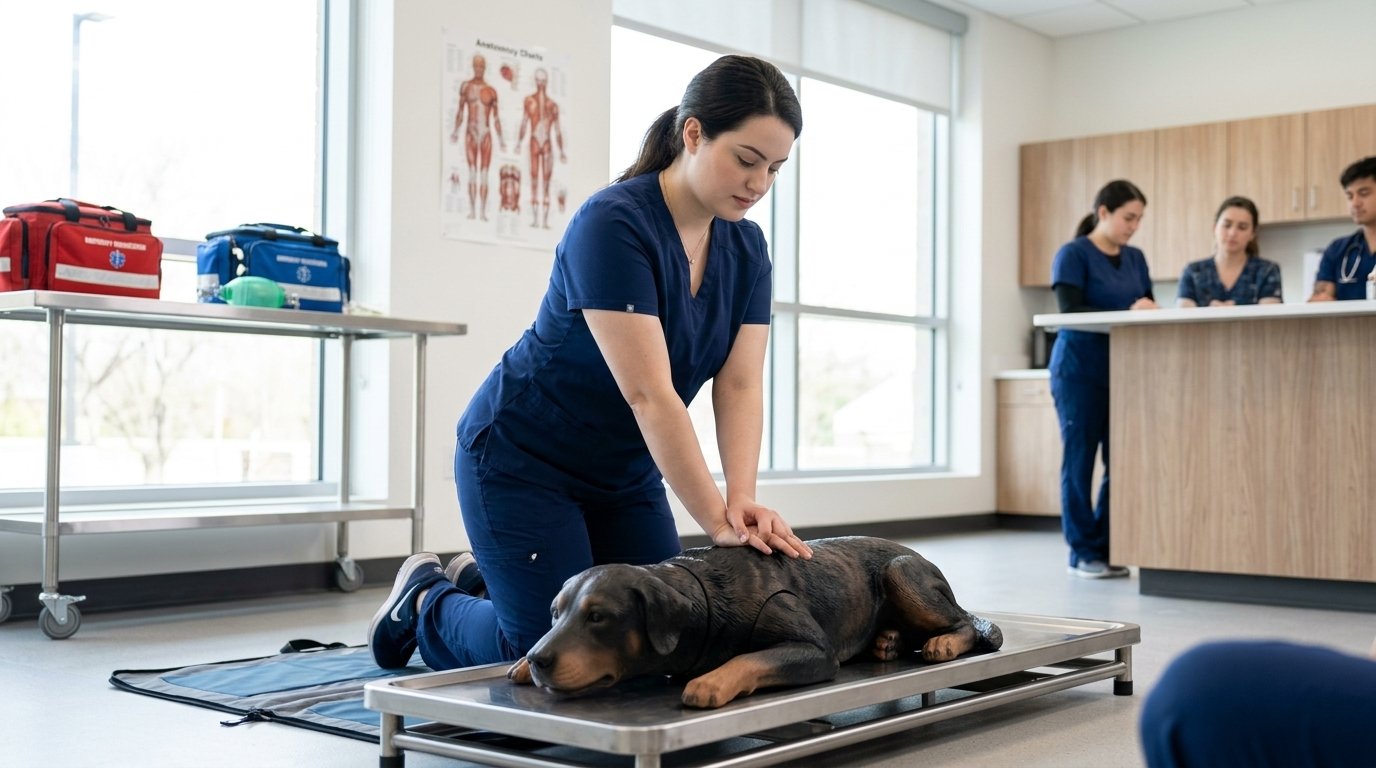
Dog CPR is an emergency measure for a dog who is unresponsive, not breathing normally, and has no detectable heartbeat. It uses chest compressions to move blood and rescue breaths to supply oxygen while someone arranges immediate veterinary treatment. It is not a treatment for fainting, weakness, choking while conscious, or labored breathing when the dog still has a heartbeat.
If this is happening now, make sure the scene is safe, call the nearest emergency veterinary hospital on speakerphone, and ask another person to drive or help if possible. Do not delay lifesaving action to read an entire online guide. The steps below are educational, not a substitute for a hands-on pet first-aid course or instructions from a veterinary professional.
Table of Contents
When Is Dog CPR Needed?
CPR is needed only when a dog is in cardiopulmonary arrest: the dog is unconscious, is not breathing normally, and has no heartbeat or pulse you can detect. Possible causes include severe trauma, drowning, electrocution, toxin exposure, airway obstruction, heatstroke, or a serious heart or respiratory event. Identifying the cause matters to the veterinary team, but an owner should not spend precious time diagnosing it before providing basic life support.
Before dog CPR, start with a rapid assessment that takes no more than about 10 seconds:
- Check responsiveness. Call the dog’s name and look for purposeful movement. Touch the shoulder or body carefully. Do not shake the dog, especially if trauma is possible.
- Look for normal breathing. Watch the chest for movement and feel near the nostrils for airflow. Occasional irregular gasps are not normal breathing and may occur during cardiac arrest.
- Check for a heartbeat or pulse. Place a hand on the left chest near where the elbow meets the rib cage, or feel high on the inside of a rear thigh for the femoral pulse. Check for no more than about 10 seconds.
- Look briefly for a visible obstruction. If the dog is unconscious, open the mouth carefully, pull the tongue forward, and remove an object only if it is clearly visible and easy to reach. Do not push an object deeper with a blind finger sweep.
Pulse checks can be difficult, particularly in a frightened situation or on an overweight or very small dog. If the dog is unresponsive and not breathing normally and you cannot detect a heartbeat promptly, begin dog CPR and follow the emergency veterinarian’s instructions. The American Red Cross pet CPR guidance likewise advises starting compressions when breathing and a heartbeat are absent.
Do not confuse sleep, a seizure recovery period, fainting, or severe weakness with cardiac arrest. A dog who is breathing normally or has a heartbeat needs urgent veterinary assessment, but chest compressions could cause injury.

What to Do Before Starting Dog CPR
First confirm that approaching the dog is safe. Move away from traffic, fire, live electricity, deep water, smoke, or another active threat if you can do so without putting yourself in danger. Turn off an electrical source before touching an electrocuted dog. An injured or frightened dog may bite reflexively, but never place a muzzle on a dog who is unconscious, vomiting, struggling to breathe, or receiving rescue breaths.
Send someone for help immediately. Give that person direct tasks: call the closest open emergency veterinary hospital, put the phone on speaker, bring the car, and identify the fastest safe route. If you are alone, make a brief call on speakerphone without delaying dog CPR. Tell the hospital:
- Your name and callback number
- That the dog is unresponsive and not breathing normally
- Whether you can detect a heartbeat
- The suspected cause, such as trauma, drowning, heat exposure, or poisoning
- Your location and estimated arrival time
The clinic may give case-specific instructions and prepare a resuscitation team. If poisoning may be involved, take the package or a photo of the label, but do not induce vomiting unless a veterinarian or animal poison specialist specifically tells you to. Reducing access to common hazards is also important; PawMindTips’ guide to household items poisonous to dogs can help owners prevent some toxin emergencies.
Place the dog on a firm, flat surface. A bed or couch absorbs force and makes compressions less effective. Most dogs are positioned on their right side, but broad, barrel-chested dogs may be positioned on their back, as explained below. Align the head and neck in a neutral, gently extended position unless a neck or spinal injury is suspected.
Dog CPR: Chest Compressions and Rescue Breaths
For an untrained owner using the public American Red Cross method, use a repeating cycle of 30 chest compressions followed by two rescue breaths. The 2024 RECOVER veterinary CPR guidelines provide the evidence-based clinical framework used by veterinary professionals; advanced hospital CPR can include an endotracheal tube, oxygen, monitoring, medications, and techniques that are not available at home.
Step 1: Position Your Hands
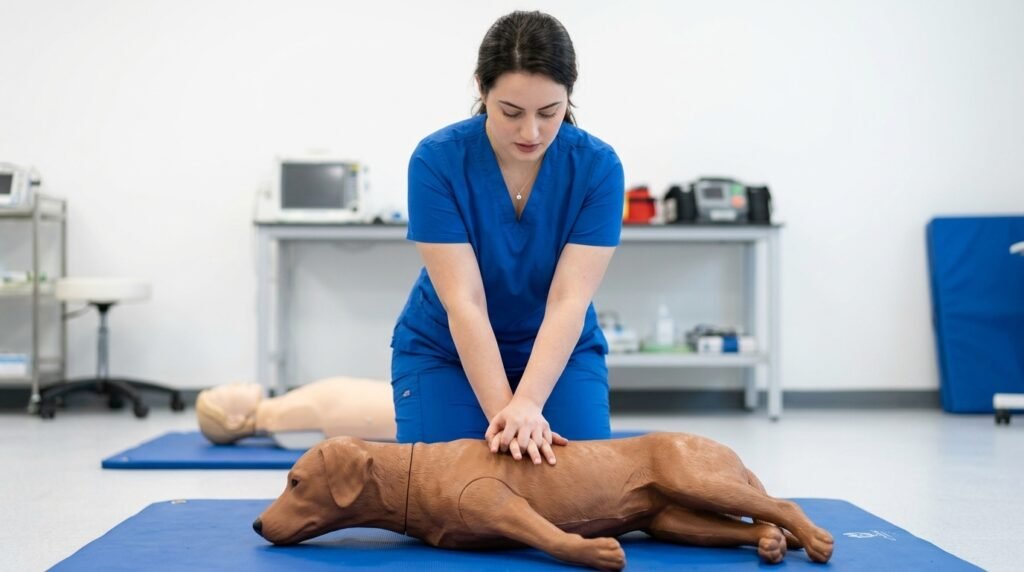
Kneel with your shoulders directly over your hands so your upper body provides the force. Keep your elbows straight. For most medium and large dogs lying on their side, place the heel of one hand over the widest part of the chest and place the other hand on top. Interlock your fingers or keep them raised so pressure is directed through the heel of the lower hand.
For a small dog or puppy, use one hand around the chest with fingers on one side and the thumb on the other, or use one hand over the heart area, depending on the dog’s size and your training. Use enough pressure to move the chest appropriately without squeezing unpredictably.
Step 2: Give 30 Chest Compressions
Compress the chest one-third to one-half of its width at a rate of 100–120 compressions per minute. Let the chest return fully to its normal shape after every compression. Full recoil allows the heart to refill; leaning continuously on the chest reduces blood flow.
Count aloud to maintain the dog CPR sequence. Keep pauses as short as possible. Compressions should be smooth, vertical, and consistent rather than jerky. On a large dog, use your body weight while keeping your shoulders over your hands. On a small dog, scale the force to the chest while still reaching the recommended depth.
Step 3: Give Two Rescue Breaths
After 30 compressions:
- Gently close the dog’s mouth.
- Extend the head and neck enough to open the airway, unless trauma makes movement unsafe.
- Seal your mouth over the dog’s nostrils. For a very small dog, your mouth may cover both the nose and mouth.
- Blow just until you see the chest rise, then allow it to fall.
- Give a second breath in the same way.
Each breath should create visible chest rise, not excessive inflation. If the chest does not rise, reposition the head, improve the seal, and check again for a visible obstruction. Overly forceful or rapid breaths can inflate the stomach, increase the risk of regurgitation, and interfere with circulation.
Step 4: Repeat and Reassess
Immediately resume 30 compressions and continue the 30:2 cycle. Briefly reassess breathing and heartbeat about every two minutes, limiting the pause to no more than roughly 10 seconds. If two trained rescuers are present, one can compress while the other manages breaths, calls the hospital, or prepares transport. Switch compressors about every two minutes if possible because fatigue quickly reduces compression quality.
Continue dog CPR until one of the following occurs:
- The dog begins breathing normally and has a heartbeat
- A veterinary professional takes over
- You reach the emergency hospital and staff assume care
- The scene becomes unsafe
- You are physically unable to continue
If a heartbeat returns but the dog is not breathing, stop chest compressions and provide rescue breathing only under real-time veterinary guidance while transporting the dog. If the dog starts breathing, keep the airway open, minimize movement, keep the dog comfortably warm without overheating, and go immediately to the emergency hospital.
How Dog Size and Chest Shape Affect CPR
Dogs vary far more in body shape than people, so one dog CPR hand position does not suit every dog. The goal is to compress the heart directly in some dogs and use the chest-pump effect in others. If you have completed a recognized pet CPR course, follow the technique you practiced for your dog’s body type.
| Dog type | Usual position | General hand placement |
|---|---|---|
| Most medium or large dogs with a rounded chest | Right side on a firm surface | Over the widest part of the rib cage |
| Deep-chested dogs, such as Greyhounds | On the side | Over the heart area or widest chest area according to trained protocol |
| Barrel-chested dogs, such as English Bulldogs | Often on the back if stable | Over the widest part of the sternum |
| Small dogs and puppies | On the side | One hand over the heart or a one-handed encircling technique |
The American Red Cross specifically describes back positioning with hands over the sternum for barrel-chested dogs. For small and deep-chested dogs, it describes placement over the heart, while its general guidance also identifies the widest portion of the chest. Because chest conformation can be hard to judge under stress, practical training with a canine manikin is much safer than trying to memorize breed lists.
Regardless of shape, the compression targets remain consistent: about one-third to one-half of chest width, 100–120 compressions per minute, full recoil, and minimal interruptions. Do not press over the abdomen, throat, or the pointed end of the sternum. Move the dog only as much as necessary to obtain an effective position and safe transport.
When CPR Should Not Be Performed
Do not perform dog CPR simply because a dog has collapsed. Chest compressions are inappropriate when the dog is responsive, breathing normally, or has a heartbeat. They can fracture ribs, injure the lungs, or cause other trauma. Instead, keep the dog still, call an emergency veterinarian, and transport promptly.
CPR should not be performed in these situations:
- The dog is conscious or responds purposefully. A responsive dog does not meet the criteria for cardiac arrest.
- The dog is breathing normally. Labored, noisy, or rapid breathing is an emergency, but it is not an indication for chest compressions while a heartbeat is present.
- A heartbeat or pulse is present. If breathing has stopped but circulation remains, rescue breaths—not compressions—may be appropriate under veterinary instruction.
- The dog is actively choking but conscious. Conscious choking requires airway-focused first aid and emergency veterinary help, not routine CPR. Begin CPR only if the dog becomes unresponsive, stops breathing normally, and has no detectable heartbeat.
- The scene is unsafe. Do not enter traffic, water, fire, toxic fumes, or an electrically live area. Call emergency services and make the area safe first.
- There are unmistakable signs that resuscitation cannot be effective. In cases of catastrophic injury or clear, prolonged death, contact a veterinarian for guidance rather than attempting CPR.
Seizures also require a different response. Do not restrain the dog, put fingers in the mouth, or begin compressions while the dog is breathing and has a heartbeat. Clear nearby objects, time the seizure, and seek veterinary care. Assess breathing and circulation after the active movements stop.
Common Dog CPR Mistakes to Avoid
Even well-intentioned dog CPR can become less effective when technique breaks down. Formal practice makes these errors easier to recognize and correct.
Delaying Compressions for a Long Pulse Check
Spend no more than about 10 seconds assessing breathing and circulation. Repeatedly searching for a difficult pulse can waste the time in which compressions are most needed. When the dog is unresponsive, not breathing normally, and has no promptly detectable heartbeat, start.
Performing CPR on a Breathing Dog
Collapse alone is not enough. Check responsiveness, breathing, and circulation first. A dog with heatstroke, shock, poisoning, or respiratory distress may be critically ill without being in cardiac arrest. These dogs need rapid cooling or other case-specific first aid and immediate veterinary care, not automatic compressions. During hot weather, prevention and early recognition are crucial; review how to keep a dog cool during summer before heat exposure becomes an emergency.
Using a Soft Surface or Incorrect Hand Location
A mattress absorbs the force that should compress the chest. Move the dog to the floor, ground, or another firm surface when safe. Place your hands according to chest shape and avoid the abdomen or lower tip of the breastbone.
Compressing Too Slowly, Too Shallowly, or Without Recoil
Aim for 100–120 compressions per minute and one-third to one-half chest depth. Keep your rhythm steady and release pressure completely after each compression. Bending the elbows, rocking forward without releasing, or pausing frequently reduces circulation.
Giving Breaths That Are Too Forceful
Blow only until the chest rises. A breath that is too large or fast may inflate the stomach and promote vomiting. If fluid or vomit enters the mouth, turn the head and body together if trauma permits, clear material you can see, and promptly resume the sequence.
Stopping Too Often
Long pauses cause blood flow to fall. Prepare your hand position before the pause for breaths, keep each transition brief, and reassess only about every two minutes. If another trained rescuer is available, switch roles quickly rather than stopping to discuss the next step.
Waiting to Arrange Veterinary Care
CPR is a bridge, not definitive treatment. Call the emergency hospital at the start, not after several cycles. Do not remain at home because the dog appears to recover. The cause of the arrest and complications of resuscitation still require urgent treatment.
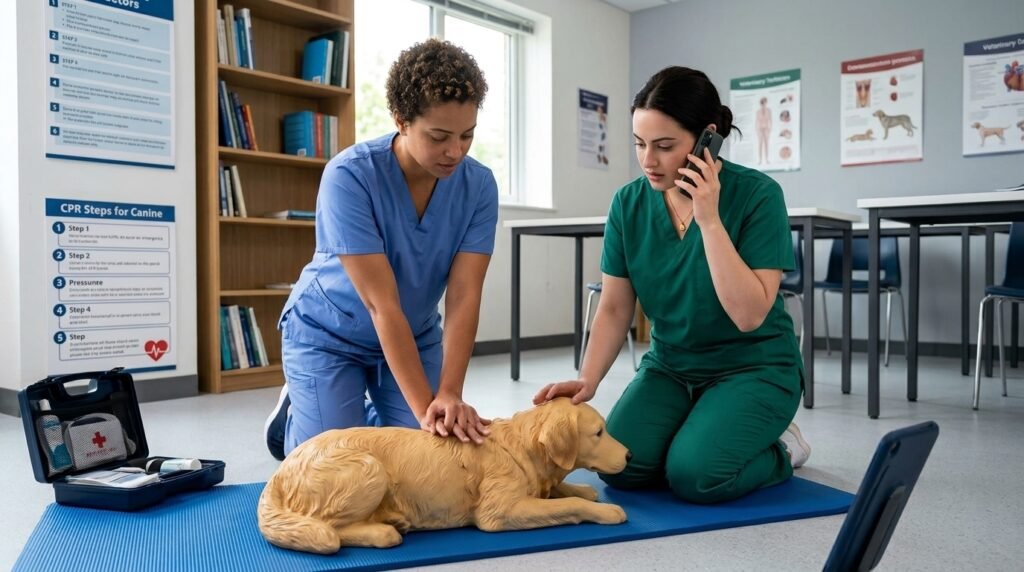
Emergency Veterinary Care After CPR
Every dog who receives dog CPR needs immediate emergency veterinary care, even if breathing and a heartbeat return. A temporary recovery does not mean the danger has passed. The dog may arrest again, and the underlying problem—such as airway disease, heart disease, trauma, heatstroke, drowning, or toxin exposure—may still be active.
The veterinary team may provide oxygen, secure the airway, monitor heart rhythm and blood pressure, test blood glucose and electrolytes, treat shock, control seizures, address toxins, or look for internal injuries. After circulation returns, careful monitoring is important because the brain, lungs, kidneys, and other organs may have been deprived of oxygen.
Transport requires coordination. Ideally, one person drives while another trained person continues CPR on a firm surface in the vehicle. Everyone should wear a seat belt when possible, and the driver must not attempt compressions. If you are alone, follow the emergency clinic’s instructions; driving while performing CPR is unsafe.
If the dog begins breathing during transport, stop compressions, keep the airway clear, and watch continuously for another arrest. Avoid food, water, or oral medication unless the veterinary team directs otherwise. Bring suspected toxin packaging, medication containers, or relevant medical records without delaying departure.
Tell the team when the dog was last seen normal, when arrest was recognized, when CPR began, how long it continued, whether breathing or a heartbeat returned, and any suspected cause. These details can guide treatment.
Preparing Before an Emergency
The worst moment to learn dog CPR is during a real arrest. Enroll in a hands-on dog CPR course that also covers choking, bleeding, shock, heat illness, and safe transport. The RECOVER Initiative offers standardized veterinary CPR education, and the American Red Cross cat and dog first-aid program provides owner-focused training options. Refresh your skills regularly because CPR technique is difficult to retain without practice.
Ask your veterinarian where the closest 24-hour emergency facilities are. Save their phone numbers, addresses, and driving routes in every household phone and on a printed card. Confirm which facility is open at night, on weekends, and on holidays. If you travel with your dog, identify an emergency clinic at the destination before leaving.
Create a simple response plan:
- Assign one person to call and one to provide first aid
- Decide who will drive
- Keep a leash, blanket, carrier, and first-aid kit accessible
- Store current medications and medical information together
- Know how to move your dog without worsening a suspected spinal injury
- Practice explaining your location and the emergency clearly
- Post poison-control and veterinary numbers where they are easy to find
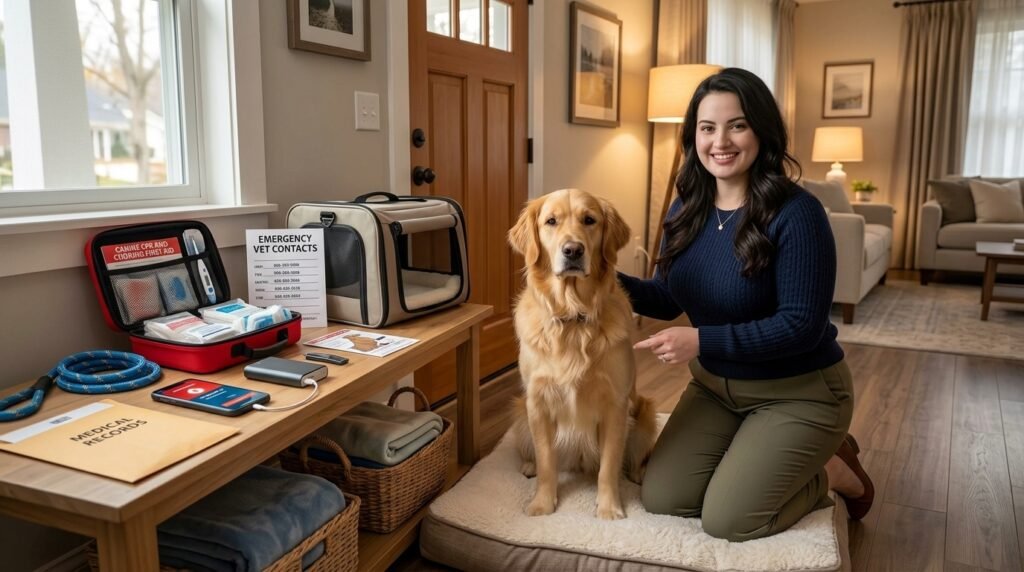
Integrate CPR preparation into a broader Dog Emergency Plan that covers contacts, medical records, evacuation, transportation, supplies, and a backup caregiver. Review it whenever you move, change veterinarians, add a pet, or begin a new medication.
Practice only on a canine CPR manikin, never by compressing a healthy dog’s chest or blowing into a healthy dog’s nose. You can safely become familiar with where your dog’s heartbeat and femoral pulse are while the dog is relaxed, but ask your veterinarian to demonstrate. Knowing what is normal makes emergency assessment less confusing.
FAQs
Can dog CPR restart a dog’s heart?
Dog CPR can circulate some oxygenated blood during cardiac arrest and may contribute to return of spontaneous circulation, but it does not guarantee that the heart will restart. The dog still needs immediate advanced veterinary treatment to address the cause and support the heart, lungs, and other organs.
What is the correct dog CPR compression rate?
For the public American Red Cross sequence, give 100–120 chest compressions per minute. Compress the chest about one-third to one-half of its width, allow full recoil, and use cycles of 30 compressions followed by two rescue breaths.
Should I give chest compressions if my dog has a heartbeat but is not breathing?
No. If a heartbeat is definitely present, chest compressions are not indicated. Rescue breathing may be needed, but call an emergency veterinarian immediately for real-time guidance and transport. Reassess circulation frequently because the dog’s condition can change.
Can I perform CPR while taking my dog to the emergency vet?
Only if another person is driving and you can continue safely on a firm surface. A driver must never attempt CPR. Call the hospital before departure, follow its instructions, and have staff ready to take over when you arrive.
Conclusion
Dog CPR is reserved for the most critical situation: a dog who is unresponsive, not breathing normally, and has no detectable heartbeat. Quickly check the airway, breathing, and circulation; send someone to call the emergency hospital; then use 30 compressions and two rescue breaths at a rate of 100–120 compressions per minute. Adapt hand placement to the dog’s chest shape, allow full recoil, and minimize pauses.
CPR can buy time, but it cannot replace emergency veterinary treatment. Arrange transport from the beginning and seek care even if the dog appears to recover. The most valuable preparation is a practical pet first-aid course, an up-to-date emergency plan, and contact information for the nearest 24-hour veterinary hospital.