Dog food measuring works best when you use the same method each time and check the information for the exact food you serve. A cup measures volume; a kitchen scale measures weight. There is no universal number of grams in a cup of kibble, so an online conversion for another product may give you the wrong portion.
Perhaps breakfast is your job, dinner is your partner’s, and training treats come from whoever walks the dog. Everyone may follow “one scoop” faithfully while serving different amounts. A heaped scoop, a different cup, or an extra handful can make the routine difficult to track.
This guide helps you put an existing feeding plan into practice: prepare the equipment, weigh portions, check conversions, and leave clear instructions for other caregivers. All quantities in the examples are hypothetical. They demonstrate the method, not how much your individual dog should eat.
Table of Contents
Dog Food Measuring: Cups, Grams, and Ounces Explained
The first step is identifying what your feeding instructions actually measure. “One cup,” “100 grams,” and “eight ounces” are not interchangeable directions.
A cup describes the space a food occupies. Grams describe its mass, commonly called weight in everyday use. The amount of kibble that fits inside a cup depends on the product and how you fill the cup.
Cups are not kitchen mugs
For US feeding instructions, check the manufacturer’s definition of a cup; many specify a standard 8-fluid-ounce measuring cup. A coffee mug, drinking glass, and scoop marked “one portion” may have different capacities. A metric cup can also differ from a US cup.
Eight fluid ounces describe volume, not eight ounces of kibble by weight. On a scale, select grams when the instructions give grams. Avoid using a liquid-volume mode to weigh dry food.
| Tool or unit | What it tells you | Main limitation |
|---|---|---|
| Measuring cup | Food volume | Filling technique and kibble shape affect the weight |
| Kitchen scale set to grams | Food weight | It must be suitable, zeroed, and used correctly |
| Unmarked scoop or mug | An unspecified volume | It is not a defined portion without checking |
| Feeder “portion” setting | A device-specific dispensing amount | It needs checking with the actual kibble |
Know which food the instructions refer to
Keep the exact product name and formula with the feeding plan. A direction written for an adult chicken recipe cannot automatically be applied to a puppy formula, even from the same brand.
Measuring accurately also does not establish that the food itself suits your dog. The FDA’s explanation of complete and balanced pet food describes the nutritional adequacy statement and its intended life stage. That is a separate check from weighing the serving.
Why the Same Cup Can Give Different Portions
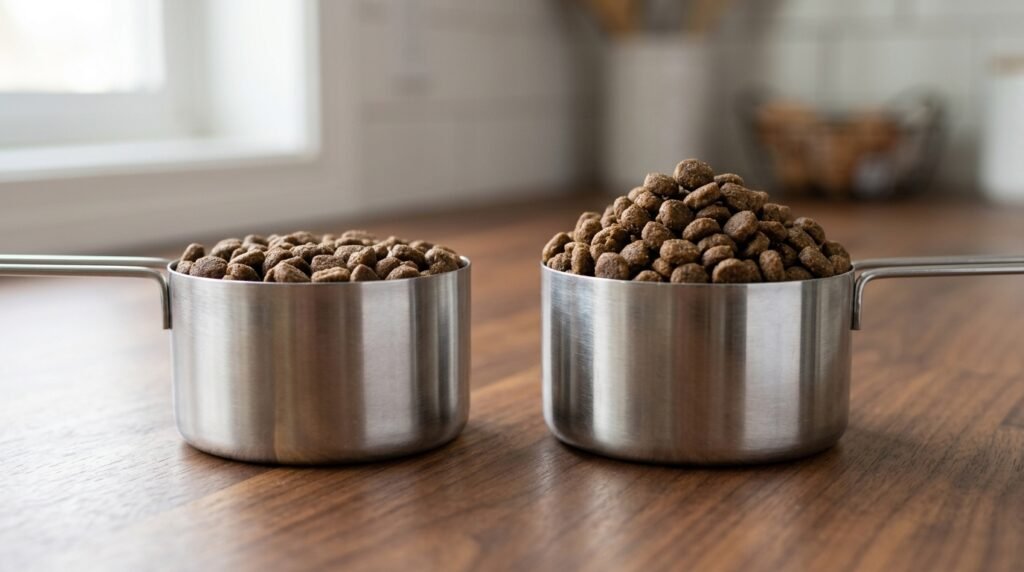
Picture filling a cup with large, irregular kibble. Spaces remain between pieces. A smaller-shaped kibble may settle differently, and a scoop with a mound above the rim holds more than a level scoop of the same food.
These differences explain why a cup-to-grams number belongs to a particular product. They also explain why “I always use the same scoop” does not necessarily mean the amount is consistent.
Level, heaped, and packed are different
When using a cup, follow the product’s measuring directions. Fill it consistently and avoid deliberately compacting the contents or adding a mound. Use an appropriately sized measuring cup rather than estimating a tiny fraction inside a large container.
For example, a one-quarter-cup measure is easier to fill consistently than guessing where one quarter falls in an unmarked scoop. This is a practical improvement, not a guarantee of a particular accuracy level.
Small differences are easier to understand in percentages
Suppose a planned serving is 25 g and a scoop delivers 30 g. The difference is 5 g, or 20% of that planned serving. The same 5 g difference is only 2% of a 250 g serving. These are arithmetic examples, not feeding recommendations.
This is why eyeballing small amounts deserves particular attention. A scale can remove the need to judge the fill line, although its display resolution and minimum reliable load still matter. Weighing is a tool for consistency; it does not make the underlying feeding target automatically correct.
How to Measure Dog Food With a Kitchen Scale
Set up a place where the bowl can sit securely and the dog cannot bump the equipment. Keep the food package nearby until you have recorded the correct units and amount.
Choose equipment suited to the portion
A digital kitchen scale with a gram display is practical for many ordinary kibble servings. Check its instructions for capacity and minimum load. A display that changes in 1 g increments is not a promise that every measurement is accurate to 1 g.
For a very small prescribed portion, ask the veterinary team what resolution is appropriate. Do not use this kitchen-food method to measure medications or concentrated supplements.
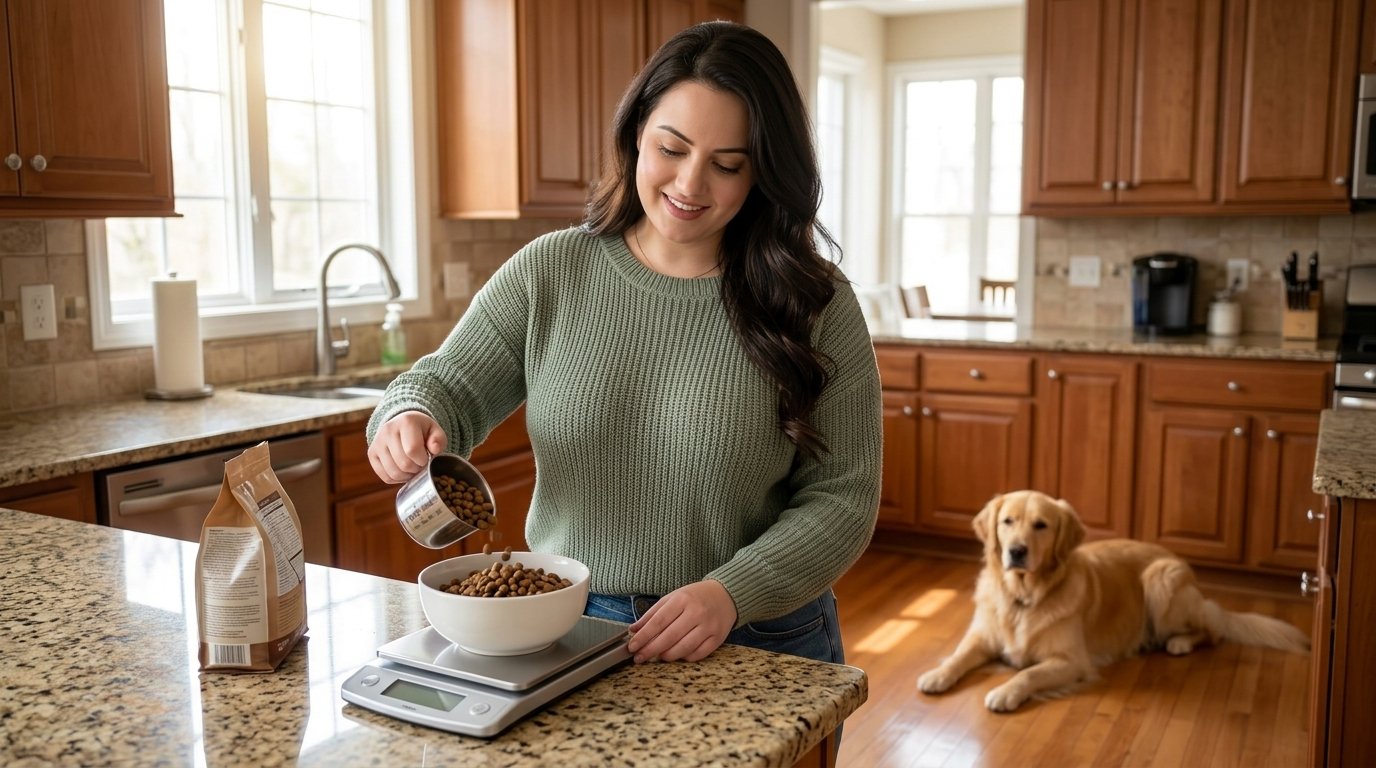
Follow these six steps
- Use a hard, level surface. A towel or uneven counter can interfere with stable readings.
- Select grams. Confirm the unit before adding food.
- Place the empty bowl on the platform. It should sit fully supported without touching nearby objects.
- Press tare or zero. The display should return to zero, excluding the bowl’s weight.
- Add food gradually. Wait for the reading to stabilize, then adjust to the planned amount.
- Check the instruction. Confirm whether you have weighed one meal or the entire day’s allocation.
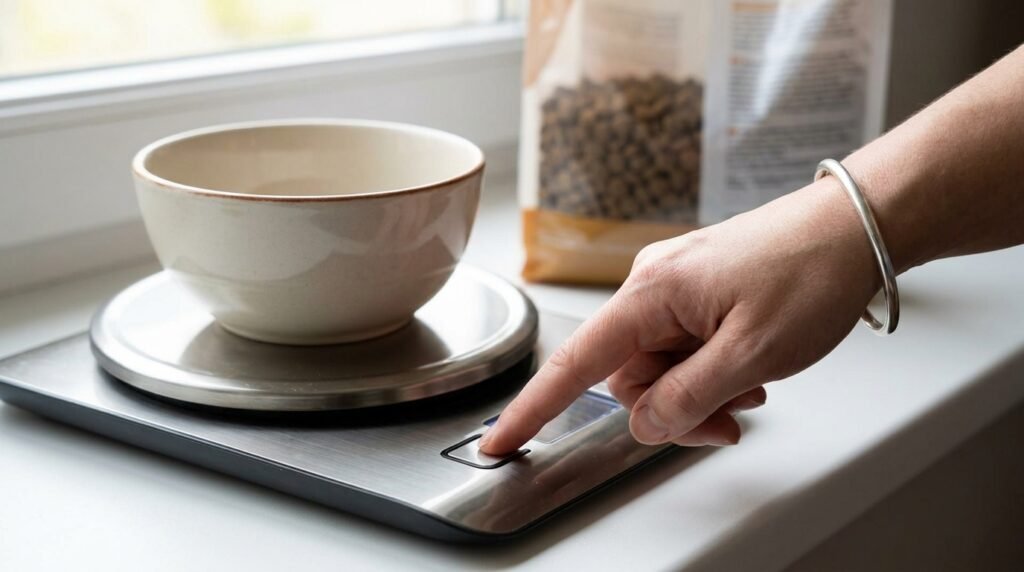
Keep your hand off the bowl while reading the scale. If the number keeps drifting, check the surface, battery, bowl position, and the manufacturer’s troubleshooting directions before using the result.
Some scales switch off quickly. If that happens halfway through measuring and you lose the tare reference, transfer the food to a clean container and start again with an empty bowl. Guessing how much the bowl weighed defeats the point of weighing it.
If you measure the whole day at once, store that allocation securely and divide it according to the feeding plan. Do not serve the full daily amount again at dinner.
Converting Dog Food Cups to Grams
Start with the product label or the manufacturer’s current information. Look for grams per cup, a feeding table in grams, or a calorie-content statement that can help check the conversion.
The WSAVA North American food-label guide illustrates where calorie information and feeding directions appear. Read the units carefully: a figure per kilogram is different from one per cup, can, or serving.
When grams per cup are available
Use this formula:
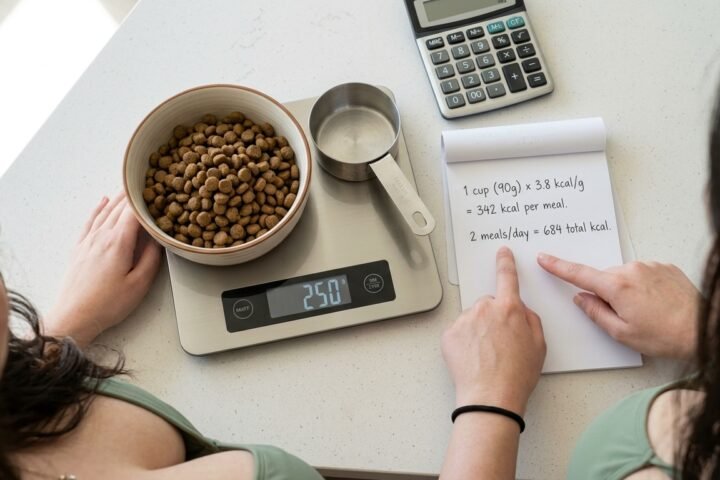
Planned cups × grams per cup = planned grams
Suppose one specific food states that a cup weighs 100 g. Its hypothetical conversion table would look like this:
| Planned volume of this example food | Calculation | Weight |
|---|---|---|
| ¼ cup | 0.25 × 100 g | 25 g |
| ½ cup | 0.5 × 100 g | 50 g |
| ¾ cup | 0.75 × 100 g | 75 g |
| 1 cup | 1 × 100 g | 100 g |
| 1½ cups | 1.5 × 100 g | 150 g |
This table applies only to the hypothetical 100-g-per-cup food. It is not a general kibble conversion chart.
If 150 g is the daily amount and the plan calls for two equal meals, each meal contains 75 g. Write both numbers on the household instructions, including “per day” and “per meal.”
When grams per cup are missing
Ask the manufacturer for the conversion for the exact formula. Include the product name and a photo of the current label if needed. Do not borrow another recipe’s number from a retailer listing.
If the label supplies both kcal per cup and kcal per kilogram, you can estimate the implied grams per cup:
Grams per cup ≈ kcal per cup ÷ (kcal per kg ÷ 1,000)
For a hypothetical food labeled 360 kcal/cup and 3,600 kcal/kg, the estimate is 360 ÷ 3.6 = 100 g/cup. Label rounding can affect this result. If values disagree or the feeding instructions are unclear, confirm them with the manufacturer rather than treating the estimate as exact.
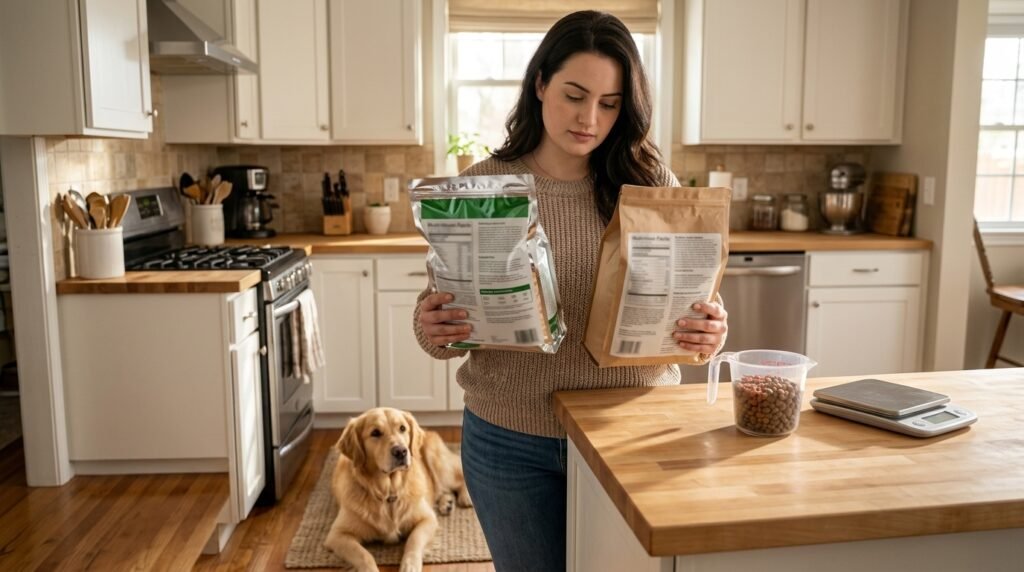
An internet chart may look convenient, but without a named product and current source it cannot answer how much your particular cup of kibble weighs.
Using Calories to Check a Measured Portion
Sometimes your veterinarian provides a calorie allocation rather than a number of cups. The conversion then depends on the food’s calorie density.
On pet-food packaging, a dietary Calorie is a kilocalorie, abbreviated kcal. Use the calorie-content statement rather than trying to calculate energy from the guaranteed-analysis percentages yourself.
Convert kcal per kilogram to kcal per gram
There are 1,000 grams in a kilogram:
kcal/kg ÷ 1,000 = kcal/g
For an example food with 3,600 kcal/kg:
3,600 ÷ 1,000 = 3.6 kcal/g
If 360 kcal has already been allocated to that food, the amount is:
360 kcal ÷ 3.6 kcal/g = 100 g
This calculation converts an established allowance. It does not tell you whether 360 kcal is the right allowance for your dog.
Keep the calorie allocation specific
If the daily plan includes separate calories for treats or another food, do not assign the entire day’s calories to the kibble as well. That counts some of the allocation twice.
For example, suppose a hypothetical plan allocates 720 kcal to a particular dry food. At 3.6 kcal/g, that food contributes 200 g for the day. If two equal meals are intended and no kibble is reserved for training, each contains 100 g.
The AAHA feeding-plan guidance includes meals, snacks, medication foods, and other sources when considering intake. A clear plan also needs review against the individual dog’s condition.
Recalculate when the food changes
The same weight of a different food may provide different calories. If the new product contains 4 kcal/g, the illustrative 720-kcal allocation becomes 180 g, not 200 g. Weighing 200 g perfectly would still apply the old conversion to the new food.
Keep both product labels during a change. Our dog food transition guide covers the broader switching process; here, the key is checking the measurement for each food separately.
Measuring Wet Food, Mixed Meals, and Training Rewards
Dog food measuring becomes more complicated when the bowl contains several components. Write down each one rather than treating “a little wet food” or “a few treats” as an unmeasured extra.
Wet food: use the matching units
Tare a clean bowl before adding wet food. If the package gives calories per can, note that can’s net weight. A different can size or formula requires its own information.
For an illustrative 300-g can containing 300 kcal, the food averages 1 kcal/g. A 100-g portion would therefore provide about 100 kcal. This is an example, not a value that applies to canned foods generally.
For products with chunks and sauce, mix the contents as appropriate before dividing so one portion is not mostly liquid and another mostly solids. Follow the product’s preparation directions, and include the components meant to be fed.
Mixed meals: calculate each component
Imagine a planned meal containing 90 g of dry food at 3.6 kcal/g plus 60 g of wet food at 1 kcal/g. The arithmetic is:
| Component | Weight | Example energy density | Calories |
|---|---|---|---|
| Dry food | 90 g | 3.6 kcal/g | 324 kcal |
| Wet food | 60 g | 1 kcal/g | 60 kcal |
| Total | 150 g | Not a single-product value | 384 kcal |
These quantities demonstrate calculation only. Equal weights of the two foods would not provide equal calories.
If a topper is part of the plan, account for it before serving. Do not assume that matching total calories makes an arbitrary mixture nutritionally balanced, particularly for puppies or dogs eating therapeutic diets.
Training rewards: reserve rather than add
When suitable for your dog’s plan, take training kibble from the weighed daily allocation. If that allocation is 200 g and you reserve 20 g for training, 180 g remains for meals. Two equal meals would then be 90 g each.
The WSAVA guide to feeding treats advises limiting treats to no more than 10% of daily calories. That is a general ceiling, not an amount every dog needs; an individual medical feeding plan may be stricter.
For separate commercial treats, use their calorie information. A 20-g bag of treats is not automatically equivalent to 20 g of your usual kibble.
A Consistent Daily Routine—and Mistakes to Avoid
A useful routine should work for everyone who feeds the dog, including a sitter who has never seen your kitchen setup.
Leave a short written feeding card
Record the food name, daily quantity, meal quantity, training allocation, and the date the plan was last checked. Avoid directions such as “the usual scoop” or “fill to about here.”
Here is a hypothetical household card:
| Item | Written instruction |
|---|---|
| Product | Exact brand and recipe from the current bag |
| Daily kibble allocation | 200 g total, including training kibble |
| Breakfast | 90 g |
| Dinner | 90 g |
| Training container | 20 g reserved from the daily total |
| Other foods | Only those included in the agreed feeding plan |
If training kibble remains unused, record it rather than automatically replacing it with extra treats. When tracking intake, distinguish food offered from food actually eaten. Also note spills or food taken by another pet.
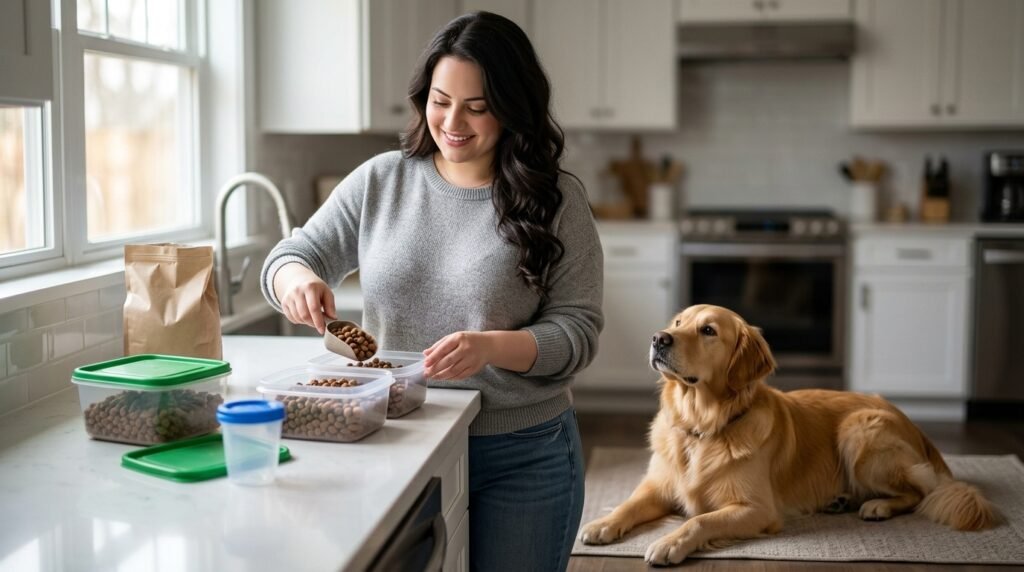
Our daily dog routine guide can help place meals and training into a workable household schedule. A simple checkmark after each meal can prevent two people from feeding dinner.
Check automatic feeders instead of assuming
A machine’s “portion” is a dispensing setting, not necessarily a fixed gram value for every kibble. Follow the feeder’s instructions and weigh several test servings using the food it will dispense. Check whether the results match the intended amount and whether the variation is acceptable for the plan.
Recheck after changing kibble, altering the setting, or servicing the feeder. Do not promise yourself an exact intake just because an app displays an exact number.
Keep preparation hygienic
The FDA’s pet-food handling advice recommends washing hands and cleaning bowls and measuring utensils. Use a clean dedicated scoop to transfer food rather than dipping a used eating bowl into the bag.
Promptly refrigerate leftover canned food according to its instructions. Store dry portions securely, and retain the original package information. Our guide to storing dry dog food covers storage in more detail.
When to Recheck the Feeding Plan
Accurate dog food measuring makes the routine easier to review, but it cannot prove that the quantity remains appropriate indefinitely. Growth, activity changes, illness, and changes in body condition can require professional reassessment.
Contact your veterinary team about unexplained weight change, persistent appetite changes, or uncertainty about an existing prescription. Bring the current label, your measurements, and a record of treats and other foods. Do not respond to every weight change by making a large unsupervised cut or increase.
The WSAVA nutrition toolkit includes body-condition resources and emphasizes individualized assessment. Weighing the meal and evaluating the dog’s nutritional needs are complementary tasks.
For a routine review, ask two separate questions: “Are we measuring the amount correctly?” and “Is this still the right amount and food for this dog?” Correcting the first does not automatically answer the second.
FAQs
How many grams are in a cup of dog food?
There is no universal conversion. Use the grams-per-cup value for your exact formula, or ask its manufacturer. For example, one food might list a value different from another even when both directions say “one cup.” Do not use the hypothetical 100-g examples in this guide as your dog’s conversion without checking the actual product.
Can I measure dog food without a kitchen scale?
Yes. Use the measuring cup specified by the product and fill it consistently, avoiding heaps and guessed fractions. Dog food measuring with a scale is useful when you want to track weight directly. If the feeding plan requires a small or closely controlled amount, ask the veterinary team which measuring method is suitable.
Should I weigh kibble before or after adding water?
When the instructions refer to dry kibble as supplied, weigh it before adding water. Plain water increases the bowl’s weight without increasing the kibble’s calories. Products intended for rehydration may have specific directions, so follow those and confirm which form the stated portion refers to. Broth or other additions may contribute calories and need separate assessment.
Do I need to recheck portions when changing dog food?
Yes. Check the new formula’s calorie density, feeding directions, and any grams-per-cup information. Do not assume the old cup volume or gram weight supplies the same calories. Keep the new measurements with the feeding plan and follow any veterinary instructions for the change.
Conclusion
Consistent dog food measuring starts with a clear feeding plan, the correct product information, and a method everyone in the household can repeat. Tare the bowl, check the units, distinguish daily amounts from individual meals, and count food used outside the bowl. Recheck conversions when the product changes, and ask your veterinarian whether the feeding plan still fits your dog.