Figuring out how much to feed a dog takes more than matching body weight to a number of cups. A good starting portion accounts for the calories in the specific food, your dog’s ideal weight, age, activity, reproductive status, body condition, and every treat or table scrap. Start with the food label or a calorie estimate, measure the full daily allowance accurately, and then adjust it according to weight and body-condition trends.
This guide walks you through that process. You will learn how to estimate daily calories, turn them into cups or grams, budget treats, divide meals, and recognize when a veterinarian should personalize the plan.
Important: The calculations below provide starting estimates for generally healthy dogs. Puppies, pregnant or nursing dogs, working dogs, severely underweight or overweight dogs, and dogs with medical conditions need individualized veterinary guidance.
Table of Contents
How Much to Feed a Dog: The Quick Answer
For most healthy adult dogs, the amount printed on the package is a reasonable place to begin—but it is not a prescription. Feeding directions are generally based on weight ranges, while calorie density can differ considerably among dry, canned, fresh, and therapeutic foods. One cup of one kibble may contain far more calories than one cup of another.
Use this simple approach:
- Identify your dog’s healthy target weight with your veterinarian.
- Estimate a starting daily calorie allowance.
- Find the food’s calories per cup, can, pouch, or kilogram.
- Reserve no more than about 10% of daily calories for treats and extras.
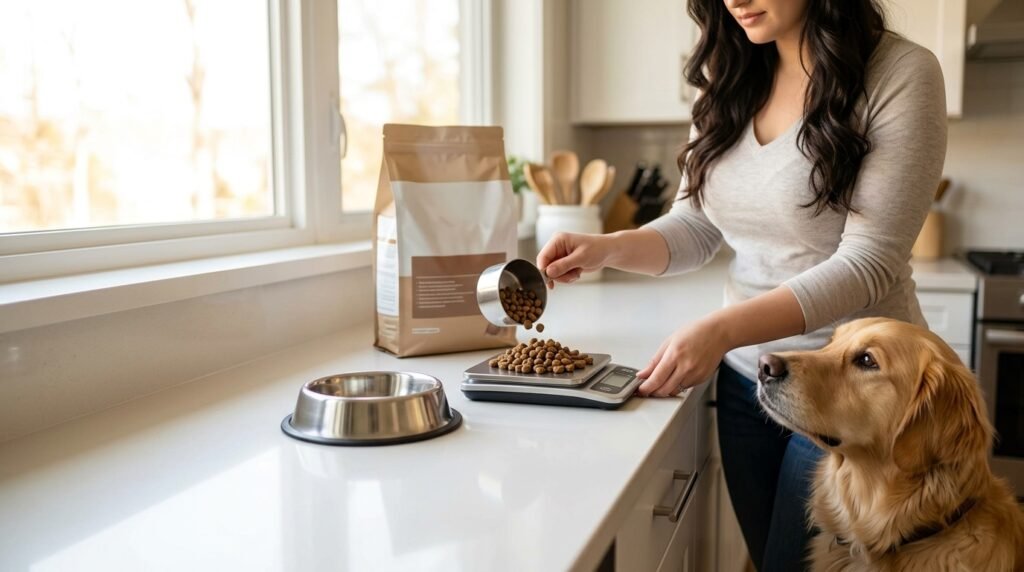
- Convert the remaining calories into an accurately measured food portion.
- Recheck weight and body condition after two to four weeks, then adjust if needed.
That last step matters. The WSAVA Global Nutrition Guidelines emphasize nutritional assessment as an ongoing part of care. A formula cannot see your dog’s waist, feel the ribs, or account perfectly for metabolism and activity.
Dog Feeding Chart: Daily Calorie Starting Points
Veterinary professionals often begin with resting energy requirement, or RER—the energy used for essential body functions at rest. A commonly used equation is:
RER = 70 × (body weight in kilograms)^0.75
An adult maintenance estimate is then calculated by multiplying RER by a life-stage factor. A commonly used starting factor for a healthy, neutered adult is about 1.6, but an individual dog may need substantially less or more. The Merck Veterinary Manual’s overview of nutritional requirements explains that energy needs vary with factors including activity, environment, and life stage.
The following estimates use roughly 1.4–1.6 × RER to create a practical starting range for a healthy adult at an appropriate weight. They are not weight-loss prescriptions.
| Dog’s weight | Weight in kg | Approximate daily calories |
|---|---|---|
| 5 lb | 2.3 kg | 180–210 kcal |
| 10 lb | 4.5 kg | 305–350 kcal |
| 20 lb | 9.1 kg | 515–590 kcal |
| 30 lb | 13.6 kg | 695–795 kcal |
| 50 lb | 22.7 kg | 1,020–1,165 kcal |
| 70 lb | 31.8 kg | 1,315–1,505 kcal |
| 90 lb | 40.8 kg | 1,585–1,810 kcal |
If you are deciding how much to feed a dog that is overweight, do not automatically calculate from the current weight and sharply reduce the result. Your veterinarian can set a safe target weight, calorie level, and rate of loss while protecting lean muscle and nutritional adequacy.
Why a cups-only chart can mislead you
Suppose Food A has 320 kcal per cup and Food B has 450 kcal per cup. A 640-calorie food allowance equals 2 cups of Food A but only about 1.42 cups of Food B. Feeding 2 cups of both would give the dog 260 additional calories from Food B.
Wet foods introduce another unit: calories per can or tray. Fresh and homemade diets may be listed in calories per package, ounce, or gram. The dependable common unit is the calorie, not the scoop.
How to Calculate Your Dog’s Food Portion in 5 Steps
Once you have a starting calorie target, finding how much to feed a dog becomes a manageable label-and-math exercise.
1. Use a healthy target weight
If your dog is at an ideal body condition, use the current weight. If your dog is clearly over- or underweight, ask your veterinary team for a target. Guessing can produce an excessive calorie restriction or encourage overly rapid weight gain.
2. Find calorie content on the package
Look for a statement such as:
- 380 kcal per cup
- 1,050 kcal per kilogram
- 320 kcal per 13-ounce can
- 210 kcal per tray
Do not confuse feeding directions with calorie content. Also check whether the product carries a nutritional-adequacy statement for your dog’s life stage. The FDA’s guide to pet-food labels explains the major label elements, including the nutritional-adequacy statement and feeding directions.
If calories are listed only per kilogram, ask the manufacturer for calories per cup or use a kitchen scale. Cup weight varies among products, so converting kilograms to “cups” without the food’s grams-per-cup value is unreliable.
3. Subtract treat and extra calories
Assume a dog’s starting target is 600 kcal per day. If you reserve 10%, the treat budget is 60 kcal and the complete-and-balanced food provides about 540 kcal.
Treat budget:
600 × 0.10 = 60 kcal
Main-food budget:
600 − 60 = 540 kcal
The 10% figure is a ceiling, not a daily goal. Your dog does not need treats, and using fewer leaves more room for nutritionally complete food.
4. Convert food calories to cups, cans, or grams
For kibble containing 360 kcal per cup:
540 kcal ÷ 360 kcal per cup = 1.5 cups per day
For canned food containing 300 kcal per can:
540 kcal ÷ 300 kcal per can = 1.8 cans per day
For food containing 3.6 kcal per gram:
540 kcal ÷ 3.6 kcal per gram = 150 grams per day
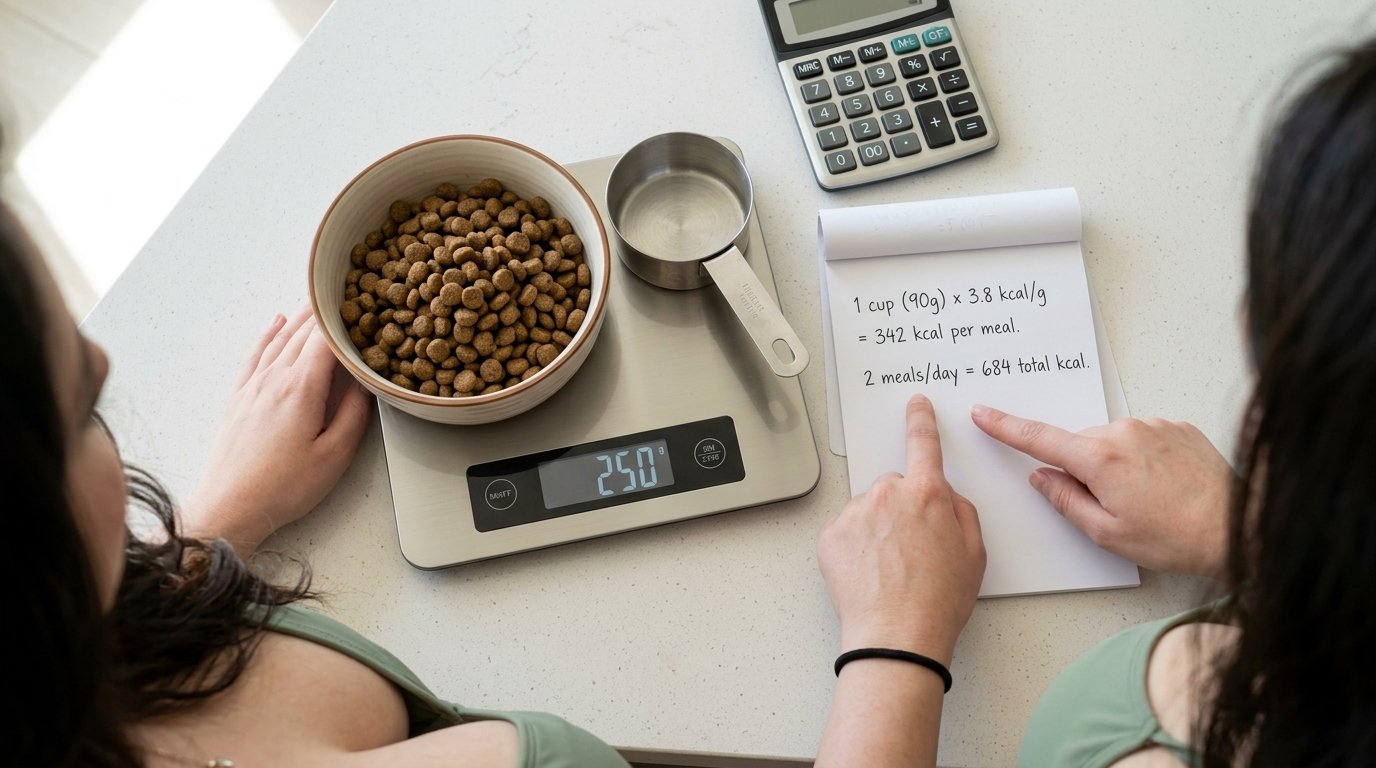
A gram scale is usually more consistent than a measuring cup, especially for small dogs or calorie-dense kibble. As the Tufts Petfoodology veterinary nutrition team notes, package recommendations cannot perfectly predict an individual animal’s needs, so monitoring remains essential.
5. Divide the daily amount into meals
Measure the entire day’s allowance, then divide it. Most healthy adult dogs do well with two meals daily. A dog receiving 1.5 cups per day could receive 0.75 cup in the morning and 0.75 cup in the evening.
More frequent, smaller meals may be appropriate for puppies, some small dogs, or dogs with a veterinarian-managed condition. Avoid changing meal timing or quantity abruptly if your dog has diabetes, takes food-dependent medication, or has a history of digestive or metabolic disease.
What Changes How Much to Feed a Dog?
Two dogs of the same weight may not need the same calories. Consider the following before treating a chart number as final.
Age and life stage
Growing puppies need energy and nutrients for development, while many mature dogs become less active and need fewer calories. Pregnancy and especially lactation can raise requirements dramatically and require veterinary oversight.
Activity and work
A dog taking relaxed neighborhood walks has different needs from a hunting, herding, agility, sled, or search-and-rescue dog. Duration, intensity, terrain, and weather all matter. Do not label a dog “active” based only on excitement around the house.
Neuter status and individual metabolism
Spayed or neutered adults often start with a different energy factor than intact adults. Yet even within those groups, metabolism varies. Breed, genetics, lean mass, and spontaneous activity can shift the actual requirement.
Body condition and health
Current weight alone does not show whether that weight is healthy. A muscular dog and an overfat dog may weigh the same. Arthritis, endocrine disease, gastrointestinal illness, kidney disease, heart disease, cancer, and medications can affect intake, nutrient needs, or activity.
Environment
Dogs doing sustained outdoor work in cold conditions may expend more energy. Conversely, an indoor dog whose activity drops during extreme heat or winter may require less. Change portions based on a meaningful trend, not a single quiet day.
Calorie density and moisture
Dry food is generally calorie-dense by volume; canned food contains much more water. A bowl can look fuller on a lower-calorie food. When changing products, recalculate from calories rather than carrying over the same number of cups.
Feeding Puppies, Adult Dogs, and Seniors
Life stage changes how much to feed a dog, how often meals should be offered, and which nutrient profile is appropriate.
Puppies
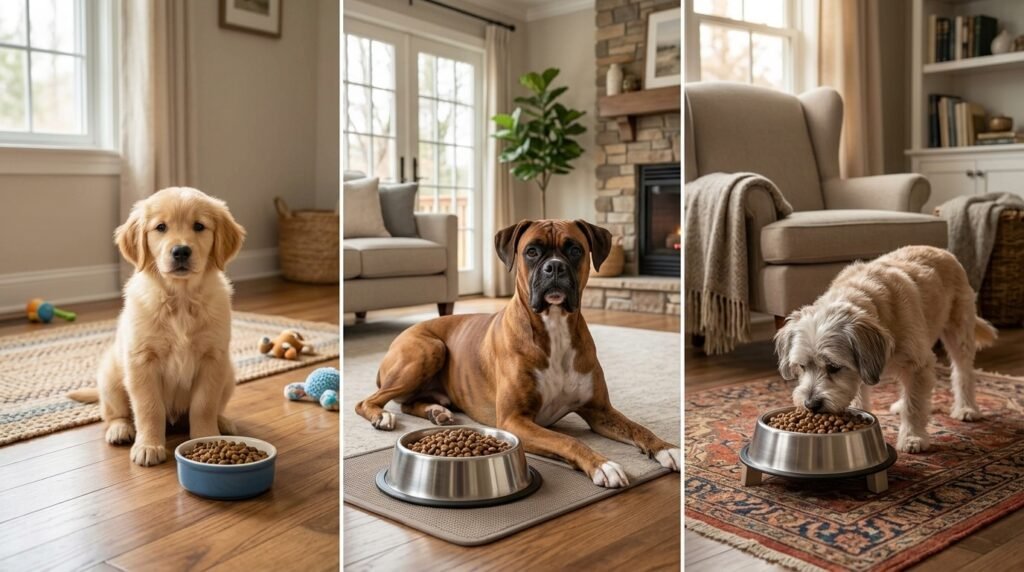
Puppies should eat a complete-and-balanced growth diet formulated for their expected adult size. Young puppies commonly need three or four measured meals a day; frequency can usually decrease as they mature. Follow the product’s puppy directions as a starting point and have growth and body condition assessed at routine veterinary visits.
Large- and giant-breed puppies need controlled energy and mineral balance. Trying to make a puppy grow as quickly as possible is not the goal. Avoid adding calcium or other supplements unless a veterinarian specifically recommends them; an appropriate commercial growth diet is designed to provide a balanced amount.
Healthy adults
Most healthy adults can eat two measured meals per day. Recalculate the daily amount whenever you change formulas, because a “cup” of the new food may deliver a different number of calories. Include training rewards and dental chews in the daily total.
Senior dogs
“Senior” does not automatically mean “feed less.” Some older dogs gain fat as activity and lean muscle decline, while others lose weight because of dental pain or disease. Track weight, muscle condition, appetite, thirst, stools, and mobility. Unexplained weight change deserves veterinary evaluation rather than a casual portion adjustment.
How Many Calories Can Come From Treats?
A widely used rule is to keep treats, toppers, chews, table food, and other extras to 10% or less of total daily calories. The remaining 90% or more should come from a complete-and-balanced diet appropriate for the dog.
For a 400-kcal daily allowance, the maximum treat budget is about 40 kcal. For an 800-kcal allowance, it is about 80 kcal. Small dogs reach their limit surprisingly quickly.
Count all extras, including:
- Training treats
- Dental chews
- Peanut butter used in toys
- Cheese or meat used to hide pills
- Edible chews
- Food shared by family members
- Caloric supplements and toppers
Break treats into tiny pieces; dogs generally value the number and timing of rewards more than their size. You can also reserve part of the measured kibble for training. Before sharing human food, review foods dogs should not eat and remember that “safe” does not mean calorie-free.
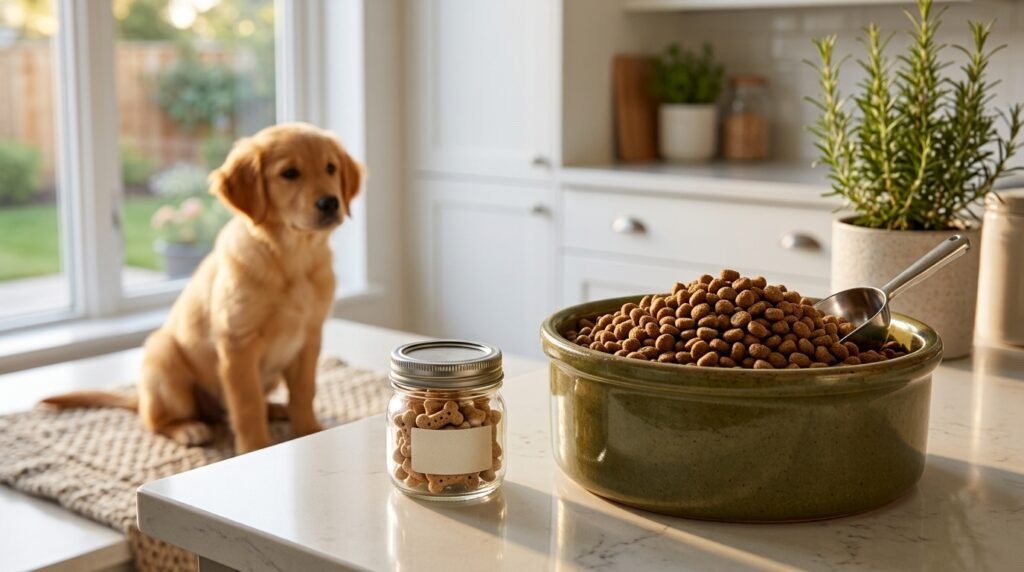
Treat calories can be harder to find than meal calories. Check the package or manufacturer’s website, or contact the company. If several people reward the dog, prepare one daily treat container so everyone draws from the same allowance.
Monitor Body Condition and Adjust the Portion
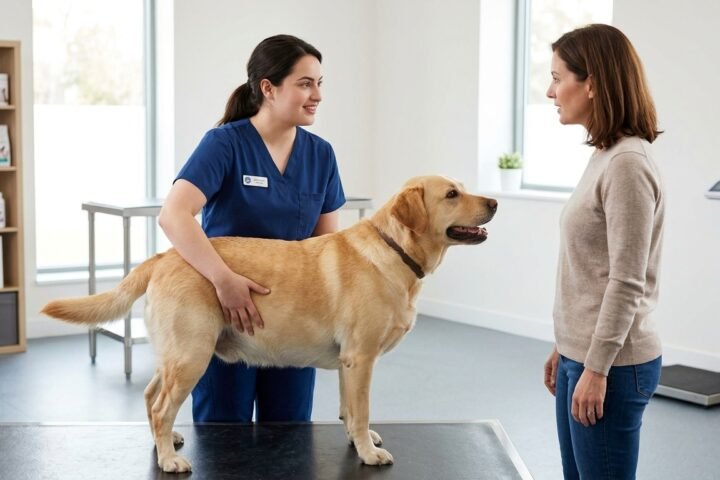
The best answer to how much to feed a dog is the amount that maintains an appropriate body and muscle condition while meeting nutritional needs. The WSAVA body-condition score resources help owners and veterinary teams assess fat coverage using sight and touch.
At an ideal condition, you should generally be able to:
- Feel the ribs under a light fat covering without pressing hard
- See a waist behind the ribs when looking from above
- See an abdominal tuck from the side
Coat length and body shape can hide changes, so use your hands as well as your eyes. Weigh small dogs at home if you have an appropriate scale; larger dogs can be weighed at a veterinary clinic or pet facility. Use the same scale and similar timing when possible.
A safe adjustment loop
- Feed the calculated amount consistently for two to four weeks.
- Record all food, treats, chews, and toppers.
- Recheck weight and body condition.
- If an otherwise healthy adult is drifting away from the target, discuss a modest adjustment—often around 5% to 10%—with your veterinary team.
- Recheck rather than making repeated large changes.

A day-to-day fluctuation or one unusually active weekend does not require a new feeding plan. Look for a trend. For intentional weight loss, get a veterinary plan; simply feeding much less of a maintenance food can also reduce essential nutrient intake.
Common Portion Mistakes and When to Call Your Vet
Even a sensible estimate for how much to feed a dog can fail when measuring and tracking are inconsistent.
Free-pouring or free-feeding
An always-full bowl makes intake difficult to measure, particularly in multi-dog homes. Measured meals reveal appetite changes and make calorie control easier.
Using a random scoop
A coffee mug or unmarked scoop may not equal a standard 8-fluid-ounce measuring cup. Even a marked cup can be inconsistent when kibble pieces settle differently. Weighing portions in grams is more precise.
Following the bag without reassessment
Feeding directions are starting estimates. The AAHA nutrition and weight-management guidelines support individualized nutritional assessment and monitoring rather than a one-size-fits-all approach.
Forgetting treats and household feeders
A “small” piece of cheese, a dental chew, and several training treats can materially change a small dog’s calorie intake. Agree on one household plan and track everything.
Assuming ingredient quality determines portion size
Ingredient questions and energy quantity are related but different. Learn how to interpret dog food fillers and ingredient roles, but use calorie density—not marketing language—to calculate the portion.
Improvising an unbalanced homemade portion
Meat, rice, and vegetables do not automatically form a complete diet. If you prefer home preparation, use a recipe formulated for your dog by a board-certified veterinary nutritionist. PawMindTips’ homemade dog food recipe guide explains the nutritional-balance issue in more detail.
Changing food too quickly
Transition gradually unless a veterinarian directs otherwise. Abrupt changes may cause vomiting, diarrhea, or food refusal and make it harder to judge whether the amount or the new food is the problem.
When to ask your veterinarian about feeding
Contact your veterinarian if you cannot determine how much to feed a dog safely, or if your dog has a medical condition, takes medication, is pregnant or nursing, is growing rapidly, performs intense work, or needs significant weight change.
Arrange an evaluation for:
- Unexplained weight loss or gain
- A sudden increase or decrease in appetite
- Increased thirst or urination
- Repeated vomiting or diarrhea
- Difficulty chewing or swallowing
- A swollen or painful abdomen
- Weakness, collapse, marked lethargy, or breathing difficulty
- Loss of muscle over the spine, skull, or hips
Seek urgent veterinary care for collapse, repeated unproductive retching with abdominal swelling, severe breathing difficulty, suspected toxin ingestion, or other rapidly worsening signs. Do not wait for a feeding adjustment to solve an acute illness.
FAQs
How many cups of food should I feed my dog each day?
There is no universal cups amount. Find your dog’s daily calorie target and divide the calories available for main food by the product’s calories per cup. For example, 540 food calories divided by 360 kcal per cup equals 1.5 cups daily. Monitor body condition and adjust with veterinary guidance.
Is it better to feed a dog once or twice a day?
Most healthy adult dogs do well with two measured meals, which makes hunger and intake easier to manage. Puppies often need three or four meals. Dogs with certain medical conditions or medication schedules may need a veterinarian-directed routine.
Should I feed my dog according to current weight or ideal weight?
Use current weight only when your dog is at an appropriate body condition. If the dog is overweight or underweight, ask a veterinarian to establish a target weight and calorie plan. Large, unsupervised calorie cuts can be unsafe and nutritionally inadequate.
How do I know whether I am feeding too much?
Track weight and body condition rather than appetite alone. Difficulty feeling the ribs, loss of a visible waist, and steady weight gain suggest the intake may be excessive. Count treats and chews before reducing the complete diet, then discuss a modest adjustment with your veterinary team.
Conclusion
The safest way to decide how much to feed a dog is to start with calories, convert those calories using the specific food label, include every treat, and validate the result through weight and body-condition trends. Package charts and equations provide a starting point, not a permanent prescription.
Measure consistently, keep treats at no more than about 10% of the daily calorie budget, and reassess after two to four weeks. If your dog is growing, ill, pregnant, nursing, highly active, or outside an ideal body condition, ask your veterinarian for an individualized feeding plan.