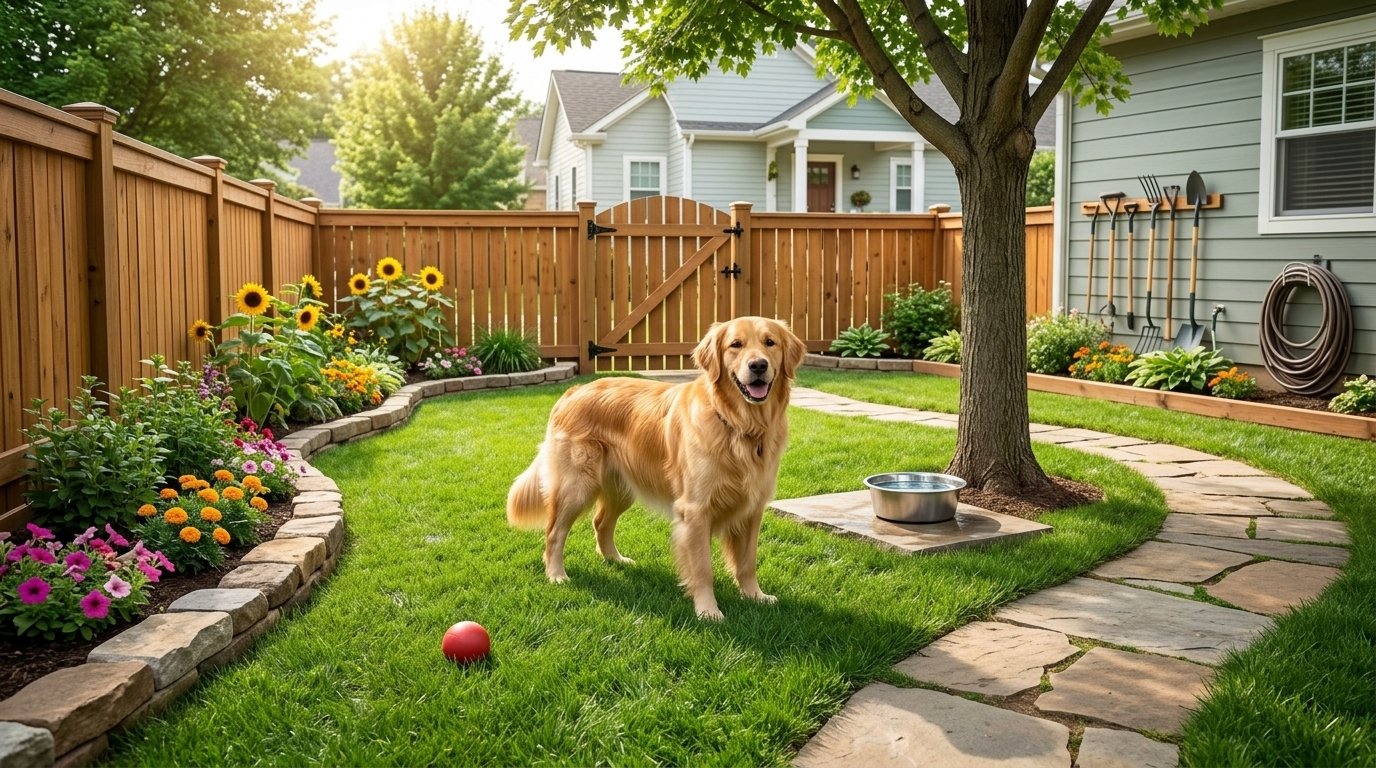
A dog-friendly yard should give your dog room to sniff, explore, play, rest, and spend time with the family without exposing them to preventable hazards. That takes more than putting up a fence and leaving a water bowl outside.
Plants, lawn products, mulch, compost, garden tools, hot patios, standing water, and small gaps around gates can all change how safe a backyard really is.
The good news is that you do not necessarily need an expensive landscaping project. Start by looking at your existing yard from your dog’s perspective. Where could they escape? What could they chew or swallow? Where can they get out of the sun? What happens when they want to dig, run, or eliminate?
By answering those questions, you can build an outdoor space that works for your dog instead of constantly trying to stop normal canine behavior.
Table of Contents
Start Your Dog-Friendly Yard With Secure Fencing
Before choosing flowers, toys, or landscaping materials, check the perimeter.
A beautiful backyard is not truly dog-friendly if your dog can squeeze under a gate, push through a loose board, or dig beneath the fence.
Walk the entire fence line and inspect it at your dog’s level. Look for:
- Loose or damaged fence boards
- Gaps beneath the fence
- Spaces beside gates
- Latches that do not close securely
- Areas where soil has eroded
- Objects a dog could climb onto before jumping
- Existing holes from digging
- Sharp wire, nails, or broken materials
Do not assume one fence height or design works for every dog. A small companion dog, an athletic jumper, and a determined digging breed can present very different containment challenges.
The more important question is whether your particular dog can safely be contained by the existing barrier.
Pay special attention to gates
Gates deserve their own inspection because they are frequently opened and closed.
Make sure the latch works reliably and that family members know to close the gate every time. If your dog is likely to push against it or exploit a partially closed gate, consider a more secure latch appropriate for your setup.
Check underneath as well. A gate can appear completely secure at eye level while leaving a surprisingly large escape route near the ground.
Watch the routes your dog already uses
Dogs often create predictable patrol paths around a yard. Instead of fighting those habits, observe them.
If your dog repeatedly runs along one fence line, keeping delicate flower beds directly against that route may create unnecessary conflict. A clear path or buffer zone can let the dog move naturally while protecting landscaping.
Penn State Extension similarly recommends considering a dog’s existing routes when designing pet-friendly pathways and leaving usable space for exercise.
A secure fence also does not make supervision unnecessary. Dogs can discover hazards, wildlife, fallen branches, mushrooms, damaged fencing, or newly opened gates between routine yard inspections.
Choose Dog-Safe Plants and Remove Toxic Ones
Plants are one of the easiest backyard hazards to overlook because something can be attractive and common in landscaping while still being unsafe for dogs to eat.
Before adding new vegetation, identify what is already growing in your yard.
The ASPCA maintains an extensive database of plants reported as toxic or non-toxic to dogs. Examples on its toxic list include plants such as azaleas, aloe, amaryllis, and American holly, while many other plants are categorized as non-toxic.
Do not rely solely on a plant’s appearance or a garden-center label that says “natural.”
If you cannot identify an existing plant, consider asking a local extension service, nursery professional, or horticulture expert before allowing a dog that chews vegetation unrestricted access to it.
Remember bulbs, berries, fallen material, and weeds
The visible leaves are not the only concern.
Dogs may investigate:
- Bulbs exposed while digging
- Fallen berries or fruit
- Seeds
- Pruned branches
- Uprooted plants
- Wild mushrooms
- Weeds growing along the fence
- Plant material placed in yard-waste piles
Penn State Extension specifically warns about toxic plants and wild mushrooms and recommends evaluating existing landscaping rather than considering only plants you intend to add.
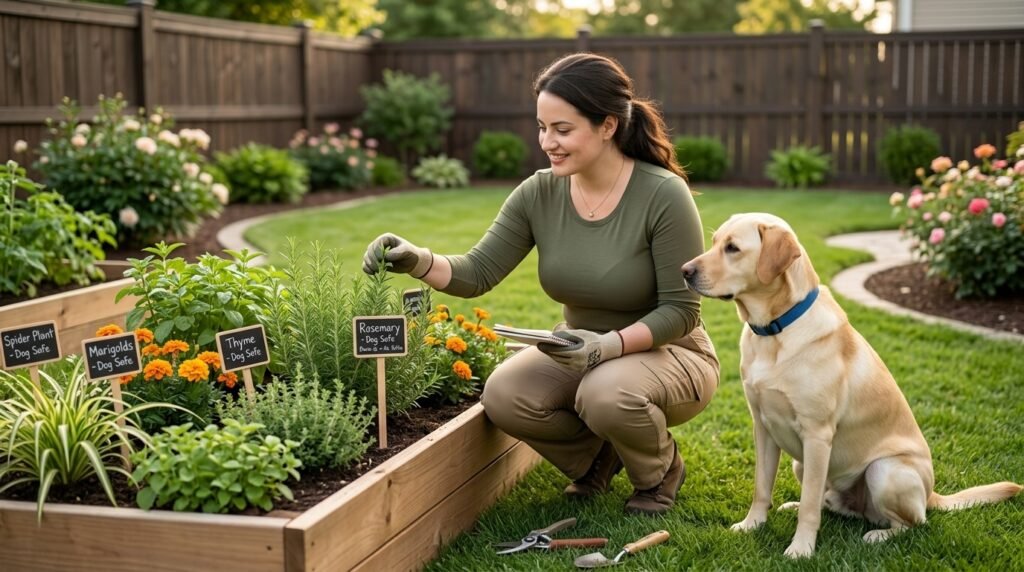
Even plants classified as non-toxic should not become unlimited snacks. Eating large quantities of plant material can still cause digestive upset.
A dog that persistently eats plants, soil, mulch, or other non-food materials deserves closer supervision and, when the behavior is frequent or unusual, a conversation with a veterinarian.
Build barriers where removal is impractical
Sometimes a plant is important to the landscape or cannot immediately be removed. In that situation, physical separation may be more realistic.
Raised beds, fencing around a garden section, or other sturdy barriers can prevent access.
The goal is not to teach a curious dog that they are “never allowed” to investigate anything. It is to design the yard so a moment of curiosity does not easily become an emergency.
Use Fertilizers, Pesticides, and Mulch Safely
A lawn product does not become safe for dogs simply because it is marketed for outdoor use.
Fertilizers, herbicides, insecticides, rodenticides, and other yard products should be chosen, stored, applied, and disposed of with pets in mind.
The U.S. Environmental Protection Agency advises removing pets from an area before pesticide application and keeping them away until the product has dried or for however long the product label specifies.
That last part matters: follow the individual product label rather than relying on a universal waiting period.
Keep garden chemicals in their original labeled containers and store them where your dog cannot reach them. Do not pour leftover products into beverage bottles, buckets, or other unlabeled containers.
If you hire a lawn service, ask exactly what products are being applied and when pets can safely return to the treated area.
Fertilizer can also be a problem
Fertilizers may smell interesting to dogs. The ASPCA notes that ingestion can cause gastrointestinal problems, while sufficiently large exposures or certain formulations can produce more serious signs.
Keep bags and spreaders secured, clean up spills promptly, and prevent access according to label instructions after application.
“Organic” and “natural” should not automatically be interpreted as “safe to eat.” A product’s ingredients, concentration, application directions, and accessibility still matter.
Be particularly careful with cocoa mulch
Mulch can make garden beds attractive and help retain moisture, but not every mulch is equally appropriate around dogs.
The ASPCA warns against cocoa mulch because it contains compounds associated with chocolate toxicity and may be appealing to dogs because of its smell.
Penn State Extension suggests natural wood options such as cedar or pine instead of cocoa mulch, while also noting that individual pets may react differently to landscaping materials.
Whatever surface you choose, watch dogs that habitually chew or swallow mulch, stones, sticks, or other landscaping materials. A material does not need to be chemically poisonous to create a choking, dental, or gastrointestinal problem if swallowed.
Provide Shade, Fresh Water, and Paw-Safe Surfaces
A dog-friendly yard must remain comfortable when weather conditions change.
Shade and water are basic requirements rather than decorative extras.
The American Veterinary Medical Association recommends that pets outdoors have access to fresh water and shade and warns owners about hot surfaces such as asphalt that can burn paws.
Shade should remain useful during the part of the day your dog is outside. A tiny shaded corner in the morning may disappear as the sun moves.
Depending on your property, shade might come from:
- Mature trees
- A covered patio
- A securely installed shade sail
- An awning
- Another well-ventilated sheltered area
Always provide clean drinking water in a stable container. Refresh it regularly, particularly in warm weather, and position it where it will not spend the entire day heating in direct sunlight.
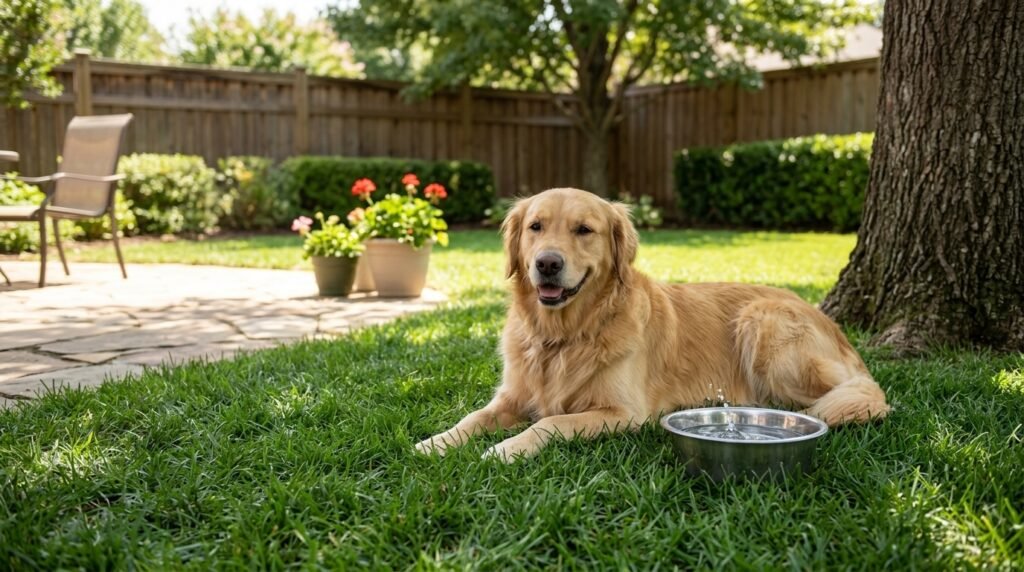
For more warm-weather precautions, PawMindTips’ guide to keeping your dog cool during summer can help owners think beyond the backyard itself.
Check surfaces before your dog spends time on them
Concrete, asphalt, stone, artificial surfaces, decks, and other hardscape can become significantly hotter than surrounding grass.
Do not assume the air temperature tells you exactly how comfortable the ground feels.
The AVMA advises avoiding hot surfaces, while the American Kennel Club recommends checking a surface with your hand and avoiding it when it is too hot to hold comfortably.
Provide routes to water, shade, and the house that do not force a dog to cross a painfully hot surface.
Dogs that are older, very young, short-nosed, overweight, or affected by certain medical conditions may need additional heat precautions. When conditions are excessively hot, a shaded backyard is not a substitute for a cool indoor environment.
Heavy panting, weakness, confusion, collapse, seizures, or other serious signs of heat illness require prompt veterinary attention.
Create Digging, Potty, and Play Areas
One of the best ways to create a functional yard is to stop treating every natural dog behavior as a landscaping problem.
Instead, give important behaviors an appropriate place.
Create a designated digging area
Digging is normal for many dogs. They may dig while investigating scents, seeking cooler soil, storing objects, or simply because digging itself is rewarding.
If your dog loves to dig, create a dedicated dig zone using an appropriate dog-safe material.
Encourage your dog to use it by placing favorite toys or rewards near or slightly beneath the surface and praising them for choosing the designated area.
Penn State Extension also recommends a dedicated dig pit as part of petscaping.
This strategy does not guarantee that your flower beds will instantly become uninteresting. Supervision and consistent redirection still matter. But providing an acceptable outlet can be much more practical than expecting a dog with a strong digging preference never to dig.
Establish a potty area
A separate elimination area can make cleanup easier and keep waste away from children’s play areas, patios, and high-traffic sections of the yard.
Choose an accessible location with appropriate drainage and a surface that can be maintained easily.
Take your dog to the same spot consistently and reward successful elimination there. Avoid punishment for mistakes elsewhere; teaching the desired location is clearer and more productive.
Remove feces regularly. Keeping the yard clean helps reduce odor, flies, and accidental contact with waste.
Leave room for actual play
A dog-friendly garden can still be beautiful, but your dog needs usable space—not just plants they are prohibited from touching.
Depending on the dog’s size and activity level, that may include:
- An open grassy play area
- A durable running route
- A sniffing area
- Outdoor toys
- A training space
- A quiet resting corner
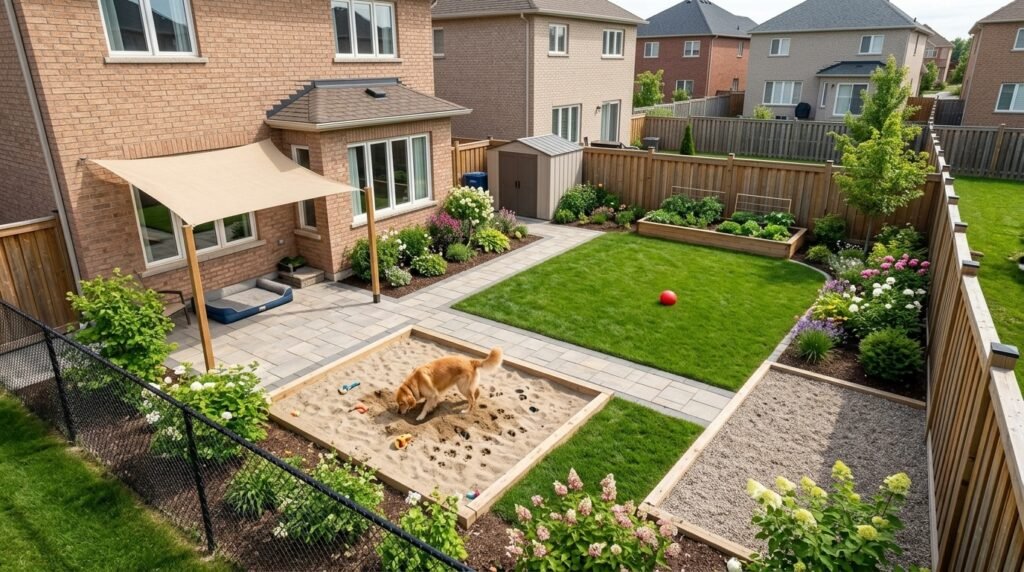
Dogs still need appropriate walks, training, social interaction, and time with their people. A large yard does not automatically meet all of a dog’s physical and mental needs.
Think in zones
An easy way to plan the backyard is to divide it into functions:
Perimeter zone: fencing and gates
Activity zone: running and play
Dig zone: acceptable digging
Potty zone: elimination and easy cleanup
Rest zone: shade and comfortable ground
Water station: clean drinking water
Garden zone: protected plants and landscaping
These zones do not require a large property. Even a small yard can use the principle by giving different corners or sections clear purposes.
Remove Tools, Compost, and Standing-Water Hazards
Some of the most important backyard hazards are not permanent parts of the landscape. They appear while people are gardening, cleaning, repairing, or entertaining.
Put garden tools away
Rakes, pruning shears, saws, wire, stakes, lawn equipment, nails, and sharp edging should not be left where a running or curious dog can reach them.
After gardening, perform a quick scan before releasing your dog into the yard.
Also look for broken toys, splintered sticks, damaged fencing, exposed wire, and debris left after storms or repair work.
Secure compost
Compost deserves special attention.
The ASPCA warns that compost can contain foods that are toxic to dogs, including items such as grapes, onions, garlic, and coffee grounds. Decomposing material can also develop mold, and ingestion of moldy material may produce serious gastrointestinal or neurologic signs.
Use a secure compost container your dog cannot open, tip over, or dig into.
The same principle applies to trash cans and yard-waste containers.
A dog that gains access to discarded food, spoiled material, plant trimmings, or chemicals can encounter several hazards at once.
Remove standing water
Buckets, plant saucers, toys, tarps, clogged containers, and unused wading pools can collect rainwater.
Standing water can support mosquito breeding and may become dirty or contaminated. Penn State Extension recommends routine checks to eliminate standing water and regularly clean water features such as birdbaths.
Give your dog clean drinking water intentionally rather than relying on whatever water happens to collect outdoors.
If you provide a dog pool, supervise its use, keep the water clean, and drain or secure it appropriately when it is not being used.
Match the Yard to Your Individual Dog
There is no universal backyard layout that is perfect for every dog.
Design decisions should reflect your dog’s:
- Size
- Age
- Mobility
- Activity level
- Digging habits
- Jumping ability
- Chewing behavior
- Sensitivity to heat
- Interest in wildlife
- Tendency to patrol or bark at fences
- History of attempting to escape
A young, athletic dog may need strong containment and a generous activity area. A senior dog may benefit more from shade, nonslip footing, easy access to the house, and shorter distances between resting and potty areas.
A puppy may investigate nearly everything with their mouth, making supervision and hazard removal especially important.
A dog that becomes highly aroused by pedestrians or neighboring dogs may also need a different fence arrangement from a dog that quietly lounges outdoors.
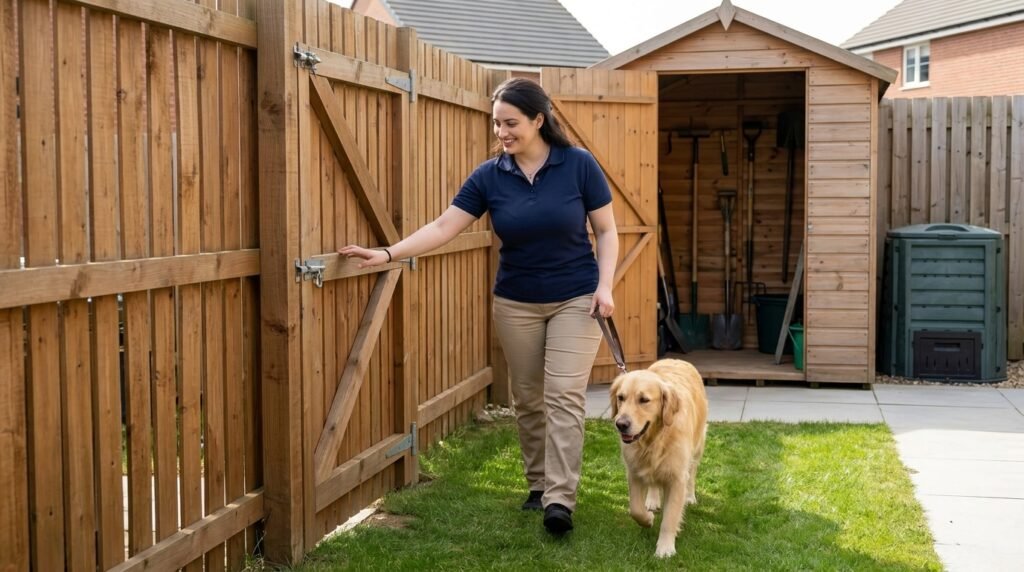
Do not wait for an escape or injury before adapting the yard. Watch your dog use the space for several days and note where problems naturally appear.
The best dog-friendly yard is not necessarily the most elaborate one. It is the yard designed around the real dog who uses it.
Dog-Friendly Yard Safety Checklist
Once the major changes are complete, perform a short safety inspection regularly.
Check that:
- Fences are intact.
- Gates close and latch securely.
- There are no new gaps or digging points.
- Toxic plants and questionable mushrooms are inaccessible.
- Plant clippings have been removed.
- Fertilizers and pesticides are securely stored.
- Product reentry instructions have been followed.
- Cocoa mulch is not being used where your dog has access.
- Garden tools and sharp objects are stored away.
- Compost and garbage are secured.
- Fresh drinking water is available.
- Reliable shade is available.
- Walking and resting surfaces are not dangerously hot.
- Standing water has been emptied.
- Dog waste has been removed.
- Toys and outdoor equipment are undamaged.
- Digging, potty, play, and rest areas remain usable.
Repeat the inspection after storms, landscaping work, pesticide or fertilizer applications, parties, contractors visiting the property, or any other activity that can change the environment.
A yard that was safe last month is not automatically safe today.
Frequently Asked Questions
What makes a yard dog-friendly?
A dog-friendly yard combines secure boundaries with safe landscaping, shade, clean water, comfortable surfaces, appropriate places to play and eliminate, and protection from hazards such as toxic plants, chemicals, compost, sharp tools, and standing water. The design should also match the individual dog’s size and behavior.
What plants are safe for a dog-friendly yard?
The answer depends on the exact plant species. The ASPCA maintains a searchable toxic and non-toxic plant database for dogs. Verify a plant’s exact identity before adding it to an area your dog can access, and remember that eating large amounts of even non-toxic plant material can cause digestive upset.
What is the safest mulch to use around dogs?
Avoid cocoa mulch around dogs because it can contain compounds associated with chocolate toxicity. Penn State Extension suggests natural wood options such as cedar or pine as alternatives. However, dogs that chew or swallow mulch still require supervision because swallowed landscaping material can cause problems even when it is not chemically toxic.
Can a dog stay outside all day in a fenced yard?
A fence alone does not make prolonged outdoor time safe. Dogs still need appropriate supervision, companionship, clean water, weather protection, exercise, and access to a suitable indoor environment. Heat, cold, wildlife, fence damage, escape attempts, and changing yard hazards should all be considered.
Conclusion
Creating a dog-friendly yard is less about buying special landscaping products and more about removing predictable risks while giving your dog appropriate ways to behave naturally.
Start with secure fencing and gates. Identify your plants, control access to toxic vegetation, use lawn chemicals carefully, avoid hazardous mulch, provide reliable shade and fresh water, and watch for hot surfaces.
Then make the yard enjoyable. A designated digging spot, potty area, play zone, comfortable resting space, and clear pathways can help your dog use the property without constantly conflicting with your landscaping.
Finally, treat yard safety as an ongoing process. Plants grow, fences deteriorate, weather changes, chemicals are applied, and new objects enter the yard.
A few minutes spent checking the space regularly can help keep your backyard both attractive for you and safer for the dog who explores it.