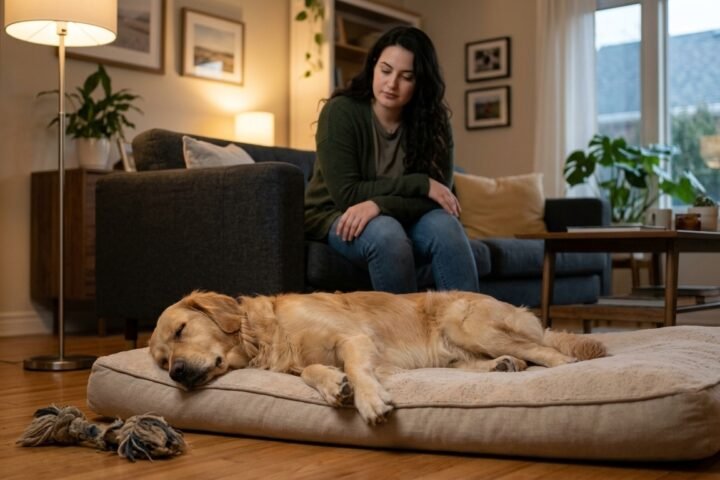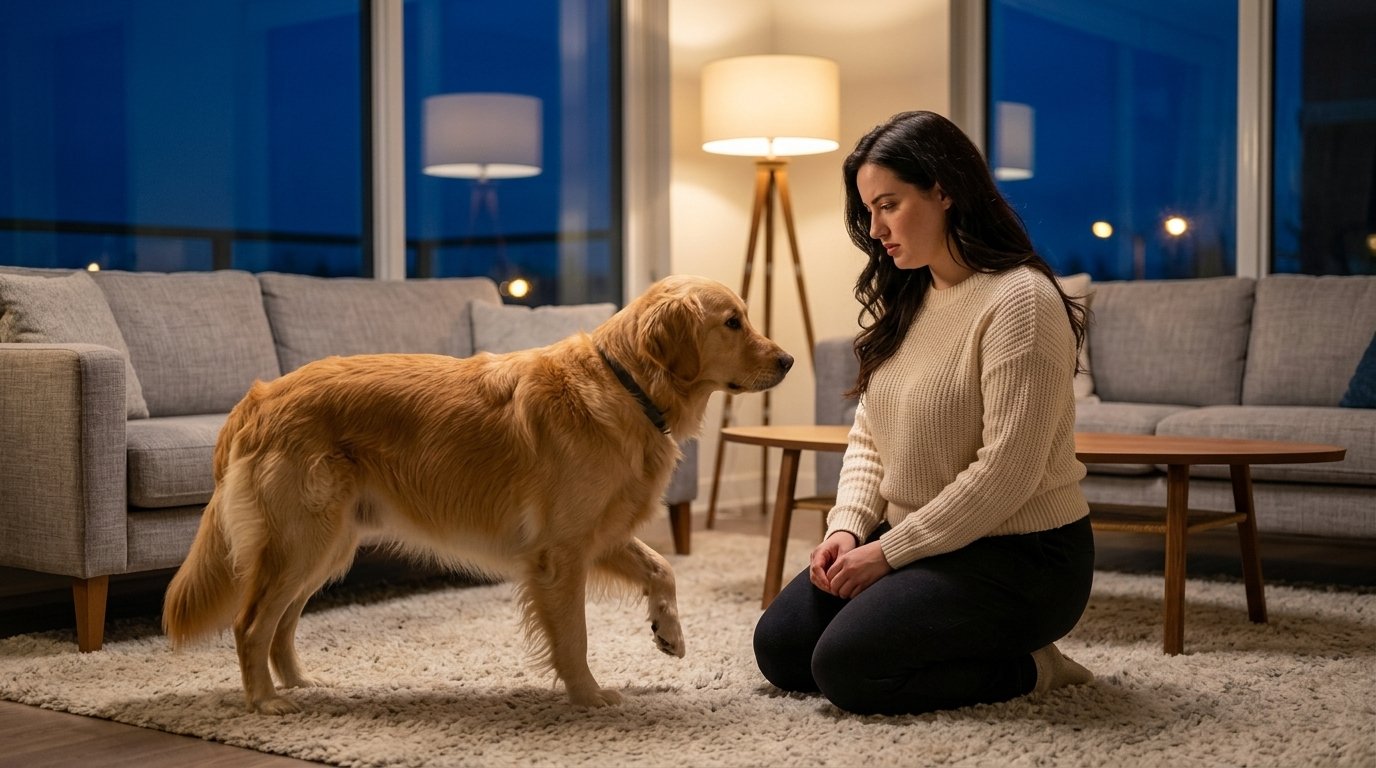
Noticing your dog limping at night can be confusing, especially if they seemed reasonably comfortable earlier in the day. Maybe the limp appears after an evening walk, becomes obvious when your dog gets up from a nap, or seems to disappear again the next morning.
The timing is useful information, but it is not a diagnosis.
A dog may limp because of something as localized as a sore paw or damaged nail, or because of a problem involving a muscle, tendon, ligament, joint, bone, nerve, or spine. Cornell University’s College of Veterinary Medicine notes that lameness can range from mild stiffness to an inability to bear weight and that a veterinary examination is important for locating the source. Cornell Vet School
Instead of assuming nighttime limping means arthritis—or assuming a mild limp is harmless—pay attention to the pattern. What your dog did before the limp, how they move after resting, whether they bear weight, and whether other symptoms appear can give your veterinarian much more useful information.
Table of Contents
Why Does My Dog Limp More at Night?
When limping becomes noticeable in the evening, start by asking a simple question:
Is the problem truly happening only at night, or is nighttime simply when you notice it most?
During the day, your dog may be walking around, playing, exploring the yard, or interacting with the family. In the evening, the environment becomes quieter and you may have more opportunities to notice subtle changes in movement.
The day’s activity may matter too. A dog that runs, plays fetch, jumps from furniture, takes a long walk, or slips during play may appear more uncomfortable later. Conversely, another dog may look relatively comfortable while moving but appear stiff when first standing after a period of rest.
Veterinarians therefore look beyond the clock. According to Cornell University College of Veterinary Medicine’s guidance for limping dogs, useful history includes whether the problem started suddenly or gradually, whether it is improving or worsening, difficulties with exercise or rising from rest, and recent activity or trauma. Cornell Vet School
So if your dog limps at 9 p.m., don’t focus only on 9 p.m. Ask what happened at 5 p.m., what the dog did during the afternoon, and what happens after they have been lying down.
A recurring nighttime pattern deserves attention even if your dog seems normal at other times.
Dog Limping at Night After Activity vs. After Rest
One of the most useful observations you can make is when the limp appears relative to movement and rest.
Limping After Exercise or an Active Day
Suppose your dog walks normally in the morning but develops a noticeable limp after an evening game of fetch or a longer-than-usual walk.
That pattern is worth recording.
Possible explanations can include paw irritation, a damaged nail, a muscle or tendon injury, ligament or joint problems, or another condition aggravated by activity. It does not tell you which one is responsible.
Note whether the limp:
- Starts during exercise or afterward
- Appears after particularly active days
- Improves with rest
- Becomes progressively worse during a walk
- Happens after running, jumping, or rough play
- Occurs consistently in the same leg
Do not repeatedly exercise your dog just to “test” the limp.
Limping When Getting Up After Rest
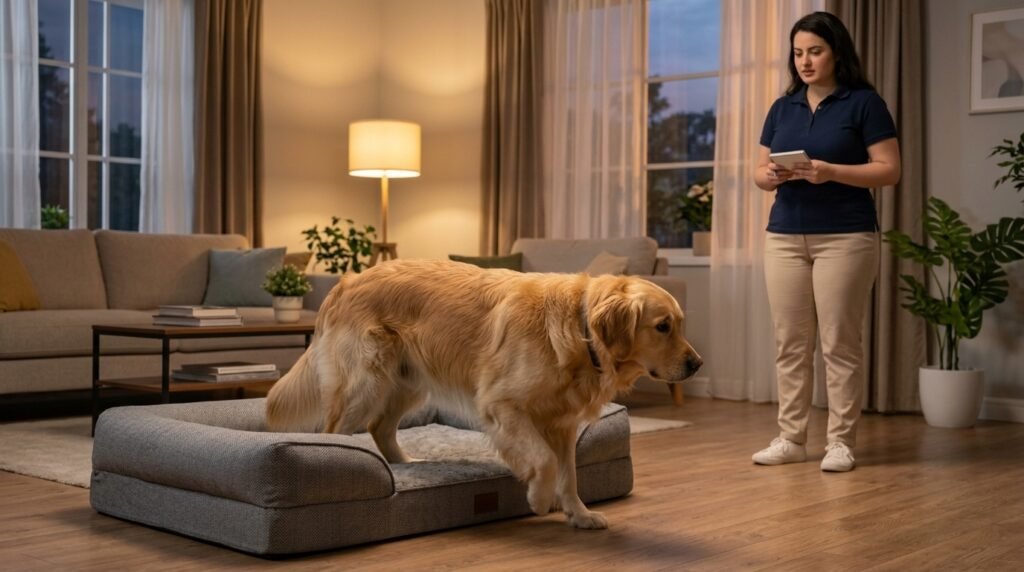
Another dog may walk reasonably well once moving but look stiff or limp for the first several steps after getting off their bed.
Stiffness after rest can occur with joint discomfort, but it should not automatically be labeled arthritis. AAHA lists limping, favoring a limb, and stiffness when rising among potential signs of pain and notes that injuries, arthritis, and other orthopedic problems can cause these changes. AAHA
Age also matters. Degenerative conditions become more relevant in older dogs, while younger dogs have their own possible developmental and orthopedic causes. Cornell emphasizes that age, breed, size, affected limb, history, and physical findings all help veterinarians narrow the possibilities. Cornell Vet School
If your dog is repeatedly stiff after sleeping, record it rather than assuming it is simply “old age.”
Possible Causes of Dog Limping at Night
There is no single condition called nighttime limping. The symptom has a broad range of possible causes.
The following categories can help you understand what your veterinarian may consider, but they are not a way to diagnose your dog at home.
Paw Pad or Foreign-Object Problems
Start at ground level.
A dog can develop lameness after stepping on a thorn, splinter, sharp debris, or another irritating object. Pads can also become cut, abraded, cracked, irritated, or burned.
Look for:
- A visible cut
- Bleeding
- Redness
- Swelling
- Something caught between the toes
- Repeated licking of one paw
- Reluctance to place the paw down
If something is deeply embedded, the paw is significantly injured, or examination causes substantial pain, stop handling it and contact your veterinarian.
Torn or Injured Nails
A damaged nail can be surprisingly painful.
Check whether a nail is cracked, split, bleeding, hanging abnormally, or injured near its base. Dewclaws deserve attention too.
Do not pull off a partially torn nail yourself. The extent of the damage may not be obvious, and manipulation can cause pain and bleeding.
Muscle, Tendon, or Other Soft-Tissue Injuries
Running, jumping, slipping, rough play, or an awkward landing can injure soft tissues.
A strain or other soft-tissue injury may not produce an obvious external wound. That is one reason watching the gait alone cannot reliably identify the underlying problem.
Cornell notes that veterinary lameness examinations evaluate structures including muscles, tendons, ligaments, joints, and bones as well as the neurologic system. Cornell Vet School
Joint and Ligament Problems
Joints and supporting ligaments are another important category.
Problems can range from acute ligament injuries to chronic degenerative disease. Osteoarthritis can cause stiffness and lameness, but seeing a dog limp at night is not enough to conclude that arthritis is the cause.
That distinction matters because different orthopedic conditions can produce similar outward signs.
If you are also noticing changes such as panting, restlessness, withdrawal, or difficulty settling, remember that behavioral changes can accompany physical discomfort. Our guide to the signs of a stressed dog explains why individual behaviors need to be interpreted in context rather than assigned a single cause.
Bone, Neurologic, and Other Medical Problems
Less obvious problems can also affect gait.
Cornell notes that lameness can involve the nervous system and that some cases require radiographs, CT or MRI, bloodwork, joint-fluid analysis, or specialist referral to determine the cause. Cornell Vet School
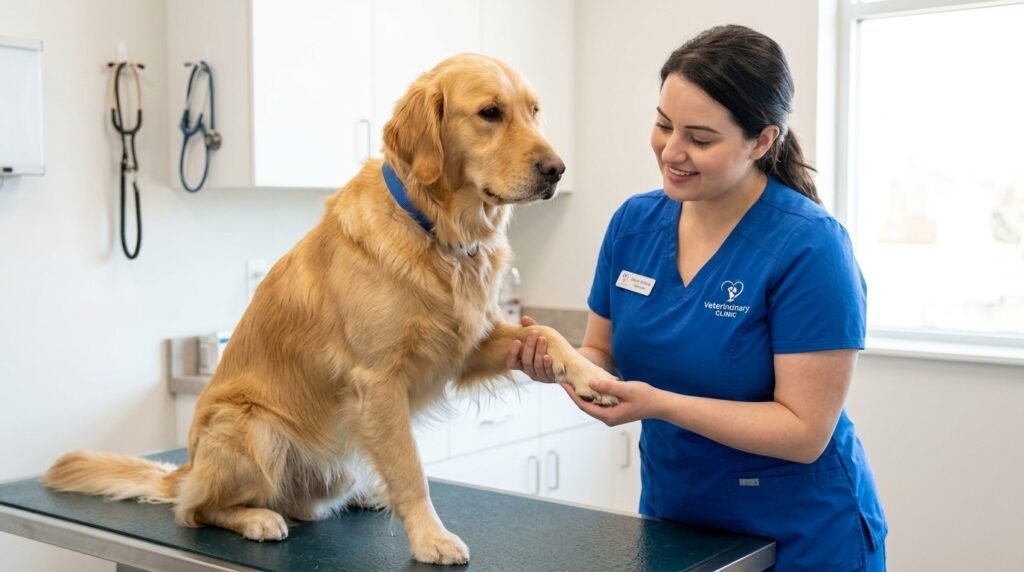
Dragging a paw, knuckling over, severe weakness, loss of coordination, or inability to stand should therefore not be treated like a simple sore paw.
What Can You Safely Check at Home?
If your dog is comfortable enough to allow it, a brief visual check may reveal useful information.
First watch your dog without manipulating the leg.
Ask:
- Which leg seems affected?
- Front or back?
- Right or left?
- Is your dog bearing full, partial, or no weight?
- Is the problem present while walking, standing, or both?
- Does your dog take shorter steps?
- Is the paw held completely off the ground?
- Does the limp improve after a few steps?
- Does turning make it more noticeable?
VCA Animal Hospitals’ first-aid guidance for limping dogs similarly recommends first identifying the affected leg and establishing when and how the limp began. Vca
Next, if your dog is calm and comfortable with handling, visually inspect the paw and nails for obvious debris, cuts, damaged nails, redness, bleeding, or swelling.
Do not repeatedly bend joints, squeeze sore areas, or force the limb through its range of motion.
A painful dog may bite even if they are normally gentle, and manipulating a significant injury can make them more uncomfortable. VCA specifically advises against attempting to examine a severely painful dog. Vca
The purpose of your home check is not to diagnose the injury. It is to identify obvious hazards and gather information.
What Should You Record for Your Veterinarian?
This is where owners can be especially helpful.
A dog may limp clearly at home and then walk almost normally at the veterinary clinic. Excitement, adrenaline, different flooring, and a change in surroundings can alter what you see.
Cornell specifically states that videos of the dog limping at home can be extremely helpful because they may show information that is not visible during the veterinary examination. Cornell Vet School
Take a Short Walking Video
If your dog can walk comfortably and doing so is safe, record a short video on level ground.
Try to capture:
- Walking away from the camera
- Walking toward the camera
- A side view
- The first few steps after getting up, if that is when the limp appears
Do not make a painful dog repeatedly walk just to obtain better footage.
Keep a Simple Limping Log
For recurring dog limping at night, note:
Time: When did you first notice it?
Activity: What did your dog do that day?
Rest: Did the limp start after sleeping or lying down?
Duration: How long did it last?
Leg: Which limb appears affected?
Weight-bearing: Is your dog still using the leg?
Trend: Better, worse, or unchanged?
Other symptoms: Swelling, licking, trembling, panting, appetite change, lethargy, or difficulty settling?
Also tell the veterinarian about falls, collisions, unusual exercise, previous orthopedic problems, current medications, and supplements.
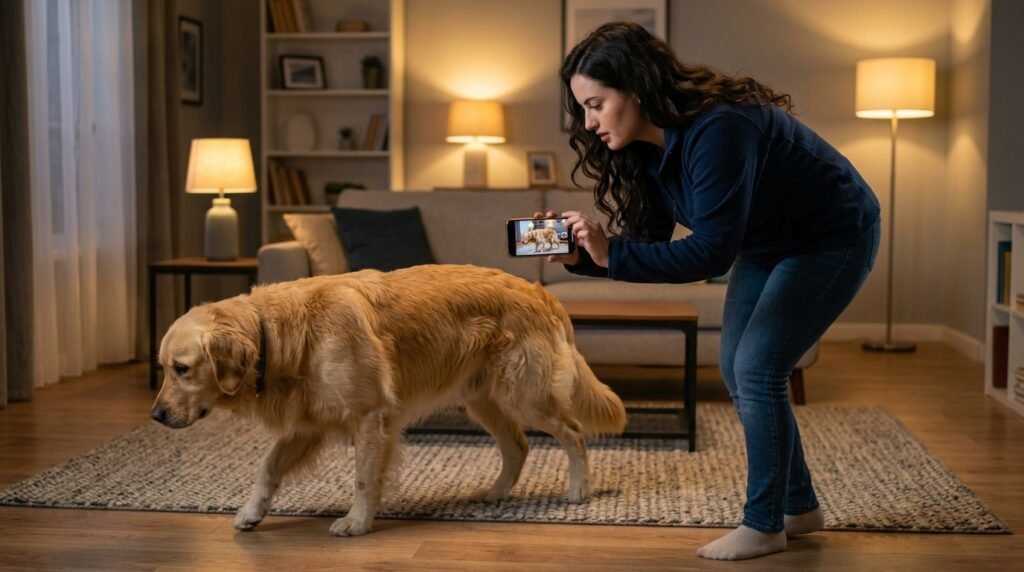
This short record can be much more useful than simply saying, “He limps sometimes at night.”
Safe Care Until Your Veterinary Appointment
If the limp is mild and your dog has none of the emergency signs discussed below, the safest temporary strategy is usually to reduce unnecessary activity while seeking veterinary advice.
Keep your dog calm.
Until you know what is wrong:
- Avoid running.
- Avoid fetch and rough play.
- Prevent jumping on and off furniture.
- Limit unnecessary stair use.
- Use controlled leash trips for bathroom needs.
- Provide a comfortable resting area.
- Keep slippery floors from becoming an additional hazard.
Do not force exercise because you think your dog needs to “walk it off.”
Exercise restriction is commonly part of veterinary management for lameness, although the appropriate degree and duration depend on the actual injury. Cornell lists rest and activity restriction among possible treatments, while VCA emphasizes that evaluation depends on the nature and severity of the limp. Cornell Vet School
If your dog is showing broader discomfort signals, observe those as well. For example, persistent licking can have multiple explanations, including physical discomfort. Our PawMindTips guide on why dogs lick their paws constantly explains why repeated paw-focused behavior should be assessed in context rather than automatically treated as behavioral.
Most importantly, temporary activity restriction is not a substitute for evaluation when the limp persists, returns, or worsens.
When Does Dog Limping Need Urgent Veterinary Care?
The fact that limping begins at night does not automatically make it an emergency—but some accompanying signs do.
Contact an emergency veterinarian or seek urgent veterinary care when your dog has a serious injury or is showing signs such as:
- An obviously deformed or unnaturally positioned limb
- An open fracture or major wound
- Severe or uncontrolled bleeding
- Inability to stand or walk
- Severe pain or distress
- Significant trauma, such as being hit by a vehicle
- Sudden neurologic abnormalities or major loss of coordination
- A limb that is dangling abnormally
- Severe or rapidly developing swelling
The American Kennel Club’s veterinary-reviewed overview of dog limping identifies problems such as obvious fractures, dislocations, significant swelling, and neurologic concerns as reasons for prompt veterinary attention. American Kennel Club
Even without dramatic emergency signs, recurrent lameness deserves attention. Cornell advises veterinary evaluation when a limp continues for more than a day or two or is severe, sudden, or worsening. Cornell Vet School
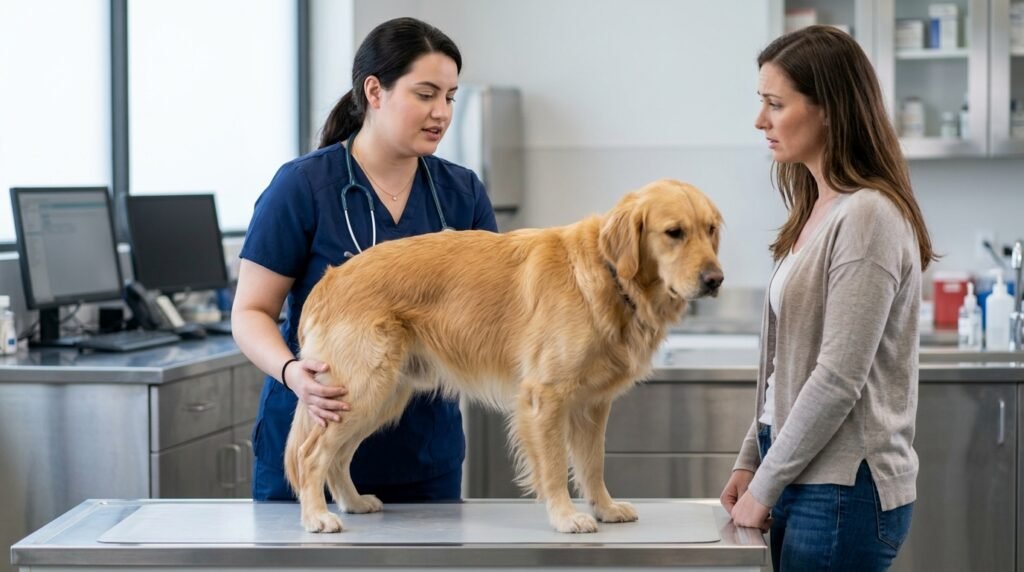
Call your regular veterinarian sooner if you are uncertain. A clinic can help determine whether the history sounds appropriate for a routine appointment, same-day assessment, or emergency hospital.
What Not to Do When Your Dog Is Limping at Night
A worried owner naturally wants to make their dog more comfortable immediately. Unfortunately, some well-intended actions can create additional risk.
Don’t Give Human Painkillers
Do not reach into your medicine cabinet for ibuprofen, naproxen, aspirin, acetaminophen, or another human pain reliever unless a veterinarian has specifically directed its use for that dog.
The U.S. Food and Drug Administration’s guidance on pain relievers for pets warns that medications intended for people may not be safe for dogs and can cause serious adverse effects. U.S. Food and Drug Administration
FDA also notes that approved veterinary NSAIDs require veterinary oversight because suitability and potential side effects need to be considered for the individual animal. U.S. Food and Drug Administration
Don’t use medication left over from another dog or an old injury either.
Don’t Diagnose Arthritis From the Time of Day
An older dog that appears stiff after rest may ultimately be diagnosed with osteoarthritis, but nighttime limping alone does not establish arthritis.
Paw injuries, nail damage, muscle or tendon injuries, ligament problems, other joint conditions, bone disease, and neurologic problems can also affect gait.
Diagnosis may require a hands-on examination and, depending on the findings, imaging or other tests. Cornell Vet School
Don’t Forcefully Manipulate the Leg
Avoid trying to reproduce pain by repeatedly bending, extending, squeezing, or twisting the affected limb.
Leave orthopedic testing to the veterinarian.
Don’t Encourage Exercise to “See If It Goes Away”
One short observation of natural movement is different from deliberately making a limping dog run.
Repeatedly testing the leg with walks, stairs, jumping, or fetch could aggravate an injury.
Don’t Ignore a Repeating Pattern
A limp that disappears by morning but returns night after night still deserves attention.
Intermittent symptoms are still symptoms.
Record the pattern and show your veterinarian the video and notes rather than waiting for the dog to become continuously lame.
Frequently Asked Questions
Why is my dog limping at night but fine during the day?
The timing alone cannot identify the cause. Activity during the day may make an existing problem more noticeable later, while other dogs appear stiff when getting up after resting. Paw, nail, soft-tissue, joint, bone, and neurologic problems can all affect gait. Record when the limp occurs, what your dog was doing beforehand, and whether it appears after rest or activity.
Why does my dog limp after getting up from sleeping?
Stiffness after rest can occur with orthopedic discomfort, including joint problems, but it does not prove that your dog has arthritis. Note how many steps it takes to improve, whether the problem is recurring, and whether there are other mobility changes. Persistent or recurring stiffness warrants veterinary assessment.
Should I take a video if my dog is limping at night?
Yes, provided your dog can move safely without being forced to walk. Cornell University specifically notes that home videos can be extremely helpful because some dogs do not display the same limp during their veterinary examination. Cornell Vet School
Can I wait until morning if my dog suddenly starts limping at night?
That depends on severity and accompanying signs. A mild, weight-bearing limp in an otherwise comfortable dog may not have the same urgency as severe pain, major trauma, inability to stand, an obviously deformed limb, substantial bleeding, or neurologic abnormalities. If you are uncertain about severity, contact an emergency veterinary service for triage rather than guessing.
Conclusion
Seeing your dog limping at night should prompt observation, not an immediate home diagnosis.
Look at the whole pattern: Does the limp follow exercise? Does it appear when your dog rises after rest? Is the same leg always affected? Can your dog bear weight? Are swelling, pain, paw damage, weakness, or other symptoms present?
Record a short video and keep notes for your veterinarian. Until the cause is known, avoid strenuous activity and do not give human pain medication or start an unprescribed treatment.
Most importantly, respond to severity rather than the time on the clock. A recurring mild limp deserves veterinary assessment, while severe pain, major trauma, inability to stand, significant bleeding, deformity, or serious neurologic changes warrant urgent veterinary attention.