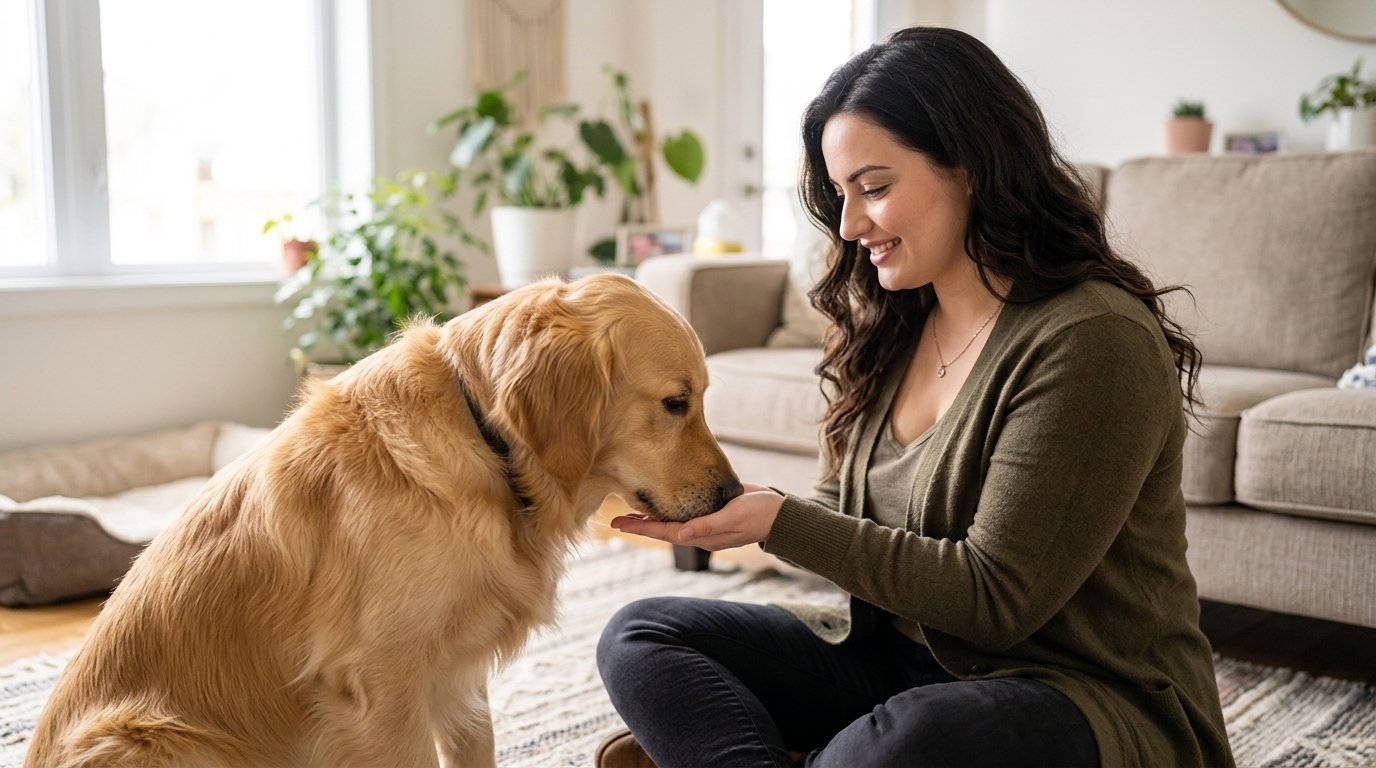
The dog touch command is a simple, reward-based training skill that teaches your dog to gently press their nose against your open palm when you say “Touch.” It may look like a small trick, but it can become a practical way to guide your dog, redirect attention, encourage polite greetings, and build confidence.
Best of all, you don’t need specialized equipment or advanced training experience to get started. A few small treats, a quiet space, and an open hand are enough.
The key is to reward your dog at the exact moment their nose makes contact with your palm. Once they understand that action, you can introduce the verbal cue and gradually practice in different positions and environments.
In this guide, you’ll learn how to teach nose-to-hand targeting step by step, how to get your reward timing right, when to say “Touch,” and what to do if your dog licks, paws at, bites, or ignores your hand.
Table of Contents
What Is the Dog Touch Command?
The dog touch command is a form of target training. Target training teaches a dog to make contact with a particular object or location using a designated body part.
For hand targeting, the goal is straightforward: your dog moves toward your open palm and touches it with their nose.
The finished behavior looks like this:
- You present your open hand.
- You say “Touch.”
- Your dog moves toward your palm.
- Their nose gently makes contact.
- You mark the successful behavior and provide a reward.
A touch should be gentle and voluntary. Your dog doesn’t need to shove your hand, jump, lick your fingers, or hold their nose against your palm for several seconds.
Initially, even a brief nose contact counts as success.
Nose Touch vs. Paw Targeting
Nose targeting and paw targeting are related skills, but they are not identical.
With nose targeting, your dog uses their nose to contact your hand or another target. With paw targeting, they use a paw to touch an object, mat, or designated surface.
For beginners, nose-to-hand targeting is often a convenient starting point because many dogs naturally investigate an unfamiliar open hand by sniffing it.
The training principles are similar, but it’s important to reward the correct body part. If your goal is a nose touch, avoid rewarding repeated paw taps.
Is Touch the Same as Come?
No. Although the behaviors can complement one another, they serve different purposes.
The recall cue “Come” asks your dog to return to you. The touch cue asks your dog to make nose contact with a particular target.
For example, a dog might respond to “Come” by approaching and stopping a few feet away. A trained nose touch gives them a precise destination: your palm.
However, hand targeting should not replace a reliable recall cue, particularly in situations involving traffic, unfamiliar dogs, or other hazards.
Why Teach Your Dog to Touch Your Hand?
Hand targeting is useful because it creates a clear, repeatable behavior that you can reward in many different situations.
According to the Dogs Trust target-training guide, targeting can help dogs focus on a chosen object and can be useful when preparing for grooming, veterinary handling, and other everyday activities.
1. Redirecting Your Dog’s Attention
Imagine you’re practicing in your backyard when your dog becomes interested in a sound near the fence.
Instead of repeatedly calling their name, you can offer your hand and ask for a familiar touch.
If your dog is comfortable and the distraction is manageable, the cue may help them turn their attention back toward you.
This works best after the behavior has been practiced in progressively more distracting environments.
A touch cue is not guaranteed to interrupt fear, panic, or intense reactivity. If your dog is too stressed to respond, increase distance from the trigger rather than repeating the cue.
2. Encouraging Polite Greetings
Some dogs become excited when visitors arrive and immediately jump up.
A familiar hand target can provide an alternative behavior to practice before a calm greeting.
For example, you might ask your dog to touch your palm, reward them, and then allow a relaxed interaction when they’re ready.
This works particularly well when combined with consistent reinforcement of calm behavior.
Our guide to good manners training in seven days explores additional foundation skills for polite household behavior.
3. Guiding Movement Without Physical Pressure
A dog who understands hand targeting can learn to follow your hand for a short distance.
This can help you guide them toward a training mat, into an appropriate position, or around an obstacle.
Instead of pushing or pulling your dog into position, you offer a familiar target and reward voluntary movement.
Keep movements comfortable and avoid using the target to force your dog into situations they find frightening.
4. Supporting Cooperative Care
Nose targeting may eventually become part of a larger cooperative-care routine.
For example, your dog might learn to place their nose against a target while you briefly inspect their body or prepare for grooming.
The target does not automatically mean your dog consents to every procedure. Cooperative care requires gradual conditioning, opportunities to opt out, and attention to signs of discomfort.
5. Building Confidence Through Small Successes
Training can become a predictable game:
Your dog sees the target, makes the correct choice, and receives positive feedback.
For dogs who enjoy participating, these short exercises can provide mental enrichment and encourage engagement.
A dog who seems worried about approaching your hand should never be forced to participate.
What You Need Before Starting Touch Training
One advantage of the dog touch command is that it requires very little equipment.
You can begin in your living room with materials you probably already have.
Small, Easy-to-Eat Treats
Choose rewards your dog enjoys and can swallow quickly.
Small pieces are usually better than large biscuits because they allow repeated practice without long interruptions.
Depending on your dog’s preferences, rewards might include:
- Pieces of their regular kibble
- Small commercial training treats
- Tiny pieces of plain, dog-safe cooked meat
- Another veterinarian-approved food reward
Account for training treats within your dog’s daily food allowance, especially if your dog needs weight management.
If you’re unsure which foods are suitable, our guide to foods dogs should avoid can help you recognize common food hazards.
A Quiet, Familiar Environment
Choose a room where your dog feels comfortable.
Turn off distracting sounds, put away exciting toys, and avoid practicing while several people are moving around.
Early training should make success easy.
A quiet room allows your dog to concentrate on the connection between their behavior and your reward.
A Marker Word or Clicker
A marker tells your dog exactly which behavior earned the reward.
You can use a clicker or a short, consistent word such as “Yes!”
If your dog hasn’t learned what the marker means, begin by saying “Yes!” and immediately giving a treat. Repeat several times so the sound predicts a reward.
The marker is not the same as the verbal touch cue.
“Touch” asks for an action. “Yes!” identifies the successful action.
An Empty Target Hand
Use one hand as the target and keep the food in your other hand or a treat pouch.
This distinction is important.
If you hold a treat inside your target palm, your dog may simply learn to sniff for food rather than respond to an empty hand.
A food scent can be a temporary introduction for a hesitant dog, but the goal is to remove that assistance promptly.
Short Training Sessions
Begin with approximately one to three minutes of practice.
A few successful repetitions are more valuable than a long session that ends with your dog becoming frustrated.
You can repeat short sessions throughout the day if your dog remains interested.
Look for relaxed body language, willing participation, and an eagerness to try again.
How to Teach the Dog Touch Command Step by Step
This is the foundation of the entire exercise.
The Battersea nose-touch training guide describes a gradual progression from investigating the hand to making contact, adding a voice cue, and changing the target’s position.
The following method uses that same reward-based learning principle while keeping the process beginner-friendly.
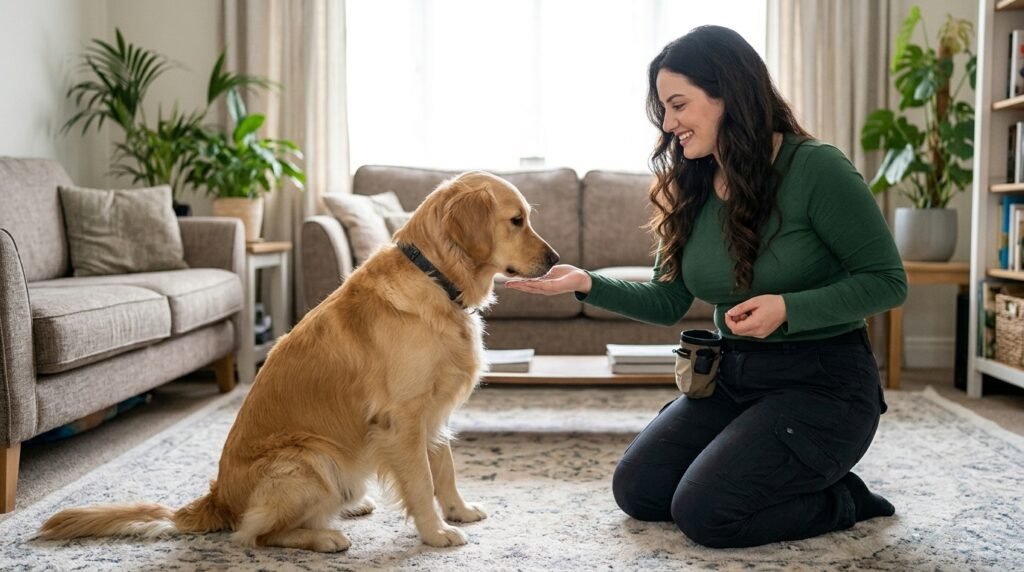
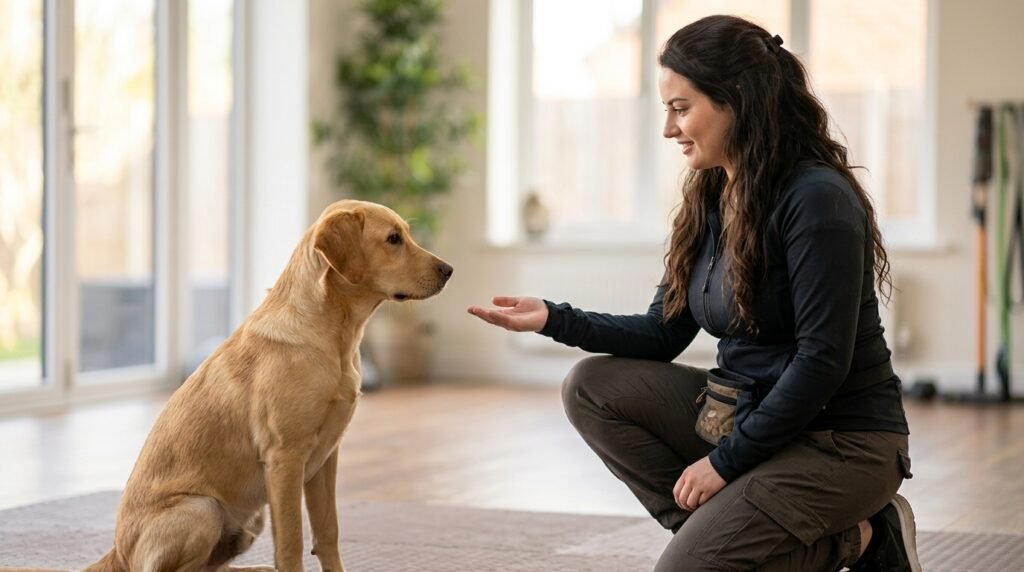
Step 1: Present Your Open Palm
Start with your dog standing or sitting comfortably.
Hold your open hand a few inches away from their nose, with your palm facing toward them.
Keep your hand still.
Don’t push it toward your dog’s face.
Many dogs will naturally lean forward to investigate the unfamiliar hand.
As your dog approaches and sniffs, you have an opportunity to reinforce that curiosity.
If your dog is uncomfortable, increase the distance and allow them to choose whether to approach.
Step 2: Reward Initial Interest
During the first few repetitions, reward your dog for showing interest in the hand.
This might include turning their head toward it or leaning forward to sniff.
Say “Yes!” and deliver a treat from your other hand.
This initial stage helps your dog discover that approaching the target is worthwhile.
Once your dog is confidently investigating the hand, raise your criteria.
From this point onward, reserve the reward for actual nose contact.
Step 3: Mark the Exact Nose Touch
Present your palm again.
Wait for your dog’s nose to make contact.
The instant it happens, say “Yes!” or click.
Then deliver the treat.
The sequence is:
Present palm
Nose contact
Mark “Yes!”
Give treat
The marker should identify nose contact, not the moment your dog starts eating.
If your timing is late, your dog may associate the reward with pulling away, licking, or performing another action.
Step 4: Reset for Another Repetition
After rewarding your dog, lower your target hand.
Allow a brief pause.
Then present your palm again.
Resetting helps your dog recognize each new opportunity to perform the behavior.
Avoid holding your palm out continuously while your dog repeatedly touches it without a clear beginning or ending.
You can also deliver the treat slightly away from your target hand, encouraging your dog to move back before trying again.
Step 5: Build Consistent Nose Contact
Practice until your dog willingly touches the empty palm several times in a row.
A practical milestone is four or five successful touches during a short session.
You don’t need perfection, and you don’t need to rush.
If your dog becomes confused, return to rewarding simple investigation for a few repetitions before rebuilding the nose-touch criterion.
At this stage, your dog is learning the physical behavior.
The verbal cue comes next.
How to Add the Verbal Cue and Get Reward Timing Right
One of the most common dog touch command mistakes is saying “Touch” repeatedly before the dog understands what action is being requested.
A verbal cue works best when it’s attached to an already familiar behavior.
When Should You Introduce “Touch”?
Wait until your dog reliably touches your palm when you present it.
Then begin saying “Touch” just before offering your hand.
For example:
- Say “Touch” once.
- Present your open palm.
- Wait for nose contact.
- Mark with “Yes!”
- Give the reward.
Over repeated sessions, your dog begins associating the word with the hand-targeting action.
Initially, the visible palm may be doing most of the work. That’s normal.
Your goal is to create a consistent relationship between the word, the hand signal, and the reward.
Why You Should Say the Cue Only Once
Repeatedly saying “Touch, touch, touch!” can make the cue less clear.
If your dog doesn’t respond, don’t assume they’re being stubborn.
They may not recognize the cue yet, the hand may be too far away, or the environment may be distracting.
Instead, pause, make the next repetition easier, and reward success.
A useful training principle is to adjust the exercise rather than increase verbal pressure.
The Difference Between a Marker and a Reward
Your marker word identifies the successful moment.
Your reward reinforces the behavior.
For example, your dog might touch your palm at 2:15:04, hear “Yes!” immediately, and receive a treat a moment later.
The marker bridges the short gap between the correct action and the delivery of food.
This is why marker consistency matters.
Reward Timing: What Counts as Correct?
| Your timing | What your dog may learn |
|---|---|
| Mark at nose contact | Touching the palm earns rewards |
| Mark while approaching | Moving toward the hand may be enough |
| Mark after licking | Licking may be part of the behavior |
| Mark after pawing | Paw contact may be reinforced |
| Mark after turning away | The desired behavior becomes less clear |
If you accidentally mark the wrong moment, give the promised reward anyway, then adjust your timing on the next repetition.
One imperfect repetition won’t ruin training.
Should You Use a Clicker?
A clicker can be helpful because it produces a consistent, recognizable sound.
However, a marker word is also effective when used consistently.
Choose whichever method you can deliver accurately.
You don’t need to use both at the same time.
When Can You Stop Giving Treats Every Time?
During early learning, reward every correct touch.
Once your dog understands the cue in several familiar settings, you can begin varying rewards while continuing to reinforce the behavior frequently.
Rewards might include food, praise, a brief game, or access to something your dog enjoys.
Avoid removing food rewards too quickly, especially when introducing new locations or distractions.
Your dog should continue finding the exercise worthwhile.
Common Dog Touch Command Mistakes and How to Fix Them
Even simple behaviors can become confusing when the training criteria aren’t clear.
The most useful response to a mistake is usually to lower the difficulty.
Mistake 1: Your Dog Licks Your Palm
Some dogs naturally investigate hands with their tongues.
If your dog licks instead of making a brief nose touch, consider whether the target hand smells strongly of food.
Wash your hand, remove visible treats, and try again.
Mark a clear nose contact before the licking begins.
Avoid scolding your dog. They’re experimenting with behaviors that might earn a reward.
Mistake 2: Your Dog Uses Their Paw
Pawing can happen when your dog is excited or has previously learned paw-based tricks.
Present the palm at a comfortable nose height.
Wait for nose contact rather than rewarding the paw tap.
If pawing continues, simplify the exercise and reinforce small movements of the nose toward the target.
Don’t grab or restrain your dog’s paw.
Mistake 3: Your Dog Bites or Mouths Your Hand
Some puppies and excitable dogs investigate with their mouths.
If your dog starts mouthing, calmly withdraw the hand and pause.
Try presenting the target at a slightly greater distance and reward a gentle sniff or nose touch before mouthing begins.
If your dog becomes increasingly excited, end the session and return when they’re calmer.
If biting appears defensive, fearful, or painful rather than playful, avoid further hand-targeting attempts until you’ve addressed the underlying concern with an appropriate professional.
Mistake 4: Your Dog Ignores Your Hand
Several factors may explain why your dog isn’t responding:
- The environment is too distracting.
- The hand is too far away.
- The reward isn’t motivating.
- The dog is tired or uncomfortable.
- The dog hasn’t learned the target behavior yet.
Try moving to a quieter area, presenting your hand closer without invading your dog’s space, and rewarding small signs of interest.
If your dog repeatedly avoids hands, respect that preference.
For a dog who appears anxious around people or handling, our guide on how to help a nervous dog provides additional context.
Mistake 5: Your Dog Only Responds When They See Food
This often happens when the treat is consistently visible in the target hand.
Switch to an empty palm and deliver food from your other hand after the successful touch.
You want the hand signal and verbal cue to predict the opportunity for a reward, not require food to be displayed first.
Mistake 6: You Move Your Hand Too Quickly
A moving hand may encourage chasing rather than deliberate nose contact.
Start with a stationary target.
Only introduce slight movement after your dog understands the basic behavior.
Later, you can teach your dog to follow the target for short distances.
Mistake 7: You Increase Difficulty Too Fast
A dog who can touch your hand in the living room may not immediately perform the same behavior in a busy park.
This doesn’t necessarily mean they’ve forgotten.
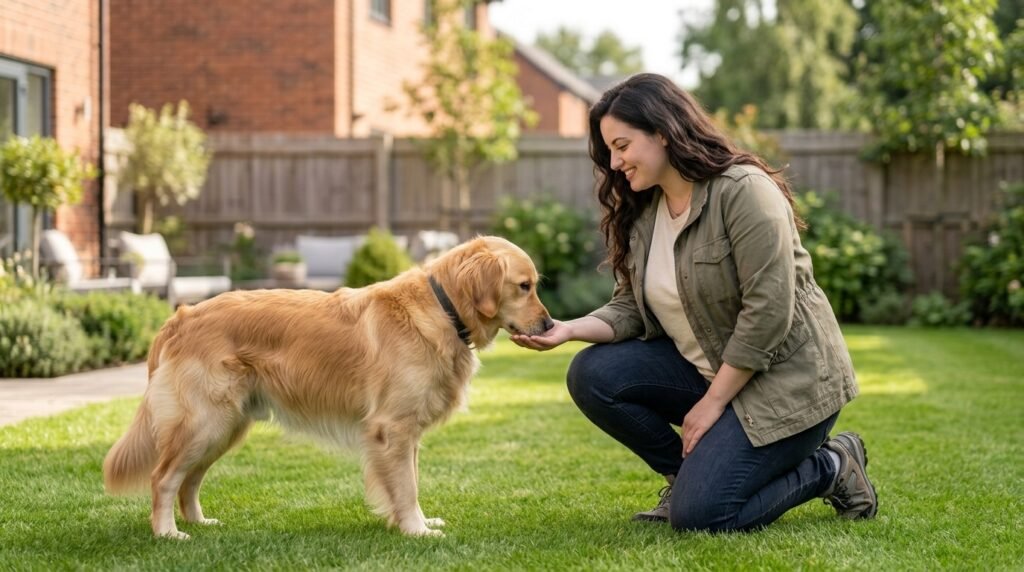
Dogs often need practice in different contexts before a cue becomes reliable.
The Dogs Trust training guidance emphasizes working at the dog’s pace and introducing distractions gradually.
How to Use the Touch Cue in Everyday Life
Once your dog understands the basic behavior, you can gradually expand how you use it.
The dog touch command is most useful when it remains enjoyable, predictable, and easy to perform.
Practice With Both Hands
Begin with your original target hand.
Then introduce the opposite hand.
Present it at approximately the same height and distance.
Your dog may initially hesitate because the picture looks different.
Reward successful touches and practice until both hands are familiar.
Change the Position of Your Palm
Try presenting your hand slightly to the left, right, or lower than usual.
Change only one variable at a time.
For a small dog, keep the target at a comfortable height rather than expecting repeated jumping.
For an older dog or one with mobility limitations, choose positions that don’t require uncomfortable reaching or twisting.
Guide Your Dog Around an Object
Place a safe, familiar object on the floor.
Use your hand target to encourage your dog to move around it.
Reward a touch after a small, comfortable movement.
This can become a fun enrichment exercise and a foundation for more advanced positioning skills.
Add the Touch Cue to Polite Greetings
When your dog is calm, ask for a touch before allowing an interaction with a familiar visitor.
Avoid asking strangers to extend their hands toward a nervous dog.
The goal is voluntary engagement, not forced contact.
If your dog prefers distance, respect that choice.
Use Touch During Basic Training
Hand targeting can complement other cues.
For example, you might practice a short sequence:
“Sit” → reward → “Touch” → reward.
Keep the cues distinct.
A stay cue asks your dog to remain in place, while touch asks them to move toward a target.
Our step-by-step sit and stay guide explains how to build those foundation behaviors separately.
Practice During Walks
Begin in a quiet outdoor location where your dog can concentrate.
Ask for a touch while standing still.
Later, practice a touch after your dog turns toward you.
This can become a useful engagement exercise, but don’t use it to pull your dog toward unfamiliar people, traffic, or situations that make them uncomfortable.
Use Hand Targeting for Grooming Preparation
If your dog enjoys the exercise, a hand target can become part of a cooperative grooming routine.
For example, you might reward a nose touch while a brush remains nearby, without actually brushing the dog yet.
Over time, and only while your dog stays comfortable, you can introduce brief handling.
The target should remain an opportunity to participate rather than a way to force compliance.
A Simple 7-Day Dog Touch Command Training Plan
Every dog learns at a different pace.
Some dogs may begin touching your palm during the first session. Others need several days to feel comfortable approaching the target.
The following plan is a flexible practice framework, not a promise that your dog will master the skill in seven days.
| Day | Main goal | Practice |
|---|---|---|
| 1 | Investigate the hand | Reward looking toward and sniffing the palm |
| 2 | Make nose contact | Mark and reward gentle nose touches |
| 3 | Build consistency | Practice several touches with an empty palm |
| 4 | Introduce “Touch” | Say the cue once before presenting the hand |
| 5 | Change hands | Practice with the left and right hand |
| 6 | Add easy variations | Change target position or practice in another room |
| 7 | Use in daily routines | Try a few successful touches during calm activities |
How Many Repetitions Should You Practice?
Start with approximately three to five repetitions per session.
If your dog is enthusiastic and successful, you may practice a little longer.
If they’re losing interest, stop earlier.
There’s no advantage to forcing a fixed number of repetitions.
When Should You Move to the Next Stage?
A useful guideline is to look for consistent success across several repetitions.
If your dog touches your palm four or five times without hesitation, you can try a small increase in difficulty.
If success drops sharply, return to the previous stage.
Training progress is rarely perfectly linear.
How to Know the Cue Is Becoming Reliable
Your dog is making progress when they:
- Recognize the open palm as a target.
- Make gentle nose contact without visible food.
- Respond after hearing “Touch” once.
- Can perform the behavior with either hand.
- Can repeat the behavior in more than one familiar location.
- Remain comfortable and interested during practice.
Reliability in a quiet room doesn’t automatically mean reliability around unfamiliar dogs, loud noises, or exciting distractions.
Continue reinforcing the skill in manageable environments.
What If Your Dog Stops Enjoying Training?
Watch for changes in body language.
Turning away repeatedly, freezing, backing off, avoiding your hand, or becoming unusually frantic can indicate that the exercise is too difficult or uncomfortable.
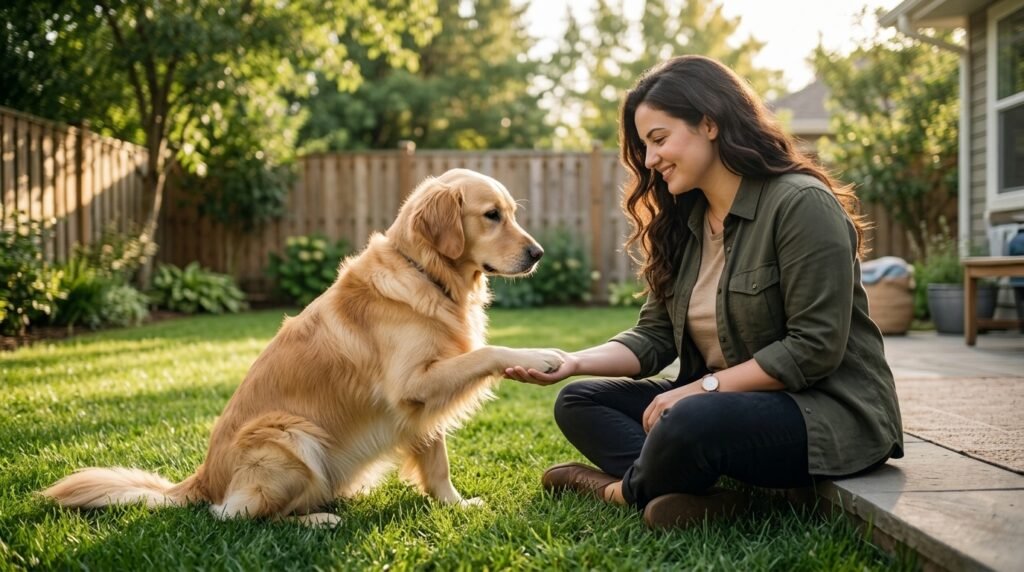
Stop, give your dog space, and reconsider the training setup.
If your dog suddenly becomes reluctant to move their head or appears painful when approaching the target, consult your veterinarian.
You can also review our guide to recognizing signs of stress in dogs to better understand the broader body-language picture.
FAQs
1. What does the dog touch command mean?
The dog touch command asks a dog to make gentle nose contact with an open hand or another trained target. It’s a positive-reinforcement skill that can help with attention, positioning, and everyday training routines.
2. How long does it take to teach a dog to touch your hand?
Some dogs understand the basic nose touch within a few short sessions, while others need more practice. Learning the verbal cue and responding reliably in different environments generally takes additional repetition. Progress depends on the dog’s comfort, experience, and the training environment.
3. Should I say “Touch” before or after my dog touches my hand?
Once your dog understands the physical behavior, say “Touch” just before presenting your hand. When their nose makes contact, mark the behavior with “Yes!” or a click, then reward. During early teaching, you can introduce the word while the behavior is already happening before moving it ahead of the hand signal.
4. Can puppies and older dogs learn nose-to-hand targeting?
Yes. Puppies and older dogs can learn hand targeting when the exercise is adjusted to their comfort and abilities. Use short sessions, appropriate rewards, and a target height that doesn’t require uncomfortable stretching or jumping. Dogs with pain, mobility limitations, or handling sensitivity may need a modified approach.
Conclusion
The dog touch command is a practical, beginner-friendly way to teach your dog to make gentle nose contact with your palm.
Start by encouraging your dog to investigate an empty hand, reward the exact moment their nose touches it, and introduce the word “Touch” only after the behavior becomes familiar.
Keep sessions short, use consistent marker timing, and increase difficulty gradually. If your dog becomes confused, simplify the exercise rather than repeating the cue or forcing contact.
With patient, reward-based practice, nose-to-hand targeting can become an enjoyable skill that supports everyday communication, confidence, and cooperative training.