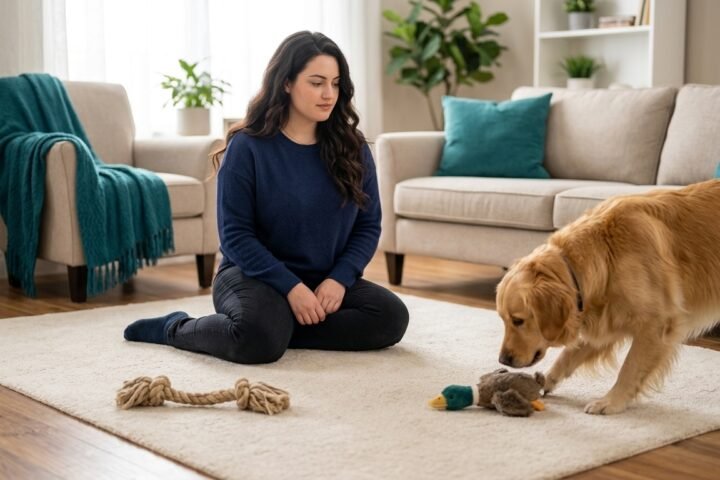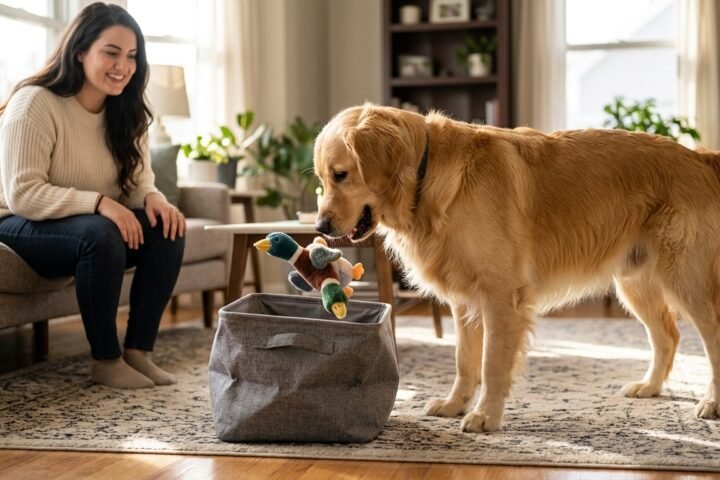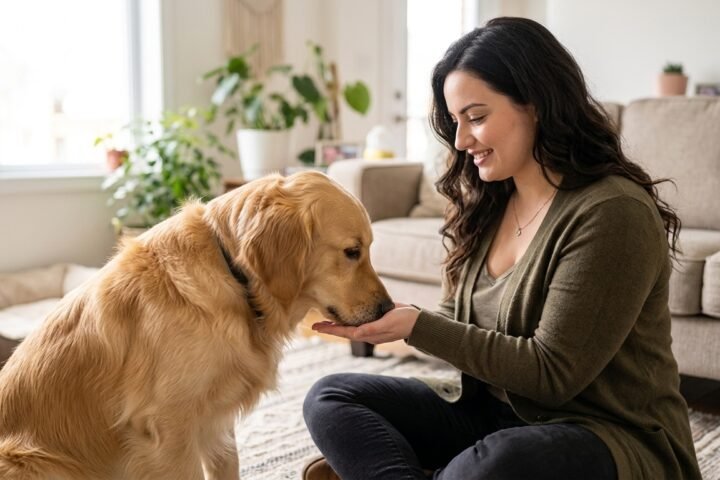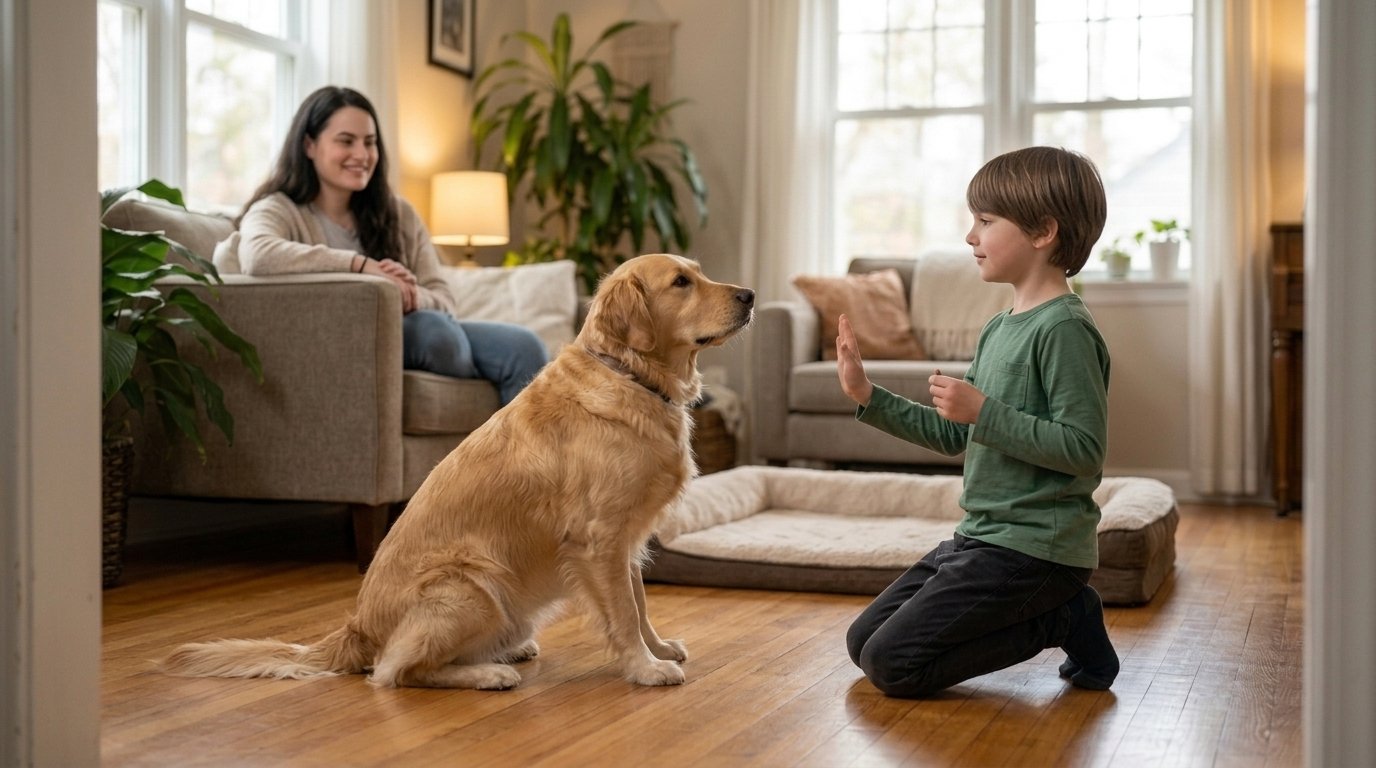
Teaching kids to train a dog can help children develop patience, responsibility, and a stronger bond with their new family pet. With the right approach, even young children can participate in simple training activities, such as helping an adult reward a puppy for sitting or tossing a treat when the dog responds correctly.
However, successful family dog training is not about expecting children to control a dog on their own. Parents must set clear boundaries, choose activities that match their child’s abilities, and make sure the dog feels comfortable throughout each session. Children also need to understand that dogs are living animals with their own needs, feelings, and limits.
The best way to begin is with short, positive sessions that teach one skill at a time. In this guide, you’ll learn how to involve children in basic commands, introduce fun training games, choose age-appropriate responsibilities, and recognize when your dog needs a break.
Table of Contents
Why Should Kids Participate in Dog Training?
Training gives children and dogs a constructive way to interact. Instead of relying on chasing, rough play, or constant petting to connect, children can learn how to communicate with their dog through predictable cues and rewards.
It helps build a trusting relationship
Dogs learn through experience. When a child consistently uses a familiar cue and rewards the dog for responding, the dog has an opportunity to associate that child with positive experiences.
For example, a child might ask a dog to sit before an adult opens the door to the backyard. When the dog sits and the door opens, the dog learns that calm behavior can lead to something enjoyable.
These small interactions can help children appreciate cooperation rather than expecting immediate obedience.
It teaches patience and responsibility
Children may initially expect a dog to understand a command after hearing it once. Training teaches them that learning takes repetition, consistency, and time.
Parents can explain that a dog isn’t being stubborn simply because it doesn’t respond. The environment might be distracting, the cue may be unfamiliar, or the dog may not understand what is being asked.
Children can also take part in appropriate care routines, such as preparing a reward pouch with an adult, practicing a known cue, or helping record the family’s training progress.
It encourages calmer behavior
A well-planned training session gives a dog an opportunity to practice useful behaviors instead of rehearsing unwanted ones.
Children can help reward four paws on the floor instead of jumping, calm greetings instead of rushing forward, and settling on a mat instead of constantly demanding attention.
These skills are particularly useful with an energetic puppy. However, training alone does not guarantee that a dog will always behave safely around children. Management, supervision, and individual temperament still matter.
Safety Rules Every Child Should Learn First
Before teaching a command, teach your child how to interact respectfully with the dog. This should happen before training begins, not after a frightening experience.
The American Kennel Club’s guidance on helping children understand and respect dogs also emphasizes supervision, personal space, and understanding canine behavior.
1. Never disturb a dog that is eating or sleeping
Children should leave dogs alone while they eat, sleep, chew a treat, or rest in their designated safe area.
Don’t use training sessions to practice taking food away, removing a chew, or reaching into the dog’s bed. These situations can create stress and increase the risk of defensive behavior.
If a toy or item needs to be retrieved, an adult should manage the situation rather than asking a child to take it.
2. Let the dog choose whether to interact
Teach children to invite interaction rather than force it.
They should not chase a dog that walks away, corner it, climb on it, pull its tail, or hug it tightly. Even a familiar family dog may feel uncomfortable with this type of contact.
A simple rule is: if the dog moves away, let it go.
3. Keep training rewards safe
Some dogs grab treats quickly. Young children may be startled by this, and a dog may accidentally nip fingers while trying to get food.
Start by practicing with a stuffed animal. When you’re ready to work with the real dog, an adult can place the treat on the floor or have the child gently toss it away from their body.
Only allow hand-feeding when the dog is calm and the adult is confident the child can do it safely.
4. Teach children to stop when the dog is uncomfortable
A dog may turn its head away, lick its lips, yawn when not tired, lower its body, freeze, or try to leave when an interaction feels uncomfortable.
Children do not need to interpret every signal perfectly. Teach them a simple response: stop what you’re doing, give the dog space, and call an adult.
A growl should never be punished or treated as a challenge. It is a warning that the situation needs to change.
5. Never leave young children alone with a dog
Active adult supervision is essential, especially during training, feeding, play, and greetings. Being in the same room is not enough if the adult is distracted.
Use a baby gate, exercise pen, or separate room when you cannot supervise closely. A dog’s crate or resting area should remain a protected space, not a place where children go to interact with it.
The Dogs Trust dog-and-child safety guide provides additional guidance on recognizing discomfort, stepping in early, and separating children and dogs when needed.
What Training Jobs Are Suitable for Different Ages?
There is no single age at which every child becomes ready to train a dog independently. Maturity, impulse control, coordination, the dog’s behavior, and the parent’s ability to supervise all affect what is appropriate.

Use these age ranges as starting points, not strict rules.
| Child’s age | Suitable participation | Adult’s role |
|---|---|---|
| Under 3 | Watch demonstrations; help choose a toy with an adult | Maintain physical separation when needed and manage every interaction |
| Ages 3–5 | Toss a treat, help say a familiar cue, or choose a training toy | Stay within immediate reach and guide every step |
| Ages 6–9 | Practice familiar cues, reward calm behavior, and join simple games | Coach closely and manage the dog’s movement |
| Ages 10–12 | Help plan short sessions and practice known skills | Supervise, correct mistakes, and assess readiness |
| Ages 13 and older | Take a more active role in routine training | Continue oversight based on the dog’s temperament and the teen’s ability |
These are general guidelines, not guarantees of safety. A calm child may be ready for more responsibility earlier, while an older child may need more guidance with an excitable or fearful dog.
Give each child a clear responsibility
Rather than letting several children give commands at once, assign simple roles.
For example:
- One child says the familiar cue.
- Another helps count successful repetitions.
- An adult delivers rewards if the dog is excitable or the children are very young.
Rotate roles so everyone can participate without crowding the dog. If the dog becomes excited or overwhelmed, end the activity and give it space.
How to Teach Kids the Basics of Positive Reinforcement
Positive reinforcement means rewarding a behavior you want to see again. In family training, the goal is to make the process clear for both the child and the dog.
The Whole Dog Journal guide to training children and beginners discusses how children can practice known behaviors and learn to mark and reward the correct response.
Step 1: Choose one simple behavior
Start with a behavior the dog already knows, such as sitting. This allows the child to practice the training sequence without introducing too many new challenges.
Choose a quiet area away from running children, visitors, other pets, and exciting outdoor activity.
Step 2: Explain the cue
Use one familiar word, such as “Sit.” Everyone in the household should use the same cue consistently.
Explain to the child that the dog may need a moment to respond. Saying the command repeatedly or shouting louder does not necessarily make it easier to understand.
Step 3: Mark the correct behavior
A marker is a short signal, such as “Yes!”, that tells the dog which behavior earned the reward.
The sequence is simple:
- The child gives the cue once.
- The dog performs the behavior.
- The child or adult immediately says “Yes!”
- The dog receives a small treat or another suitable reward.
Practice the timing with a stuffed animal first if the child needs help understanding the sequence.
Step 4: Reward calmly
Use small treats appropriate for the dog, accounting for allergies, dietary restrictions, and the dog’s daily food needs.
If the dog grabs at fingers, have the child drop the treat on the floor or let an adult deliver it. Do not ask a frightened child to keep hand-feeding a dog that is too excited.
Step 5: Keep sessions short
A few minutes of focused practice is usually a better starting point than a long session. Finish while the child and dog are still engaged and comfortable.
If the dog repeatedly fails to respond, becomes distracted, or walks away, make the activity easier or stop. Learning is not improved by forcing the dog to continue.
Easy Dog Commands Kids Can Practice
Once your child understands the basic reward sequence, introduce a few useful behaviors. Choose commands the adult has already taught the dog, or have an adult lead the initial teaching process.
Sit
“Sit” is a convenient starting point because it can be practiced in calm, everyday situations.
Have the child give the cue once. When the dog sits, mark the behavior and reward it. The child should remain calm rather than leaning over the dog or waving a treat excitedly.
Useful practice opportunities include sitting before a game begins or before an adult puts down the dog’s food bowl.
Down
“Down” asks the dog to lie on the floor. Because some dogs find this position uncomfortable or challenging, start with an adult demonstrating the behavior.
The child can watch, give the familiar cue if ready, and help reward the dog when it lies down. Never push the dog’s body into position.
Come
Recall training teaches a dog to move toward a person when called. It is an important skill, but children should initially practice indoors or in a secure, enclosed area with an adult.
The child can stand a short distance away, use the dog’s familiar recall cue, and reward the dog for approaching. Keep the activity cheerful and easy.
Never test a child’s recall skills beside a road, near an open gate, or in another unsecured location.
Go to your mat
Teaching a dog to go to a mat gives the family a useful way to encourage calm behavior.
An adult can teach the dog to approach the mat and reward it for stepping onto or settling on it. Children can then help reward the behavior during quiet family activities.
This should be a positive resting option, not a way to trap or confine the dog. The dog must be free to leave unless an adult is safely managing a separate situation.
Leave it
“Leave it” can help a dog disengage from an item, but it should be taught carefully. Children should not practice by placing dangerous objects in front of the dog or trying to take something from its mouth.

An adult should teach the behavior using safe, controlled setups and rewards. Children can participate after the dog understands the cue and the adult can manage the exercise.
If a dog guards food, toys, or stolen objects, children should not practice retrieval or trading exercises independently.
Fun Family Dog Training Games
Training games help children learn timing and consistency while giving dogs a rewarding activity. Choose games that minimize chasing, grabbing, and physical excitement.
1. The name game
Say the dog’s name once in a calm, friendly voice. When the dog looks toward the speaker, mark the response and reward it.
Take turns with one child at a time, keeping everyone far enough apart that the dog can respond without becoming frantic.
The purpose is to teach the dog that responding to its name is worthwhile, not to see who can shout the loudest.
2. Find the treat
With an adult’s help, hide a few appropriate treats in easy-to-find locations around a safe room. Let the dog sniff them out.
Children can help choose hiding places, but they should not put treats where the dog must climb, jump on furniture, or enter unsafe areas.
Keep this game separate from children’s snacks and never ask a child to hide food near the dog’s bowl or prized toys.
3. Reward four paws on the floor
If the dog jumps up when children arrive, teach the family to reward calm greetings instead.
An adult can manage the dog behind a gate or on a suitable leash. When the dog has four paws on the floor, the adult or an appropriately capable child can reward the behavior.
If the dog jumps again, the adult should calmly manage the situation rather than expecting a child to push the dog away or physically restrain it.
4. Take turns with a trick
Once the dog knows a simple behavior, such as a nose target or a spin, family members can take turns asking for it and rewarding success.
Keep the trick easy enough that the dog can succeed. Avoid tricks that involve jumping on children, grabbing clothing, or placing paws on a child’s body.
5. Practice calm moments
Not every game needs to involve movement. An adult can reward the dog for relaxing on a mat while a child reads a book nearby or works on a quiet activity.
This teaches the family to notice and reward calm behavior rather than giving the dog attention only when it is excited.
The best game is one that both the child and dog can enjoy without pressure. If the dog starts barking frantically, mouthing, jumping, or trying to escape, stop and reset the environment.
Understanding Dog Body Language During Training
A child can follow every training step correctly and still need to stop if the dog is uncomfortable. Dogs communicate through their posture, facial expressions, movement, and behavior.
Parents should learn to recognize signs of stress and teach children simple rules for responding.
Signs that the dog may need a break
Look for changes such as:
- Turning the head or body away.
- Repeated lip licking or yawning outside an obvious tired moment.
- Ears held back, a lowered body, or a tucked tail.
- Trying to hide, leave, or move behind an adult.
- Becoming unusually still or stiff.
- Growling, showing teeth, or snapping.
No single signal tells the whole story, and some behaviors have more than one explanation. Watch the overall pattern and the situation.
PawMindTips readers can also review signs of a stressed dog to better understand common signs of discomfort. A dog showing repeated fear around children may benefit from a veterinary assessment and qualified behavior support.
What children should do when a dog shows discomfort
Teach a three-step response:
- Stop: End the command, touching, or game.
- Give space: Do not follow, corner, hug, or reach for the dog.
- Tell an adult: Let the parent decide whether to end the session, create separation, or seek professional advice.
Children should never be expected to resolve growling, guarding, or aggressive behavior themselves.
What if the dog growls?
Take the growl seriously. Stop the interaction, calmly create distance, and prevent the child from approaching the dog again in that situation.

Do not scold the dog for growling or make the child repeat the interaction to prove that it is safe. Punishing warning signals can make the situation harder to interpret and manage.
If growling, snapping, guarding, or fear occurs repeatedly, arrange a veterinary check and seek help from a qualified, reward-based trainer or veterinary behavior professional. Until then, use reliable physical separation and adult management.
How to Build a Consistent Family Training Routine
A simple routine helps children understand their responsibilities and prevents training from becoming chaotic.
Choose one goal at a time
Pick a single behavior for the family to practice over several short sessions. For example, everyone might work on rewarding the dog for sitting before a greeting.
Agree on the exact cue, the behavior that earns a reward, and the appropriate reward. Consistency helps the dog understand what the family expects.
Create a family training chart
A small chart on the refrigerator can help children participate without turning training into a competition.
Include:
- The skill being practiced.
- The cue everyone will use.
- The reward the adult has approved.
- A simple record of successful sessions.
- A reminder to stop if the dog appears uncomfortable.
Focus on effort and calm participation rather than the number of tricks the dog performs.
Fit training around everyday life
Children can help practice familiar behaviors before a game, during a quiet indoor activity, or when the adult is preparing the dog’s meal.
These everyday moments can be more useful than a long, complicated session. Keep the dog’s needs in mind: training should not replace walks, rest, play, social interaction, or appropriate mental stimulation.
Avoid mixed messages
If one family member rewards jumping while another ignores it, the dog may receive inconsistent feedback. Family members should agree on basic rules and follow the same approach.
This does not mean every child must become a dog-training expert. The adult should coordinate the plan and take responsibility for decisions about safety.
Know when professional help is needed
A new dog may need time to settle into a household. If it is fearful of children, guards food or toys, bites, snaps, or becomes difficult to manage, don’t rely on children’s training sessions to solve the problem.
Start with separation and safe management. Ask a veterinarian whether pain or another health issue could be contributing to the behavior, and seek an appropriately qualified professional for a tailored plan.
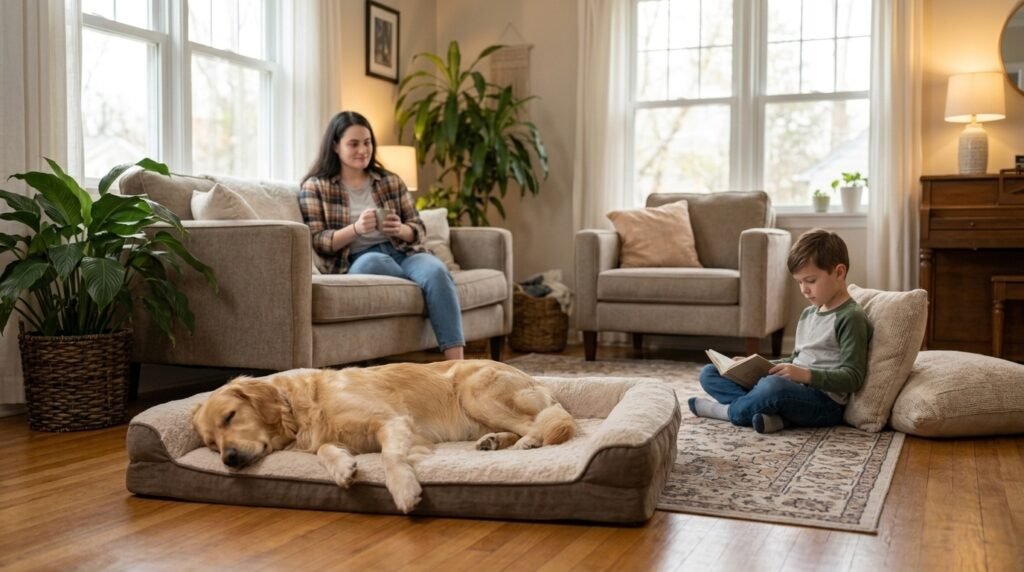
For more support with canine fear, see how to help a nervous dog. Do not force a dog to interact with children in the hope that it will simply get used to them.
Frequently Asked Questions
1. At what age can kids start training a dog?
Children can begin participating in simple activities during early childhood, but an adult must choose and supervise each task. Younger children may be better suited to tossing treats or watching demonstrations, while older children may practice familiar cues with guidance.
2. What is the easiest command for a child to teach a dog?
“Sit” is often a practical first choice when the dog already understands the cue. The child can practice saying it once, marking the correct response, and rewarding the dog under adult supervision.
3. Can kids train a puppy without adult help?
Young children should not train a puppy without active adult supervision. Puppies may jump, nip, grab treats, or become overstimulated quickly. An adult must manage the interaction and ensure both the child and puppy remain comfortable.
4. What should I do if my dog growls at my child during training?
Stop the interaction, create safe separation, and prevent further contact in that situation. Do not punish the growl or ask the child to try again. Contact a veterinarian and a qualified behavior professional for guidance, especially if the behavior repeats or escalates.
Conclusion
Teaching kids to train a dog works best when families prioritize safety, consistency, and positive experiences over perfect obedience. Start with familiar commands, short sessions, simple games, and rewards the dog enjoys. Give every child responsibilities that match their maturity, and make sure an adult remains responsible for supervision and management.
Most importantly, teach children to respect a dog’s boundaries. A dog that walks away, freezes, or shows signs of discomfort needs space, not another command. With thoughtful guidance, family training can become a rewarding shared activity that helps children learn patience while supporting a healthier relationship with their dog.