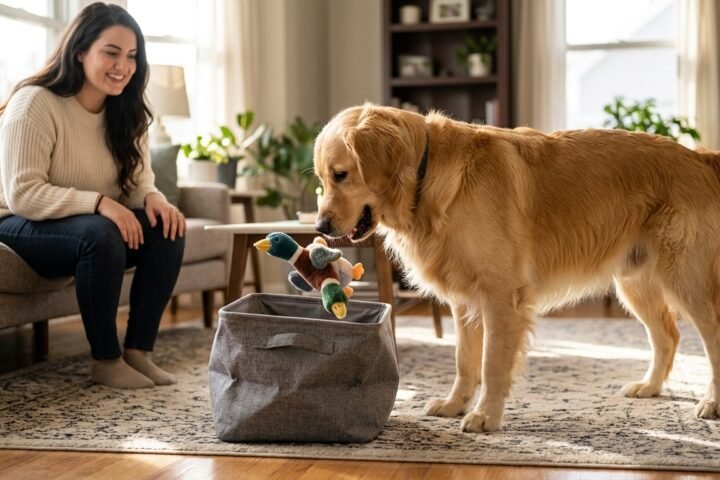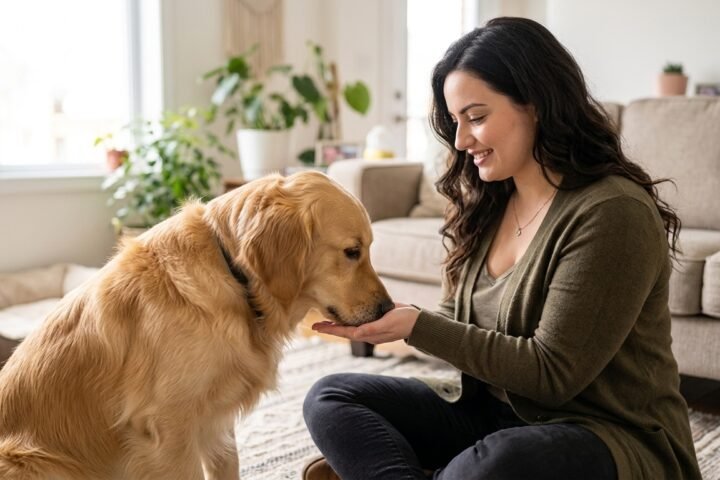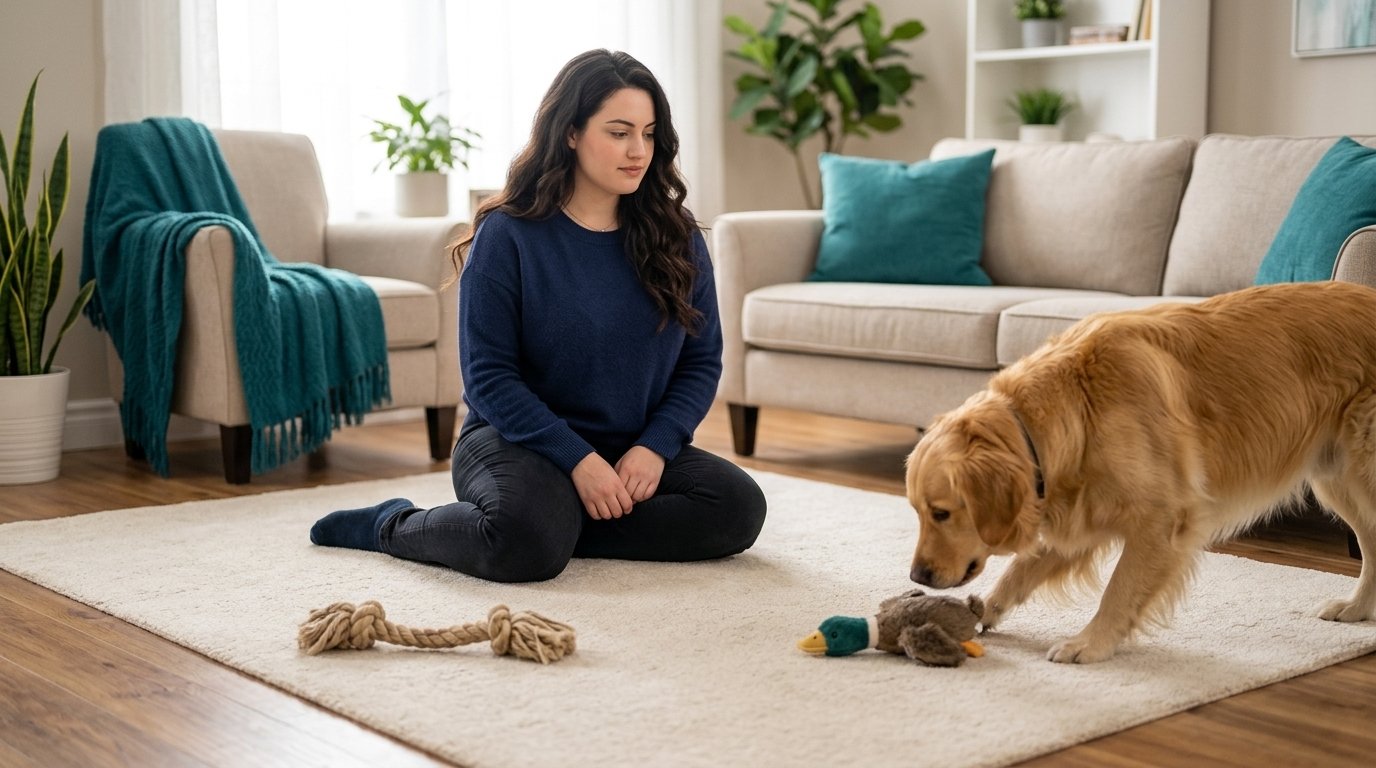
Teaching dog toy names starts with a simple association: one familiar toy, one consistent word, and a reward for interacting with the right object. Once your dog can select that toy reliably, you can practice finding it in easy hiding places. Returning it to your hand is an optional additional skill.
The useful goal is modest: when a favorite toy goes missing in a familiar room, your dog may be able to help locate it. This takes practice, and learning several object names is genuinely difficult for many dogs. A happy one-toy search game still counts as success.
Start with a toy you can see and a task your dog can understand. Build toward the missing-toy moment gradually, rather than turning the first session into a search around the entire house.
Table of Contents
Can Dogs Learn Toy Names and Find a Missing Toy?
Some dogs can learn spoken labels for individual objects. However, understanding dog toy names is different from responding to a familiar routine, following a pointing hand, or grabbing whichever toy looks most exciting.
Research from Eötvös Loránd University found that learning multiple toy labels was challenging for most dogs in a controlled training study, while a small group learned them readily. Those unusually skilled dogs should not become the standard for your pet.
A dog who struggles with this game is not necessarily inattentive or poorly trained. Object-label learning asks a different question from familiar actions such as sitting or coming when called.
Separate the three parts of the task
Think about what you actually want your dog to do:
- Recognize: choose Duck rather than Rope when both are available.
- Search: locate Duck when it is no longer immediately visible.
- Retrieve: carry Duck back and release it voluntarily.
A dog can search enthusiastically without distinguishing two names. Another can identify a toy but prefer to leave it on the floor. Train the part that is missing instead of repeating the whole request more loudly.
For example, if your dog touches Duck correctly but walks away, identification may be developing while carrying is not. If your dog retrieves Rope every time, enthusiasm is strong but the spoken label may not yet control the choice.
Learning dog toy names also does not guarantee that your dog can recover a toy lost outdoors, under heavy furniture, or in an unfamiliar building. Keep early goals inside a small, safe area where you know the toy is available.
Choose Clear Dog Toy Names and a Safe Setup
Choose a familiar, intact dog toy that your pet enjoys investigating. It should be easy to notice and appropriate for your dog’s size. A dog who prefers nose touches does not need a toy that fits comfortably in the mouth, but it must still be safe to interact with.
Avoid starting with socks, keys, children’s toys, or anything you do not want your dog collecting later. Remove damaged items and pieces that could be swallowed. Practice with one dog at a time so nobody has to compete for the object or reward.
Make the labels easy for everyone to remember
Useful dog toy names are consistent and clearly different from each other. “Duck” and “Rope” are easier for a household to keep distinct than “Ball,” “Small Ball,” and “Blue Ball.” There is no need to invent an elaborate vocabulary.
Write your chosen dog toy names where family members can see them. If one person says “Duck” and another says “Quackers,” settle on one word during teaching. Later variations are unnecessary for this task.
Use the name for one specific object initially. Calling every round toy “Ball” adds a category-learning challenge that you do not need yet.
Prepare rewards and a quiet space
Use a nonslip floor, remove distracting toys, and keep rewards ready without holding food over the target. Food positioned beside the correct toy can make it unclear what your dog is following.
The American Veterinary Society of Animal Behavior’s humane training guidance recommends reward-based methods. There is no reason to scold, pull, or physically position a dog for a toy game.
Choose tiny treats your dog already tolerates. VCA’s guidance on training treats recommends keeping treats within 10% of daily calories; suitable portions of the regular food ration can also be used. Follow your veterinarian’s dietary instructions if your dog has a prescribed diet.
Teach One Toy Name Before Adding Choices
Begin with Duck alone. Your immediate aim is a relaxed, repeatable response to that object, not a perfect fetch.
- Place Duck within easy reach on the floor.
- When your dog voluntarily looks toward or approaches it, acknowledge that interest and reward.
- Gradually reward a clearer response, such as touching the toy with the nose.
- Once that response is predictable, say “Duck” just before it happens.
- Mark the touch and give the reward promptly.
- Reset calmly and offer another easy opportunity.
A marker can be a click or a short word such as “yes.” First make sure your dog understands that it predicts a reward. VCA explains how clicker and target training can identify the precise action being rewarded and build a behavior in small increments.
Use the same response criterion within a short practice block. If one touch earns a reward and the next suddenly requires a full retrieve, your dog has to guess what changed.
Move the spoken cue earlier
As the association develops, say the name before your dog starts moving toward the toy. Wait quietly for a response. Reward the intended interaction, then reset.
If your dog does nothing, the word may not yet mean much. Make the setup easier rather than saying “Duck, Duck, Duck.” A closer placement or a brief return to the previous exercise is more informative than louder repetition.
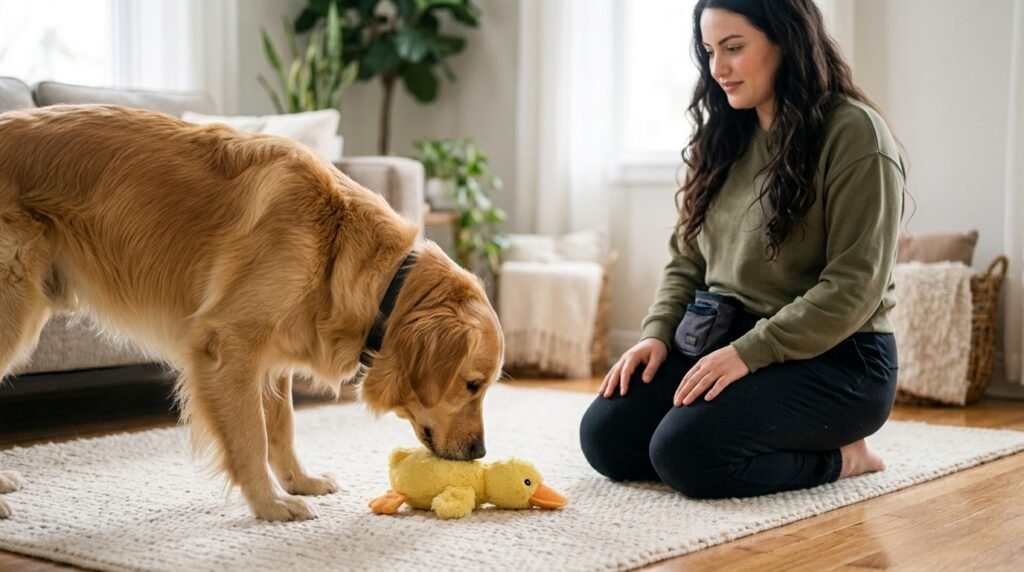
This first stage introduces dog toy names, but one available object cannot prove name discrimination. Your dog might simply have learned that touching the only toy earns food. That is a useful foundation, not a finished vocabulary test.
Keep notes about the actual behavior: “touched Duck without pointing” tells you more than “understands everything.” If play makes your dog too excited to pause, try quieter rewards or a less stimulating toy.
Check Whether Your Dog Recognizes Two Different Names
Expand your dog toy names practice by teaching Rope separately using the same general approach. Put Duck away during those introductory lessons so your dog has a clear opportunity to interact with the new object.
When both individual responses are comfortable, place the toys several feet apart and stand centrally. Ask for one name in an ordinary voice. Reward the first clear selection when it matches your request.
The AKC’s toy-name training guide also describes progressing from individual toys to choices between named toys. Its relevance here is the specific training task; it is included as an editorially useful source, not simply because it was supplied as a competitor.
Remove clues that can hide confusion
To check dog toy names more carefully, vary both the requested object and its location. Keep your hands still, face the middle of the setup, and avoid leaning toward the answer.
Do not ask for Duck five times and then assume one successful Rope choice proves both labels. Equally, avoid a perfectly alternating sequence that might become its own clue.
A sample request order could be Duck, Rope, Rope, Duck, Rope, with positions rearranged between trials. That sequence is an example, not a required test. On another day, use a different order.
For household practice, you might wait until roughly four of five first choices are correct across several short sessions before adding difficulty. This is a convenient teaching checkpoint, not scientific proof of language understanding. Five trials alone are too few to establish a reliable ability.
Track your dog toy names separately in the practice log. A dog who gets Duck right every time and Rope wrong every time needs more help with the distinction, even if some sessions look successful.
What to do after a wrong choice
Stay neutral. Do not punish the selection or keep repeating the cue while your dog cycles through every object. Reset with an easier arrangement, or return to separate practice with the less familiar toy.
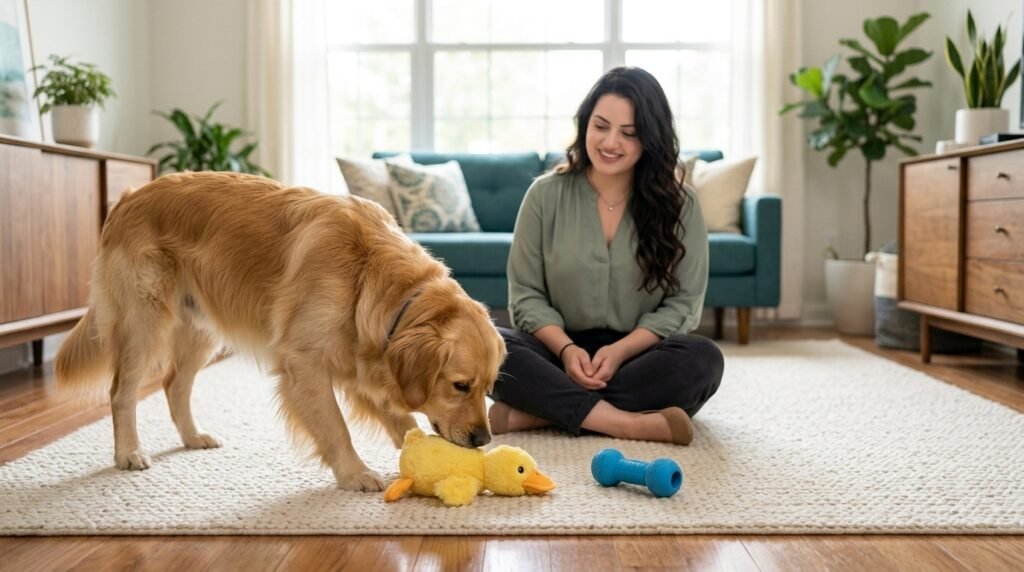
If you help by indicating the correct object, reward the learning moment but record it as assisted. Assistance is useful teaching; it simply should not be counted as an independent correct choice.
Reliable responses to dog toy names should survive small changes in position. Until then, maintain the easy setup and leave hidden searches for another session.
Turn Recognition Into a Gentle Find-It Game
Now build the search component with one known toy. Begin close enough that your dog can succeed without guessing which room to investigate.
If you are still working on dog toy names, you can play a general one-toy searching game separately. Just describe it accurately: finding a familiar object is enjoyable even when name discrimination has not been established.
Start with a visible placement
Set Duck on an open patch of floor while your dog watches. Return to your starting spot and say “Find Duck” once. Let your dog approach, then reward the response you have chosen, such as a nose touch.
Use a helper or a comfortable barrier while placing the toy if needed. A reliable stay can be convenient, and PawMindTips’ guide to teaching a dog to stay explains that foundation. However, a stay is not a prerequisite, and a broken stay should not turn this game into a confrontation.
Change one feature of the search
Once visible placements are easy, try the following progression at your dog’s pace:
| Search setup | What changes | Keep easy |
|---|---|---|
| Toy visible near your starting point | Introduce the search phrase | One toy, quiet room |
| Toy beside an open doorway | Approach a new position | Short distance, visible toy |
| Toy partly behind a stable object | Slightly reduce visibility | Dog watches placement |
| Toy out of immediate view nearby | Search beyond the first glance | Same familiar room |
| Easy placement made out of sight | Reduce reliance on watching | Very small search area |
These are suggested household arrangements. Skip any location that encourages climbing, squeezing, scratching furniture, or reaching near cords. Do not hide objects inside operating appliances or anywhere your dog could become trapped.
After an easy find, allow a short reward break. Do not immediately make every repetition harder. Mixing familiar successes with small new challenges keeps the task understandable.
Move from staged searches to a misplaced toy
Before asking for a genuinely missing item, check the likely search area yourself. Close access to unsafe rooms and confirm that your dog will not need to move furniture.
Give the familiar cue and observe. If your dog locates Duck but cannot reach it safely, go to the location and retrieve it yourself. Rewarding an indication is more useful than insisting on an impossible carry.
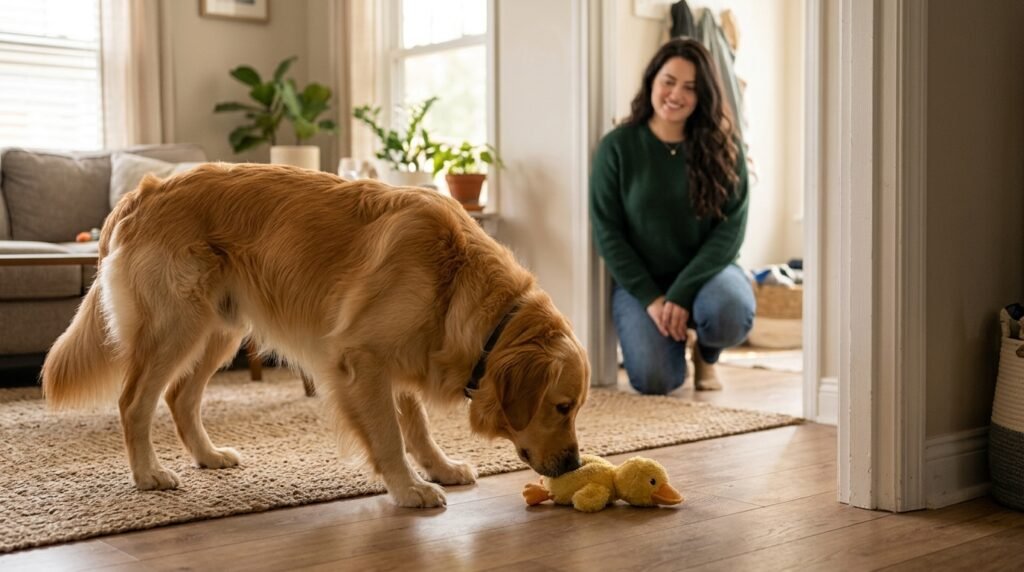
If the search becomes aimless, stop and help. Avoid repeatedly sending your dog through the same empty room. Reset later with a toy whose location you know.
Dog toy names make the request more specific only when the label has been learned. A search that follows pointing or remembered placement can still be fun, but it should not be mistaken for independent recognition.
Add Returning the Toy as a Separate Skill
Once your dog finds the toy, decide whether carrying it back matters. For many households, a nose touch or a pause beside the object is enough to show where it is.
If you want a retrieve, practice it close to you before combining it with a search. Reward a voluntary pickup, then a small movement toward you while holding the toy. Increase the distance only when those pieces are comfortable.
Keep this practice distinct from work on dog toy names. Otherwise, a dog who selects correctly may lose rewards because a separate carrying skill is unfinished.
Make giving up the toy worthwhile
Use a voluntary exchange. Offer a suitable reward and accept the toy when your dog releases it; do not pry the mouth open. Returning the toy for another brief game can help prevent every handover from predicting the end of fun.
AVSAB’s discussion of using natural activities as rewards explains why a preferred activity can reinforce another behavior. For a dog who enjoys gentle toy play, the next round may be part of the payoff.
If your dog runs away with the object, reduce the distance and reconsider what happens when they approach you. Chasing can accidentally make keeping the toy more entertaining than bringing it back.
PawMindTips’ guide to habits that can damage a dog’s trust offers related guidance on avoiding intimidating interactions. A toy lesson should feel predictable and safe.
If your dog freezes, stiffens, growls, or guards the toy, stop approaching or reaching for it. Give space and seek qualified reward-based behavior support before continuing exchange games. Training should never require risking a bite.

Troubleshoot Mistakes and Use a Flexible Practice Plan
When progress stalls, identify the smallest part that is difficult. Changing several things at once makes it harder to tell whether the problem is the label, the search, the environment, or the return.
Common problems and useful adjustments
| What happens | Possible explanation | Try next |
|---|---|---|
| Your dog always takes the left toy | Position is influencing the choice | Rearrange positions and keep your own stance neutral |
| The favorite toy wins every time | Preference outweighs the label | Revisit separate name practice; use less unequal toy choices |
| Your dog watches your hands | Food or gestures may be the main cue | Keep food out of sight until after the marker |
| Your dog touches every toy rapidly | The choice task is unclear | Reset after one choice and make the next repetition easier |
| Your dog finds the toy but leaves it | Carrying has not been taught | Reward the find; practice retrieving separately if wanted |
| The game works in one room only | The setting may be part of the learned routine | Return to very easy trials in the new room |
Track progress without turning play into an exam
Use a short note containing the requested label, toy positions, first choice, assistance, and your dog’s willingness to continue. Record errors as information, not a score your dog must defend.
For example: “Duck requested; Duck on right; Rope chosen first; no pointing; relaxed.” The next session can address that distinction instead of introducing a third object.
When teaching dog toy names, compare performance across days rather than expecting steady improvement within every session. A busier house, a new training spot, or lower interest in food can change the experience.
A practical session structure
Try one easy warm-up, a few repetitions of the current skill, and a relaxed finish. One or two minutes may be plenty initially. End sooner if your dog disengages; there is no minimum number of trials to complete.
Move through stages by readiness, not by calendar:
- Establish comfortable interaction with one toy.
- Introduce its label and practice a second toy separately.
- Check first choices between two visible objects.
- Build easy searches using a familiar toy.
- Add returning and releasing only if useful.
Avoid squeezing the entire progression into a single weekend. Some dogs will remain at one stage, and that is acceptable. Dog toy names are an optional enrichment challenge, not a basic obedience requirement.
Repeated turning away, retreating, or tense behavior means the session needs a pause. Consider the whole situation rather than diagnosing stress from one isolated gesture. PawMindTips’ guide to recognizing signs of a stressed dog can help you notice when the activity has stopped being comfortable.
If picking up a toy suddenly seems uncomfortable, or a previously easy activity changes noticeably, stop and discuss the change with your veterinarian. Do not try to train through apparent pain.
Frequently Asked Questions
How long does it take to teach dog toy names?
There is no reliable deadline. A dog may enjoy a single-toy routine quickly while still struggling to distinguish two spoken labels. Allow repeated short sessions and judge progress by relaxed, independent choices. Some dogs never develop reliable name discrimination, even with practice.
Can an older dog learn to find a toy by name?
An older dog can participate in an adapted version, but success with dog toy names varies individually. Use comfortable footing, accessible locations, and brief sessions. A nose touch can replace carrying. Account for hearing, vision, and mobility changes when choosing the task.
What if my dog finds the toy but will not bring it back?
Reward locating it if that was the current goal. Retrieving requires additional skills, including pickup, carrying, approaching you, and releasing. Practice those separately at close range, or let your dog indicate the toy while you collect it. Do not chase or force a handover.
Should I hide treats with the toy to help my dog find it?
For this exercise, keep the reward with you. Food hidden beside the toy may turn the task into finding food instead of finding the requested object. Separate treat-search games are fine, but they do not establish recognition of a toy’s spoken name.
Conclusion: Make the Next Search Easy
Start dog toy names training with one familiar object, a consistent label, and a response your dog offers comfortably. Check visible choices before making searches harder, and teach returning the toy separately if you want that extra step.
Your next session can be as simple as a few rewarding interactions with Duck on the living-room floor. Keep the environment safe, help when needed, and let your dog’s enjoyment determine how far the game goes.