Dog treat calories can quietly turn a balanced feeding plan into an oversized daily menu. A biscuit after breakfast, cheese during medication, rewards on a walk, and a dental chew at night may each seem small, but together they can contribute meaningful energy. For most healthy dogs, a practical starting point is to keep all treats and extras within 10% of total daily calories while reserving at least 90% for a complete and balanced food.
That guideline is simple; applying it is not always simple. Your dog’s ideal allowance depends on body size, age, activity, reproductive status, current body condition, and health. This guide shows you how to create a realistic treat budget, decode package labels, and make rewards last without unintentionally overfeeding your dog.
Table of Contents
Why Dog Treat Calories Matter More Than Treat Count
There is no universal safe number of treats per day. One tiny training morsel may contain fewer than two calories, while a large biscuit, chew, spoonful of peanut butter, or piece of cheese may contain dozens. Telling an owner to give “three treats” means very little unless the size and energy content are known.
Calories also come from more places than products labeled as treats. Count every extra your dog consumes, including:
- Training rewards
- Dental chews
- Edible bones and long-lasting chews
- Food used to hide medication
- Table scraps
- Lick-mat ingredients
- Stuffed-toy fillings
- Supplements that provide calories
- Food offered by family members, visitors, or dog walkers
Commercial dog foods labeled complete and balanced are designed to supply essential nutrients in suitable proportions. Most treats are intended for intermittent or supplemental feeding, not as the nutritional foundation of the diet. If extras crowd out too much regular food, the problem is not only excess energy; the overall diet can also become nutritionally unbalanced.
Weight gain often happens gradually, making small daily excesses easy to overlook. The Association for Pet Obesity Prevention’s clinical surveys have repeatedly highlighted excess weight as a common companion-animal concern. Tracking dog treat calories is more reliable than judging a reward by whether it looks small.
Use the 10% Rule as a Ceiling, Not a Goal
The widely used 10% rule means that treats and other non-complete foods should provide no more than about 10% of a dog’s total daily energy allowance. The American Kennel Club’s guidance on daily treats uses this approach and emphasizes that the dog’s regular food should provide the remaining 90%.
For a dog assigned 600 calories per day, the calculation is:
600 × 0.10 = 60 treat calories per day
That 60-calorie figure covers all extras combined. It does not mean 60 calories of packaged biscuits plus a dental chew plus food from the table.
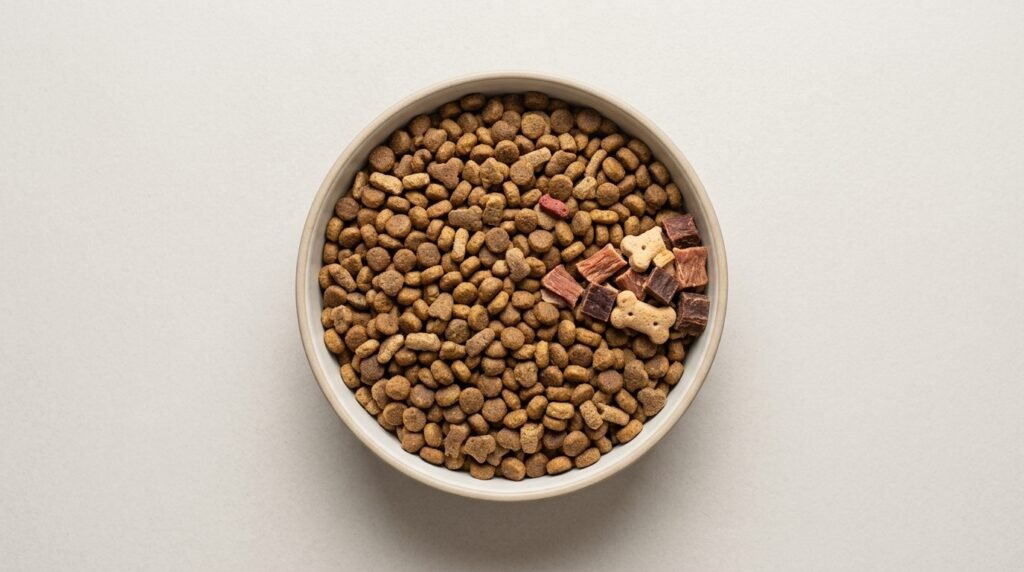
The rule is a maximum guideline rather than an invitation to use the entire allowance. A dog can receive fewer extras, and some dogs should. Dog treat calories may need to stay below 10% for animals on therapeutic diets, weight-loss plans, or tightly controlled nutrient plans; some may need only veterinarian-approved rewards.
Do not estimate a dog’s total daily calorie requirement from weight alone and treat the result as a prescription. Energy equations provide starting estimates, but individual needs vary. The WSAVA nutrition toolkit supports individualized nutritional assessment, including body condition, muscle condition, diet history, and life-stage factors. Your veterinarian can establish an appropriate target and adjust it using weight and body-condition trends.
How to Calculate Your Dog’s Daily Treat Budget
Follow this four-step process to manage dog treat calories without guesswork.
Step 1: Establish the total daily calorie target
The most accurate practical source is your veterinarian, particularly if your dog is a puppy, senior, underweight, overweight, pregnant, highly athletic, or managing a disease. Feeding directions on a bag are starting estimates and may not match an individual dog’s needs. You cannot set an appropriate dog treat calories allowance until this target is reasonably established.
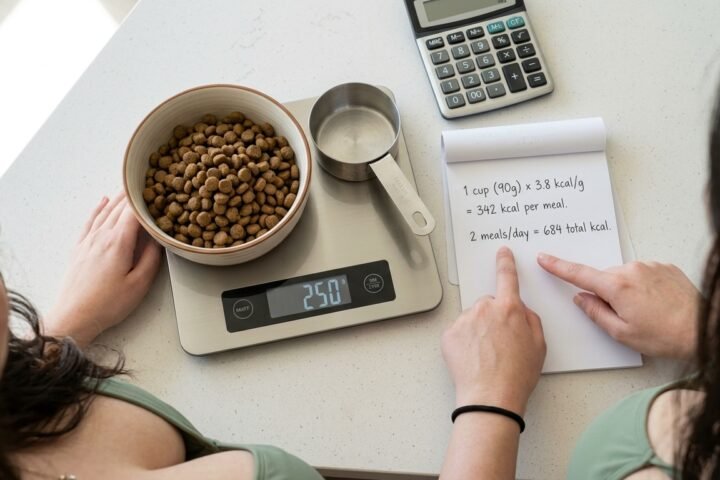
If your dog maintains an ideal body condition on a carefully measured amount, you can discuss that current intake with your veterinary team. Keep in mind that cups are less precise than grams because kibble shape and scoop technique affect volume.
Step 2: Multiply the daily target by 0.10
Use this formula:
Daily calorie target × 0.10 = maximum calories from all treats and extras
If a dog’s target is 400 calories, the upper treat budget is 40 calories. If the target is 1,000 calories, it is 100 calories. A smaller dog has much less room for error, so breaking rewards into tiny pieces is especially valuable.
Step 3: Subtract every planned extra
Start with the largest or least flexible item. If a 400-calorie dog receives a 25-calorie dental chew, only 15 calories remain in a 40-calorie treat budget. Medication food and training rewards must fit inside that remainder. Recording dog treat calories in one daily total prevents separate extras from being overlooked.
Step 4: Divide by calories per treat
If the remaining allowance is 15 calories and each training reward contains three calories:
15 ÷ 3 = 5 treats
Treats do not need to be served whole unless the product cannot be safely divided. Dogs generally value the immediate reward and repetition more than the physical size of each piece. Breaking a soft treat into four parts turns one 12-calorie treat into four three-calorie rewards.
How to Read and Calculate Calories on Treat Labels
Look for a calorie-content statement, often expressed as kilocalories, or kcal. In pet-food labeling, one kcal is the unit owners commonly call one food calorie. The statement may list energy per piece, per cup, per can, per package, or per kilogram.
The easiest label says 3 kcal per treat. Multiply three by the number served. Ten treats would supply 30 calories.
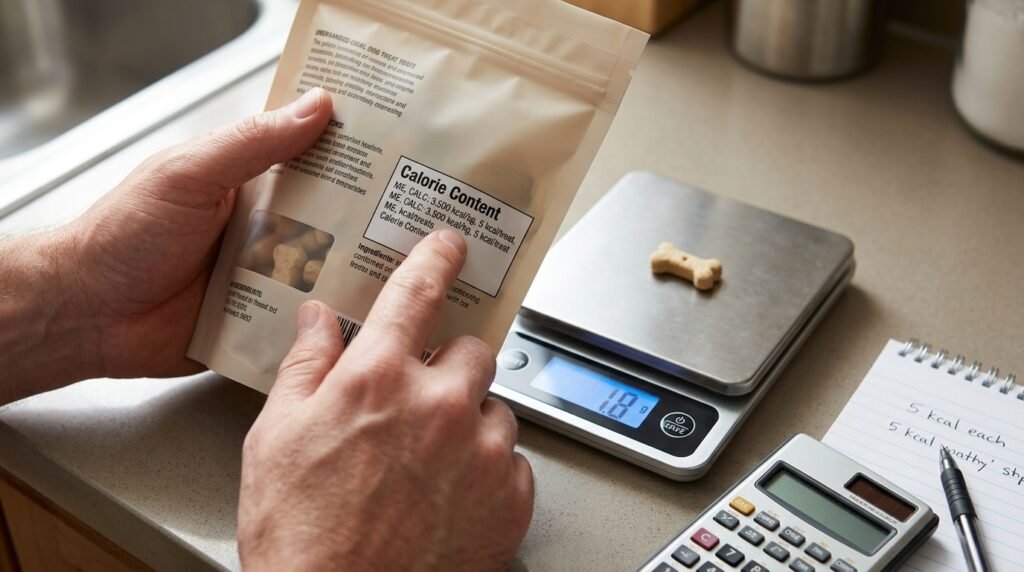
If a label gives calories per ounce, weigh the portion in ounces and multiply. If it gives only kcal per kilogram, use a kitchen scale and this formula to calculate dog treat calories:
kcal/kg ÷ 1,000 = kcal per gram
Then:
kcal per gram × treat weight in grams = calories per treat
Example: A product supplies 3,200 kcal/kg, and one piece weighs 5 grams.
- 3,200 ÷ 1,000 = 3.2 kcal per gram
- 3.2 × 5 = 16 calories per piece
If the package does not provide enough information, contact the manufacturer rather than relying on an online estimate for a different product. The FDA explains required pet-food labeling elements in its overview of pet food labels. Recipes and manufacturing can change, so check the package currently in your hand.
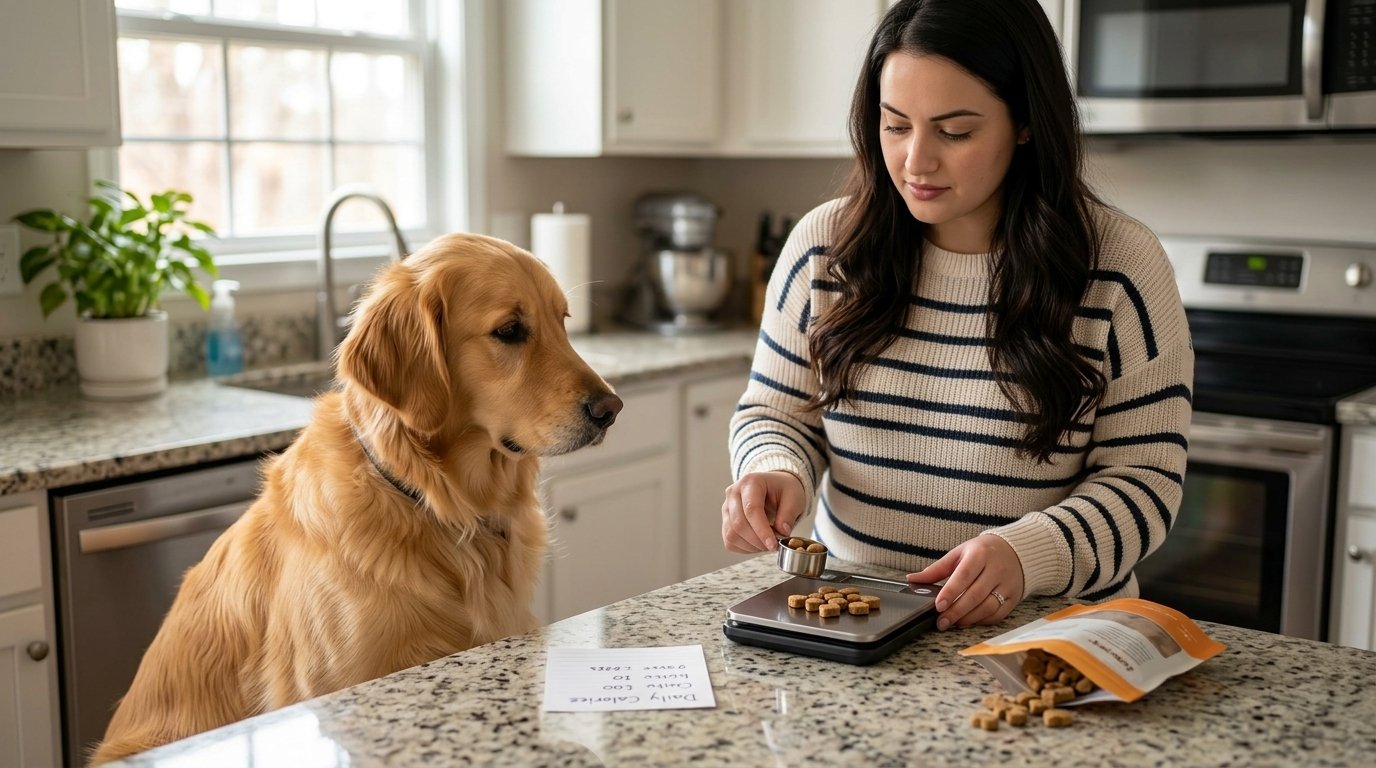
For irregular chews, weigh the amount before offering it and weigh any uneaten remainder afterward. The difference is the amount consumed. This is more accurate than assuming your dog finished the entire chew.
Daily Dog Treat Calories: Practical Examples
The following examples demonstrate the math; they are not feeding prescriptions. The total daily targets are hypothetical, and your dog’s correct target may be different.
| Example daily target | 10% maximum for extras | Example use of the budget |
|---|---|---|
| 250 kcal | 25 kcal | 20 kcal dental chew + five 1-kcal rewards |
| 400 kcal | 40 kcal | Twenty 2-kcal training rewards |
| 600 kcal | 60 kcal | 30 kcal chew + fifteen 2-kcal rewards |
| 900 kcal | 90 kcal | Thirty 3-kcal rewards |
| 1,200 kcal | 120 kcal | 60 kcal enrichment filling + thirty 2-kcal rewards |
These examples show why the same product affects dogs differently. A 30-calorie chew consumes most or all of a small dog’s allowance but only one-quarter of the example budget for a larger dog. Dog treat calories must be compared with the individual’s allowance, not another dog’s treat count.
Do not automatically remove an equal number of calories from complete food every time treats run high. Occasional substitution may be appropriate under professional guidance, but repeatedly cutting balanced meals to make space for nutritionally incomplete extras can dilute essential nutrients. A better routine is to plan rewards first, use some measured kibble for training, or choose smaller treats.
Keep Training Effective Without Calorie Overload
Training can require dozens of repetitions, so reward design matters more than an arbitrary treat count. The goal is a reward your dog values, delivered quickly, in the smallest effective amount. Planning dog treat calories before a session makes many repetitions possible. Purina’s guidance on using treats for training likewise recommends small portions and accounting for treats within daily feeding.
Use these strategies:
- Reserve part of the meal. Weigh the full daily food first, then transfer a portion into a training pouch. Kibble used this way is already part of the main calorie allowance.
- Cut rewards before the session. Pea-sized or smaller pieces make one treat last across several repetitions.
- Match value to difficulty. Use ordinary kibble for easy behaviors at home and higher-value food for distractions, recall, grooming, or veterinary handling.
- Mix food with nonfood rewards. Praise, sniff breaks, toys, access to the yard, and permission to greet can reinforce behavior when the dog values them.
- Track as you go. Put the day’s entire allowance in one container each morning. When it is empty, the food rewards are finished.
- Choose lower-calorie products for repetition. Compare calories per piece, not marketing words such as “natural” or “healthy.”

For safety, rewards should be small enough to swallow comfortably and suitable for the dog’s chewing style. Supervise chews, and avoid pieces that are extremely hard, prone to splintering, or small enough to become a choking hazard.
Choosing Treats That Fit the Calorie Budget
The best treat is not defined by a single ingredient or front-of-package claim. It must be safe for the individual dog, useful for its purpose, and easy to portion within the daily limit. Compare dog treat calories alongside ingredient suitability rather than treating either factor as the whole answer.
When comparing products, consider:
- Calories per piece or per gram
- Treat size and whether it can be divided cleanly
- Fat content, especially for a dog with a history of pancreatitis
- Sodium and other nutrients if a therapeutic diet restricts them
- Ingredient compatibility with confirmed food allergies
- Texture appropriate for the dog’s teeth and chewing habits
- Whether the product is intended only for intermittent or supplemental feeding
Small portions of dog-safe whole foods can sometimes work as rewards, but “human food” is not automatically low-calorie or safe. Review foods dogs should not eat before sharing from your kitchen. Avoid grapes, raisins, chocolate, xylitol-containing products, onions, garlic, alcohol, and other known hazards. The ASPCA Animal Poison Control toxic-food guide provides a useful safety reference.
Ingredient quality and calorie density are separate questions. A treat made from recognizable ingredients can still be high in fat and calories. Likewise, concerns about dog food fillers and ingredient lists should not replace evaluation of the complete nutrient profile, serving size, and role of the product in the whole diet.
Dogs That Need an Individualized Treat Limit
General dog treat calories guidelines are least reliable when nutrition is part of medical care. Ask your veterinarian before changing extras if your dog has obesity, diabetes, pancreatitis, kidney disease, heart disease, gastrointestinal disease, urinary disease, a suspected food allergy, or another condition managed through diet.
Therapeutic diets work only when the entire intake supports the plan. A seemingly harmless chew can introduce an excluded protein, add substantial fat or sodium, or weaken a controlled nutrient profile. In some cases, the safest reward is a portion of the prescribed food. Your veterinary team may also approve a compatible prescription treat.
Puppies need particular care because growth requires balanced mineral and nutrient intake. Treats should not displace a meaningful share of a complete growth diet. Senior dogs may need fewer calories as activity and lean body mass change, although age alone does not determine an allowance. Highly active working dogs may need more energy, but their plans should still prioritize complete nutrition rather than simply increasing snacks.
For an overweight dog, do not use an online maintenance estimate as a weight-loss prescription. The AAHA nutrition and weight-management resources emphasize nutritional assessment and monitoring. Safe weight loss requires an appropriate calorie target, adequate nutrients, and follow-up adjustments.
Signs Your Current Treat Budget Needs Adjustment
Even careful calculations are starting points. Monitor the dog in front of you. Revisit the plan if you notice:
- Gradual weight gain or loss
- Ribs becoming much harder or easier to feel
- Loss of a visible waist when viewed from above
- Reduced muscle over the back, hips, or head
- Frequent soft stool, vomiting, gas, or itching after a new treat
- Reduced appetite for regular meals
- Family members regularly exceeding the shared allowance
- A change in activity, medication, health, or life stage
The WSAVA body condition score chart for dogs can help owners discuss body condition with a veterinary professional, but it does not replace an examination. Weigh small dogs on a suitable scale when possible, and record results consistently. For larger dogs, your veterinary clinic may allow periodic scale checks.
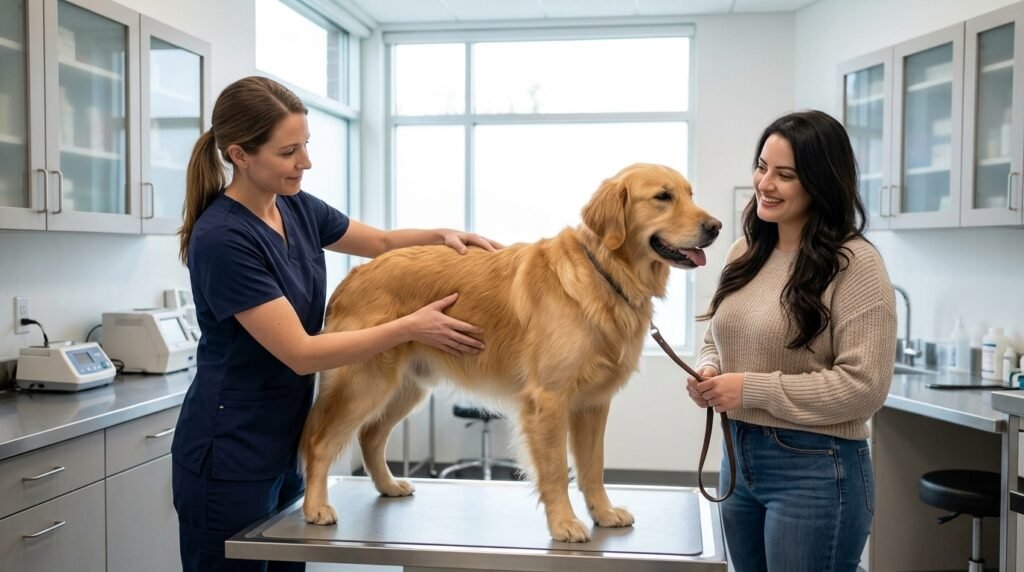
A simple household log can uncover the cause of unexpected changes. Record the product, dog treat calories per piece, number given, and person giving it. Include weekend outings and food offered during cooking. Review the total weekly rather than focusing only on a single unusually active day.
FAQs
How many calories from treats can my dog have per day?
For many healthy dogs, treats and extras should stay within 10% of a veterinarian-approved total daily calorie target. Multiply that target by 0.10, then count every reward, chew, table scrap, and calorie-containing extra within the result. Some dogs need a lower or specially designed allowance.
Should I subtract treats from my dog’s regular food?
Plan all calories together, but do not routinely replace large portions of complete food with nutritionally incomplete treats. Using measured kibble as rewards is often the simplest option. If significant meal adjustment is needed, ask your veterinarian how to preserve nutritional balance.
Are low-calorie treats always healthy for dogs?
No. A low calorie count does not prove that a treat is appropriate for your dog’s allergies, medical needs, teeth, or chewing behavior. Review calories, ingredients, nutrient restrictions, portion size, and physical safety together.
What if the package does not list calories per treat?
Look for kcal per kilogram or per unit. Divide kcal/kg by 1,000 to get calories per gram, weigh one treat, and multiply. If the label lacks enough information or the serving is unclear, contact the manufacturer before making it a routine reward.
Conclusion
Managing dog treat calories does not mean removing the fun from training or bonding. It means giving every extra a place in the day’s plan. Begin with a veterinarian-approved calorie target, treat 10% as the upper limit for all extras combined, check calories per piece or gram, and use tiny rewards or measured kibble when repetition matters.
Monitor weight and body condition instead of assuming the first calculation will remain correct forever. If your dog is growing, overweight, on a therapeutic diet, or living with a medical condition, ask your veterinarian to personalize both the daily calorie target and the reward list.