Successful dog weight loss is not about suddenly cutting a dog’s food in half or pushing an out-of-shape dog through exhausting workouts. A safer approach starts by finding out how much weight your dog actually needs to lose, setting an individualized calorie target, measuring everything they eat, and monitoring how their body responds.
That matters because two overweight dogs of the same weight can have very different needs. Age, body condition, muscle mass, activity, neuter status, medical conditions, medications, and mobility can all influence an appropriate weight-management plan.
The goal is therefore not simply to make the number on the scale drop. It is to help your dog gradually reach a healthier body condition while preserving nutrition, muscle, comfort, and quality of life.
Here is how to build a structured plan with your veterinary team.
Table of Contents
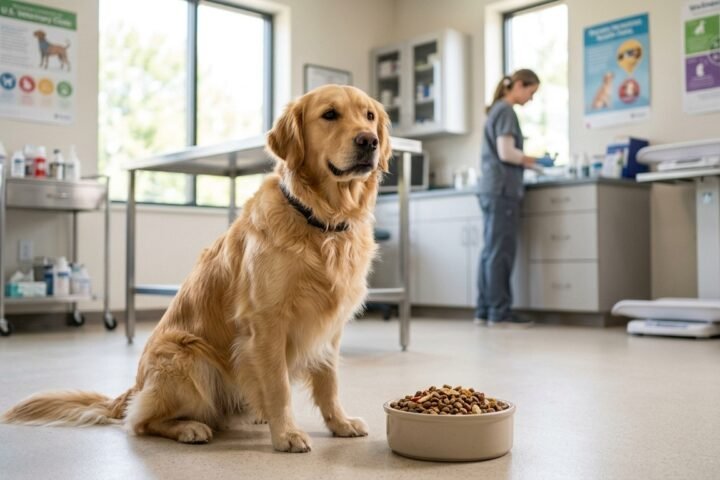
1. Start Dog Weight Loss With a Veterinary Assessment
Before reducing calories, establish a reliable starting point.
A dog’s scale weight alone does not tell you whether that weight is appropriate. A naturally large-framed dog and a smaller-framed dog of the same breed may have different ideal weights.
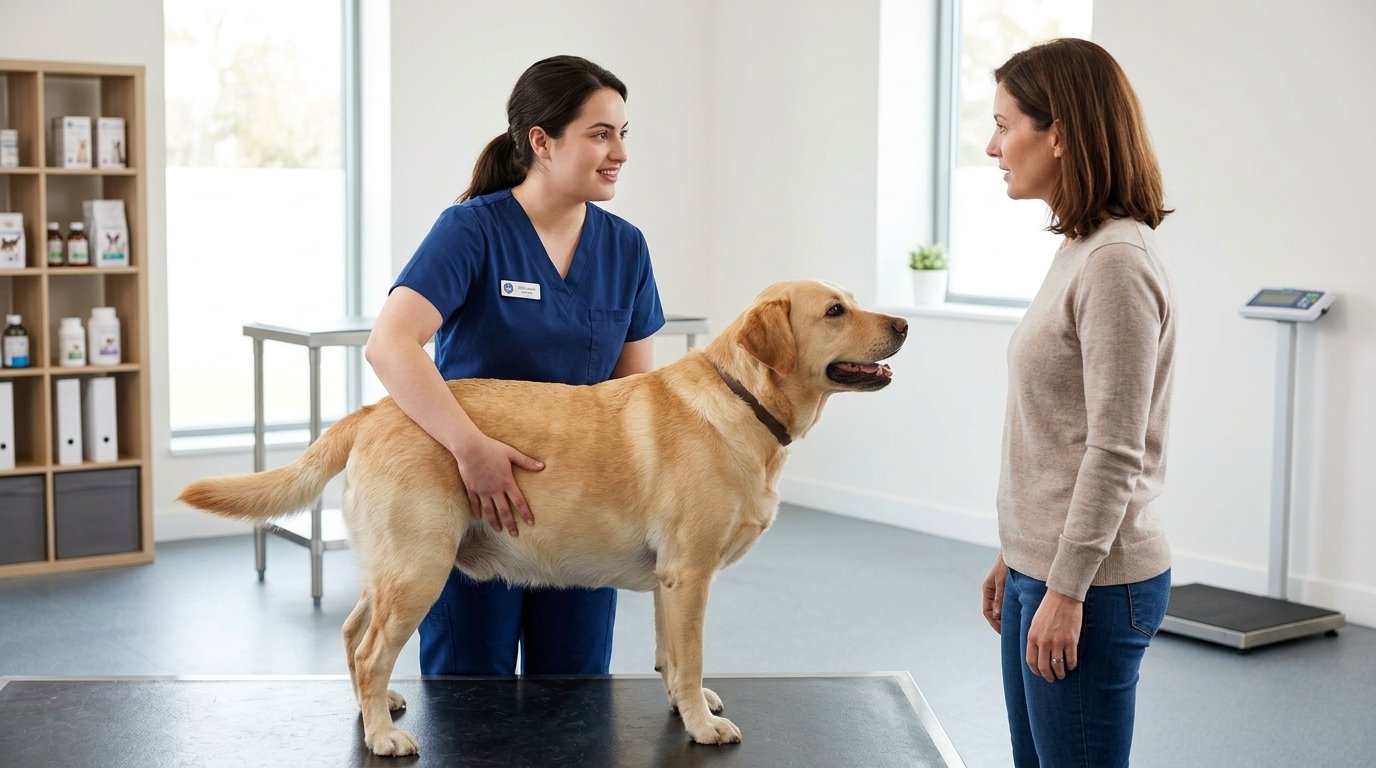
Veterinarians commonly use a body condition score (BCS) along with body weight and physical examination. On the commonly used nine-point scale, an ideal body condition is generally around 4–5 out of 9. Your veterinarian may also consider muscle condition because an overweight dog can still have inadequate muscle mass.
At an ideal condition, the ribs should generally be easy to feel without a heavy layer of fat, a waist should be visible from above, and an abdominal tuck should be apparent from the side.
These observations are useful at home, but they should not replace a professional assessment when you are planning intentional weight reduction.
Establish a baseline
At the initial appointment, ask your veterinarian about:
- Current weight
- Body condition score
- Muscle condition
- Estimated target weight
- Current diet and calorie intake
- Appropriate daily calorie target
- Treat allowance
- Suitable activity
- Recheck schedule
Bring an honest diet history too.
Write down everything your dog normally consumes over several days—not only breakfast and dinner.
Include:
- Dry or wet food
- Treats
- Dental chews
- Training rewards
- Food used in puzzle toys
- Toppers
- Supplements that contain calories
- Peanut butter or other foods used with medications
- Table scraps
- Food given by other family members
Small extras are easy to forget, but collectively they can make a meaningful difference.
Why a veterinary assessment matters
Most excess weight results from an ongoing mismatch between calories consumed and energy used, but that does not mean every weight problem should automatically be treated by feeding less.
Health problems, pain, reduced mobility, certain medications, and endocrine disorders can sometimes contribute to weight gain or make weight reduction harder. Cornell notes that conditions including hypothyroidism and Cushing’s disease can play a role in some dogs.
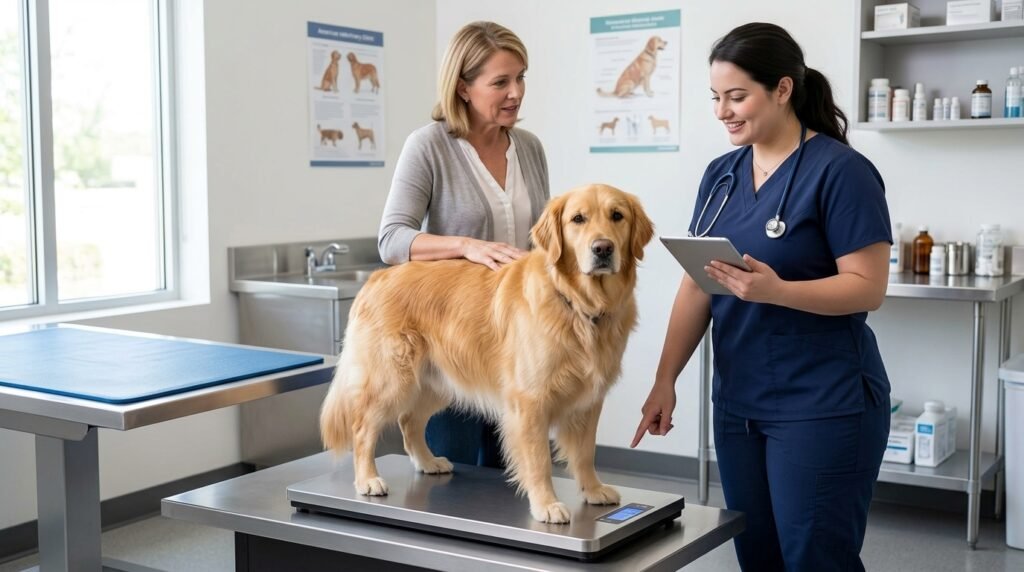
If weight gain has been unexplained, your dog has other symptoms, or a carefully followed plan produces little progress, veterinary reassessment becomes particularly important.
2. Set a Daily Calorie Target With Your Veterinarian
Once you know the starting body condition and target weight, the next step in dog weight loss is creating a daily calorie budget.
This is more useful than simply deciding to feed “20% less” or removing an arbitrary scoop of kibble.
Your dog’s calorie target needs to account for the individual dog and the intended rate of weight reduction. AAHA’s weight-management guidance specifically emphasizes calculating weight-loss energy requirements around ideal weight and then adjusting according to the individual patient’s response and lifestyle.
Your veterinarian can convert that calorie target into an actual amount of the food you use.
For example, the useful question is not:
“How many cups should an overweight dog eat?”
It is:
“How many calories should this dog receive, and how many grams or measured portions of this food provide those calories?”
Food energy density varies considerably. A cup of one food may contain a very different number of calories from a cup of another.
Do not create a crash diet
Avoid making a dramatic reduction simply because you want faster results.
Rapid or excessive restriction is not the objective. Veterinary guidance emphasizes gradual, monitored weight reduction rather than starvation or aggressive dieting.
There is another reason not to keep shrinking the portion indefinitely.
If a dog needs substantial calorie restriction, simply feeding much less of a regular maintenance food may not always be the most nutritionally appropriate strategy. Cornell notes that some dogs do better on a diet specifically formulated for weight reduction because it can provide lower calorie density while still supplying appropriate nutrients.
That does not mean every overweight dog automatically needs prescription food.
It means food choice and calorie restriction should be considered together.
If you’re considering home-prepared meals during weight reduction, remember that familiar ingredients do not automatically create a nutritionally complete diet. PawMindTips’ guide to a homemade dog food recipe explains why long-term homemade diets should be appropriately formulated rather than improvised.
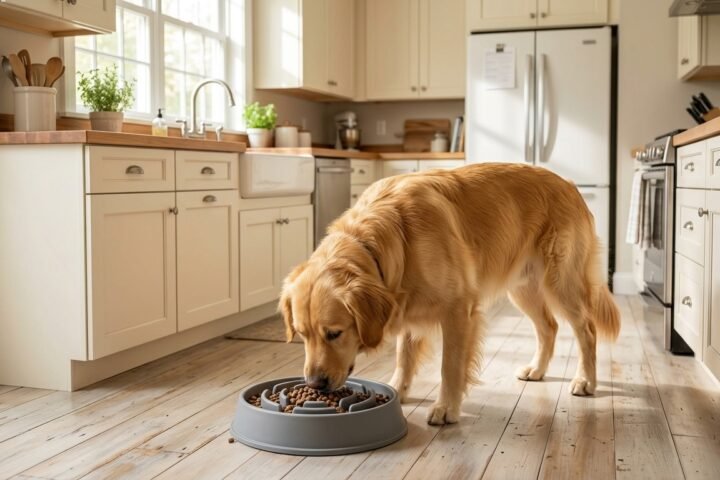
3. Measure Food Portions Accurately
Once your veterinarian gives you a daily amount, consistency becomes one of the most important parts of the plan.
“About a cup” is not the same as a controlled portion.
A rounded scoop today, a slightly bigger scoop tomorrow, and an extra handful on the weekend can make the actual calorie intake very different from the planned intake.
Cornell specifically recommends accurate measurement because heaping portions can introduce extra calories that interfere with weight reduction.
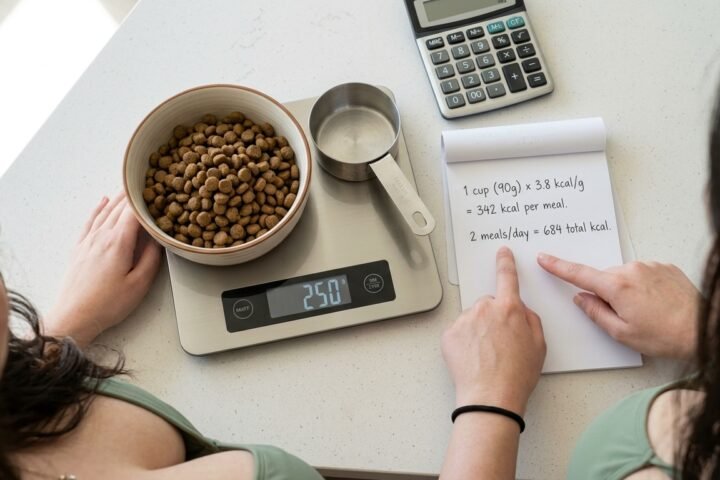
A kitchen scale can make portions more consistent
If your food manufacturer provides calorie information by weight, weighing kibble in grams with a kitchen scale can be more repeatable than estimating portions by eye.
Your veterinarian can help you translate the daily calorie allowance into the correct amount of your dog’s food.
Once you have that amount:
- Measure the entire day’s food.
- Divide it among the dog’s scheduled meals.
- Reserve part for training if desired.
- Do not refill the bowl because it “looks empty.”
- Make sure everyone in the household follows the same plan.
If several people feed the dog, consider preparing the entire day’s ration in one labeled container each morning. When the container is empty, the normal food budget for that day has been used.
Feeding instructions on the package are a starting point
Do not assume the feeding chart printed on a dog-food bag represents a personalized weight-loss prescription.
AAHA advises owners to treat package feeding recommendations as a starting point and use veterinary guidance to determine the appropriate amount for an individual pet.
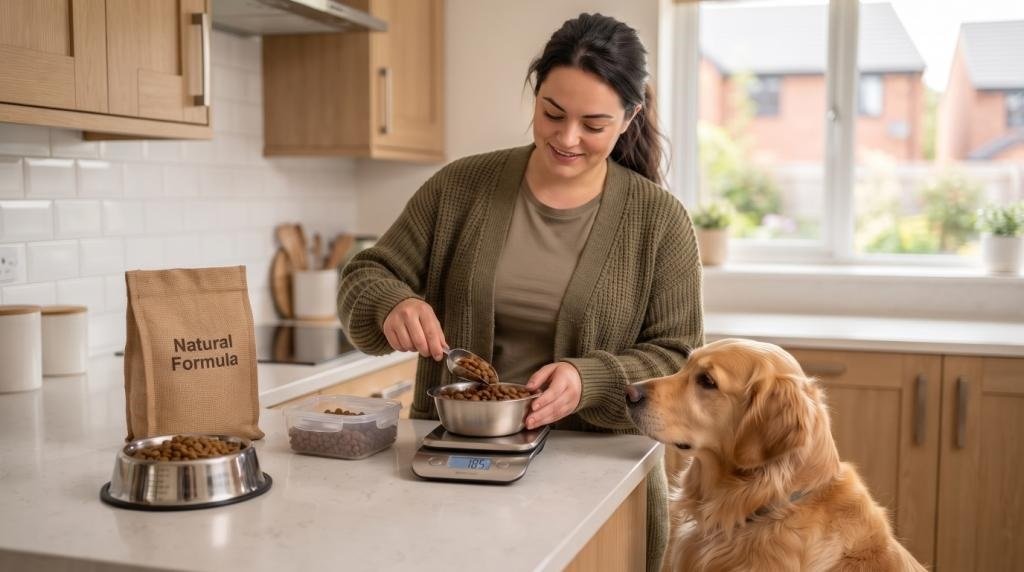
The right amount can change as your dog loses weight, becomes more active, ages, or moves from active weight reduction into maintenance.
4. Count Treats, Toppers, Chews, and Table Scraps
One of the most common ways a carefully measured dog weight loss plan becomes inaccurate is through calories that never make it into the food bowl.
Imagine measuring every meal perfectly but also giving:
- A dental chew
- Several training treats
- Cheese with medication
- Peanut butter in a toy
- A spoonful of topper
- Pieces of chicken while cooking
- Leftovers from dinner
Those calories still count.
Merck Veterinary Manual and AAHA recommend keeping treats and other non-complete foods to a small proportion of total calorie intake; the commonly used guideline is less than or around 10% of daily calories.
For a dog on a calorie-controlled plan, however, even that allowance needs to fit within the total established by your veterinary team.
Treat calories belong inside the budget
A practical approach is:
Daily calorie target = meals + treats + toppers + chews + other caloric extras
Not:
Daily calorie target = meals, with treats added afterward
If you use food rewards frequently for training, set aside part of your dog’s measured daily food and use individual pieces as rewards. Cornell recommends this strategy as a way to provide frequent reinforcement without automatically adding another source of calories.
You can also use non-food rewards when appropriate:
- Praise
- Petting
- A favorite toy
- A brief game
- Sniffing opportunities
- Attention
- A short walk
Be cautious with table scraps
Human leftovers can be surprisingly calorie-dense, and some foods are unsafe for dogs altogether.
If family members regularly share their meals, make one household rule: nothing goes to the dog unless it has been included in the plan.
PawMindTips’ guide to foods dogs should not eat can help household members recognize foods and ingredients that should not be offered at all.
This matters especially when “just one bite” comes from several people. Each individual portion may look insignificant, while the combined daily total is not.
5. Build Activity Around Your Dog’s Current Fitness
Food intake is central to weight management, but appropriate physical activity supports fitness, mobility, muscle maintenance, and overall health.
The key word is appropriate.
An overweight adult dog that has been sedentary should not suddenly be expected to complete long runs or intense exercise sessions.
Cornell recommends increasing activity gradually and watching how the dog responds. Difficulty breathing, struggling to keep up, or clearly trying to slow down are reasons to stop and discuss the dog’s exercise tolerance with a veterinarian.
Start from what your dog can comfortably do now
The right starting point depends on:
- Age
- Current fitness
- Degree of excess weight
- Joint health
- Heart and respiratory health
- Weather
- Breed and body type
- Mobility
- Previous activity
For one dog, a useful starting activity may be a comfortable leash walk.
For another with significant obesity, arthritis, or limited stamina, several short walks may be more appropriate than one long outing.
Low-impact activities such as walking or, for suitable dogs, swimming may be incorporated when appropriate. Cornell notes that physical activity can complement dietary changes while helping maintain muscle and joint mobility.
If swimming becomes part of the plan, follow proper dog swimming safety guidance rather than assuming every dog is naturally a safe or confident swimmer.
Increase gradually rather than chasing calorie burn
Do not think of exercise as permission to feed extra treats afterward.
A long walk followed by a calorie-dense snack can undermine the calorie deficit you were trying to create.
Instead, treat activity as one component of a complete dog weight loss program:
Controlled calorie intake + appropriate nutrition + gradual activity + monitoring
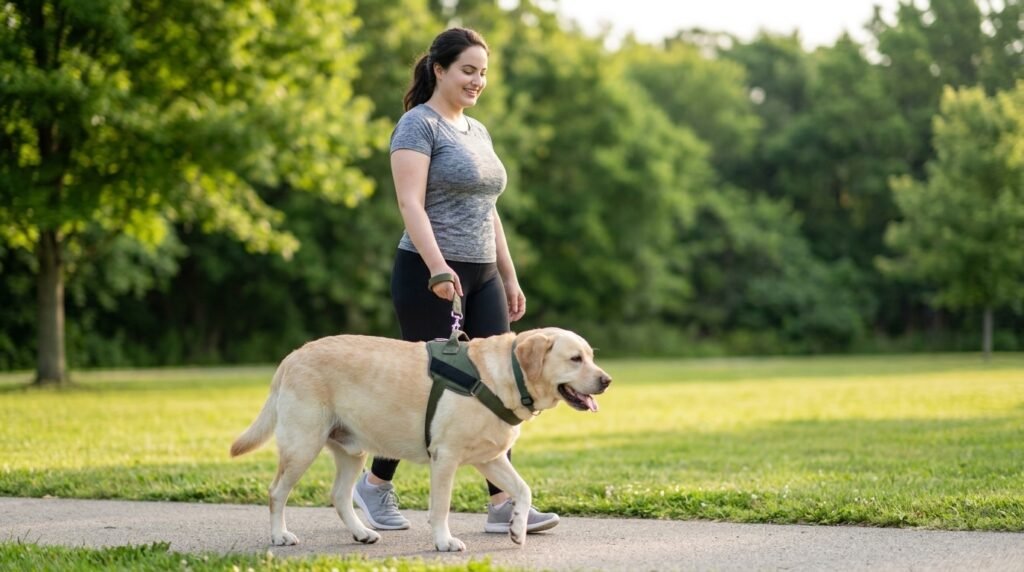
If your dog limps, becomes unusually exhausted, struggles to breathe, repeatedly refuses exercise, or appears painful, stop increasing activity and seek veterinary advice.
6. Track Dog Weight Loss and Adjust the Plan
A plan without measurements quickly becomes guesswork.
Regular weigh-ins tell you whether the calorie and activity plan is producing the intended trend.
Cornell recommends frequent monitoring during active weight reduction and notes that the plan should be adjusted when loss is too fast or too slow.
Your veterinarian may choose a recheck schedule based on your dog’s health, degree of excess weight, and diet.
Keep a simple progress record
Your log can contain:
| Date | Weight | Daily Food | Treats/Extras | Activity | Notes |
|---|---|---|---|---|---|
| Start | Record | Record | Record | Baseline | BCS/vet notes |
| Recheck | Record | Same/changed | Record | Record | Energy/appetite |
| Recheck | Record | Same/changed | Record | Record | Vet adjustment |
You do not need complicated software.
A notebook or phone spreadsheet is enough.
Also consider taking a photograph from above and another from the side at consistent intervals. Changes in waist and abdominal contour may become easier to recognize when photographs are compared over time.
Look at the trend, not one measurement
Body weight can fluctuate, and progress may not be perfectly linear.
What matters is whether the overall pattern is moving toward the target at a rate your veterinarian considers appropriate.
Avoid responding to a single disappointing weigh-in by suddenly slashing the food allowance.
Instead, review the data.
Ask:
- Were portions measured consistently?
- Were treats included?
- Did another household member feed the dog?
- Has activity changed?
- Did the food itself change?
- Has your dog been stealing another pet’s food?
- Are calorie-containing chews or toppers being overlooked?
- Does the veterinary team need to reassess the calorie target?
That turns a frustrating plateau into information you can use.
7. What If Your Dog Is Not Losing Weight?
If dog weight loss stalls despite apparently following the plan, the answer is not automatically “feed even less.”
First audit the plan.
Check the calorie leaks
For several days, record absolutely everything your dog consumes.
Look for easy-to-miss sources:
- Training treats
- Dental products
- Chews
- Table food
- Food dropped by children
- Food stolen from another pet
- Toppers
- Supplements
- Food used to hide medication
- Multiple family members feeding the same dog
The Royal Kennel Club specifically identifies inaccurate measurement and multiple household members offering food among factors that can contribute to excessive calorie intake.
Check your measuring method
If you have been estimating portions, start measuring according to the veterinary plan.
If you changed foods, check the calorie density of the new food. The same volume does not necessarily contain the same number of calories.
Review activity
Has your dog’s activity declined because of weather, schedule changes, pain, stiffness, or fatigue?
Do not simply double the exercise to compensate.
If an overweight dog appears uncomfortable during movement, pain or another health problem may need veterinary attention before activity can safely increase.
Ask for a veterinary recheck
A plateau can also mean the original plan needs adjustment as your dog’s body changes.
Your veterinarian may reassess:
- Current weight
- Body condition
- Muscle condition
- Calorie intake
- Food choice
- Activity
- Treat allowance
- Medical history
- Medications
- Possible underlying health problems
AAHA notes that resistance to weight reduction can sometimes be associated with medical issues such as hypothyroidism, Cushing’s disease, osteoarthritis, or certain medications.
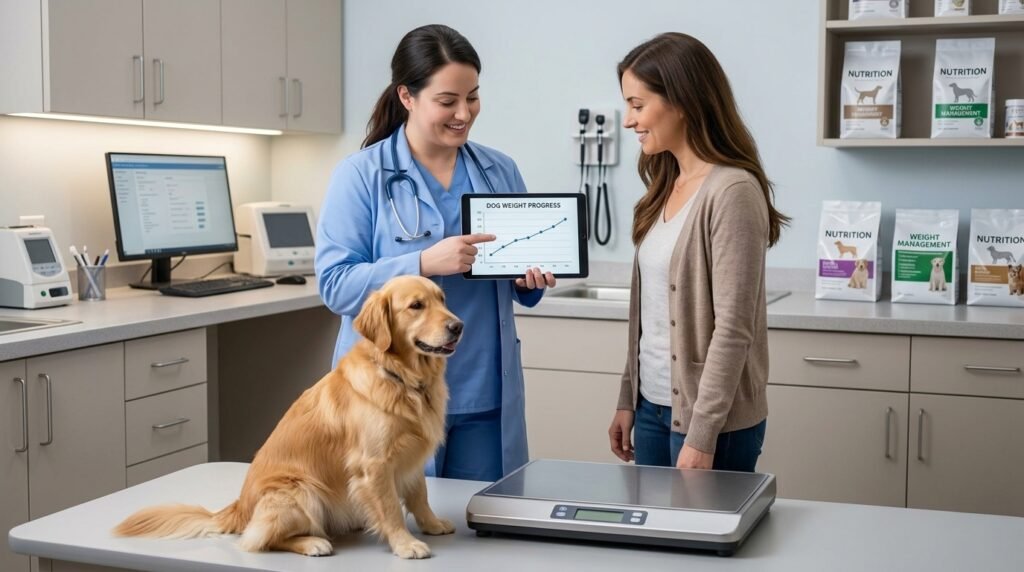
That is why persistent lack of progress deserves a review rather than increasingly aggressive food restriction at home.
8. Maintain a Healthy Weight After the Diet
Reaching the target does not mean the weight-management process is finished.
The objective changes from losing excess weight to preventing it from returning.
Your dog’s calorie needs during maintenance may differ from those used during active weight reduction. Ask your veterinarian how much food to provide once the target body condition has been reached rather than simply returning to the old feeding routine.
That old routine may have contributed to the weight gain in the first place.
Merck Veterinary Manual describes reaching an ideal body condition as the short-term goal and maintaining that condition as the long-term objective.
Keep the habits that worked
Useful long-term habits include:
- Continue measuring meals
- Keep treats within the daily plan
- Maintain regular activity
- Check body condition periodically
- Continue routine weigh-ins
- Adjust calories when activity changes
- Reassess nutrition as your dog ages
- Discuss unexplained weight changes with your veterinarian
Do not wait until your dog has regained a large amount of weight before responding.
Small upward trends are easier to address.
Weight maintenance is especially important when lifestyle changes. An injury, arthritis flare, aging, medication change, seasonal weather, or reduced walking schedule can decrease energy expenditure without automatically reducing appetite.
A sustainable dog weight loss plan therefore teaches you more than how to get weight off. It creates feeding and activity habits that can help keep your dog at an appropriate condition over the long term.
FAQs
How can I help my dog lose weight safely?
Start with a veterinary assessment to establish body condition, target weight, health considerations, and an individualized calorie goal. Measure meals accurately, include treats and extras in the calorie budget, introduce activity according to your dog’s fitness, and monitor weight regularly. Avoid crash dieting or making major calorie cuts without veterinary guidance.
How much food should I give my dog for weight loss?
There is no universal number of cups or grams appropriate for every overweight dog. The amount depends on the dog’s target weight, body condition, health, activity, and the calorie density of the specific food. Ask your veterinarian to establish a daily calorie target and convert it into an appropriate amount of your dog’s diet.
How quickly should dog weight loss happen?
Weight reduction should be gradual and monitored rather than rushed. Published veterinary resources use somewhat different target ranges, which is another reason to have your veterinarian establish an appropriate rate for your individual dog. If weight is falling unexpectedly fast, your dog seems weak or unwell, or the diet appears excessively restrictive, contact your veterinarian.
Why is my overweight dog not losing weight even though I feed less?
Hidden calories from treats, chews, toppers, scraps, inaccurate portions, or multiple feeders can interfere with progress. Reduced activity and changes in calorie needs can also matter. If you are accurately following the prescribed plan and weight still does not change as expected, schedule a veterinary recheck rather than repeatedly cutting food yourself.
Conclusion
Safe dog weight loss is a structured process, not a crash diet.
Start by having your veterinarian assess body condition and establish an appropriate target weight. From there, create an individualized calorie budget, measure food accurately, account for every meaningful source of calories, and gradually build activity around what your dog can comfortably handle.
Record progress and use regular weigh-ins to determine whether the plan is working. If weight is not changing as expected, review the plan with your veterinary team instead of making increasingly severe food cuts.
And once the target condition is reached, keep the successful habits in place.
The best outcome is not simply a lower number on the scale. It is a dog who reaches and maintains a healthier body condition through a feeding, activity, and monitoring routine that can realistically continue for life.