For many families, fireworks are a fun part of summer celebrations and holidays. For dogs, however, those same celebrations can be frightening. Fear of Fireworks in Dogs can range from mild nervousness to intense panic, and some dogs may try to escape or injure themselves while attempting to get away from the noise.
Fireworks are especially challenging because they are loud, sudden, unpredictable, and accompanied by flashes of light and vibrations. Your dog cannot understand why explosions are happening outside, so the experience can feel like a genuine threat.
Common reactions include trembling, panting, pacing, barking, hiding, whining, drooling, refusing food, clinging to an owner, scratching at doors, or attempting to escape.
The good news is that there are several practical ways to make fireworks easier for your dog. Preparation is especially important because it is much easier to prevent a dog from reaching a state of extreme panic than to calm them after fear has already taken over.
In this guide, you will learn 9 proven ways to help a dog scared of fireworks, along with prevention strategies, safety precautions, training techniques, and signs that it is time to involve your veterinarian.
Table of Contents
Why Are Dogs Scared of Fireworks?
Understanding why dogs react to fireworks can help you respond appropriately.
Dogs have much more sensitive hearing than humans, so the explosive sounds that seem merely loud to us can be overwhelming for them. Fireworks also occur unpredictably. A dog may hear a massive explosion without any obvious warning, followed by another explosion from a completely different direction.
The combination of loud sound, flashes, vibration, unfamiliar smells, and unpredictability can create a powerful fear response.
Research has found that fireworks are one of the most common specific noise fears reported in dogs. Some dogs are naturally more noise-sensitive than others, while previous frightening experiences may also contribute to the problem.
Fear of Fireworks in Dogs can also become stronger over time if the dog repeatedly experiences frightening fireworks without appropriate management.
Common Signs of Firework Fear
Your dog may show one or several of these behaviors:
- Trembling or shaking
- Heavy panting
- Pacing
- Whining
- Barking
- Drooling
- Hiding
- Restlessness
- Dilated pupils
- Flattened ears
- Tucked tail
- Refusing food
- Excessive licking
- Staying unusually close to you
- Scratching at doors or windows
- Trying to escape
- Destructive behavior
Some dogs become quiet rather than visibly frantic. Hiding under furniture, freezing, avoiding eye contact, or refusing to interact can also indicate fear.

Never assume that a dog is simply being stubborn or dramatic. These behaviors can be genuine signs of distress.
1. Create a Safe Space Before Fireworks Start
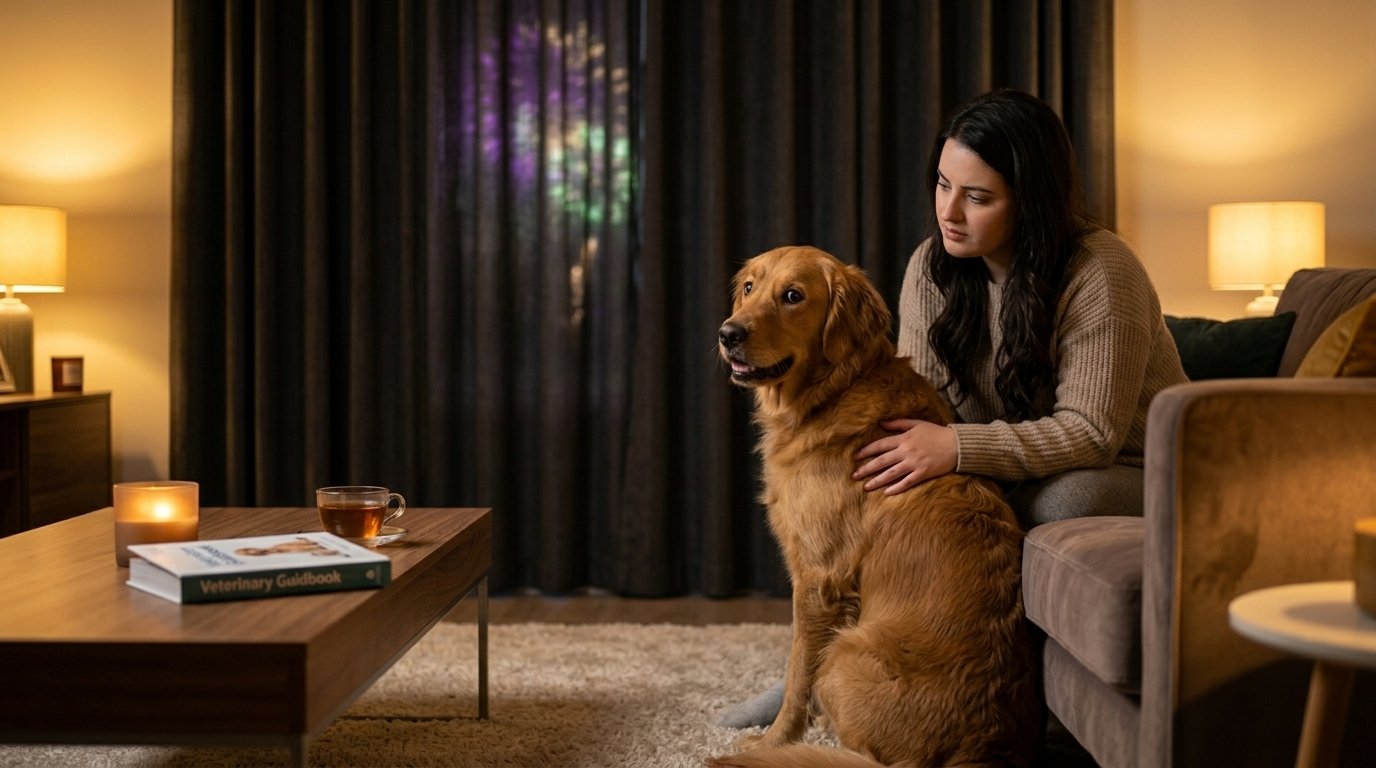
One of the most effective ways to manage Fear of Fireworks in Dogs is to create a comfortable indoor safe space before the first explosion occurs.
Choose a room where outside noise is naturally reduced. A room with few windows can be particularly useful.
Place familiar items inside, such as:
- Your dog’s bed
- A favorite blanket
- Familiar toys
- Fresh water
- A food puzzle
- A stuffed enrichment toy
Close windows and curtains to reduce both sound and flashes of light.
If your dog already likes their crate, you can make the crate part of the safe area. However, never force a dog into a crate if they do not already view it as a comfortable place.
Let Your Dog Choose the Safe Location
Every dog is different.
Some dogs prefer a crate. Others feel safer underneath a table, beside a sofa, or next to their owner.
The goal is to provide a secure option rather than force your dog into a particular location.
If your dog chooses to hide, allow them to do so as long as the area is safe.
2. Exercise Your Dog Before Fireworks Begin
Exercise can be an important part of your fireworks preparation plan.
Take your dog for a walk earlier in the day, before fireworks become frequent. You can also provide mental stimulation through training, puzzle toys, scent games, or other enrichment activities.
The purpose is not to exhaust your dog to the point of exhaustion. Instead, you want to give them normal physical and mental activity before the stressful period begins.
Take Bathroom Breaks Early
Do not wait until fireworks are already exploding to take your dog outside.
Give your dog an opportunity to exercise and use the bathroom before the noise becomes intense.
Once fireworks begin, keep your dog indoors whenever possible. If they need to go outside, use a leash even if you have a fenced yard.
A frightened dog may suddenly run through an open gate, jump a fence, or pull away from an owner.
This is particularly important because escape is one of the biggest safety concerns associated with Fear of Fireworks in Dogs.
3. Reduce the Sound and Light Coming Into Your Home
You cannot control what happens outside, but you can control your dog’s indoor environment.
Before fireworks begin:
- Close windows.
- Close curtains or blinds.
- Secure exterior doors.
- Turn on background sound.
- Move your dog to a quieter room.
White noise, a fan, television, radio, or calm music can provide a steady background sound that helps reduce the contrast between silence and sudden explosions.
Cornell University College of Veterinary Medicine recommends using white noise and music as part of a broader strategy for managing fireworks and thunderstorm fear.
Don’t Simply Turn the Volume Up
The goal is not to create another loud environment.
Use a comfortable background volume rather than blasting music or television.
A consistent sound may help mask some of the outside noise while giving your dog something familiar to hear.
You can also close curtains or blinds to reduce flashes of light, particularly if your dog reacts strongly to the visual effects of fireworks.
4. Offer Food-Based Enrichment
If your dog is still willing to eat, food enrichment can provide a useful distraction.
Consider offering:
- A stuffed food toy
- A frozen enrichment toy
- A lick mat
- A puzzle feeder
- Small high-value treats
- A favorite chew
Food-based activities can encourage licking, chewing, and mental engagement while providing something positive to focus on.
However, do not force your dog to eat.
A severely frightened dog may be too stressed to accept food. If your dog normally loves treats but refuses them during fireworks, this can be a sign that their anxiety is significant.
Prepare the Enrichment Ahead of Time
Do not wait until your dog is already panicking.
Prepare stuffed or frozen food toys earlier in the day and keep them ready in the refrigerator or freezer.
This makes your evening easier and ensures you are not trying to prepare everything while fireworks are already happening.
5. Stay Calm and Comfort Your Dog
When your dog is frightened, your behavior matters too.
If your dog comes to you, calmly reassure them. You can sit nearby, speak in a soft voice, or gently pet them if they enjoy physical contact.
There is no need to ignore a frightened dog simply because you are worried that comforting them will “reward” their fear.
Fear is an emotional response. You are not teaching your dog to become afraid by providing calm support.
The best approach is to remain relaxed and predictable.
Follow Your Dog’s Preference
Some dogs want to sit beside their owners.
Some want to be held.
Others prefer to hide somewhere quiet.
Allow your dog to communicate what makes them comfortable.
If your dog moves away, give them space. If they come closer, calmly allow them to stay near you.
The goal is to make your home feel safe rather than forcing your dog to behave normally.
For many owners dealing with Fear of Fireworks in Dogs, simply being present and calm can make a stressful evening easier.
6. Use Gradual Desensitization Before Fireworks Season
If your dog is afraid of fireworks, long-term training can be more useful than relying only on emergency strategies.
Desensitization involves gradually introducing your dog to a sound at a level that does not cause fear.
For example, you can use a recording of fireworks at a very low volume while your dog is relaxed.
Pair the sound with something positive, such as:
- Treats
- Play
- Praise
- A favorite food toy
- Relaxed interaction
Over time, the volume can gradually increase, but only while your dog remains comfortable.
This process is often combined with counterconditioning, where the dog learns that a previously frightening sound predicts something positive.

Never Rush the Process
The biggest mistake is increasing the volume too quickly.
If your dog starts panting, pacing, hiding, trembling, or showing other signs of stress, the sound is too intense.
Lower the volume or stop the session.
Desensitization should happen gradually and preferably well before the next major fireworks event.
If your dog has severe noise sensitivity, working with a qualified positive-reinforcement trainer or veterinary behaviorist can make the process safer and more effective.
7. Consider Calming Tools Carefully
Some dogs may benefit from additional calming tools.
Depending on your dog’s needs, options may include:
- Anxiety wraps
- Calming beds
- Pheromone products
- Food enrichment
- White-noise machines
- Veterinarian-recommended supplements
These products should be viewed as part of a broader plan rather than guaranteed solutions.
For example, an anxiety vest should be introduced while your dog is relaxed. Do not wait until fireworks are already exploding and then put an unfamiliar product on your dog for the first time.
Be Careful With Supplements
A product labeled “natural” is not automatically safe or effective for every dog.
Before giving your dog a supplement, discuss it with your veterinarian. This is particularly important if your dog takes other medications or has an underlying health issue.
Some research has explored supplements and other interventions for canine noise-related fear, but individual responses can vary.
For severe Fear of Fireworks in Dogs, calming products should not replace professional evaluation when your dog is experiencing significant distress.
8. Make Escape Prevention a Priority
This may be the most important safety step you take.
A frightened dog can behave in ways that are completely out of character.
A dog that normally stays calmly in the yard may suddenly:
- Run through an open door
- Jump a fence
- Break through a barrier
- Pull out of a collar
- Scratch through a door
- Run into traffic
Before fireworks begin, inspect your home and yard.
Make sure doors and gates are secure, windows are closed, and your dog’s collar fits correctly.
Check that identification information is current. If your dog has a microchip, make sure the registration information is up to date.
Never Assume a Fenced Yard Is Enough
A fence may normally keep your dog secure, but panic can cause a dog to attempt things they would never normally try.
If your dog must go outside during fireworks, keep them on a leash and stay with them.
Avoid letting a frightened dog outside alone.
This simple precaution can dramatically reduce the risk associated with Fear of Fireworks in Dogs.
9. Talk to Your Veterinarian About Severe Fear
Not every dog can be helped with environmental changes alone.
If your dog experiences severe panic, speak with your veterinarian.
Professional help may be appropriate if your dog:
- Attempts to escape
- Injures themselves
- Becomes extremely destructive
- Cannot settle
- Trembles uncontrollably
- Pants excessively
- Remains distressed for hours
- Refuses food during fireworks
- Becomes more fearful every year
Your veterinarian can determine whether medication, behavior modification, or a combination of approaches may be appropriate.
Some dogs with severe noise anxiety benefit from medication prescribed specifically for stressful events.
If medication is prescribed, follow your veterinarian’s instructions carefully. It is often useful to discuss the plan before fireworks season rather than waiting until the evening of the event.
Don’t Give Human Medication
Never give your dog human anti-anxiety medication, sleeping medication, or another drug unless your veterinarian specifically instructs you to do so.
The correct medication and dosage depend on the individual dog.
Can Fear of Fireworks in Dogs Be Prevented?
In some cases, prevention and early training can reduce the likelihood or severity of noise fear.
This is particularly useful for puppies and dogs that have not yet developed a strong fireworks reaction.
Controlled exposure to fireworks sounds at a low volume, combined with positive experiences, may help dogs form a more positive association with the sound.
However, prevention does not mean taking your dog outside and exposing them to real fireworks.
It also does not mean playing extremely loud recordings.
The exposure needs to be controlled and gradual.
If your dog already shows significant fear, professional guidance can help you avoid accidentally making the problem worse.
What NOT to Do When Your Dog Is Afraid of Fireworks
Knowing what to avoid is just as important as knowing what to do.
Don’t Punish Fearful Behavior
Never punish your dog for trembling, hiding, barking, pacing, or attempting to stay close to you.
Your dog is responding emotionally to something they perceive as threatening.
Punishment can increase stress and make future fireworks events more difficult.
Don’t Force Your Dog to Watch Fireworks
You do not need to make your dog sit outside and watch fireworks.
“Facing the fear” at full intensity can overwhelm a dog and may make the fear response stronger.
Don’t Leave Doors Open
Keep exterior doors securely closed once fireworks are expected.
A frightened dog can escape in seconds.
Don’t Wait Until Panic Starts
Preparation should happen before fireworks begin.
Set up the safe space, exercise your dog, prepare enrichment, close windows, and secure doors ahead of time.
Don’t Introduce New Products at the Worst Possible Moment
If you plan to use an anxiety wrap, calming product, or food toy, introduce it while your dog is relaxed.
That way you already know whether your dog accepts it.
A Simple Fireworks Safety Plan
If fireworks are expected tonight, use this simple plan.
Earlier in the Day
- Give your dog normal exercise.
- Provide mental enrichment.
- Check your dog’s identification information.
- Prepare the safe room.
- Prepare food toys or enrichment.
- Discuss prescribed medication with your veterinarian if necessary.
Before Fireworks Begin
- Feed your dog.
- Give your dog a bathroom break.
- Close windows and curtains.
- Bring your dog indoors.
- Turn on background noise.
- Secure doors and gates.
During Fireworks
- Stay calm.
- Let your dog choose their preferred safe location.
- Offer comfort if your dog seeks it.
- Provide food enrichment if they are willing to eat.
- Keep doors and windows secure.
- Do not punish fearful behavior.
- Avoid unnecessary trips outside.
This preparation can make the evening much safer and more predictable.
When Fireworks Fear Becomes a Bigger Problem
Some dogs recover shortly after fireworks stop.
Others may remain nervous for hours or longer.
If your dog’s recovery period becomes longer every year, or if their reaction becomes increasingly severe, do not assume the problem will disappear on its own.

Fear can become stronger through repeated frightening experiences.
That is why early intervention is important.
A dog that hides for a few minutes may need only environmental management. A dog that repeatedly attempts to escape, injures themselves, or remains distressed long after the fireworks stop may need a more comprehensive treatment plan.
The sooner you recognize the difference, the sooner you can give your dog appropriate support.
FAQs
Why are dogs scared of fireworks?
Dogs may fear fireworks because the explosions are loud, sudden, unpredictable, and accompanied by flashes and vibrations. Some dogs are naturally more sensitive to noise, while previous frightening experiences can contribute to the problem.
How can I calm my dog during fireworks?
Create a quiet indoor safe space, close windows and curtains, use background noise, exercise your dog earlier, and provide food enrichment if your dog is willing to eat. Calm reassurance can also help.
Should I comfort my dog during fireworks?
Yes. If your dog seeks you out, calm reassurance and gentle interaction are appropriate. However, allow your dog to decide whether they want physical contact or prefer to hide somewhere quiet.
Should I give my dog medication for fireworks anxiety?
Some dogs with severe anxiety may benefit from veterinarian-prescribed medication. Never give your dog medication without veterinary guidance. A veterinarian can determine whether medication is appropriate and how it should be used.
Can a dog get over a fear of fireworks?
Many dogs can improve with appropriate management, gradual desensitization, counterconditioning, and professional behavior support. However, severe fear should not be ignored.
Is it safe to take a scared dog outside during fireworks?
Only when necessary and with appropriate restraint. Keep your dog on a leash and stay with them. Never assume a frightened dog will behave normally simply because they have previously been reliable outdoors.
Conclusion
Fear of Fireworks in Dogs can be stressful for both pets and their owners, but preparation can make a major difference.
Start before the first explosion.
Exercise your dog earlier in the day. Create a quiet safe space. Close windows and curtains. Use steady background noise. Offer enrichment if your dog is comfortable eating. Stay calm and allow your dog to choose where they feel safest.
Most importantly, take escape prevention seriously.
A frightened dog may behave completely differently from normal, so secure doors, gates, windows, collars, and identification information before fireworks begin.
For dogs with severe anxiety, do not rely on home remedies alone. Your veterinarian can help determine whether behavior modification, medication, or a combination of approaches is appropriate.
The goal is not to make your dog enjoy fireworks.
The goal is to help your dog feel safe, secure, and supported while the noise is happening.