A dog that constantly pulls on the leash can turn an ordinary walk into a frustrating battle. You may find yourself gripping the leash tightly, slowing down, stopping repeatedly, or even being pulled toward other dogs, people, squirrels, and interesting smells. If you have been wondering how to stop a dog from pulling on the leash, the good news is that pulling is a trainable behavior.
Dogs do not automatically understand that a leash means they should walk politely beside a person. Walking calmly on a leash is a learned skill that improves through repetition, clear communication, and appropriate rewards. The American Kennel Club recommends reinforcing desirable leash behavior and stopping forward movement when a dog pulls.

The goal is not to force your dog into a perfect heel for the entire walk. Instead, you want your dog to understand that a loose leash allows the walk to continue, while pulling makes the forward movement stop. With patience and consistency, even a determined puller can learn better walking habits.
This guide explains how to stop a dog from pulling on the leash using eight practical training strategies that can be incorporated into everyday walks.
Table of Contents
Why Dogs Pull on the Leash
Before learning how to stop a dog from pulling on the leash, it helps to understand why the behavior happens.
Pulling is not necessarily a sign that your dog is stubborn, dominant, or deliberately trying to control you. In many cases, the environment simply offers stronger rewards than staying beside you.
A dog may pull because it wants to:
- Reach an interesting smell
- Greet another dog
- Investigate a person
- Chase a moving object
- Explore a new area
- Walk faster
- Get closer to something exciting
- Release built-up energy
- Continue moving after the leash becomes tight
Dogs also learn from consequences. If pulling consistently gets them closer to a tree they want to sniff, another dog they want to greet, or an exciting destination, the pulling behavior can become stronger.
The American Kennel Club explains that dogs tend to repeat behaviors that produce rewards. That is why changing what happens after pulling is an important part of leash training.
Pulling can become a learned habit
Imagine your dog sees a squirrel.
The dog pulls.
You continue walking.
The dog gets closer.
From your dog’s perspective, pulling worked.
This simple pattern can happen hundreds of times without the owner realizing it. Over time, your dog may begin pulling automatically whenever something interesting appears.
The solution is to teach a different pattern:
Interesting thing appears → dog feels tension → owner stops or creates distance → dog returns attention → loose leash → reward → walking continues.
That new pattern gives your dog a clear alternative.
Excitement can make training harder
Some dogs pull because they become highly excited outdoors. The sights, sounds, scents, people, and animals outside can overwhelm their ability to focus.
If your dog walks nicely inside the house but immediately pulls once you step outside, that does not mean the training has failed. It means the outdoor environment is much more difficult.
Start in an easier location and gradually increase distractions as your dog improves. This progression is also recommended in established loose-leash training guidance.
Reward Loose-Leash Walking
One of the most important principles in learning how to stop a dog from pulling on the leash is to reward the behavior you actually want.
Instead of waiting for your dog to pull and then correcting the problem, actively look for moments when your dog is already doing well.

For example, reward your dog when:
- The leash is loose
- Your dog looks toward you
- Your dog walks beside you
- Your dog slows down with you
- Your dog responds to their name
- Your dog chooses not to pull toward a distraction
At the beginning, rewards may need to be frequent.
Use small, valuable rewards
Choose treats your dog genuinely enjoys, but keep individual pieces small enough that you can provide multiple rewards during training.
You can also use non-food rewards.
For many dogs, getting permission to sniff a bush is highly rewarding. The AKC specifically recommends using everyday “life rewards,” such as opportunities to sniff, as part of leash training.
This creates a useful relationship:
Loose leash = access to good things.
Reward before your dog pulls
Timing matters.
If your dog walks beside you for several steps and then pulls, do not wait until the leash becomes tight before deciding to reward. Reinforce the good behavior while it is happening.
For example:
- Put your dog on the leash.
- Wait for the leash to become loose.
- Say a calm marker such as “Yes.”
- Give a small treat.
- Take a few steps.
- Reward again when your dog remains beside you.
As your dog’s skills improve, gradually increase the number of steps between rewards.
This is a practical foundation for how to stop a dog from pulling on the leash without turning every walk into a correction session.
Stop When the Leash Gets Tight
Another core principle of how to stop a dog from pulling on the leash is simple: do not allow pulling to produce forward movement.
When your dog reaches the end of the leash and creates tension, stop walking.
Do not yank backward.
Do not drag your dog toward you.
Simply stop and wait for an opportunity to reward a loose leash.

The AKC describes this approach as stopping when the dog pulls and waiting for the dog to return or loosen the leash before continuing.
Look for a loose leash
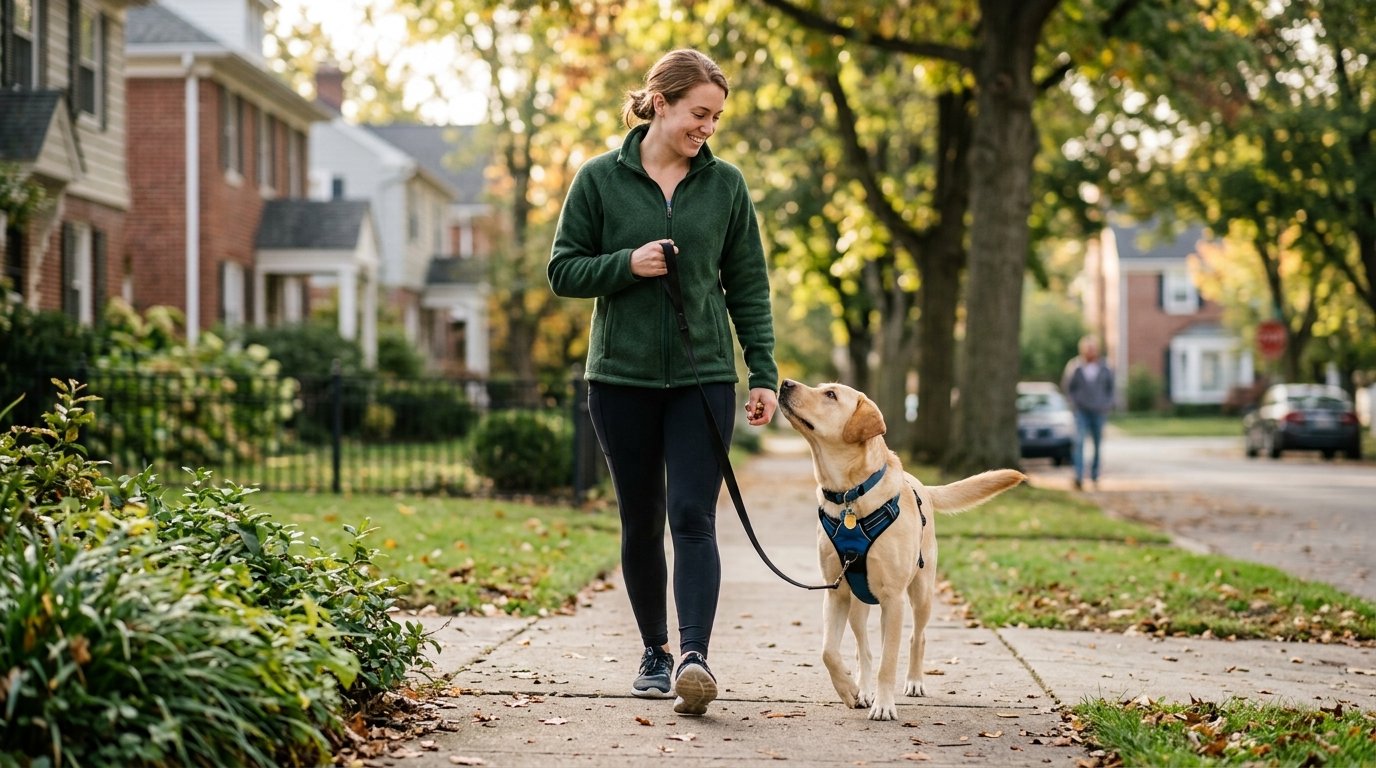
A useful visual target is a relaxed leash hanging in a soft curve rather than a straight, tight line.
When the leash becomes loose:
- Mark the behavior
- Praise your dog
- Offer a reward
- Continue walking
At first, this may happen every few steps.
That is okay.
Your goal is not distance. Your goal is learning.
Why stopping works
If pulling makes the walk stop while loose-leash behavior makes the walk continue, your dog eventually has a reason to choose the second option.
This is especially important for dogs that have practiced pulling for months or years.
Do not expect a long walk to suddenly become perfect after one training session.
Instead, think of each walk as hundreds of tiny learning opportunities.
Teach a Reliable Walking Cue
A clear verbal cue can make how to stop a dog from pulling on the leash easier because your dog learns what you want before problems occur.
You might use:
- “Let’s go”
- “With me”
- “Let’s walk”
- “This way”
The exact phrase matters less than consistency.
VCA Animal Hospitals recommends establishing a cue that communicates that rewards are available for walking on a loose leash.
How to teach the cue
Begin somewhere quiet.
- Put the leash on your dog.
- Wait for your dog to look toward you.
- Say your walking cue cheerfully.
- Take one or two steps.
- Reward your dog for following.
- Repeat several times.
- Gradually increase the number of steps.
Keep your body language positive.
You want the cue to predict cooperation, movement, and rewards—not frustration.
Practice before going on a long walk
Do not wait until your dog is already pulling down the sidewalk to introduce the cue.
Practice indoors first.
Then try:
- Your living room
- A hallway
- Your yard
- A quiet driveway
- A quiet sidewalk
- A low-distraction park
Once your dog understands the cue in easier environments, you can gradually introduce more challenging distractions.
Use Direction Changes
Direction changes are another useful technique when learning how to stop a dog from pulling on the leash.
If your dog repeatedly races ahead, you can calmly change direction before the leash becomes fully tight.
For example, walk forward for several steps. If your dog moves too far ahead, say “This way” and turn in another direction.
When your dog follows you, reward them.
This teaches your dog to pay attention to where you are going rather than automatically deciding the route.
Make direction changes predictable
Avoid turning abruptly in a way that scares or physically jerks your dog.
The goal is communication, not punishment.
You want your dog to learn:
Pay attention to my person because my person controls where we go.
The AKC recommends changing direction and rewarding the dog for catching up and walking with a loose leash.
Use the technique before pulling becomes extreme
Direction changes are usually easiest when your dog is still capable of responding.
If your dog is already lunging toward another animal or completely unable to disengage, increasing distance may be more useful than repeatedly changing direction.
That brings us to one of the most important parts of successful leash training: managing distractions.
Manage Distractions
If you want to understand how to stop a dog from pulling on the leash, do not overlook the environment.
A dog that can calmly walk past an empty sidewalk may struggle when passing:
- Another dog
- A cat
- A squirrel
- Children playing
- A busy road
- A crowded park
- A favorite person
- Food smells
- A familiar dog friend
These distractions can be much more rewarding than your treats.
Increase distance when necessary
If your dog cannot respond to their name, take a treat, or look toward you, the distraction may simply be too intense.
Instead of forcing the dog to remain close to the trigger, increase your distance.
Cross the street.
Move into a driveway.
Turn around.
Step behind a parked vehicle if appropriate.
Choose a quieter route.
Then begin training again when your dog is able to focus.
VCA’s guidance similarly recommends increasing distance when a dog cannot disengage from a distraction.

Train gradually
Think of distractions as levels.
Level 1: Quiet room
Level 2: Backyard
Level 3: Quiet street
Level 4: Neighborhood with mild activity
Level 5: Park with moderate distractions
Level 6: Busy walking area
Your dog does not have to master every level immediately.
Progress gradually.
If your dog starts pulling heavily, that is information—not failure. It may mean the environment has become too difficult.
Keep walks mentally engaging
A walk should not be nothing more than marching forward.
Allow appropriate sniffing opportunities, practice short training exercises, and occasionally reward your dog for checking in with you.
The AKC notes that sniffing and other environmental rewards can make walks more enriching while supporting training.
Choose Appropriate Walking Equipment
Equipment alone will not teach how to stop a dog from pulling on the leash, but appropriate equipment can make training safer and easier to manage.
For many dogs, a well-fitted harness can be useful during training.
The key is proper fit and appropriate use.
Standard leash
A regular fixed-length leash is often easier for beginners because it gives you predictable control over the amount of distance between you and your dog.
Harness
A properly fitted harness can reduce pressure on the neck compared with attaching the leash directly to a collar.
However, harnesses are not magic anti-pulling devices. Your dog still needs to learn the behavior you want.
Retractable leashes
Retractable leashes can be convenient in suitable situations, but they can make loose-leash training more difficult because pulling can cause the leash to extend.

The AKC specifically notes that retractable leashes can reward pulling and recommends establishing polite walking skills with a standard leash first.
Avoid relying on painful corrections
Training equipment should not replace communication and reward-based learning.
The American Veterinary Society of Animal Behavior states that reward-based training should be used for dog training and behavior modification and advises against aversive methods such as leash corrections, choke chains, prong collars, and electronic collars.
If you are struggling with a powerful dog, seek professional guidance on safe equipment selection rather than escalating physical corrections.
Avoid Common Leash Training Mistakes
Knowing how to stop a dog from pulling on the leash also means understanding what can accidentally reinforce the problem.
Pulling back against your dog
One of the most common reactions is to pull harder when your dog pulls.
This can create a tug-of-war.
The AKC explains that dogs can naturally pull against pressure, making the situation more frustrating for both sides.
Instead, focus on creating slack, stopping movement, redirecting attention, and rewarding the behavior you want.
Allowing pulling sometimes
Consistency is critical.
If pulling is unacceptable on Monday but gets your dog to the park faster on Tuesday, your dog receives mixed information.
Everyone who regularly walks the dog should understand the same basic rule.
The AKC notes that other people walking your dog can unintentionally undo training when they use different rules.
Training for too long
Long sessions can create frustration.
Instead, practice several short sessions.
A five-minute focused training session can be more useful than a long walk where your dog spends most of the time pulling.
Expecting immediate perfection
Loose-leash walking is a skill.
Your dog may improve quickly in one environment and struggle again somewhere new.
That is normal.
Measure progress in small steps:
- Fewer pulling episodes
- Faster response to your cue
- More frequent check-ins
- Longer periods of loose leash
- Better recovery around distractions
Ignoring your dog’s needs
Some dogs pull because they are desperate to explore.
If every walk consists of strict obedience with no opportunity to sniff, investigate, or move naturally, frustration may increase.
Training and enrichment should work together.
A successful walk can include structured loose-leash practice followed by appropriate opportunities to sniff and explore.
When to Seek Professional Help
Most owners can improve ordinary leash pulling with consistent training, but some cases require additional help.
Consider working with a qualified professional if your dog:
- Lunges aggressively at people or dogs
- Shows intense fear outdoors
- Barks continuously at passing dogs
- Cannot disengage from triggers
- Has caused you to fall
- Is strong enough to create a safety risk
- Suddenly develops severe leash behavior
- Shows signs of pain during walks
- Becomes extremely distressed when wearing a leash
If pulling suddenly appears in a dog that previously walked normally, a veterinary examination may also be appropriate, particularly if you notice pain, limping, reluctance to move, or other physical changes.
For behavior cases involving fear, aggression, or severe reactivity, avoid trying increasingly harsh corrections on your own. A qualified behavior professional can help identify the underlying issue and create a safer training plan.
The AVSAB recommends reward-based methods and encourages owners to work with professionals who follow humane, evidence-based practices.
Frequently Asked Questions
1. How long does it take to stop a dog from pulling on the leash?
The timeline varies depending on the dog’s age, history, temperament, environment, and how consistently training is practiced. Some dogs improve within a few sessions, while dogs with a long-established pulling habit may need weeks or longer. Focus on gradual improvement rather than expecting perfect walks immediately.
2. Should I stop walking when my dog pulls?
Yes. Stopping when the leash becomes tight can help prevent pulling from being rewarded with forward movement. Wait for the leash to loosen or for your dog to reconnect with you, then reward and continue. This is a core principle of how to stop a dog from pulling on the leash.
3. Is a harness better than a collar for a dog that pulls?
A properly fitted harness may be useful for managing some dogs during training, particularly when reducing pressure on the neck is important. However, equipment does not replace training. Your dog still needs to learn that loose-leash walking is rewarding.
4. What should I do if my dog pulls toward other dogs?
Create more distance before your dog becomes overwhelmed. Call your dog back toward you, reward attention, and continue walking when the leash is loose. If your dog cannot disengage, move farther away and practice at a lower level of distraction. For serious reactivity or aggression, seek qualified professional help.
Conclusion
Learning how to stop a dog from pulling on the leash is less about finding one magic command and more about consistently teaching your dog what behavior works.
Reward loose-leash walking. Stop when pulling creates leash tension. Teach a clear walking cue. Use gentle direction changes. Manage distractions instead of forcing your dog to cope with situations that are too difficult. Choose appropriate equipment and avoid training methods based on pain or intimidation.
Most importantly, be patient.
Your dog does not need to walk perfectly from day one. Start in an easy environment, reward small improvements, and gradually make the training more challenging. With consistent practice, your dog can learn that staying connected with you is rewarding and that a loose leash is the key to continuing the walk.
A calmer walk is not only easier for you—it gives your dog a safer, more predictable, and more enjoyable way to explore the world.