Mental stimulation for senior dogs does not have to involve complicated puzzles, expensive toys or exhausting adventures. A slow sniffing walk, a simple treat search or a two-minute training session can give an older dog an enjoyable reason to explore, think and interact with you.
The right activities should match your dog’s present abilities—not what your dog could do several years ago. Arthritis, dental pain, reduced stamina, hearing loss and declining vision can turn a previously enjoyable game into an uncomfortable experience.
This guide offers 11 gentle activities you can adjust for your senior dog’s health, mobility, senses and confidence. You will also learn how to recognize frustration and when a change in behavior deserves veterinary attention.
Table of Contents
Why Mental Stimulation for Senior Dogs Matters
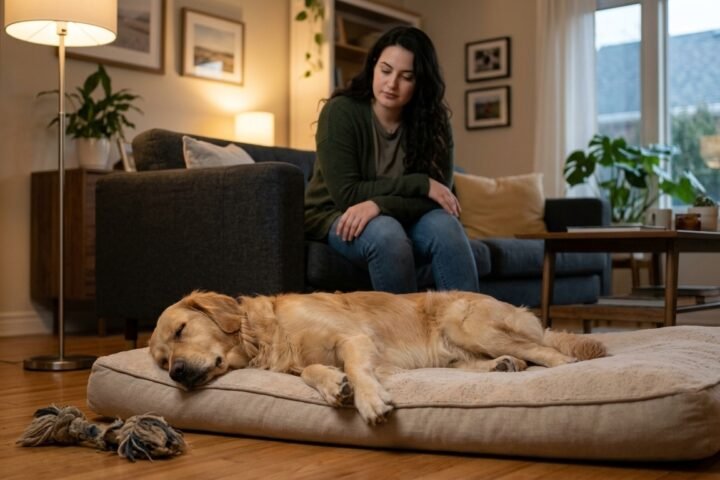
Older dogs may spend more time sleeping, but that does not mean they no longer need meaningful activity. Most still benefit from opportunities to sniff, make choices, solve manageable problems and enjoy positive social interaction.
According to Cornell University’s senior dog enrichment guidance, many older dogs remain interested in walks, activities and learning. The challenge is to adjust those experiences to the dog’s current physical abilities.
Appropriate enrichment may help:
- Reduce boredom during long periods indoors
- Encourage safe movement
- Preserve familiar skills
- Provide predictable, positive social contact
- Give dogs more control over their environment
- Support confidence as hearing or vision changes
- Improve daily quality of life
Mental exercise is not a guaranteed way to prevent dementia, nor is it a substitute for veterinary treatment. However, the Merck Veterinary Manual’s discussion of aging and cognitive dysfunction identifies physical and mental enrichment as an important part of managing older dogs, including those experiencing cognitive changes.
An enrichment session also does not need to be long. For many seniors, several short, successful activities are more appropriate than one difficult 30-minute challenge.
Check Your Senior Dog’s Health Before Adding Activities
Arrange a veterinary examination before substantially changing an older dog’s exercise or enrichment routine, particularly if your dog has recently become less active, irritable, confused or reluctant to play.
A dog who walks away from a puzzle may not be bored or stubborn. The dog might have:
- Neck, back or joint pain
- Dental disease
- Reduced ability to smell the reward
- Trouble seeing or hearing the toy
- Fatigue
- Medication-related drowsiness
- Anxiety about an unfamiliar object
- A medical or neurological condition
Pain can produce significant behavioral changes. A dog with sore hips, for example, may avoid a hard-floor search game because walking and turning on that surface hurts. The same dog may happily participate when treats are placed nearby on a nonslip mat.
If you notice hesitation around movement, learn to recognize other possible signs that your dog is in pain and discuss them with your veterinarian rather than trying to motivate the dog through discomfort.
Before each activity, consider five questions:
- Can my dog move comfortably on this surface?
- Can my dog see, hear or smell the relevant cue?
- Is the reward safe for my dog’s teeth and medical needs?
- Can I make the activity easier immediately?
- Can my dog stop or walk away freely?
Your veterinarian can help determine which activities are appropriate for a dog with arthritis, heart disease, breathing problems, neurological disease or another chronic condition.
11 Gentle Brain Games and Activities for Older Dogs
The best mental stimulation for senior dogs is safe, achievable and rewarding. Begin with the easiest version of each game. Increase difficulty only if your dog remains relaxed and interested.
1. Take a Slow Sniffing Walk
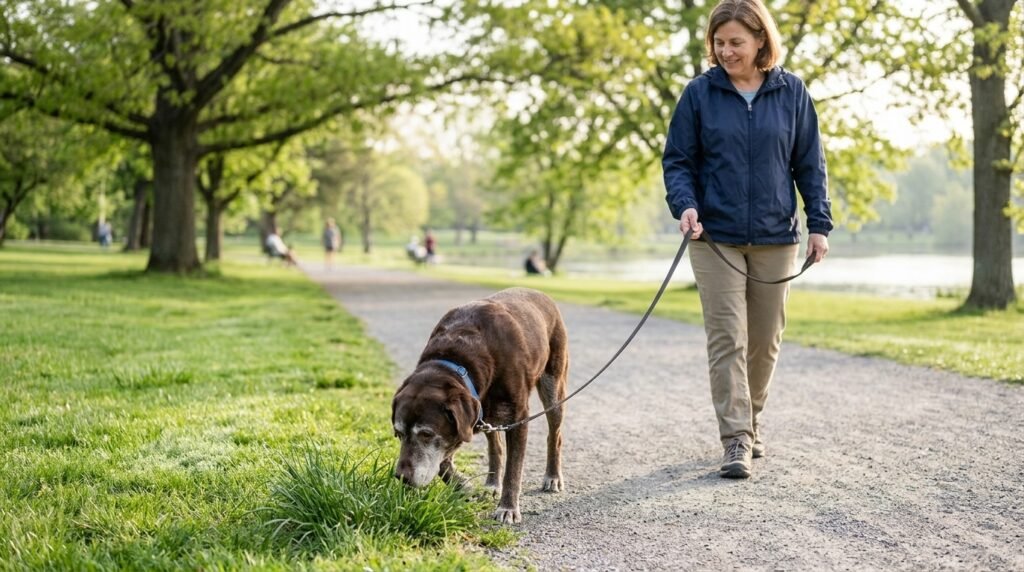
A senior walk does not need to cover a long distance to be meaningful. Let your dog investigate grass, trees, safe objects and other interesting smells at a comfortable pace.
Cornell recommends treating senior outings more like “sniffathons” than demanding exercise walks. Choose an easy route, avoid extreme temperatures and bring water when appropriate.
To make a sniffing walk senior-friendly:
- Use a comfortable harness if recommended for your dog
- Choose flat ground with reliable footing
- Allow frequent pauses
- Keep the route short enough for the return trip
- Avoid pulling your dog away from every safe smell
- Consider a new but quiet route occasionally
If your dog has hearing or vision loss, keep the dog securely leashed. An older dog may become disoriented or fail to locate you after wandering only a short distance.
2. Create an Easy Treat Search
Place several small treats in visible or lightly concealed locations and encourage your dog to find them. At first, let the dog watch you place every reward.
Suitable locations might include:
- On a nonslip mat
- Beside a familiar piece of furniture
- Under the edge of a lightweight towel
- Inside an open cardboard box
- A few feet apart along a safe hallway
Avoid stairs, slippery floors and tight spaces. The dog should not need to climb, jump or crawl under furniture.
Once your dog understands the game, you can hide treats behind easy obstacles or in another nearby room. If the dog gives up, simplify the search instead of repeatedly telling the dog to “find it.”
Use part of the dog’s measured meal when possible so the game does not add excessive calories.
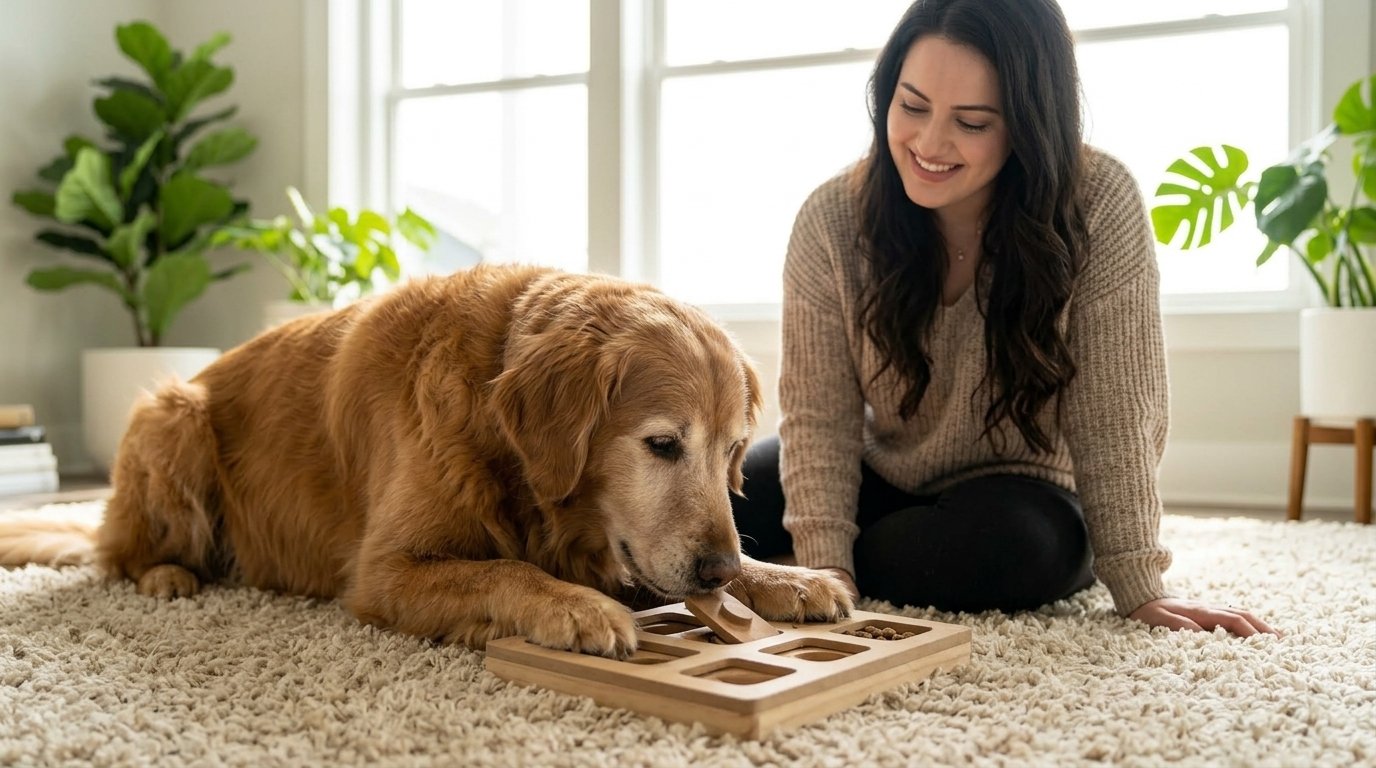
3. Serve a Meal in a Beginner Puzzle Feeder
Food puzzles combine eating with gentle problem-solving. For a senior beginner, choose a stable puzzle with large, easy-to-move components.
Start by leaving compartments partly open. You can also place a few pieces of food around the puzzle so the dog experiences an immediate success.
The puzzle should not require your dog to:
- Push forcefully with a painful nose or paw
- Stand for an extended time
- Bend the neck uncomfortably
- Chase a rolling object across a slippery floor
- Bite hard plastic with sensitive teeth
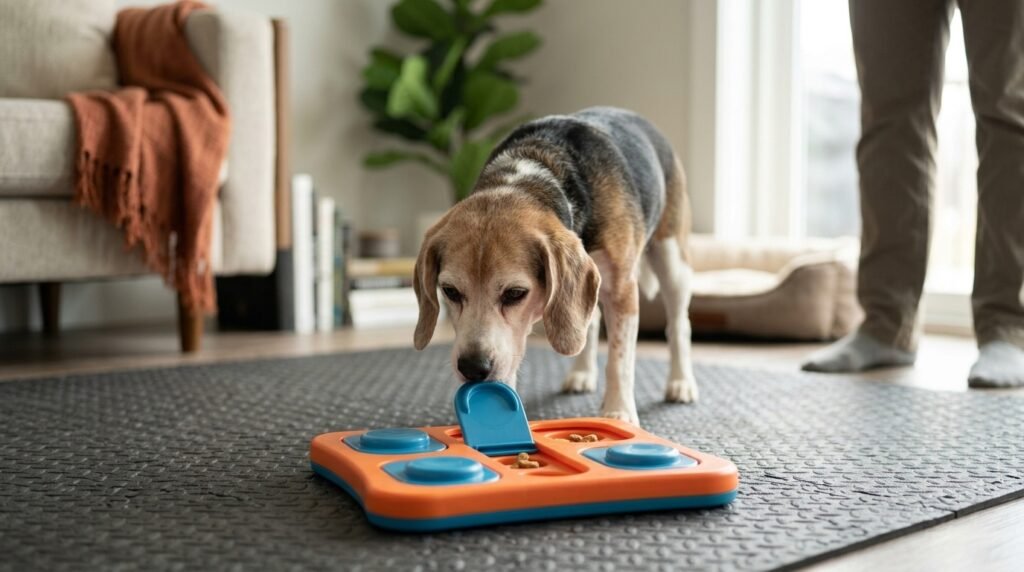
Supervise the first sessions. Remove any toy your dog tries to chew apart or swallow. Food puzzles should be washed regularly, especially when used with moist food.
4. Roll Treats in a Towel
Spread a towel flat, scatter a few pieces of kibble across it and loosely roll or fold it. Encourage your dog to investigate and unroll the fabric.
Keep the first version extremely simple. A tightly knotted towel can be frustrating and may be unsafe for a dog inclined to chew or swallow fabric.
This activity works especially well for dogs that enjoy using their noses but cannot walk far. Place the towel on a nonslip surface and remain nearby throughout the game.
Skip this activity if your dog guards food, destroys fabric or becomes distressed when a reward is difficult to reach. If food or toy possession causes tension, review the PawMindTips guide to understanding resource guarding in dogs and seek qualified help when necessary.
5. Practice Familiar Cues
Mental stimulation for senior dogs can come from skills they already know. Ask for one or two comfortable behaviors, reward them and finish while your dog is still interested.
Good options may include:
- Touching your hand with the nose
- Looking at you
- Going to a mat
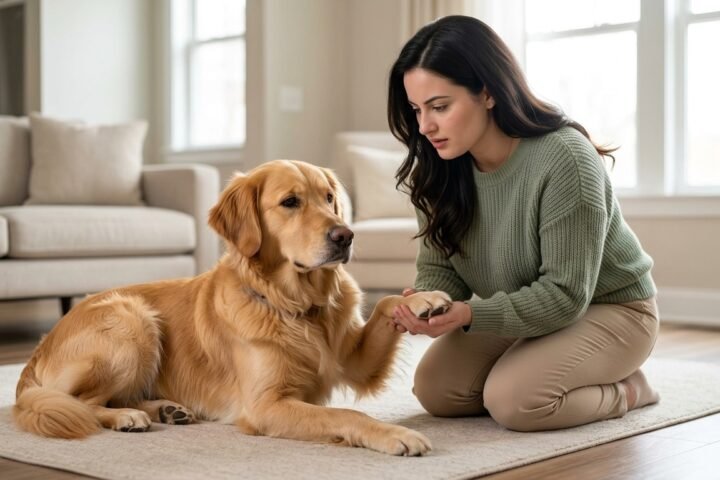
- Offering a paw while lying down
- Finding a familiar person
- Waiting briefly for a treat
- Resting the chin on a towel
Avoid repeated sits, downs or rollovers if those movements appear uncomfortable. A dog with hip or spinal pain may understand the cue perfectly but struggle to perform it.
If “stay” remains physically comfortable, use very short distances and durations. The PawMindTips step-by-step stay training guide can be adapted by keeping the exercise brief and rewarding.
Training should feel like a conversation, not an examination. Give the cue once, allow extra processing time and help your dog succeed.
6. Teach One Low-Impact New Skill
The familiar saying that old dogs cannot learn new tricks is inaccurate. Older dogs can learn, although they may need shorter lessons, clearer cues and more repetition.
Consider teaching your dog to:
- Touch a target with the nose
- Choose between two hands
- Ring a low, accessible bell
- Place the chin in your hand
- Look toward a named family member
- Find a clearly visible toy
- Step onto a flat mat
Use reward-based methods and sessions lasting approximately one to three minutes. Do not physically force the dog into position.
A nose-targeting skill is particularly useful because it provides mental exercise without demanding repeated sitting, jumping or turning.
7. Play a Cup-Choice Game
Place a treat beneath one of two lightweight, stable cups while your dog watches. Leave enough space under the chosen cup for the scent to escape, then allow the dog to indicate a choice.
Initially, lift the cup as soon as your dog approaches it. Later, you can switch the cups’ positions gently before offering the choice.
Use containers that cannot trap the dog’s muzzle or shatter. Do not let your dog chew plastic cups.
If two choices are confusing, use one cup until your dog understands that investigating it reveals food. The purpose is engagement, not testing whether your dog can solve a difficult memory problem.
8. Introduce a Safe Scent Box
Place a safe, familiar scent on a piece of fabric and let your dog investigate it. Food aromas usually create the easiest starting point. You can then place the scented item in an open box with one or two unscented items.
Never use essential oils casually for scent work. Concentrated oils may be irritating or toxic, and older dogs with respiratory or other medical conditions may be especially vulnerable. Food, a familiar toy or an item carrying a household member’s scent is generally a simpler choice.
Keep boxes open and shallow. Remove staples, packing tape, sharp edges and loose pieces that might be swallowed.
Dogs experiencing mild visual or hearing loss may still enjoy nose-based exploration, although smell can also decline with age. Watch what your individual dog can comfortably detect.
9. Offer a Supervised Exploration Box
Fill a shallow cardboard box or low-sided container with safe objects your dog can investigate. Possible items include:
- Loosely crumpled paper
- A familiar toy
- A clean towel
- Empty cardboard tubes that are too large to swallow
- A few visible treats
- A soft grooming brush carrying a familiar scent
Let the dog choose whether to approach. Do not push the dog’s face into the box or bury food so deeply that retrieving it becomes frustrating.
This activity adds novelty without requiring much walking. However, it is unsuitable for dogs that consume paper, cardboard or fabric.
10. Play Gentle Hide-and-Seek
Ask a familiar person to stand partly visible behind a doorway and call the dog once. When the dog finds the person, offer calm praise and a small reward.
Keep the search area compact and free of obstacles. A dog with declining hearing may respond better to a visual cue or the person’s scent than a voice. A dog with reduced vision may need the person to remain close and make a soft, familiar sound.
Never hide in a way that alarms the dog. If your senior appears worried when a person disappears, use a simpler version in which the person remains visible.
For an older dog with anxiety, predictable and gentle interaction is especially important. The PawMindTips guide on helping a nervous dog feel safer explains why gradual exposure and choice work better than overwhelming a worried dog.
11. Give Your Dog a Choice Activity
Choice itself can be enriching. Present two suitable toys, two walking directions or two resting spots and observe which option your dog selects.
You can teach a simple selection system:
- Hold one safe item in each hand.
- Present both at an accessible height.
- Let your dog sniff or look toward an item.
- Offer the selected activity.
- Accept it if the dog chooses neither.
Choice activities help owners notice changing preferences. A senior may begin selecting softer toys, shorter walks or food activities that require less standing. Those choices provide useful information about comfort and ability.
A consistent change in preference—particularly sudden avoidance of food, touch, movement or family interaction—should be discussed with a veterinarian.
Adapt Activities for Arthritis, Hearing Loss and Poor Vision
Aging affects dogs differently. Mental stimulation for senior dogs becomes safer when the environment accommodates the dog rather than expecting the dog to compensate.
| Senior change | Helpful adaptation | What to avoid |
|---|---|---|
| Arthritis or weakness | Nonslip mats, raised puzzles, short sessions | Jumping, sharp turns, slippery floors |
| Vision loss | Familiar layout, scent and sound cues | Moving furniture frequently, stairs without barriers |
| Hearing loss | Hand signals, floor vibrations, visual cues | Startling the dog by approaching from behind |
| Dental discomfort | Soft rewards and lickable puzzles if vet-approved | Hard chews and toys requiring forceful biting |
| Reduced smell | More aromatic vet-approved rewards | Making searches difficult too quickly |
| Cognitive changes | Simple tasks and a consistent routine | Complex puzzles, punishment and abrupt changes |
| Low stamina | One- to three-minute sessions | Continuing after fatigue appears |
Place rugs or nonslip runners around activity areas. If a puzzle slides away whenever your dog touches it, secure it against a wall or on a rubber mat.
Senior dogs may take longer to process a cue. Pause before repeating yourself. Rapid repetition can add pressure without improving understanding.
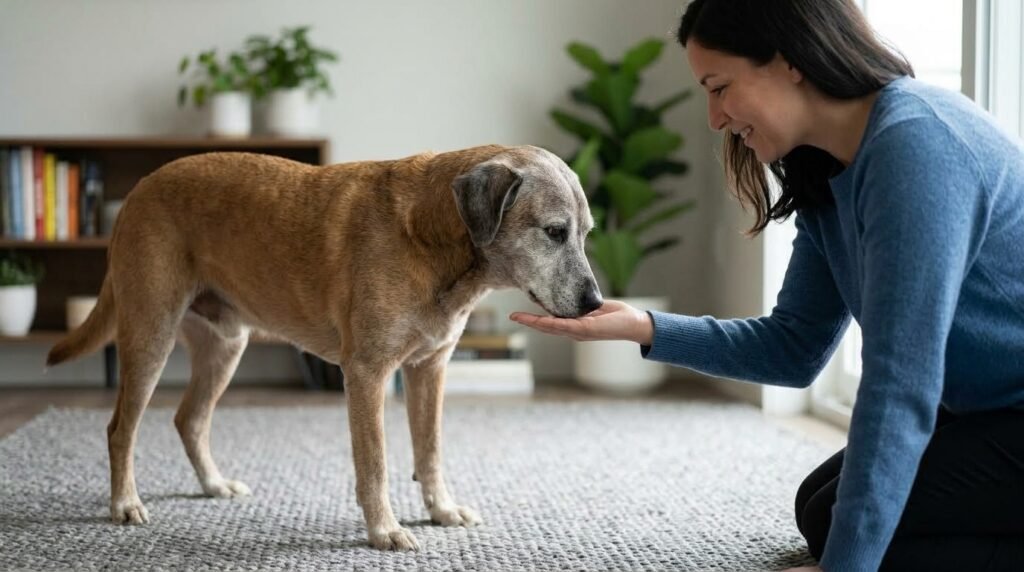
The objective is not constant novelty. Dogs with cognitive changes often benefit from a balance of mild novelty and a predictable routine. Familiarity can provide security, while a manageable variation—such as placing the same puzzle in a slightly different safe location—can encourage exploration.
Build a Simple Daily Enrichment Routine
A sustainable schedule is better than occasional, overly ambitious activity sessions. One possible routine is:
Morning: A slow, five- to fifteen-minute sniffing walk, adjusted for health and weather.
Breakfast: Part of the meal served in an easy puzzle feeder or scattered across a nonslip snuffle mat.
Afternoon: A one- to three-minute training session using familiar cues.
Evening: A simple treat search, supervised exploration box or quiet choice between two toys.
This is only an example. Some senior dogs will want more, while dogs with significant illness may prefer one brief activity followed by rest.
Use the “finish wanting more” principle. End a session after a few successful repetitions instead of waiting for exhaustion or frustration.
Keep a short record of:
- Activity used
- Duration
- Interest level
- Ease of movement
- Signs of frustration
- Recovery afterward
- Changes noticed over time
This record can help you identify which activities your dog enjoys and provide useful information during veterinary appointments.
Mental enrichment should complement sleep, social contact, appropriate physical activity, veterinary care and suitable nutrition. It should not keep a tired dog awake or pressure a dog to participate.
Choose Safe Toys, Food Rewards and Difficulty Levels
Select toys according to the dog in front of you—not the manufacturer’s age label alone. A toy marketed for senior dogs may still be too hard, small, unstable or complicated for your particular pet.
A suitable enrichment toy should be:
- Large enough that it cannot be swallowed
- Strong enough for the dog’s chewing style
- Free of sharp or easily detached parts
- Easy to clean
- Stable on the floor
- Appropriate for the dog’s dental health
- Simple enough to produce early success
Supervision is essential when introducing a toy. Inspect it regularly and discard it if pieces loosen or surfaces become sharp.
When food drives the activity, account for the calories. Use part of the dog’s normal meal or tiny pieces of an appropriate reward. Dogs with diabetes, pancreatitis, kidney disease, allergies or prescription diets may require veterinarian-approved ingredients.
Do not dramatically reduce balanced meals to compensate for numerous treats without veterinary guidance. A senior dog still needs an appropriate complete diet.
Adjust difficulty according to your dog’s response:
- Too easy: The dog completes it immediately and remains eager. Add one minor challenge.
- Appropriate: The dog works steadily, succeeds and chooses to continue.
- Too hard: The dog paws frantically, barks, bites the object, walks away or looks repeatedly to you for help.
A puzzle that creates distress is not beneficial simply because it is mentally demanding.
Signs Your Senior Dog Needs a Break
Stop or simplify an activity if your dog shows:
- Panting unrelated to heat
- Repeated yawning or lip licking
- Turning the head or body away
- Freezing
- Pacing
- Whining or barking
- Frantic scratching or biting at the puzzle
- Sudden loss of interest
- Limping or difficulty rising
- Trembling
- Confusion
- Irritability
- Refusal of a normally valued reward
Some of these behaviors can indicate stress, pain, fatigue or a medical problem. Context matters. A single yawn is not a diagnosis, but several changes occurring together deserve attention.
Allow the dog to leave. Lower the difficulty the next time, shorten the session or choose a different type of enrichment.
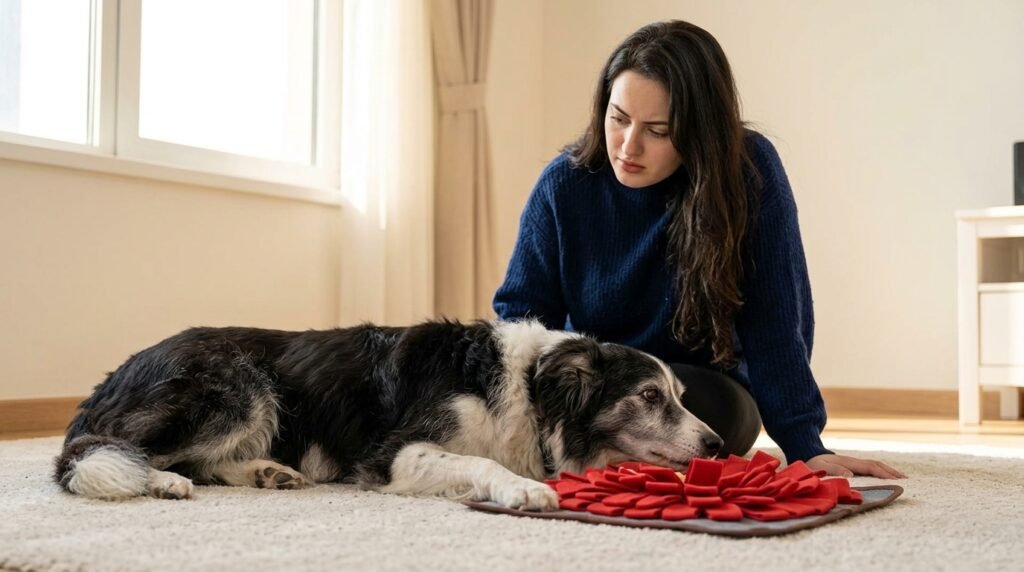
Never scold a senior dog for failing to complete an activity. Punishment can increase anxiety and may make the dog reluctant to interact with you or the enrichment object again.
When Behavior Changes Need Veterinary Attention
Mental stimulation for senior dogs supports quality of life, but games cannot diagnose or treat an underlying disease.
Contact your veterinarian if you notice a persistent or sudden change such as:
- Getting trapped behind furniture or in corners
- Appearing lost in familiar rooms
- Staring blankly at walls
- Sleeping much more during the day
- Pacing or vocalizing at night
- New house-soiling
- Increased anxiety or clinginess
- Reduced recognition of familiar people
- Repetitive pacing
- Major changes in appetite or activity
- Falling, circling, tremors or weakness
- Sudden aggression or sensitivity to touch
The AAHA senior-care guidelines explain that signs of canine cognitive dysfunction can include disorientation, altered social interaction, sleep changes, house-soiling, activity changes and anxiety. They also emphasize that other health problems can resemble cognitive decline.
A veterinarian may need to evaluate pain, sensory loss, organ disease, urinary conditions, neurological problems or medication effects. Cognitive dysfunction is generally assessed after competing medical explanations have been considered.
Early evaluation matters because management may be more helpful when cognitive changes are recognized promptly. Do not assume that significant confusion, nighttime distress or house-soiling is simply an unavoidable part of getting old.
Frequently Asked Questions
How much mental stimulation does a senior dog need?
There is no universal number of minutes. Begin with one- to five-minute sessions and observe your dog’s interest, comfort and recovery. Several brief activities spread throughout the day are often more manageable than one long session.
What is the best mental stimulation for senior dogs with arthritis?
Scent searches on nonslip flooring, raised puzzle feeders, nose-target training and simple choice games can provide enrichment with little physical strain. Ask your veterinarian which movements are safe for your dog’s specific condition.
Can mental stimulation prevent dementia in dogs?
No activity can guarantee that a dog will not develop canine cognitive dysfunction. Environmental enrichment may support cognitive health and is included in veterinary management recommendations, but it is not a cure or substitute for professional evaluation.
What if my senior dog is not interested in toys?
Try food searches, sniffing walks, calm social interaction, grooming your dog enjoys or a familiar training cue. A sudden loss of interest can also signal pain, sensory decline or illness, so discuss significant changes with your veterinarian.
Conclusion
Mental stimulation for senior dogs works best when it is gentle, flexible and centered on the individual dog. Sniffing walks, easy searches, beginner puzzles, choice games and brief reward-based training can make ordinary days more engaging without placing excessive demands on aging joints.
Start with activities your dog can complete successfully. Use secure footing, appropriate rewards and short sessions, and let your dog decide when to stop.
Most importantly, do not explain away sudden confusion, nighttime restlessness, new house-soiling or loss of interest as “just old age.” Enrichment can support an older dog’s quality of life, but meaningful behavioral or physical changes should receive veterinary attention.