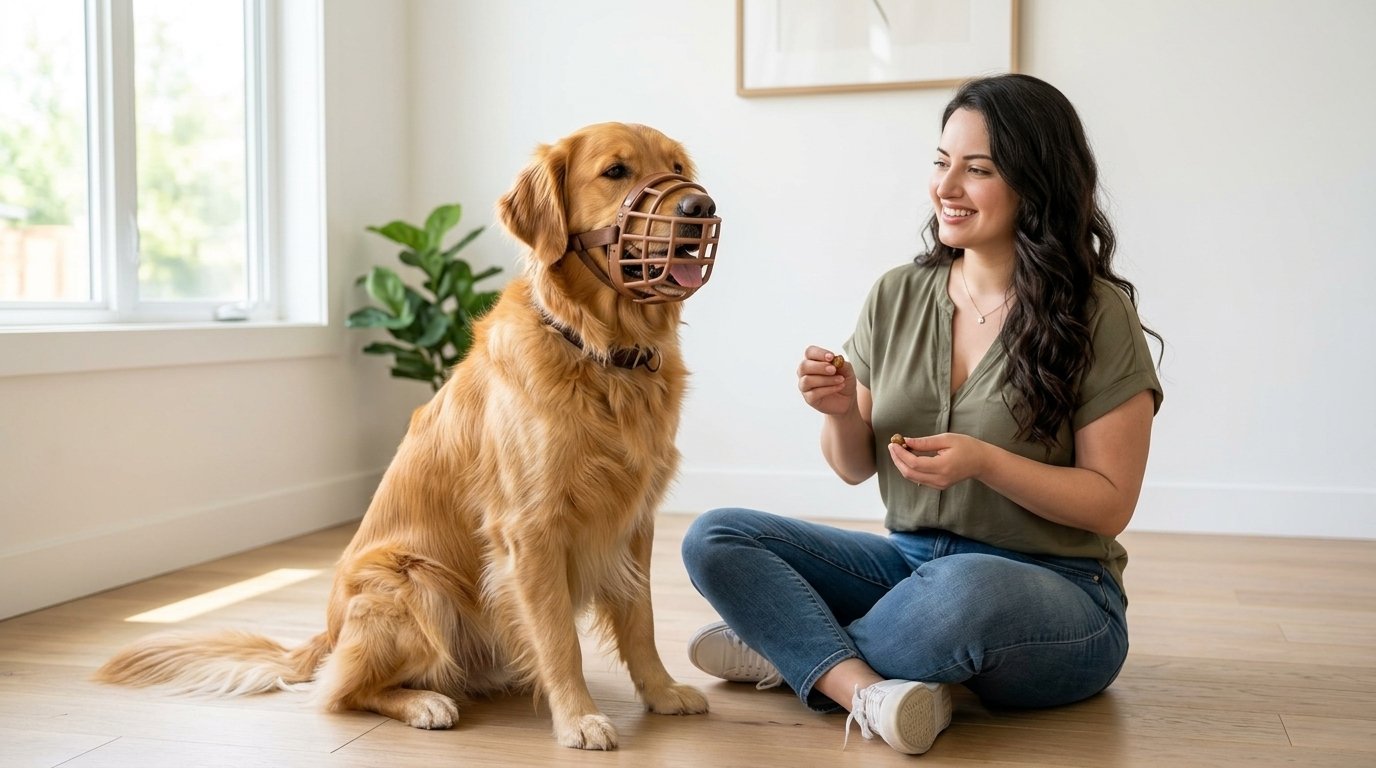
Muzzle training for dogs does not have to involve forcing equipment onto a frightened dog. Done well, it is a gradual process in which your dog learns that seeing the muzzle, putting their nose inside it, having the straps fastened, and eventually wearing it all predict safe and rewarding experiences.
A muzzle can be useful for veterinary care, grooming, behavior-management situations, scavenging prevention, and unexpected emergencies. Even a normally friendly dog may behave defensively when frightened, injured, or in pain.
The goal, however, is not simply to make your dog “tolerate” a muzzle. Good training helps your dog participate voluntarily and become comfortable with it.
This seven-step guide explains how to choose an appropriate muzzle, check the fit, introduce it without force, build duration gradually, and avoid mistakes that can make dogs afraid of wearing one.
Table of Contents
Why Muzzle Training for Dogs Is a Useful Life Skill
A muzzle is often associated with aggression, but that is only one reason a dog might wear one.
A dog may need or benefit from a muzzle during:
- Veterinary examinations
- Painful or uncomfortable medical procedures
- Grooming or handling
- Behavior-management situations
- Carefully managed exposure around known triggers
- Walks when scavenging presents a serious risk
- Emergencies in which an injured or frightened dog must be handled
- Situations in which local rules require one
Cornell University’s canine health guidance explains that even friendly dogs may become more inclined to growl or bite when frightened, stressed, in pain, or being handled in unfamiliar ways. A properly fitted basket muzzle can provide an additional safety layer while still allowing the dog to pant, drink, and receive treats.
That is why learning to wear a muzzle before an emergency occurs can be valuable.
Trying to introduce unfamiliar equipment for the first time while a dog is already injured, frightened, or overwhelmed can make the situation harder for everyone.
Instead, treat muzzle training like teaching your dog to wear a harness or accept routine handling: practice when nothing stressful is happening.
A muzzle is management, not a cure
This distinction is essential.
A muzzle can help prevent a bite, but it does not make an uncomfortable dog suddenly comfortable around a trigger.
If your dog is frightened by strangers, for example, wearing a muzzle does not remove that fear. You should still provide appropriate distance and address the underlying behavior.
Dogs Trust similarly notes that a muzzle does not change how a dog feels about a situation or trigger.
If fear is part of the reason you’re considering a muzzle, learning how to help a nervous dog without forcing interaction can help you approach both problems with the same emphasis on choice and gradual progress.
Choose the Right Muzzle Before Training
Successful muzzle training for dogs begins with appropriate equipment.
For most training and many routine management situations, a basket-style muzzle is preferable to a tight sleeve-style muzzle.
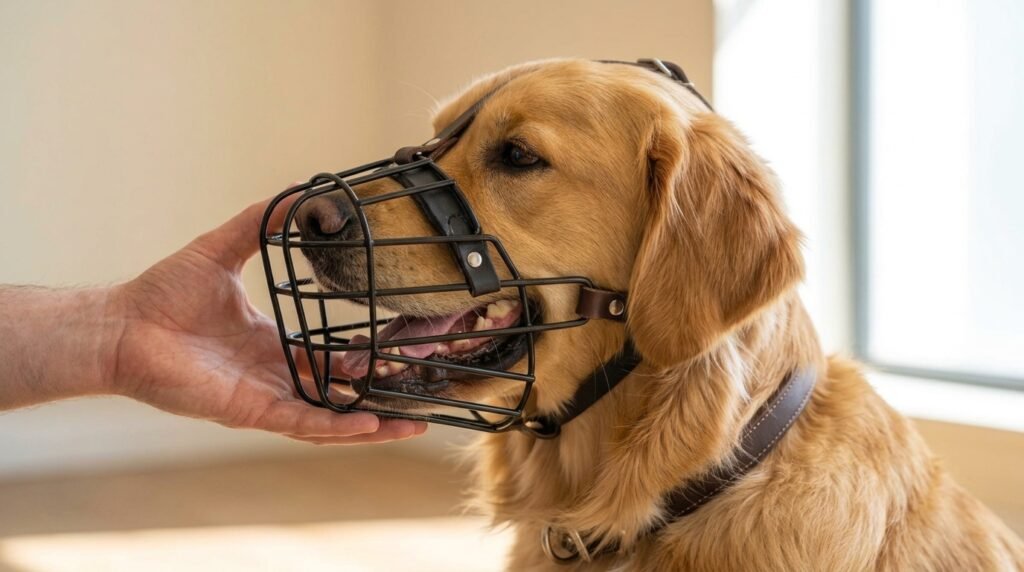
A well-designed and correctly fitted basket muzzle should provide enough space for your dog to:
- Pant adequately
- Open their mouth
- Accept training treats
- Drink when appropriate
- Breathe normally
- Move without the muzzle rubbing against sensitive areas
VCA Animal Hospitals’ muzzle training guidance recommends basket muzzles and notes that a proper fit should permit panting and treats while keeping the muzzle away from the dog’s eyes, nostrils, and soft nose tissue.
Tight fabric or sleeve muzzles restrict mouth movement and generally are not suitable for normal training or prolonged wear. VCA describes their use as appropriate only for very short urgent situations when there is no alternative.
Match the muzzle to your dog’s face
Dogs do not all have the same head shape.
A muzzle that fits one Labrador may be completely inappropriate for another breed—or even another Labrador.
Consider:
- Snout length
- Snout circumference
- Head shape
- Panting room
- Strap position
- Distance from the eyes
- Distance from the end of the nose
- Security when the dog moves
Brachycephalic dogs, including breeds with very short muzzles, can present additional fitting challenges. Ask your veterinarian or an experienced qualified professional for help if you cannot find equipment that safely accommodates your dog’s face and breathing.
Never choose a muzzle merely because the package lists your dog’s breed.
Individual measurements matter more.
How Should a Basket Muzzle Fit?
Fit deserves attention before you start building significant wearing time.
Your dog’s muzzle should be secure enough that it cannot simply be rubbed or shaken off, but “secure” does not mean squeezing the dog’s mouth shut.
Look at your dog from the front, side, and above.
Check that:
- The muzzle does not press against the eyes.
- It does not rub painfully across the bridge of the nose.
- The nostrils remain unobstructed.
- Your dog has sufficient room to pant.
- Your dog can take appropriately sized treats through it.
- Straps are secure without digging into the skin.
- The basket remains stable during normal movement.
- Your dog cannot easily pull it off.
Cornell’s basket muzzle training guidance specifically recommends a basket design that permits panting, drinking, and treats. Cornell also advises adjusting the strap so the muzzle cannot slip over the head while leaving appropriate space beneath the strap.
Panting room is particularly important because dogs use panting to regulate body temperature.
Do not assume that being able to close the straps means the fit is correct.
If you are uncertain, have a veterinarian or experienced reward-based trainer assess the muzzle before progressing to longer wearing periods.
Muzzle Training for Dogs: 7 Gentle Steps
The following progression is intentionally gradual.
There is no prize for completing all seven steps in one day. Some dogs move quickly, while others need repeated sessions at an early stage before they are ready to progress.
A useful rule is simple:
Advance according to your dog’s comfort, not according to a calendar.
Step 1: Let Your Dog Notice the Muzzle
Start somewhere quiet and familiar.
Have small, high-value treats ready. Bring out the muzzle, but do not immediately move it toward your dog’s face.
Allow your dog to look at or investigate it.
When your dog calmly notices the muzzle, reward them.
You can then put the muzzle away briefly and repeat.
The first lesson is not “wear this.”
It is:
“When this object appears, good things happen.”
Keep the first sessions short. Cornell recommends short muzzle-training sessions and beginning when the dog is not already stressed.
Do not chase your dog with the muzzle, corner them, or hold their head still.
If your dog backs away as soon as the muzzle appears, increase the distance and reward calm observation instead.
For a dog with an established fear of the muzzle, simply being comfortable in the same room with it may be the first training goal.
Step 2: Encourage Voluntary Nose Entry
Once your dog is comfortable approaching the muzzle, turn the opening toward them.
Place a treat inside or hold a treat so your dog needs to put part of their nose into the basket to reach it.
The important word is voluntary.
Your dog should move toward the muzzle.
Do not push the muzzle over your dog’s face.
Let them eat the reward and withdraw their nose whenever they want.
Repeat until your dog readily approaches.
As confidence improves, begin rewarding progressively deeper nose placement.
Eventually, your dog should comfortably put their entire nose inside.
Dogs Trust’s step-by-step muzzle training method similarly emphasizes giving dogs the choice to put their nose in and out of the muzzle and to move away.
Choice is especially valuable with cautious dogs because forcing the equipment onto the face can quickly create the association you are trying to prevent.
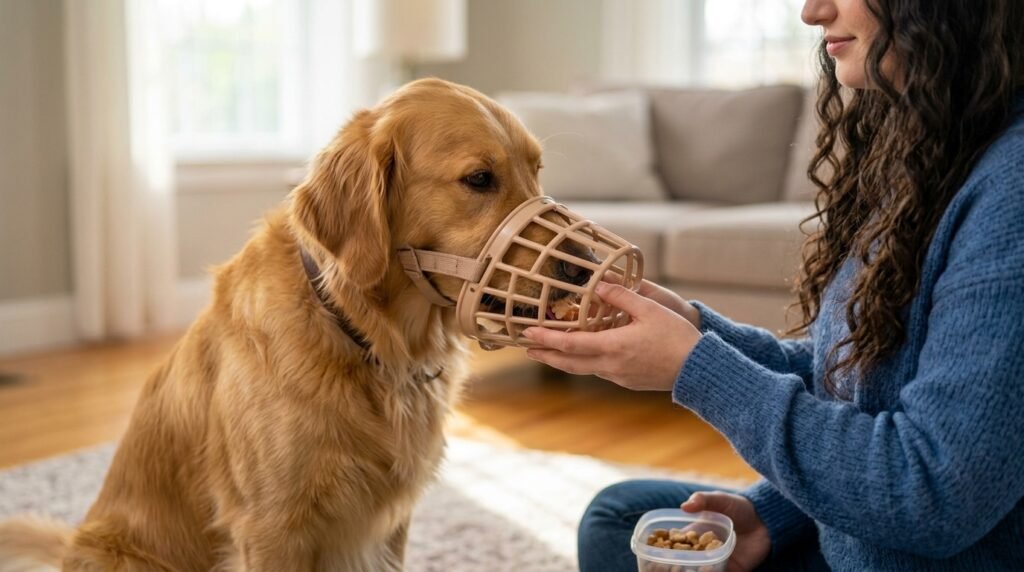
Step 3: Reward Staying in the Muzzle
Now start building a little duration without fastening anything.
Present the muzzle.
Let your dog voluntarily insert their nose.
Instead of immediately giving one treat and removing the muzzle, provide several small rewards through the basket while their nose remains inside.
Then stop feeding and let the dog withdraw.
At first, this might last only a second or two.
Gradually work toward several comfortable seconds.
Watch your dog’s body language throughout the exercise.
A dog who is comfortable may eagerly return to the muzzle when it is presented again.
Signs you may be progressing too quickly include:
- Repeatedly turning the head away
- Backing up
- Freezing
- Refusing normally desirable treats
- Frantic pawing
- Trying to escape
- Becoming unusually tense
- Avoiding you when the muzzle appears
One signal alone does not always prove distress, so consider the whole situation. PawMindTips’ guide to signs of a stressed dog can help you recognize clusters of body-language changes that suggest a training session has become too difficult.
If your dog becomes worried, return to an easier stage.
Going backward temporarily is not failure. It is part of good training.
Step 4: Introduce the Strap and Fastener Separately
A dog may be completely comfortable putting their nose into the basket but become startled when a strap moves behind their head or a buckle clicks.
Treat this as a separate skill.
Before fastening the muzzle on your dog, practice gentle strap movement.
You might:
- Let your dog put their nose into the muzzle.
- Briefly touch or lift the strap.
- Reward.
- Release your dog.
You can also practice the buckle sound away from the dog’s head if the click itself causes concern.
Keep the difficulty low.
When your dog remains relaxed as the straps move around their head, you can begin preparing to fasten them.
Do not suddenly hold your dog still and buckle the muzzle simply because they willingly placed their nose inside.
You want voluntary nose entry and comfortable fastening to become parts of the same positive routine.
Step 5: Fasten the Muzzle Briefly
When your dog comfortably keeps their nose in the basket and accepts strap movement, fasten the muzzle for a very short period.
At first:
Fasten → reward → unfasten.
The muzzle may stay secured for only one or two seconds.
That is enough.
Repeat until fastening feels routine.
Then gradually increase the interval:
- A few seconds
- Several seconds
- A little longer
- A short easy activity
Continue rewarding your dog through the basket.
VCA’s training progression likewise recommends initially securing the muzzle only briefly, feeding immediately, removing it, and increasing wearing time gradually.
Avoid making large jumps in duration.
If your dog is comfortable for 10 seconds, that does not automatically mean they are ready for 20 minutes.
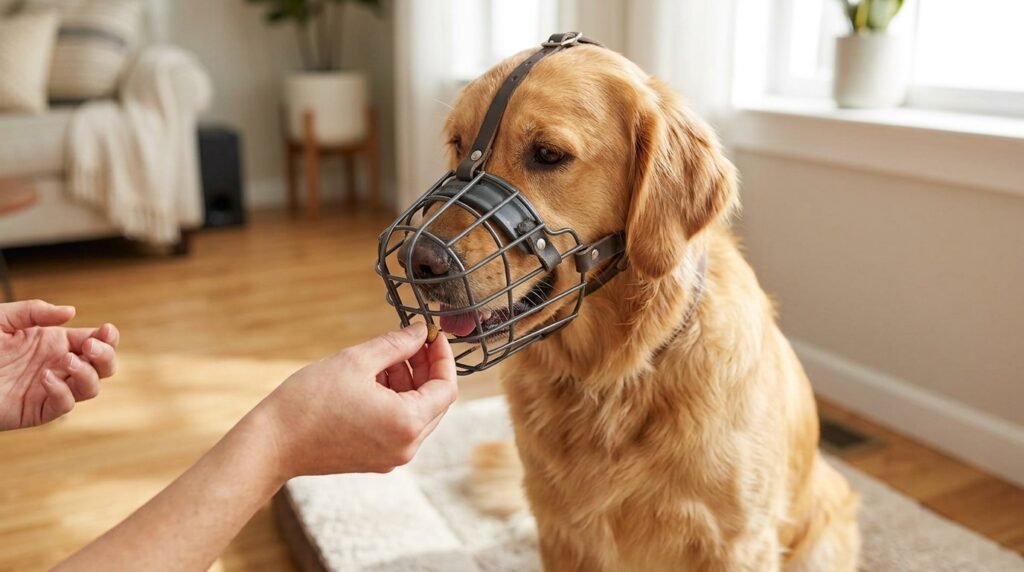
Step 6: Add Movement and Easy Activities
Standing still in a muzzle and moving around in one can feel different to a dog.
Once your dog can comfortably wear the fastened muzzle for short periods, introduce easy movement.
Start indoors.
You might ask your dog to:
- Take two or three steps with you
- Touch your hand
- Sit
- Walk across the room
- Follow you
- Perform a familiar easy trick
Reward frequently.
Choose behaviors your dog already knows well. This is not the time to teach something difficult.
Movement also gives you an opportunity to observe the fit.
Does the muzzle shift toward the eyes?
Does it rub when your dog turns their head?
Does your dog have adequate panting space?
Can they take rewards easily?
Does the strap remain secure?
Address fitting problems before progressing.
Once indoor movement is easy, practice in another low-distraction area.
Avoid jumping directly from a quiet living room to the most difficult environment in your dog’s life.
Step 7: Gradually Build Real-World Comfort
The final stage of muzzle training for dogs is generalization.
Your dog needs to learn that wearing the muzzle remains safe and predictable in different settings.
Depending on why you need it, you might gradually practice:
- Around the house
- In the yard
- During a quiet walk
- Getting into the car
- Near the veterinary clinic without an appointment
- During simple handling exercises
- Around other carefully managed everyday situations
Change one difficulty at a time whenever possible.
For example, do not simultaneously increase duration, introduce a crowded environment, add unfamiliar people, and expect difficult handling.
If your dog is comfortable wearing the muzzle for five minutes at home but becomes tense immediately outside, reduce the environmental difficulty.
Your dog is giving you useful information.
The aim is not to prove they can endure the muzzle.
The aim is to create a dog who understands what is happening and remains comfortable wearing it.
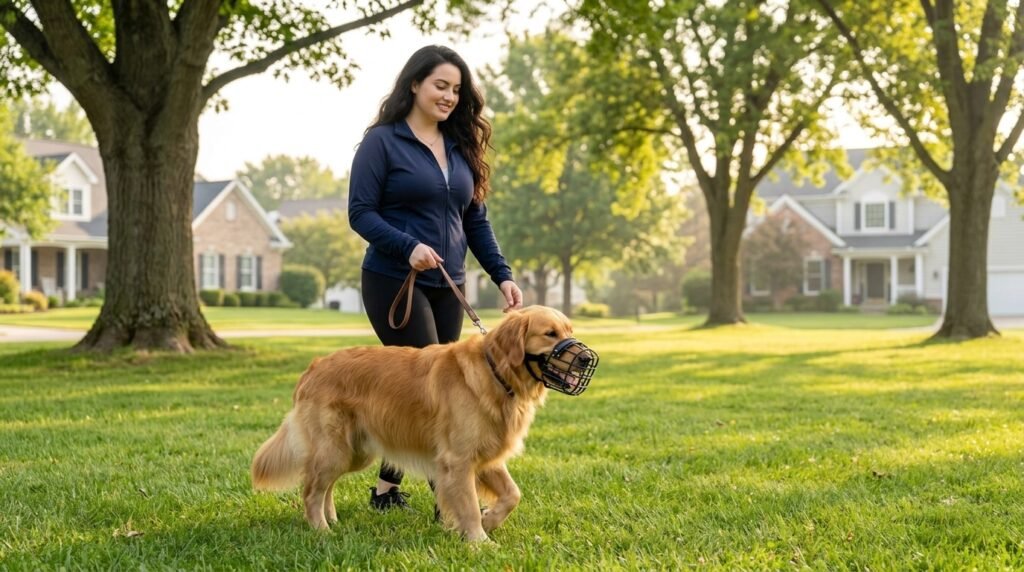
How Fast Should Muzzle Training Progress?
There is no universal schedule.
Some dogs with no negative history around face handling may progress relatively quickly. A dog who has previously been restrained, forced into a muzzle, or frightened during veterinary procedures may need much more time.
Rather than asking, “How many days should this take?” ask:
“What is my dog telling me at this stage?”
Good signs include:
- Approaching when the muzzle appears
- Voluntarily inserting the nose
- Remaining interested in food
- Relaxed movement
- Normal engagement with you
- Comfort with strap movement
- Returning for another repetition
- Wearing the muzzle without persistent attempts to remove it
If your dog suddenly refuses to participate, do not automatically assume stubbornness.
Check whether:
- You increased duration too quickly.
- The environment became harder.
- The muzzle rubs or pinches.
- The dog is tired or stressed.
- The rewards are not valuable enough.
- You accidentally began moving the muzzle toward the dog instead of letting the dog approach it.
- A recent unpleasant event changed the dog’s association.
Short successful sessions are usually more useful than continuing until the dog becomes frustrated.
Common Muzzle Training Mistakes
Even a good training plan can become unpleasant if the muzzle is introduced too quickly.
Forcing the dog’s face into the muzzle
This removes choice and can make the dog actively avoid the equipment.
Present the basket and teach the dog to move toward it.
Fastening it during the first introduction
Putting the muzzle on immediately skips the association-building stages.
Unless an emergency requires immediate safety measures, establish voluntary nose entry first.
Increasing duration too quickly
A dog who calmly wears the muzzle for five seconds is not necessarily prepared to wear it throughout an hour-long outing.
Increase duration in manageable increments.
Using the muzzle only for unpleasant events
If the muzzle appears exclusively before injections, painful procedures, or other frightening experiences, your dog may learn that its appearance predicts something bad.
Practice during ordinary, positive situations too.
Ignoring stress signals
Training should become easier when your dog shows discomfort, not more forceful.
If your dog freezes, retreats, repeatedly refuses food, or tries desperately to remove the muzzle, assess what changed and return to an easier stage.
Punishing resistance
Scolding a frightened dog does not teach comfort.
It may instead make the muzzle—and you—part of the stressful experience.
This is also why avoiding habits that can damage your dog’s trust matters during handling exercises. Predictability and respecting reasonable attempts to disengage can help preserve your dog’s confidence in the training process.
Leaving a muzzled dog unattended
A muzzle is safety equipment, not a substitute for supervision.
Cornell specifically advises against leaving a muzzled dog unattended because the dog may remove, chew, or potentially swallow parts of the equipment.
What a Muzzle Can—and Cannot—Do
Understanding the limits of a muzzle is just as important as teaching a dog to wear one.
A muzzle can provide an additional safety barrier
When appropriately selected and fitted, a muzzle can reduce bite risk during situations in which defensive behavior is possible.
That can be valuable during veterinary care or as one part of a professionally designed behavior-management plan.
A muzzle does not cure aggression or fear
Suppose your dog lunges because another dog is too close.
Putting on a muzzle can add a safety layer, but it does not change the underlying emotional response.
You still need appropriate distance, management, and—when necessary—professional behavior support.
A muzzle should not be used to stop barking
This is particularly important.
A muzzle should not be selected or tightened with the purpose of holding the dog’s mouth shut.
VCA Animal Hospitals explicitly advises that muzzles should not be used as a tool to stop barking.
If barking is the problem, identify why the dog is barking and address that behavior appropriately rather than restricting normal mouth movement.
A muzzle is not punishment
Never put a muzzle on a dog to “teach them a lesson.”
The muzzle should predict safety, rewards, and predictable handling—not anger or punishment.
A muzzle does not justify putting a dog into overwhelming situations
A muzzled dog can still experience fear.
Do not use the equipment as permission to force a fearful dog closer to people, dogs, handling, or other triggers they cannot cope with.
Management should reduce risk while behavior work addresses the underlying problem.
When Professional Help Is Appropriate
Many dogs can learn basic muzzle skills through gradual positive reinforcement at home.
However, professional help becomes especially important when safety or significant fear is involved.
Contact your veterinarian and/or an appropriately qualified behavior professional if your dog:
- Has bitten someone or another animal
- Has attempted to bite during handling
- Shows escalating aggression
- Has severe fear around people or dogs
- Panics when anything approaches their face
- Guards food used during training
- Cannot tolerate necessary handling
- Suddenly develops aggressive behavior
- Appears painful
- Has a facial or respiratory condition that complicates muzzle fitting
Pain and illness can affect behavior, so a sudden change should not automatically be treated as a training problem.
If there is an immediate bite risk, prioritize safety and professional guidance rather than deliberately recreating the trigger to practice.
American Kennel Club guidance on appropriate muzzle use also notes that injured dogs may bite because of pain, even when biting is otherwise out of character.
The best muzzle-training plan therefore combines two ideas:
Prepare before you need the equipment, and respect the reason you may need it.
FAQs
1. How long does muzzle training for dogs take?
There is no fixed timeline. Some dogs become comfortable with the basic process relatively quickly, while dogs with previous fear, forced handling, or negative muzzle experiences may need considerably longer. Progress according to your dog’s body language rather than trying to meet a deadline.
2. What should I do if my dog keeps pawing at the muzzle?
First check the fit and make sure the muzzle is not rubbing, pinching, blocking vision, or preventing adequate panting. If fit is appropriate, persistent pawing may indicate that training progressed too quickly. Shorten the wearing period and return to an easier stage where your dog remains comfortable.
3. What type of muzzle is best for muzzle training?
A properly fitted basket-style muzzle is generally preferred for training because it can provide room for panting, drinking, and receiving treats. The exact design must suit your dog’s individual face and intended use. Tight sleeve-style muzzles that hold the mouth closed are not appropriate for normal extended training sessions.
4. Can I use a muzzle to stop my dog from barking?
No. A muzzle should not be tightened or selected to hold a dog’s mouth closed simply to stop barking. Barking has an underlying cause that should be addressed separately. A properly fitted basket muzzle should provide adequate mouth and panting room.
Conclusion
Muzzle training for dogs works best when the muzzle becomes familiar before it is urgently needed.
Choose an appropriate basket-style muzzle, make sure it fits correctly, and begin with the simplest possible interaction. Reward your dog for noticing it, encourage voluntary nose entry, gradually build duration, introduce the straps carefully, and only then add movement and real-world situations.
Most importantly, listen to the dog in front of you.
Slowing down when your dog becomes uncomfortable is not losing progress. It is how you protect the positive association you are trying to build.
A well-fitted muzzle can provide an important layer of safety, but it should never replace appropriate supervision, distance from triggers, veterinary care, or professional behavior support when those are needed.
With patient, reward-based practice, wearing a muzzle can become another ordinary life skill rather than something your dog first encounters during an already stressful emergency.