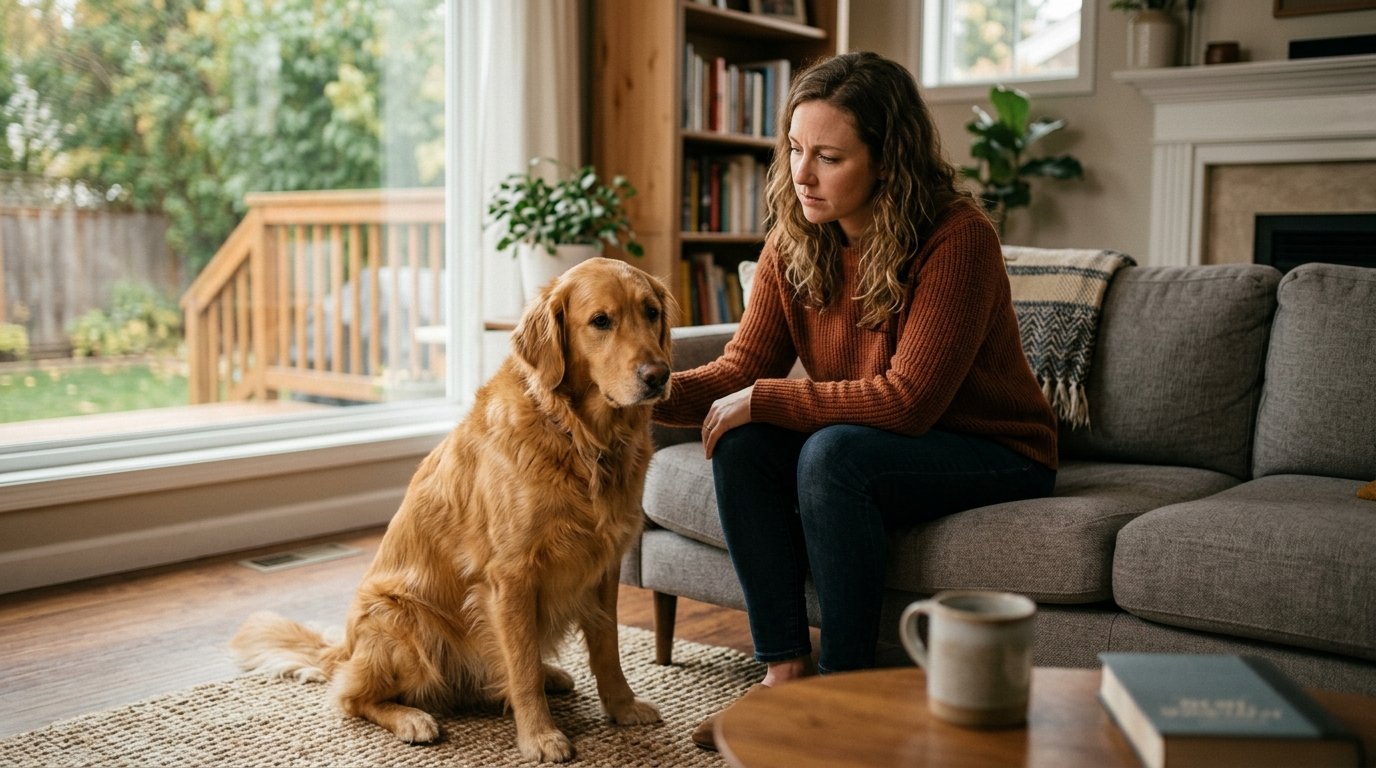
You can love your dog deeply and still make mistakes that affect how safe, understood, and connected they feel. In fact, many of the things that hurt your dog’s feelings are not acts of cruelty at all. They are ordinary habits that seem harmless from a human point of view.
A dog may experience being pushed away, shouted at, ignored, or frightened very differently from the way we intend. Dogs communicate largely through body language, patterns, associations, and behavior. When those signals are repeatedly misunderstood, the relationship can become confusing for them.
The good news is that most of the things that hurt your dog’s feelings can be changed without becoming a perfect dog owner. You do not need complicated equipment or military-style discipline. You need consistency, patience, observation, and a willingness to understand what your dog is communicating.

This guide is based on the ideas in the supplied source transcript and supported where appropriate by veterinary and animal-behavior resources. One important distinction: dogs can experience emotions such as fear, frustration, and pleasure, but we should avoid assuming every human emotion maps directly onto a dog’s mind. What matters most is observable behavior and the effect our actions have on their welfare and learning.
Table of Contents
1. Things That Hurt Your Dog’s Feelings: Taking Away Their Food
One of the most important things that hurt your dog’s feelings is repeatedly taking food away while they are eating simply to “test” whether they will tolerate it.
Imagine sitting down for dinner and having someone repeatedly reach for your plate. Even if they give it back every time, you would eventually become tense when they approached.
Dogs can develop a similar association around valuable resources. The ASPCA explains that resource guarding is normal canine behavior and can range from moving away with an item to growling or biting when someone approaches.
Why taking food away can backfire
If a dog repeatedly learns that a human approaching the bowl means food disappears, the dog may begin eating faster, becoming stiff, freezing, staring, growling, or attempting to protect the bowl.
That does not mean the dog is “bad.” It means the dog has learned that their resource may not be secure.
One of the most dangerous things that hurt your dog’s feelings is turning mealtime into a confrontation. Punishing a dog for guarding can increase fear and may make the behavior worse. The ASPCA specifically recommends changing the dog’s emotional association with people approaching food rather than intimidating or dominating the dog.
What to do instead
Give your dog space while eating. Keep children and other pets away from the bowl. If your dog is comfortable with your presence, you can gradually create positive associations by approaching from a safe distance and adding something even more valuable to the meal.
If your dog already growls, snaps, freezes, or has attempted to bite over food, do not experiment with taking the bowl away. Seek help from a qualified veterinary behavior professional or appropriately experienced trainer.
For more guidance, see our dog behavior resources.
2. Things That Hurt Your Dog’s Feelings: Greeting Them With Overwhelming Energy
Coming home to an excited dog can be one of the happiest moments of your day. Your dog jumps, wiggles, spins, whines, and races around because you are finally back.
But there is a difference between happiness and overwhelming arousal.
The supplied transcript emphasizes that some dogs struggle to settle after highly energetic greetings. Instead of helping them regulate their excitement, humans can accidentally make the arrival even more intense. This is another example of things that hurt your dog’s feelings without intending to.
Try becoming the calm part of the equation
When you walk through the door, keep your movements and voice relatively calm. Give your dog a moment to settle before turning the greeting into a major event.
You do not need to ignore your dog for a long period or act cold. The goal is simply to avoid teaching your dog that every arrival must become an emotional explosion.

A calm greeting can be especially helpful for dogs that already struggle with anxiety, jumping, whining, pacing, or difficulty settling.
If your dog’s behavior becomes frantic whenever you leave or return, focus on gradual behavior work rather than simply making greetings bigger or smaller. Fear and anxiety can interfere with learning, and the American Kennel Club recommends helping fearful dogs become comfortable enough to learn before expecting training to work.
3. Things That Hurt Your Dog’s Feelings: Using the Crate as Punishment
A crate can become a wonderful resting place when a dog learns that it is safe, comfortable, and predictable.
But using the crate as punishment changes that association.
If every trip into the crate happens after a mistake, a dog may begin to associate the space with frustration, isolation, or your anger. This is why using the crate as punishment belongs among the things that hurt your dog’s feelings that owners should reconsider.
Turn the crate into a positive space
Instead of sending your dog into the crate angrily, build positive associations.
You can:
- Place comfortable bedding inside.
- Offer appropriate treats or food in the crate.
- Give your dog a favorite safe toy.
- Allow the dog to enter voluntarily when possible.
- Keep training sessions short and positive.
- Avoid using the crate as an angry “time-out” location.
A crate should be part of a dog’s management and rest routine, not a symbol that they have disappointed you.
For dogs with behavior problems, safe confinement can sometimes be useful when introduced properly and when the dog remains comfortable. VCA Animal Hospitals notes that confinement can help prevent unwanted interactions when it is secure, comfortable, and properly trained.
4. Things That Hurt Your Dog’s Feelings: Laughing When They Are Afraid
This may be one of the most surprising things that hurt your dog’s feelings.
Your dog hides during a thunderstorm. Their body shakes. They pant. Their ears move backward. They try to squeeze behind furniture.
You might think their reaction looks dramatic or even funny.
But your dog does not understand the joke.
Fear is a real physiological state. A frightened dog may show behaviors such as freezing, hiding, panting, lip licking, yawning, lowered posture, tucked tail, or attempts to escape. The AKC recommends paying attention to these early warning signs and modifying the situation rather than forcing a fearful dog to cope beyond their ability.
What your dog needs from you
You do not have to panic when your dog panics.
Instead:
- Stay calm.
- Reduce exposure to the frightening stimulus when possible.
- Give your dog access to a safe area.
- Use a steady voice.
- Allow them to approach you.
- Avoid forcing interaction.
- Ask your veterinarian about persistent or severe fear.
Your calm presence can become a predictable source of safety.
For more ways to understand subtle canine signals, explore our dog body language guide.
5. Things That Hurt Your Dog’s Feelings: Petting Them on the Head Without Watching Their Response
Many people automatically pat a dog on top of the head.
But dogs do not all enjoy it.
The important lesson is not “never touch a dog’s head.” Individual preferences vary. Instead, watch what your dog does when you reach toward them.
The AKC notes that some dogs become uncomfortable with head pats and may lower their head, move away, lick their lips, yawn, pull their ears back, or show whale eye.

That makes unwanted head touching another of the things that hurt your dog’s feelings when the dog is clearly communicating discomfort.
Learn the difference between tolerance and enjoyment
A dog remaining still does not automatically mean they love what you are doing.
Look for signs that the dog is actively comfortable:
- Leaning toward your hand
- Relaxed facial muscles
- Loose body posture
- Choosing to remain close
- Returning for more contact
On the other hand, turning away, freezing, repeatedly licking the lips, lowering the head, or moving away can indicate that the interaction is not welcome.
Many dogs are more comfortable being touched around the chest, shoulder, or side of the body. Let your dog show you what they prefer.
The same principle applies to hugging. The AKC points out that many dogs tolerate hugs rather than genuinely enjoying them, and stress signals can be easy for owners to miss.
6. Things That Hurt Your Dog’s Feelings: Changing the Rules Every Day
Dogs learn through patterns.
If your dog is allowed on the couch Monday, pushed off Tuesday, invited back Wednesday, and yelled at for jumping on a guest Thursday, the problem is not that your dog is deliberately being difficult.
The rule is unclear.
Inconsistency is one of the quieter things that hurt your dog’s feelings because it can make the dog’s environment difficult to predict.
Consistency creates confidence
Your household does not need hundreds of rules.
Choose a few important boundaries and make sure everyone follows them.
For example:
- Couch access is either allowed or not allowed.
- Jumping on people is redirected consistently.
- Begging is handled the same way by everyone.
- Certain rooms are either accessible or restricted.
- Training cues have predictable consequences.
Reward-based training can make those expectations easier for a dog to understand. AVSAB currently recommends reward-based methods for dog training and behavior modification and advises against aversive methods because of their risks to welfare and the human-animal bond.
A predictable household is not boring to a dog. It is reassuring.
7. Things That Hurt Your Dog’s Feelings: Ignoring Their Attempts to Communicate
Your dog paws at your leg.
You keep scrolling.
They nudge your hand.
You move it away.
They sit beside you and stare.
You continue looking at your screen.
These moments can seem insignificant, but they are communication opportunities.
Dogs use posture, movement, facial expressions, vocalizations, pawing, nudging, eye contact, and positioning to interact with people. The exact meaning depends on context. A paw could mean attention, play, food, access to something, discomfort, or another need. The AKC notes that pawing can have several different meanings depending on the situation.
That makes ignoring communication attempts another important category of things that hurt your dog’s feelings.
You do not have to say yes every time
Acknowledgment does not mean giving your dog everything they request.
Sometimes you simply need to say, “I see you,” then continue what you were doing.
Other times the message may require investigation.
If your dog suddenly starts pawing, pacing, whining, staring at the door, or behaving differently, consider whether they need to go outside, are uncomfortable, are frightened, or are trying to tell you something has changed.
A dog who learns that communication gets no response may eventually stop trying or escalate the behavior.
8. Things That Hurt Your Dog’s Feelings: Shouting When They Misbehave
Your dog pulls something from the trash.
They chew a shoe.
They have an accident indoors.
You become frustrated and raise your voice.
It is a human reaction, but shouting is rarely the clearest way to teach a dog what you actually want.
This is among the most damaging things that hurt your dog’s feelings because fear can replace learning.
A dog generally does not understand that your anger five or ten minutes later is punishment for something they did earlier. Instead, they may associate your current facial expression, body posture, location, or voice with danger.
The AKC explains that what owners interpret as a “guilty look” is often a response to human behavior and fear rather than proof that a dog understands a past mistake in the human sense.
Use a better sequence
Instead of:
Mistake → shouting → fear
Try:
Mistake → calm interruption → redirect → reward the desired behavior
For example, if your dog grabs a shoe, calmly interrupt the behavior, offer an appropriate chew item, and praise or reward them for taking the correct item.
This gives the dog information rather than simply adding fear.
AVSAB’s current guidance supports reward-based training as the preferred approach for dog training and behavior modification.
9. Things That Hurt Your Dog’s Feelings: Physically Pushing Them Away
Dogs often seek physical closeness.
They may lean against your legs while you cook, put their head on your lap, sit beside you, or try to climb next to you.
Sometimes you genuinely need space.
That is completely okay.
The problem is repeatedly using physical pushing as your primary way of communicating boundaries.

Among the things that hurt your dog’s feelings, physical rejection can be especially confusing because the dog may not understand the human boundary you intended to communicate.
Set boundaries without rejecting your dog
Teach useful cues such as:
- “Off”
- “Place”
- “Bed”
- “Wait”
- “Leave it”
Then reward your dog when they follow the cue.
For example, if your dog jumps beside you while you are working, calmly guide them toward their bed and reward them for settling there.
This is clearer than repeatedly pushing them away.
You can also intentionally schedule moments of connection. When you have time, invite your dog close and give them calm, focused attention.
The goal is not to give your dog unlimited access to your body. The goal is to make boundaries predictable without making affection unpredictable.
10. Things That Hurt Your Dog’s Feelings: Ignoring Their Need for Social Connection
The final item may be the biggest lifestyle issue on the list.
Dogs need more than food, water, and a place to sleep. Their needs include appropriate physical activity, mental stimulation, social interaction, exploration, rest, and meaningful time with their people.
That does not mean you must entertain your dog every minute of the day.
But regularly leaving a dog alone for long periods with little enrichment can create problems.
This is one of the most serious things that hurt your dog’s feelings because loneliness and boredom can show up as behaviors owners mistakenly label as “bad.”
You may see:
- Excessive barking
- Destructive chewing
- Restlessness
- Repetitive behaviors
- Attention-seeking
- Difficulty settling
- Changes in appetite or sleep
- Separation-related behavior
Give your dog meaningful daily connection
A better routine might include:
A sniffing walk: Let your dog explore rather than rushing every step.
Interactive play: Choose games appropriate for your dog’s age, size, health, and temperament.
Training: Short reward-based sessions provide mental stimulation.
Enrichment: Food puzzles, scent games, safe chew options, and exploration can occupy the brain.
Social time: If your dog enjoys other dogs, appropriate social opportunities may be beneficial.
Quiet companionship: Sometimes simply sitting beside your dog without your phone is valuable.
Your dog does not need perfection. They need a relationship that is dependable enough for them to understand that they are safe, heard, and valued.
For additional practical guidance, visit our dog care resources.

How to Know If Your Dog Is Uncomfortable
Understanding the things that hurt your dog’s feelings becomes much easier when you learn to recognize discomfort before it turns into a larger behavior problem.
Watch the whole body rather than focusing on one signal.
Possible signs of stress or discomfort include:
- Turning the head away
- Lowering the body
- Freezing
- Stiffening
- Tucked tail
- Ears pulled back
- Lip licking
- Repeated yawning
- Whale eye
- Moving away
- Hiding
- Panting when there is no obvious reason
- Growling
- Trying to escape
None of these signals should automatically be interpreted in isolation. Context matters.
For example, yawning can simply mean your dog is tired. But yawning combined with turning away, lip licking, flattened ears, and a tense body may suggest discomfort.
The better you become at reading your dog’s full body language, the easier it becomes to prevent situations from escalating.
What to Do When You Realize You’ve Made a Mistake
Learning about the things that hurt your dog’s feelings may make you think about something you’ve done before.
Do not panic.
You do not need to feel guilty for being an imperfect dog owner.
Dogs live in the present far more than humans do, and relationships can improve through repeated positive experiences.
Start with small changes.
If you shouted, practice using a calmer interruption.
If you constantly interrupted your dog’s meals, stop disturbing the bowl.
If you ignored their communication, start acknowledging it.
If you used the crate as punishment, rebuild its association with comfort.
If you pushed your dog away, teach a clear alternative behavior.
If you have been inconsistent, agree on household rules.
If your dog lacks enrichment, add short daily walks, sniffing opportunities, training, play, and quiet companionship.
The point of learning about things that hurt your dog’s feelings is not to become ashamed of your past. It is to become better at understanding your dog from today forward.
4 Frequently Asked Questions About Things That Hurt Your Dog’s Feelings
1. What are the most common things that hurt your dog’s feelings?
Common examples include shouting, inconsistent rules, ignoring communication attempts, using the crate as punishment, taking food away unnecessarily, physically pushing a dog away, overwhelming greetings, and ignoring a dog’s need for social interaction. The effect varies by individual dog and situation.
2. Can yelling hurt my dog’s feelings?
Yes. More precisely, yelling can create fear, stress, or confusion and can interfere with learning. Dogs do not necessarily connect delayed punishment with the earlier behavior. Reward-based training provides clearer information and is recommended by AVSAB.
3. How can I tell if my dog is uncomfortable?
Look for changes in body language such as turning away, freezing, stiffening, lowered posture, tucked tail, flattened ears, lip licking, yawning, whale eye, hiding, or attempts to escape. Context is important, and a sudden behavior change should be discussed with your veterinarian.
4. Can I rebuild trust after hurting my dog’s feelings?
Absolutely. Many relationship problems can improve when owners become more predictable, respectful, calm, and responsive. Use positive reinforcement, respect your dog’s boundaries, provide appropriate enrichment, and avoid repeatedly putting them into situations that cause fear.
Conclusion
The biggest lesson behind these things that hurt your dog’s feelings is simple: your dog does not need a perfect human.
They need a predictable one.
They need someone who notices when their body becomes tense. Someone who respects their food. Someone who does not turn fear into entertainment. Someone who provides clear boundaries instead of confusing punishment. Someone who recognizes that pawing, nudging, looking away, moving closer, moving away, and other behaviors can be attempts to communicate.
You may have made some of these mistakes before. That does not make you a bad dog owner.
What matters is what you do next.
Choose one habit from this list and change it today. Make mealtime safer. Make greetings calmer. Make the crate positive. Stop laughing at fear. Watch your dog’s body language. Keep household rules consistent. Respond to communication. Replace shouting with redirection. Teach boundaries without rejection. And give your dog intentional time with you.
The most meaningful way to avoid things that hurt your dog’s feelings is to stop asking only, “How do I make my dog behave?”
Start asking:
“What is my dog trying to tell me?”
That small change in perspective can create a calmer dog, a stronger bond, and a much happier life together.