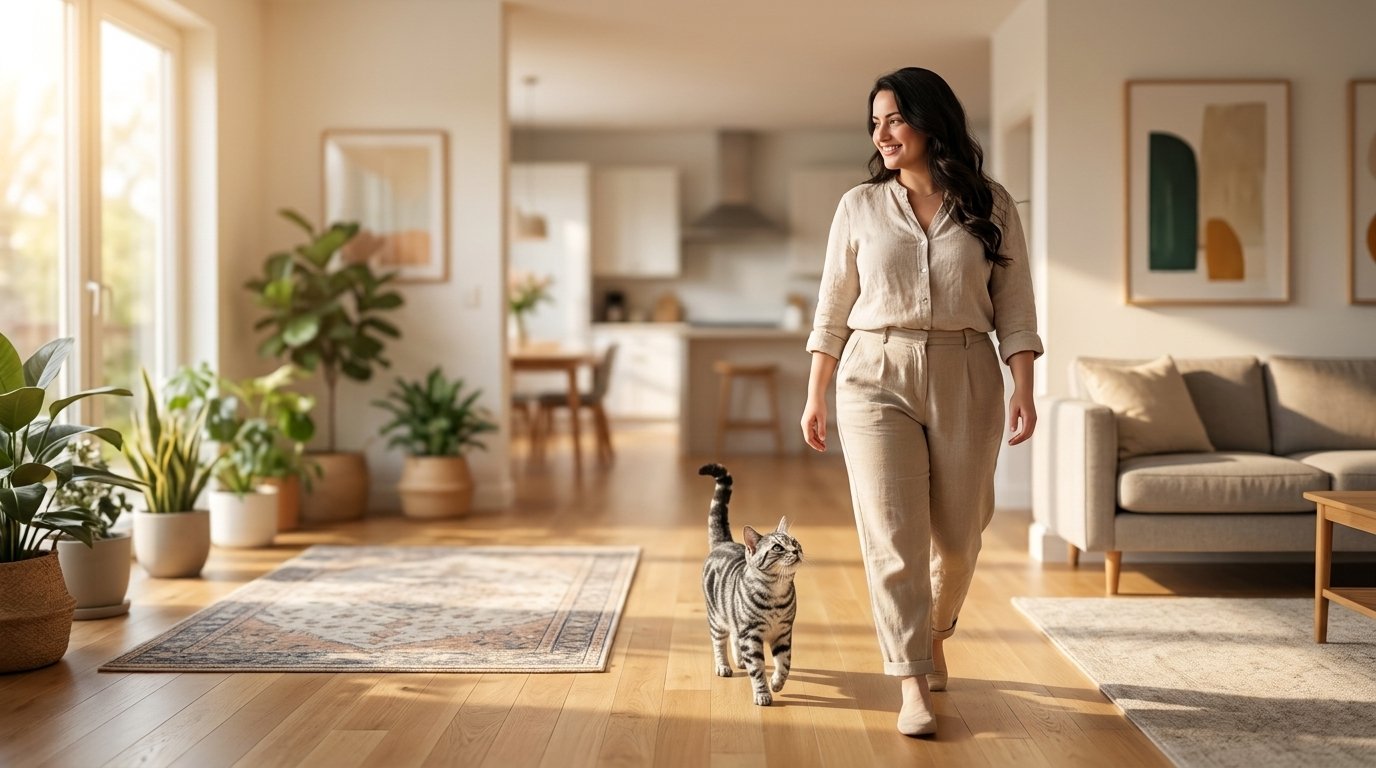
If you regularly find yourself asking, “why does my cat follow me everywhere?”, the answer is usually reassuring. Many cats follow their people because they enjoy their company, expect attention or food, are curious about household activity, or have learned that staying nearby leads to something interesting.
A cat who calmly follows you from the bedroom to the kitchen and then settles nearby is usually displaying normal social or routine-based behavior. However, context matters. If your previously independent cat suddenly becomes unusually clingy—especially alongside changes in appetite, weight, thirst, vocalization, mobility, litter box habits, or energy—it is worth discussing the change with your veterinarian.
Understanding when your cat follows you, what happens afterward, and whether the behavior is new can tell you much more than following alone.
Table of Contents
Is It Normal for a Cat to Follow You Everywhere?
In many cases, yes.
Although cats are sometimes portrayed as completely independent pets, individual cats differ greatly in how much social contact they prefer. Some enjoy being physically close to their people, while others prefer simply sharing the same room.
Following can be one way your cat maintains that social connection.
A cat might walk behind you when you leave the living room, sit beside your desk while you work, appear when you enter the kitchen, or wait outside the bathroom door. None of those behaviors automatically means the cat is anxious or excessively dependent.
Instead of focusing only on how frequently your cat follows you, look at the bigger picture.
A relaxed cat may:
- walk behind you without frantic vocalizing;
- settle down after reaching the room;
- continue eating, sleeping, grooming, and playing normally;
- spend some time independently;
- show relaxed ears, posture, and movement; and
- cope normally when you are temporarily unavailable.
The Feline Veterinary Medical Association’s guidance on feline environmental needs emphasizes that cats benefit from positive, predictable human interaction while still having control over their social interactions and access to appropriate resources.
That makes an important point: following you is not automatically a behavior that needs to be stopped.
The more useful question is why your particular cat is doing it.
Why Does My Cat Follow Me Everywhere? 7 Common Reasons
There is rarely one universal explanation. Your cat can even have different reasons at different times of day.
Here are seven of the most common possibilities.
1. Your Cat Enjoys Your Companionship
Sometimes the simplest explanation is the right one: your cat likes being around you.
A socially connected cat does not necessarily need to sit on your lap or be held. Some cats express their preference for company by resting a few feet away, moving into whichever room their person enters, or quietly watching household activities.
If your cat follows you with a relaxed body and then lies down nearby, companionship is a reasonable explanation.
This behavior can be especially noticeable when you return after being away. Your cat may follow you, rub against your legs, vocalize, or simply remain closer than usual for a while.
PetMD notes that following people can be one of several ways cats display affectionate or social behavior.
Avoid assuming, however, that following always means “love.” Behavior should be interpreted in context. The same cat that follows you for company in the evening may follow you toward the kitchen because dinner is approaching.
2. Your Cat Wants Attention or Play
Your movements make you interesting.
When you stand up, your cat may interpret it as an opportunity for petting, play, grooming, conversation, or another type of interaction.
Consider what normally happens after your cat catches up with you.
Does your cat:
- rub against your legs?
- bring you toward a favorite toy?
- trill or meow?
- roll over nearby?
- paw gently at you?
- walk toward a familiar play area?
Those clues may indicate that social interaction is the goal.
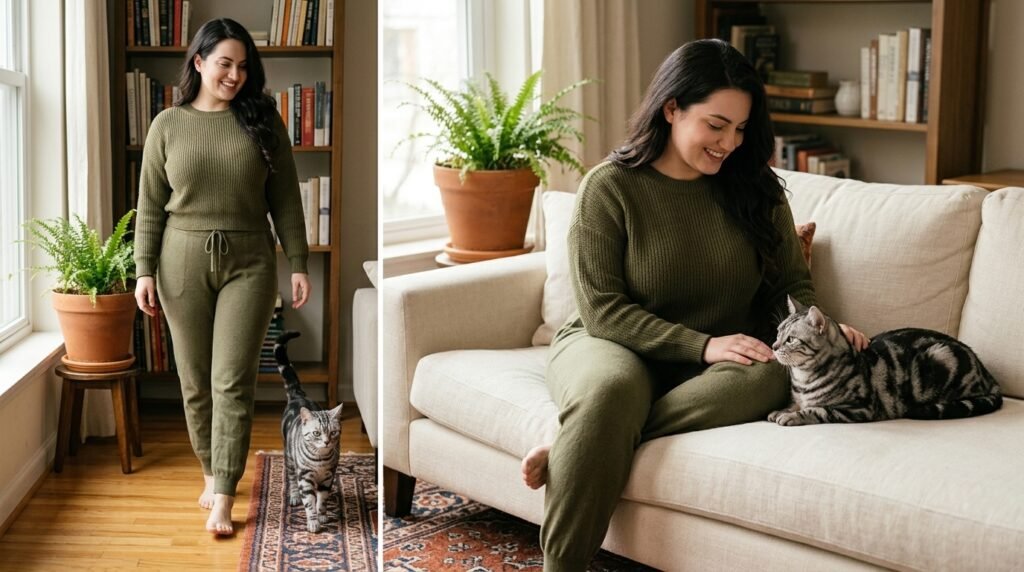
Cats can also learn from consequences. If following you reliably results in petting or play, the behavior may become part of your cat’s daily routine.
That is not necessarily a problem. Predictable, positive interaction can be beneficial. The goal is simply to make sure your cat also has opportunities to rest and engage with an enriching environment without depending on constant human entertainment.
3. Your Cat Has Learned Your Feeding Routine
Cats can become remarkably good observers of household routines.
Your cat may know that:
- you walk into the kitchen before breakfast;
- opening a certain cabinet means food is coming;
- finishing your morning coffee happens before feeding;
- getting home from work predicts dinner; or
- a particular sound means treats are available.
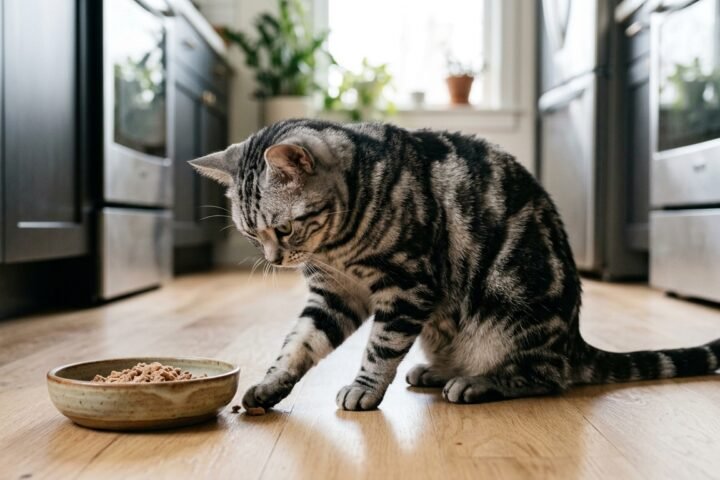
If following becomes especially intense near normal mealtimes, food anticipation may be the explanation.
This is partly why it is helpful to consider timing.
A cat who follows you mostly at 6 p.m. before dinner is giving you different information from a cat who suddenly follows you continuously throughout the entire day.
Be careful about responding to every instance of following with extra treats. Doing so can accidentally strengthen a pattern in which your cat follows, meows, receives food, and then repeats the same strategy whenever food is desired.
Instead, keep meals reasonably predictable and feed an appropriate diet and amount for your individual cat.
Also pay attention if the apparent hunger itself is new.
For example, hyperthyroidism occurs particularly in middle-aged and older cats and can cause weight loss despite an increased appetite, along with signs such as increased thirst, urination, restlessness, vomiting, diarrhea, or increased vocalization.
Following you toward the food bowl alone does not diagnose hyperthyroidism or any other disease. But a major unexplained change in appetite combined with other changes deserves veterinary attention.
4. Your Cat Is Curious About What You Are Doing
Cats monitor their surroundings closely, and you are one of the most active parts of that environment.
Every time you:
- open a closet;
- carry a box;
- rearrange furniture;
- enter a rarely used room;
- open a door;
- unpack groceries; or
- start an unfamiliar activity,
you create something worth investigating.
Your cat may simply follow to find out what changed.
This can explain why an otherwise independent cat suddenly appears when you begin cleaning a cabinet or opening a room that is normally closed.
Following may therefore have less to do with needing attention and more to do with gathering information.
Curiosity is particularly easy to recognize when your cat quickly loses interest once the mystery is solved. The cat follows you into the room, sniffs or looks around, and then returns to another activity.
That is very different from a cat who seems unable to settle unless constantly beside you.
5. Your Cat May Be Bored or Need More Enrichment
If your cat’s indoor world rarely changes, you may become the most interesting event of the day.
Indoor cats need opportunities to perform normal feline behaviors, including exploring, scratching, climbing, hiding, playing, observing, and engaging in hunting-like activities.
The Feline Veterinary Medical Association recommends meeting cats’ environmental needs through safe spaces, appropriate resources, opportunities for play and predatory behavior, positive human interaction, and an environment that respects feline sensory needs.
Following alone does not prove boredom, but look for a pattern.
An understimulated cat may also:
- repeatedly solicit activity;
- become restless;
- show little independent play;
- interrupt you frequently;
- become highly excited by minor household movement; or
- constantly look for something to do.
Try increasing appropriate enrichment rather than simply trying to make your cat stop following you.
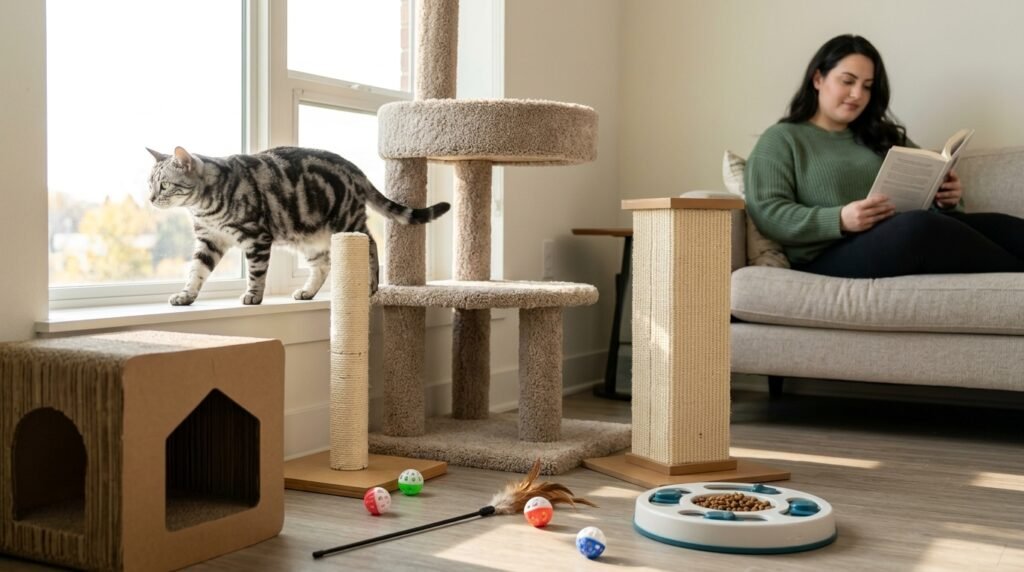
Useful options include scratching surfaces, climbing areas, window-viewing locations, boxes or safe hiding places, rotating toys, food puzzles, and short interactive play sessions.
The goal is not to keep your cat busy every second. Cats need plenty of rest. Instead, provide meaningful choices so following you is one enjoyable activity rather than the only interesting option available.
6. Following You Has Become Part of Your Cat’s Routine
Sometimes following becomes a habit because your daily lives are closely synchronized.
Imagine this sequence:
You wake up.
Your cat follows you downstairs.
You enter the kitchen.
Breakfast appears.
Later, you sit at your desk.
Your cat sleeps nearby.
In the evening, you move toward the bedroom.
Your cat follows because bedtime is approaching.
After hundreds of repetitions, your movements themselves can become signals about what will happen next.
That is why a cat may get up the moment you stand, even when the cat does not immediately want food, play, or petting.
Routine can also help explain why cats seem unusually interested in particular destinations.
Why Does My Cat Follow Me to the Bathroom?
Bathroom following is extremely common in discussions about clingy cats.
There does not have to be one mysterious feline explanation.
Your bathroom may offer:
- a predictable part of your routine;
- an interesting closed door;
- running water;
- a sink or tub to investigate;
- a familiar opportunity for attention; or
- simply another room you entered.
If your cat has repeatedly received petting when following you into the bathroom, that history can strengthen the routine too.
The important point is that bathroom following by itself usually tells you very little about your cat’s health or emotional state. Look at the rest of the behavior.
A relaxed cat who follows you inside, investigates the sink, receives a head rub, and walks away is different from a cat showing frantic distress whenever a door separates you.
7. Your Cat May Be Looking for Reassurance
Changes in the home can affect feline behavior.
A move, visitor, new pet, unfamiliar noise, altered schedule, loss of a familiar companion, or conflict with another household cat may make some cats spend more time close to a trusted person.
Your presence may simply be familiar when other parts of the environment feel less predictable.
If increased following started after a household change, observe the rest of your cat’s behavior.
Watch for:
- more hiding;
- reduced play;
- altered eating;
- increased startle responses;
- tension around another pet;
- changes in sleeping locations;
- increased vocalization; or
- changes in litter box use.
Do not force extra physical contact simply because your cat seems uncertain. Cats should have opportunities to choose when and how they interact.
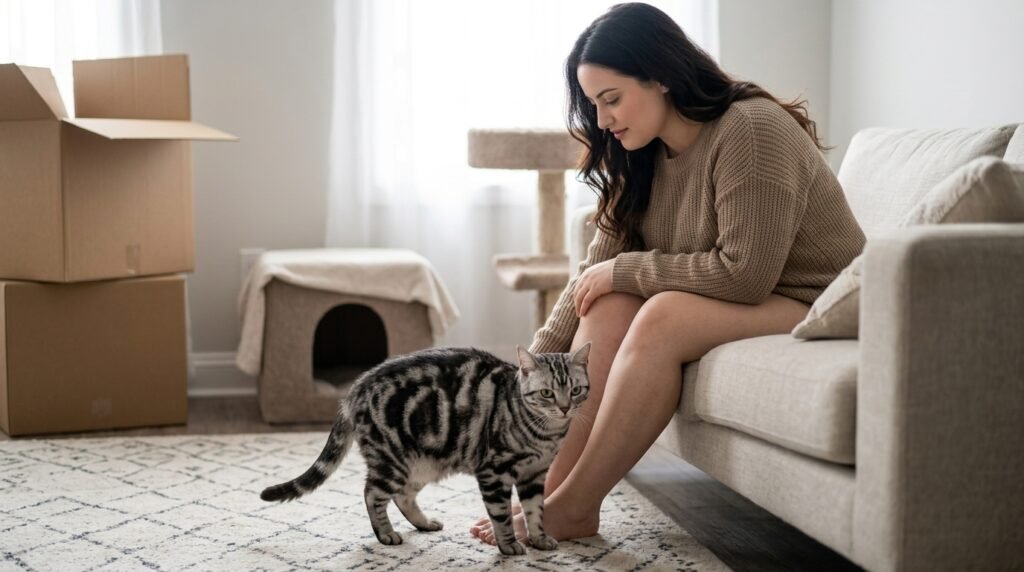
Provide safe resting and hiding places and ensure essential resources are accessible. In multi-cat homes, resources may need to be separated so one cat cannot easily block another from food, water, resting places, scratching areas, or litter boxes.
Professional feline guidance emphasizes both safe spaces and appropriately distributed resources as important parts of a healthy home environment.
How Can You Tell Why Your Cat Is Following You?
Instead of guessing, become a behavior detective for a few days.
Record what happens immediately before and after the following behavior.
Look at the timing
Does it happen:
- before meals?
- after you return home?
- when you stop working?
- near bedtime?
- during normally quiet periods?
- throughout the entire day?
Predictable timing often points toward routine, food, or expected interaction.
Look at the destination
Where does your cat lead or follow you?
Following you into the kitchen suggests a different context from following you to a toy basket, bedroom, closed door, or favorite chair.
Watch what your cat does next
This is often the most useful clue.
A cat who follows you and immediately sits beside the food bowl may be making a food-related request.
A cat who brings you toward a toy may want interaction.
A cat who follows you and calmly falls asleep nearby may simply prefer your company.
Read the rest of the cat, not just the footsteps
Avoid interpreting one behavior in isolation.
Notice posture, ears, tail position, vocalization, activity level, appetite, grooming, sleep, mobility, and litter box habits.
Also ask whether the cat can disengage.
A cat that chooses your company but can still relax alone is showing a different pattern from a cat that becomes extremely distressed whenever you are inaccessible.
What Should You Do If Your Cat Follows You Constantly?
If your cat is healthy, relaxed, and has always enjoyed following you, you may not need to do anything.
There is no rule saying an affectionate or socially interested cat must become more independent.
If the behavior is inconvenient or appears driven by boredom or constant requests, focus on meeting the underlying need rather than punishing the following itself.
Create predictable interaction
Schedule short periods for interactive play, petting, grooming if your cat enjoys it, or other positive social activities.
Predictability can help your cat learn that attention is available without needing to request it constantly.
Make independent activities worthwhile
Create an environment that remains interesting when you are occupied.
Depending on your cat’s preferences, that might include:
- a window perch;
- vertical climbing space;
- scratching posts;
- cardboard boxes;
- rotating toys;
- safe hiding spots;
- puzzle feeding; and
- appropriately designed interactive toys.
Indoor living can be safe, but feline veterinary guidance notes that indoor cats still need opportunities for play, foraging or hunting-like behavior, vertical space, safe territory, and other essential resources.
Avoid punishment
Do not yell at, spray, chase, or physically punish a cat for following you.
Following is communication or behavior—not deliberate misbehavior intended to annoy you.
If you need privacy, calmly manage access to the room and make another comfortable location appealing.
Respect your cat’s choices
A cat that follows you does not necessarily want to be picked up.
Some cats enjoy proximity more than physical handling. Let your cat choose whether the interaction becomes petting, play, lap time, or simply sitting nearby.
Why Is My Cat Suddenly Following Me Everywhere?
This is the most important distinction in the article.
Ask yourself:
Has my cat always behaved this way, or is this genuinely new?
A lifelong “shadow cat” who remains healthy and relaxed is very different from a normally independent cat that becomes inseparable over several days.
A sudden behavioral change does not automatically mean your cat is ill. Environmental changes, routine disruptions, or stress may also alter behavior.
But sudden clinginess should not automatically be dismissed as extra affection either.
Cats can change how they interact with people when they are uncomfortable or unwell. Cornell’s guidance for senior cats specifically warns caregivers not to assume behavioral or physical changes are simply normal aging and recommends contacting a veterinarian when such changes appear.
Older cats deserve particular attention because medical, sensory, mobility, and cognitive changes can alter behavior.
Cornell notes that feline cognitive dysfunction may involve changes such as disorientation, altered sleep-wake patterns, reduced interest in play, inappropriate elimination, staring, and unexplained vocalization. These signs have multiple possible causes, so veterinary evaluation is needed rather than attempting to diagnose cognitive dysfunction from clinginess alone.
When Should You Call Your Veterinarian?
Consider contacting your veterinarian when increased following is new, persistent, or accompanied by another meaningful change, including:
- eating noticeably more or less;
- unexplained weight loss or gain;
- increased thirst or urination;
- vomiting or diarrhea;
- hiding more than usual;
- reduced activity;
- difficulty jumping or walking;
- apparent pain;
- unusual nighttime restlessness;
- markedly increased vocalization;
- confusion or disorientation;
- grooming changes;
- litter box changes; or
- a major personality change.
Cornell lists appetite changes, weight loss, vomiting, diarrhea, excessive thirst, urination changes, lethargy and breathing problems among signs that can warrant veterinary attention.
Seek prompt veterinary care for severe signs such as difficulty breathing, inability to urinate, collapse, seizures, significant trauma, or other obvious emergencies rather than waiting to see whether clinginess improves.
The key principle is simple: following you is not a diagnosis.
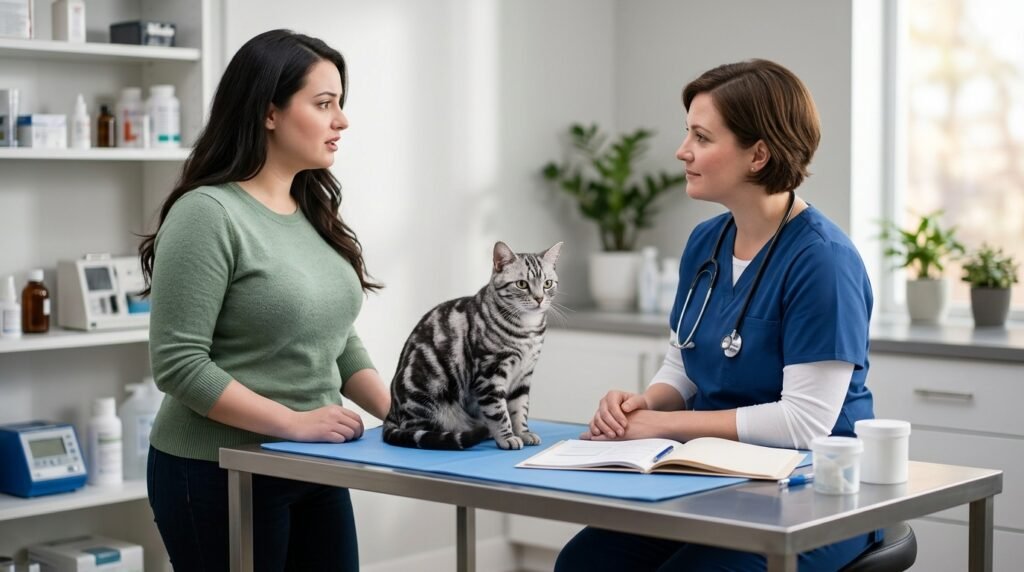
Your veterinarian will interpret the behavior alongside your cat’s age, medical history, physical examination and any other symptoms.
FAQs
Why does my cat follow me everywhere but doesn’t want to be petted?
Your cat may enjoy proximity without wanting physical contact. Some cats prefer sharing space, watching their person, or moving between rooms together. Respect your cat’s choice rather than assuming following is an invitation to pick them up or pet them.
Why does my cat follow me everywhere and meow?
Consider what happens next. Meowing and following near mealtime may be a learned food request, while similar behavior near a toy may signal a desire for interaction. If persistent vocalization or following is new—especially with appetite, weight, thirst, litter box, sleep, mobility, or other behavioral changes—contact your veterinarian.
Why does my cat follow me to the bathroom?
Your bathroom may be interesting because of routine, running water, a closed door, familiar smells, or the predictable opportunity to spend time with you. If your cat is otherwise relaxed and healthy, bathroom following alone usually is not a reason for concern.
Should I worry if my cat suddenly becomes very clingy?
A sudden change deserves more attention than a long-standing habit. Look for changes in appetite, drinking, weight, vocalization, mobility, sleep, grooming, litter box use, energy, or general behavior. If the clinginess is unexplained, persistent, or accompanied by other changes, arrange veterinary advice.
Conclusion
So, why does my cat follow me everywhere? In most cases, your cat may simply enjoy your companionship, want attention, anticipate food, investigate what you are doing, need more stimulation, follow a familiar routine, or seek reassurance.
Rather than labeling every following cat as needy or anxious, consider the timing, context, body language, and what happens afterward.
Most importantly, know your cat’s normal baseline. A relaxed cat that has always followed you is usually very different from a previously independent cat that suddenly becomes unusually clingy. When following represents a significant behavioral change—especially alongside physical or behavioral symptoms—your veterinarian is the right person to help determine what has changed.