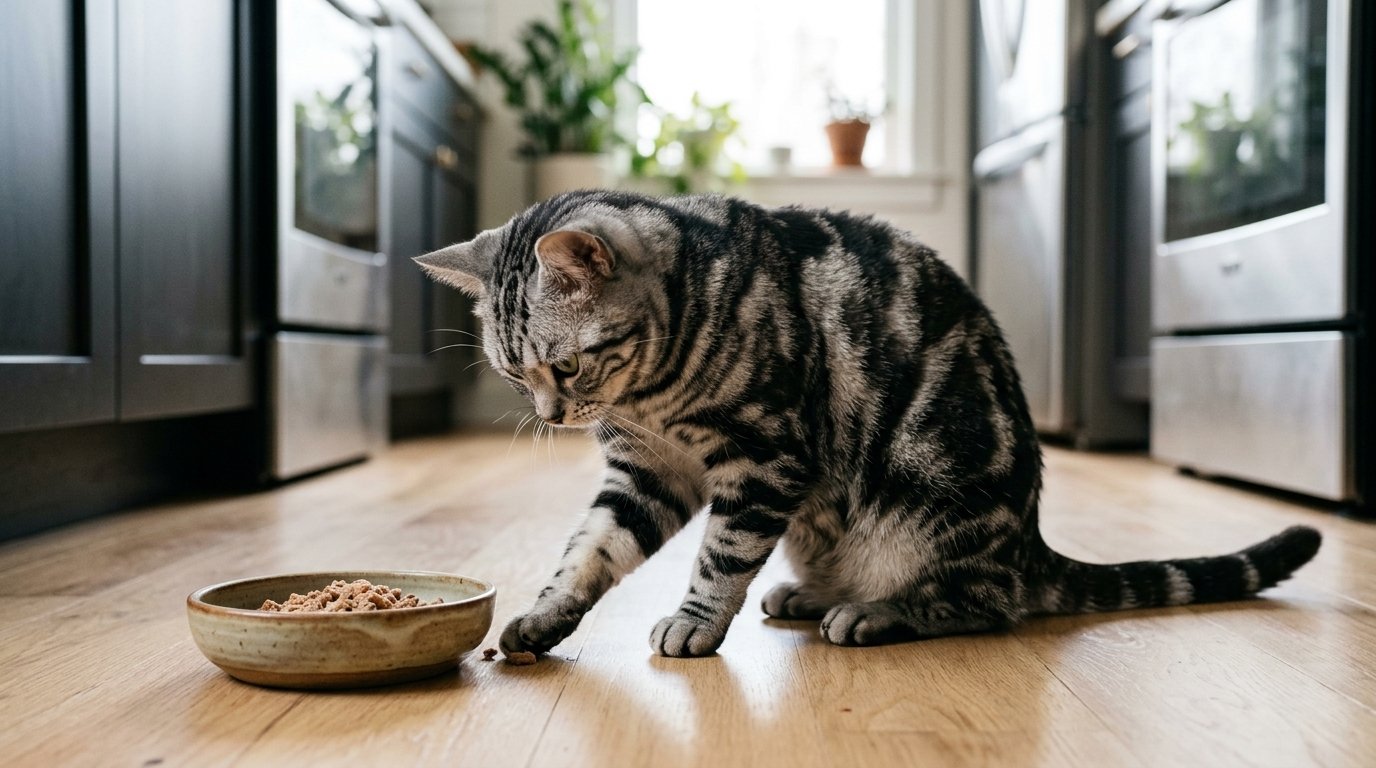
You set down your cat’s dinner, expecting them to start eating. Instead, they sniff the food, turn around, and begin scratching the floor as though they are trying to bury something. Sometimes, they even drag a nearby towel toward the dish.
If you’ve noticed your cat scratching around food bowl areas, this behavior is usually normal. Many cats instinctively make digging or covering motions around their food, even when there is nothing available to bury it with.
The behavior may relate to hiding food remains, keeping the feeding area clean, or simply following an inherited routine. However, bowl placement, food preferences, and changes in appetite can also influence what happens at mealtime.
Understanding the difference helps you decide whether to leave your cat alone, make a small feeding adjustment, or contact your veterinarian.
Table of Contents
Why Do Cats Scratch Around Their Food Bowls?
Cats sometimes perform a behavior that looks remarkably similar to burying something in soil.
They may extend one front paw and repeatedly scrape the floor beside their food dish. Others alternate paws, scratch a feeding mat, or pull nearby fabric toward the bowl.
This behavior is often described as food covering or food caching, although scratching beside a dish does not necessarily mean a cat is actually trying to store food.
Domestic cats retain many behaviors associated with their wild ancestors. Covering leftover prey or food remains may help explain why some cats continue to make burying motions around meals.
Importantly, a cat does not need to have experienced outdoor hunting to display this behavior. It can appear in indoor cats and kittens that have never needed to hide food.
What does food-covering behavior look like?
Common examples include:
- Scraping the floor beside a full or empty bowl.
- Pawing repeatedly at the edge of a feeding mat.
- Pulling a towel or lightweight fabric toward leftover food.
- Making digging motions after sniffing a meal.
- Scratching briefly before walking away.
- Returning to the bowl, sniffing again, and repeating the movement.
These actions may last only a few seconds or continue longer.
A relaxed cat that eats normally, maintains a healthy weight, and occasionally scratches beside the dish generally gives you little reason for concern.
The behavior becomes more important when it appears alongside food refusal, pain, repeated vomiting, or other changes.
5 Common Reasons for Cat Scratching Around Food Bowl Areas
Although food-covering instinct is the leading explanation, several factors can contribute to scratching around a feeding station.
1. Your cat is instinctively trying to bury food
The most familiar explanation is an inherited food-covering behavior.
In natural environments, leaving food remains exposed can attract other animals. Concealing those remains may reduce obvious signs of a recent meal.
Indoor cats may retain related movements even though they have no soil, leaves, or other materials available.
Imagine a cat eating a portion of wet food, stepping away, and scratching the kitchen tile. The floor obviously cannot cover the leftovers, but the movement may still resemble an instinctive burying routine.
This is especially plausible when scratching occurs immediately after a meal.
However, owners should avoid assuming that every cat scratches for exactly the same reason. Individual motivation cannot be determined from paw movements alone.
2. Your cat may be finished eating
Some cats begin pawing around the bowl after they have eaten enough.
They may leave a small portion of food, scrape the surrounding floor, and walk away to rest.
In this situation, scratching may be associated with the end of the meal rather than dislike of the food.
For example, a cat offered a large serving may eat part of it and then display covering motions around the remaining portion.
The practical question is whether your cat is consuming an appropriate amount over the entire day.
A cat that eats normally across scheduled meals may simply have finished for the moment.
By contrast, a cat that repeatedly leaves most of its food and begins losing weight needs closer attention.
3. Your cat may be reacting to the food
Cats can develop preferences for particular textures, smells, and food temperatures.
Some prefer moist food, while others are more comfortable with dry kibble or a familiar recipe.
A cat may sniff an unfamiliar meal, paw around the dish, and walk away without eating.
This does not prove that the cat is attempting to reject or dispose of the food. Nevertheless, food acceptance is worth considering when scratching appears alongside avoidance.
According to VCA Animal Hospitals’ explanation of food palatability, factors such as food characteristics and the feeding environment can affect how pets respond to meals.
If the behavior began after a diet change, observe whether your cat still eats enough.
Avoid repeatedly changing foods without a clear reason, especially when your cat requires a veterinary prescription diet.
4. Your cat may be trying to conceal leftovers
Scratching can sometimes occur when food remains in the bowl.
In an outdoor setting, concealing food could potentially make it less obvious to other animals.
Your indoor cat may perform similar movements without actually moving or hiding the food.
You might notice this after serving canned food with a strong smell or after offering more food than your cat wants at one sitting.
Some cats even pull nearby objects toward the dish.
A towel that mysteriously ends up over a food bowl may be evidence of this covering behavior rather than an attempt to play with the towel.
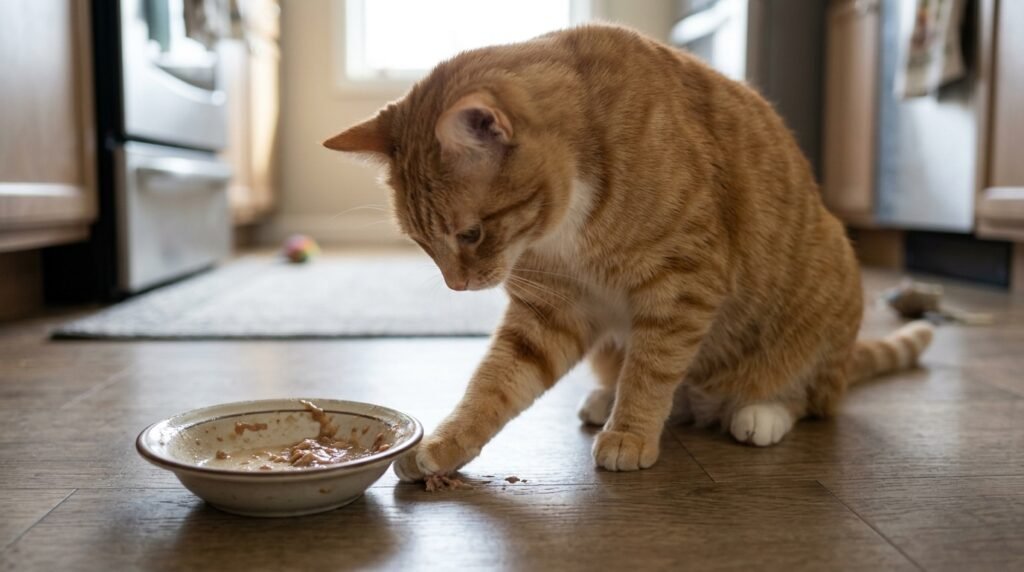
Still, food covering does not necessarily mean the cat intends to return and eat the leftovers later.
Practical tip: Offer appropriately measured portions and promptly store or discard uneaten perishable food instead of leaving it exposed for extended periods.
5. Your cat may be kneading or following a familiar routine
Not every paw movement near food is a digging motion.
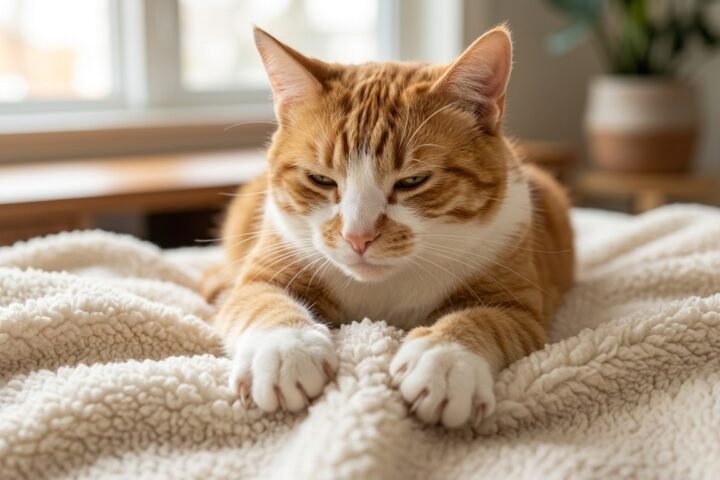
Some cats knead soft surfaces by rhythmically pressing their paws downward, alternating between left and right.
Kneading is often associated with comfort, anticipation, or a familiar routine.
A cat standing on a soft feeding mat may knead while waiting for dinner, especially if the surface resembles a blanket or carpet.
Watch the actual movement:
- Scratching: The paw usually reaches outward and scrapes backward across the surface.
- Kneading: The paws press down rhythmically, often alternating.
- Playful pawing: The cat may bat at the dish, move food pieces, or chase something nearby.
These behaviors can overlap, and a short observation is not always enough to identify the precise motivation.
If your cat looks comfortable and continues eating normally, you generally do not need to interrupt.
Cat Scratching Before Eating vs. After Eating: What’s the Difference?
The timing of scratching can provide useful context.
A cat that scratches before eating may be responding differently from one that scratches after finishing dinner.
However, timing is only one clue. It should be considered alongside appetite, body language, and the feeding environment.
| Timing | Possible explanation | What to check |
|---|---|---|
| Before eating | Anticipation, familiar routine, or food hesitation | Does the cat eventually eat? |
| During eating | Bowl movement, food handling, or interruption | Is the bowl stable and comfortable? |
| Immediately after eating | Food-covering instinct or meal completion | Was enough food consumed? |
| Around leftovers | Covering behavior or reduced interest | Is the serving too large? |
| Around an empty bowl | Habit, anticipation, or food-seeking | Is the feeding schedule appropriate? |
Why does my cat scratch before eating?
Some cats scratch the floor before taking their first bite.
This can happen even when the meal is familiar and the cat is hungry.
A brief scratching routine followed by normal eating is usually not concerning.
If your cat scratches, repeatedly approaches and retreats, or seems reluctant to eat, look more carefully at the surroundings.
Check whether the dish is clean, whether another animal is nearby, and whether anything has changed about the food.
A cat that wants to eat but appears unable to do so may be experiencing oral discomfort, nausea, or another medical problem.
Why does my cat scratch after eating?
Scratching after a meal is especially consistent with food-covering behavior.
A cat may finish eating, scrape the floor several times, and leave the feeding area.
The action does not automatically indicate that the food was unpleasant.
In fact, cats may scratch after eating meals they clearly enjoy.
If your cat maintains normal appetite and behavior, there is usually no need to prevent these movements.
Why does my cat scratch around an empty bowl?
Scratching near an empty dish may be a continuation of the same familiar behavior.
It may also happen when your cat expects food or associates the feeding station with a regular routine.
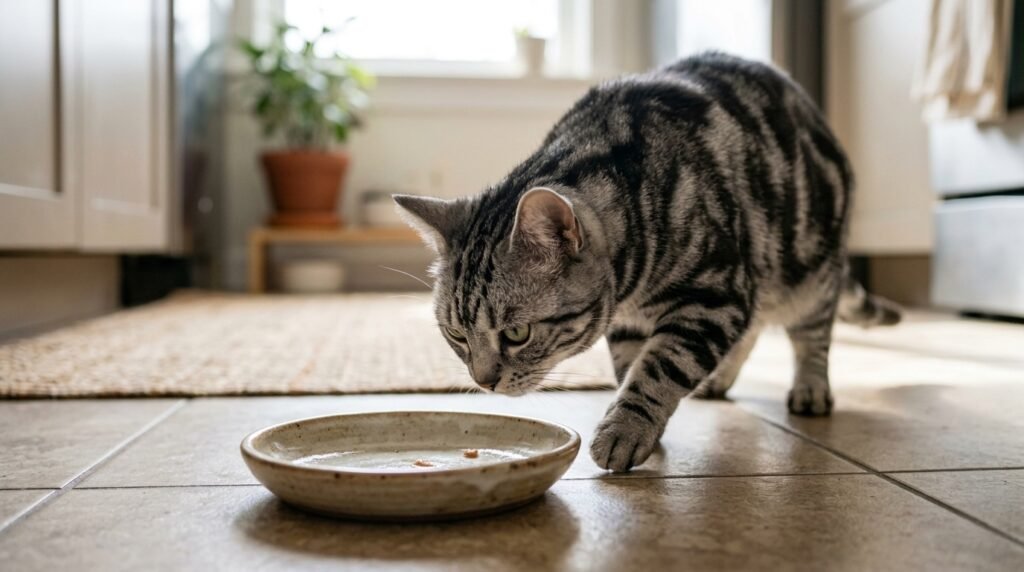
Avoid interpreting scratching alone as proof of hunger.
Instead, assess the cat’s daily food intake, body condition, feeding schedule, and overall behavior.
If your cat constantly seeks food despite eating an appropriate amount, discuss the change with your veterinarian.
What Does Scratching Around Leftover Food Mean?
Leftover food is one of the most useful details to observe.
A cat that eats part of a meal and scratches around the remaining portion may simply be finished.
Another cat might be uncomfortable with the food or the feeding environment.
The behavior alone cannot reliably distinguish these situations.
Does scratching mean my cat hates the food?
Not necessarily.
A cat may enthusiastically eat a favorite meal and still scratch afterward.
Likewise, a cat may reject a meal without scratching at all.
Rather than relying on the scratching motion, observe whether your cat:
- Approaches the food willingly.
- Eats a reasonable portion.
- Returns for later meals.
- Maintains stable body weight.
- Shows normal energy and activity.
- Has developed new food preferences or avoidance.
A sudden refusal of a familiar diet deserves more attention than an occasional burying gesture.
Should you leave leftover food for later?
That depends on the type of food and your veterinarian’s feeding recommendations.
Wet food should not remain at room temperature indefinitely. Follow the product’s storage directions and refrigerate or discard leftovers promptly.
Dry food is less perishable, but it can still become stale, contaminated, or unappealing when left exposed.
The Cornell Feline Health Center’s feeding guidance emphasizes appropriate nutrition and monitoring a cat’s food intake.
Measured meals can make it easier to identify whether your cat is actually eating enough.
Should you reduce the portion size?
If your cat regularly leaves substantial leftovers, review the amount being served.
Some cats prefer smaller, more frequent meals rather than one or two large portions.
However, do not reduce the total daily calories simply to prevent scratching.
Your cat’s food requirements depend on age, weight, body condition, health, activity, and the calorie content of the diet.
A veterinarian can help determine an appropriate daily amount.
For cats with medical conditions, follow the prescribed feeding plan rather than making major changes independently.
How Food Bowl Placement and Design Affect Your Cat
Sometimes, the feeding setup contributes to unusual behavior around the bowl.
Although a cat’s scratching may remain instinctive, improving the feeding environment can make mealtimes more comfortable.
Choose a quiet feeding location
Cats generally benefit from predictable access to food in an area where they feel secure.
A bowl beside a noisy washing machine, a busy doorway, or a frequently used hallway may create unnecessary interruptions.
The feline environmental needs guidelines published by VCA recommend separating important resources and providing appropriate access to food, water, resting spaces, and litter areas.
A practical feeding location should be:
- Away from the litter box.
- Free from frequent startling noises.
- Easy for the cat to approach and leave.
- Protected from interference by other pets.
- Comfortable and accessible for older cats.
Try moving the bowl to a quieter area if your cat appears hesitant, frequently interrupted, or unusually alert while eating.
Consider the shape of the food bowl
Some cats may prefer shallow, wide dishes instead of deep bowls.
Whiskers are sensitive sensory structures, and repeated contact with the sides of a narrow dish can be uncomfortable for some individuals.
VCA’s veterinary explanation of feline whiskers discusses their sensory functions and suggests flatter dishes to reduce unnecessary contact.
A shallow ceramic or stainless-steel dish may be worth trying.
However, scratching near food is not a reliable diagnostic sign of so-called whisker fatigue. Changing the dish is a comfort adjustment, not a guaranteed treatment.
Keep the bowl stable and clean
A lightweight bowl that slides across tile can create noise and movement.
Some cats may become distracted when the dish shifts as they eat.
Choose a stable, easy-to-clean bowl and place it on a non-slip surface.
Wash dishes regularly, remove food residue, and avoid strong cleaning-product odors.
A clean feeding station may improve comfort, although it will not necessarily eliminate instinctive scratching.
Provide separate feeding spaces for multiple cats
Sharing a feeding station can create competition, even when cats do not openly fight.
One cat may hover near another, block access, or approach just as the other begins eating.
This can affect feeding behavior.
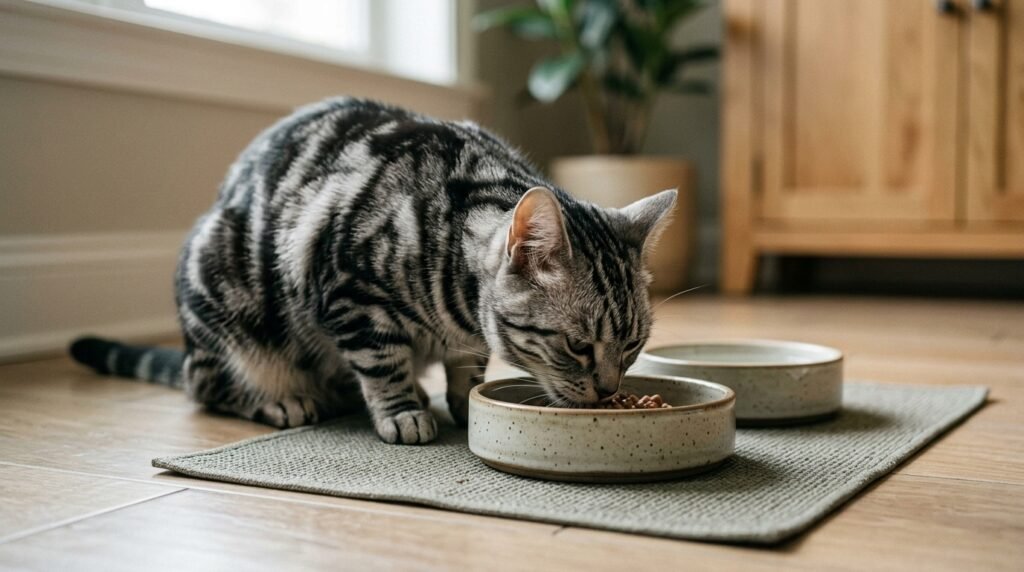
In multi-cat households, provide separate feeding locations where each cat can eat without being watched or interrupted by another animal.
You may also find it useful to observe other everyday feline behavior, such as the reasons discussed in why cats follow their owners around the house.
What Should You Do If Your Cat Keeps Scratching Around the Bowl?
Most cats do not need special training to stop this behavior.
The goal should be to make mealtimes comfortable, protect household surfaces, and recognize any changes that deserve attention.
Step 1: Observe without interrupting
Watch when your cat scratches and what happens afterward.
Does the cat eat normally? Does scratching occur only when leftovers remain? Does it happen around every meal?
A short video can help you compare patterns over time.
Avoid immediately scolding or moving the cat away.
Step 2: Use a protective feeding mat
If scratching damages flooring or causes a mess, place a washable, non-slip mat beneath the food bowl.
Choose a mat that lies flat and does not have loose threads, tassels, or easily detachable pieces.
Some cats may scratch the mat instead of the floor, which is acceptable as long as the material is safe.
If your cat tries to chew or swallow pieces of the mat, remove it.
Step 3: Review the feeding schedule
Predictable mealtimes can make it easier to monitor food intake.
For cats that eat too much at once or leave large portions, smaller measured meals may help.
Do not assume every cat needs the same schedule.
Age, medical conditions, weight-management goals, and food type all matter.
The VCA feeding guidelines for cats provide additional information about tailoring feeding practices to individual needs.
Step 4: Remove uneaten perishable food
If your cat finishes eating and begins trying to cover the leftovers, calmly remove the dish after the meal.
Store or discard uneaten wet food according to safe handling instructions.
Avoid allowing towels, paper, or other household items to remain over exposed food.
A covered bowl is not the same as properly refrigerated food.
Step 5: Redirect gently when necessary
If your cat repeatedly scratches expensive flooring or pulls objects across the kitchen, try redirecting attention after the meal.
Offer a short play session, a favorite toy, or another appropriate activity.
The VCA’s guidance on food-based environmental enrichment explains how foraging opportunities and food puzzles can support natural behaviors.
Some cats enjoy puzzle feeders or supervised food-search games.
Introduce these gradually and make sure your cat can still consume the required daily amount.
Step 6: Avoid punishment
Do not spray your cat with water, shout, strike, or forcibly restrain them for scratching near food.
Punishment can create fear and make the feeding area less comfortable.
If scratching causes no damage and your cat is otherwise healthy, allowing the behavior is often the simplest choice.
For other types of scratching, such as clawing sofas or carpets, see our guide on gentle ways to stop a cat from scratching furniture.
Food-covering movements and furniture scratching are different behaviors, so they should not automatically be managed in the same way.
When Could Scratching Around Food Signal a Health Problem?
Scratching itself is usually harmless.
The concern arises when the behavior appears together with changes in appetite, weight, comfort, or general health.
A cat may approach the bowl, sniff food, paw at the floor, and walk away because they are not feeling well.
Possible underlying issues include dental pain, nausea, gastrointestinal disease, or other conditions affecting appetite.
You cannot diagnose these problems from scratching alone.
Watch for these warning signs
Contact your veterinarian if scratching is accompanied by:
- Suddenly eating much less than usual.
- Repeatedly approaching food but refusing to eat.
- Drooling, bad breath, or difficulty chewing.
- Vomiting or diarrhea.
- Unexplained weight loss.
- Unusual hiding or lethargy.
- Signs of mouth pain.
- Sudden changes in normal feeding behavior.
According to the Cornell Feline Health Center’s guidance on loss of appetite, sustained food refusal can have serious consequences for cats.
A cat that is not eating should receive prompt veterinary attention. Do not wait a full day to seek advice, particularly for kittens, sick cats, or cats with existing medical conditions.
When is urgent veterinary care necessary?
Seek immediate veterinary help if your cat has severe weakness, collapse, breathing difficulty, repeated vomiting with inability to keep food or water down, or other signs of serious illness.
A cat that appears hungry but cannot chew or swallow also needs prompt assessment.
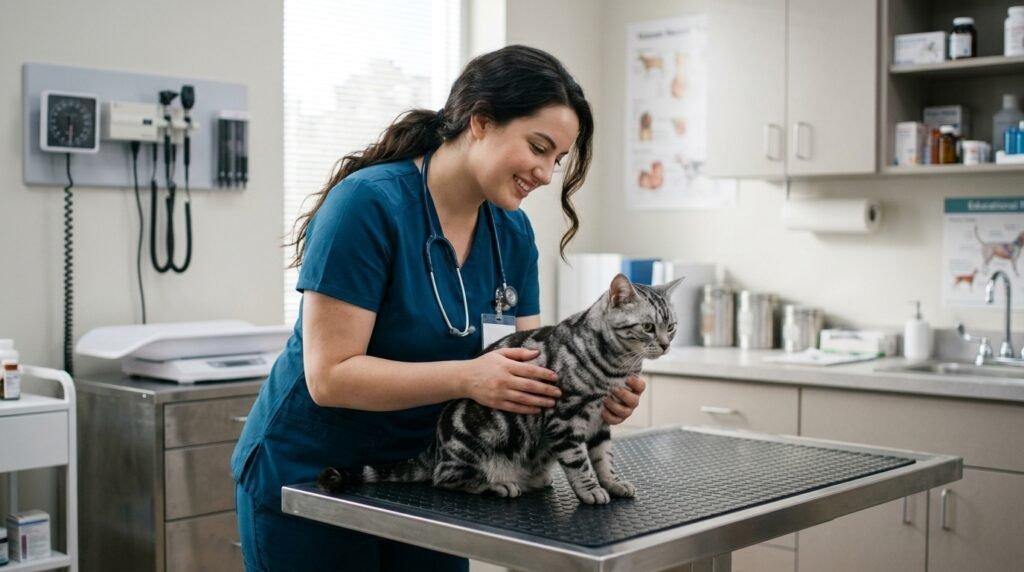
Avoid forcing food into the mouth or giving human medications without veterinary instructions.
If your cat is scratching normally, eating well, maintaining weight, and behaving as usual, veterinary treatment for the scratching itself is generally unnecessary.
Common Mistakes Cat Owners Should Avoid
Understanding the behavior is useful, but avoiding unnecessary interventions is equally important.
Mistake 1: Assuming scratching always means the food is bad. A cat can enjoy a meal and still perform food-covering movements afterward.
Mistake 2: Repeatedly changing diets. Frequent food changes can complicate feeding routines and may upset some cats’ digestion. Investigate genuine food refusal rather than reacting to scratching alone.
Mistake 3: Leaving wet food exposed for long periods. A cat’s apparent attempt to cover food does not protect it from spoilage.
Mistake 4: Punishing instinctive behavior. Scolding can increase stress without addressing the underlying motivation.
Mistake 5: Ignoring reduced appetite. Scratching may be harmless, but persistent food avoidance is not something to dismiss.
Mistake 6: Assuming every cat needs to stop. Some cats will continue making burying motions regardless of how carefully the feeding station is arranged.
The most helpful approach is to focus on the cat’s overall comfort and eating habits rather than trying to eliminate every unusual movement.
Frequently Asked Questions
1. Why is my cat scratching around the food bowl but not eating?
Your cat may be performing an instinctive covering behavior, reacting to the food, or feeling uncomfortable with the feeding environment. If your cat repeatedly refuses meals, appears unwell, or shows other appetite changes, contact your veterinarian promptly.
2. Does scratching around the food bowl mean my cat is saving food for later?
It may resemble food-caching behavior, but that does not prove your cat intends to return later. Domestic cats can make instinctive burying movements without actually storing food. Remove perishable leftovers safely rather than relying on the cat’s covering behavior.
3. Why does my cat scratch the floor after eating wet food?
Some cats scratch after eating because the movements resemble an instinctive attempt to cover remaining food. The smell or amount of wet food may influence the situation, but scratching does not automatically mean your cat dislikes the meal.
4. Should I stop my cat from scratching around the food bowl?
Usually not. If your cat is healthy, eating normally, and causing no damage, the behavior can be left alone. If scratching creates a mess, try a washable mat, stable dish, appropriate portions, and gentle redirection rather than punishment.
Conclusion
Seeing your cat scratching around food bowl areas can seem strange, especially when the movements look like an attempt to bury dinner under an invisible layer of dirt.
In most cases, this is a harmless behavior associated with natural food-covering instincts or familiar mealtime routines.
Pay attention to when scratching occurs, how much your cat eats, and whether the feeding area is comfortable. Simple changes to bowl placement, portion management, and cleanup may make mealtimes easier.
Most importantly, judge the behavior in context. A relaxed cat that scratches after eating is very different from one that suddenly refuses food or shows signs of illness.
When appetite and health are normal, there is usually no reason to interfere with this curious feline habit.