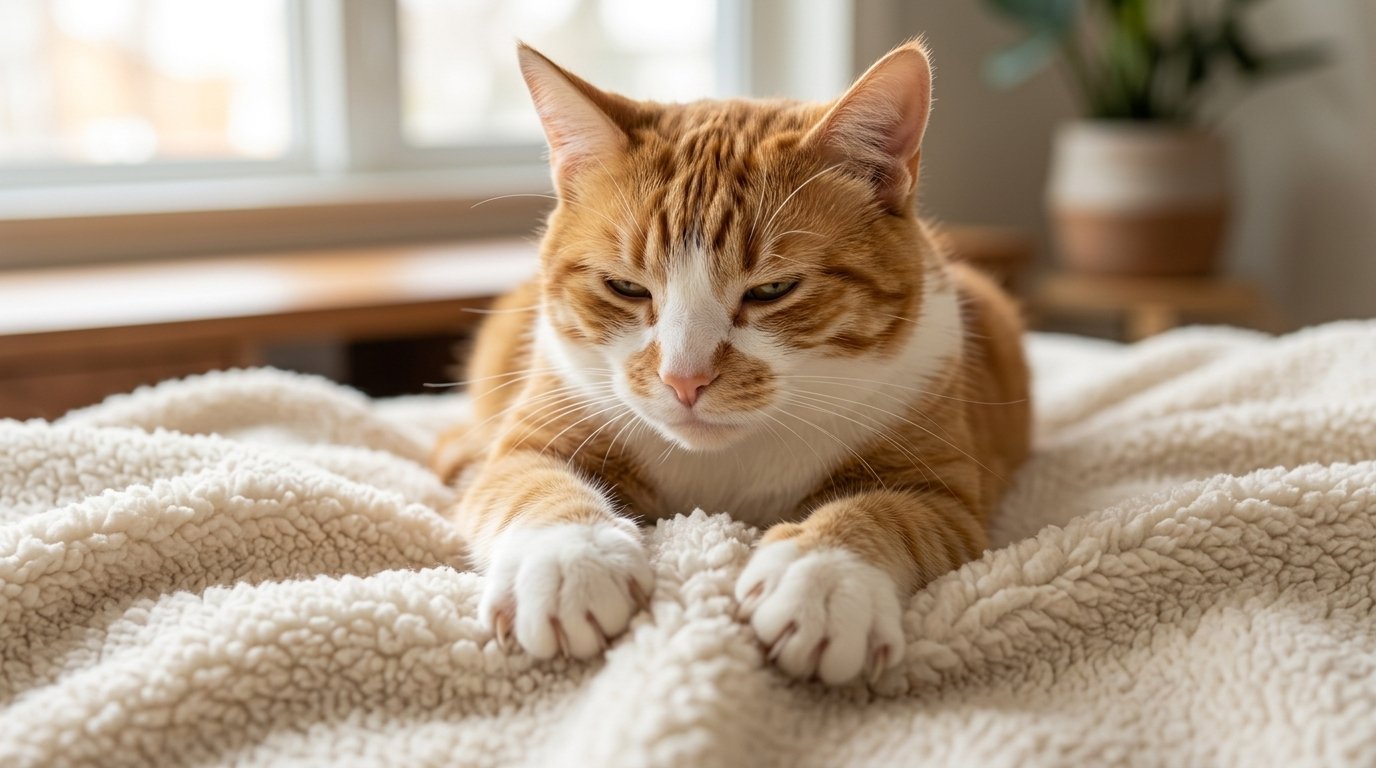
If you’ve ever watched your cat rhythmically push one front paw and then the other into a blanket—or directly into your lap—you may have wondered: why do cats knead? This familiar behavior, affectionately called “making biscuits,” begins during kittenhood but often continues throughout adult life.
Most kneading is completely normal. Cats may knead because the motion is associated with early nursing, because they’re relaxed, because they’re preparing a comfortable resting place, or because they’re leaving their scent on a familiar surface. A cat may even purr or drool while doing it.
The important part is context. Kneading a favorite blanket while relaxed is different from a sudden, dramatic change in kneading accompanied by hiding, appetite changes, pain, or other unusual behavior.
Here’s how to understand what your cat’s biscuit-making may mean—and how to respond without discouraging a natural feline behavior.
Table of Contents
Why Do Cats Knead? 6 Likely Reasons
Kneading is the repetitive motion a cat makes by pressing the front paws against a surface, usually alternating between the left and right paws. Some cats keep their claws retracted, while others extend them with every push.
The behavior has strong roots in kittenhood, although there probably isn’t one single explanation for every adult cat.
1. Kneading begins during nursing
One of the strongest explanations starts very early in a cat’s life.
Nursing kittens press their paws against their mother’s abdomen around the mammary glands. This kneading motion helps stimulate milk flow while they feed. The experience takes place while the kitten is warm, fed, protected, and physically close to its mother.
VCA Animal Hospitals explains that kittens knead while nursing to stimulate milk production and notes that the behavior may continue into adulthood in association with comfort and relaxation.
An adult cat obviously isn’t expecting a blanket—or your stomach—to produce milk. Instead, the familiar movement may persist because it became associated with a deeply comforting early-life experience.
That helps explain why kneading frequently appears when a cat is sleepy, cozy, purring, or settling beside a trusted person.
2. Kneading may help cats relax
Watch your cat’s entire body during a typical kneading session.
You may notice:
- Soft or partially closed eyes
- Relaxed ears
- A loose body
- Purring
- Slow movements
- Settling down afterward
Those signals suggest that the cat is comfortable rather than agitated.
AAHA describes kneading as a normal behavior associated with comfort and relaxation and emphasizes that cats should be allowed an appropriate way to express it.
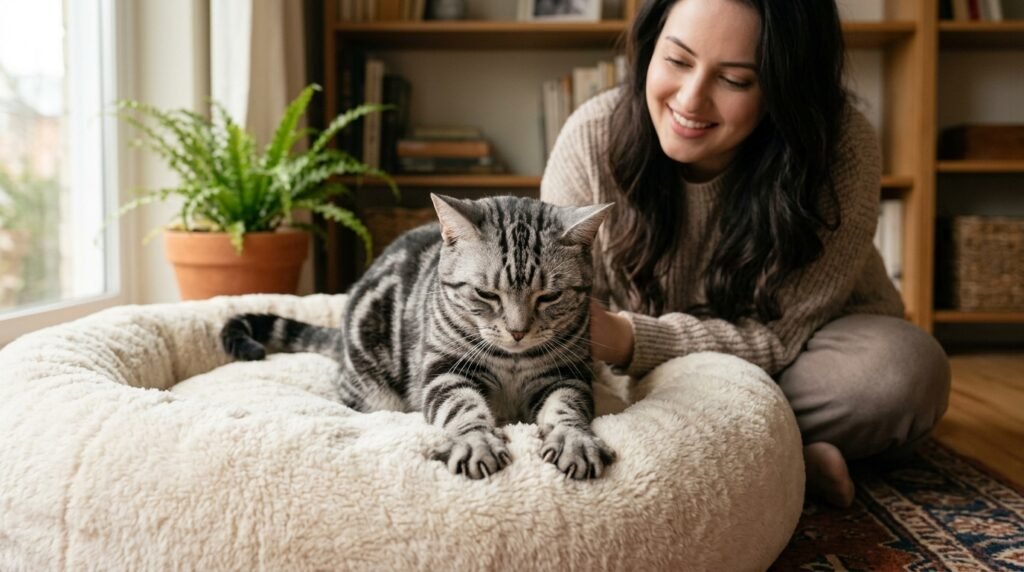
For some cats, biscuit-making seems to function almost like a familiar relaxation ritual. They climb onto their favorite blanket, begin kneading, purr for several minutes, turn around, and finally curl up to sleep.
3. Your cat may be preparing a sleeping spot
Cats frequently knead bedding shortly before lying down.
One theory connects this to ancestral resting behavior. A cat living outdoors would not have had a plush fleece bed waiting in the corner. Pressing vegetation or another soft surface could help prepare a more comfortable place to rest.
Modern house cats don’t need to flatten grass before bedtime, but instinctive behavioral patterns can remain even when their original practical purpose is less important.
That may be why your cat walks onto a blanket, kneads intensely for a minute or two, turns around, and then falls asleep exactly where the kneading occurred.
4. Kneading may leave your cat’s scent
Scent is extremely important in feline communication.
Cats don’t rely only on obvious visual signals. They also use scent to create familiarity within their environment.
Cats have scent-producing structures around their paws, and kneading may help deposit their individual scent on objects or places they regularly use. Both AAHA’s explanation of kneading behavior and VCA’s cat-behavior guidance discuss scent marking as one possible function of kneading.
That doesn’t necessarily mean your cat is making an aggressive territorial claim.
Think of it more as adding familiar scent to a familiar resting environment.
5. Cats may knead people they feel comfortable around
If your cat regularly chooses your lap, stomach, chest, or legs as a kneading surface, take the rest of the interaction into account.
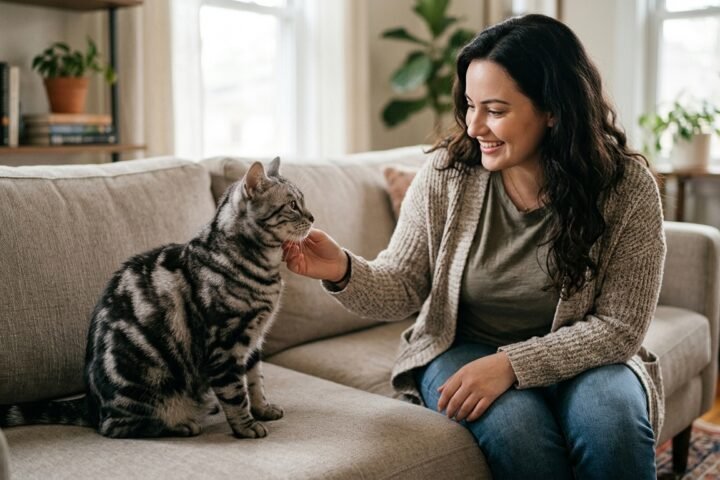
A relaxed cat voluntarily approaching you, settling against you, purring, and kneading is generally displaying comfort and security.
Kneading should not automatically be translated into one human emotion such as “My cat is saying I love you.” Feline behavior is more nuanced than that. But choosing to perform a vulnerable, relaxing behavior while in close physical contact with you can certainly be consistent with trust and social comfort.
Cornell University veterinary experts have also described kneading as a behavior that can be associated with feline affection.
6. Kneading can sometimes be self-soothing
Here’s an important qualification: kneading doesn’t always mean “happy.”
Behaviors associated with comfort can also be used when an animal is trying to comfort itself.
A cat experiencing stress or discomfort may knead because the familiar action is soothing. That is why you should interpret the behavior alongside everything else happening.
A cat kneading a blanket while stretched comfortably beside you is very different from a cat suddenly hiding under furniture, eating less, behaving unusually, and kneading far more frequently than normal.
Your cat’s change from their normal pattern matters more than kneading by itself.
Why Do Cats Knead Blankets and Soft Surfaces?
Blankets are nearly perfect kneading surfaces from a cat’s perspective.
They are soft, warm, compressible, and often located where the cat already feels safe. Some materials may also resemble the tactile comfort associated with the kitten’s early nursing environment.
Cats may knead:
- Fleece throws
- Beds
- Pillows
- Comforters
- Soft furniture
- Clothing
- Plush toys
- Their owner’s lap
If your cat has one particular blanket that triggers biscuit-making almost immediately, there’s usually no reason to discourage it.
In fact, providing a designated kneading blanket can be extremely useful.
If your cat’s claws damage an expensive comforter or furniture, place a thick, appealing blanket in one of the cat’s favorite resting locations. When kneading begins somewhere inappropriate, calmly encourage the cat toward that surface.
The objective isn’t to eliminate kneading. It is to give the behavior an acceptable outlet.
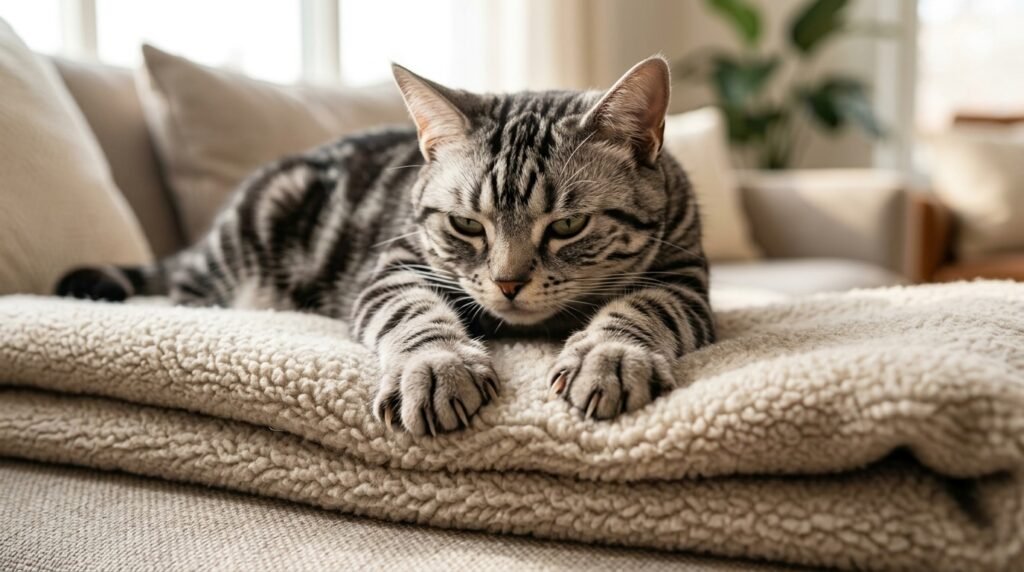
One additional behavior deserves attention: some cats combine kneading with sucking, licking, or mouthing fabric.
Occasional gentle suckling associated with relaxation can accompany the same comfort routine. However, actually chewing and swallowing fabric is different. Ingested nonfood material can create serious gastrointestinal problems, so a cat that consumes blanket fibers, wool, string, or other fabric needs veterinary guidance rather than simply a softer kneading blanket.
Why Does My Cat Knead Me?
Your lap combines several things cats like: warmth, softness, familiarity, and social contact.
If your cat climbs onto you and begins kneading, they may simply be performing the same comforting routine they use on their favorite blanket.
This often occurs while the cat is:
- Purring
- Being gently petted
- Preparing for a nap
- Relaxing after play
- Seeking close contact
- Settling into a familiar routine
So does kneading mean your cat loves you?
It is reasonable to interpret relaxed kneading on a person as a positive sign, but avoid treating one behavior as a perfect translation of emotion.
Look at the complete picture.
A comfortable cat may have a loose body, neutral or forward-facing ears, soft eyes, and relaxed movements. A cat that is tense, repeatedly flicking its tail, flattening its ears, or trying to leave is communicating something different, even if kneading occurred earlier in the interaction.
Why does my cat knead my stomach?
Your stomach may simply provide a warm, soft, elevated resting surface.
Cats don’t understand the inconvenience of twenty sharp little pressure points being applied to human skin. From their perspective, your abdomen may be an exceptionally comfortable place to settle.
A thick blanket between your body and your cat usually solves the problem without ending an interaction your cat enjoys.
Why does my cat knead me but not someone else?
Cats develop individual preferences.
Your scent, body temperature, usual sitting location, handling style, routine, or relationship with the cat may make you the preferred kneading surface.
That doesn’t necessarily prove that the cat likes everyone else less. Cats can express comfort and social attachment in many different ways.
One cat may knead its favorite person. Another may sleep beside them. Another may follow them around the house without ever making a single biscuit.
Individual variation is normal.
Why Do Cats Knead With Their Claws Out?
If you’re wondering why do cats knead while repeatedly sticking their claws into you, the simplest explanation is that claw movement can naturally accompany the paw motion.
Your cat probably isn’t intentionally scratching you.
The claws may extend as the toes spread and the paw presses into the surface. Unfortunately, human skin isn’t nearly as resistant as a thick blanket.
The result can be surprisingly painful even though the cat is perfectly relaxed.
Do not respond by yelling, hitting, pushing the cat roughly, or spraying them with water. Punishment doesn’t teach the cat that its claws hurt human skin; it may simply make a previously comfortable interaction stressful.
Instead, manage the surface.
Put a thick folded blanket across your lap before your cat settles down. If the claws begin hurting, calmly shift or redirect the cat onto the blanket rather than abruptly throwing them off.
AAHA specifically recommends redirecting uncomfortable kneading toward an appropriate plush surface rather than punishing a cat for expressing this natural behavior.
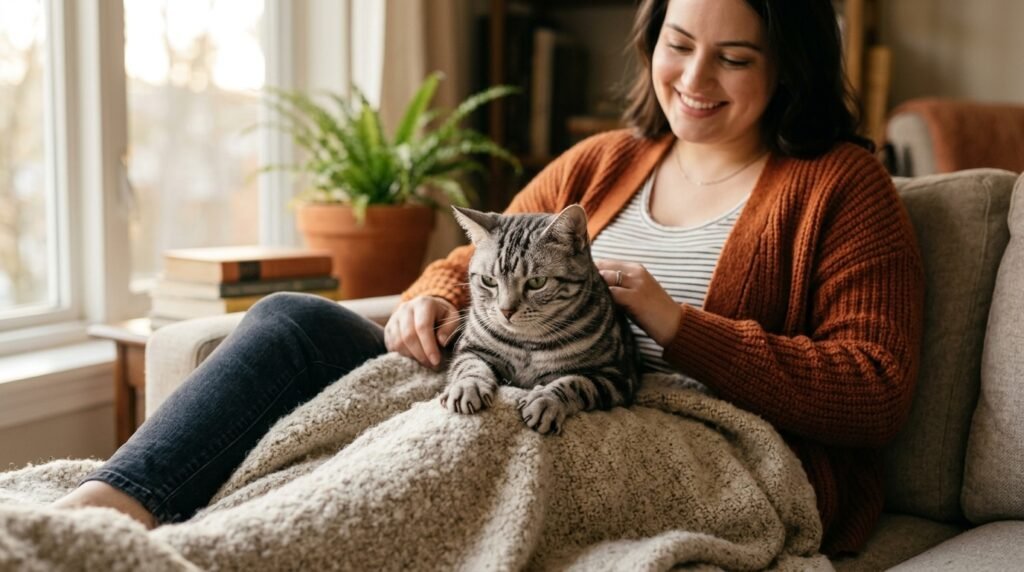
Regular nail care may also reduce painful sharp tips. If you’re unsure how to trim your cat’s nails safely, ask your veterinarian or veterinary technician to demonstrate rather than cutting blindly.
Why Do Some Cats Drool While Kneading?
A cat who becomes extremely relaxed while kneading may occasionally drool.
For an individual cat who has always produced a small amount of saliva while purring, cuddling, and making biscuits, this may simply be part of their relaxation pattern.
But context is particularly important with drooling because saliva can also accompany medical problems.
PetMD’s veterinary guidance on cat drooling notes that a small amount of drooling can occur in relaxed cats, while new, excessive, or unexplained drooling can be associated with problems such as dental disease, nausea, pain, toxin exposure, or other illness.
A useful distinction is therefore pattern versus change.
If your cat has spent years producing a tiny wet spot on the blanket only while kneading and purring, that pattern is quite different from suddenly developing heavy drooling throughout the day.
Contact your veterinarian if drooling is new, persistent, excessive, or occurs with signs such as:
- Difficulty eating
- Reduced appetite
- Pawing at the mouth
- Vomiting
- Marked lethargy
- Mouth pain
- Unusual hiding
- Behavioral changes
Suspected toxin exposure, collapse, severe distress, or breathing difficulty requires urgent veterinary attention.
Don’t assume drooling is harmless simply because your cat also happens to be kneading.
How to Handle Painful or Destructive Kneading
You usually don’t need to “stop” cat kneading.
A better strategy is to preserve the normal behavior while changing where or how it happens.
Give your cat a kneading station
Choose a thick, washable blanket or soft cat bed.
Place it where your cat naturally likes to relax rather than somewhere inconvenient that they rarely visit.
A blanket on the couch beside you, for example, is more likely to succeed than a beautiful cat bed hidden in an unused room.
Create a barrier when your cat kneads you
Keep a folded throw near your usual sitting spot.
When your cat arrives for a kneading session, place the blanket over your legs before the claws start working.
This lets your cat continue the routine while protecting your skin.
Redirect calmly
If your cat begins kneading delicate furniture, don’t turn the situation into a confrontation.
Guide their attention toward the designated blanket. You can make the preferred location rewarding with gentle attention, treats when appropriate, or access to a comfortable resting area.
Consistency matters.
If one family member allows kneading on an old couch while another constantly removes the cat from it, the rules become difficult for the cat to predict.
Keep nails appropriately maintained
Regular nail trimming can make kneading considerably less painful.
Scratching posts are also an important part of a cat-friendly environment, although scratching and kneading are not the same behavior.
Never consider declawing simply because kneading hurts.
Don’t punish biscuit-making
Kneading is not spiteful behavior.
Your cat isn’t trying to damage your blanket or hurt your legs. Punishment can add fear or conflict to an otherwise normal behavior.
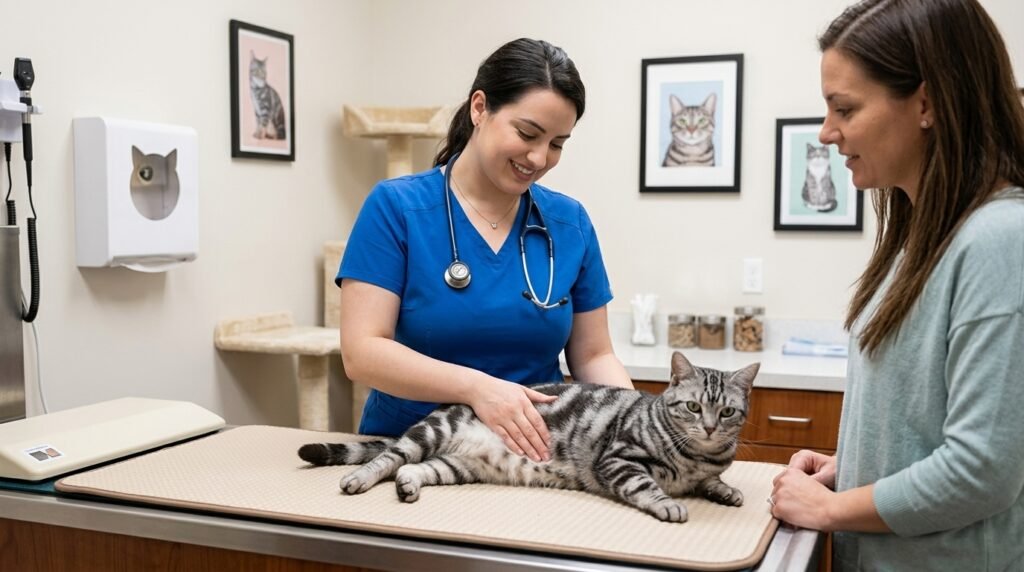
AAHA advises against yelling at or punishing cats for kneading and recommends providing an acceptable outlet instead.
The practical goal is simple: redirect the paws, not the emotion behind the behavior.
When Can a Change in Kneading Be Concerning?
Normal kneading generally doesn’t require veterinary treatment.
However, knowing your cat’s normal habits gives you a useful baseline.
Pay attention when the pattern changes substantially.
For example, consider veterinary advice if your cat suddenly:
- Kneads much more than before
- Stops a long-established kneading routine while showing other behavioral changes
- Hides while repeatedly kneading or purring
- Appears uncomfortable when moving or settling
- Develops appetite changes
- Becomes unusually withdrawn
- Shows aggression or sensitivity to touch
- Drools excessively
- Chews or consumes fabric while kneading
- Shows other signs of pain or illness
VCA notes that cats can sometimes knead and purr as self-soothing behaviors when they aren’t feeling well, while AAHA recommends veterinary evaluation when there is a significant change in kneading behavior.
That does not mean increased kneading diagnoses anxiety, arthritis, pain, or any particular disease.
Behavior alone rarely provides that level of certainty.
Instead, consider the combination of signs and the magnitude of the change.
If your cat has happily made biscuits every evening for ten years, continuing to do so is probably simply your cat being your cat. If the same cat suddenly spends hours hiding, kneading compulsively, eating poorly, and behaving differently, the broader change deserves attention.
FAQs
Why do cats knead their owners?
Cats may knead their owners because a warm lap or body provides a soft, comfortable resting place and because kneading is associated with relaxation and security. If your cat voluntarily settles on you with relaxed body language while kneading, the behavior is generally consistent with feeling comfortable around you.
Why do cats knead blankets before lying down?
Kneading may help a cat settle and prepare a comfortable sleeping surface. It may also be connected with the soothing kneading behavior learned during nursing. For many cats, kneading a blanket becomes part of a predictable bedtime routine.
Why does my cat knead and drool at the same time?
Some cats produce a small amount of saliva when they become deeply relaxed while kneading or purring. If this has always been your cat’s pattern and occurs only during relaxed interactions, it may be normal. New, excessive, or persistent drooling—especially with eating problems, mouth discomfort, vomiting, or behavior changes—should be discussed with a veterinarian.
Should I stop my cat from kneading me with claws?
You don’t normally need to stop the underlying kneading behavior. Place a thick blanket between your cat’s paws and your skin, maintain the nails appropriately, or calmly redirect your cat to a designated soft surface. Avoid punishment because kneading is a natural feline behavior.
Conclusion
So, why do cats knead? The familiar biscuit-making motion begins during nursing and can continue into adulthood as part of relaxation, settling down, scent communication, social comfort, or self-soothing.
Whether your cat kneads a fleece blanket, your favorite sweater, or directly on your stomach, the behavior is usually completely normal.
Your job isn’t necessarily to stop it. If claws make kneading uncomfortable, use a thick blanket, provide an appealing alternative surface, and redirect gently rather than punishing your cat.
Most importantly, learn your individual cat’s normal pattern. A relaxed lifelong biscuit-maker usually isn’t cause for concern. A sudden change in kneading combined with pain, excessive drooling, appetite changes, hiding, or other unusual behavior is a reason to contact your veterinarian.
Understanding the whole cat—not just the moving paws—is the best way to understand what those biscuits really mean.