Have you ever watched your cat stare through a window at a bird and suddenly make a strange clicking, chattering, or chirping sound? If you’ve wondered, why do cats chatter at birds? you’re not alone. This curious behavior is commonly associated with a cat’s natural hunting instincts, intense excitement, and possible frustration when prey is out of reach.
Cat chattering may involve rapid jaw movements, little clicking sounds, and high-pitched chirps. Some cats do it frequently, while others quietly watch birds without making a sound. Both responses can be normal.
Although researchers and cat behavior experts have proposed several explanations, no single theory explains every cat’s behavior. Understanding the situation, your cat’s body language, and the sounds they make can help you interpret what’s happening.
Let’s explore five possible reasons cats chatter at birds, what the behavior may mean, and how to support your cat’s natural instincts safely.
Table of Contents
What Is Cat Chattering, and What Does It Sound Like?
Cat chattering is a distinctive behavior in which a cat rapidly moves its jaw, sometimes producing a series of short clicks or stuttering sounds. It may be accompanied by chirps, squeaks, or little tweets.
You might notice your cat doing it while watching:
- Birds sitting on a fence or tree branch
- Squirrels moving through the yard
- Insects flying past a window
- Small animals moving beyond a closed door
- Other potential prey in the garden
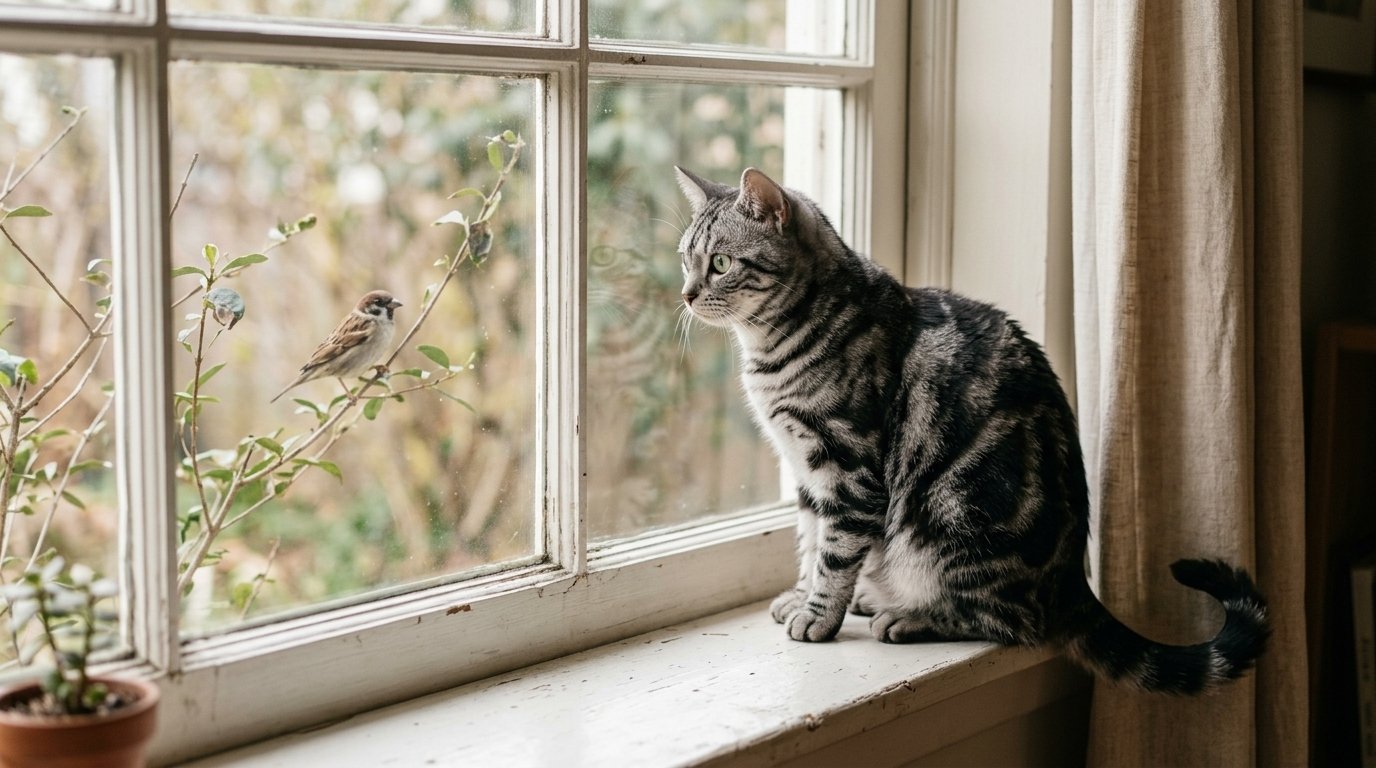
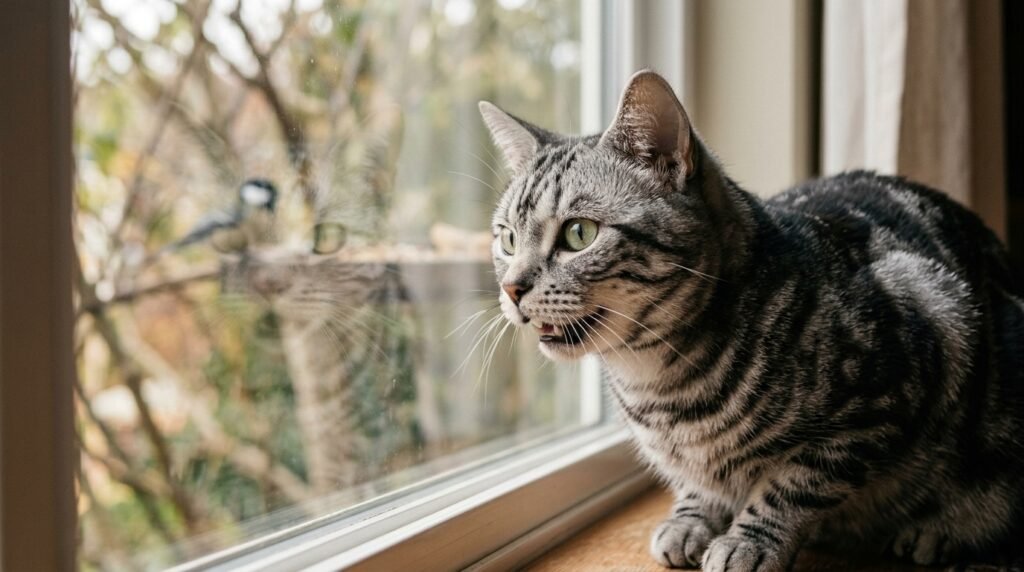
A chattering cat often appears intensely focused on whatever has caught its attention. Its eyes may widen, its ears may point forward, and its body may lean toward the window.
The tail may twitch or move from side to side, while the cat remains almost completely still apart from its jaw.
Cats Protection describes this behavior as a natural feline response commonly observed when cats watch birds, rodents, and other prey animals. However, not every cat chatters, and the absence of chattering does not mean a cat has weak hunting instincts. Read Cats Protection’s explanation of cat chattering.
5 Possible Reasons Cats Chatter at Birds
There isn’t one confirmed explanation for every instance of cat chattering. Several possibilities may help explain why a cat reacts this way when watching wildlife.
1. Their Natural Hunting Instincts Kick In
One of the most widely accepted explanations is that chattering is associated with a cat’s predatory instincts.
Domestic cats retain many behaviors used by their ancestors to locate, stalk, chase, and capture prey. Even cats that have never hunted a bird can show intense interest when they see one moving outdoors.
A bird’s quick movements can trigger a sequence of attention and tracking behaviors. Your cat may lower its body, focus on the bird, shift its weight forward, and prepare to move.
The bird may be on the other side of a window, but your cat’s interest is still real. The instinctive response doesn’t depend on whether the cat can actually catch its target.
You may notice your cat:
- Following the bird with its eyes
- Crouching close to the window
- Moving its head as the bird changes direction
- Flicking its tail
- Making repeated clicking or chirping noises
These signs are consistent with focused interest in potential prey, although body language alone cannot reveal exactly what the cat is feeling.
2. Your Cat May Be Excited by the Sight of Prey
Another possibility is that chattering reflects excitement or heightened arousal.
Birds are visually stimulating to cats. They move unpredictably, change direction quickly, and may appear and disappear among branches. For a cat with strong prey-oriented interests, watching this activity can be highly engaging.
Chattering may occur as part of that intense response.
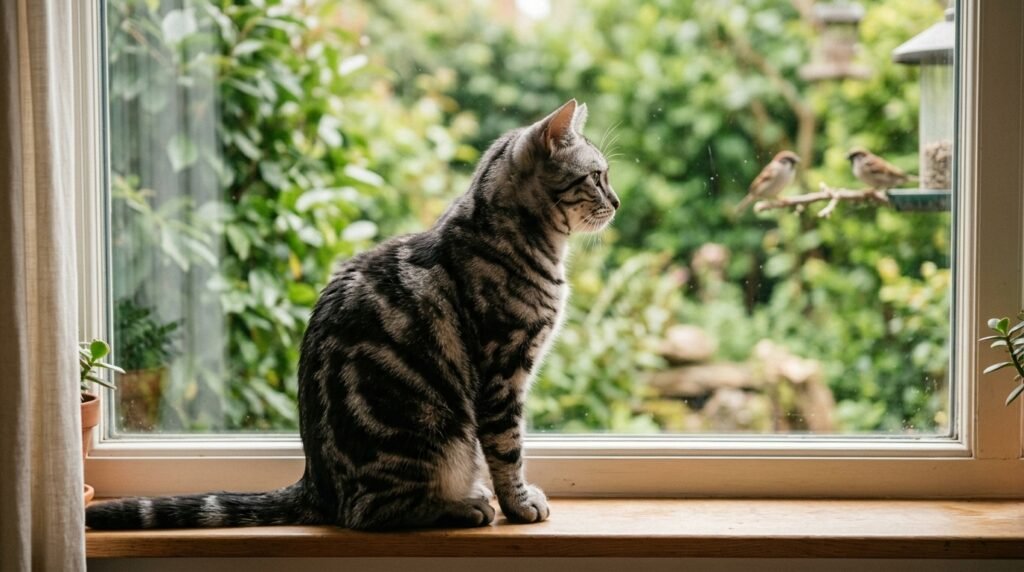
Imagine your cat sitting quietly on the windowsill. A sparrow lands outside, hops across a branch, and suddenly flies away. Your cat’s eyes follow every movement, and a rapid series of little clicks begins.
The sounds may accompany the cat’s excitement and concentration, but they do not provide a reliable translation of its emotional state.
It is important not to assume that every chattering cat is happy, angry, or experiencing exactly the same emotion. Cats communicate through a combination of vocalizations, posture, movement, and context.
A review of feline vocal communication published in the Journal of Veterinary Science explains that cats use a varied vocal repertoire and that vocalizations can change according to their circumstances. Read the review on feline vocal communication.
3. Your Cat May Feel Frustrated When It Cannot Reach the Bird
A cat that spots a bird through a closed window can see the potential target but cannot approach it.
Some behavior experts suggest that this blocked opportunity may contribute to frustration or heightened arousal. The cat’s attention is directed toward something it instinctively wants to pursue, yet the barrier prevents a chase.
This explanation is plausible, but it is not a proven explanation for every chattering episode.
Consider what happens when a bird lands just outside the window. Your cat may move closer, twitch its tail, and make repeated clicking sounds. When the bird flies away, the cat may continue staring outside for a moment before settling down.
That behavior could reflect frustration, excitement, anticipation, or a combination of responses.
How can you tell whether your cat is becoming frustrated?
Look at the entire situation rather than focusing on the sound alone. A cat that remains intensely fixated on the window, repeatedly lunges at the glass, or struggles to disengage may benefit from a change of activity or a less stimulating view.
If the behavior appears to distress your cat, gently redirect its attention to an interactive toy or another enjoyable activity. Avoid scolding or frightening it.
4. Your Cat May Be Trying to Mimic Prey Sounds
One intriguing theory is that some feline chattering or chirping may resemble the sounds made by birds or rodents.
In theory, a sound resembling prey vocalizations might help a predator approach an animal more closely. Observations of vocal mimicry in certain wild cats have also inspired discussion of this possibility.
However, this does not establish that your pet cat deliberately imitates birds whenever it chatters at the window.
The sound may simply occur as part of a broader response to seeing potential prey. The exact function of cat chattering remains uncertain, and the mimicry explanation should be treated as a theory rather than a confirmed fact.
You may notice that your cat’s noises sound remarkably birdlike. That can be fascinating to observe, but it doesn’t necessarily mean your cat is trying to communicate with the bird in its own language.
5. Your Cat May Be Responding to a Highly Stimulating Situation
Chattering is often associated with birds, but cats can also show unusual vocalizations and intense attention when watching squirrels or other moving animals.
The important factor may be the combination of movement, visual interest, and the opportunity to engage in hunting-related behavior.
Some cats become particularly animated when watching wildlife from a favorite windowsill. Others prefer to observe quietly.
Your cat’s personality, previous experiences, environment, and individual vocal habits may influence how it responds.
You don’t need to make your cat chatter or encourage it to produce the sound. A cat that watches birds calmly is not missing an essential experience.
Instead, provide opportunities for your cat to explore, play, stalk toys, climb, and investigate its surroundings in ways that suit its individual preferences.
What Does Your Cat’s Body Language Tell You?
The sound is only one part of the picture. Watching your cat’s posture and behavior can help you understand the context in which chattering occurs.
Here are some common signs to look for.
Forward-facing ears and a focused stare: Your cat is paying close attention to something. This is common when a bird or another moving animal catches its eye.
A crouched body: Your cat may be adopting a posture associated with watching or preparing to pursue something.
A twitching tail: Tail movement can accompany intense interest or arousal. Its meaning depends on the rest of the cat’s body language.
Rapid jaw movements: These are characteristic of chattering, especially when the cat is watching prey through a window.
Relaxing when the bird leaves: If your cat quickly settles once the stimulus disappears, that context may support the interpretation that the episode was linked to watching wildlife.
No single sign proves what your cat is feeling. For example, a moving tail can accompany several different emotional states, and wide eyes may occur in many situations.
Instead of assigning a fixed meaning to each movement, observe patterns over time. Notice what happens before the sound begins, how your cat behaves during it, and how quickly it returns to normal afterward.
If you want to understand feline sounds more broadly, it helps to remember that cats use vocalizations flexibly. A chirp made while watching prey is not necessarily the same as a friendly trill directed at a familiar person.
Cat Chattering vs. Chirping, Trilling, and Teeth Grinding
People often use words such as chattering, chirping, and twittering interchangeably. However, the sounds and movements may differ.
| Sound or behavior | What you may notice | What it may indicate |
|---|---|---|
| Chattering | Rapid jaw movements and clicking sounds | Often associated with watching potential prey |
| Chirping | Short, high-pitched calls | May occur during prey watching or other interactions |
| Trilling | A rolling, often friendly-sounding vocalization | Frequently used in social interactions |
| Meowing | A familiar vocal call with varied pitches and lengths | Often used in communication with people |
| Teeth grinding | Repeated rubbing or grinding movements of the teeth | May indicate oral discomfort and deserves attention |
These descriptions are practical distinctions, not a definitive diagnostic system. Individual cats vary, and similar sounds can be difficult to classify without observing the context.
When Is Teeth Chattering Different From Normal Bird Chattering?
The circumstances matter.
If your cat briefly chatters while watching a bird and then returns to normal, the behavior is often harmless.
However, repeated teeth grinding or chattering that occurs during eating, grooming, resting, or ordinary interactions may have a different explanation. Dental disease and oral pain can cause abnormal mouth movements or difficulty eating.
Pay attention to signs such as:
- Dropping food while eating
- Chewing on one side of the mouth
- Pawing repeatedly at the mouth
- Excessive drooling
- Bad breath that is new or persistent
- Avoiding hard food
- Vocalizing when the mouth is touched
These signs warrant veterinary attention, particularly if they are new or worsening.
Don’t assume that every jaw movement is a hunting behavior. If you cannot tell whether your cat is chattering at prey or experiencing mouth discomfort, recording a short video can help your veterinarian assess what is happening.
Is It Normal for Cats to Chatter at Birds?
Yes. Occasional chattering when a cat watches birds or other potential prey is generally considered a normal feline behavior.
It does not automatically mean your cat is unhappy, aggressive, or in need of treatment. Nor does every cat need to chatter to be considered behaviorally healthy.
The context is especially important.
If your cat makes the sound while watching a bird, remains otherwise alert and coordinated, and returns to its usual activities afterward, there is generally no reason to stop the behavior.
You also do not need to interrupt your cat simply because the sound seems unusual. Punishing a cat for a natural behavior can create unnecessary stress without addressing its underlying motivation.
Can Indoor Cats Chatter Even If They Have Never Hunted?
Absolutely. Indoor cats retain predatory behavior patterns even when they have never caught live prey.
Watching a bird through a window can provide visual stimulation and trigger tracking or stalking behavior. The response does not require previous hunting success.
Indoor cats can benefit from opportunities to express these behaviors through appropriate play. Toys that move unpredictably, puzzle feeders, climbing structures, and scratching surfaces can make the home environment more engaging.
If your cat enjoys watching wildlife, you can also provide a comfortable resting spot near a securely closed window.
Should You Worry if Your Cat Never Chatters?
No. Some cats chatter frequently, some do it occasionally, and others rarely or never make the sound.
Individual differences in temperament, experience, and vocal behavior are normal. A cat that quietly observes birds can still be attentive and interested in its surroundings.
There is no need to train your cat to chatter or compare its behavior with videos of other cats.
What matters more is whether your cat eats normally, remains active, engages with its environment, and behaves consistently with its usual personality.
A sudden change in vocalization, however, deserves attention if it occurs alongside other unusual signs.
How to Support Your Cat’s Hunting Instincts Safely
You do not have to eliminate normal chattering. Instead, focus on giving your cat safe, satisfying ways to engage in natural behaviors.
1. Offer Interactive Play Every Day
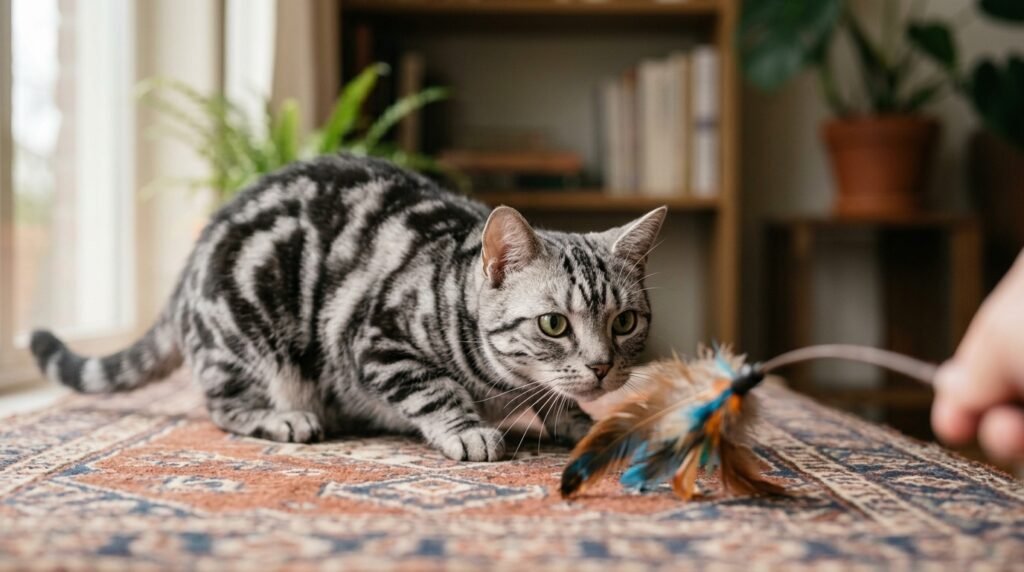
Wand toys and feather toys can encourage stalking, chasing, and pouncing.
Move the toy in ways that resemble prey: pause, change direction, move it behind an object, and allow your cat opportunities to catch it. Let your cat complete the sequence instead of making the toy permanently unreachable.
Short sessions tailored to your cat’s age, health, and energy level can provide useful mental and physical stimulation.
Finish with an opportunity to catch the toy and, where appropriate, a small treat or part of the cat’s normal meal.
2. Add Puzzle Feeders and Foraging Opportunities
Food puzzles can encourage cats to investigate, manipulate objects, and work for some of their food.
Start with an easy puzzle so your cat can learn how it works. Gradually increase the challenge if your cat enjoys it.
Use a portion of the cat’s normal daily food allowance rather than adding excessive treats. Supervise new toys and remove anything that breaks or could be swallowed.
3. Create a Comfortable Window-Watching Spot
A stable cat perch near a securely closed window can provide a place to observe the outdoors.
Make sure the perch is secure and the window cannot be pushed open or accessed unsafely. Check screens carefully, as ordinary window screens may not reliably prevent falls or escapes.
If your cat becomes overly stimulated or appears distressed by what it sees, reduce the visual exposure temporarily. You can close a blind, cover part of the window, or guide your cat toward another activity.
4. Provide Climbing and Scratching Opportunities
Cat trees, sturdy shelves, and appropriate scratching posts allow cats to climb, stretch, explore, and rest.
Position resources where your cat can comfortably access them. Older cats or those with mobility difficulties may need lower platforms or steps.
Environmental enrichment is not about keeping your cat constantly busy. It is about providing meaningful choices, comfortable resting places, and opportunities to engage in natural behavior.
5. Protect Birds and Other Wildlife
Watching wildlife through a closed window allows your cat to observe without directly attacking an animal.
If you use bird feeders, consider their placement carefully. Avoid locations where cats can easily ambush birds, and keep your cat physically separated from wildlife.
For outdoor time, a properly secured enclosure or supervised access to a suitable enclosed space can offer stimulation while reducing opportunities to chase and injure wild animals.
If your cat repeatedly becomes distressed while watching wildlife, modify the setup to reduce that stress rather than forcing continued exposure.
When Should You Contact a Veterinarian?
Normal chattering at a bird does not usually require veterinary treatment. However, not every clicking or jaw movement should automatically be attributed to hunting instincts.
Contact your veterinarian if:
- The behavior begins suddenly without an obvious trigger.
- Your cat repeatedly chatters when no prey or other clear stimulus is present.
- You notice teeth grinding, drooling, or signs of mouth pain.
- Your cat struggles to eat, drops food, or refuses meals.
- The jaw appears locked, moves abnormally, or seems painful.
- The behavior occurs alongside lethargy, disorientation, weakness, or other unusual changes.
Seek urgent veterinary care if your cat has difficulty breathing, collapses, experiences a seizure, or develops sudden severe neurological signs.
A video can be particularly helpful if the behavior occurs intermittently. Record the movement from a safe distance and note what your cat was doing immediately beforehand.
Do not force your cat’s mouth open or attempt to manipulate its jaw to investigate the cause.
A veterinarian can determine whether the behavior resembles ordinary prey-related chattering or whether an examination is needed to investigate dental, oral, or other medical causes.
Frequently Asked Questions
1. Why do cats chatter at birds through a window?
Cats commonly chatter while watching birds because the sight of potential prey can trigger focused attention and hunting-related behavior. Excitement and frustration at being unable to reach the bird may also contribute, although the exact cause varies.
2. Does my cat chatter because it is frustrated?
Possibly, but frustration is only one proposed explanation. Chattering may also accompany excitement or intense interest in prey. Consider your cat’s overall body language and behavior rather than assuming the sound always signals distress.
3. Should I stop my cat from chattering at birds?
Not usually. Occasional chattering during bird-watching is generally normal and does not need to be stopped. Provide appropriate play and enrichment, and reduce visual stimulation if your cat appears distressed. Consult a veterinarian if the behavior is new or accompanied by signs of illness or pain.
4. Why does my cat chatter at birds but not at other animals?
Cats differ in what captures their attention. Your cat may respond particularly strongly to birds because of their movement, sounds, or the situations in which it sees them. Not chattering at squirrels, insects, or other animals is not, by itself, a cause for concern.
Conclusion
Why do cats chatter at birds? The behavior is most often associated with natural hunting instincts and intense interest in potential prey. Excitement, frustration, and possible prey mimicry are additional explanations, but no single theory has been confirmed for every cat.
If your cat chatters briefly while watching birds and otherwise behaves normally, you generally do not need to intervene. Offer daily interactive play, opportunities to climb and explore, and safe ways to observe the outdoors.
Most importantly, distinguish ordinary bird-watching behavior from unusual jaw movements or changes in health. If chattering begins suddenly, occurs without an obvious trigger, or accompanies signs of pain or illness, seek veterinary advice.