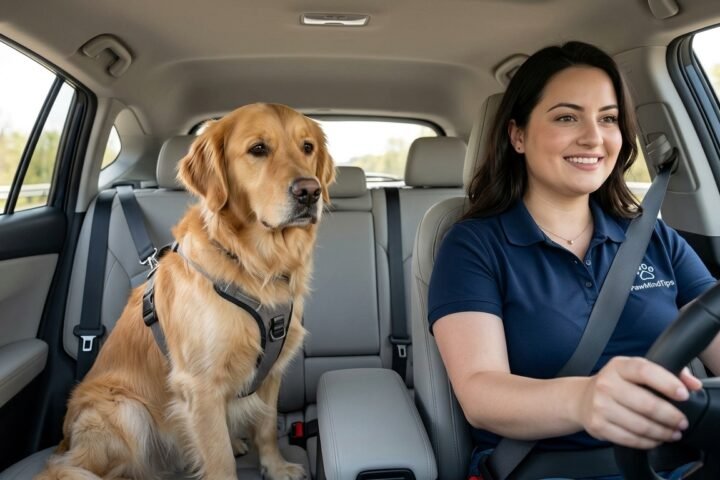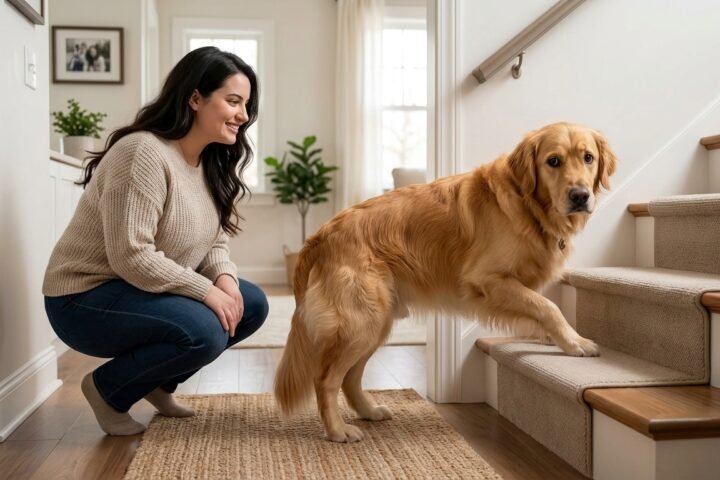
Is your dog afraid of harness time? Running behind the couch, lowering the head, backing away, or becoming motionless is not stubbornness. Those behaviors usually mean the dog expects something uncomfortable, frightening, or overwhelming. The trigger may be the harness itself, the way it is put on, a snapping buckle, restricted movement, physical pain, or what happens after it appears.
The most effective response is not to catch your dog and put the harness on quickly. First, check comfort and fit. Then rebuild the association in steps small enough that your dog can remain relaxed and choose to participate. This guide shows you how to identify the likely cause, read early stress signals, and teach comfortable harness wearing without force.
Table of Contents
Why Is My Dog Afraid of Harness Time?
A dog cannot explain whether the scary part is the sight of the gear, hands reaching over the head, a leg being lifted, a clip snapping near the ribs, or pressure during the walk. Observing exactly when the reaction begins provides the best clue.
Common causes include:
- A negative history. The harness may once have pinched skin, caught fur, been pulled over sore ears, or predicted a stressful outing. One frightening event can create a strong association.
- Handling sensitivity. Some dogs dislike hands near their face, feet, shoulders, or torso. If your dog also avoids grooming, toweling, or petting in particular places, the difficulty may be broader than the harness.
- The design. An over-the-head loop can worry a head-shy dog. A step-in model may be harder for a dog that dislikes paw handling or has joint pain. Stiff material, bulky hardware, or straps close to the armpits may also feel unpleasant.
- The sound or motion. The buckle click, jingling tags, Velcro, dangling straps, or a harness moving toward the body may each be a distinct trigger.
- Poor fit or pain. Chafing, pressure, restricted shoulder motion, skin disease, neck or back pain, and sore joints can make wearing equipment painful.
- What the harness predicts. If it always leads to a noisy hallway, elevator, traffic, unfamiliar dogs, or a frightening outdoor environment, the dog may fear the walk rather than the equipment.
- Rushed restraint. Chasing, cornering, holding the collar, or forcing the head through can teach a dog that the harness removes choice.
If your dog afraid of harness gear runs only after you pick it up, begin with visual exposure. If the dog approaches happily but retreats when you lift the loop, work on hand and harness movement. If concern appears only after fastening or during movement, investigate fit and discomfort before doing more training.
Before Training, Check Fit, Skin, and Physical Comfort
When a previously comfortable dog suddenly becomes a dog afraid of harness handling, schedule a veterinary check rather than assuming a behavior problem. Pain can alter movement, posture, tolerance of touch, and willingness to be handled. The AAHA pain-management guidelines emphasize recognizing behavioral and mobility changes as part of pain assessment.
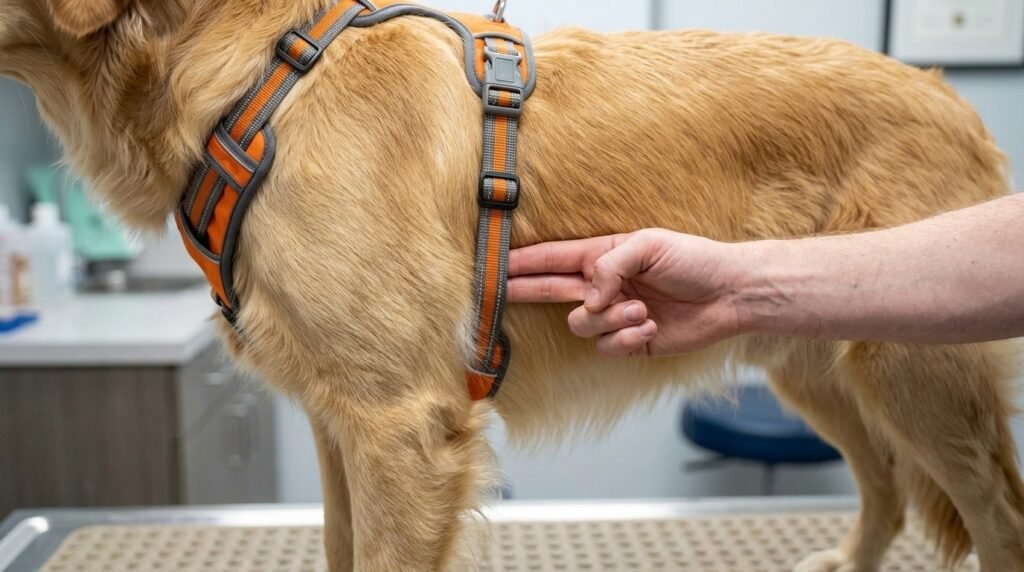
Remove the harness and examine it as well as your dog’s body. A dog afraid of harness wear may be responding to:
- Redness, hair loss, dampness, sores, or rubbed areas under straps
- Tangled hair or skin caught near clips and adjustment sliders
- Sensitivity around the neck, shoulders, armpits, chest, back, or legs
- Limping, stiffness, shortened steps, reluctance to use stairs, or difficulty rising
- Coughing, gagging, or noisy breathing associated with pressure
- A cracked clip, twisted strap, rough seam, or sharp edge
A practical harness-fit check
Fit the harness according to its manufacturer’s instructions because designs vary. It should be secure enough that the dog cannot back out, but it should not pinch, rub, press on the throat, or block natural shoulder movement. You should usually be able to slide about two fingers beneath the straps without forcing them. Body shape and harness construction still matter.
With the harness on briefly, check that straps lie flat and do not rotate dramatically, ride into the armpits, tighten across the neck, or change the dog’s stride. The AKC’s illustrated explanation of common harness types and placement shows how common models should sit.
Do not test a new fit on a full walk. Invite a few indoor steps, remove it, and inspect the coat and skin. Recheck growing puppies and dogs whose weight or coat changes often.
Contact your veterinarian promptly if touching the area causes a yelp, snap, sudden flinch, or marked distress; if you see wounds or swelling; or if there is coughing, breathing difficulty, weakness, or an abnormal gait. Breathing trouble, collapse, severe pain, or significant injury requires urgent veterinary care.
Read Your Dog’s Stress Signals Before You Continue
A freeze is easy to misread as cooperation. A relaxed dog has soft muscles, normal breathing, freely moving eyes, and the ability to disengage or approach. A dog afraid of harness handling may become rigid, hold the breath, lower the body, pin the ears, tuck the tail, turn away, lick the lips, tremble, or stop taking food.
Reviewing the broader signs of a stressed dog can help you notice subtle signals before your dog runs or shuts down. Early signs matter because learning works best below the dog’s fear threshold—the point at which the dog can notice the trigger and still eat, move normally, sniff, and make choices.
Use this simple traffic-light guide:
| Zone | What you may see | What to do |
|---|---|---|
| Green | Loose body, normal movement, willingly approaches, readily eats | Continue for a few repetitions |
| Yellow | Slower approach, head turn, lip lick, body lean, delayed treat-taking | Make the step easier or increase distance |
| Red | Freezing, fleeing, hiding, trembling, growling, refusing favorite food | Stop; remove pressure and return to a much easier step later |
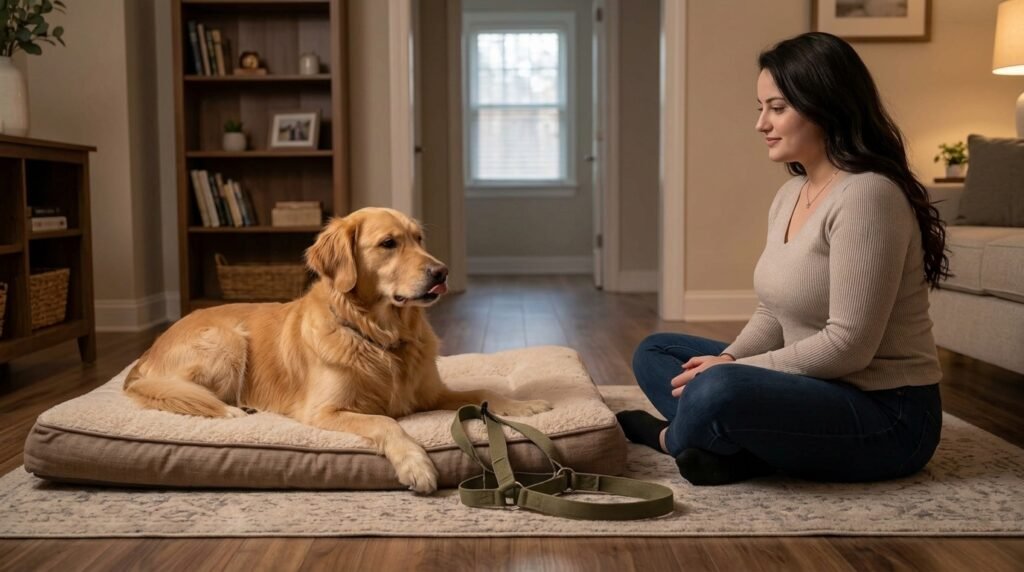
Growling is information, not disobedience. Punishment may suppress a warning while leaving fear intact. The American Veterinary Society of Animal Behavior’s humane-training guidance recommends reward-based methods and warns against aversive methods.
Prepare a Calm Harness-Training Setup
For a dog afraid of harness sessions, preparation reduces accidental pressure. Work in a quiet room with a nonslip floor and an open exit path. Put other pets away. Choose tiny, high-value treats your dog can eat quickly, or use a favorite toy if food is not motivating when the dog is relaxed.
Keep sessions short—often 30 seconds to three minutes. End while your dog still wants to participate. Several easy sessions are more useful than one long struggle.
Choose equipment that suits the individual. A harness that opens at the neck can help a dog that dislikes objects passing over the head. A dog that resists paw handling may prefer a design that does not require stepping in. Do not assume one style is best for every body.
Use a marker such as “yes” to identify the relaxed behavior that earns food. Practice away from the harness first: say “yes,” then give a treat until the sound predicts the reward.
Keep a simple log: date, step practiced, earliest stress signal, and easiest successful repetition. Progress according to behavior, not a deadline. VCA’s veterinary behavior guide to desensitization and counterconditioning explains why exposure must begin at a low enough intensity to avoid fear and be paired with something positive.
How to Help a Dog Afraid of Harness Gear: 8 Gentle Steps
These steps are intentionally small. Your dog may complete several in one calm session or need days at a single stage. Begin at the first step that produces no more than mild awareness. If the dog scared of harness gear backs away, stiffens, stops eating, or reaches forward while keeping the feet planted far behind, lower the difficulty.
1. Let the harness exist at a safe distance
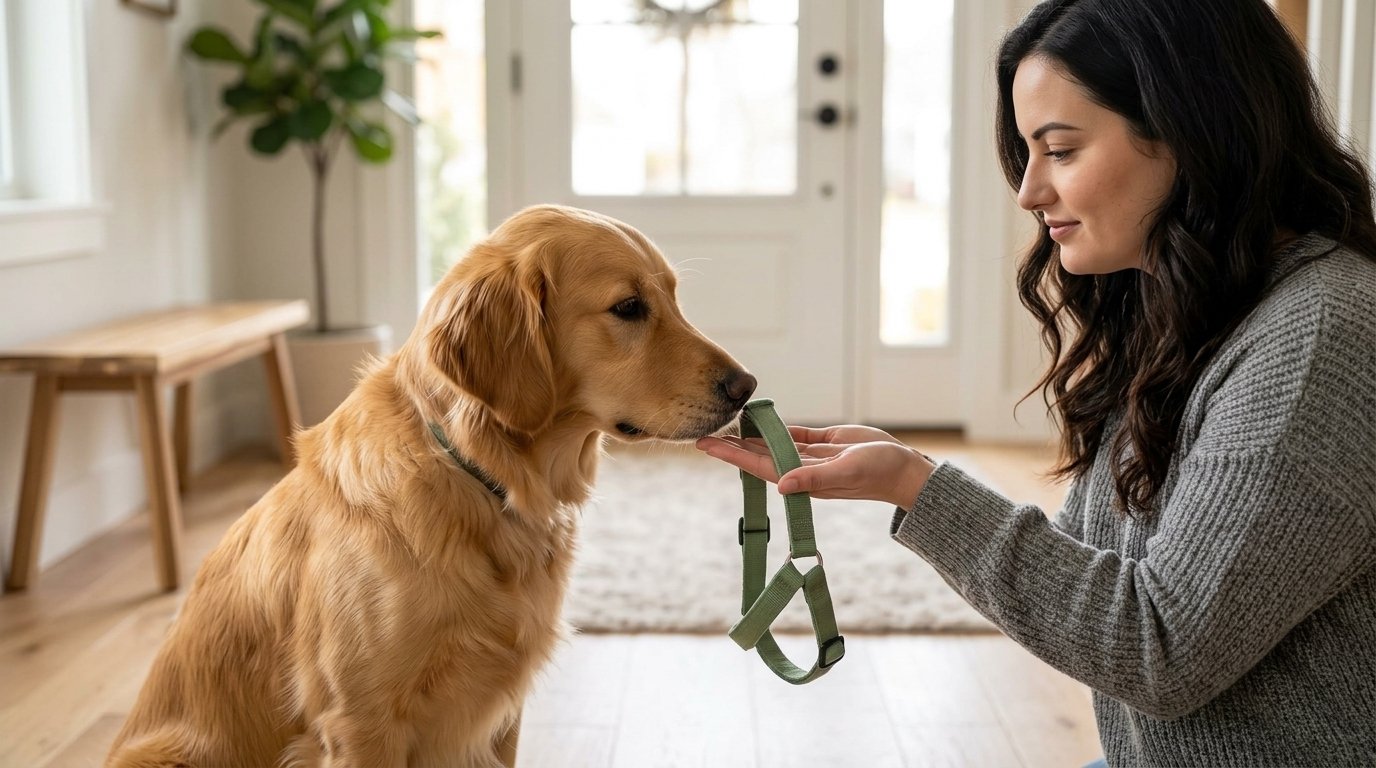
Place the harness on the floor far enough away that your dog notices it without retreating. The instant the dog looks at it, mark and place or toss a treat away from the harness. Tossing the reward away creates a natural break and lets the dog decide whether to return.
Do not lure a dog afraid of harness gear close enough to feel trapped. If the dog will not enter the room, begin farther away or with the harness partly covered. Progress when your dog remains loose and willingly re-engages several times.
2. Reward voluntary investigation
Place the harness still on the ground. Mark a glance, step toward it, sniff, or gentle nose touch. Let the dog withdraw whenever desired. Gradually reward closer investigation, but never require touching as the price of leaving.
For a dog afraid of harness handling, control is reinforcing. The lesson is: “My choices make good things happen, and nobody grabs me.” Once the dog approaches with a relaxed body and no hesitation, move to the next stage.
3. Condition your hand lifting and moving it
Pick the harness up only an inch, mark, feed, and put it down. Over repetitions, lift it slightly higher. Later, move it a few inches sideways—not toward the dog—then reward. Separate motion from contact so you can identify which part worries your dog.
If your dog afraid of harness movement retreats when your arm extends, shorten the motion. Avoid leaning over the dog; sit sideways and move predictably.
4. Work on buckle, tag, and Velcro sounds separately
Make the quietest possible buckle click at a comfortable distance, then immediately deliver a treat. Do not buckle the harness on the dog yet. When the dog hears the sound and happily anticipates food, gradually reduce distance over multiple sessions.
Treat Velcro and jingling hardware as separate exercises. A sound-sensitive dog afraid of harness buckles may need the click muffled in a towel. If the dog startles, increase distance or soften the noise.
5. Teach a voluntary nose or chin target
For an over-the-head harness, hold the neck opening wide and still. Present food through the opening so the dog can reach forward, but keep the loop far from the face and never move it over the head. Progress from a nose entering briefly to the muzzle, then the whole head—always with the dog moving into the opening.
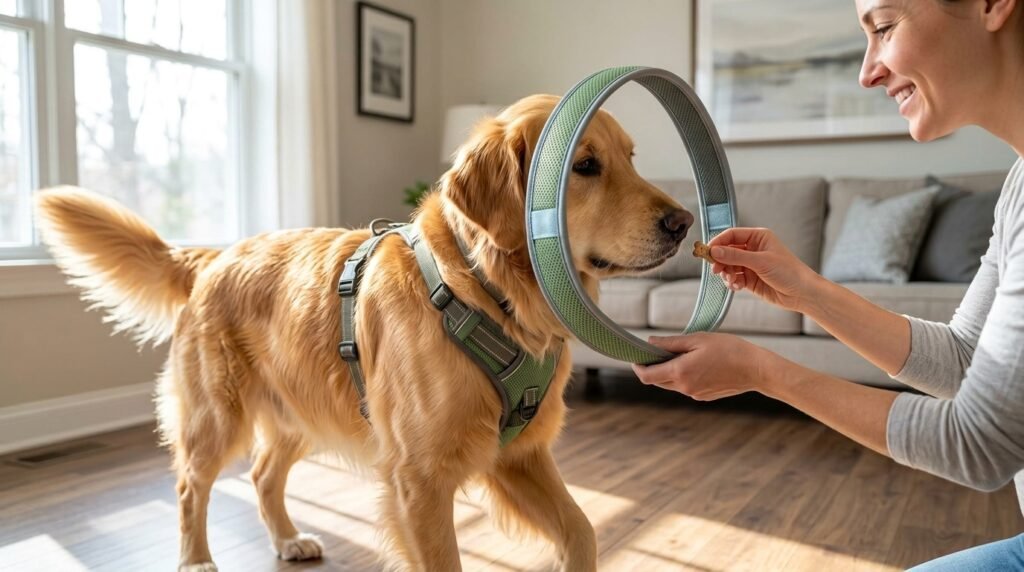
Reduce reliance on a lure by marking an offered nose movement and rewarding afterward. For a neck-opening harness, practice touching the strap lightly to the shoulder. For a step-in design, teach each paw to target a low mat or loop without lifting the leg by force.
6. Add brief, gentle contact
Once the dog eagerly performs the target, allow the harness to touch the neck or shoulders for one second, feed, and remove it. Build duration in tiny increments. Keep straps loose and unfastened. A dog afraid of harness pressure may accept contact but tense when weight rests on the back, so watch the whole body rather than focusing only on whether the dog stays in place.
If ordinary touch is difficult, work on cooperative handling separately. Forcing contact can damage trust; the PawMindTips guide to habits that destroy dog trust explains why restraint and ignored warnings can make future handling harder.
7. Fasten one clip, then remove it
When contact is comfortable, fasten one buckle, feed several treats, unclip, and finish. Keep fingers clear of skin and fur. For a dog afraid of harness fastening, add another clip only in a later easy repetition. Set approximate strap adjustments beforehand.
Practice putting the harness on and taking it off without immediately going outside. This prevents the gear from predicting only an arousing or scary walk. The dog is ready to progress when approaching, targeting, fastening, and removal all happen with loose posture and normal treat-taking.
8. Build movement and real-life use gradually
With the harness fastened and the leash unattached, reward one voluntary step indoors, then remove the harness. Build to several steps, a simple treat scatter, or a familiar cue. Next attach a lightweight leash while you hold it slack. Practice briefly in the house, then in a quiet yard or low-distraction area.
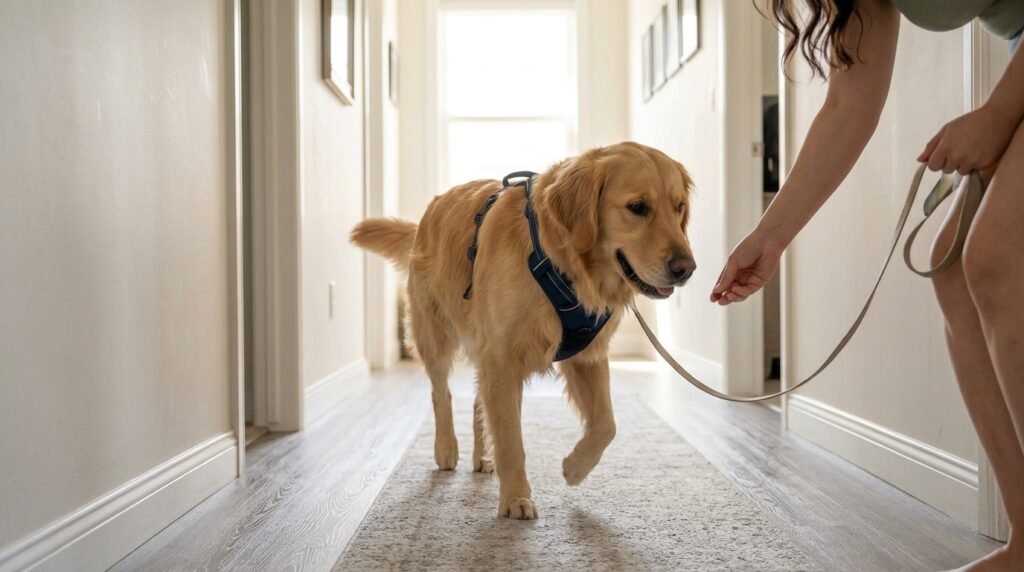
Keep the first walks short and easy. If the environment itself is frightening, work on that separately; PawMindTips’ gentle strategies for helping a nervous dog can help reduce general fear without flooding. A walk is not a reward if the dog finds the location overwhelming.
What If Your Dog Freezes in the Harness?
If your dog freezes in harness equipment, do not pull the leash, push the body, or assume the dog will “get used to it.” Stop moving. Loosen social pressure by turning your body slightly sideways, keeping the leash slack, and allowing space. If the dog can comfortably eat, toss a treat a short distance to invite voluntary movement. If the dog remains rigid or refuses food, calmly remove the harness if you can do so without a struggle.
Afterward, check fit, skin, gait, and when the freeze began. A dog afraid of harness pressure may be unfamiliar with the sensation, in pain, or over threshold. Return to one second of contact or a single buckle and reward relaxed movement.
Do not use food to pull a dog through severe fear. Food helps when it changes emotion at a tolerable intensity, not when it masks distress.
If freezing occurs with other equipment, touch, or movement, or appeared suddenly, ask your veterinarian to assess pain and mobility. Video recorded without provoking the response can help the veterinarian or behavior professional see posture and movement at home.
Common Harness-Training Mistakes to Avoid
When a dog runs away from harness gear, urgency can tempt owners to move faster. These common shortcuts often prolong the problem:
- Chasing or cornering the dog. This makes the appearance of the harness predict loss of control.
- Holding the dog still while another person fastens it. Restraint may produce shutdown rather than comfort.
- Repeating exposure until the dog gives up. Flooding can intensify fear or teach helplessness.
- Advancing because the dog took one treat. Look for loose posture, willing re-approach, and several easy repetitions.
- Making every harness session end in a difficult walk. Include brief put-on/take-off practice followed by calm indoor activities.
- Ignoring removal. Pulling gear quickly over the face can undo careful work. Condition unfastening, lifting straps, and removal in reverse order.
- Correcting avoidance or growling. Fear is an emotional response, not a challenge to authority.
- Training through suspected pain. Behavior work cannot make an uncomfortable harness fit correctly or treat an underlying medical condition.
While retraining, use safe enrichment that does not require forcing feared equipment: food-search games, indoor play, a securely fenced yard, or veterinarian-approved activity. Do not switch casually to a collar for a dog that pulls, coughs, has a medical restriction, or can slip out. Ask your veterinarian or a qualified reward-based trainer about a safe temporary setup.
When to Get Veterinary or Behavior Help
Arrange a veterinary examination if fear began suddenly, the dog resists touch in a new area, movement has changed, the harness leaves marks, or you notice coughing, skin lesions, swelling, weakness, or signs of pain. This article provides general education and cannot diagnose the cause.
Seek a credentialed, reward-based behavior professional if your dog afraid of harness response includes panic, snapping, or a bite risk; if necessary walks cannot be managed safely; or if careful practice is not improving comfort. A veterinary behaviorist is especially appropriate when fear is severe, generalized, or accompanied by other anxiety concerns. The Merck Veterinary Manual’s overview of canine behavior modification explains that effective plans manage triggers, change emotional responses, and reinforce desirable behavior rather than relying on punishment.
A good professional should observe body language, work below threshold, explain each step, and never guarantee a fixed timeline. Avoid anyone who recommends intimidation, leash corrections, forced exposure, or punishing warning signals.
Frequently Asked Questions
Why does my dog run away when I pick up the harness?
A dog afraid of harness gear has usually learned that it predicts something unpleasant: being caught, gear passing over the head, a pinch or buckle sound, pressure, or a stressful walk. Note the first reaction, rule out poor fit or pain, and begin where the dog remains relaxed.
How long does it take to get a dog used to a harness?
There is no reliable fixed timeline. A mildly unsure dog may improve over several short sessions, while an established fear may require weeks or professional help. Progress when your dog shows loose posture, takes food normally, and voluntarily repeats the current step—not because a certain number of days has passed.
Should I leave the harness on so my dog gets used to it?
No. Unsupervised or prolonged wear can cause rubbing, snagging, or increased distress, and exposure above the dog’s threshold may worsen fear. Use short, supervised sessions, remove the harness while the dog is still comfortable, and inspect the skin and coat.
What harness is best for a dog afraid of harness handling?
The best design is secure, correctly fitted, comfortable in motion, and easy for that individual dog to put on. A neck-opening model may help a head-shy dog; a non-step-in model may suit a dog that dislikes paw handling. Fit, escape risk, body shape, and any medical needs matter more than a universal style label.
Conclusion
A dog afraid of harness handling needs safety, choice, and a pace set by observable comfort—not restraint or repeated forced exposure. Start by checking the dog’s body and the equipment. Then separate the challenge into sight, movement, sound, touch, fastening, and walking, rewarding calm voluntary participation at each stage.
If your dog freezes, flees, refuses favorite food, or becomes rigid, make the task easier. If the reaction is sudden, painful, severe, or unsafe, involve your veterinarian and a qualified reward-based behavior professional. Gentle training may feel slower at first, but it protects trust and creates a more dependable path toward peaceful walks.