Dog counter surfing is the habit of reaching, jumping, or climbing onto a kitchen counter or dining table to take food. It can be frustrating, but it is rarely a sign that a dog is being spiteful or “dominant.” Food smells inviting, stealing it is immediately rewarding, and one successful raid can keep a dog checking the counter for weeks.
The most reliable solution combines prevention with reward-based training. Keep food safely out of reach, block kitchen access when you cannot supervise, reward four paws on the floor, and teach your dog to relax on a mat while you cook. The seven steps below turn those ideas into a practical routine for puppies and adult dogs.
Table of Contents
What Is Dog Counter Surfing, and Why Does It Continue?
A dog does not need to climb fully onto a counter to qualify as a counter surfer. A tall dog may place two paws on the edge, a small dog may use a chair as a step, and a determined dog may snatch food from a dining table without touching the tabletop. The common feature is obtaining—or searching for—something valuable from a human food surface.
The behavior persists because it operates like a slot machine. Most checks may produce nothing, but an occasional sandwich, stick of butter, or dirty plate makes future checks worthwhile. The food itself rewards the behavior, so a dog can learn it without any attention from a person. Even yelling may add excitement after the food has already been won.
Common dog counter surfing contributors include:
- Food or crumbs regularly left within reach
- Chairs or stools that give a smaller dog access
- A history of receiving scraps near the counter or table
- Boredom and unsupervised access to the kitchen
- Inconsistent rules among family members
- Increased appetite, especially after a diet change or while taking certain medications
- A lack of an equally clear behavior to perform during cooking
Some dogs are persistent scavengers, but breed and size do not determine the outcome. Learning history and home setup matter more than labels such as “stubborn.”
Why Food Stealing Can Become a Safety Emergency
Dog counter surfing is not merely an etiquette problem. Counters can hold chocolate, grapes, raisins, onions, garlic, alcohol, yeast dough, cooked bones, medications, knives, hot pans, or food wrapped in plastic. The ASPCA’s list of people foods to avoid explains why several ordinary ingredients can harm pets. Sugar-free gum, candy, baked goods, and some nut butters may contain xylitol; the FDA warns that xylitol is dangerous to dogs.
If your dog steals something potentially toxic, do not wait for symptoms and do not induce vomiting unless a veterinary professional directs you to do so. Note the product, ingredients, estimated amount, time, and your dog’s weight. Call your veterinarian, an emergency veterinary clinic, or the ASPCA Animal Poison Control Center at (888) 426-4435. A consultation fee may apply. Collapse, repeated vomiting, tremors, seizures, breathing difficulty, severe weakness, or loss of consciousness requires immediate emergency care.
Food wrappers, skewers, corn cobs, string, and cooked bones may cause choking or internal obstruction even when the food itself is not toxic. Contact a veterinarian promptly if one of these objects is missing or you suspect it was swallowed. PawMindTips’ guide to household items poisonous to dogs offers additional prevention context, but an actual exposure needs professional advice.
Prepare the Kitchen Before You Start Training
Training cannot compete with repeated jackpots. Before the first session, make counter surfing unprofitable throughout the home.
Move bread, fruit bowls, cooling racks, snack bags, dirty dishes, and pet-food containers into closed cabinets, the refrigerator, or a latched pantry. Push appliances and food farther back only as a temporary supervised measure; many dogs can reach farther than expected. Wipe grease and crumbs from counters, clear the dining table after meals, and move chairs fully under the table. Use a lidded or secured trash can.
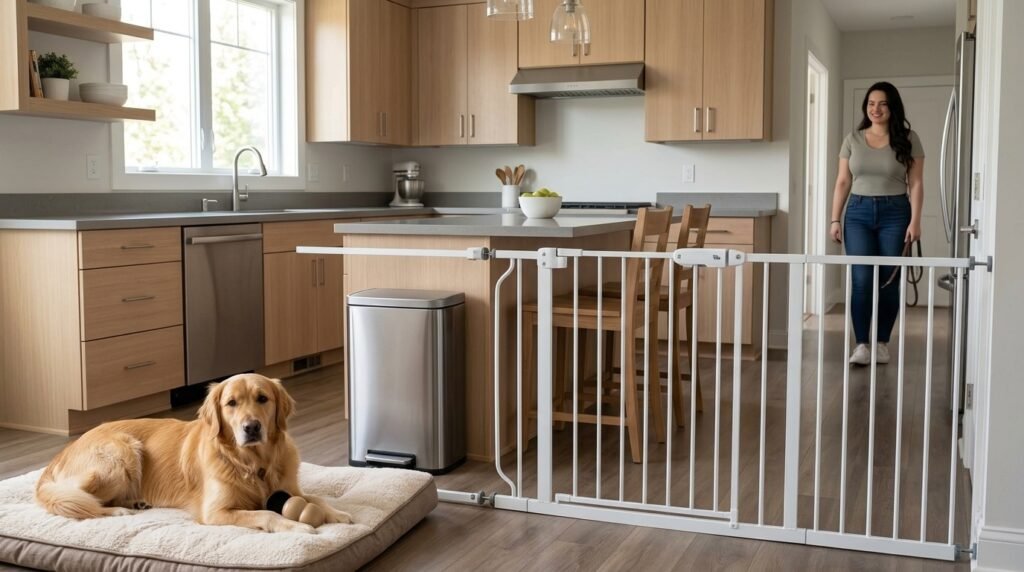
Choose a management barrier appropriate for your dog:
- Close the kitchen door.
- Install a securely mounted baby gate.
- Use an exercise pen to create distance from the preparation area.
- Place the dog in another comfortable room with enrichment.
- Use a properly introduced crate only if the dog is relaxed there—never as punishment.
Next, place a nonslip mat far enough from the counter that your dog cannot lunge toward food. Prepare pea-sized treats and begin with a boring setup item, such as an empty plate. Never use toxic food as a prop.
Everyone needs the same dog counter surfing rule: food never comes from the counter edge or dining table. Dog-safe food can go in the dog’s bowl after the human meal. Consistency removes the mixed message that the table sometimes pays.
How to Stop Dog Counter Surfing in 7 Steps
These steps progress from prevention to real-life cooking. Work in short sessions—often three to five minutes—and end while your dog is successful. If the dog repeatedly jumps, stares intensely at food, or cannot take a treat gently, reduce the difficulty rather than repeating a cue more loudly.
Step 1: Prevent Every Unsupervised Rehearsal
For the next several weeks, assume your dog is not ready to be alone with accessible food. Clear the surfaces and use a gate, door, pen, or comfortable separate area whenever no adult is actively supervising. This includes quick moments such as answering the door, helping a child, or stepping outside.
Management stops dog counter surfing from paying while the new habit grows. One stolen roast chicken does not erase all learning, but it can renew persistent checking.
During busy meal preparation, offer an appropriate activity outside the work zone, such as a food-stuffed toy, safe chew, sniffing game, or part of the regular meal. Count edible enrichment in the daily diet.
Step 2: Capture and Reward Four Paws on the Floor
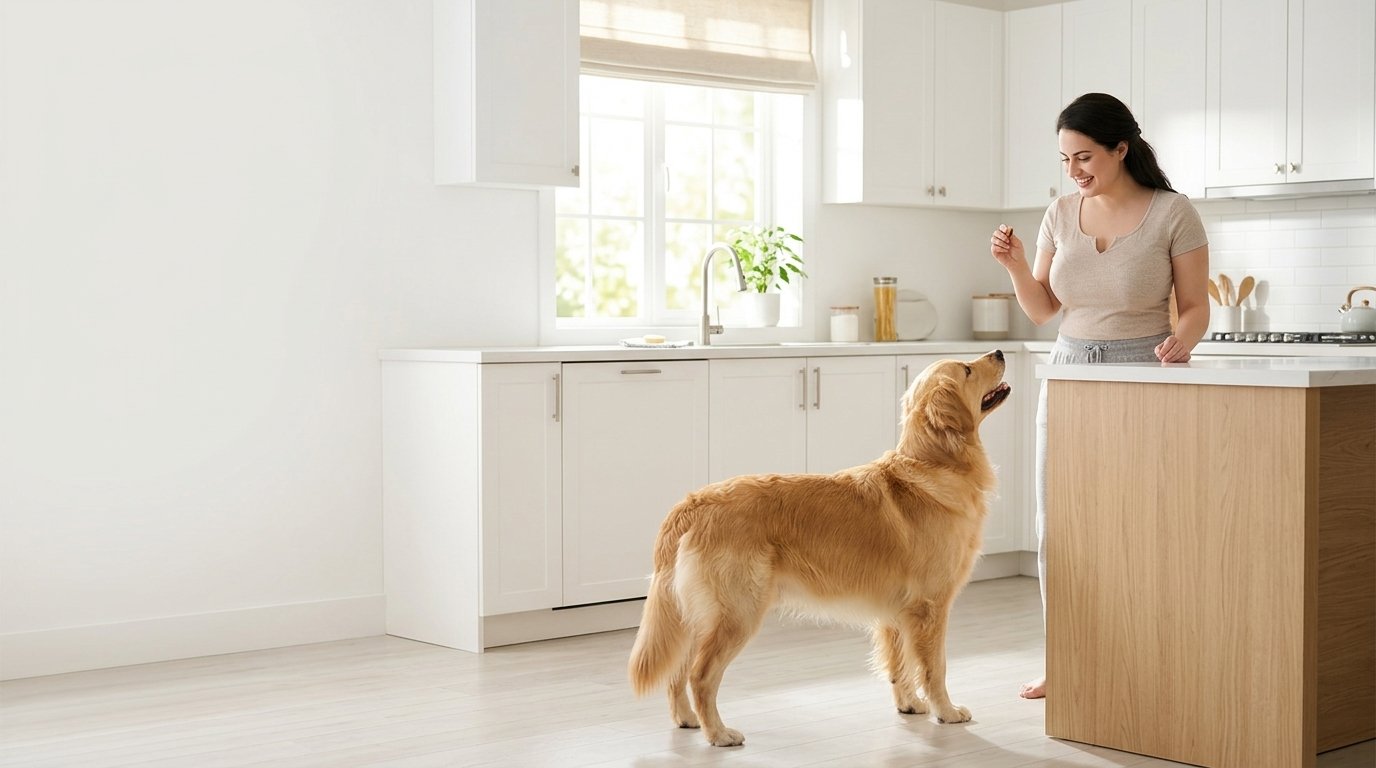
Start in the kitchen with completely clear counters. Stand quietly and wait. The moment your dog has all four paws on the floor and turns away from the counter, mark the behavior with “yes” or a click, then deliver a treat low—near the floor and away from the counter.
Rewarding low matters. Holding a treat high can draw the dog upward. At first, reinforce after one second, then two or three seconds. A voluntary sit or down can also earn a reward, but calm standing and choosing to leave are useful too.
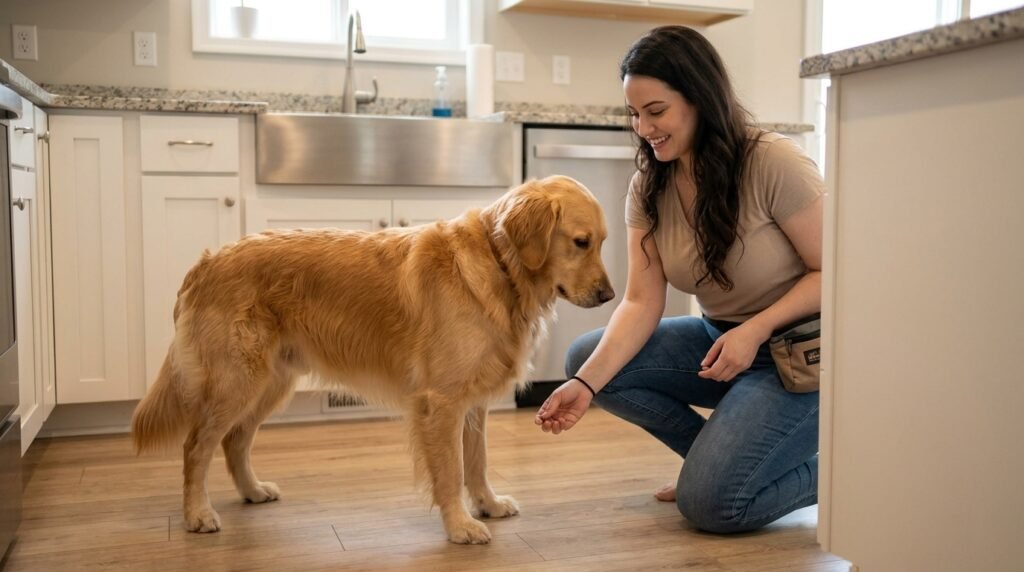
If your dog already understands basic cues, refresh them away from food first. The PawMindTips guide to teaching a dog sit and stay can help build the foundation without adding kitchen temptation too soon.
Step 3: Teach a Mat as the Best Place During Cooking
Place the mat outside the busiest cooking path. Toss one treat onto it. When your dog steps onto the mat, mark and place another treat between the front paws. Release with a consistent word such as “free,” then toss a reset treat away from the mat. Repeat until the dog readily returns.
Add a cue—“mat,” “place,” or “bed”—just before the dog moves toward it. Gradually reward four paws on the mat, then a sit or down, then brief relaxation. Build duration one small interval at a time: one second, three seconds, five seconds, and so on. Deliver treats on the mat so leaving it is not required to get paid.
Once the dog can remain for 20–30 seconds in a quiet kitchen, add mild human movement: take one step, touch a cabinet, or pick up an empty bowl. Return to reward before the dog gets up. If your dog already has a dependable stay, use the same gradual approach to distance and distractions described in How to Teach a Dog to Stay.
The mat should feel safe. Never drag or hold the dog there; the goal is a voluntary station, not restraint.
Step 4: Practice Around Low-Value Food at a Safe Distance
Use a leash only for safety and prevention, not for corrections. Keep it loose and either hold it or secure it to yourself; never leave a tethered dog unattended. Put a low-interest food item in a closed container well back from the counter edge. Position the dog far enough away to notice it without jumping.
Mark and reward any good choice: looking back at you, keeping four paws down, moving away, or going to the mat. Begin with frequent rewards. If the dog jumps or strains toward the counter, calmly increase distance or remove the setup. Do not scold. The mistake shows that the exercise advanced too quickly.
A “leave it” cue is a useful backup, but preventing dog counter surfing should not require constant prompting. Food should become a signal to remain on the floor, disengage, or go to the mat.
Reward-based methods are not merely a soft option. The American Veterinary Society of Animal Behavior’s humane dog training position statement supports reward-based methods for canine training and advises against aversive methods.
Step 5: Increase Only One Difficulty at a Time
Dog counter surfing often returns when people raise food value, distance, duration, and distraction all at once. Separate those variables.
Use a boring item while you take one step away. When that is easy, stay away for two seconds. Return closer before using slightly more interesting secured food. Later, rehearse cooking movements while the dog rests on the mat.
Use this progression:
- Empty plate, handler beside the dog
- Low-value food in a closed container
- Handler one or two steps away
- Several seconds of mat duration
- Quiet food preparation
- More appealing food secured well out of reach
- Family movement or a normal meal, with active supervision
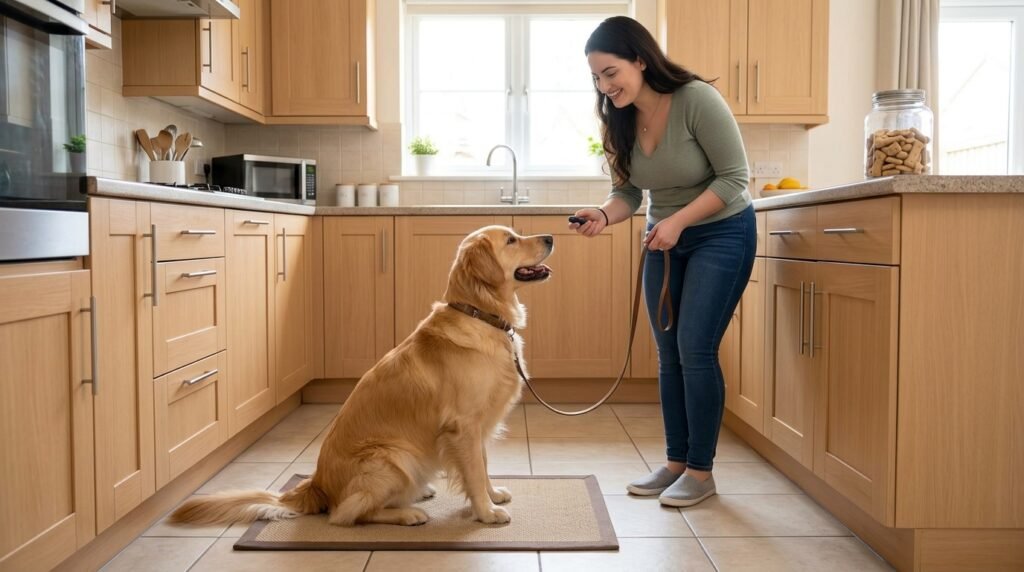
Advance after at least eight successful repetitions out of ten across two sessions. If performance falls apart, return to the last successful version. Never test dog counter surfing by leaving valuable food accessible and walking away; a theft rehearses the habit and could cause an emergency.
Step 6: Build a Predictable Cooking and Dining Routine
Before ingredients come out, cue the mat and provide the first reward. During cooking, reinforce calm behavior at intervals your dog can manage. In the beginning that may mean every few seconds. Gradually vary and lengthen the intervals, sometimes delivering a small handful or a safe chew for sustained relaxation.
Release the dog only after food has been put away and surfaces are clear. During family meals, use the same mat at a suitable distance or manage the dog behind a gate. Ask diners not to feed from the table. Afterward, clear dishes before releasing the dog into the area.
Real-life rewards can help. Access to greet a family member, sniff the floor after safe crumbs have been removed, or receive dinner may follow calm mat behavior. The routine becomes: cooking begins, go settle, good things arrive there, and the release comes when the kitchen is safe.
If frustration leads you to shout, shove, or grab, pause and use a barrier instead. Harsh interactions can damage cooperation without teaching the desired alternative. These habits that destroy dog trust are worth avoiding throughout training.
Step 7: Generalize the Skill and Maintain It
Dogs do not automatically apply a kitchen lesson to the dining room, patio, or a relative’s home. Practice dog counter surfing prevention separately in each location, changing one detail at a time.
Continue occasional rewards. Surprise your dog for choosing the floor, moving away from a dropped napkin, or settling during dinner.
Management should also remain a household habit. A trained dog is still a dog, and a holiday roast left at nose height is an unfair and potentially dangerous test. Reliable behavior reduces risk; safe food storage provides the backup.
Common Mistakes and Deterrents to Avoid
Several popular responses may interrupt a moment without solving the learning problem.
Punishing after the theft: A dog cannot reliably connect a lecture minutes later with taking food earlier. Punishment may instead teach the dog to steal faster or only when people are absent.
Chasing the dog: A chase can turn theft into a game and may prompt rapid swallowing. If the dog has a safe item, calmly trade for a higher-value dog treat. If the item is toxic, sharp, or likely to obstruct, contact a veterinary professional immediately rather than risking a bite or delaying care.
Startling booby traps: Unpredictable noise, unstable trays, shock mats, or other aversive devices can cause fear, injure a dog, or create anxiety about the kitchen without teaching where to go. They may also affect a child or another pet.
Relying on “off” alone: “Off” is useful after paws rise, but repeatedly rewarding only after a jump can create a chain: jump up, get told off, return to the floor, earn food. Reinforce the floor and mat before the jump happens.
Leaving food out to test the dog: A test that the dog is likely to fail is practice for stealing. Proof the skill in controlled sessions, and keep valuable food inaccessible outside those sessions.
Using inconsistent household rules: If one person feeds from the table, dog counter surfing remains worth trying. Write the routine down for other caregivers.
How Long Does Training Take?
There is no universal deadline. A puppy may improve quickly once access ends, while years of dog counter surfing may require weeks or months of consistent work. Progress is rarely linear.
Track observable behavior rather than expecting a sudden cure. Useful measures include:
- Number of attempted jumps per meal-preparation period
- Seconds or minutes relaxed on the mat
- Distance from food at which the dog can disengage
- Percentage of successful repetitions at each training level
- Number of accidental food-access incidents per week
Keep sessions easy. Three calm minutes daily usually teaches more than one exhausting weekend session. Sleep, exercise, sniffing, and adequate nutrition support learning but do not replace management.
If appetite suddenly increases alongside weight loss, excessive thirst or urination, vomiting, diarrhea, or a medication change, schedule a veterinary examination. Training cannot resolve a medical cause of unusual hunger.
Troubleshooting Persistent Dog Counter Surfing
If dog counter surfing persists, inspect the environment. The usual cause is an available reward or a training jump that was too large—not defiance.
The dog steals only when alone: Stop unsupervised kitchen access and strengthen automatic mat or floor choices as you gradually move away. Use a camera only in an already secured, food-free area—not for a risky test.
The dog leaves the mat repeatedly: Shorten duration, move the mat farther from food, improve its traction, and reward more often. Practice when no cooking is happening before adding realistic distractions.
The dog is too excited to take treats: Increase distance and lower food intensity. A dog who cannot eat, respond, or disengage is not ready for that setup.
The dog steals from children: Use physical separation during snacks and meals. Children should not guard food, push the dog away, or retrieve stolen items. Adult management is essential.
The dog guards stolen food: Do not corner, grab, or punish the dog. Resource guarding can present a bite risk and needs an individualized plan from a qualified, reward-based behavior professional.
Seek professional help if dog counter surfing involves aggression, barrier anxiety, repeated ingestion of objects, or no improvement despite consistent management. Ask a trainer about credentials, methods, and safety. For sudden appetite or behavior changes, begin with your veterinarian.
FAQs
Should I punish my dog for counter surfing?
No. Punishment does not teach the dog what to do instead and may make stealing more secretive. Prevent access, reinforce four paws on the floor, and reward a mat settle. If you catch an attempt, calmly guide the situation toward an easier successful choice.
Can I stop dog counter surfing with “leave it” alone?
“Leave it” is useful, but it requires you to notice the temptation and cue the dog. A stronger plan also removes unsupervised rewards and builds an automatic alternative, such as moving away from the counter or settling on a mat.
Why does my dog steal food only when I leave the room?
Your presence may have become the signal not to jump, while accessible food remains rewarding in your absence. Keep surfaces clear and block access when you leave. In supervised sessions, reinforce independent choices and increase your distance very gradually.
Will my dog eventually stop checking the counter completely?
Many dogs check far less after a long period without finding food and with consistent reinforcement for better choices. However, no training makes accessible human food risk-free. Continue safe storage and reasonable kitchen management even after the habit improves.
Conclusion
Dog counter surfing improves when stealing stops paying and calm kitchen behavior starts paying instead. Clear counters, secure dangerous foods, control unsupervised access, reward four paws on the floor, and make a mat the best place to be during cooking and meals. Raise difficulty gradually and preserve safe management even when your dog becomes reliable.
If your dog steals a toxic food or swallows packaging, bones, skewers, or another hazardous object, contact a veterinarian or animal poison service promptly. For ordinary training setbacks, lower the difficulty and return to consistent practice—the goal is a safe, repeatable routine, not a risky test of willpower.