Dog door dashing is more than an annoying habit. A dog who slips past a person at the front door can reach traffic, become lost, frighten a visitor, or turn a routine delivery into an emergency. The safest solution combines management that prevents escape today with short, reward-based lessons that teach your dog what to do instead.
The goal is simple: your dog learns that an open exterior door is not permission to cross. They remain behind a defined boundary until you give a release cue. The seven steps below build that response gradually, without yelling, chasing, intimidating body pressure, or testing your dog in an unsafe situation.
Safety first: Until the behavior is reliable around real distractions, use a leash and a secure secondary barrier whenever an exterior door may open. Training reduces risk, but it does not make an unprotected open door safe overnight.
Table of Contents
Why Dog Door Dashing Happens
The outdoors can be intensely rewarding. Scents, movement, people, wildlife, another dog, or the familiar start of a walk may all pull your dog toward the opening. If rushing through has ever produced access to those things, the behavior has paid off. Even one successful escape can strengthen it.
Some dogs also learn a predictable chain: keys jingle, shoes go on, the leash appears, and the door opens. Excitement rises at every link. By the time the lock turns, the dog may be too aroused to respond to a cue they perform easily in the kitchen.
Other contributors can include:
- Limited impulse-control practice around moving doors
- Inconsistent household rules
- Guests who open the door while calling or petting the dog
- Too little physical exercise or enrichment
- Fear of a person entering the home
- Separation-related attempts to follow a departing person
- Strong chase, roaming, or social motivation
Dog door dashing is not proof that your dog is dominant, stubborn, or trying to disrespect you. It usually means crossing the threshold has a powerful reward history and the safer alternative needs more practice in that context.
If your dog becomes frantic when a particular person enters, growls, lunges, or appears panicked when someone leaves, address the emotional issue rather than treating it as a manners problem alone. Avoid forced greetings and seek qualified, reward-based professional help.
Stop an Escape Before Training Begins
Management prevents dog door dashing from being rehearsed. Every successful rush lets the dog practice the exact response you want to change. A secure setup also lets you train calmly instead of fearing an escape.
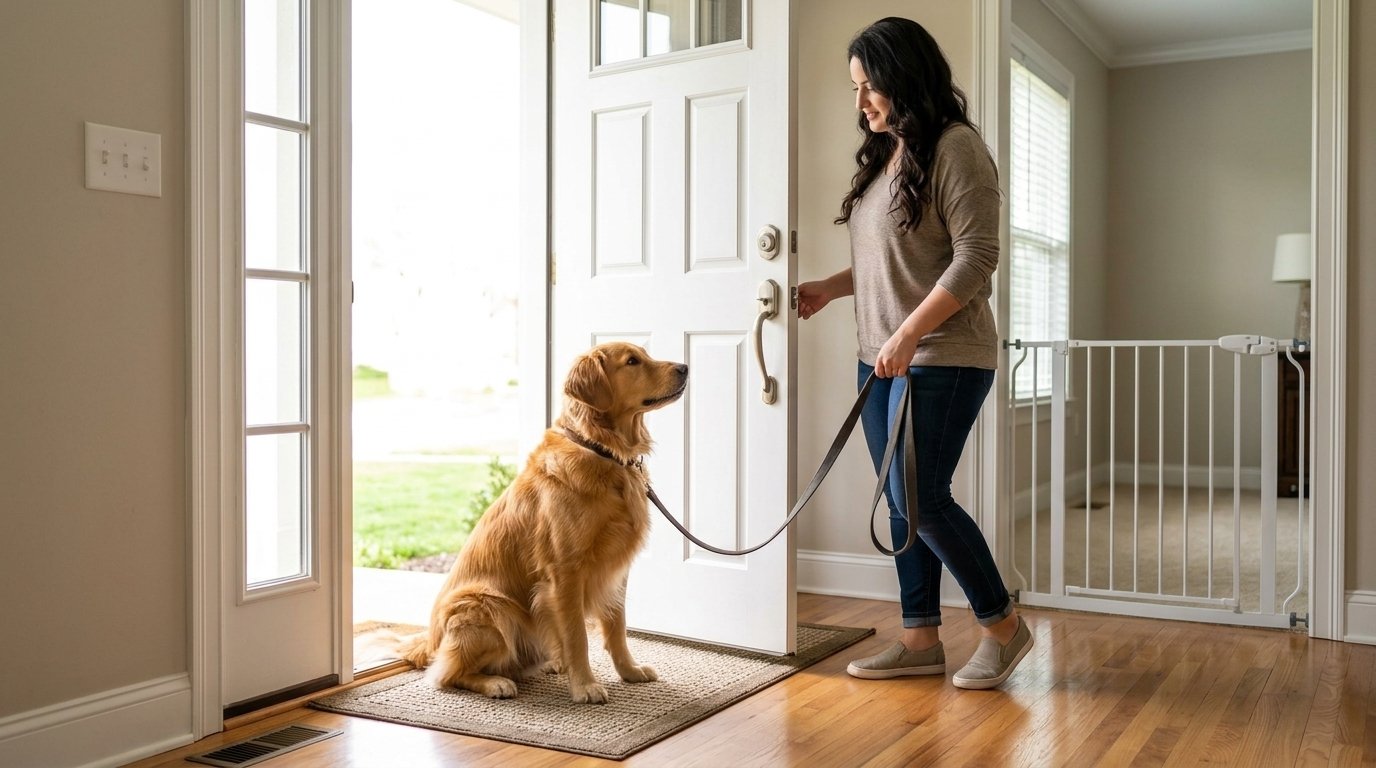
Create at least two layers between your dog and the outdoors whenever possible:
- Primary control: A well-fitted harness and standard leash, a closed interior door, a crate, or a sturdy exercise pen.
- Secondary control: A securely installed baby gate or exercise pen positioned several feet inside the entry.
The East Bay SPCA escape-prevention guide recommends an “airlock” or catch-pen arrangement near exits, so one barrier closes before the exterior door opens. Choose a barrier appropriate for your dog’s height, strength, and climbing ability. A pressure-mounted gate that a large dog can push over is not a safety layer.
For daily life, add these habits:
- Keep treats in a sealed container away from the dog but near the entry.
- Put a sign on the inside of the door reminding family and visitors not to open it until the dog is secured.
- Ask delivery drivers to leave packages outside.
- Have expected guests text before they arrive.
- Clip the leash on before walks, not while the exterior door is open.
- Check that screens, storm doors, and latches close reliably.
- Give children one simple rule: only an adult opens an exterior door.
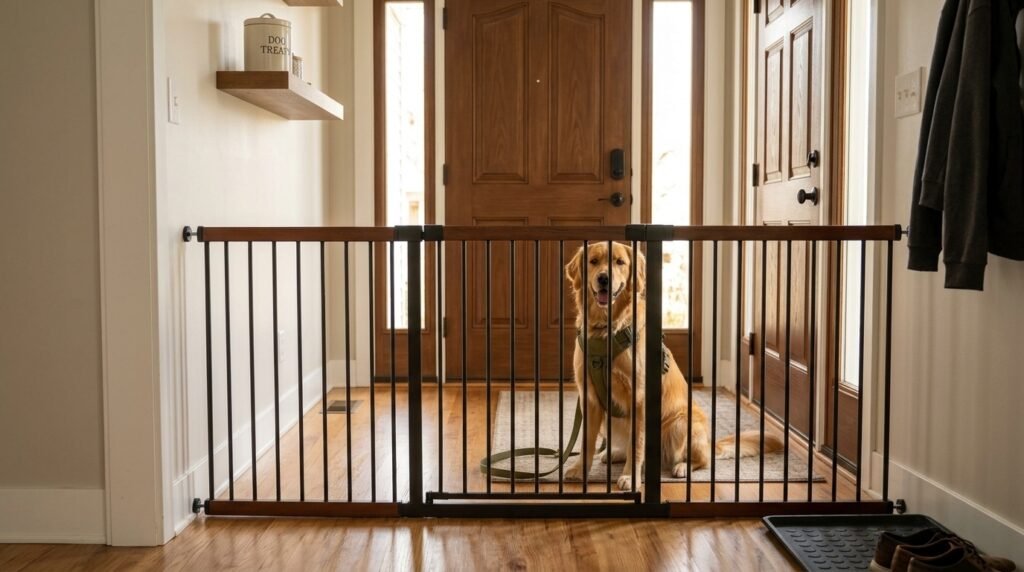
The Animal Humane Society’s door-dashing guidance likewise recommends keeping dogs out of the foyer with a gate or pen and arranging quieter guest arrivals. These precautions are the safety net that makes dog door dashing training possible.
How to Stop Dog Door Dashing in 7 Steps
Use five-minute sessions once or twice a day. Start at an interior door or at the locked exterior door with a second barrier closed. Use pea-sized treats your dog values. If your dog cannot eat, respond to their name, or briefly disengage from the doorway, the setup is too difficult.
Step 1: Build a Reinforcement Zone Away From the Door
Choose a visible line three to six feet from the threshold. A rug, mat, or strip of painter’s tape can help people stay consistent, though the dog does not need to stare at the marker.
Stand with your dog on the indoor side of that line. Mark with “yes” or a click the moment your dog pauses, turns toward you, or moves away from the door. Deliver the treat behind the line—ideally slightly behind the dog. Reward placement matters: food near the threshold draws the dog forward, while food farther inside builds value away from the exit.
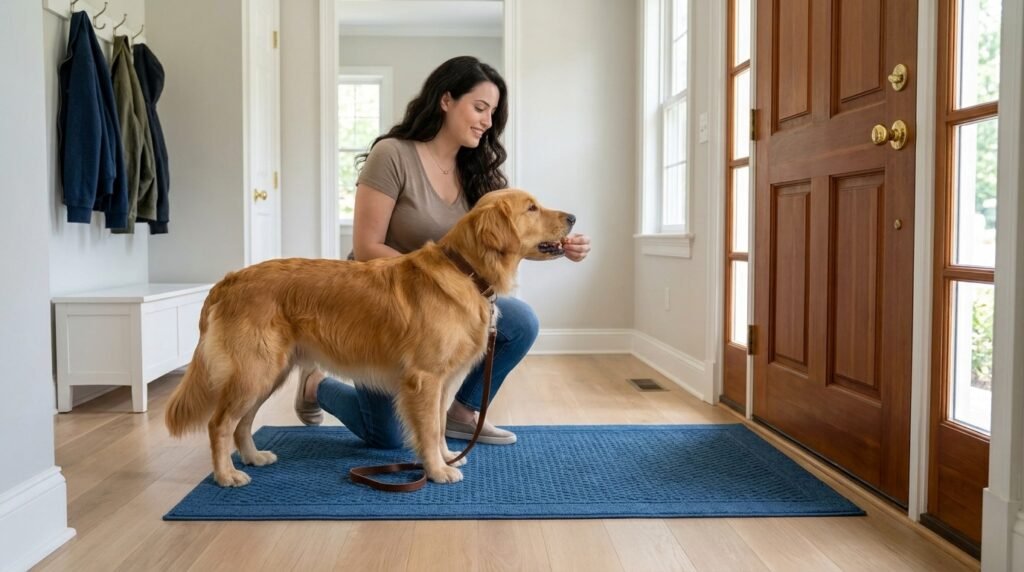
Do not say “wait” yet. First teach the behavior, then name it. This foundation changes dog door dashing into a voluntary choice to remain in the reinforcement zone.
Step 2: Make Tiny Door Movements Predict Staying Back
Touch the doorknob, mark your dog for remaining behind the line, and feed away from the door. Repeat until touching the knob no longer launches them forward. Then progress through very small actions:
- Turn the knob.
- Move the door a fraction of an inch.
- Open it one inch.
- Open it several inches.
- Briefly open it wide while all safety layers remain in place.
Advance only when your dog succeeds at least four out of five times with loose body language. If they move toward the opening, calmly close the door. Do not scold, push them backward, or repeat commands. Reset at an easier level and reward the next correct choice.
This method makes the consequence clear: moving forward makes access disappear; waiting makes rewards—and eventually permission to go out—available. It replaces dog door dashing with a response the dog can control. The AKC doorway-wait protocol similarly closes the door when the dog approaches and rewards holding back.
Step 3: Add the “Wait” Cue
Once your dog reliably stays behind the line as the door moves, say “wait” once, pause for a second, and begin the familiar door-opening sequence. Mark and reward success behind the line.
Use “wait” for a temporary pause at the boundary rather than requiring a rigid sit. Your dog may stand, sit, or turn away as long as they do not cross. Cornell’s explanation of “stay” versus “wait” makes a useful distinction: “stay” asks for a maintained position, while “wait” means to hold back temporarily.
That distinction is practical at a door. A dog who shifts from sitting to standing has not created danger; a dog who crosses without permission has. Keep the criterion focused on the threshold.
If your dog does not yet understand a stationary cue, build that foundation separately with seven simple steps for teaching a dog to stay. Practice away from the entry so the door session remains short and specific.
Step 4: Add Your Movement Through the Door
Many dogs can resist a stationary opening but follow as soon as their person steps forward. Break your movement into pieces.
Ask for “wait,” open the door slightly, move one foot toward the threshold, return, mark, and feed behind the line. Next place one foot across, then return. Progress to one full step outside, immediately returning to reward your dog.
Keep the leash slack but secure. It is a backup, not a tool for jerking the dog into place. If the leash tightens, the repetition was too hard. Reduce door width, shorten your movement, increase distance from the threshold, or use better treats.
Mix easy repetitions with harder ones. Do not make every trial progressively more difficult. A pattern such as easy, easy, moderate, easy builds confidence and prevents frustration.
Step 5: Teach a Clear Release Cue
Choose one release phrase everyone can use, such as “let’s go,” “free,” or “okay, out.” Avoid a word that occurs constantly in household conversation if it may release the dog accidentally.
With the dog waiting and the leash attached, say the release cue once and move through together. Then reward outside or begin the walk. Access to the outdoors becomes a powerful real-life reward for waiting.
Not every repetition should end with the dog exiting. Sometimes open the door, step out, return, reward indoors, and close it. This teaches the essential rule that an open door does not guarantee access.
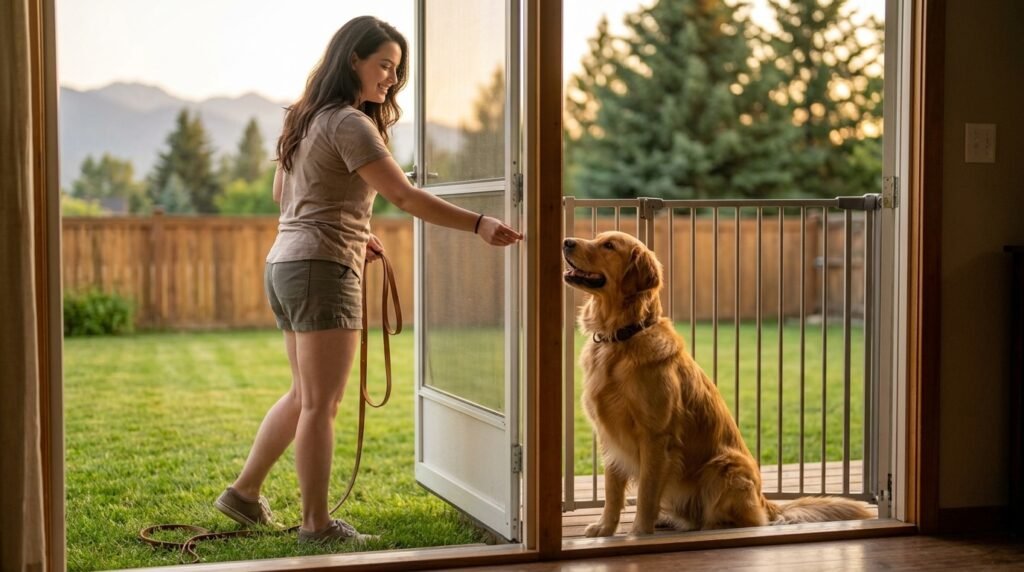
Your cues should have separate meanings:
- Wait: Do not cross this boundary yet.
- Release cue: You now have permission to cross.
- Stay: Hold the requested position until released.
- Place or mat: Go to a designated location and remain there according to your trained criteria.
Consistency matters more than the word itself. If one person releases with “free” and another permits an uncued exit, dog door dashing will remain rewarding.
Step 6: Build Duration, Distance, and Distractions Separately
Training often fails when three challenges increase at once. Do not open the door wider, wait longer, walk farther away, and add a visitor in the same repetition. Change one variable at a time.
For duration, begin with one or two seconds and increase unevenly: two seconds, three, one, four, two. For distance, take half a step away, return, and reward. For distractions, start with quiet sounds recorded at low volume before using a real knock or doorbell.
Practice at different doors only after the basic response is fluent. Dogs do not automatically generalize from the laundry-room door to the front door, garage, yard gate, car door, or vacation rental. Prevent dog door dashing by beginning each new location at an easier level.
Reward-based training makes the desired response worth repeating. VCA’s veterinary behavior guidance on using reinforcement and rewards recommends reinforcing behaviors you want while avoiding punishment. Harsh corrections near the entrance can add fear or conflict without teaching a reliable alternative.
Step 7: Rehearse Real Life Without Removing the Safety Net
Set up controlled practice before depending on the behavior. Ask a familiar helper to act as a guest while the dog is leashed behind a secure gate. The helper should text instead of ringing the bell at first.
Use this sequence:
- Secure the leash and close the secondary barrier.
- Send the dog to the reinforcement zone or mat.
- Cue “wait.”
- Open the exterior door only as far as the dog can handle.
- Let the helper enter quietly and ignore the dog.
- Close and latch the door.
- Reward calm behavior.
- Release the dog to greet only if greeting is safe and the dog remains relaxed.
Gradually add a knock, doorbell, bags, and less familiar helpers. If the dog rushes or cannot eat, increase distance and simplify. Keep fearful or reactive dogs comfortably separated and work with a qualified professional. Door training should never force social interaction.
Practice Door Manners With Guests and Deliveries
Guest arrivals combine sound, a person at the boundary, door movement, social excitement, and household commotion. Because these triggers can revive dog door dashing, quiet practice does not prove readiness for the entire chain.
Give visitors a short script before they arrive: “Please text me from outside. I’ll secure the dog before I open the door. Once you enter, please ignore the dog until I say they’re ready.” Clear instructions prevent a well-meaning guest from calling the dog toward the opening.
For unexpected knocks, management takes priority. Toss treats away from the foyer, guide the dog behind a gate or into another room, close that barrier, and then answer the door. Do not attempt a difficult training repetition while a driver is waiting and the dog is overexcited.
A mat can be useful because it gives the dog an obvious destination. However, “go to mat” and door boundary training are related but different skills. Teach the mat away from visitors first. PawMindTips’ broader seven-day good-manners framework can support consistent household routines, while the threshold rule in this article remains the safety-specific behavior.
Everyone in the home should follow the same sequence. Post it near the entry until it becomes automatic:
Secure dog → close barrier → open exterior door → close and latch door → release or greet.
Dog Door Dashing Troubleshooting Guide
| Problem | Likely reason | Safer adjustment |
|---|---|---|
| Dog rushes when your hand touches the knob | Knob movement predicts outdoor access | Reward at a greater distance for looking away or staying back when you reach toward the knob |
| Dog waits for food but bolts when treats disappear | Rewards were faded too quickly | Keep food hidden, reward intermittently, and use permission to go outside as a real-life reward |
| Dog breaks when you step outside | Handler movement is a separate trigger | Practice half-steps and immediate returns with the leash and barrier in place |
| Dog sits but leans or crawls over the line | The sit became the goal instead of the boundary | Reward farther behind the line and reinforce any position that remains safely inside |
| Dog ignores the release cue | The cue is unclear or not rewarding | Say it once, move through together, and follow with a walk, sniffing, play, or another valued activity |
| Dog succeeds alone but fails with guests | The distraction jump is too large | Use a familiar helper, greater distance, no bell, and a closed gate; add one challenge at a time |
| Dog becomes afraid near the entrance | Corrections, noise, or visitors may predict stress | Stop doorway drills, create distance, avoid forced greetings, and seek professional behavior support |
Avoid turning dog door dashing into a test of willpower. Blocking with your body may be ordinary safe positioning, but looming, stepping into the dog, grabbing their collar, or repeatedly pushing them back can create conflict. Arrange the environment so the correct response is easy and reinforced.
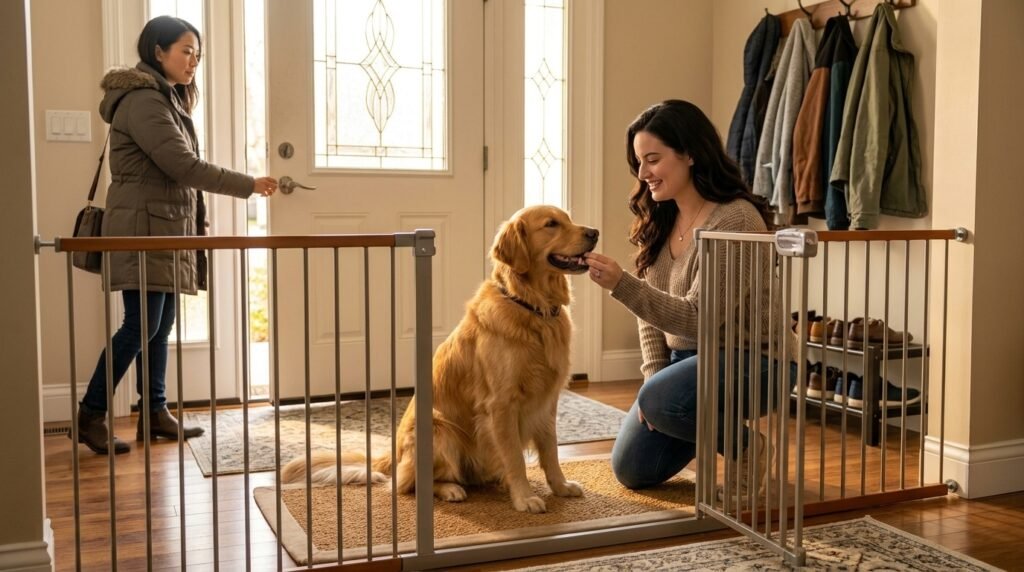
Also avoid repeating “wait, wait, wait.” Give the cue once at a level where your dog can succeed. If they cannot, change the setup. Clear criteria and good management are more effective than louder language.
Safety Backup: Identification, Recall, and Professional Help
Even excellent dog door dashing training needs redundancy. Keep a current ID tag on a properly fitted collar, and microchip your dog with up-to-date contact information. The AVMA’s pet safety guidance identifies proper identification and microchipping as important routes home for separated pets.
Teach an emergency recall separately in a fenced area or on a long line. Do not call your dog and punish them after they return, even if you are frightened. You want coming to you to remain safe and valuable.
If your dog gets out:
- Do not chase directly behind them if that makes them run faster.
- Use a cheerful voice and move away from the dog to invite pursuit.
- Toss high-value food nearby if they slow down.
- Open a familiar car door if your dog loves rides and it is safe to do so.
- Alert local shelters, animal control, neighbors, and the microchip registry promptly.
- Keep people away from traffic and avoid crowding a frightened dog.
Consider professional assistance if dog door dashing has caused repeated escapes, your dog defeats barriers, redirects biting, guards the entry, panics when someone leaves, or reacts aggressively to visitors. Choose a credentialed, reward-based trainer or veterinary behavior professional who can observe the household setup.
While building the prerequisite skills, PawMindTips’ guide to teaching sit and stay step by step can help improve communication away from the high-stakes doorway. Keep the front-door protocol focused on safety rather than formal obedience.
Frequently Asked Questions
How long does it take to stop dog door dashing?
Some dogs understand the basic dog door dashing protocol within a few sessions, but reliable behavior around guests, wildlife, and walk-time excitement may take weeks or months. Progress depends on reinforcement history, arousal, consistency, and carefully added distractions. Continue using barriers throughout training.
Should my dog sit every time the door opens?
No. A sit can help early in training, but the safety criterion is staying behind the boundary until released. Your dog may stand, sit, or move farther indoors. Requiring a perfect sit can distract from the behavior that matters most: not crossing.
What should I do when my dog breaks the wait cue?
Calmly close the door, reset farther back, and make the next repetition easier. Do not punish the dog. In dog door dashing training, a mistake shows that the opening, duration, movement, or distraction was too difficult.
Can I practice with the front door open if my dog is on a leash?
Only with a secure grip, well-fitted equipment, and preferably a second closed barrier. A leash alone can be dropped, pulled from a hand, or attached to equipment the dog can slip. Begin with tiny openings and never test the behavior beside traffic or another immediate hazard.
Conclusion
Dog door dashing improves when safety management and skill training work together. Prevent rehearsal with a leash and secure barrier, reward your dog for remaining behind a clear boundary, add door movement gradually, teach “wait,” and reserve one consistent cue for permission to cross.
Practice first in easy conditions, then add your movement, duration, new doors, and controlled guest arrivals one variable at a time. Keep identification current and continue using the safety setup even after progress appears strong. The best door manners are not built by testing whether your dog will fail; they are built through many safe repetitions in which waiting reliably pays off.