Learning how to stop a cat from scratching furniture starts with one important change in perspective: your goal is not to stop scratching altogether. Scratching is a normal part of being a cat. Instead, you want to give your cat better places to perform that natural behavior while making your couch, chairs, carpet, and other household items less appealing.
That distinction can make training much easier. A cat that scratches a sofa is not necessarily being stubborn, destructive, or spiteful. The sofa may simply provide exactly what the cat wants—a stable surface, satisfying texture, convenient location, and enough height for a full-body stretch.
The solution is therefore more than buying a random scratching post and putting it in a corner. You need to understand your cat’s scratching preferences, offer an attractive alternative in the right location, reward appropriate scratching, and temporarily protect the furniture while the new habit develops.
Table of Contents
Why Do Cats Scratch Furniture?
Scratching is an instinctive feline behavior. According to the Cornell Feline Health Center’s guidance on destructive behavior, cats can be redirected toward appropriate scratching objects, but scratching itself is an innate behavior.
Cats scratch for several reasons.
Claw maintenance
Scratching helps a cat shed worn outer claw sheaths. You may occasionally find small, curved pieces that look like hollow claws around a scratching area. These can simply be discarded outer layers rather than an indication that the cat has lost an entire claw.
Stretching
Watch a cat using a tall scratching post and you may see the entire body extend. The cat reaches upward, anchors the front claws, and stretches the shoulders, back, and legs.
This is one reason a short, unstable scratching post may lose a competition with a tall couch arm.
Communication and marking
Scratching also leaves visible and scent-related signals. The ASPCA’s destructive scratching guidance explains that cats scratch for purposes including stretching, claw maintenance, and marking.
This helps explain why cats may choose conspicuous furniture rather than an inexpensive scratching board hidden in an unused room.
Emotional arousal
Scratching may occur when a cat is excited or aroused, and changes in scratching can sometimes occur alongside stress.
Instead of asking, “How do I make my cat stop scratching?” ask:
“What is this piece of furniture providing that my cat’s scratcher is not?”
That question often leads directly to the solution.
How to Stop a Cat From Scratching Furniture
The most reliable approach combines several strategies rather than depending on one deterrent.
Start by observing the unwanted scratching for several days. Pay attention to:
- Which objects your cat chooses
- Which part of the furniture gets scratched
- Whether the cat scratches vertically or horizontally
- The texture being targeted
- When scratching happens
- Whether it occurs after waking
- Whether particular windows, doors, people, or animals seem associated with it
Then recreate those desirable characteristics in an appropriate scratcher.
For example, a cat repeatedly scratching the vertical corner of a fabric couch may be telling you that they like an upright, textured, stable scratching surface in that particular room.
A small cardboard pad across the house may technically be a “cat scratcher,” but it does not match what that cat is seeking.
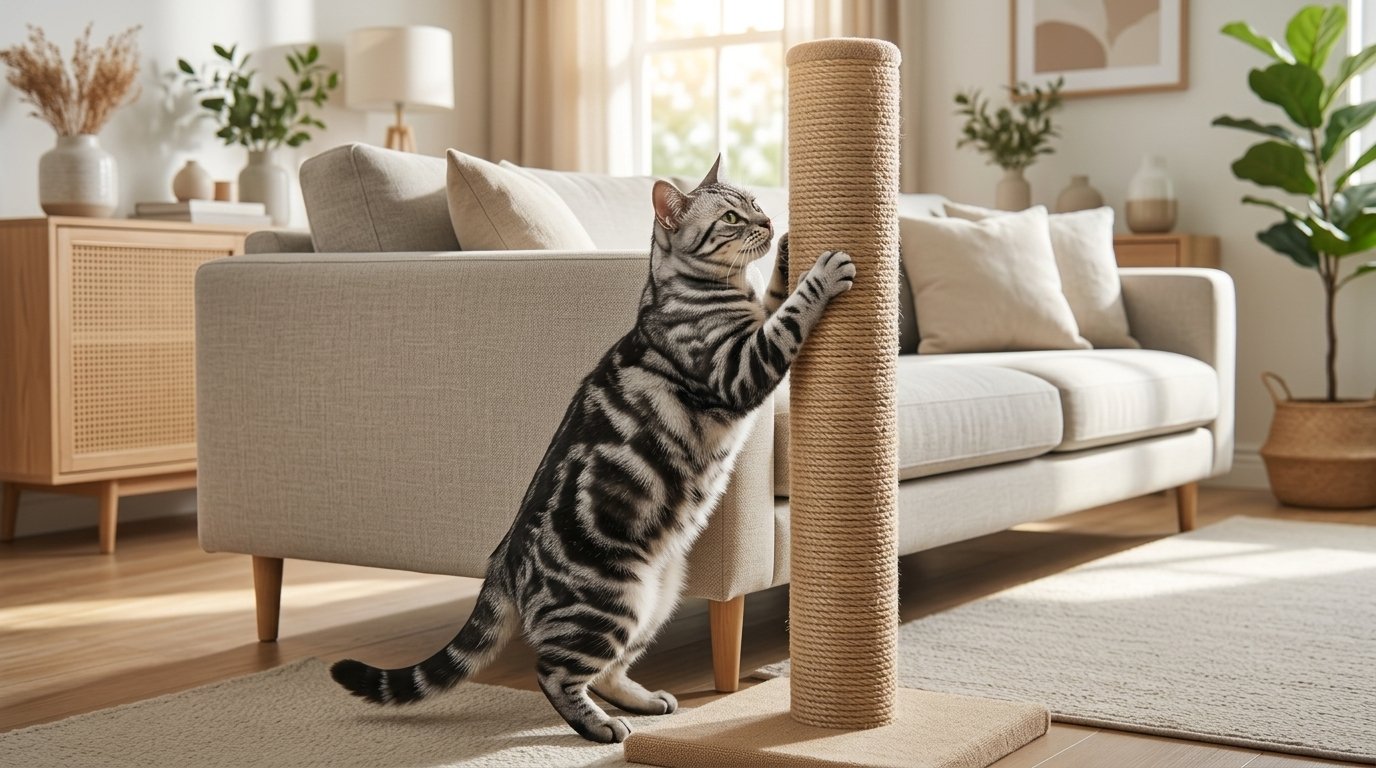
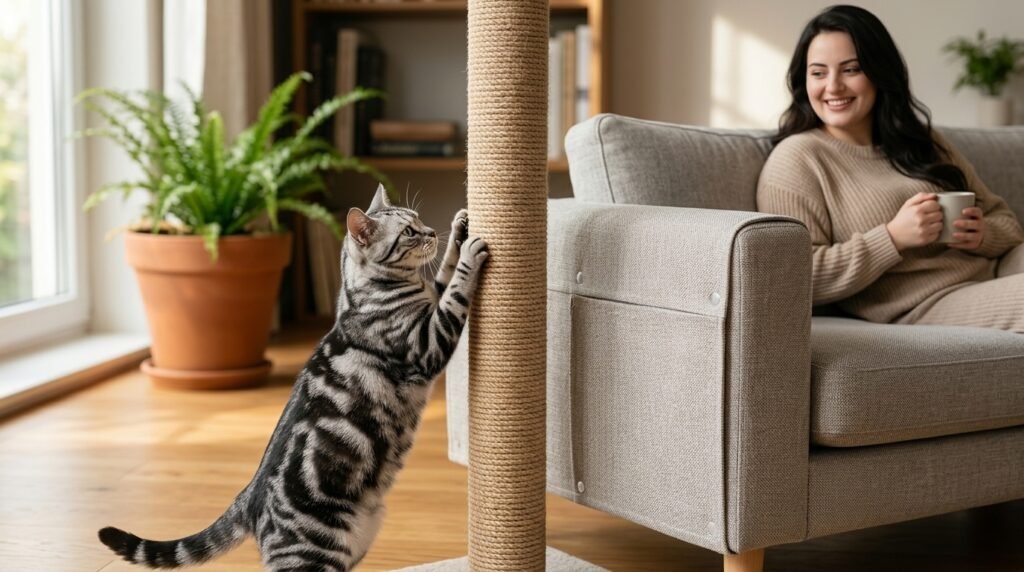
Your first experiment should therefore be a tall, sturdy vertical scratcher placed immediately beside the couch.
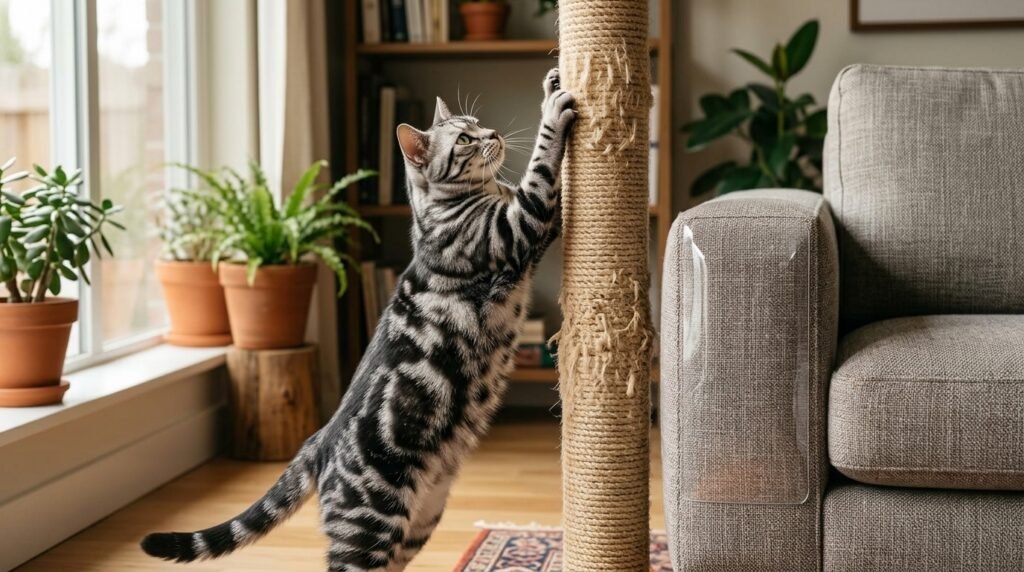
If the cat instead scratches carpet, a horizontal cardboard, sisal, or other appropriate floor-level scratching surface may make more sense.
The goal is not to force the cat to adapt to whatever scratcher you bought. It is to make the acceptable option competitive with the furniture.
Choose the Right Scratching Surface
One of the biggest mistakes when figuring out how to stop a cat from scratching furniture is assuming every cat wants the same type of scratching post.
They do not.
The Cat Friendly Homes scratching-post guidance recommends experimenting with size, shape, and texture and notes that cats may prefer materials such as sisal, cardboard, or carpet.
Vertical scratchers
A vertical post can work particularly well for cats that target:
- Couch arms
- Chair sides
- Door frames
- Curtains
- Upright furniture legs
The post should be tall enough to allow a satisfying stretch and stable enough to remain firmly in place.
Stability matters enormously.
Imagine reaching upward for a stretch while the object supporting you suddenly tips toward you. A cat may have a similarly unpleasant experience with a lightweight scratching post.
Meanwhile, the couch does not wobble.
If your cat tried a small post once, caused it to move, and returned to the sofa, the problem may be the scratcher rather than the cat.
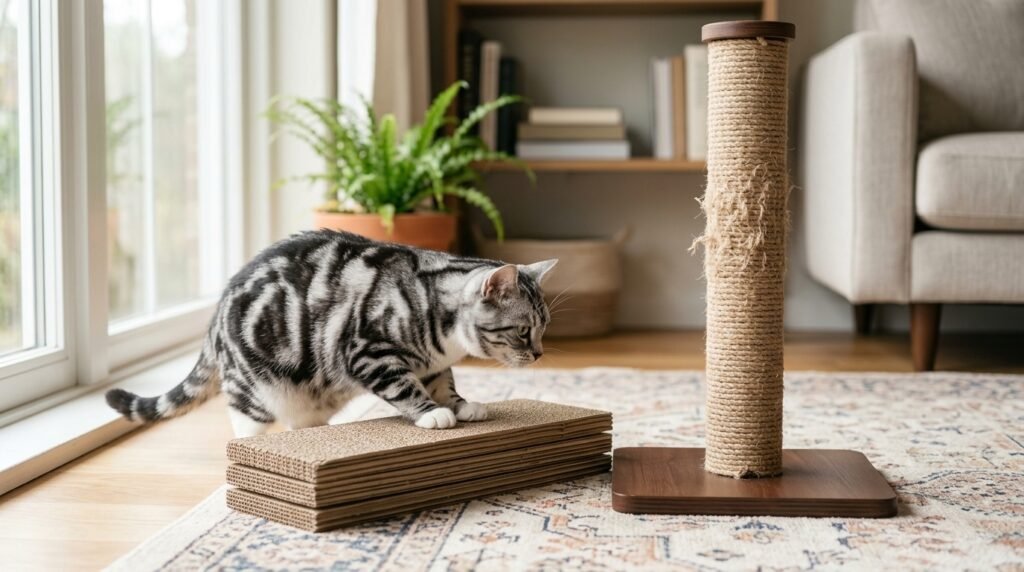
Horizontal scratchers
Some cats prefer scratching along the floor.
This preference often becomes obvious when a cat scratches:
- Carpet
- Rugs
- Stair carpeting
- Floor mats
- The horizontal base of upholstered furniture
For these cats, try a stable horizontal scratching pad or board rather than insisting on a vertical post.
Cornell specifically recommends observing whether a cat scratches vertically or horizontally and choosing an appropriate scratching object accordingly.
Try more than one texture
Texture can be just as important as orientation.
Common scratching materials include:
- Sisal
- Corrugated cardboard
- Wood
- Carpet-like materials
- Other durable cat-safe scratching surfaces
If your cat ignores one material, that does not necessarily mean they dislike scratching posts. They may dislike that particular scratching post.
Give them choices and watch what they actually use.
In a multi-cat home, having multiple scratching locations becomes even more important. Each cat should have convenient opportunities to perform natural behaviors without having to compete for one desirable resource.
Put Scratching Posts Where Your Cat Needs Them
Placement can determine whether a scratcher becomes useful or decorative.
A beautiful scratching tower hidden in a spare bedroom may do nothing to save the living-room couch.
Cats frequently scratch in socially or territorially meaningful places. They may also scratch soon after waking.
The VCA Animal Hospitals guide to furniture scratching recommends putting the scratching post directly against or near the furniture the cat has been scratching and moving it gradually only after the cat is reliably using it.
That gives you a straightforward starting rule:
Put the new scratcher beside the existing scratching spot.
If your cat scratches the left corner of the couch, start there.
If your cat scratches near a favorite sleeping area, put another scratcher nearby.
If your cat repeatedly targets a particular room, do not expect one post in a different part of the house to solve the problem.
Do not move a successful post too quickly
Once your cat starts choosing the scratcher, resist the temptation to immediately move it somewhere more convenient for you.
First establish the behavior.
After your cat is using the scratcher reliably, you can gradually shift it toward a nearby location if necessary. Small changes are less likely to disrupt the new habit than suddenly relocating it across the room.
In some cases, the best long-term location may simply be where the cat wanted a scratching surface in the first place.
That is a reasonable compromise if it keeps both the cat and the furniture safe.
Redirect and Reward Instead of Punishing
If you want to learn how to stop a cat from scratching furniture gently, positive reinforcement should be central to your approach.
Punishment does not teach the cat what scratching surface you actually want them to use.
Yelling, hitting, frightening, or spraying a cat can also associate you—or the room—with an unpleasant experience.
Current Cat Friendly Homes guidance on unwanted behaviors specifically advises against punishment and recommends positive reinforcement, appropriate scratchers, and furniture protection.
Instead, make the desired behavior worthwhile.
When your cat voluntarily uses the scratching post or pad, immediately provide something the cat values. Depending on the individual cat, that might be:
- A small treat
- Praise
- Petting
- A favorite toy
- A brief play session
- Another positive interaction
Timing matters. The reward should follow the desired behavior closely enough for your cat to form an association between using the scratcher and the good consequence.
You can also make the scratching area interesting with appropriate toys. Some cats respond to catnip, although not every cat does.
Avoid physically forcing your cat’s paws against the scratching post. The goal is for the cat to choose and enjoy the surface rather than learn that approaching it leads to unwanted handling.
Make the right choice easy
Suppose your cat approaches the sofa every evening after waking from a nap.
Instead of waiting for scratching and then reacting, place an appropriate scratcher right beside that sofa corner.
When the cat wakes and approaches the area, you can encourage interest in the scratcher with play or another positive cue. Reward the cat when they use it.
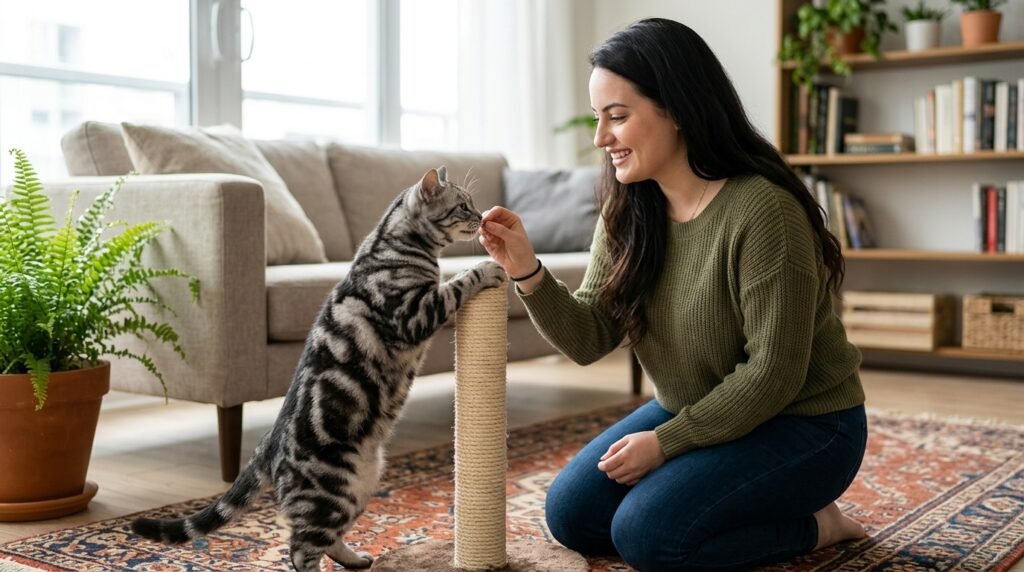
That is much clearer than allowing the cat to scratch the sofa and then delivering punishment they may not understand.
Consistency matters more than intensity.
Protect Furniture While Your Cat Learns
Redirection takes time, so furniture protection can help prevent additional damage while the new scratching habit develops.
The purpose of furniture protection is not to frighten or hurt your cat. It is simply to make the old surface less rewarding while a better option is readily available.
Depending on the furniture and your cat, temporary options may include:
- A fitted furniture protector
- A protective couch cover
- A blanket securely covering the targeted section
- A cat-safe surface protector
- Rearranging access temporarily when practical
The ASPCA discusses covering undesirable scratching surfaces while positioning acceptable scratching alternatives nearby.
Because recommendations about deterrent surfaces can differ among behavior resources, choose the least stressful option that works for your cat. For example, current Cat Friendly Homes guidance favors furniture protectors and specifically cautions against punishment-based approaches.
Whatever protection you choose, pair it with an attractive scratching alternative.
Simply blocking the couch without providing somewhere appropriate to scratch leaves the underlying behavioral need unresolved.
Protect the exact target first
You do not necessarily need to cover every piece of furniture.
Start with the areas your cat actually targets.
If only one couch corner is being scratched, protect that corner and put the preferred scratcher immediately beside it.
Once the cat consistently chooses the scratcher, you can assess whether the temporary furniture protection is still necessary.
Avoid unsafe homemade deterrents
Be cautious about internet remedies involving strong fragrances, essential oils, homemade chemical sprays, or substances not specifically established as safe around cats.
A furniture solution should never introduce a poisoning, skin, respiratory, or ingestion hazard.
Physical protection plus an attractive scratching alternative is often a simpler strategy.
Nail Care, Enrichment, and Other Helpful Strategies
Even excellent scratching training does not replace basic claw care.
Regular nail trimming can reduce how much damage sharp claw tips cause, although trimming does not remove a cat’s natural need to scratch.
The ASPCA’s general cat-care guidance recommends regular claw trimming and providing a sturdy scratching post. If you are unsure how to trim your cat’s claws safely, ask your veterinarian or veterinary technician to demonstrate.
Never rush nail trimming if your cat becomes frightened or struggles strongly. Cooperative handling can be built gradually.
Give your cat an interesting environment
A scratching post should not be the only enrichment available.
Depending on your home and your cat’s preferences, enrichment can include:
- Interactive play
- Appropriate climbing opportunities
- Cat trees
- Window-viewing areas
- Toys rotated periodically
- Hiding and resting places
- Predictable positive interaction with family members
These resources do not guarantee that furniture scratching will disappear, but meeting more of your cat’s behavioral needs can make an appropriate scratching setup more successful.
Declawing is not the simple solution it may sound like
Declawing is fundamentally different from trimming nails.
Humane World for Animals’ explanation of declawing describes the procedure as amputation of the last bone of the toes and discusses potential physical and behavioral consequences.
For ordinary furniture scratching, focus on environmental modification, appropriate scratching surfaces, claw care, and positive reinforcement instead of viewing declawing as a convenient training tool.
What If Your Cat Still Scratches the Furniture?
If the problem continues, troubleshoot the setup before concluding that your cat cannot be redirected.
Ask yourself:
Is the scratcher tall or long enough?
A vertical post should allow a satisfying stretch.
Does it wobble?
If it shifts or tips, replace or stabilize it.
Does the orientation match the cat’s preference?
A carpet-scratching cat may prefer a horizontal option.
Is the texture attractive?
Experiment with materials rather than repeatedly offering the same unwanted surface.
Is it in the right place?
A scratcher beside the targeted sofa is generally more relevant than one hidden in another room.
Are you rewarding its use?
Notice and reinforce the behavior you want.
Did you move the scratcher too soon?
Return it to the successful location and establish the habit before attempting gradual relocation.
Has the scratching pattern changed suddenly?
A noticeable behavioral change deserves more attention than a long-standing habit.
If your cat suddenly begins scratching much more frequently, seems unusually anxious, has other behavioral changes, or you cannot identify why the behavior has intensified, discuss the situation with your veterinarian.
The feline-veterinarian-backed Cat Friendly Homes scratching resource notes that continued or increased unwanted scratching may be associated with stress, anxiety, attention-seeking, or insecurity and recommends discussing persistent concerns with a veterinarian.
A veterinarian can also help determine whether discomfort, stress, environmental changes, or another issue needs consideration. When necessary, they can help you find qualified feline behavior support.
FAQs
What is the fastest way to stop a cat from scratching furniture?
Start by putting a sturdy scratching post or pad directly beside the furniture your cat already scratches. Match the scratcher’s orientation and texture to the cat’s existing preference, temporarily protect the furniture, and reward the cat immediately for using the appropriate surface. Do not expect scratching itself to disappear—the goal is redirection.
Why does my cat scratch the couch even with a scratching post?
The couch may offer something the scratching post does not. It might be taller, sturdier, better positioned, or have a more satisfying texture. Compare the couch with the scratcher and experiment with vertical versus horizontal orientation, different materials, greater stability, and better placement.
Should I punish my cat for scratching furniture?
No. Punishment does not teach your cat which surface you want them to scratch and can create fear or stress. Instead, protect the unwanted surface, provide a suitable alternative nearby, and use positive reinforcement when your cat chooses it.
Will trimming my cat’s nails stop furniture scratching?
Nail trimming may reduce damage from sharp claw tips, but it will not remove the natural motivation to scratch. Your cat still needs appropriate scratching surfaces, so use routine claw care as one part of a broader redirection strategy.
Conclusion
The key to how to stop a cat from scratching furniture is not eliminating a natural feline behavior. It is giving that behavior a better destination.
Observe whether your cat prefers vertical or horizontal scratching, identify the textures and locations they choose, and provide sturdy alternatives that match those preferences. Put scratchers beside existing problem areas, reward appropriate scratching, and temporarily protect the furniture while the new habit develops.
If your first scratching post fails, do not assume your cat is impossible to train. Change the material, orientation, stability, or location and try again.
With patience and a setup designed around your cat’s actual preferences, you can protect your furniture while still allowing your cat to scratch, stretch, mark, and behave like a cat.