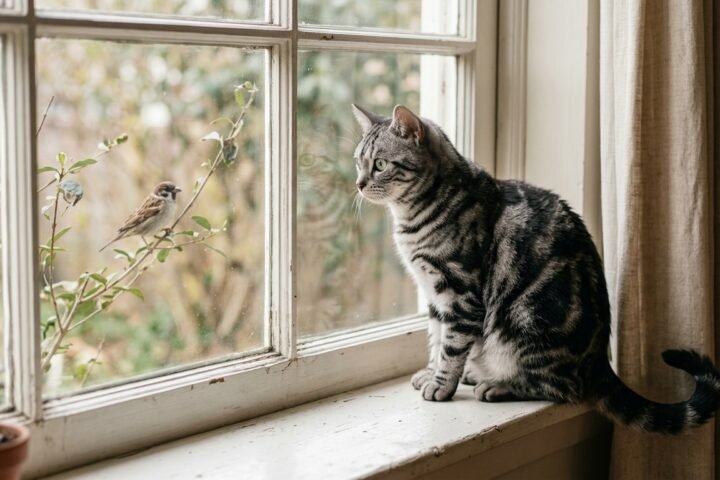
If you have ever wondered why does my cat bite me when I pet her, the answer often has less to do with your cat suddenly becoming “mean” and more to do with how she experiences touch. A cat may enjoy the first few strokes, become increasingly stimulated, and eventually use a nip or bite to end an interaction that has crossed her comfort threshold.
That does not mean every petting bite has the same explanation. Context matters. Some cats tolerate only brief physical contact. Some dislike being touched in particular places. Play, fear, frustration, or pain can also influence biting.
The most useful approach is therefore not simply trying to stop the bite. Learn what happens before it.
By noticing changes in your cat’s tail, ears, eyes, posture, skin, and willingness to remain near your hand, you can often end a petting session while she is still comfortable.
Table of Contents
Why Does My Cat Bite Me When I Pet Her?
When an apparently friendly cat seeks attention, accepts petting, and then bites, one possible explanation is petting-induced aggression. The term can sound more severe than the behavior sometimes is. In practice, the cat may simply have reached the point at which continued physical contact is no longer welcome.
The Cornell Feline Health Center’s guidance on feline aggression explains that cats showing petting-induced aggression may display dilated pupils, tail lashing, or ears moving backward before becoming aggressive. Cornell also notes that the reasons behind this behavior are not completely understood.
That distinction matters.
It is tempting to say, “My cat became overstimulated,” as though every bite during petting has one proven cause. Overstimulation is a useful possibility, but you should still consider the entire situation.
Ask yourself:
- Did she approach you for interaction?
- How long had you been petting her?
- Where were you touching her?
- Did her tail begin moving?
- Did her body become tense?
- Did she turn her head toward your hand?
- Did you continue after she shifted position?
- Was the bite gentle or forceful?
- Is this her usual behavior or something new?
Patterns often reveal much more than the bite alone.
She may want affection—but not unlimited touching
A cat can genuinely choose to sit beside you, rub against you, purr, and enjoy several strokes while still having a limit.
Wanting social contact does not automatically mean wanting continuous full-body petting.
Think of these as separate choices. Your cat might want to sit on your lap without being stroked. She might enjoy cheek rubs but dislike long strokes down her back. She may request several seconds of petting and then prefer to simply remain beside you.
Respecting those distinctions can make physical interaction more predictable.
Petting-Induced Overstimulation: When Pleasant Touch Becomes Too Much
If you keep asking why does my cat bite me when I pet her even though she was purring, pay attention to duration.
The first stroke and the twentieth stroke do not necessarily feel the same to your cat.
The MSD Veterinary Manual’s overview of feline behavior problems notes that cats that bite during petting may have a low tolerance for physical contact or may become more easily overstimulated by it.

PetMD similarly explains that gentle bites during interaction can have several meanings—including overstimulation, frustration, play, or social interaction—so body language and context help distinguish them. PetMD’s veterinary-reviewed guide to cat love bites
This is why a cat can appear relaxed at the beginning of an interaction and later decide that she wants it to stop.
Every cat has her own threshold
There is no universal “safe” number of strokes.
One cat might happily accept prolonged head and cheek rubs. Another might become restless after only a few strokes. Your own cat may even have different tolerance levels depending on the situation.
Her threshold may be lower when she is:
- already highly alert
- watching something interesting
- resting and does not want prolonged handling
- frustrated
- frightened
- recovering from a stressful event
- uncomfortable or painful
Rather than trying to make every petting session longer, learn the duration that consistently ends before your cat becomes uncomfortable.
If biting usually happens around the same point, shorten the interaction.
Signs Your Cat Wants You to Stop Petting
One of the best answers to why does my cat bite me when I pet her is sometimes found in the seconds immediately before the bite.
Cats communicate with combinations of posture, movement, facial expression, ears, eyes, whiskers, and tail position. The ASPCA’s feline aggression and body-language guide emphasizes reading these signals together rather than treating aggression as a single, context-free behavior.
During petting, watch especially for a change from relaxed behavior to increasing tension.
1. Her tail starts twitching or lashing
A relaxed tail becoming increasingly active can be an early clue that the interaction is changing.
A tiny tail-tip movement does not automatically mean “stop immediately” in every cat. But if the movement becomes faster or stronger while you continue petting, treat it as useful information.
2. Her ears rotate sideways or backward
Ear position can change quickly.
If previously neutral ears begin turning back while you pet your cat, pause rather than testing how much more she will tolerate.
3. She turns toward your hand
A sudden head turn toward the hand doing the petting deserves attention.
She may be monitoring the touch, preparing to interrupt it, or communicating that she has had enough.
Continuing to stroke after repeated head turns can turn a subtle warning into a more obvious response.
4. Her body becomes tense
A comfortable cat may feel loose and settled.
When muscles tighten, the body freezes, or the cat suddenly changes from relaxed to rigid, stop touching and give her an opportunity to move away.
5. Her pupils change
Dilated pupils can occur for several reasons, including arousal, fear, excitement, and lighting conditions. They should therefore never be interpreted alone.
But widening pupils combined with a tense body, backward ears, and tail movement can be significant.
6. The skin on her back twitches
Some cats show visible skin movement or rippling as stimulation builds.
If you notice this repeatedly before biting, add it to your personal list of that cat’s “petting is over” signals.
7. She tries to reposition or leave
This is perhaps the clearest signal of all.
If your cat moves away from your hand, stands up, shifts beyond reach, or attempts to leave your lap, let her go.
Do not pull her back for “one more cuddle.”
The goal is not to find the final possible second before a bite. It is to respond to the earlier, quieter signals so biting becomes unnecessary.
Where Does Your Cat Actually Like Being Petted?
Sometimes the answer to why does my cat bite me when I pet her is not simply how long you pet her—it is where you are touching her.
Individual preferences vary considerably.
Some cats enjoy contact around the cheeks, forehead, chin, or areas near the ears. Others have very specific preferences and may dislike touch elsewhere.

A cat that voluntarily rubs her cheek against your hand is giving you useful information about the kind of interaction she is currently choosing.
Be cautious about assuming an exposed belly is an invitation
A cat lying on her back may look irresistible, but exposing the abdomen does not automatically mean she wants a belly rub.
If touching the belly consistently results in grabbing, kicking, or biting, stop treating that area as part of normal petting.
Watch for location-specific reactions
Keep track of whether your cat reacts only when you touch:
- her lower back
- hips
- abdomen
- legs
- paws
- tail
- neck
- one side of her body
- one particular joint or area
A consistent reaction to one location is different from a cat that simply becomes restless after prolonged petting everywhere.
Location-specific sensitivity becomes particularly important if it is new.
Let your cat participate in the interaction
Try a simple consent-style approach.
Offer your hand without immediately reaching over her. If she approaches, rubs against you, or positions her head for contact, provide a few gentle strokes.
Then stop briefly.
What happens next?
If she leans back toward you, rubs against your hand, or clearly seeks more contact, continue for another short interval.
If she turns away, remains neutral, becomes tense, or leaves, let the interaction finish.
This gives your cat repeated opportunities to choose continued contact rather than having petting imposed continuously.
Love Bite, Play Bite, or Warning Bite?
The phrase “love bite” can make feline biting sound simpler than it is.
PetMD describes cat love bites as generally gentle bites that do not break the skin, but also notes that such biting can be associated with affection, play, overstimulation, frustration, or other motivations. PetMD’s explanation of cat love bites
So do not decide what a bite means from its nickname.
Look at what happens around it.
A gentle social nibble
A very gentle mouth contact during an otherwise relaxed interaction may occur without the tension associated with a stronger defensive bite.
The cat may remain loose and comfortable afterward.
Even then, you do not have to encourage the behavior if you do not want teeth on your skin.
A petting-limit warning
This often follows increasing stimulation.
You may notice tail movement, a head turn, muscle tension, restlessness, ear changes, or attempts to disengage.
The bite ends the petting.
If that pattern repeats, your cat has effectively shown you where her current threshold lies.
Play biting
Play has a different behavioral pattern.
Young cats in particular may stalk, pounce, grab, kick, and bite as part of play. The Cornell Feline Health Center describes stalking, pouncing, tail movement, and biting among behaviors that can occur with play aggression.
Avoid turning your fingers into prey.
Use appropriate interactive toys that keep teeth and claws away from human hands.
Fearful or defensive biting
A fearful cat may crouch, flatten her ears, hiss, growl, attempt to escape, or show other defensive signals.
This is not the moment to continue petting in an attempt to reassure her physically.
Give her space.
Pain-related biting
Pain changes the situation substantially.
Cornell notes that painful conditions can contribute to aggressive responses and specifically advises ruling out medical causes when aggression is a concern. Cornell’s feline aggression guidance
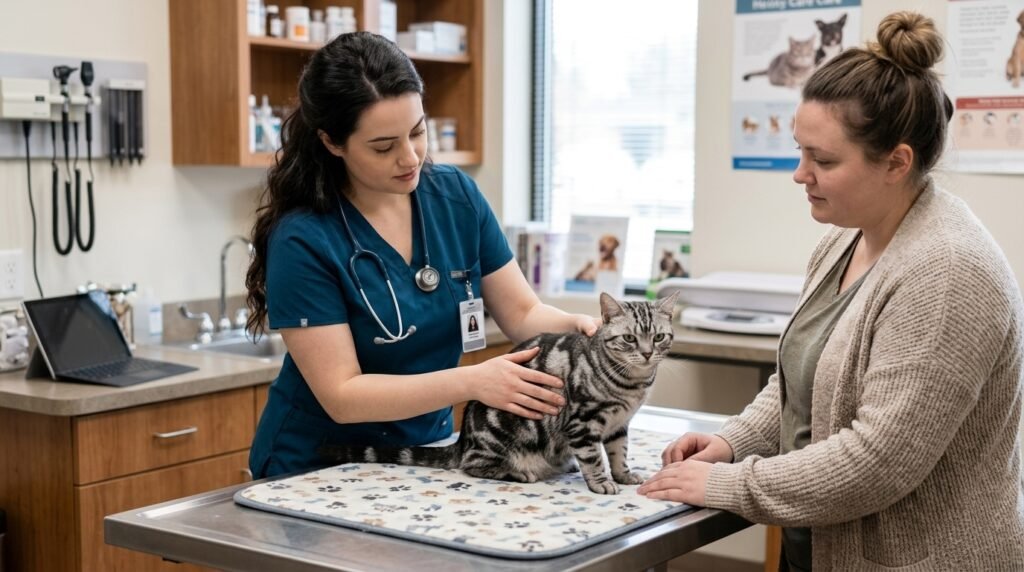
If a cat that previously enjoyed touch suddenly begins biting when her back, mouth, hip, abdomen, or another area is touched, arrange a veterinary assessment rather than assuming she has simply developed an attitude.
How to Pet Your Cat Without Triggering a Bite
If why does my cat bite me when I pet her has become a recurring question in your home, the goal should not be forcing your cat to tolerate more handling.
Make interactions easier for her to understand and easier to leave.
Start with shorter petting sessions
If she commonly bites after prolonged stroking, stop much earlier.
For example, instead of continuously petting her while she sits on your lap, give a few gentle strokes and pause.
Let her request more.
Over time, you will learn her comfortable range.
Favor the areas she consistently enjoys
Do not insist that a cat “should” enjoy being stroked everywhere.
If cheek and head contact repeatedly produces relaxed behavior while lower-back touching produces tension, respect that preference.
Pause frequently
Petting does not need to be continuous.
A pause gives you an opportunity to observe her response.
Does she:
- move closer?
- rub against your hand?
- remain relaxed?
- turn away?
- begin grooming?
- leave?
- become tense?
Those responses help guide what you do next.
Stop at the first meaningful change
Do not wait for teeth.
If you recognize your cat’s usual pre-bite pattern, end contact while the interaction is still calm.
This is one of the most practical ways to reduce biting.
Allow an easy exit
Avoid trapping a cat between your body and furniture while petting her.
A cat that can simply leave may have less reason to escalate communication.
If she stands up, let her walk away.
Do not punish the warning
Physical punishment can increase fear and worsen aggressive behavior. Cornell advises against physical punishment in managing feline aggression. Cornell Feline Health Center
Avoid hitting, grabbing, pinning, yelling at, or otherwise physically correcting a cat for biting.
Punishing subtle warnings can also create another problem: the cat may learn that communication does not make the uncomfortable interaction stop.
Respecting early signals gives her a safer way to communicate.
Keep hands out of rough play
If your cat regularly grabs, kicks, and bites hands during play, change the game.
Use toys designed to create distance between your hands and the cat’s teeth and claws.
The CDC’s guidance for healthy interaction with cats also advises avoiding rough play, particularly because bites and scratches can spread germs.
What Should You Do When Your Cat Bites During Petting?
When the bite occurs, your immediate response matters.
If possible, remain calm and end the interaction rather than turning the moment into a physical confrontation.
PetMD recommends avoiding physical retaliation and notes that sudden reactions can sometimes escalate the interaction. PetMD’s cat-biting guidance
Give your cat space to disengage.
Then think about what happened immediately beforehand.
Ask:
- How long had I been petting her?
- Where was I touching?
- What did her tail do?
- Did she turn toward my hand?
- Did her ears change?
- Did she try to leave?
- Was she already excited or stressed?
- Was the bite gentle or forceful?
- Has this happened before in the same situation?
You are looking for a repeatable pattern.

A simple mental or written log can be surprisingly useful. If your cat repeatedly becomes tense after approximately the same type or duration of touch, you can change future interactions before biting occurs.
If the bite breaks your skin
Cat bites should not be dismissed merely because the wound looks small.
The CDC’s cat-health guidance says cat bites and scratches can spread germs and recommends immediately washing bite or scratch wounds with warm, soapy water. The CDC also identifies circumstances in which medical attention should be sought, including serious wounds or wounds that become red, painful, warm, or swollen.
Separate the two issues:
Your veterinarian evaluates why your cat may be biting.
Your healthcare professional evaluates an injury to you.
Do not rely on a behavior article to determine whether a puncture wound needs medical treatment.
When Sudden Biting Deserves a Veterinary Check
A long-standing cat who has always preferred very short petting sessions is different from a cat whose behavior changes suddenly.
If your cat used to enjoy being touched and has recently started biting, flinching, hiding, avoiding handling, or reacting strongly when a certain area is touched, contact your veterinarian.
The Cornell Feline Health Center explains that medical problems—including painful conditions—can contribute to aggression and that medical causes should be considered before a behavior problem is managed solely through environmental or behavioral changes.
Veterinary evaluation becomes particularly sensible when biting is accompanied by changes such as:
- sensitivity in one specific area
- difficulty jumping
- stiffness or altered movement
- reduced activity
- appetite changes
- unusual hiding
- changes in grooming
- reluctance to be picked up
- vocalizing when touched
- dental or mouth discomfort
- unexplained weight or behavior changes
- rapidly escalating aggression
These signs do not prove a particular diagnosis.
They simply make “she is overstimulated” an insufficient assumption.
A veterinarian can assess the cat and determine whether pain, illness, or another medical factor needs investigation.
If medical causes are ruled out but the biting is frequent, severe, unpredictable, or creates a safety problem, ask your veterinarian about appropriate feline behavior support.
Frequently Asked Questions
Why does my cat bite me when I pet her and she is purring?
Purring does not guarantee that a cat wants indefinite petting. A cat may initially enjoy the interaction and later reach her touch limit. Watch the rest of her body for tail flicking, tension, ear changes, head turning, or attempts to move away rather than using purring alone as permission to continue.
Why does my cat want me to pet her and then bite me?
She may genuinely want brief physical affection but not prolonged or repetitive touch. Some cats have relatively short petting thresholds. Give a few strokes, pause, and let your cat indicate whether she wants the interaction to continue.
Why does my cat bite me gently when I stop petting her?
A gentle bite can occur in several contexts, including attention seeking, play, social interaction, frustration, or overstimulation. Do not assume every gentle bite means affection. Look at her posture and what happened immediately before and after the bite.
Should I worry if my cat suddenly starts biting when touched?
A sudden change deserves more attention, particularly if your cat reacts when one specific area is touched or shows other changes in movement, appetite, grooming, activity, or behavior. Pain and medical problems can influence aggression, so discuss a new or unexplained change with your veterinarian.
Conclusion
If you are asking why does my cat bite me when I pet her, begin by looking at the entire interaction rather than viewing the bite as an isolated act.
Your cat may be reaching her petting threshold, communicating a touch preference, becoming highly stimulated, shifting into play, feeling frightened, or—in some cases—responding to discomfort or pain.
Learn her individual pattern. Keep petting sessions short enough to remain pleasant, pause frequently, favor areas she voluntarily offers for touch, and stop when her body language changes.
Most importantly, do not punish communication.
When biting appears suddenly, becomes severe, or is associated with sensitivity or other physical or behavioral changes, involve your veterinarian. Respecting your cat’s boundaries while staying alert to possible medical changes gives you a much better foundation for safe, comfortable affection.