Dog barking at the doorbell can turn an ordinary delivery or friendly visit into a frantic rush of noise, jumping, and door-dashing. The goal is not to punish your dog for noticing a visitor or demand perfect silence. It is to teach a safer, repeatable response: hear the bell, move away from the entrance, go to a mat, and wait for guidance.
This reward-based plan breaks that sequence into manageable skills. You will first prevent uncontrolled rehearsals, then teach the mat behavior, practice the sound at an easy level, and gradually add door movement and guests. Most families can begin in a few minutes a day, but progress should follow the dog’s comfort—not a rigid deadline.
Table of Contents
Why Is Your Dog Barking at the Doorbell?
A doorbell predicts a sudden change: someone may enter, a package may appear, or the household may become excited. Through repetition, the sound itself can produce intense anticipation before your dog even sees a person. The ASPCA’s guide to barking notes that barking has different functions, so identifying the motivation matters before choosing a training response.
Common motivations include:
- Alarm: The unexpected sound startles the dog.
- Territorial concern: A person is approaching the dog’s home.
- Social excitement: The bell predicts a favorite visitor and attention.
- Frustration: A barrier prevents the dog from reaching the person.
- Learned habit: Racing and barking have been repeated so often that they form an automatic sequence.
- Fear: Strangers, entryways, or previous experiences make arrivals feel unsafe.
Watch the whole dog instead of judging the bark alone. A loose, wiggly body and broad tail movement often suggest social excitement. A low posture, retreating, trembling, tucked tail, or refusal of food may indicate fear. A hard stare, stiff body, forward weight, growling, or snapping calls for extra distance and professional guidance.
If you are unsure what the vocalizing means, PawMindTips’ guide to the common reasons dogs bark can help you identify the broader pattern. Sudden new barking, unusual irritability, confusion, or sensitivity can also be associated with pain or another health change; arrange a veterinary exam rather than assuming it is purely a training issue.
Set Up for Success Before Doorbell Training
Every full-volume sprint rehearses the old routine. Management prevents more dog barking at the doorbell while the new skill is still weak.
Choose a mat or raised bed at least several feet from the door. It should be outside the door’s swing and away from the path guests use. For a dog that might slip outside, use a closed interior door, securely mounted baby gate, exercise pen, or leash held by an adult. Never tether a dog unattended or attach a leash where a lunging dog could be injured.
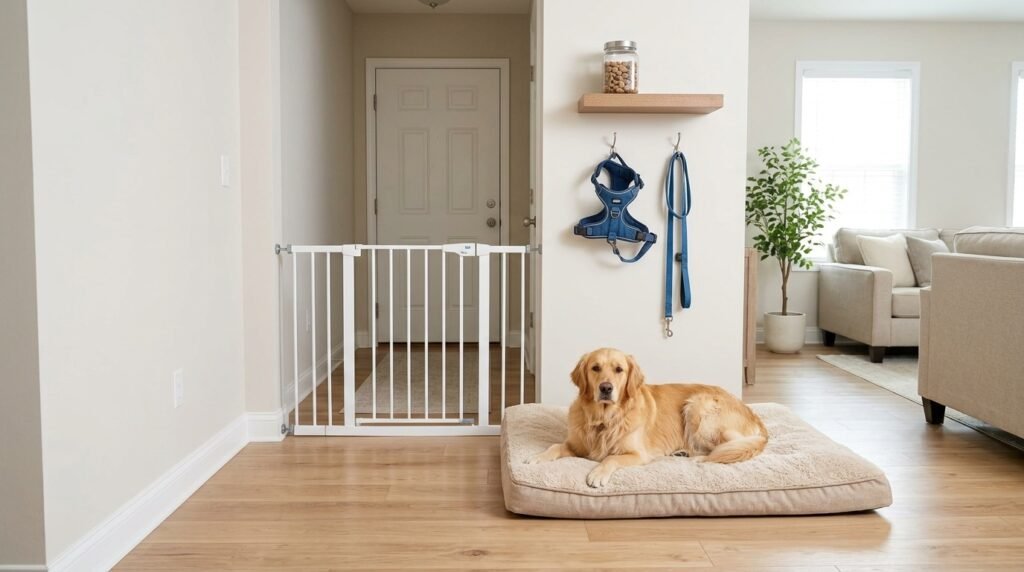
Prepare:
- A mat with clear boundaries
- Tiny, high-value treats your dog can eat quickly
- A treat container near—but out of reach of—the entrance
- A recorded version of your actual doorbell
- A leash and comfortable harness for planned visitors
- A gate or separate room for surprise arrivals
- A stuffed food toy or safe chew for longer visits
Temporarily reduce unnecessary rings: ask drivers not to ring and visitors to text. In an apartment, white noise may soften hallway sounds. This limits uncontrolled dog barking at the doorbell but does not replace training.
Decide on simple cues. “Mat” can mean move onto the bed. “Stay” or “wait” can mean remain there, and “free” can release the dog. Everyone in the household should use the same words. If the dog has not learned duration yet, review how to teach a dog to stay before expecting the skill around guests.
Keep sessions short—about two to five minutes—and stop while your dog is still successful. Three calm repetitions are more valuable than 20 increasingly frantic ones.
Teach the Mat Behavior Without the Doorbell
Build a valuable mat behavior in a quiet room before combining it with dog barking at the doorbell.
Step 1: Make the mat rewarding
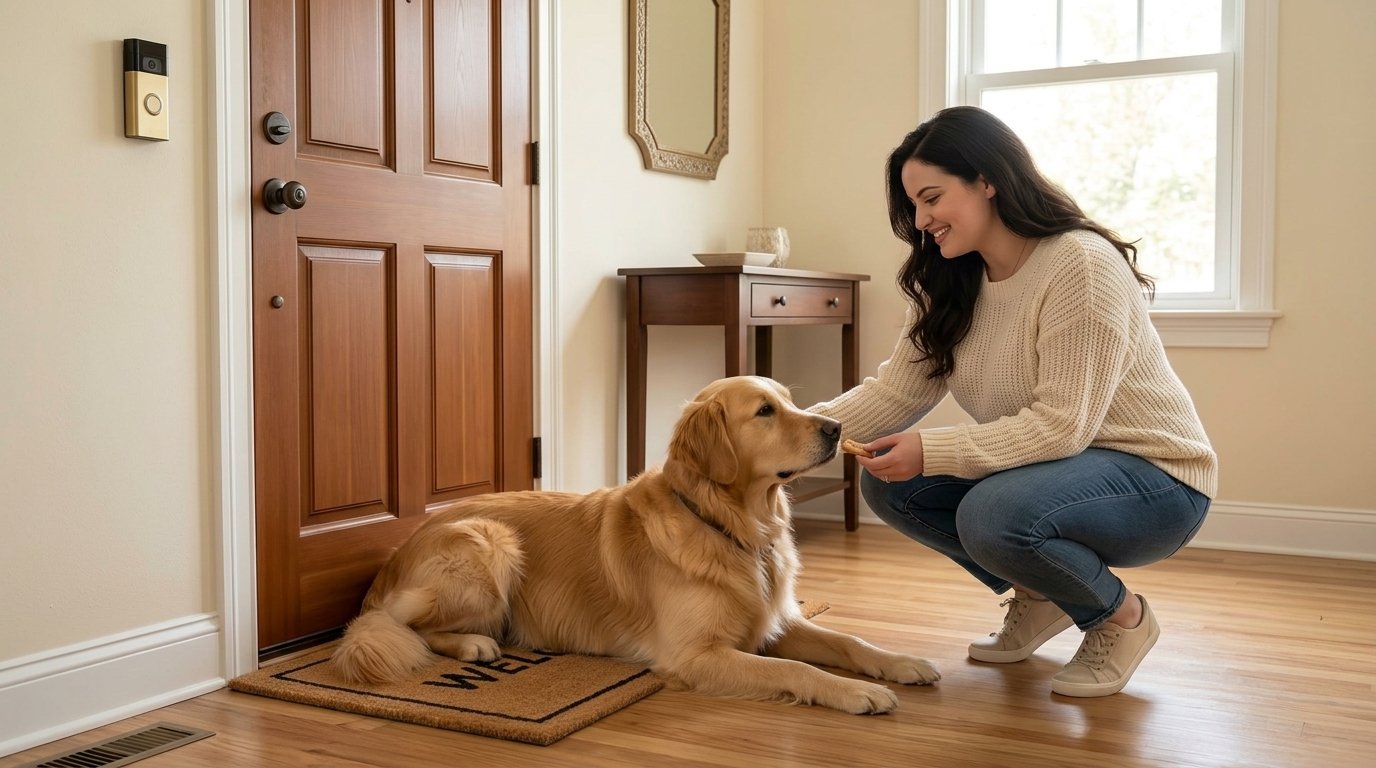
Place the mat on the floor. When your dog looks at, approaches, or steps on it, mark the behavior with “yes” or a click and place a treat on the mat. Delivering the food there matters: it makes the location itself valuable. Allow the dog to leave, then wait for another approach.
Do not push, pull, or repeatedly point. Let your dog discover that choosing the mat makes rewards appear. After several easy successes, say “mat” just before the dog moves toward it.
Step 2: Add a settled position
Once the dog readily reaches the mat, reward four paws on it. Then cue a sit or down if your dog already knows one. Feed several treats low and between the paws to encourage staying rather than bouncing back toward you.
Step 3: Build duration, distance, and distraction separately
Begin with one second on the mat, reward, and release. Increase to two or three seconds, but occasionally return to an easier repetition. Next, take one small step away and immediately return to reward. Only after those skills are solid should you add mild distractions, such as touching a doorknob.
Change one variable at a time. If you increase distance, reduce duration and distraction. Aim for success on at least four out of five repetitions before making the exercise harder. A mistake simply means the current step is too difficult.
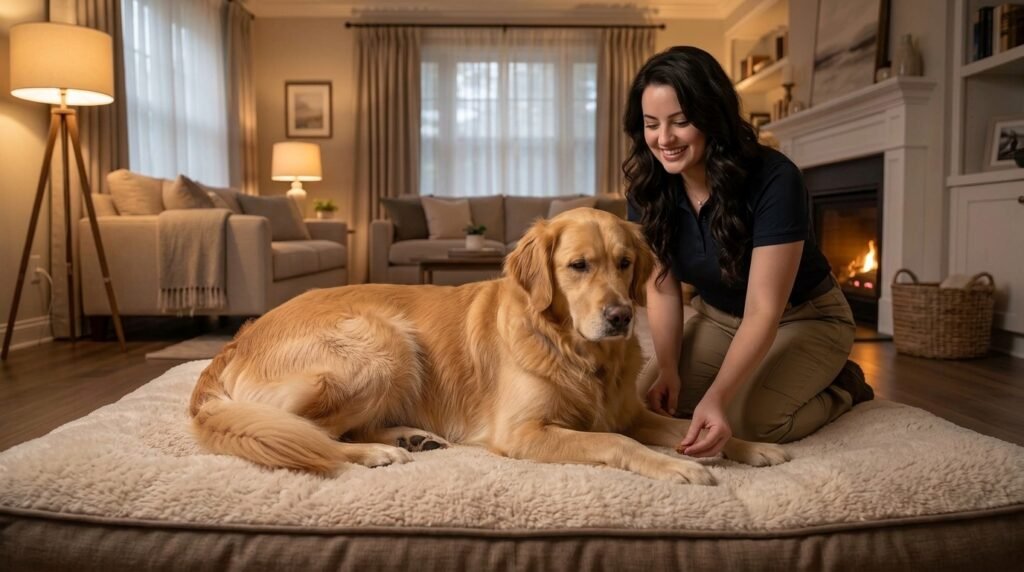
Practice from different positions around the room, including near the couch and hallway. The dog should eventually move to the mat when you are not standing beside it. This foundation is what makes a plan for dog barking at the doorbell workable during real life.
Change the Emotional Response to the Doorbell Sound
Before asking for obedience, make the sound less overwhelming. To change dog barking at the doorbell, present an easy version of the sound and follow it with something the dog loves.
Record the bell on your phone. Start at a volume low enough that your dog notices but can still eat, respond to their name, and keep a reasonably relaxed body. Play one brief ring, then immediately feed three to five small treats. Pause for 15 to 30 seconds and repeat.
At this stage, do not demand a sit, silence, or eye contact. The simple pattern is:
Soft bell → excellent food → pause.
If your dog barks once but can quickly turn back and eat, lower the volume for the next repetition. If the dog erupts, runs to the door, cannot eat, pants, paces, or scans the room, the exercise is too hard. Stop, allow recovery, and resume later at a much easier level or from farther away.
Over several sessions, increase the volume in tiny increments. Vary the device’s location so the recording gradually resembles the real bell. Do not jump from a quiet phone recording to repeated full-volume ringing. The American Kennel Club’s doorbell guidance likewise recommends changing the dog’s association with the sound and ultimately making it a cue for the desired behavior.
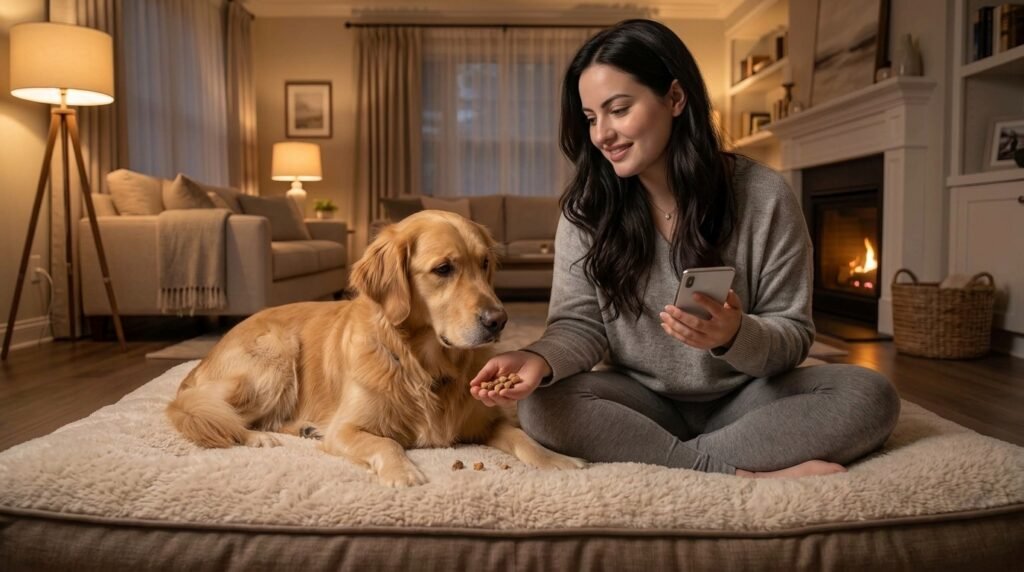
This stage is especially important when fear contributes to dog barking at the doorbell. Scolding may interrupt noise but can make the sound or visitor feel more threatening. The American Veterinary Society of Animal Behavior’s humane training position supports reward-based methods and advises against aversive training.
Turn the Doorbell Into a Cue to Go to the Mat
Now connect the two familiar pieces. Begin with the low-volume recording and stand close to the mat.
- Play the bell once.
- Pause for half a second.
- Say “mat.”
- Mark when your dog reaches it.
- Deliver several treats on the mat.
- Give the release cue.
Repeat only three to five times, then take a break. After enough successful repetitions, pause longer before saying “mat.” Your dog may begin moving toward the mat as soon as the sound plays. When that happens, enthusiastically mark and reward—the sound is becoming the cue.
Do not eliminate the verbal cue too quickly. If the dog hesitates, say “mat” and make the next repetition easier. Practice dog barking at the doorbell setups from different rooms and realistic owner positions.
Build a short stay after arrival. Feed every second at first, then vary the interval: one second, three seconds, two seconds, five seconds. Random variation is often easier than increasing in a straight line. Return to the mat to reward so the dog does not creep toward the entrance.
The first realistic target is not zero sound. It is a dog who can hear the bell, perhaps give one alert bark, disengage, and reach the mat. That is meaningful progress. Trying to suppress every vocalization can obscure the more useful goals of recovery, distance from the door, and safe control.
Add the Door, a Helper, and a Guest-Arrival Routine
Dog barking at the doorbell involves more than a chime. Your movement, the lock, an opening door, a visible person, and entry are separate distractions. Add them one at a time.
First cue the mat, then touch the doorknob and return to reward. Next turn the knob, open the door an inch, open it wider, step outside, and speak through the opening. If the dog leaves the mat, calmly reset without scolding and reduce the challenge.
Ask a familiar helper to practice at a planned time. Give the helper instructions by text so no one repeatedly rings while you organize the dog. Use this sequence:
- The helper rings once.
- Your dog goes to the mat behind a barrier or while wearing a supervised leash.
- You reward on the mat.
- The helper waits while you open the door.
- The guest enters quietly and initially ignores the dog—no staring, leaning over, or excited greeting.
- You continue rewarding calm behavior.
- If appropriate, release the dog only after the guest is seated and the dog’s body is relaxed.
Some dogs should not greet. A fearful dog may be happier behind a gate with a stuffed food toy throughout the visit. A dog with a bite history, snapping, lunging, or intense guarding needs an individualized safety plan from a qualified professional before staged greetings.
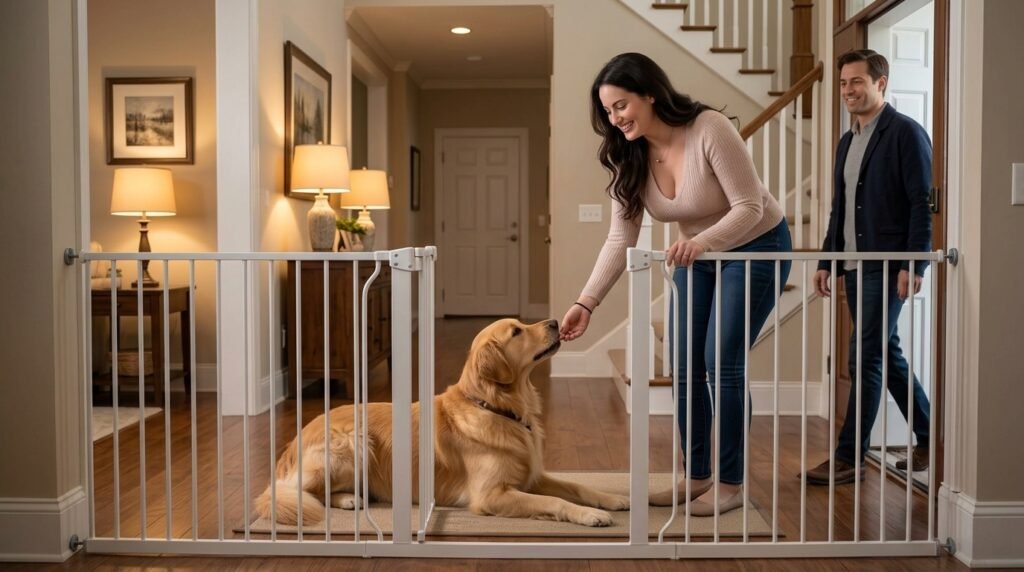
Keep early rehearsals brief. One helper can repeat an arrival, with breaks, so novelty fades. Later, vary the clothing, time, and whether the person enters or leaves a package. Never recruit an unprepared delivery driver.
A Practical 14-Day Plan for Dog Barking at the Doorbell
This schedule for dog barking at the doorbell is a framework, not a deadline. Repeat days as needed; if stress escalates, return to the last easy step.
| Days | Practice | Ready to progress when… |
|---|---|---|
| 1–2 | Reward voluntary mat visits; add the “mat” cue | Dog goes to the mat promptly in 4 of 5 attempts |
| 3–4 | Add a sit/down, brief duration, and release cue | Dog remains for 10 relaxed seconds with frequent rewards |
| 5–6 | Play a very soft recording, then feed; no mat cue required | Dog notices the sound and readily eats without rushing away |
| 7–8 | Soft bell, then “mat,” reward, and release | Dog reaches the mat in 4 of 5 repetitions |
| 9–10 | Increase volume gradually and delay the verbal cue | Dog begins moving to the mat when the bell plays |
| 11 | Add doorknob touches and tiny door movements | Dog holds position while the door moves slightly |
| 12 | Practice full door opening without a visitor | Dog stays on the mat while you open and close the door |
| 13 | Add one familiar helper for short mock arrivals | Dog can recover, eat, and remain behind the boundary |
| 14 | Rehearse the complete routine and one package-only visit | Dog completes most of the sequence with minimal prompting |
Use two or three short sessions daily when practical. Stop if the dog refuses food, repeatedly yawns, paces, hides, or grows more reactive. PawMindTips’ signs of a stressed dog can help identify an over-threshold session.
Track the date, bell volume, distance from the door, number of barks, time needed to reach the mat, and time needed to relax. Improvement may first appear as two barks instead of ten, a faster turn away, or quicker recovery—not immediate silence.
Manage Real Visitors While Training Continues
Unexpected visitors will arrive before training is reliable. Prioritize safety and prevent another rehearsal of dog barking at the doorbell rather than testing an unfinished skill.
For a surprise ring:
- Toss a small scatter of treats away from the door or cue the mat if your dog can respond.
- Place the dog behind a secure gate or closed interior door.
- Give a prepared food toy if the dog can eat comfortably.
- Handle the delivery or admit the guest.
- Keep the dog separated until arousal has dropped.
Do not grab the collar of an intensely aroused dog unless immediate safety requires it; redirected bites can occur when a dog is frightened or frustrated. A lightweight house leash may help under direct supervision, but remove it when the dog is unattended to avoid entanglement.
Avoid shouting “quiet.” From the dog’s perspective, your raised voice may add to the alarm. Also avoid shock, spray, or ultrasonic bark collars. These tools do not teach where to go or how to cope, and an unpleasant event paired with the bell may worsen fear of visitors. Humane World for Animals’ barking guidance recommends addressing the reason for barking and teaching alternative behavior rather than simply punishing noise.
If your dog is generally worried about unfamiliar people or household sounds, work on confidence away from the entrance too. These gentle ways to help a nervous dog can complement—but should not overwhelm—the doorbell plan.
In multi-dog homes, train separately first because one dog’s reaction can trigger the others. Use barriers and individual mats; combine dogs only when each performs reliably alone. For real arrivals, separation may remain safest.
Troubleshooting Dog Barking at the Doorbell
The dog ignores food. The trigger is too intense, the dog is too close, or the reward is not valuable enough. Lower the recording, increase distance, or practice at a calmer time. Refusing favorite food is useful information, not stubbornness.
The recording works, but the real bell does not. The real sound includes vibration, location, and a history of visitors. Record it from different rooms, practice at gradually higher volume, then have a helper activate the real bell once while no one enters. Drop back several difficulty levels when changing one element.
The dog runs to the mat and immediately leaves. Reinforcement may be arriving too slowly, or duration was increased too fast. Give several treats on the mat, shorten the stay, and use a clear release cue.
Barking gets worse during practice. Stop the session. Repeated triggering is not desensitization; it can strengthen the reaction. Resume with a quieter sound, greater distance, fewer repetitions, and better management between sessions.
The dog is calm until the guest enters. Separate “person appears” and “person crosses the threshold” into smaller exercises. The helper can appear at a distance, toss a treat away from themselves if appropriate, and leave. Later, practice a one-step entry followed by an exit.
Family members are inconsistent. Put the routine near the door: “Ring → mat → reward → barrier → open.” Keep supplies ready and decide which adult handles the dog and which handles the visitor.
Seek help from a reward-based certified trainer or behavior consultant if progress stalls despite easier practice. Contact a veterinarian or board-certified veterinary behaviorist when dog barking at the doorbell includes panic, escape attempts, inability to recover, sudden behavior change, or serious fear. Growling, snapping, lunging, guarding the entry, or any bite history warrants professional help and physical separation from guests. Do not punish growling; it is safety information.
Conclusion: Build a Calm Response One Step at a Time
Dog barking at the doorbell improves when the dog gets a clear, well-rehearsed job and the trigger is introduced at a manageable intensity. Prevent uncontrolled rushes, make the mat rewarding, pair the sound with good outcomes, and gradually add door movement and cooperative guests.
Measure recovery and safe choices rather than demanding instant silence. Some dogs may always give a brief alert, and that can be compatible with a calm household if they can disengage and move away from the entrance. Work at your dog’s pace, use barriers during real visits, and involve a qualified professional when fear or aggression makes arrivals unsafe.