A dog jumping on guests is usually excited, social, and trying to get closer—not deliberately being rude. Unfortunately, every touch, laugh, push, or spoken “off” can make the greeting rewarding. The most effective solution is to prevent repeated jumping while teaching one simple alternative: people come closer only when all four paws stay on the floor.
The plan below turns that rule into a practical arrival routine. You will prepare the space, teach without real visitors, add door sounds gradually, and recruit calm helpers before expecting success at a busy gathering.
Table of Contents
Why Is Your Dog Jumping on Guests?
Most greeting jumps work because they earn access to something the dog values: a face, hands, eye contact, speech, movement, or play. Even pushing a dog away can provide physical contact and turn the moment into an exciting wrestling game. If one visitor rewards the jump while another objects, the behavior becomes unpredictable but persistent—the dog keeps trying because jumping sometimes pays.
In other words, dog jumping on guests continues when the dog repeatedly reaches people faster by jumping than by staying grounded.
The arrival itself also builds arousal. A car door closes, footsteps approach, the doorbell rings, people speak, and the door opens. By the time the visitor enters, the dog may be too excited to perform a cue that is easy in the kitchen. That is why fixing a dog jumping on guests requires more than repeating “sit” at the hardest moment.
Common reasons include:
- seeking attention or physical contact;
- a history of being greeted while upright;
- excitement triggered by the bell, knock, or opening door;
- frustration caused by being held back and then suddenly released;
- limited practice around unfamiliar people;
- stress or uncertainty that looks like high excitement.
Watch the whole dog rather than assuming every jump is friendly. A loose, wiggly body generally differs from a stiff body, hard stare, growling, repeated retreating and advancing, tucked tail, or attempts to escape. PawMindTips’ guide to signs of a stressed dog can help you notice when an arrival is emotionally difficult rather than merely exciting.
Make “Four Paws on the Floor” the Greeting Rule
“Stop jumping” describes what you dislike, but it does not tell the dog what will open access to the visitor. A clearer rule is: four paws down makes people approach; paws up makes people pause or move away. The consequence is immediate, consistent, and directly connected to what the dog wants.
This makes dog jumping on guests a teachable greeting problem with one observable success criterion.
A sit can be an excellent greeting position, but it is not mandatory. Some dogs pop out of a sit as a person reaches down. Others find sitting difficult on slick flooring or when aroused. Calm standing with four paws down is still a successful greeting. Choose one of these behaviors:
- Four paws down: flexible and easiest to capture in daily life.
- Sit for greeting: clear and familiar, especially for dogs with a fluent sit.
- Go to mat: creates distance from the doorway and works well for intense arrivals.
Make the behavior easy before involving visitors. If you choose sit, practice it with gradual distractions. The PawMindTips tutorial on how to teach a dog to stay helps build brief duration, but do not demand a long, rigid stay during an exciting greeting.
The American Veterinary Society of Animal Behavior’s humane training position recommends reward-based methods and specifically explains that common behaviors such as jumping can be addressed by arranging the environment and reinforcing desirable responses. That combination—management plus teaching—is the foundation of this plan.
Prepare for Dog Jumping on Guests Before the Door Opens
Training goes better when you stop surprise arrivals from becoming full-speed rehearsals. Management is not failure or avoidance; it prevents the old habit from being strengthened while the new one is still fragile.
Set up the following:
- a properly fitted harness and regular six-foot leash;
- a sturdy baby gate, exercise pen, or closed room;
- a nonslip mat positioned several feet from the door;
- pea-size, high-value treats placed out of the dog’s reach;
- a note or text asking helpers to wait while you secure the dog;
- a simple visitor script everyone can follow.
Before an expected visit, meet your dog’s normal needs with a sniff walk, bathroom break, or quiet enrichment. Do not attempt to exhaust the dog with frantic exercise immediately before the arrival; that can produce an even more aroused dog. Allow a short decompression period, then attach the leash before the bell rings.
Good preparation keeps dog jumping on guests from being rehearsed before you can reinforce the alternative.
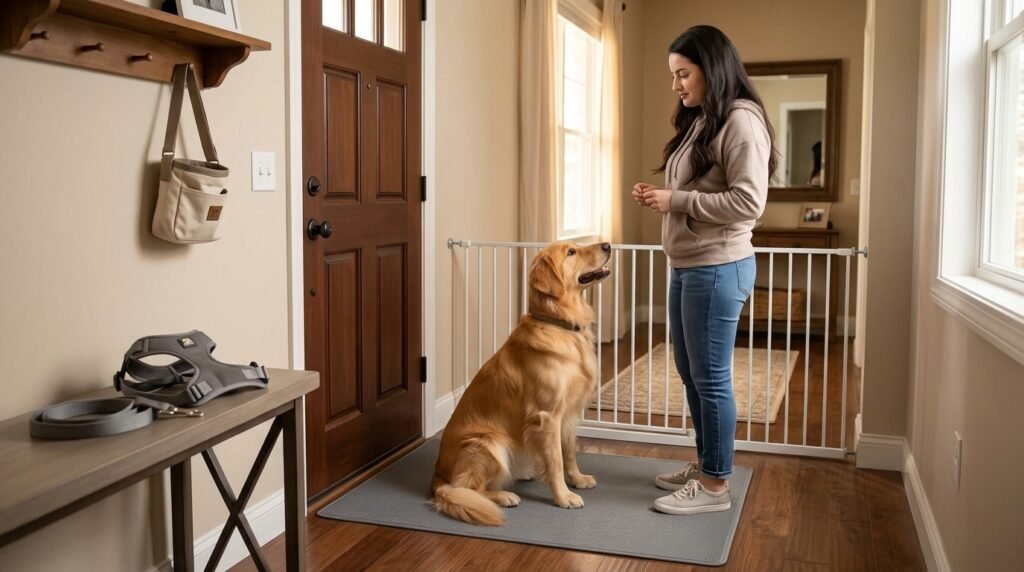
For children, older adults, anyone with limited balance, or a dog large enough to knock someone down, begin behind a physical barrier. A leash is a backup, not a tool for jerking or holding the dog inches from the visitor. Maintain enough distance for learning. If the dog cannot take food, respond to a familiar cue, or briefly place four paws down, increase distance or end the greeting.
How to Stop a Dog Jumping on Guests in 7 Steps
Do not begin with an important dinner or unpredictable delivery. Arrange brief sessions with a patient adult helper. This controlled process is how dog jumping on guests becomes a calm greeting habit.
1. Teach the four-paw rule with household members
Approach your dog calmly. While all paws remain down, mark the moment with “yes” or a click and deliver a treat low, near the dog’s nose or on the floor. Low delivery helps keep the dog grounded. Then step away and repeat.
If the dog jumps, freeze and turn slightly away. Keep hands close to your body and avoid talking, touching, or pushing. The instant the paws return to the floor, mark and reward. Your timing should make the contrast obvious: jumping stops access; paws down restores it.
Practice in several rooms and with different household members. A dog that succeeds only when one person holds treats has not yet learned the general greeting rule.
These easy repetitions build the foundation for changing dog jumping on guests during real arrivals.
2. Build a strong mat behavior away from the door
Place a nonslip mat in a quiet room. Mark and reward looking at it, stepping onto it, and eventually standing, sitting, or lying on it. Toss a reset treat away, then let the dog return. Add a cue such as “place” only after the dog is predictably moving to the mat.
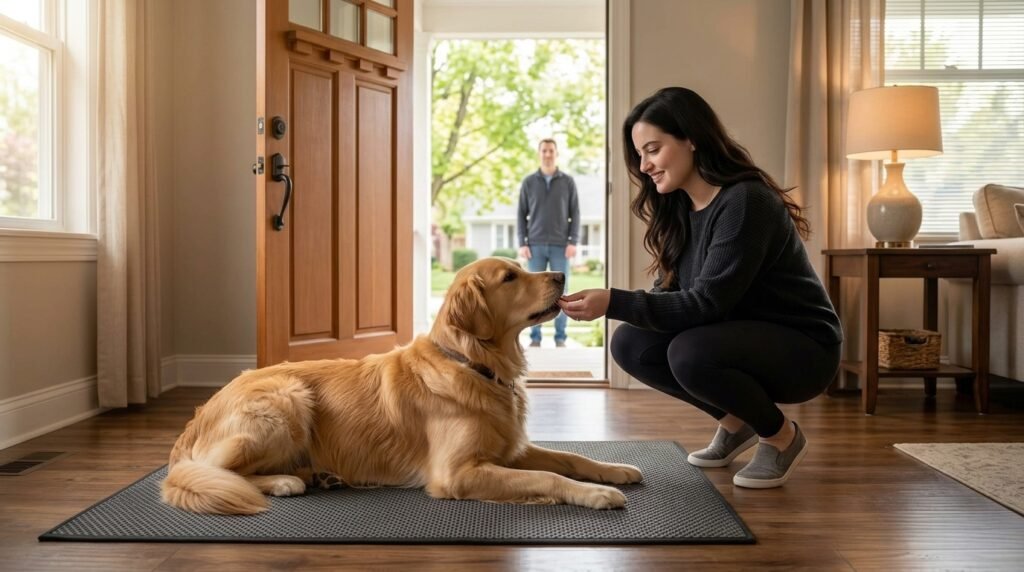
Gradually reward several seconds on the mat while you take a step, touch a doorknob, or walk toward the door. Release the dog with a consistent word such as “free.” The mat should feel safe and rewarding, never like banishment.
3. Separate door sounds from actual visitors
Many dogs explode into motion before a person appears. Record the doorbell, tap lightly on a table, or have a household member knock softly. Start at an intensity that the dog notices without rushing the entrance. Cue the mat, mark success, and reward.
Increase only one difficulty at a time: louder sound, movement toward the door, turning the handle, opening the door an inch, or seeing a familiar helper outside. If the dog leaves the mat repeatedly, make the next repetition easier. Gradual exposure is more productive than flooding the dog with repeated, full-intensity ringing.
4. Rehearse entries with one calm helper
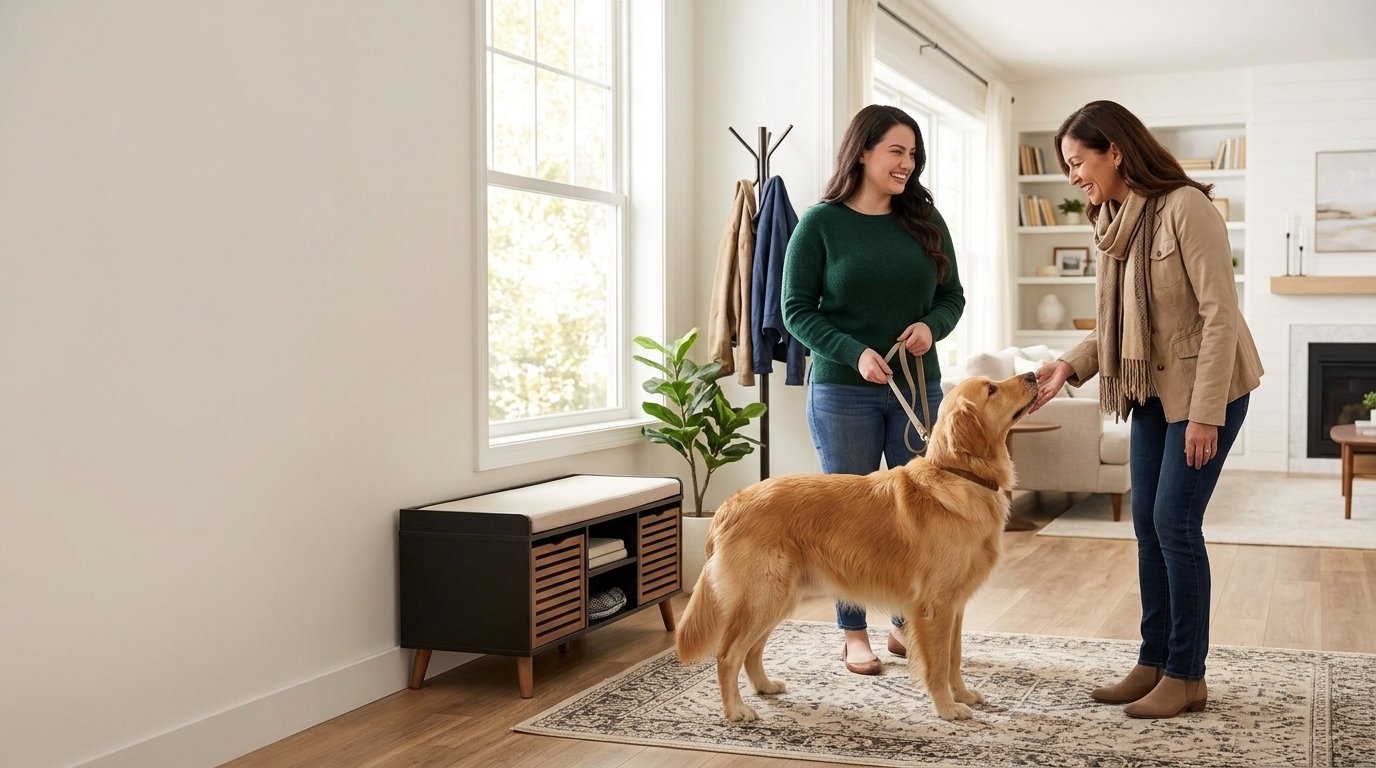
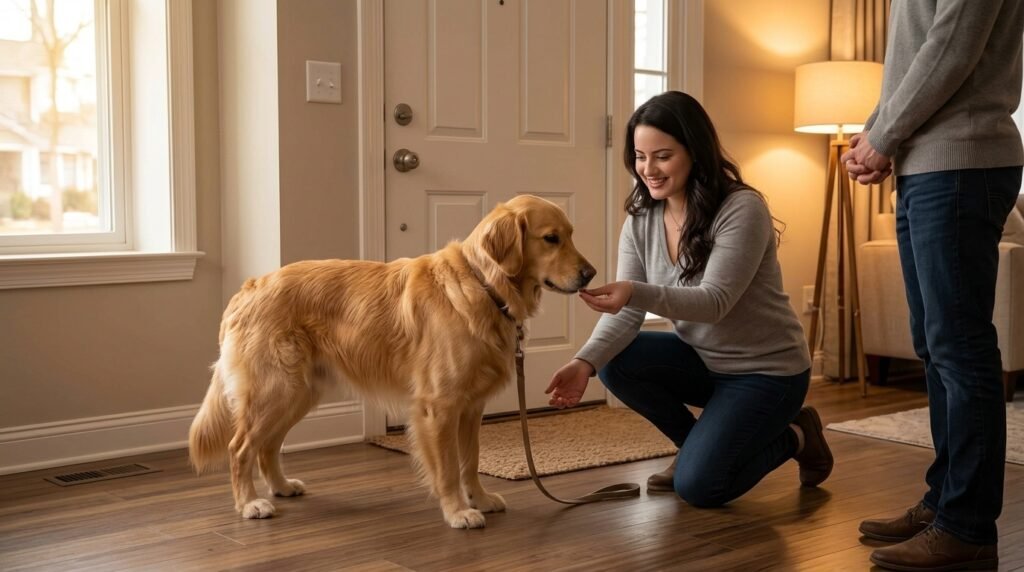
Put the harness and leash on before the helper approaches. Position the dog far enough from the door to think. Cue the chosen behavior. The helper opens the door or steps inside only while the dog remains grounded.
If paws lift, the helper silently steps back outside or turns away. As soon as four paws return to the floor, you mark and reward; the helper tries again. The person’s approach is itself a reward, while treats reinforce the exact body position you want.
For a dog jumping on guests, this step often produces the breakthrough because the dog discovers that calm behavior controls access. Aim for several easy wins, not a flawless five-minute visit.
5. Add a brief, low-key greeting
When the dog can remain grounded as the helper enters, allow one or two seconds of greeting. Ask the helper to stand sideways, keep hands low, and pet the chest or shoulder rather than looming over the head. Feed several small treats low while the dog stays grounded.
If the dog jumps, the helper immediately removes attention by standing up and turning away. Do not scold or pull the leash tight. Reset at greater distance, ask for an easier behavior, and try a shorter greeting. End while the dog is succeeding.
6. Practice with different people and realistic details
Dogs do not generalize automatically. A calm family friend, an energetic relative, a person wearing a hat, and someone carrying a bag can feel like different exercises. Change one feature at a time and return to easier criteria whenever the context changes.
Rehearse jackets, hugs between humans, conversation, people sitting down, and the guest standing again. Many dogs greet politely at the door and jump when the visitor moves later. Reward four paws down during those transitions too.
Keep early sessions controlled. One helper should not invite three more people in without warning. If a real visitor cannot participate, manage the dog behind a gate with a chew or food toy rather than sacrificing training consistency.
Generalization is essential because dog jumping on guests may return whenever the person, location, or arrival pattern changes.
7. Fade treats gradually, not abruptly
Once the dog succeeds across people and settings, shift from rewarding every correct greeting to a variable schedule. Sometimes offer food; other times reward with calm petting, permission to approach, a sniff break, or access to the room. Continue occasional high-value rewards for difficult arrivals.
Do not hide all treats merely to “test” the dog. If dog jumping on guests returns, increase management, shorten the greeting, and reinforce more frequently for a while.
Give Guests One Simple Greeting Script
Visitors can unintentionally undo weeks of practice in seconds. Send this script before they arrive or post it near the entrance:
For dog jumping on guests, the most useful visitor is predictable, quiet, and willing to follow the same rule every time.
- Please wait until I say we are ready before entering.
- Come in quietly and stand sideways.
- Keep your hands, voice, and eye contact neutral if the dog jumps.
- Approach or pet only while all four paws are down.
- If paws come up, turn away immediately.
- Keep the first greeting short and calm.
Avoid asking guests to repeat cues. The handler should guide the dog; the visitor’s job is to make access contingent on grounded paws. Children should not serve as training helpers for a dog that may knock them down. They can meet the dog later through a barrier or after the dog has settled, under close adult supervision.
The AKC’s guidance on jumping during greetings similarly emphasizes teaching an appropriate alternative and rewarding it consistently. The critical word is consistently. If family members permit jumping but visitors do not, the dog is being asked to distinguish a complicated rule that is much harder than “four paws down for every greeting.”
Mistakes That Keep Dog Jumping on Guests Going
Pushing, kneeing, shouting, or leash corrections
Physical responses may feel immediate, but they can add attention, increase excitement, cause pain, or make visitors predict conflict. They also fail to teach the greeting you want. The AVSAB statement advises against pain, intimidation, and force-based techniques; reward-based teaching is not permissiveness—it uses clear structure while protecting welfare.
If frustration has led to harsh interactions, step back and rebuild predictable, safe practice. Avoiding intimidation also matters for the relationship; PawMindTips explains how inconsistent or forceful handling can become one of the habits that destroy dog trust.
Repeating “off” or “sit” when the dog cannot respond
A cue repeated ten times becomes background noise. Say it once. If the dog cannot respond, lower the difficulty by moving farther away, closing the door, or using the barrier. Then reinforce a reachable success.
Holding the leash tight near the visitor
Constant restraint can increase frustration and allows the dog to rehearse lunging or bouncing at the end of the leash. Use distance and barriers so the leash stays mostly slack. Never tether a dog unattended near the entrance.
Rewarding too late or too high
If the treat appears after the dog rises, you may reinforce the upward movement. Mark while paws are down and deliver low. A small scatter on the floor can interrupt bouncing, but follow it with deliberate practice so food on the floor does not become the only strategy.
Moving too quickly to real parties
Training with one familiar helper does not prepare a dog for six loud arrivals. At gatherings, management may be the humane choice. A quiet room, gate, or pen with appropriate enrichment protects guests and prevents a major setback.
Troubleshoot the Pattern, Not Just the Jump
The dog sits, then jumps during petting: Make greetings one second long. The guest withdraws before the dog rises, then returns if paws remain down. Build duration in tiny increments.
The dog behaves for you but jumps on newcomers: Practice with a larger variety of calm helpers. Begin behind a gate and reward while the helper moves, speaks, sits, and stands.
The puppy cannot stay still: Do not require a long sit. Reward four paws down rapidly, use treat scatters between repetitions, and keep sessions under two minutes. Puppies need many brief rehearsals and realistic expectations.
The dog jumps after the guest sits: Treat standing, walking, laughing, and hugging as separate training triggers. Cue the mat before the guest changes position, then reinforce calm behavior.
The dog ignores food: The environment is probably too difficult, the reward may be too low-value, or the dog may be stressed. Increase distance, reduce intensity, and give the dog a break. A dog refusing favorite food during a visitor setup is information, not stubbornness.
The dog barks, retreats, or looks conflicted: Do not lure the dog closer to a stranger. Provide distance and choice. Review how to help a nervous dog and use a qualified professional if visitors trigger ongoing fear.
Keep a small log of the helper, distance, number of successful entries, and what caused a jump. Progress is not “good” or “bad”; it is the ability to succeed with slightly more movement, proximity, novelty, or duration over time.
When Dog Jumping on Guests Needs Professional Help
Friendly jumping is often manageable at home, but seek qualified help when the dog is difficult to control safely, repeatedly knocks people down, guards the doorway, redirects biting onto the handler or leash, or shows stiff posture, growling, snapping, lunging, intense fear, or an inability to recover after visitors leave.
Professional support is especially important when dog jumping on guests occurs alongside fear, guarding, or aggressive behavior.
Start with a veterinarian if the behavior appeared suddenly or is accompanied by pain, sensitivity, confusion, sleep changes, or other physical or behavioral changes. Medical discomfort can affect tolerance and arousal, and an online article cannot diagnose the cause.
For training support, use the CCPDT certified professional directory or the IAABC consultant locator, and ask candidates to describe their methods. Choose someone who uses reward-based strategies, provides a written management plan, and does not rely on fear, pain, “alpha” explanations, or guarantees.
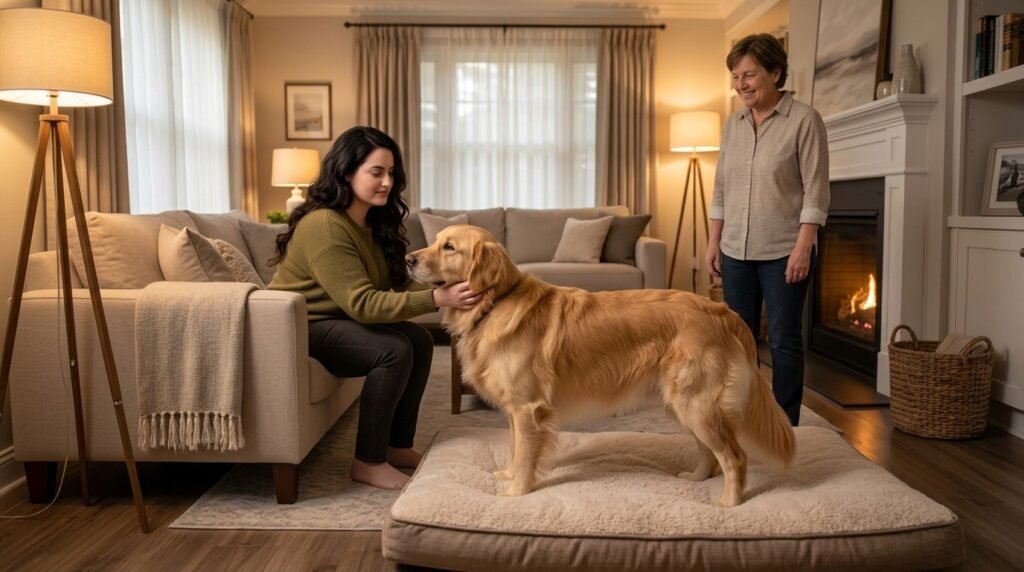
Until help is in place, do not conduct risky greeting experiments. Separate the dog securely before opening the door, tell visitors not to approach, and prioritize safety over social interaction.
Frequently Asked Questions
How long does it take to stop a dog jumping on guests?
Some dogs improve after several controlled sessions, but reliability may take weeks or longer. Progress depends on rehearsal history, arousal, household consistency, and access to suitable helpers. Prevent unwanted practice throughout training and judge improvement across several visitors, not one easy greeting.
Should guests ignore my dog when they enter?
Guests should briefly remove attention when paws rise, but ignoring alone is incomplete. Reinforce four paws down, a sit, or a mat behavior and allow approach only while that behavior continues. The dog needs a clear route to earning the greeting.
Is “sit” or “place” better for polite greetings?
Use the behavior your dog can perform comfortably at the required distance. Sit is simple for many dogs; place creates helpful space at a busy doorway. Calm standing with four paws down is also valid. You can teach place for entry and release to a four-paw greeting after the dog settles.
What should I do if my dog jumps on an unexpected visitor?
Do not improvise a training session. Ask the person to wait, secure your dog behind a gate or closed door, and provide safe enrichment. If conditions become calm, practice at a distance; otherwise, keep the dog separated for the visit. Management prevents another rewarded rehearsal.
Conclusion
Solving dog jumping on guests is less about suppressing excitement and more about giving that excitement a predictable path. Prevent full-speed door rushes, make four paws down the rule, rehearse with calm helpers, and let access to people reward the behavior you want. Use a mat or barrier when the situation is too difficult, and progress one variable at a time.
Consistency matters more than force. If your dog shows fear, aggression, sudden behavior change, or creates a fall or bite risk, pause direct greetings and involve a veterinarian or qualified reward-based behavior professional. Calm greetings grow from safe practice—not from testing the dog in situations they are not ready to handle.