Your dog used to come when called, hold a stay, or walk beside you—and now it seems as if those lessons disappeared. Dog training regression is a temporary drop in the reliability of a behavior a dog previously performed. It does not automatically mean your dog has forgotten the cue, become stubborn, or decided to challenge you.
Dog training regression can appear when the setting becomes harder, rewards lose value, routines shift, stress rises, or a dog enters a new developmental stage. Sudden changes can also reflect pain or illness. Identify what changed, lower the difficulty, reinforce success, and rebuild reliability in small steps.
This guide explains eight common causes and gives you a positive, measurable seven-day reset plan.
Table of Contents
What Is Dog Training Regression?
Dog training regression occurs when a previously learned behavior becomes less consistent. A dog who once sat on the first cue may now need two prompts. A reliable recall may fail at the park. A puppy may have house-training accidents after several clean weeks. An adolescent dog may suddenly pull, jump, or act unable to hear familiar words.
Regression is not always a loss of learning. Dogs are highly sensitive to context. A cue learned in a quiet kitchen may not yet be fluent in a yard, on a sidewalk, or beside another dog. The word is the same, but the entire picture surrounding it is different.
Think of three possibilities:
- The dog knows the skill but cannot perform it at the current difficulty. Distraction, distance, duration, stress, or low motivation is interfering.
- The skill was never fully generalized. The dog learned “sit in the kitchen,” not yet “sit anywhere.”
- The dog’s physical or emotional state has changed. Pain, illness, fear, fatigue, or major disruption can reduce performance.
One poor session is not proof of dog training regression. Look for a pattern across several opportunities and note the cue, setting, distractions, reward, and any health or behavior changes.
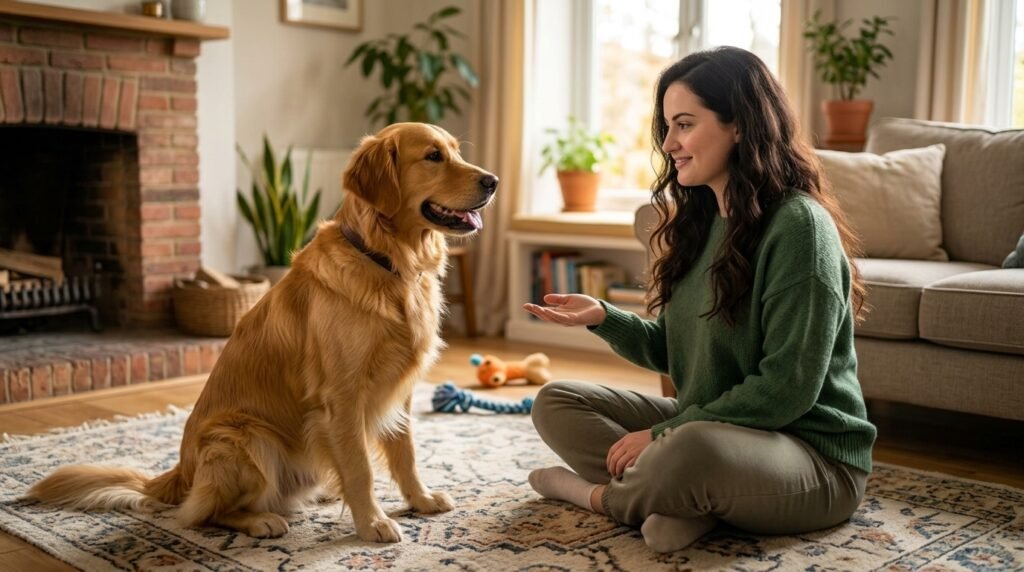
Why Do Dogs Regress in Training? 8 Common Causes
Several causes can occur together. Work through this list instead of assuming your dog is deliberately refusing.
1. Adolescence changes attention and impulse control
Adolescent dog training regression commonly appears as puppies mature. The teenage stage may begin around six months and continue beyond the first birthday. The dog becomes more interested in the environment while self-control is still developing.
Your adolescent has not necessarily erased earlier learning. The environment has become more valuable, and the behavior needs renewed reinforcement under carefully controlled difficulty. Use a long line for recall practice, return to generous rewards, and avoid testing an unfinished skill off leash.
2. The behavior was tied to one context
Dogs do not automatically generalize a behavior across locations, surfaces, handler positions, and distractions. “Down” while you stand in the living room may feel different when you sit on a park bench. A stay beside you is different from a stay while you walk away.
During dog training regression, make familiar behaviors easier in new locations. If your dog can stay for 30 seconds indoors, ask for only three to five seconds in the yard. PawMindTips’ guide to teaching a reliable stay explains how duration, distance, and distraction change difficulty.
3. Difficulty increased too quickly
Owners often raise several criteria at once. They ask the dog to work longer, farther away, and around stronger distractions in the same repetition. Failure then looks like dog forgetting commands, but the training question was simply too difficult.
Change only one variable at a time:
- Duration: how long the behavior continues
- Distance: how far the dog or handler moves
- Distraction: what competes for attention
If you add distraction, shorten duration and reduce distance. When you add distance, begin in a quiet place. A mistake tells you to lower one criterion, not to correct the dog.
4. Reinforcement became too thin or predictable
Many owners stop rewarding as soon as a behavior begins to look trained. If coming when called ends play every time and produces nothing valuable, ignoring the call may become the better deal. Food is not the only reward: access to sniffing, a toy, praise, movement, or release back to play can reinforce behavior.
During dog training regression, increase the rate and value of rewards. Pay especially well for difficult responses. Once reliability returns, vary rewards gradually rather than removing them completely.
5. Cues or household rules became inconsistent
One person says “down” to mean lie down; another uses it to mean get off the couch. Someone allows jumping while another scolds it. Repeating a cue—“come, come, COME”—can teach the dog that the first word is optional.
To resolve dog training regression, create a household cue list. Agree on the word, hand signal, expected behavior, release cue, and reward. Ask once, then make the situation easier. Consistency is also central when teaching sit and stay.
6. Stress, excitement, or fatigue reduced learning capacity
A dog who is frightened, overexcited, sleep-deprived, or mentally exhausted may be unable to respond as usual. Moving home, boarding, visitors, construction noise, a new baby, schedule changes, or a frightening event can all affect behavior.
Watch for lip licking, panting when it is not hot, pacing, trembling, tucked posture, scanning, avoidance, or an inability to take food. The PawMindTips guide to signs of a stressed dog can help you recognize when the answer is decompression rather than another training repetition.
7. The dog’s needs or motivation changed
Training after an exhausting outing, before an urgent bathroom break, or with a reward the dog no longer values can produce poor results. Too little exercise and enrichment may make concentration difficult; too much activity without rest can do the same.
Before training, check toileting, water, temperature, appropriate activity, sniffing, sleep, and stimulation. Then test several safe rewards to learn what matters in that setting.
8. Pain, illness, sensory change, or aging affected behavior
A sudden loss of a reliable behavior deserves special attention, particularly in an adult or senior dog. A dog who stops sitting may have discomfort. House-training accidents may accompany urinary or gastrointestinal problems. Reduced response to verbal cues may reflect hearing changes. Behavior change can be one sign of pain even when a dog does not cry.
Do not try to train through suspected discomfort. Arrange a veterinary examination if the change is sudden, severe, persistent, or paired with appetite changes, altered sleep, limping, stiffness, confusion, accidents, touch sensitivity, withdrawal, or aggression. A board-certified veterinary behaviorist is qualified to evaluate the interaction between medical and behavioral concerns.
First, Find Your Dog’s Current Baseline
Before fixing dog training regression, determine the easiest version your dog can perform comfortably. This prevents you from guessing and gives you a measurable starting point.
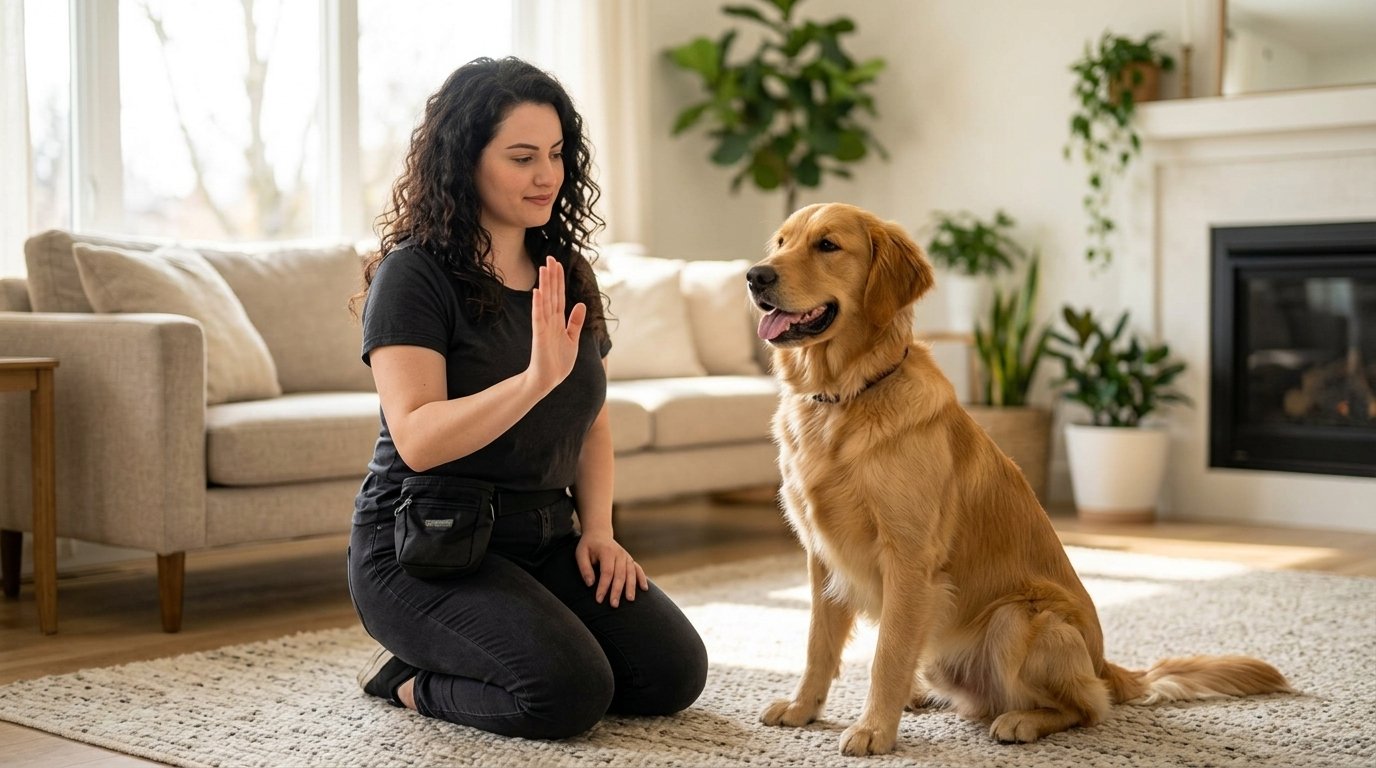
Choose one affected skill. Set up a quiet, familiar space and prepare a high-value reward. Ask for the cue once using your normal voice and body position. If your dog responds, reward immediately. Repeat only three to five times, with short breaks.
Record:
| Variable | What to note |
|---|---|
| Cue | The exact verbal cue and hand signal used |
| Setting | Room, yard, street, class, or park |
| Difficulty | Duration, distance, and distractions |
| Response | First-cue response, delayed response, or no response |
| Reward | Food, toy, sniffing, praise, or play |
| Dog’s state | Calm, excited, tired, worried, uncomfortable |
If the dog succeeds four out of five times, you have a workable baseline. If not, simplify again: move closer, shorten the behavior, remove distractions, use a clearer signal, or improve the reward.
Compare today with the last reliable period. A dog training regression log should note changes in schedule, environment, family, health, equipment, rewards, exercise, sleep, and cue delivery. A short video may reveal repeated cues, late rewards, or leash tension.
Do not test a risky behavior to find its limit. Use a leash, long line, gate, or fenced area where needed. Management prevents rehearsal of unwanted behavior and protects the dog while training is rebuilt.
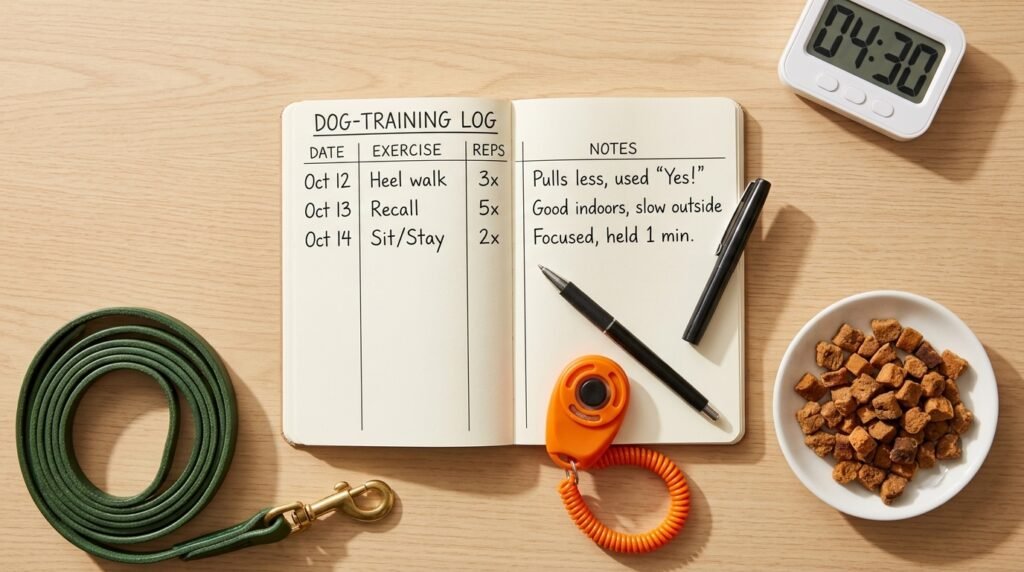
How to Fix Dog Training Regression Step by Step
Use four actions: reduce, reinforce, rebuild, and generalize.
Step 1: Reduce the challenge
Return to the last version that produced easy success. Practice recall across a room instead of across a dog park. Ask for a two-second stay rather than 30 seconds. Walk on a quiet driveway rather than a busy sidewalk.
Reducing difficulty during dog training regression restores a clear pattern: cue, response, reward. Aim for four successful responses out of five before adding a small challenge.
Step 2: Reinforce promptly and generously
Mark the correct response with a consistent word such as “yes” or a clicker, then deliver the reward promptly. Choose rewards based on the environment. Kibble may work in the kitchen; chicken, play, or permission to sniff may be more effective outdoors.
The American Veterinary Society of Animal Behavior recommends reward-based methods. Avoid leash corrections, intimidation, shouting, shock, or other aversive responses. Punishment can add stress without teaching the desired response and may damage trust. If frustration has entered your sessions, review these habits that destroy dog trust.
Step 3: Rebuild one variable at a time
Increase difficulty in tiny increments. For a stay, add one second or one step—not both. For recall, increase distance slightly while keeping the area quiet. For leash walking, add a mildly interesting stretch after success in a low-distraction area.
Mix easy repetitions with harder ones. Progress need not rise in a straight line:
- Easy repetition
- Easy repetition
- Slightly harder repetition
- Easy repetition
- Slightly harder repetition
If the dog fails twice in a row, stop raising criteria. Make the next repetition easier. End after a success, then allow rest.
Step 4: Generalize and maintain
Once dog training regression improves to about 80% success at one level, change one feature: the room, handler position, quiet outdoor setting, or one mild distraction.
Continue reinforcing throughout the dog’s life. You can reduce constant food rewards after a behavior is truly fluent, but keep meaningful reinforcement in the system. Real-life rewards—going through a door, greeting a friend, chasing a toy, or returning to sniff—help maintain skills without turning every response into a formal drill.
A 7-Day Dog Training Regression Reset Plan
This dog training regression plan is a framework, not a deadline. Spend longer at any stage if needed. Use two or three sessions a day, each about two to five minutes.
Day 1: Observe and rule out red flags
Select one regressed behavior. Note health, appetite, sleep, movement, toileting, stress signals, and recent changes. Test the easiest safe version three to five times. Contact your veterinarian rather than continuing the plan if you notice a sudden or concerning physical or behavioral change.
Day 2: Rebuild the cue-reward connection
Practice in a quiet, familiar area. Give the cue once, mark the correct response, and reward every successful repetition. Stop while the dog remains engaged. Your goal is clarity, not endurance.
Day 3: Strengthen fluency
Repeat the easy version in two short sessions. Change your position slightly or move to another quiet room, but reduce expectations after changing context. Track first-cue responses. Aim for four successes out of five without visible stress.
Day 4: Add one small challenge
Increase only one variable. Add one second, one step, or one mild distraction. Reward generously. If performance drops below 80%, return to the previous level immediately.
Day 5: Practice in real life—with management
Use the behavior in one controlled daily situation. Ask for a brief stay before placing the food bowl down, practice recall on a long line, or reward several loose-leash steps on a quiet route. Safety equipment remains in place; training does not replace it.
Day 6: Generalize carefully
Try one new but manageable location. Start at half the difficulty the dog handled at home. Let the dog look around and settle before asking for the cue. If food is refused or focus is impossible, create more distance from the distraction or leave.
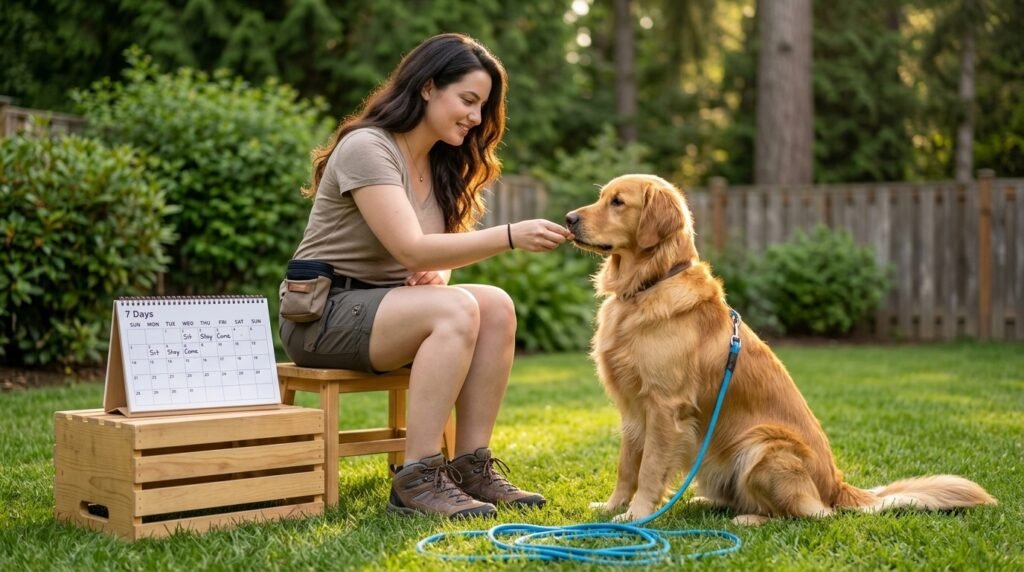
Day 7: Review the data and choose the next step
Compare Day 7 with the baseline. Is the dog responding faster? Are first-cue responses increasing? Are mistakes less frequent? Is the dog relaxed and willing to work? Continue at the successful level for another week, raise one criterion slightly, or seek help if there is no improvement.
Troubleshooting Common Dog Training Setbacks
Dog training regression looks different across skills, so match the solution to the behavior.
“My dog stopped coming when called”
Stop using the cue when you cannot safely support it. Practice indoors, then in a fenced area or on a long line. Never punish the dog after they reach you, even if they took too long. Reward arrival, occasionally release the dog back to fun, and prevent off-leash opportunities to ignore an unfinished recall.
“My dog breaks stay again”
Identify whether duration, distance, or distraction caused the break. Shorten that variable. Reward while the dog is still in position, then use a clear release cue. Do not wait until failure. Detailed progression is available in the PawMindTips guide on how to teach a dog to stay.
“My dog pulls on the leash again”
Begin where your dog can notice the environment and still eat or orient to you. Reward near your side, use sniffing as a real-life reward, and turn away or add distance before excitement becomes unmanageable. Choose quieter times and shorter routes while rebuilding the skill.
“My house-trained dog is having accidents”
Return temporarily to a puppy-style schedule: frequent supervised trips, reward outdoor elimination, and manage indoor freedom. Do not punish accidents. Because urinary, digestive, mobility, medication, and age-related problems can cause new accidents, contact your veterinarian when the change is sudden, repeated, or accompanied by other symptoms.
“My dog listens at home but not outside”
This is usually a generalization or difficulty problem, not proof that the dog stopped listening. Begin outdoors at a distance from activity. Use better rewards, ask for easier behaviors, and keep sessions short. Move closer to distractions only after the current distance produces relaxed, consistent responses.
Mistakes That Make Regression Last Longer
Training setbacks often persist because the dog keeps rehearsing failure or the emotional cost of training increases. Avoid these common errors:
- Repeating the cue. One clear cue followed by an easier setup is more useful than saying the word five times.
- Testing instead of teaching. Repeatedly calling a dog away from squirrels does not build recall if the dog cannot succeed at that level.
- Raising several criteria together. Add duration, distance, or distraction separately.
- Removing rewards too early. Strengthen the behavior before making reinforcement less frequent.
- Punishing confusion or fear. Aversive methods may suppress behavior without solving the underlying difficulty.
- Training for too long. Several short, successful sessions usually beat one frustrating marathon.
- Ignoring stress and recovery. Rest and decompression can be part of an effective training plan.
- Letting household rules conflict. Agree on cues, expectations, and reinforcement.
- Assuming every setback is behavioral. Sudden changes deserve a health check when appropriate.
Do not label the dog as stubborn. Describe the observable problem: “She responds indoors but not within 30 feet of another dog.” That description suggests a specific adjustment.
When to Call a Veterinarian or Training Professional
Seek veterinary advice promptly when dog training regression is sudden, intense, or accompanied by physical or personality changes. Warning signs include pain, limping, stiffness, altered appetite or thirst, vomiting or diarrhea, new toileting accidents, confusion, sleep disruption, touch sensitivity, withdrawal, unusual vocalization, or new aggression.
Urgent veterinary care is appropriate for collapse, breathing difficulty, seizures, severe injury, repeated unproductive retching, inability to urinate, suspected poisoning, or another acute emergency. Training should wait.
For a physically healthy dog, consult a qualified reward-based trainer if you cannot identify a workable baseline, the setback continues despite consistent practice, or safety is becoming difficult. Fear, separation-related distress, compulsive behavior, reactivity, or aggression may require a credentialed behavior consultant or veterinary behaviorist rather than a general obedience class.
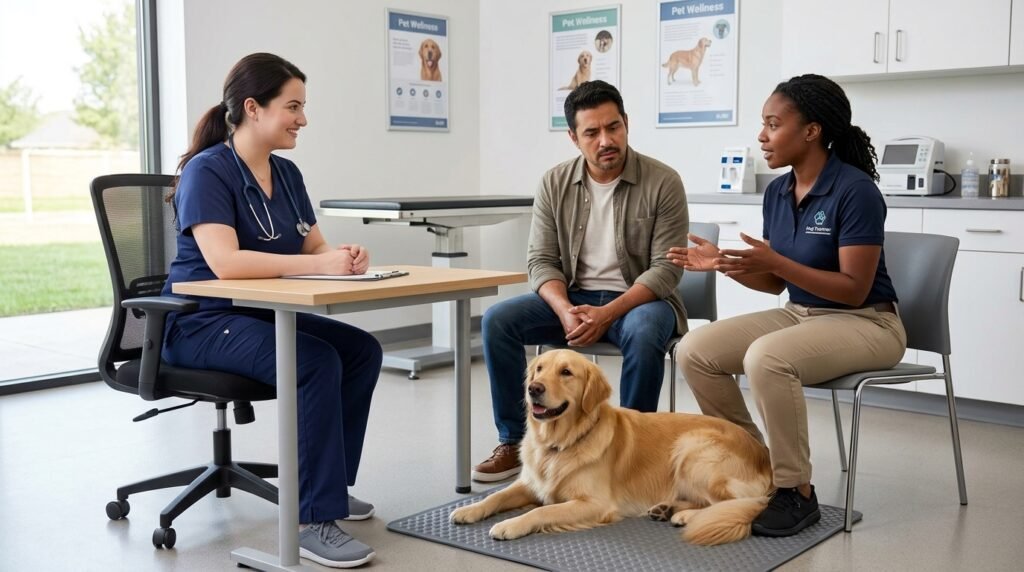
The American College of Veterinary Behaviorists explains the medical and behavioral role of board-certified specialists. Whichever professional you choose, ask about credentials, methods, safety plans, and how progress will be measured. Avoid anyone who guarantees a cure, relies on fear or pain, or describes the problem as a battle for dominance.
Frequently Asked Questions
Is dog training regression normal?
Temporary setbacks are common, especially during adolescence, after routine changes, in new environments, or when difficulty rises too quickly. Normal does not mean every change should be ignored. Sudden or severe regression, particularly with health or personality changes, warrants veterinary advice.
How long does dog training regression last?
There is no fixed timeline. A context-related setback may improve within several focused sessions, while adolescent fluctuations can recur over weeks or months. Measure response speed, success rate, stress level, and recovery after mistakes rather than expecting progress by a specific date.
Should I start training from the beginning again?
Usually you do not need to erase the whole plan. Return to the easiest version your dog can perform, reinforce it well, and rebuild one variable at a time. If the dog cannot perform even the easiest familiar version, check stress, motivation, cue clarity, and possible health concerns.
Why has my dog suddenly stopped listening to commands?
Distraction, incomplete generalization, weak reinforcement, inconsistent cues, stress, adolescence, fatigue, pain, illness, or sensory change can all reduce responses. Record when and where it occurs. If the change is abrupt, widespread, or paired with other symptoms, consult your veterinarian.
Conclusion
Dog training regression is best treated as information, not defiance. Find the easiest successful version of the skill, rule out medical or emotional concerns, restore valuable reinforcement, and change only one difficulty variable at a time. Short sessions and careful management prevent more mistakes from becoming habits.
Your dog does not need perfection to make progress. Look for calmer practice, faster responses, fewer errors, and success across gradually varied settings. If improvement stalls or the change is sudden, painful, fearful, or unsafe, involve your veterinarian or a qualified reward-based behavior professional.