Training a dog does not have to be complicated or stressful. Whether you have a playful puppy, an adopted adult dog, or a companion that simply needs better manners, the right approach can make training easier and more enjoyable.
The best dog training tips focus on clear communication, consistency, patience, and rewarding behaviors you want your dog to repeat. Positive reinforcement is especially useful because it helps dogs understand which behaviors produce desirable outcomes.
Puppies can begin learning simple behaviors when they come home, while adult dogs can continue learning throughout their lives. The important thing is to match your training approach to your dog’s age, personality, motivation, and environment.
In this guide, you’ll discover 10 practical dog training tips for beginners, including how to teach basic commands, encourage good behavior, improve leash skills, build reliable recall, and avoid common training mistakes.
Table of Contents
Why Dog Training Matters
Dog training is about much more than teaching your dog to sit or shake paws. Effective training gives your dog a predictable way to understand what you expect and gives you a practical way to communicate.
Good training can make everyday situations easier, including:
- Walking on a leash
- Greeting visitors
- Going to the veterinarian
- Traveling
- Coming when called
- Waiting at doors
- Settling down at home
- Responding around distractions
- Interacting appropriately with people and other animals
Consistent training can also strengthen the relationship between you and your dog. When your dog understands which behaviors earn rewards, communication becomes clearer and everyday interactions become easier.
For more help understanding canine communication, you can explore the relevant dog body language resources on PawMindTips.
10 Essential Dog Training Tips for Beginners
1. Start With Positive Reinforcement
One of the most important dog training tips for beginners is to reward behaviors you want your dog to repeat.
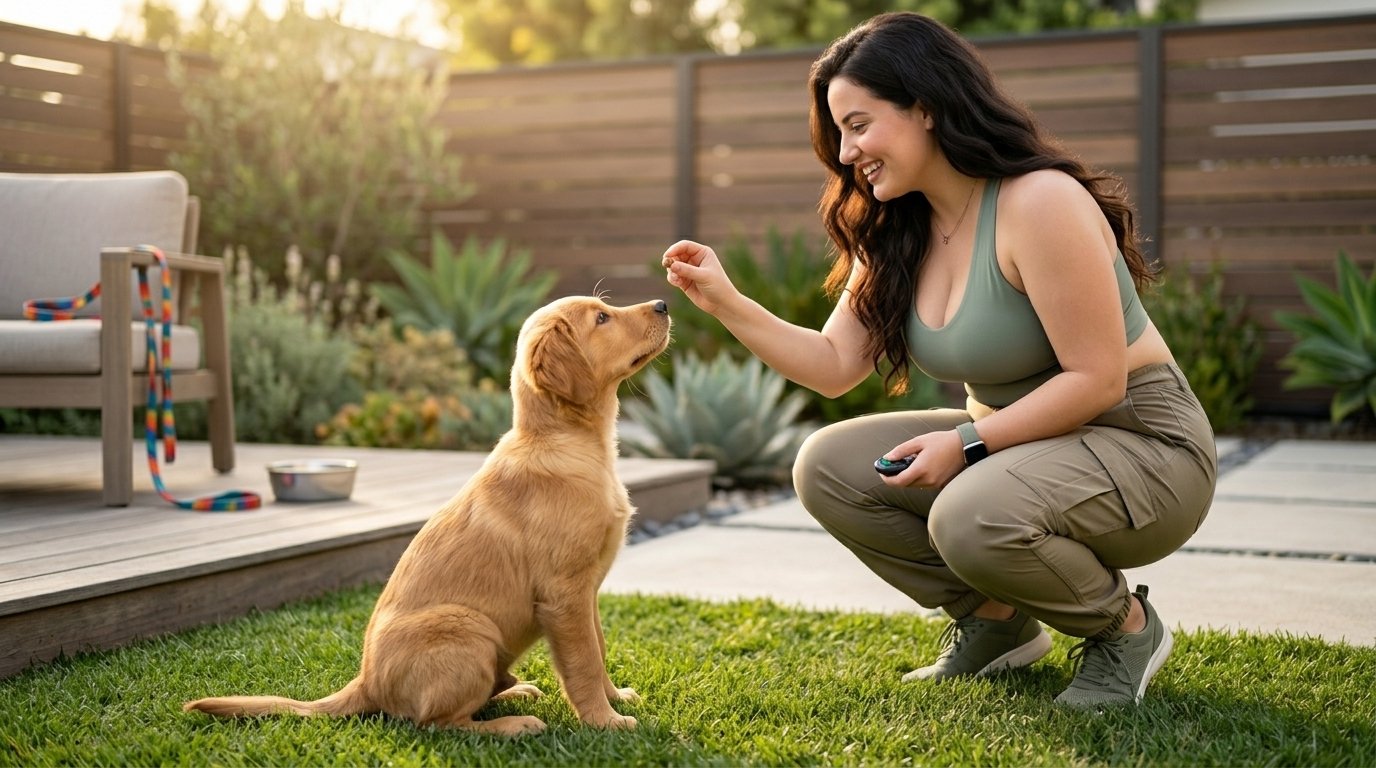
Positive reinforcement means providing something your dog values immediately after a desirable behavior. This might be a small treat, praise, play, a favorite toy, or access to something your dog enjoys.
For example, ask your dog to sit. When your dog sits successfully, mark the behavior with a cheerful “Yes!” and immediately provide the reward.
Your dog gradually learns this pattern:
Cue → Behavior → Reward → Repeat
The reward does not always have to be food. Some dogs are highly motivated by toys, games, praise, attention, or affection.
The American Kennel Club’s positive reinforcement guidance explains how rewarding desirable behavior can help dogs understand what their owners want.
How to use positive reinforcement effectively
- Reward the correct behavior quickly.
- Use rewards your dog genuinely values.
- Keep your voice upbeat.
- Keep sessions short.
- Reward calm behavior as well as obedience.
- Gradually vary rewards as behaviors become reliable.
The objective is to make the correct choice clear and worthwhile.
2. Keep Training Sessions Short and Focused
Long training sessions can become boring or frustrating, especially for puppies.
One of the most practical dog training tips is to use several short sessions rather than forcing your dog through one long lesson.
For a young puppy, five to 10 minutes can be enough for focused practice. Adult dogs may tolerate longer sessions, but engagement is still more important than duration.
Try dividing training throughout the day.
Morning: Practice name recognition, attention, and sit.
Afternoon: Practice leash walking.
Evening: Practice stay, come, or another basic behavior.
You can also incorporate training into normal activities.
Ask your dog to sit before putting down the food bowl. Reward calm behavior before opening the door. Ask for attention before beginning a walk.
These small moments can add up without making training feel like a daily chore.
The AKC’s puppy training guidance also emphasizes keeping early training short, positive, and manageable.
3. Be Consistent With Commands and Household Rules
Consistency is one of the most important dog training tips because dogs learn through repeated associations.
Imagine that one family member allows the dog to jump onto the couch while another person constantly removes the dog. The dog receives conflicting information and has a harder time understanding the household rules.
Everyone should agree on important expectations.
Decide:
- Which words will be used for commands
- Whether the dog is allowed on furniture
- How jumping will be handled
- Where the dog sleeps
- How visitors should greet the dog
- Which behaviors receive rewards
- Which areas of the home are off-limits
Use simple cues such as:
- Sit
- Down
- Stay
- Come
- Leave it
- Drop it
- Wait
Try not to change the cue constantly.
For example, if “come” means return to you, avoid switching between several phrases every time you call your dog.
Predictable communication makes learning easier.
4. Teach the Most Useful Basic Commands First
Good dog training tips should prioritize useful behaviors rather than focusing only on entertaining tricks.
You don’t need to teach dozens of commands before your dog can become well behaved. Start with skills that improve communication, manners, and safety.
Sit
“Sit” is one of the easiest foundation behaviors and can be useful before meals, walks, greetings, and other exciting situations.
Down
“Down” can encourage your dog to settle and provides an alternative to jumping or becoming overly excited.
Stay
“Stay” teaches your dog to remain in a position until you provide another cue.
Come
Reliable recall is an important safety behavior because it gives you a way to call your dog back to you.
Leave It
“Leave it” can help prevent your dog from picking up or approaching something inappropriate.
Drop It
“Drop it” teaches your dog to release an object that is already in its mouth.

The American Kennel Club’s basic command guide covers several foundational behaviors that are useful for puppies and beginning obedience training.
Focus on reliability rather than quantity. A dog that consistently responds to a few important commands is more practically trained than a dog that knows many tricks but ignores them around distractions.
5. Reward Good Behavior Before Your Dog Makes a Mistake
Many owners notice their dogs primarily when something goes wrong.
Your dog lies quietly on the floor, and nobody reacts.
Then your dog jumps onto the kitchen counter, and suddenly everyone pays attention.
From your dog’s perspective, attention itself can sometimes become rewarding.
One of the smartest dog training tips is therefore to actively look for desirable behavior.
If your dog calmly lies beside you, reward that calmness.
If your puppy chooses a toy instead of chewing your shoes, praise the choice.
If your dog watches a visitor without jumping, reinforce the calm response.
This approach teaches your dog what to do rather than simply showing them what not to do.
The AKC’s training advice provides additional guidance on reinforcing desirable behaviors.
6. Use the Right Reward for Your Individual Dog
Not every dog considers the same thing rewarding.
One dog may work enthusiastically for tiny treats. Another may prefer a favorite toy, praise, or a quick game of tug.
Finding your dog’s strongest motivators is an important part of effective dog training tips because motivation can change depending on the environment and difficulty of the behavior.
You can create a simple reward hierarchy.
Everyday rewards: Regular kibble or ordinary praise.
Medium-value rewards: Favorite treats or toys.
High-value rewards: Special treats reserved for particularly difficult situations.
Use lower-value rewards when training is easy and save more exciting rewards for situations involving greater distractions.
For example, your dog may happily sit in the living room for kibble but struggle to focus at a busy park. A higher-value reward may help maintain motivation.
Keep treats appropriately small and remember that training treats contribute to your dog’s overall daily food intake.
7. Pay Attention to Timing
Timing can make a major difference in how quickly your dog understands a behavior.
Imagine asking your dog to sit. Your dog sits immediately, but you wait five seconds before delivering the treat.
Your dog may not clearly understand which behavior earned the reward.
A useful training sequence is:
Cue → Behavior → Marker → Reward
For example:
“Sit.”
Your dog sits.
“Yes!”
Treat.
A consistent verbal marker such as “Yes!” or a clicker can help identify the exact moment your dog performs the desired behavior.
Good timing is therefore one of the dog training tips that can make learning much clearer, particularly when teaching more complicated behaviors.
The AKC guide to training with rewards provides additional information about using rewards effectively.
8. Practice in Different Places
Your dog may sit perfectly in your living room and then struggle to respond at a park.
That doesn’t necessarily mean your dog is stubborn.
Dogs have to learn that a behavior applies in different environments, and distractions can dramatically increase the difficulty.
One of the most useful dog training tips is to gradually change where you practice.
Start somewhere quiet.
Then progress through:
- Another room
- Your backyard
- A quiet outdoor location
- A neighborhood sidewalk
- A more distracting public environment
If your dog struggles, reduce the difficulty.
Don’t repeatedly give a command your dog cannot successfully follow. Instead, make the situation easier, help your dog succeed, reward the success, and gradually increase the challenge again.
This approach helps prevent frustration and creates stronger behavior over time.
9. Prioritize Leash Walking and Recall
Two skills deserve special attention because they can affect your dog’s everyday safety: leash walking and recall.
Loose-leash walking
Reward your dog for staying near you rather than constantly pulling ahead.
Begin indoors or in a quiet location with minimal distractions. Once your dog understands the desired behavior, gradually practice in more challenging environments.
Don’t expect a young puppy to immediately walk perfectly through a busy neighborhood.
Build the skill gradually.
Recall
Teach your dog that returning to you is worthwhile.
Use an enthusiastic voice and valuable rewards.
Practice recall regularly in safe, controlled environments.
Avoid calling your dog only when something enjoyable is about to end. If every recall means that playtime is over or the walk is finished, your dog may become less enthusiastic about returning.

Instead, practice recalls that lead to treats, praise, play, or another positive experience.
The American Kennel Club’s training guidance also emphasizes making recall rewarding and avoiding punishment after your dog comes to you.
For safety, don’t test an unreliable recall by allowing your dog to run freely in an unsecured or dangerous area.
10. Be Patient and Train for Progress, Not Perfection
Perhaps the most important of these dog training tips is patience.
Dogs learn at different speeds.
A young puppy has a developing attention span. An adult rescue dog may arrive with habits that have been reinforced for months or years.
Your dog may perform a behavior perfectly one day and struggle with it the next.
That does not necessarily mean training has failed.
Look for gradual improvement.
Ask yourself:
- Does my dog respond faster than before?
- Can my dog focus for longer?
- Are unwanted behaviors happening less frequently?
- Can my dog recover from distractions more easily?
- Does my dog understand the command in more than one environment?
These are meaningful signs of progress.
If you become frustrated, end the session and try again later. A calm trainer usually creates a better learning environment than an owner who is becoming increasingly irritated.
Puppy Training vs. Adult Dog Training
The basic principles can work for both puppies and adult dogs, but your expectations should match the dog’s age and experience.
Puppies are still developing physically and mentally. They need plenty of sleep, safe exploration, appropriate play, socialization, and frequent opportunities to learn.
You can begin simple training when a puppy comes home. The AKC puppy training guide explains how foundational behaviors can be introduced early.
Adult dogs can also learn new behaviors.
If you adopt an older dog, don’t assume that previous habits cannot change. You may simply need additional repetition and patience while teaching new responses.
The most important factor is not simply age. Training should match your dog’s motivation, environment, history, and ability to focus.
Common Dog Training Mistakes to Avoid
Even owners with good intentions can accidentally make training harder.
Repeating commands too many times
If you say “sit, sit, sit, sit” before your dog responds, your dog may learn that the command isn’t important until it has been repeated.
Give the cue clearly and allow your dog an opportunity to respond.
Training for too long
When your dog becomes tired or distracted, learning can become less productive.
Keep sessions short and finish after a successful behavior whenever possible.
Accidentally rewarding unwanted behavior
If your dog jumps and immediately receives attention, that attention may reinforce jumping.
Instead, reward an alternative behavior such as standing calmly or sitting.
Expecting instant reliability
Learning a behavior in a quiet room is only the beginning.
Your dog still needs practice around distractions before the behavior becomes reliable in everyday life.
Using harsh punishment
Reward-based training focuses on reinforcing desirable behavior rather than relying on painful or frightening methods.
The American Kennel Club’s positive reinforcement resource explains the principles behind reward-based learning.
If your dog has serious aggression, fear, or anxiety, punishment can make the situation more complicated. Consider qualified professional help instead.
A Simple Daily Dog Training Routine
You don’t need a complicated schedule to make progress.
A simple routine can provide plenty of opportunities to practice.
Morning — 5 Minutes
Practice:
- Name recognition
- Attention
- Sit
- Down
Midday — 5 Minutes
Practice:
- Loose-leash walking
- Leave it
- Calm behavior
Evening — 5 to 10 Minutes
Practice:
- Stay
- Come
- Review previously learned behaviors
You can also integrate training into everyday life.
Ask for a sit before meals.
Reward calm behavior when visitors arrive.
Practice waiting briefly before opening doors.
Reward your dog for checking in with you during walks.
These small interactions turn training into part of your dog’s normal routine.
For related guidance on your dog’s physical activity needs, visit How Much Exercise Does a Dog Need? on PawMindTips.
How to Know When Your Dog Is Ready for the Next Level
Your dog is generally ready for greater difficulty when they can perform a behavior consistently in an easier environment.
For example, if your dog can reliably sit in the living room, practice the same behavior in the backyard.
Once that becomes easy, introduce a mild distraction.

Then gradually increase the challenge.
Think of training like building a staircase. You don’t ask your dog to jump from the first step to the tenth. You build one successful step at a time.
If your dog suddenly struggles, return to an easier level.
This gives your dog more opportunities to succeed and prevents unnecessary frustration.
When Should You Get Professional Dog Training Help?
Basic obedience can be handled by many owners, but some behavior problems require professional support.
Consider seeking qualified help if your dog shows:
- Serious aggression
- Repeated biting
- Severe fear
- Intense resource guarding
- Dangerous escape behavior
- Significant anxiety
- Sudden major behavior changes
- Persistent problems despite consistent training
A qualified trainer or behavior professional can help identify what may be contributing to the problem and develop an appropriate plan.
For serious or sudden behavior concerns, speaking with your veterinarian is also a sensible first step because medical problems can sometimes influence behavior.
If you’re preparing a puppy for veterinary care, you can also reference the dog vaccination information on PawMindTips.
Frequently Asked Questions About Dog Training Tips
What should I teach my dog first?
Start with attention and practical behaviors such as sit, down, come, stay, leave it, and loose-leash walking. Focus on skills that improve communication, manners, and safety.
How long should dog training sessions last?
Puppies generally benefit from short sessions of around five to 10 minutes, while adult dogs may tolerate somewhat longer sessions. The important thing is to keep training engaging and stop before your dog becomes frustrated or exhausted.
Are treats necessary for dog training?
No. Treats are a convenient reward, but dogs can also work for toys, games, praise, attention, or other things they value.
Can an older dog learn new commands?
Yes. Adult and senior dogs can learn new behaviors. Training may require additional patience and repetition, particularly when replacing established habits.
What is the best method for training a dog?
Reward-based positive reinforcement is a widely used approach for teaching desirable behaviors. It focuses on reinforcing behaviors you want your dog to repeat rather than relying primarily on fear or pain.
For additional professional information, the American Kennel Club training resources provide a useful starting point.
Final Thoughts
The best dog training tips are not complicated tricks. They are simple habits practiced consistently over time.
Start with small behaviors.
Use rewards your dog values.
Keep sessions short.
Use consistent commands.
Practice in different environments.
Reward good choices.
And be patient.
Whether you’re training an energetic puppy or helping an adult rescue dog develop new habits, progress comes from repeated positive experiences.
Your dog does not need to become perfect after a few sessions. What matters is gradual improvement.
Every successful sit, calm greeting, loose-leash step, and reliable recall builds better communication between you and your dog.
With consistency and patience, training can become much more than obedience work. It can become a daily way to strengthen trust, improve communication, and create a safer and happier life together.